Endocrine
system
Physiology
Presented by/
Dr/ dina hamdy merzeban
Endocrine control of calcium metabolism
Calcium distribution in the body
Plasma Ca++ concentration is one of the most tightly controlled variables in
the body
Calcium
distribution
in the body
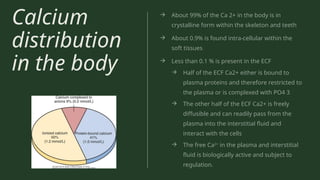
→ About 99% of the Ca 2+ in the body is in
crystalline form within the skeleton and teeth
→ About 0.9% is found intra-cellular within the
soft tissues
→ Less than 0.1 % is present in the ECF
→ Half of the ECF Ca2+ either is bound to
plasma proteins and therefore restricted to
the plasma or is complexed with PO4 3
→ The other half of the ECF Ca2+ is freely
diffusible and can readily pass from the
plasma into the interstitial fluid and
interact with the cells
→ The free Ca2+
in the plasma and interstitial
fluid is biologically active and subject to
regulation.
The function of ECF Ca 2+
:
The function of ECF Ca 2+:
Neuromuscula
r excitability:
Excitation-
contraction
coupling
Stimulus-
secretion
coupling:
Maintenance
of tight
junctions
between cells:
Clotting of
Blood:
The function of ECF
Ca 2+:
→ Neuromuscular excitability:
A fall in free Ca2+
results in over-excitability of
nerves and muscles, conversely, a rise in free
Ca2+
depresses neuromuscular excitability and
causes cardiac
arrhythmias, {A in free Ca
↓ 2+
increases Na+
permeability, with the resultant influx of Na+
moving resting potential closer to threshold
(depolarization)}.
The function of ECF Ca 2+:
→ Excitation- contraction coupling in cardiac and smooth
muscle.
→ Stimulus-secretion coupling:
→ The entry of Ca2+
into secretory cells, triggers the release of
the secretory product by exocytosis.
The function of ECF
Ca 2+:
Calcium forms part of the intercellular
cement that holds particular cell tightly
together. In addition it is involved in cell
motility and cilia action.
Maintenance of tight junctions between
cells:
The function of ECF Ca 2+:
Clotting of
Blood:
Calcium serves as a cofactor in
several steps of the cascade of
reactions that lead to clot
formation. Also it acts as a
second messenger in many
cells.
Control of Ca2+
metabolism
Control of Ca2+ metabolism
Calcium homeostasis:( 9-11mg
%) Involves the immediate
adjustments required to
maintain constant free plasma
Ca2+
concentration on a
minute to minute basis. (Rapid
exchanges between bone and
ECF and to a lesser extend by
modifications in urinary excretion
of Ca2+
).
Calcium balance: Involves the
more slowly responding
adjustments required to
maintain a constant total amount
of Ca2+ in the body
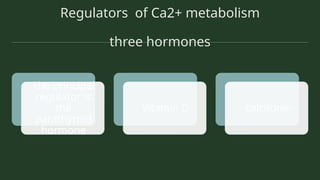
Regulators of Ca2+ metabolism
three hormones
The principal
regulator is
the
parathyroid
hormone
Vitamin D calcitonin
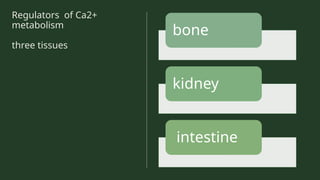
Regulators of Ca2+
metabolism
three tissues
bone
kidney
intestine
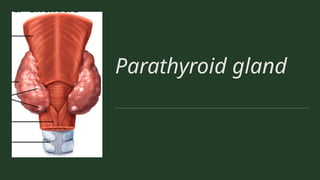
Parathyroid gland
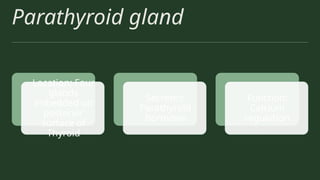
Parathyroid gland
Location: Four
glands
imbedded on
posterior
surface of
Thyroid
Secretes:
Parathyroid
hormone
Function:
Calcium
regulation
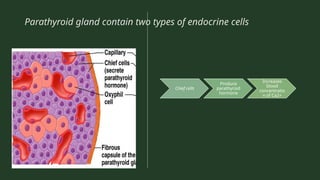
Parathyroid gland contain two types of endocrine cells
Chief cells
Produce
parathyroid
hormone
Increases
blood
concentratio
n of Ca2+
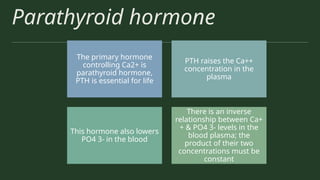
Parathyroid hormone
The primary hormone
controlling Ca2+ is
parathyroid hormone,
PTH is essential for life
PTH raises the Ca++
concentration in the
plasma
This hormone also lowers
PO4 3- in the blood
There is an inverse
relationship between Ca+
+ & PO4 3- levels in the
blood plasma; the
product of their two
concentrations must be
constant
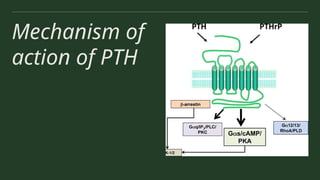
Mechanism of
action of PTH
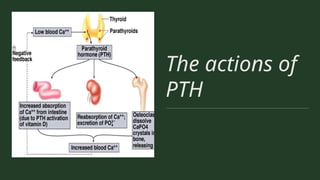
The actions of
PTH
Action of
PTH on bone
→ BONE
→ PTH uses bone as a bank from which it
withdraws Ca2+ as needed to maintain
plasma Ca2+ level
→ PTH has two major effects on the bone
that raise plasma Ca2+ concentration
First
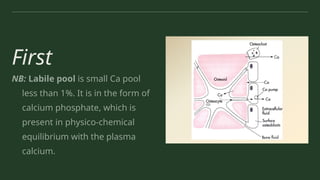
NB: Labile pool is small Ca pool
less than 1%. It is in the form of
calcium phosphate, which is
present in physico-chemical
equilibrium with the plasma
calcium.
First
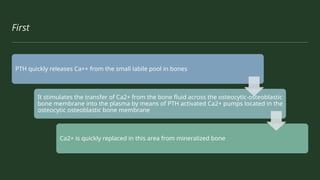
PTH quickly releases Ca++ from the small labile pool in bones
It stimulates the transfer of Ca2+ from the bone fluid across the osteocytic-osteoblastic
bone membrane into the plasma by means of PTH activated Ca2+ pumps located in the
osteocytic osteoblastic bone membrane
Ca2+ is quickly replaced in this area from mineralized bone
Second
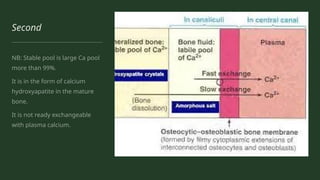
NB: Stable pool is large Ca pool
more than 99%.
It is in the form of calcium
hydroxyapatite in the mature
bone.
It is not ready exchangeable
with plasma calcium.
PTH's chronic effect
Under conditions of chronic
hypocalcemia PTH influences the
slow exchange of Ca2+ between
bone itself and ECF by promoting
actual localized dissolution of bone
It stimulates osteoclast to eat up
bone, increasing the formation of
more osteoclasts, and transiently
inhibiting the bone forming activity
of osteoblast
Prolonged excess PTH secretion
over months or years eventually
lead to the formation of cavities
throughout the bone, that are filled
with very large, overstuffed
osteoclasts
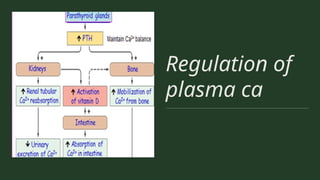
Action of PTH on kidney
PTH INCREASES
REABSORPTION OF
CALCIUM & REDUCES
REABSORPTION OF
PHOSPHATE
NET EFFECT OF ITS
ACTION IS INCREASED
CALCIUM & REDUCED
PHOSPHATE IN
PLASMA
IT ENHANCES THE
ACTIVATION OF
VITAMIN D BY THE
KIDNEY
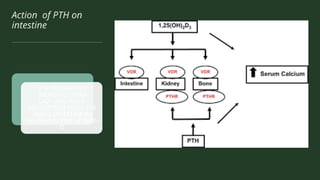
Action of PTH on
intestine
PTH INDIRECTLY
INCREASES BOTH
CA2+ AND PO43-
ABSORPTION FROM THE
SMALL INTESTINE BY
HELPING ACTIVE VITAMIN
D
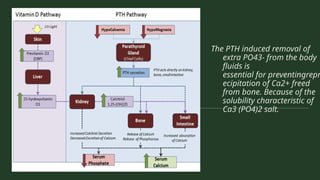
The PTH induced removal of
extra PO43- from the body
fluids is
essential for preventingrepr
ecipitation of Ca2+ freed
from bone. Because of the
solubility characteristic of
Ca3 (PO4)2 salt.
The solubility product =
plasma concentration of
Ca2+ X plasma
concentration of PO 3- =
constant.
A rise of their
concentrations
will raise this
value above the
solubility
product and
results in the
precipitation of
the salt
→ When plasma PO43- level
rises, some plasma Ca2+ is
forced back into bone
through hydroxyapatite
crystal formation, reducing
plasma Ca level and
keeping constant the
calcium phosphate product
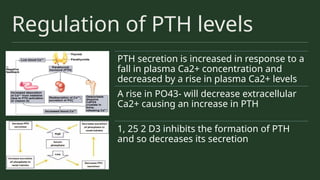
Regulation of PTH levels
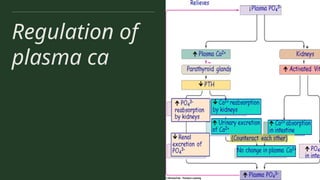
PTH secretion is increased in response to a
fall in plasma Ca2+ concentration and
decreased by a rise in plasma Ca2+ levels
A rise in PO43- will decrease extracellular
Ca2+ causing an increase in PTH
1, 25 2 D3 inhibits the formation of PTH
and so decreases its secretion
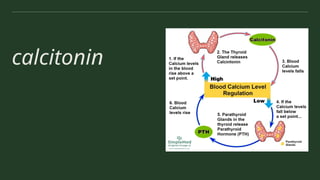
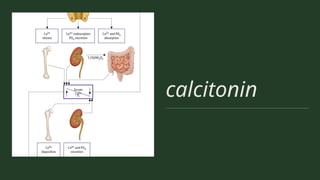
calcitonin
Calcitonin
Calcitonin is a polypeptide hormone secreted by the parafollicular or “C” cells of the
thyroid gland
It is released in response to high plasma calcium
Calcitonin acts on bone osteoclasts to reduce bone resorption
Net result of its action is a decline in plasma calcium & phosphate
It is not essential for maintaining either Ca2+ homeostasis or balance, it is important
in extreme hypercalcemia
calcitonin
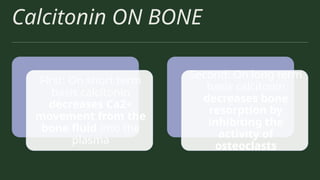
Calcitonin ON BONE
First: On short term
basis calcitonin
decreases Ca2+
movement from the
bone fluid into the
plasma
Second: On long term
basis calcitonin
decreases bone
resorption by
inhibiting the
activity of
osteoclasts
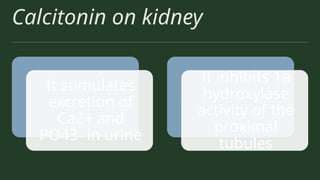
Calcitonin on kidney
It stimulates
excretion of
Ca2+ and
PO43- in urine
It inhibits 1a
hydroxylase
activity of the
proximal
tubules
Regulation of calcitonin secretion
Increase plasma Ca2+ stimulates calcitonin secretion and a
fall in plasma Ca2+ inhibits calcitonin secretion
Calcitonin plays a role in protecting skeletal integrity when
there is a large Ca2+ demand as in pregnancy or breast
feeding
it hastens the storage of newly absorbed Ca2+
following a meal.
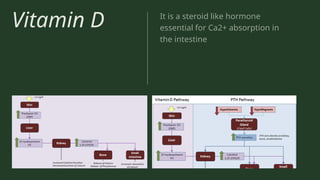
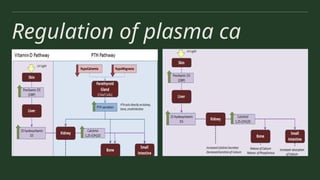
Vitamin D It is a steroid like hormone
essential for Ca2+ absorption in
the intestine
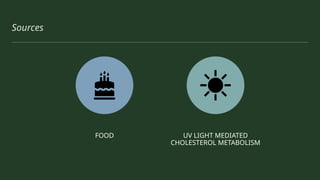
Sources
FOOD UV LIGHT MEDIATED
CHOLESTEROL METABOLISM
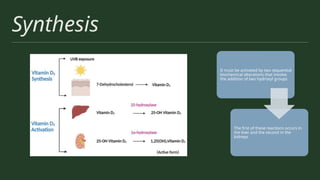
Synthesis
It must be activated by two sequential
biochemical alterations that involve
the addition of two hydroxyl groups
The first of these reactions occurs in
the liver and the second in the
kidneys
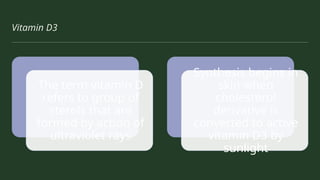
Vitamin D3
The term vitamin D
refers to group of
sterols that are
formed by action of
ultraviolet rays
Synthesis begins in
skin when
cholesterol
derivative is
converted to active
vitamin D3 by
sunlight
Function of
vitamin D
Increase Ca2+
and PO43-
absorption in the
intestine
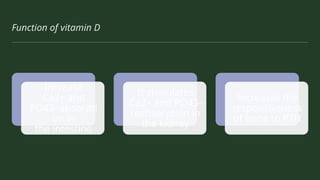
Function of vitamin D
Increase
Ca2+ and
PO43- absorpti
on in
the intestine
It stimulates
Ca2+ and PO43-
reabsorption in
the kidney
Increases the
responsiveness
of bone to PTH
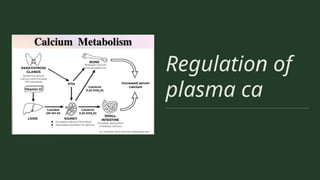
Regulation of
plasma ca
Regulation of plasma ca
Regulation of
plasma ca
Regulation of
plasma ca
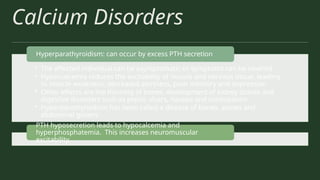
Calcium Disorders
• The affected individual can be asymptomatic
or symptoms can be severe
• Hypercalcemia reduces the excitability of
muscle and nervous tissue, leading to
muscle weakness, decreased alertness, poor
memory and depression
• Other effects are the thinning of bones
• development of kidney stones
• digestive disorders such as peptic ulcers,
nausea and constipation
• Hyperparathyroidism has been called a
Hyperparathyroidism: can occur by
excess PTH secretion
Calcium Disorders
• The affected individual can be asymptomatic or symptoms can be severed
• Hypercalcemia reduces the excitability of muscle and nervous tissue, leading
to muscle weakness, decreased alertness, poor memory and depression
• Other effects are the thinning of bones, development of kidney stones and
digestive disorders such as peptic ulcers, nausea and constipation
• Hyperparathyroidism has been called a disease of bones, stones and
abdominal groans
Hyperparathyroidism: can occur by excess PTH secretion
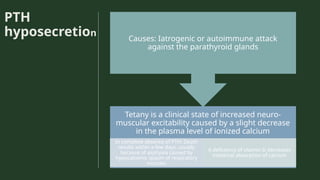
PTH hyposecretion leads to hypocalcemia and
hyperphosphatemia. This increases neuromuscular
excitability.
PTH
hyposecretion
Tetany is a clinical state of increased neuro-
muscular excitability caused by a slight decrease
in the plasma level of ionized calcium
In complete absence of PTH: Death
results within a few days, usually
because of asphyxia caused by
hypocalcemic spasm of respiratory
muscles
A deficiency of vitamin D decreases
intestinal absorption of calcium
Causes: Iatrogenic or autoimmune attack
against the parathyroid glands
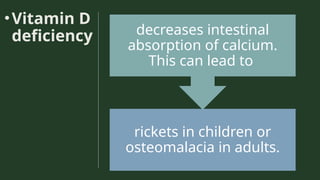
•Vitamin D
deficiency
rickets in children or
osteomalacia in adults.
decreases intestinal
absorption of calcium.
This can lead to

Endocrine Physiology ca homeostasis.pptx

  • 1.
  • 2.
    Presented by/ Dr/ dinahamdy merzeban
  • 3.
    Endocrine control ofcalcium metabolism
  • 4.
    Calcium distribution inthe body Plasma Ca++ concentration is one of the most tightly controlled variables in the body
  • 5.
    Calcium distribution in the body →About 99% of the Ca 2+ in the body is in crystalline form within the skeleton and teeth → About 0.9% is found intra-cellular within the soft tissues → Less than 0.1 % is present in the ECF → Half of the ECF Ca2+ either is bound to plasma proteins and therefore restricted to the plasma or is complexed with PO4 3 → The other half of the ECF Ca2+ is freely diffusible and can readily pass from the plasma into the interstitial fluid and interact with the cells → The free Ca2+ in the plasma and interstitial fluid is biologically active and subject to regulation.
  • 6.
    The function ofECF Ca 2+ :
  • 7.
    The function ofECF Ca 2+: Neuromuscula r excitability: Excitation- contraction coupling Stimulus- secretion coupling: Maintenance of tight junctions between cells: Clotting of Blood:
  • 8.
    The function ofECF Ca 2+: → Neuromuscular excitability: A fall in free Ca2+ results in over-excitability of nerves and muscles, conversely, a rise in free Ca2+ depresses neuromuscular excitability and causes cardiac arrhythmias, {A in free Ca ↓ 2+ increases Na+ permeability, with the resultant influx of Na+ moving resting potential closer to threshold (depolarization)}.
  • 9.
    The function ofECF Ca 2+: → Excitation- contraction coupling in cardiac and smooth muscle. → Stimulus-secretion coupling: → The entry of Ca2+ into secretory cells, triggers the release of the secretory product by exocytosis.
  • 10.
    The function ofECF Ca 2+: Calcium forms part of the intercellular cement that holds particular cell tightly together. In addition it is involved in cell motility and cilia action. Maintenance of tight junctions between cells:
  • 11.
    The function ofECF Ca 2+: Clotting of Blood: Calcium serves as a cofactor in several steps of the cascade of reactions that lead to clot formation. Also it acts as a second messenger in many cells.
  • 12.
  • 13.
    Control of Ca2+metabolism Calcium homeostasis:( 9-11mg %) Involves the immediate adjustments required to maintain constant free plasma Ca2+ concentration on a minute to minute basis. (Rapid exchanges between bone and ECF and to a lesser extend by modifications in urinary excretion of Ca2+ ). Calcium balance: Involves the more slowly responding adjustments required to maintain a constant total amount of Ca2+ in the body
  • 14.
    Regulators of Ca2+metabolism three hormones The principal regulator is the parathyroid hormone Vitamin D calcitonin
  • 15.
    Regulators of Ca2+ metabolism threetissues bone kidney intestine
  • 16.
  • 17.
    Parathyroid gland Location: Four glands imbeddedon posterior surface of Thyroid Secretes: Parathyroid hormone Function: Calcium regulation
  • 18.
    Parathyroid gland containtwo types of endocrine cells Chief cells Produce parathyroid hormone Increases blood concentratio n of Ca2+
  • 19.
    Parathyroid hormone The primaryhormone controlling Ca2+ is parathyroid hormone, PTH is essential for life PTH raises the Ca++ concentration in the plasma This hormone also lowers PO4 3- in the blood There is an inverse relationship between Ca+ + & PO4 3- levels in the blood plasma; the product of their two concentrations must be constant
  • 20.
  • 21.
  • 22.
    Action of PTH onbone → BONE → PTH uses bone as a bank from which it withdraws Ca2+ as needed to maintain plasma Ca2+ level → PTH has two major effects on the bone that raise plasma Ca2+ concentration
  • 23.
    First NB: Labile poolis small Ca pool less than 1%. It is in the form of calcium phosphate, which is present in physico-chemical equilibrium with the plasma calcium.
  • 24.
    First PTH quickly releasesCa++ from the small labile pool in bones It stimulates the transfer of Ca2+ from the bone fluid across the osteocytic-osteoblastic bone membrane into the plasma by means of PTH activated Ca2+ pumps located in the osteocytic osteoblastic bone membrane Ca2+ is quickly replaced in this area from mineralized bone
  • 25.
    Second NB: Stable poolis large Ca pool more than 99%. It is in the form of calcium hydroxyapatite in the mature bone. It is not ready exchangeable with plasma calcium.
  • 26.
    PTH's chronic effect Underconditions of chronic hypocalcemia PTH influences the slow exchange of Ca2+ between bone itself and ECF by promoting actual localized dissolution of bone It stimulates osteoclast to eat up bone, increasing the formation of more osteoclasts, and transiently inhibiting the bone forming activity of osteoblast Prolonged excess PTH secretion over months or years eventually lead to the formation of cavities throughout the bone, that are filled with very large, overstuffed osteoclasts
  • 27.
    Action of PTHon kidney PTH INCREASES REABSORPTION OF CALCIUM & REDUCES REABSORPTION OF PHOSPHATE NET EFFECT OF ITS ACTION IS INCREASED CALCIUM & REDUCED PHOSPHATE IN PLASMA IT ENHANCES THE ACTIVATION OF VITAMIN D BY THE KIDNEY
  • 28.
    Action of PTHon intestine PTH INDIRECTLY INCREASES BOTH CA2+ AND PO43- ABSORPTION FROM THE SMALL INTESTINE BY HELPING ACTIVE VITAMIN D
  • 29.
    The PTH inducedremoval of extra PO43- from the body fluids is essential for preventingrepr ecipitation of Ca2+ freed from bone. Because of the solubility characteristic of Ca3 (PO4)2 salt.
  • 30.
    The solubility product= plasma concentration of Ca2+ X plasma concentration of PO 3- = constant.
  • 31.
    A rise oftheir concentrations will raise this value above the solubility product and results in the precipitation of the salt → When plasma PO43- level rises, some plasma Ca2+ is forced back into bone through hydroxyapatite crystal formation, reducing plasma Ca level and keeping constant the calcium phosphate product
  • 32.
    Regulation of PTHlevels PTH secretion is increased in response to a fall in plasma Ca2+ concentration and decreased by a rise in plasma Ca2+ levels A rise in PO43- will decrease extracellular Ca2+ causing an increase in PTH 1, 25 2 D3 inhibits the formation of PTH and so decreases its secretion
  • 33.
  • 34.
    Calcitonin Calcitonin is apolypeptide hormone secreted by the parafollicular or “C” cells of the thyroid gland It is released in response to high plasma calcium Calcitonin acts on bone osteoclasts to reduce bone resorption Net result of its action is a decline in plasma calcium & phosphate It is not essential for maintaining either Ca2+ homeostasis or balance, it is important in extreme hypercalcemia
  • 35.
  • 36.
    Calcitonin ON BONE First:On short term basis calcitonin decreases Ca2+ movement from the bone fluid into the plasma Second: On long term basis calcitonin decreases bone resorption by inhibiting the activity of osteoclasts
  • 37.
    Calcitonin on kidney Itstimulates excretion of Ca2+ and PO43- in urine It inhibits 1a hydroxylase activity of the proximal tubules
  • 38.
    Regulation of calcitoninsecretion Increase plasma Ca2+ stimulates calcitonin secretion and a fall in plasma Ca2+ inhibits calcitonin secretion Calcitonin plays a role in protecting skeletal integrity when there is a large Ca2+ demand as in pregnancy or breast feeding it hastens the storage of newly absorbed Ca2+ following a meal.
  • 39.
    Vitamin D Itis a steroid like hormone essential for Ca2+ absorption in the intestine
  • 40.
    Sources FOOD UV LIGHTMEDIATED CHOLESTEROL METABOLISM
  • 41.
    Synthesis It must beactivated by two sequential biochemical alterations that involve the addition of two hydroxyl groups The first of these reactions occurs in the liver and the second in the kidneys
  • 42.
    Vitamin D3 The termvitamin D refers to group of sterols that are formed by action of ultraviolet rays Synthesis begins in skin when cholesterol derivative is converted to active vitamin D3 by sunlight
  • 43.
    Function of vitamin D IncreaseCa2+ and PO43- absorption in the intestine
  • 44.
    Function of vitaminD Increase Ca2+ and PO43- absorpti on in the intestine It stimulates Ca2+ and PO43- reabsorption in the kidney Increases the responsiveness of bone to PTH
  • 45.
  • 46.
  • 47.
  • 48.
  • 49.
    Calcium Disorders • Theaffected individual can be asymptomatic or symptoms can be severe • Hypercalcemia reduces the excitability of muscle and nervous tissue, leading to muscle weakness, decreased alertness, poor memory and depression • Other effects are the thinning of bones • development of kidney stones • digestive disorders such as peptic ulcers, nausea and constipation • Hyperparathyroidism has been called a Hyperparathyroidism: can occur by excess PTH secretion
  • 50.
    Calcium Disorders • Theaffected individual can be asymptomatic or symptoms can be severed • Hypercalcemia reduces the excitability of muscle and nervous tissue, leading to muscle weakness, decreased alertness, poor memory and depression • Other effects are the thinning of bones, development of kidney stones and digestive disorders such as peptic ulcers, nausea and constipation • Hyperparathyroidism has been called a disease of bones, stones and abdominal groans Hyperparathyroidism: can occur by excess PTH secretion PTH hyposecretion leads to hypocalcemia and hyperphosphatemia. This increases neuromuscular excitability.
  • 51.
    PTH hyposecretion Tetany is aclinical state of increased neuro- muscular excitability caused by a slight decrease in the plasma level of ionized calcium In complete absence of PTH: Death results within a few days, usually because of asphyxia caused by hypocalcemic spasm of respiratory muscles A deficiency of vitamin D decreases intestinal absorption of calcium Causes: Iatrogenic or autoimmune attack against the parathyroid glands
  • 52.
    •Vitamin D deficiency rickets inchildren or osteomalacia in adults. decreases intestinal absorption of calcium. This can lead to