Animal Digestion


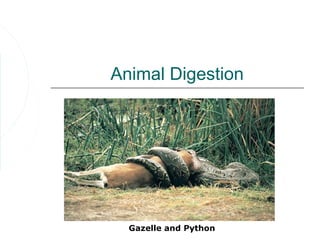
  Gazelle and Python
How do animals get their food?


 filter (suspension) feeding   substrate feeding


        fluid feeding            bulk feeding
Eating a balanced diet
   What happens if an animal’s diet is
    missing an essential nutrient?
     deficiency   diseases
        scurvy — vitamin C (collagen production)
        rickets — vitamin D (calcium absorption)

        blindness — vitamin A (retinol production)

        anemia — vitamin B (energy production)
                            12
Digestion System Diversity
          Intracellular Digestion   Extracellular Digestion
          • food particles engulfed • the breakdown of food
             by phagocytosis          particles outside of
          • food vacuoles fuse        cells
             with lysosomes         • occurs in
             containing hydrolytic    compartments that
             enzymes                  are continuous with
          • Example: sponges          the outside of the
                                      animal’s body
                                    • Examples: hydra,
                                      worms, insects,
                                      humans
intracellular
  digestion
Digestive System Diversity
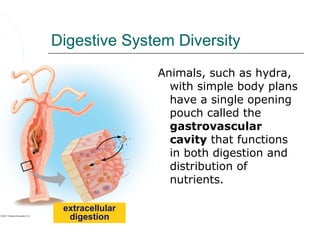
                 Animals, such as hydra,
                   with simple body plans
                   have a single opening
                   pouch called the
                   gastrovascular
                   cavity that functions
                   in both digestion and
                   distribution of
                   nutrients.

 extracellular
  digestion
Digestive System Diversity
More complex animals, such as
humans, have a digestive
tube, the alimentary canal,
with two openings, a mouth
and an anus.


Everybody’s got one!
Digestive
    mouth                                       stomach
    break up food            Organ Review      kills germs
    moisten food                               break up food
    digest starch                              digest proteins
    kill germs                                 store food
liver
produces bile
   - stored in gall bladder
break up fats                               small intestines
                                             breakdown food
pancreas                                       - proteins
produces enzymes to                           - starch
 digest proteins & carbs                       - fats
                                             absorb nutrients


                                             large intestines
                                             absorb water
Maintaining Homeostasis

•   Interactions between certain organs
    help to regulate homeostasis.
•   Example:
    •   After stomach mechanically breaks
        down food, enzymes are produced by
        the stomach and small intestine to
        chemically digest them into nutrients.
    •   These nutrients are absorbed by the
        small intestine and eventually delivered
        to cells.
Maintaining Homeostasis:
                                                 Ooooooh!
     Stomach                                     Zymogen!
     •   Functions
          disinfect
                   food
           HCl = pH 2
               kills
                    bacteria
               breaks apart cells

               Components of HCl are

                produced by parietal cells
          chemical
                  digestion
           Example: pepsin
               enzyme   breaks down proteins
               chief cells secrete pepsinogen

                  activated by HCl

But the stomach is made out of protein!
What stops the stomach from digesting itself?
mucus secreted by stomach cells protects
stomach lining
Maintaining Homeostasis:
Small intestine
    Function
        chemical digestion
          digestive enzymes
       absorption through villi & microvilli:
          finger-like projections

          increase surface area for absorption

          over 6 meters!

          small intestine has huge surface area = 300m 2

           (~size of tennis court)
          most nutrients are absorbed across the

           epithelium of the small intestine
    Structure
       3 sections
          duodenum = most digestion

          jejunum = absorption of nutrients & water

          ileum = absorption of nutrients & water
Duodenum
   1st section of small intestines
     acidfood from stomach mixes with
      digestive juices from accessory glands:
                         pancreas
                         liver
                         gall bladder
Accessory Organ:
Pancreas
    Digestive enzymes
        peptidases
           trypsin

        trypsinogen
           chymotrypsin
                chimotrypsinogen                      small intestines
            carboxypeptidase
                procarboxypeptidase
     • pancreatic amylase
    Buffers
        reduces acidity
           alkaline solution rich in
            bicarbonate (HCO3-)
           buffers acidity of material from
            stomach                          Explain how this is a
                                              molecular example of
                                              structure-function theme.
Accessory Organ: Liver
             Digestive System Functions
                 produces bile
                    bile contains bile salts
                   o   stored in gallbladder until needed
                   o   break up and absorb fats in the duodenum
                           act like detergents to breakup fats


Circulatory System
Connection
bile contains
colors from old
red blood cells
collected in liver =
iron in RBC rusts &
makes feces brown
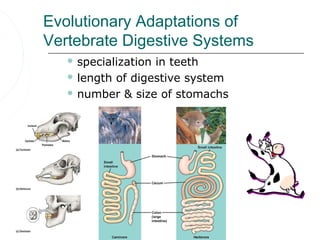
Evolutionary Adaptations of
Vertebrate Digestive Systems
    specializationin teeth
    length of digestive system

    number & size of stomachs
Digesting cellulose
              How well you digest cellulose
               governs life strategy of herbivores
starch


cellulose


bond between the sugars governs digestibility
Cow
   can digest cellulose well;
  no need to eat
  supplemental sugars
Gorilla
   can NOT digest cellulose
   well; must supplement with
   sugar source, like fruit
Mutualistic Adaptations
      How can cows digest cellulose efficiently?
          symbiotic bacteria in stomachs help digest cellulose-
           rich meals                 caprohagy     ruminant
          rabbit vs. cow adaptation: eat feces vs. chew cud


Ruminants
additional
mechanical
digestion by
chewing food
multiple times
after mixing it
with enzymes
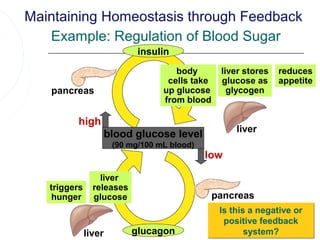
Maintaining Homeostasis through Feedback
   Example: Regulation of Blood Sugar
                             insulin
                                      body        liver stores   reduces
                                    cells take    glucose as     appetite
   pancreas                        up glucose       glycogen
                                   from blood

         high
                                                      liver
                      blood glucose level
                       (90 mg/100 mL blood)
                                              low

                  liver
   triggers     releases
    hunger      glucose                          pancreas
                                                  Is this a negative or
                                                   positive feedback
              liver        glucagon                      system?
Homeostatic Imbalance

Diabetes mellitus
• caused by a deficiency of insulin or a
  decreased response to insulin
• marked by elevated blood glucose
  levels

Digestion

  • 1.
    Animal Digestion Gazelle and Python
  • 2.
    How do animalsget their food? filter (suspension) feeding substrate feeding fluid feeding bulk feeding
  • 3.
    Eating a balanceddiet  What happens if an animal’s diet is missing an essential nutrient?  deficiency diseases  scurvy — vitamin C (collagen production)  rickets — vitamin D (calcium absorption)  blindness — vitamin A (retinol production)  anemia — vitamin B (energy production) 12
  • 4.
    Digestion System Diversity Intracellular Digestion Extracellular Digestion • food particles engulfed • the breakdown of food by phagocytosis particles outside of • food vacuoles fuse cells with lysosomes • occurs in containing hydrolytic compartments that enzymes are continuous with • Example: sponges the outside of the animal’s body • Examples: hydra, worms, insects, humans intracellular digestion
  • 5.
    Digestive System Diversity Animals, such as hydra, with simple body plans have a single opening pouch called the gastrovascular cavity that functions in both digestion and distribution of nutrients. extracellular digestion
  • 6.
    Digestive System Diversity Morecomplex animals, such as humans, have a digestive tube, the alimentary canal, with two openings, a mouth and an anus. Everybody’s got one!
  • 7.
    Digestive mouth stomach break up food Organ Review kills germs moisten food break up food digest starch digest proteins kill germs store food liver produces bile - stored in gall bladder break up fats small intestines breakdown food pancreas - proteins produces enzymes to - starch digest proteins & carbs - fats absorb nutrients large intestines absorb water
  • 8.
    Maintaining Homeostasis • Interactions between certain organs help to regulate homeostasis. • Example: • After stomach mechanically breaks down food, enzymes are produced by the stomach and small intestine to chemically digest them into nutrients. • These nutrients are absorbed by the small intestine and eventually delivered to cells.
  • 9.
    Maintaining Homeostasis: Ooooooh! Stomach Zymogen! • Functions  disinfect food HCl = pH 2  kills bacteria  breaks apart cells  Components of HCl are produced by parietal cells  chemical digestion Example: pepsin  enzyme breaks down proteins  chief cells secrete pepsinogen  activated by HCl But the stomach is made out of protein! What stops the stomach from digesting itself? mucus secreted by stomach cells protects stomach lining
  • 10.
    Maintaining Homeostasis: Small intestine  Function  chemical digestion digestive enzymes  absorption through villi & microvilli:  finger-like projections  increase surface area for absorption  over 6 meters!  small intestine has huge surface area = 300m 2 (~size of tennis court)  most nutrients are absorbed across the epithelium of the small intestine  Structure  3 sections  duodenum = most digestion  jejunum = absorption of nutrients & water  ileum = absorption of nutrients & water
  • 11.
    Duodenum  1st section of small intestines  acidfood from stomach mixes with digestive juices from accessory glands:  pancreas  liver  gall bladder
  • 12.
    Accessory Organ: Pancreas  Digestive enzymes  peptidases  trypsin  trypsinogen  chymotrypsin  chimotrypsinogen small intestines  carboxypeptidase  procarboxypeptidase • pancreatic amylase  Buffers  reduces acidity  alkaline solution rich in bicarbonate (HCO3-)  buffers acidity of material from stomach Explain how this is a molecular example of structure-function theme.
  • 13.
    Accessory Organ: Liver  Digestive System Functions  produces bile  bile contains bile salts o stored in gallbladder until needed o break up and absorb fats in the duodenum  act like detergents to breakup fats Circulatory System Connection bile contains colors from old red blood cells collected in liver = iron in RBC rusts & makes feces brown
  • 14.
    Evolutionary Adaptations of VertebrateDigestive Systems  specializationin teeth  length of digestive system  number & size of stomachs
  • 15.
    Digesting cellulose  How well you digest cellulose governs life strategy of herbivores starch cellulose bond between the sugars governs digestibility
  • 16.
    Cow can digest cellulose well; no need to eat supplemental sugars Gorilla can NOT digest cellulose well; must supplement with sugar source, like fruit
  • 17.
    Mutualistic Adaptations  How can cows digest cellulose efficiently?  symbiotic bacteria in stomachs help digest cellulose- rich meals caprohagy ruminant  rabbit vs. cow adaptation: eat feces vs. chew cud Ruminants additional mechanical digestion by chewing food multiple times after mixing it with enzymes
  • 18.
    Maintaining Homeostasis throughFeedback Example: Regulation of Blood Sugar insulin body liver stores reduces cells take glucose as appetite pancreas up glucose glycogen from blood high liver blood glucose level (90 mg/100 mL blood) low liver triggers releases hunger glucose pancreas Is this a negative or positive feedback liver glucagon system?
  • 19.
    Homeostatic Imbalance Diabetes mellitus •caused by a deficiency of insulin or a decreased response to insulin • marked by elevated blood glucose levels

Editor's Notes

  • #10 Still, the epithelium is continually eroded, and the epithelium is completely replaced by mitosis every three days. Gastric ulcers, lesions in the stomach lining, are caused by the acid-tolerant bacterium Heliobacter pylori . Ulcers are often treated with antibiotics. Pepsin is secreted in an inactive form, called pepsinogen by specialized chief cells in gastric pits. Parietal cells, also in the pits, secrete hydrochloric acid which converts pepsinogen to the active pepsin only when both reach the lumen of the stomach, minimizing self-digestion. Also, in a positive-feedback system, activated pepsin can activate more pepsinogen molecules.
  • #11 About every 20 seconds, the stomach contents are mixed by the churning action of smooth muscles. As a result of mixing and enzyme action, what begins in the stomach as a recently swallowed meal becomes a nutrient-rich broth known as acid chyme . At the opening from the stomach to the small intestine is the pyloric sphincter , which helps regulate the passage of chyme into the intestine. A squirt at a time, it takes about 2 to 6 hours after a meal for the stomach to empty.
  • #15 Teeth: Carnivore - sharp ripping teeth; “canines” Herbivore - wide grinding teeth; molars Omnivore - both kinds of teeth Length: Carnivores - short digestive system; protein easier to digest than cellulose Herbivores & omnivores - long digestive system; more time to digest cellulose; symbiotic bacteria in gut
  • #16 Starch = all the glycosidic linkage are on same side = molecule lies flat Cellulose = cross linking between OH (H bonds) = rigid structure & hard to digest The digestion of cellulose governs the life strategy of herbivores. Either you do it really well and you’re a cow or an elephant (spend a long time digesting a lot of food with a little help from some microbes & have to walk around slowly for a long time carrying a lot of food in your stomach) Or you do it inefficiently and have to supplement your diet with simple sugars, like fruit and nectar, and you’re a gorilla.