MOT 612

               Innovation Management

                          Spring 2010


Different Types and Forms of Innovation


By:
Name: Al-Motaz Bellah Alaa ElDin Al-Agamawi

ID: 102027
MOT 612: Class Three Assignment                                    By:Al-Motaz Bellah Al-Agamawi, ID: 102027


RADICAL COMPONENT

USB Flash Drive

           WHO MADE IT?
1
    Trek Technology and IBM began selling the first USB flash drives commercially in 2000


           WHAT IMPACT ON THE SOCIETY AND INDUSTRY?

As computer, information and electronic media are playing a major role in our daily life, the
introduction of the USB Flash technology have a great impact on society. It is easier, faster and
more comfortable to use USB flash storage to collaborate and share files with others.

As a result of the advancement which happens in the flash desk technology, especially in the
storage capacity which reaches gaga bits today and USB 2 technology which gives a higher
transfer rate, many manufacturers offer the flash storage as an option in their machines rather
than the normal Hard disk technology. It is expected that in the near future when flash storage
capacity increases and production cost flow down and also when it become more mature, that it
will replace the normal today hard disk storage technology specially because it will solve the
mechanical speed limitation of the normal hard desk (head seeking time). Also you can feel the
usage of the USB technology in many normal electronic machine of today like car cassettes,
satellite receivers, TV sets and many other machines, USB outlet is almost found in most of
today normal electronic machines.

           WHEN DID THE INNOVATION OCCUR?

In 2000

           COMMENTS IF ANY?

Patent ownership have a conflect on the company who have invented the technology and which
have the rights in it. Two main claiming companies are Netac Technology, a Shenzen consumer
electronics company which claims to have invented the USB flash drive in the late 1990s.


1
    Source: http://en.wikipedia.org/wiki/USB_flash_drive#History

Spring 2010                                                                                       Page |1
MOT 612: Class Three Assignment                               By:Al-Motaz Bellah Al-Agamawi, ID: 102027


RADICAL SYSTEM
2
    Xerography  Photocopying Machines

          WHO MADE IT?

Inventor was Chester Carlson, having the first prototype of a photocopy machine in 1938.

Carlson tried to find finance for a period of 6 years, until believer entrepreneur Wilson from
haloids decided to fund him with 25,000 USD in 1946. After that they were ready but with no
real production until the department of defense gives them an order of 120,000 USD to develop a
dry photographic process. In 1961 Xerox the world first photocopying producer had been
established.

Another important person with a great impact on Xerox, Haloids marketing manager, C. Peter
McColough. McColough, sales and marketing strategy which could be summarized as cost to the
customer should be a function of the number of copies produced. By this Haloid was able to sell
the machines in an affordable price and reach a large segment of customers.

          WHAT IMPACT ON THE SOCIETY AND INDUSTRY?

Xerography opened a completely new market which was not existing before Carlson invention.
Before 40th of the 19th century there was nothing called photocopying machines, after
cooperation between Carlson and Haloid the a new market and industry have started to rise until
reaching an industry size of 20 Billion USD in 1986. Real diffusion have started in mid 60th, in
1960 the sales reached 3 million USD, in 1961 almost 60 million and in 1966 about 428 million
USD.

Photocopying machines have a great impact on society including individuals and business, you
can imagine the required effort to have a copy of a document or a page from a book before
having this marvelous invention of xerography

          WHEN DID THE INNOVATION OCCUR?

I believe that the innovation occurred on stages:
2
    Source of Xerography: Customized Management of Technology, T. Khalil

Spring 2010                                                                                  Page |2
MOT 612: Class Three Assignment                       By:Al-Motaz Bellah Al-Agamawi, ID: 102027


   a) Carlson: 1938, first prototype including the world first dry photocopy.
   b) 1946, Wilson commercialization and approaching the department of defense to have the
       first sales worries 120,000 USD.
   c) Their office market introduction for model A and the price relation with consumption and
       number of printed papers.

       COMMENTS IF ANY?

Xerography is a very clear case study for a radical innovation and a science pull approach.
Before it existence no one have imagined the added value and everybody thought that it is a
luxury at the beginning. Carlson and Wilson is a typical example for the success which could
happened when a brilliant inventor meets a believing entrepreneur. Also the leasing idea and
designing a licensing schema linking the usage with the price is a good lesson for how new
innovation can be introduced to the market through innovative marketing approach to reach the
diffusion.


Spring 2010                                                                             Page |3
MOT 612: Class Three Assignment                                  By:Al-Motaz Bellah Al-Agamawi, ID: 102027


INCREMENTAL

Voice Over IP

           WHO MADE IT3?

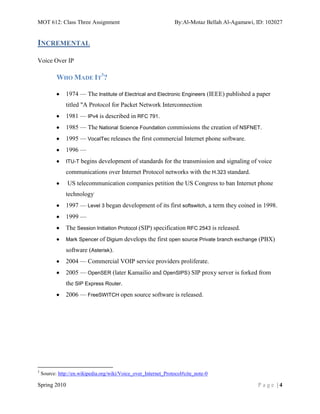
               1974 — The Institute of Electrical and Electronic Engineers (IEEE) published a paper
               titled "A Protocol for Packet Network Interconnection
               1981 — IPv4 is described in RFC 791.
               1985 — The National Science Foundation commissions the creation of NSFNET.
               1995 — VocalTec releases the first commercial Internet phone software.
               1996 —
               ITU-T begins   development of standards for the transmission and signaling of voice
               communications over Internet Protocol networks with the H.323 standard.
                US telecommunication companies petition the US Congress to ban Internet phone
               technology.
               1997 — Level 3 began development of its first softswitch, a term they coined in 1998.
               1999 —
               The Session Initiation Protocol (SIP) specification RFC 2543 is released.
               Mark Spencer of Digium develops       the first open source Private branch exchange (PBX)
               software (Asterisk).
               2004 — Commercial VOIP service providers proliferate.
               2005 — OpenSER (later Kamailio and OpenSIPS) SIP proxy server is forked from
               the SIP Express Router.
               2006 — FreeSWITCH open source software is released.


3
    Source: http://en.wikipedia.org/wiki/Voice_over_Internet_Protocol#cite_note-0

Spring 2010                                                                                      Page |4
MOT 612: Class Three Assignment                          By:Al-Motaz Bellah Al-Agamawi, ID: 102027


       WHAT IMPACT ON THE SOCIETY AND INDUSTRY?

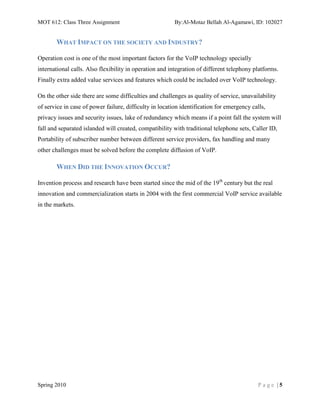
Operation cost is one of the most important factors for the VoIP technology specially
international calls. Also flexibility in operation and integration of different telephony platforms.
Finally extra added value services and features which could be included over VoIP technology.

On the other side there are some difficulties and challenges as quality of service, unavailability
of service in case of power failure, difficulty in location identification for emergency calls,
privacy issues and security issues, lake of redundancy which means if a point fall the system will
fall and separated islanded will created, compatibility with traditional telephone sets, Caller ID,
Portability of subscriber number between different service providers, fax handling and many
other challenges must be solved before the complete diffusion of VoIP.

       WHEN DID THE INNOVATION OCCUR?

Invention process and research have been started since the mid of the 19th century but the real
innovation and commercialization starts in 2004 with the first commercial VoIP service available
in the markets.


Spring 2010                                                                                Page |5
MOT 612: Class Three Assignment                                 By:Al-Motaz Bellah Al-Agamawi, ID: 102027


NEXT GENERATION TECHNOLOGY
4
    A Cordless (Wireless) Future of Electricity

           WHO MADE IT?
5
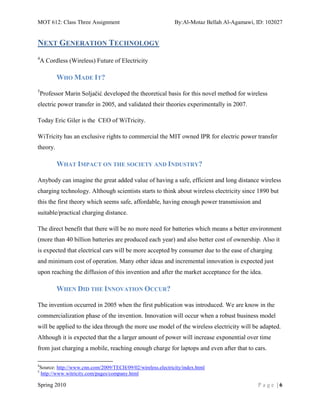
    Professor Marin Soljačić, developed the theoretical basis for this novel method for wireless
electric power transfer in 2005, and validated their theories experimentally in 2007.

Today Eric Giler is the CEO of WiTricity.

WiTricity has an exclusive rights to commercial the MIT owned IPR for electric power transfer
theory.

           WHAT IMPACT ON THE SOCIETY AND INDUSTRY?

Anybody can imagine the great added value of having a safe, efficient and long distance wireless
charging technology. Although scientists starts to think about wireless electricity since 1890 but
this the first theory which seems safe, affordable, having enough power transmission and
suitable/practical charging distance.

The direct benefit that there will be no more need for batteries which means a better environment
(more than 40 billion batteries are produced each year) and also better cost of ownership. Also it
is expected that electrical cars will be more accepted by consumer due to the ease of charging
and minimum cost of operation. Many other ideas and incremental innovation is expected just
upon reaching the diffusion of this invention and after the market acceptance for the idea.

           WHEN DID THE INNOVATION OCCUR?

The invention occurred in 2005 when the first publication was introduced. We are know in the
commercialization phase of the invention. Innovation will occur when a robust business model
will be applied to the idea through the more use model of the wireless electricity will be adapted.
Although it is expected that the a larger amount of power will increase exponential over time
from just charging a mobile, reaching enough charge for laptops and even after that to cars.

4
    Source: http://www.cnn.com/2009/TECH/09/02/wireless.electricity/index.html
5
    http://www.witricity.com/pages/company.html

Spring 2010                                                                                    Page |6
MOT 612: Class Three Assignment                         By:Al-Motaz Bellah Al-Agamawi, ID: 102027


The main challenge will be market and consumers acceptance for the idea.

        COMMENTS IF ANY?

The technology is named “magnetically coupled resonance”. Basically it send magnetic filed
through air with a special frequency and then the device at other end receive it and turn it again
to electricity.


Spring 2010                                                                               Page |7

Different Types and Forms of Innovation

  • 1.
    MOT 612 Innovation Management Spring 2010 Different Types and Forms of Innovation By: Name: Al-Motaz Bellah Alaa ElDin Al-Agamawi ID: 102027
  • 2.
    MOT 612: ClassThree Assignment By:Al-Motaz Bellah Al-Agamawi, ID: 102027 RADICAL COMPONENT USB Flash Drive WHO MADE IT? 1 Trek Technology and IBM began selling the first USB flash drives commercially in 2000 WHAT IMPACT ON THE SOCIETY AND INDUSTRY? As computer, information and electronic media are playing a major role in our daily life, the introduction of the USB Flash technology have a great impact on society. It is easier, faster and more comfortable to use USB flash storage to collaborate and share files with others. As a result of the advancement which happens in the flash desk technology, especially in the storage capacity which reaches gaga bits today and USB 2 technology which gives a higher transfer rate, many manufacturers offer the flash storage as an option in their machines rather than the normal Hard disk technology. It is expected that in the near future when flash storage capacity increases and production cost flow down and also when it become more mature, that it will replace the normal today hard disk storage technology specially because it will solve the mechanical speed limitation of the normal hard desk (head seeking time). Also you can feel the usage of the USB technology in many normal electronic machine of today like car cassettes, satellite receivers, TV sets and many other machines, USB outlet is almost found in most of today normal electronic machines. WHEN DID THE INNOVATION OCCUR? In 2000 COMMENTS IF ANY? Patent ownership have a conflect on the company who have invented the technology and which have the rights in it. Two main claiming companies are Netac Technology, a Shenzen consumer electronics company which claims to have invented the USB flash drive in the late 1990s. 1 Source: http://en.wikipedia.org/wiki/USB_flash_drive#History Spring 2010 Page |1
  • 3.
    MOT 612: ClassThree Assignment By:Al-Motaz Bellah Al-Agamawi, ID: 102027 RADICAL SYSTEM 2 Xerography  Photocopying Machines WHO MADE IT? Inventor was Chester Carlson, having the first prototype of a photocopy machine in 1938. Carlson tried to find finance for a period of 6 years, until believer entrepreneur Wilson from haloids decided to fund him with 25,000 USD in 1946. After that they were ready but with no real production until the department of defense gives them an order of 120,000 USD to develop a dry photographic process. In 1961 Xerox the world first photocopying producer had been established. Another important person with a great impact on Xerox, Haloids marketing manager, C. Peter McColough. McColough, sales and marketing strategy which could be summarized as cost to the customer should be a function of the number of copies produced. By this Haloid was able to sell the machines in an affordable price and reach a large segment of customers. WHAT IMPACT ON THE SOCIETY AND INDUSTRY? Xerography opened a completely new market which was not existing before Carlson invention. Before 40th of the 19th century there was nothing called photocopying machines, after cooperation between Carlson and Haloid the a new market and industry have started to rise until reaching an industry size of 20 Billion USD in 1986. Real diffusion have started in mid 60th, in 1960 the sales reached 3 million USD, in 1961 almost 60 million and in 1966 about 428 million USD. Photocopying machines have a great impact on society including individuals and business, you can imagine the required effort to have a copy of a document or a page from a book before having this marvelous invention of xerography WHEN DID THE INNOVATION OCCUR? I believe that the innovation occurred on stages: 2 Source of Xerography: Customized Management of Technology, T. Khalil Spring 2010 Page |2
  • 4.
    MOT 612: ClassThree Assignment By:Al-Motaz Bellah Al-Agamawi, ID: 102027 a) Carlson: 1938, first prototype including the world first dry photocopy. b) 1946, Wilson commercialization and approaching the department of defense to have the first sales worries 120,000 USD. c) Their office market introduction for model A and the price relation with consumption and number of printed papers. COMMENTS IF ANY? Xerography is a very clear case study for a radical innovation and a science pull approach. Before it existence no one have imagined the added value and everybody thought that it is a luxury at the beginning. Carlson and Wilson is a typical example for the success which could happened when a brilliant inventor meets a believing entrepreneur. Also the leasing idea and designing a licensing schema linking the usage with the price is a good lesson for how new innovation can be introduced to the market through innovative marketing approach to reach the diffusion. Spring 2010 Page |3
  • 5.
    MOT 612: ClassThree Assignment By:Al-Motaz Bellah Al-Agamawi, ID: 102027 INCREMENTAL Voice Over IP WHO MADE IT3? 1974 — The Institute of Electrical and Electronic Engineers (IEEE) published a paper titled "A Protocol for Packet Network Interconnection 1981 — IPv4 is described in RFC 791. 1985 — The National Science Foundation commissions the creation of NSFNET. 1995 — VocalTec releases the first commercial Internet phone software. 1996 — ITU-T begins development of standards for the transmission and signaling of voice communications over Internet Protocol networks with the H.323 standard. US telecommunication companies petition the US Congress to ban Internet phone technology. 1997 — Level 3 began development of its first softswitch, a term they coined in 1998. 1999 — The Session Initiation Protocol (SIP) specification RFC 2543 is released. Mark Spencer of Digium develops the first open source Private branch exchange (PBX) software (Asterisk). 2004 — Commercial VOIP service providers proliferate. 2005 — OpenSER (later Kamailio and OpenSIPS) SIP proxy server is forked from the SIP Express Router. 2006 — FreeSWITCH open source software is released. 3 Source: http://en.wikipedia.org/wiki/Voice_over_Internet_Protocol#cite_note-0 Spring 2010 Page |4
  • 6.
    MOT 612: ClassThree Assignment By:Al-Motaz Bellah Al-Agamawi, ID: 102027 WHAT IMPACT ON THE SOCIETY AND INDUSTRY? Operation cost is one of the most important factors for the VoIP technology specially international calls. Also flexibility in operation and integration of different telephony platforms. Finally extra added value services and features which could be included over VoIP technology. On the other side there are some difficulties and challenges as quality of service, unavailability of service in case of power failure, difficulty in location identification for emergency calls, privacy issues and security issues, lake of redundancy which means if a point fall the system will fall and separated islanded will created, compatibility with traditional telephone sets, Caller ID, Portability of subscriber number between different service providers, fax handling and many other challenges must be solved before the complete diffusion of VoIP. WHEN DID THE INNOVATION OCCUR? Invention process and research have been started since the mid of the 19th century but the real innovation and commercialization starts in 2004 with the first commercial VoIP service available in the markets. Spring 2010 Page |5
  • 7.
    MOT 612: ClassThree Assignment By:Al-Motaz Bellah Al-Agamawi, ID: 102027 NEXT GENERATION TECHNOLOGY 4 A Cordless (Wireless) Future of Electricity WHO MADE IT? 5 Professor Marin Soljačić, developed the theoretical basis for this novel method for wireless electric power transfer in 2005, and validated their theories experimentally in 2007. Today Eric Giler is the CEO of WiTricity. WiTricity has an exclusive rights to commercial the MIT owned IPR for electric power transfer theory. WHAT IMPACT ON THE SOCIETY AND INDUSTRY? Anybody can imagine the great added value of having a safe, efficient and long distance wireless charging technology. Although scientists starts to think about wireless electricity since 1890 but this the first theory which seems safe, affordable, having enough power transmission and suitable/practical charging distance. The direct benefit that there will be no more need for batteries which means a better environment (more than 40 billion batteries are produced each year) and also better cost of ownership. Also it is expected that electrical cars will be more accepted by consumer due to the ease of charging and minimum cost of operation. Many other ideas and incremental innovation is expected just upon reaching the diffusion of this invention and after the market acceptance for the idea. WHEN DID THE INNOVATION OCCUR? The invention occurred in 2005 when the first publication was introduced. We are know in the commercialization phase of the invention. Innovation will occur when a robust business model will be applied to the idea through the more use model of the wireless electricity will be adapted. Although it is expected that the a larger amount of power will increase exponential over time from just charging a mobile, reaching enough charge for laptops and even after that to cars. 4 Source: http://www.cnn.com/2009/TECH/09/02/wireless.electricity/index.html 5 http://www.witricity.com/pages/company.html Spring 2010 Page |6
  • 8.
    MOT 612: ClassThree Assignment By:Al-Motaz Bellah Al-Agamawi, ID: 102027 The main challenge will be market and consumers acceptance for the idea. COMMENTS IF ANY? The technology is named “magnetically coupled resonance”. Basically it send magnetic filed through air with a special frequency and then the device at other end receive it and turn it again to electricity. Spring 2010 Page |7