1
Invention ,Innovation
&Patent Filing
Dr.Gurumeet c wadhawa
Karmaveer Bhaurao Patil College,
Vashi
Inventions
Inventions
Evaluate an invention that
solves a problem and
determine ways to improve the
design.
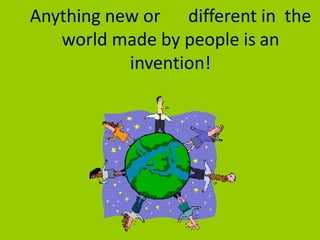
Anything new or different in the
world made by people is an
invention!
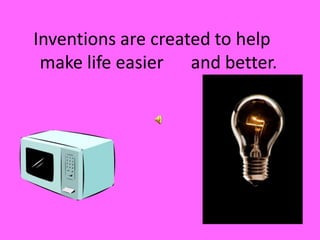
Inventions are created to help
make life easier and better.
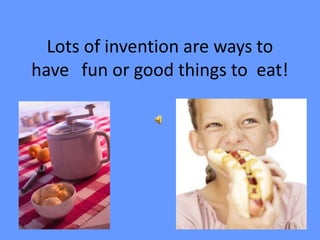
Lots of invention are ways to
have fun or good things to eat!
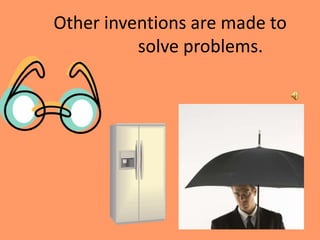
Other inventions are made to
solve problems.
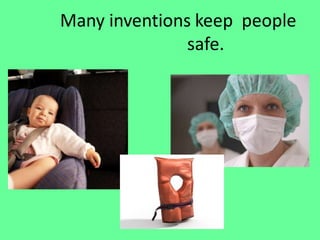
Many inventions keep people
safe.
People who create inventions are
called inventors.
Inventors can live anywhere in
the world and be any age!
Inventors can be anyone that
wants to help the world!
People have been creating
inventions for hundreds of
years.
Don’t give up!
• Inventors need to plan for a
long time and have to try many
times before they can get their
invention to work the right way.
No copy cats!
• Once an invention works, inventors will
need to get a patent.
• A patent makes sure that no one can
copy their idea.
• A patent means the inventor can sell
their invention to make money!
Improvements!
• Inventions can be changed to
make them better!
• Changing the design or plan of an
invention can help the people who
use them.
Refrigerator
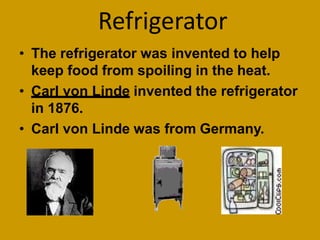
• The refrigerator was invented to help
keep food from spoiling in the heat.
• Carl von Linde invented the refrigerator
in 1876.
• Carl von Linde was from Germany.
Airplane
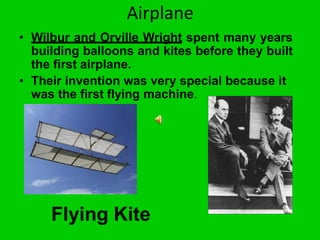
• Wilbur and Orville Wright spent many years
building balloons and kites before they built
the first airplane.
• Their invention was very special because it
was the first flying machine.
Flying Kite
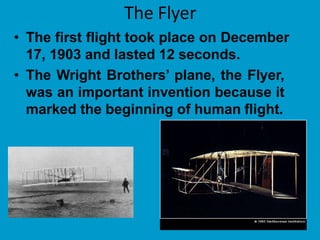
The Flyer
• The first flight took place on December
17, 1903 and lasted 12 seconds.
• The Wright Brothers’ plane, the Flyer,
was an important invention because it
marked the beginning of human flight.
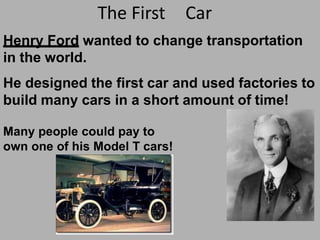
The First Car
Henry Ford wanted to change transportation
in the world.
He designed the first car and used factories to
build many cars in a short amount of time!
Many people could pay to
own one of his Model T cars!
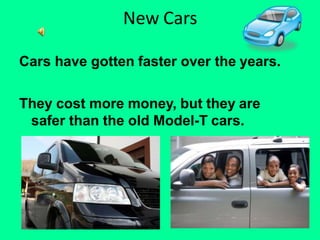
New Cars
Cars have gotten faster over the years.
They cost more money, but they are
safer than the old Model-T cars.
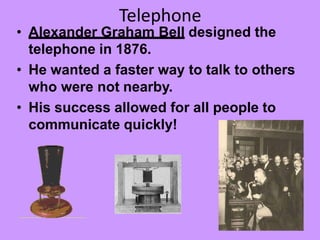
Telephone
• Alexander Graham Bell designed the
telephone in 1876.
• He wanted a faster way to talk to others
who were not nearby.
• His success allowed for all people to
communicate quickly!
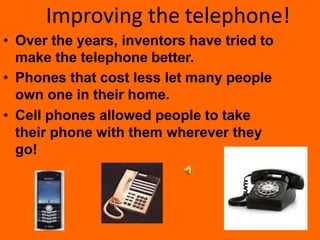
Improving the telephone!
• Over the years, inventors have tried to
make the telephone better.
• Phones that cost less let many people
own one in their home.
• Cell phones allowed people to take
their phone with them wherever they
go!
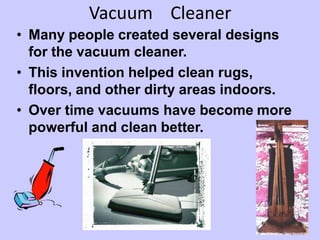
Vacuum Cleaner
• Many people created several designs
for the vacuum cleaner.
• This invention helped clean rugs,
floors, and other dirty areas indoors.
• Over time vacuums have become more
powerful and clean better.
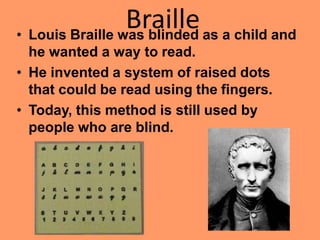
Braille
• Louis Braille was blinded as a child and
he wanted a way to read.
• He invented a system of raised dots
that could be read using the fingers.
• Today, this method is still used by
people who are blind.
Did you know?
• August is National Inventors' Month.
• The first patent was issued in 1790 to
Samuel Hopkins for a new way of making
soap!
• Kleenex tissue was first created to be a gas
mask to use in World War I.
• Benjamin Franklin created bifocals because
he hated wearing two pairs of glasses!
• Toilet paper was invented by Seth Wheeler
in New York!
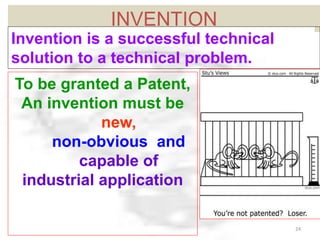
INVENTION
Invention is a successful technical
solution to a technical problem.
To be granted a Patent,
An invention must be
new,
non-obvious and
capable of
industrial application
24
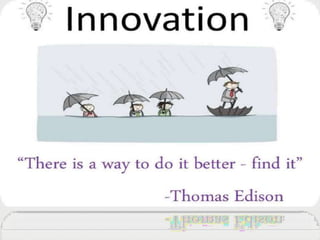
 The term innovation refers to a “new way of doing
something”. It may refer to incremental and emergent or
radical and revolutionary changes in thinking, products,
processes, or organizations.
 Innovation recipes = Creativity + Failure + Iteration
What is innovation?

 Schumpeter argued that innovation comes about t
h
r
o
u
g
h
new combinations made by an entrepreneur, resulting in
 a new product,
 a new process,
 opening of new market,
 new way of organizing the business,
 new sources of supply
What is innovation?

 An innovation can increase profits on the
 Value side (customers value your innovation enough
to pay more for it)
 Or the cost side ( the company produces the
offering in a more efficient way)
 Either way, value is created for the firm and the
consumer.
What is innovation?

Innovation and Invention

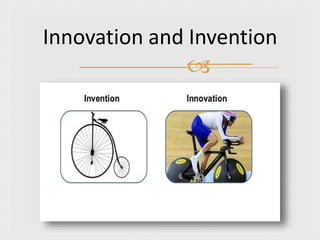
 An invention is different from an innovation at any
particular time in that it doesn't have commercial value
but it may have in future.
 There is no shortage of ideas and inventions in
the world. The challenge is to introduce these
successfully to a market.
 Only that idea/invention can be called an innovation.
Innovation and Invention

 In other words, innovation requires interplay
between a product offering (technology) and a
market (people).
 Innovation provides better quality product at l
o
w
e
r
price which leads to higher standard of living.
 Old strategies are replicated.
Innovation and Invention

 Product Innovation
 Process
Innovation
 Service Innovation
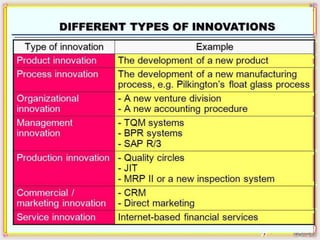
Types of Innovation

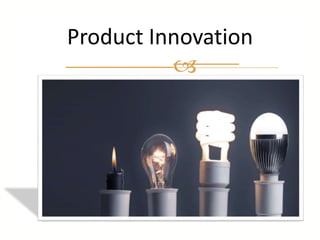
Product Innovation

 Change in how the product is noticed by
the consumers (change in physical
structure).
 These changes include change in product
d
e
s
i
g
n
,research and development, and new product
development (NPD).
 To meet customer needs and demands (why
c
h
a
n
g
e
?
)
Product innovation

 The degree of change can include the
following:
 Incremental improvements
 Addition to product families
 Next-gen products
 New core products
 Examples of product innovation are as follows:
 Introducing a new screen size for TVs.
 Changing from a CRT TV to a flat screen.
 Adding functionality such as internet access
to TVs.
Product innovation

 Continuous improvements, making the
product more:
 efficient, effective
 useful or user friendly
 valuable to users
 integrated with other products, technologies, or
systems.
Product Innovation

•  It involves a new or significantly
improved method for t
h
eproduction or
delivery of output that adds value to the
organization.
•  The term “process” refer to an
interrelated set of activities designed to
transform inputs into a specified output for
benefits of customers.
Process Innovation

 Make processes:
 simpler
 faster
 more accurate
 more reliable
 less expensive
 Reducing unit costs by improving the production capacity
.
Process Innovation

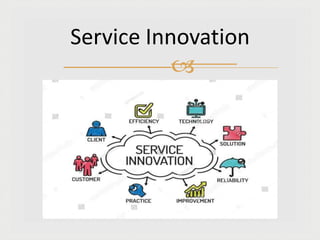
Service Innovation

•  Services involves products
(intangible) that form an extendedpart of the
product life cycle, from initial sales to end-of-
life recycling and disposal.
•  Service industries in areas such as
finance, food, education, transportation, health
make up most organizations in any economy.
Service Innovation

 New way of providing service / a new service.
 New information technology platforms, particularly the
internet have also added the scope of service innovation.
The internet is a valuable resource on which new service
relationships between organizations and their customers are
being developed every day.
 Technology + better service.
Service Innovation



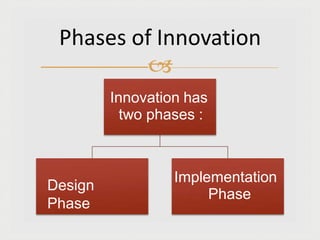
Innovation has
two phases :
Design
Phase
Implementation
Phase
Phases of Innovation
 The design phase is marked by much divergent thinking
and creativity, brainstorming, search for alternatives, etc.
Research studies suggest that the management of the
design phase needs to be marked by great
administrative flexibility and these types of innovation to
achieve the necessary growth to survive.
Design Phase

 It requires a very different mode of management.
 It involves putting the chosen innovation to w
o
r
k
.
 Much planning needs to be done, careful
coordination & control, and evaluation of progress.
Implementation Phase


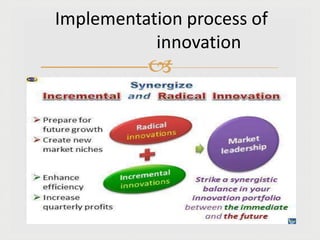
 Incremental innovation :- It is less ambitious
inits scope and offers less potential for returns for
the organization, but consequently the associated
risks are much less. It consists of smaller
endeavors, making than easier to manage than
their larger innovation.
Implementation process of
innovation

Implementation process of
innovation
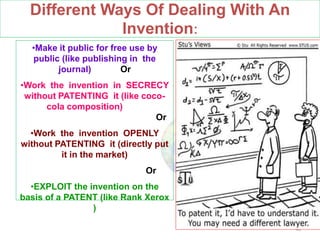
Different Ways Of Dealing With An
Invention:
48
•Make it public for free use by
public (like publishing in the
journal) Or
•Work the invention in SECRECY
without PATENTING it (like coco-
cola composition)
Or
•Work the invention OPENLY
without PATENTING it (directly put
it in the market)
Or
•EXPLOIT the invention on the
basis of a PATENT (like Rank Xerox
)
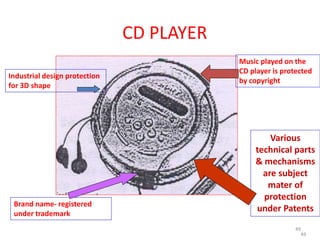
CD PLAYER
49
Industrial design protection
for 3D shape
Brand name- registered
under trademark
Music played on the
CD player is protected
by copyright
Various
technical parts
& mechanisms
are subject
mater of
protection
under Patents
49
50
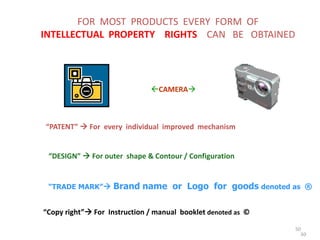
FOR MOST PRODUCTS EVERY FORM OF
INTELLECTUAL PROPERTY RIGHTS CAN BE OBTAINED
CAMERA
“PATENT”  For every individual improved mechanism
“DESIGN”  For outer shape & Contour / Configuration
“TRADE MARK” Brand name or Logo for goods denoted as ®
“Copy right” For Instruction / manual booklet denoted as ©
50
51
A patent is a Monopoly Right granted
•For an invention
•By the government
•To the inventor or his assignee
•For a limited period
•It is valid within the country of
grant
What Does Patent System Do ?
52
Patents for progress
It encourages RESEARCH.
Induces an inventor to disclose his
inventions
instead of keeping them as secret.
Provides inducement for capital
investment
encouraging technological
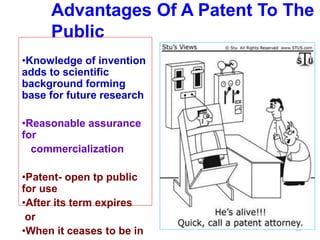
Advantages Of A Patent To The
Public
53
•Knowledge of invention
adds to scientific
background forming
base for future research
•Reasonable assurance
for
commercialization
•Patent- open tp public
for use
•After its term expires
or
•When it ceases to be in
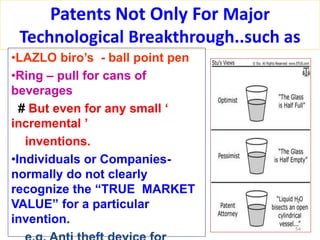
Patents Not Only For Major
Technological Breakthrough..such as
•LAZLO biro’s - ball point pen
•Ring – pull for cans of
beverages
# But even for any small ‘
incremental ’
inventions.
•Individuals or Companies-
normally do not clearly
recognize the “TRUE MARKET
VALUE” for a particular
invention.
54
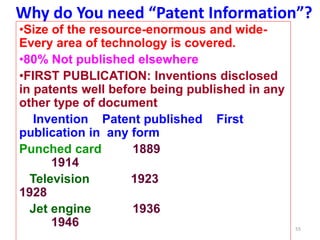
Why do You need “Patent Information”?
•Size of the resource-enormous and wide-
Every area of technology is covered.
•80% Not published elsewhere
•FIRST PUBLICATION: Inventions disclosed
in patents well before being published in any
other type of document
Invention Patent published First
publication in any form
Punched card 1889
1914
Television 1923
1928
Jet engine 1936
1946 55
56
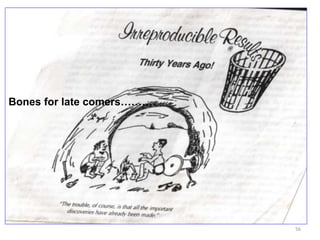
Bones for late comers……….
Patent Record Holders
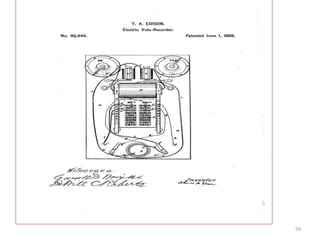
Edison (Born 1847)
credited for phonograph, the kinetoscope,
the dictaphone, radio, the electric lamp, the
autographic printer, the tattoo machine,
carbon microphone. Most of these
inventions were improvements of earlier
inventions. He holds 2,332 patents, including
1084 utility patents (patents for inventions)
and 9 artistic design patents.
Hunpei Yamazaki (Born 1942)
a Japanese inventor in the field of computer
58
Silverbrook (Born 1958)
an Australian inventor, scientist, 9,797 patents
on
digital music synthesis, digital video, digital
printing, digital paper, internet commerce,
computer graphics, liquid crystal
displays, robotics, 3D fabrication, organic
chemistry, DNA analysis, lab-on-a-chip, solar
photovoltaics, software, image processing,
Microelectromechanical
systems, mechanicalengineering, cryptography,
sensors, nanotechnology, microfluidics, polyme
rs, fault tolerance, parallel
processing, semiconductor fabrication,
59
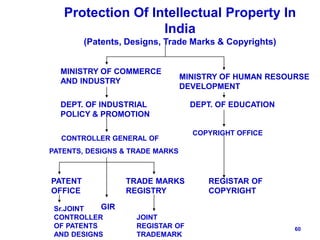
Protection Of Intellectual Property In
India
(Patents, Designs, Trade Marks & Copyrights)
60
Sr.JOINT
CONTROLLER
OF PATENTS
AND DESIGNS
JOINT
REGISTAR OF
TRADEMARK
MINISTRY OF COMMERCE
AND INDUSTRY
MINISTRY OF HUMAN RESOURSE
DEVELOPMENT
DEPT. OF INDUSTRIAL
POLICY & PROMOTION
DEPT. OF EDUCATION
CONTROLLER GENERAL OF
PATENTS, DESIGNS & TRADE MARKS
PATENT
OFFICE
TRADE MARKS
REGISTRY
COPYRIGHT OFFICE
REGISTAR OF
COPYRIGHT
GIR
61
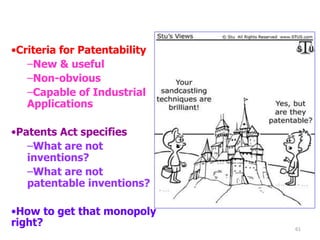
•Criteria for Patentability
–New & useful
–Non-obvious
–Capable of Industrial
Applications
•Patents Act specifies
–What are not
inventions?
–What are not
patentable inventions?
•How to get that monopoly
right?
Law of Patents
62
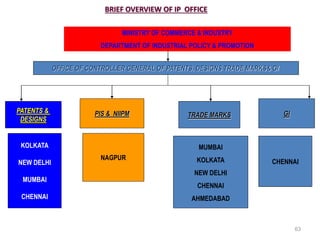
MINISTRY OF COMMERCE & INDUSTRY
DEPARTMENT OF INDUSTRIAL POLICY & PROMOTION
OFFICE OF CONTROLLER GENERAL OF PATENTS, DESIGNS TRADE MARKS& GI
PATENTS &
DESIGNS
PIS & NIIPM TRADE MARKS GI
KOLKATA
NEW DELHI
MUMBAI
CHENNAI
NAGPUR
MUMBAI
KOLKATA
NEW DELHI
CHENNAI
AHMEDABAD
CHENNAI
BRIEF OVERVIEW OF IP OFFICE
63
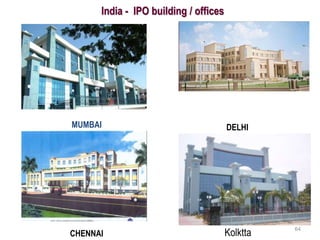
DELHI
MUMBAI
CHENNAI
India - IPO building / offices
Kolktta 64
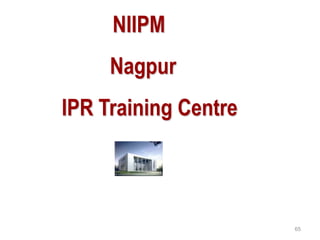
NIIPM
Nagpur
IPR Training Centre
65
9 May 2021 66
PATENT ?
• A MONOPOLY RIGHT
• GRANTED
§ BY THE GOVT.
§ FOR FULL DISCLOSURE OF INVENTION
§ TO OWNER OR HIS ASSIGNEE
§ FOR LIMITED PERIOD OF TIME i.e. 20 years
• A NEGATIVE RIGHT
• A TERRITORIAL RIGHT
9 May 2021 67
WHAT CAN BE PATENTED ?
• ALL PROCESSES & PRODUCTS WHICH ARE
• NEW
• INVOLVING INVENTIVE STEP
• CAPABLE OF INDUSTRIAL APPLICATION
9 May 2021 68
“NEW”
MEANS
SHOULD NOT BE
I. PUBLISHED IN INDIA OR ELSEWHERE
II. IN PRIOR PUBLIC KNOWLEDGE OR PRIOR
PUBLIC USE WITH IN INDIA OR ELSEWHERE IN
THE WORLD
III. CLAIMED IN ANY CLAIMS IN ANY SP. FILED IN
INDIA PRIOR & PUBLISHED LATER
9 May 2021 69
No Anticipation by publication
• Invention published Without consent of the
inventor or applicant.
provided
 Application was made within reasonable
time
 invention was not commercially worked
in India
9 May 2021 70
No Anticipation...
• If the prior use of the invention is:
• a secret use
• by the govt. to check it’s merit
9 May 2021 71
INVENTIVE STEP
1. A FEATURE THAT MAKES INVENTION NOT
OBVIOUS TO A PERSON OF ORDINARY SKILL IN
THE ART
2. A FEATURE OF AN INVENTION THAT INVOLVES
TECHNICAL ADVANCE AS COMPARED TO
ORDINARY SKILL IN THE EXISTING KNOWLEDGE
OR HAVING ECONOMIC SIGNIFICANCE OR BOTH
9 May 2021 72
INDUSTRIAL APPLICATION MEANS
INVENTION IS
CAPABLE OF BEING MADE OR
CAPABLE OF BEING USED IN
AN INDUSTRY
9 May 2021 73
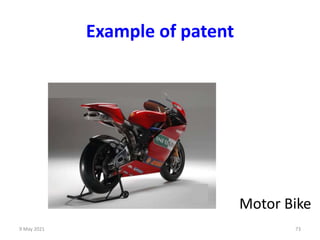
Example of patent
Motor Bike
Non- Patentable Invention [Section 3a]
• Frivolous inventions,
• Inventions contrary to well established natural laws
Examples:-
 Machine that gives more than 100% performance
 Perpetual machine
 Newton’s laws of gravitation
74
Non- Patentable Invention [Section 3b]
Primary or intended use or commercial exploitation of which could be -
contrary to Public order
or morality or
which causes serious prejudice to
human, animal or plant life or health or to the environment
For example
Gambling machine,
Device for house-breaking
Biological warfare material or device
weapons of mass destruction (WMD)
75
Non- Patentable Invention [Section 3c,3d]
c) Mere Discovery of a Scientific Principle or
formulation of an Abstract Theory or
discovery of any living thing or
discovery of non-living substance occurring in nature
d) The mere discovery of a new form of a known substance which does not
result in the enhancement of the known efficacy of that substance OR the
mere discovery of any new property or new use for a known substance OR
of the mere use of a known process, machine or apparatus, unless such
known process results in a new product or employs at least one new reactant.
76
Non- Patentable Invention [Section 3f ,3h ]
f) Mere arrangement or re-arrangement or duplication of known devices, each
functioning independently of one another in a known way
for example -. A Bucket fitted with torch,
An Umbrella with fan
A Clock and radio in a single cabinet
h) Method of Agriculture or Horticulture
for example :- producing new form of a known plant,
preparation of an improved soil
However, Agricultural Equipment's are patentable
77
Non- Patentable Invention [Section 3i ]
i) Any process for medicinal, surgical, curative, prophylactic,
diagnostic, therapeutic or other treatment of human beings
or a similar treatment of animals to render them free
of disease or to increase their economic value or
that of their products
For example:
o Removal of cancer tumor
o Surgical processes,
o Method of vaccination
Non- Patentable Invention [Section 3j,k ]
j) Plants & animals in whole or any part thereof other than micro- organisms,
but including seeds, varieties and species and essentially biological process
for production or propagation of plants & animals
k) A mathematical method or a business method or algorithms or a
computer programme per se
For example-
• Computer program claimed by itself or as a
record on a carrier – not patentable
• Program controlled machines/ program
controlled process- normally patentable
Non- Patentable Invention [Section 3l,m ]
l) A literary, dramatic, musical or artistic work or any other
aesthetic creation including cinematographic work and
television productions.
m) A mere scheme or rule or method of performing mental act or
method of playing game
For examples –
• Scheme for learning a language ,
• Method for solving a crossword puzzle,
• Method of learning a language,
• Method of teaching / learning
Non- Patentable Invention [Section 3n,0,p]
n).Presentation of information
o) Topography of integrated circuits
p) Traditional knowledge or aggregation or duplication of
known properties of traditionally known components .
9 May 2021 82
DEFENCE RELATED INVENTION
• SECRECY DIRECTIONS ARE ISSUED
• REVIEWED 6 MONTHLY
• NO PUBLICATION TILL CESSATION OF SEC.
DIRECTION
• NO PUB.=NO PATENT
9 May 2021 83
NON PATENTABLE INVENTIONS Sec 4
• INVENTIONS RELATING TO EXTRACTION,
PREPARATION, BENEFICIATION OF ORES
RELATING TO SUBSTANCES, COMPOUNDS
USEFUL TO PRODUCE ATOMIC ENERGY
• SECTION 20(1) OF THE ATOMIC ENERGY ACT
1962
9 May 2021 84
NON PATENTABLE INVENTIONS Sec 4
• LIST OF PRESCRIBED SUBSTANCES
• URANIUM
• THORIUM
• RADIUM
• ZIRCONIUM
• GRAPHITE
• BERYLLIUM
• LITHIUM
• DEUTERIUM
• PLTONIUM
• NEPTUNIUM
9 May 2021 85
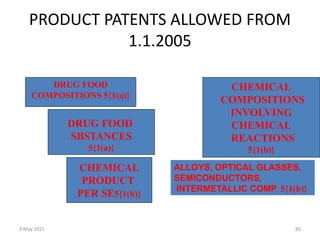
PRODUCT PATENTS ALLOWED FROM
1.1.2005
DRUG FOOD
COMPOSITIONS 5{1(a)}
DRUG FOOD
SBSTANCES
5{1(a)}
CHEMICAL
PRODUCT
PER SE5{1(b)}
CHEMICAL
COMPOSITIONS
INVOLVING
CHEMICAL
REACTIONS
5{1(b)}
ALLOYS, OPTICAL GLASSES,
SEMICONDUCTORS,
INTERMETALLIC COMP. 5{1(b)}
9 May 2021 86
PRODUCT PATENTING ?
• YES
• BUT NO TO
• ISOMERS,SALTS,ESTERS,POLYMORPHS,COMPLEXES,D
ERIVATIVES,
• HOMOLOGUES,METABOLITES, PURE FORMS ( PATENTABLE
IF THESE HAVE IMPROVED INDUSTRIAL APPLICATION)
• & THE PRODUCT CLAIMING PRIORITY PRIOR TO
1.1. 1995 ?????
9 May 2021 87
USE OF BIOLOGICAL MATERIAL
• SHOULD BE DEPOSITED IN INT. DEPOSITORY
PRIOR TO FILING OF APPLICATION AND REF.
THEREOF SHOULD BE IN SPECIFICATION
• SPECIFICATION SHOULD CONTAIN ALL DETAILS
SAID MATERIAL
• GEOGRAPHICAL ORIGIN OF THE SAID
MATERIAL SHOULD BE DISCLOSED
88
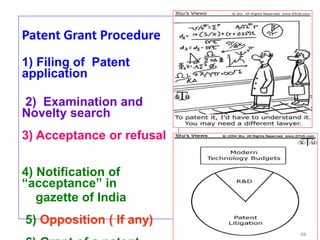
Patent Grant Procedure
1) Filing of Patent
application
2) Examination and
Novelty search
3) Acceptance or refusal
4) Notification of
“acceptance” in
gazette of India
5) Opposition ( If any)
88
89
Contents of Patent Application (To be
submitted in duplicate)
1. Application for grant of patent in Form-1.
2. Provisional / complete specification in Form-2.
3. Statement and undertaking under Section 8 in
Form-3, if
applicable. (An applicant must file Form 3
either along with the
application or within 6 months from the date of
Application)
4. Declaration as to inventorship in Form 5
5. Power of authority in Form-26 ( if filed through
a Patent Agent. )
6. Abstract
90
10) Signature of the applicant or authorized person /
Patent Agent along with name and date .
11) The Specification and drawings shall be signed by
the agent/applicant with date.
For biological patents
1) For biological material obtained from India, the
applicant is required to submit the permission from the
National Biodiversity Authority any time before the grant
of the patent.
2) Indicate clearly the source of geographical origin of
any biological material used in the Specification.
91
92
E-filing:
1. Facility to file a Patent Application online from the
native place of the agent.
2. Applicant / agent must have a digital signature. For the
first time, applicant /
agent has to register as a new user and has to create
login ID and
password on the Patent office portal.
(http://www.ipindia.nic.in).
3. A preliminary Software (Client Software) has to be
installed on the host computer and all the relevant in soft
copy have to be uploaded.
93
Language
Documents shall be written or typewritten or printed either
in Hindi or in English language and legible characters with
deep indelible ink with lines widely spaced upon.
Paper size
One side of strong white paper of a size A4 with a margin
of at least 4 centimeters on the top and left hand part and 3
centimeters on the bottom and right hand part thereof.
Lines spacing of 1 .5 or double space in non-script type
font preferably in a font size of 12.
Signature
Any signature which is not legible or which is written in a
script other than Hindi or English shall be accompanied by
a transcription of the name either in Hindi or in English in
94
Bibliography
• http://www.ideafinder.com/history/inventions/refri
gerator.htm
• http://gardenofpraise.com/ibdwrigh.htm
• http://www.nasm.si.edu/exhibitions/gal100/wright
1903.html
• http://www.first-to-
fly.com/Adventure/Workshop/workshop.htm
• http://en.wikipedia.org/wiki/Henry_Ford
• http://www.ideafinder.com/history/inventions/tele
phone.htm
THANK YOU
96

Reseach and ipr

  • 1.
    1 Invention ,Innovation &Patent Filing Dr.Gurumeetc wadhawa Karmaveer Bhaurao Patil College, Vashi
  • 2.
  • 3.
    Inventions Evaluate an inventionthat solves a problem and determine ways to improve the design.
  • 4.
    Anything new ordifferent in the world made by people is an invention!
  • 5.
    Inventions are createdto help make life easier and better.
  • 6.
    Lots of inventionare ways to have fun or good things to eat!
  • 7.
    Other inventions aremade to solve problems.
  • 8.
  • 9.
    People who createinventions are called inventors. Inventors can live anywhere in the world and be any age!
  • 10.
    Inventors can beanyone that wants to help the world! People have been creating inventions for hundreds of years.
  • 11.
    Don’t give up! •Inventors need to plan for a long time and have to try many times before they can get their invention to work the right way.
  • 12.
    No copy cats! •Once an invention works, inventors will need to get a patent. • A patent makes sure that no one can copy their idea. • A patent means the inventor can sell their invention to make money!
  • 13.
    Improvements! • Inventions canbe changed to make them better! • Changing the design or plan of an invention can help the people who use them.
  • 14.
    Refrigerator • The refrigeratorwas invented to help keep food from spoiling in the heat. • Carl von Linde invented the refrigerator in 1876. • Carl von Linde was from Germany.
  • 15.
    Airplane • Wilbur andOrville Wright spent many years building balloons and kites before they built the first airplane. • Their invention was very special because it was the first flying machine. Flying Kite
  • 16.
    The Flyer • Thefirst flight took place on December 17, 1903 and lasted 12 seconds. • The Wright Brothers’ plane, the Flyer, was an important invention because it marked the beginning of human flight.
  • 17.
    The First Car HenryFord wanted to change transportation in the world. He designed the first car and used factories to build many cars in a short amount of time! Many people could pay to own one of his Model T cars!
  • 18.
    New Cars Cars havegotten faster over the years. They cost more money, but they are safer than the old Model-T cars.
  • 19.
    Telephone • Alexander GrahamBell designed the telephone in 1876. • He wanted a faster way to talk to others who were not nearby. • His success allowed for all people to communicate quickly!
  • 20.
    Improving the telephone! •Over the years, inventors have tried to make the telephone better. • Phones that cost less let many people own one in their home. • Cell phones allowed people to take their phone with them wherever they go!
  • 21.
    Vacuum Cleaner • Manypeople created several designs for the vacuum cleaner. • This invention helped clean rugs, floors, and other dirty areas indoors. • Over time vacuums have become more powerful and clean better.
  • 22.
    Braille • Louis Braillewas blinded as a child and he wanted a way to read. • He invented a system of raised dots that could be read using the fingers. • Today, this method is still used by people who are blind.
  • 23.
    Did you know? •August is National Inventors' Month. • The first patent was issued in 1790 to Samuel Hopkins for a new way of making soap! • Kleenex tissue was first created to be a gas mask to use in World War I. • Benjamin Franklin created bifocals because he hated wearing two pairs of glasses! • Toilet paper was invented by Seth Wheeler in New York!
  • 24.
    INVENTION Invention is asuccessful technical solution to a technical problem. To be granted a Patent, An invention must be new, non-obvious and capable of industrial application 24
  • 26.
     The terminnovation refers to a “new way of doing something”. It may refer to incremental and emergent or radical and revolutionary changes in thinking, products, processes, or organizations.  Innovation recipes = Creativity + Failure + Iteration What is innovation? 
  • 27.
     Schumpeter arguedthat innovation comes about t h r o u g h new combinations made by an entrepreneur, resulting in  a new product,  a new process,  opening of new market,  new way of organizing the business,  new sources of supply What is innovation? 
  • 28.
     An innovationcan increase profits on the  Value side (customers value your innovation enough to pay more for it)  Or the cost side ( the company produces the offering in a more efficient way)  Either way, value is created for the firm and the consumer. What is innovation? 
  • 29.
  • 30.
     An inventionis different from an innovation at any particular time in that it doesn't have commercial value but it may have in future.  There is no shortage of ideas and inventions in the world. The challenge is to introduce these successfully to a market.  Only that idea/invention can be called an innovation. Innovation and Invention 
  • 31.
     In otherwords, innovation requires interplay between a product offering (technology) and a market (people).  Innovation provides better quality product at l o w e r price which leads to higher standard of living.  Old strategies are replicated. Innovation and Invention 
  • 32.
     Product Innovation Process Innovation  Service Innovation Types of Innovation 
  • 33.
  • 34.
     Change inhow the product is noticed by the consumers (change in physical structure).  These changes include change in product d e s i g n ,research and development, and new product development (NPD).  To meet customer needs and demands (why c h a n g e ? ) Product innovation 
  • 35.
     The degreeof change can include the following:  Incremental improvements  Addition to product families  Next-gen products  New core products  Examples of product innovation are as follows:  Introducing a new screen size for TVs.  Changing from a CRT TV to a flat screen.  Adding functionality such as internet access to TVs. Product innovation 
  • 36.
     Continuous improvements,making the product more:  efficient, effective  useful or user friendly  valuable to users  integrated with other products, technologies, or systems. Product Innovation 
  • 37.
    •  Itinvolves a new or significantly improved method for t h eproduction or delivery of output that adds value to the organization. •  The term “process” refer to an interrelated set of activities designed to transform inputs into a specified output for benefits of customers. Process Innovation 
  • 38.
     Make processes: simpler  faster  more accurate  more reliable  less expensive  Reducing unit costs by improving the production capacity . Process Innovation 
  • 39.
  • 40.
    •  Servicesinvolves products (intangible) that form an extendedpart of the product life cycle, from initial sales to end-of- life recycling and disposal. •  Service industries in areas such as finance, food, education, transportation, health make up most organizations in any economy. Service Innovation 
  • 41.
     New wayof providing service / a new service.  New information technology platforms, particularly the internet have also added the scope of service innovation. The internet is a valuable resource on which new service relationships between organizations and their customers are being developed every day.  Technology + better service. Service Innovation 
  • 42.
  • 43.
     Innovation has two phases: Design Phase Implementation Phase Phases of Innovation
  • 44.
     The designphase is marked by much divergent thinking and creativity, brainstorming, search for alternatives, etc. Research studies suggest that the management of the design phase needs to be marked by great administrative flexibility and these types of innovation to achieve the necessary growth to survive. Design Phase 
  • 45.
     It requiresa very different mode of management.  It involves putting the chosen innovation to w o r k .  Much planning needs to be done, careful coordination & control, and evaluation of progress. Implementation Phase 
  • 46.
      Incremental innovation:- It is less ambitious inits scope and offers less potential for returns for the organization, but consequently the associated risks are much less. It consists of smaller endeavors, making than easier to manage than their larger innovation. Implementation process of innovation
  • 47.
  • 48.
    Different Ways OfDealing With An Invention: 48 •Make it public for free use by public (like publishing in the journal) Or •Work the invention in SECRECY without PATENTING it (like coco- cola composition) Or •Work the invention OPENLY without PATENTING it (directly put it in the market) Or •EXPLOIT the invention on the basis of a PATENT (like Rank Xerox )
  • 49.
    CD PLAYER 49 Industrial designprotection for 3D shape Brand name- registered under trademark Music played on the CD player is protected by copyright Various technical parts & mechanisms are subject mater of protection under Patents 49
  • 50.
    50 FOR MOST PRODUCTSEVERY FORM OF INTELLECTUAL PROPERTY RIGHTS CAN BE OBTAINED CAMERA “PATENT”  For every individual improved mechanism “DESIGN”  For outer shape & Contour / Configuration “TRADE MARK” Brand name or Logo for goods denoted as ® “Copy right” For Instruction / manual booklet denoted as © 50
  • 51.
    51 A patent isa Monopoly Right granted •For an invention •By the government •To the inventor or his assignee •For a limited period •It is valid within the country of grant
  • 52.
    What Does PatentSystem Do ? 52 Patents for progress It encourages RESEARCH. Induces an inventor to disclose his inventions instead of keeping them as secret. Provides inducement for capital investment encouraging technological
  • 53.
    Advantages Of APatent To The Public 53 •Knowledge of invention adds to scientific background forming base for future research •Reasonable assurance for commercialization •Patent- open tp public for use •After its term expires or •When it ceases to be in
  • 54.
    Patents Not OnlyFor Major Technological Breakthrough..such as •LAZLO biro’s - ball point pen •Ring – pull for cans of beverages # But even for any small ‘ incremental ’ inventions. •Individuals or Companies- normally do not clearly recognize the “TRUE MARKET VALUE” for a particular invention. 54
  • 55.
    Why do Youneed “Patent Information”? •Size of the resource-enormous and wide- Every area of technology is covered. •80% Not published elsewhere •FIRST PUBLICATION: Inventions disclosed in patents well before being published in any other type of document Invention Patent published First publication in any form Punched card 1889 1914 Television 1923 1928 Jet engine 1936 1946 55
  • 56.
    56 Bones for latecomers……….
  • 57.
    Patent Record Holders Edison(Born 1847) credited for phonograph, the kinetoscope, the dictaphone, radio, the electric lamp, the autographic printer, the tattoo machine, carbon microphone. Most of these inventions were improvements of earlier inventions. He holds 2,332 patents, including 1084 utility patents (patents for inventions) and 9 artistic design patents. Hunpei Yamazaki (Born 1942) a Japanese inventor in the field of computer
  • 58.
    58 Silverbrook (Born 1958) anAustralian inventor, scientist, 9,797 patents on digital music synthesis, digital video, digital printing, digital paper, internet commerce, computer graphics, liquid crystal displays, robotics, 3D fabrication, organic chemistry, DNA analysis, lab-on-a-chip, solar photovoltaics, software, image processing, Microelectromechanical systems, mechanicalengineering, cryptography, sensors, nanotechnology, microfluidics, polyme rs, fault tolerance, parallel processing, semiconductor fabrication,
  • 59.
  • 60.
    Protection Of IntellectualProperty In India (Patents, Designs, Trade Marks & Copyrights) 60 Sr.JOINT CONTROLLER OF PATENTS AND DESIGNS JOINT REGISTAR OF TRADEMARK MINISTRY OF COMMERCE AND INDUSTRY MINISTRY OF HUMAN RESOURSE DEVELOPMENT DEPT. OF INDUSTRIAL POLICY & PROMOTION DEPT. OF EDUCATION CONTROLLER GENERAL OF PATENTS, DESIGNS & TRADE MARKS PATENT OFFICE TRADE MARKS REGISTRY COPYRIGHT OFFICE REGISTAR OF COPYRIGHT GIR
  • 61.
    61 •Criteria for Patentability –New& useful –Non-obvious –Capable of Industrial Applications •Patents Act specifies –What are not inventions? –What are not patentable inventions? •How to get that monopoly right?
  • 62.
  • 63.
    MINISTRY OF COMMERCE& INDUSTRY DEPARTMENT OF INDUSTRIAL POLICY & PROMOTION OFFICE OF CONTROLLER GENERAL OF PATENTS, DESIGNS TRADE MARKS& GI PATENTS & DESIGNS PIS & NIIPM TRADE MARKS GI KOLKATA NEW DELHI MUMBAI CHENNAI NAGPUR MUMBAI KOLKATA NEW DELHI CHENNAI AHMEDABAD CHENNAI BRIEF OVERVIEW OF IP OFFICE 63
  • 64.
    DELHI MUMBAI CHENNAI India - IPObuilding / offices Kolktta 64
  • 65.
  • 66.
    9 May 202166 PATENT ? • A MONOPOLY RIGHT • GRANTED § BY THE GOVT. § FOR FULL DISCLOSURE OF INVENTION § TO OWNER OR HIS ASSIGNEE § FOR LIMITED PERIOD OF TIME i.e. 20 years • A NEGATIVE RIGHT • A TERRITORIAL RIGHT
  • 67.
    9 May 202167 WHAT CAN BE PATENTED ? • ALL PROCESSES & PRODUCTS WHICH ARE • NEW • INVOLVING INVENTIVE STEP • CAPABLE OF INDUSTRIAL APPLICATION
  • 68.
    9 May 202168 “NEW” MEANS SHOULD NOT BE I. PUBLISHED IN INDIA OR ELSEWHERE II. IN PRIOR PUBLIC KNOWLEDGE OR PRIOR PUBLIC USE WITH IN INDIA OR ELSEWHERE IN THE WORLD III. CLAIMED IN ANY CLAIMS IN ANY SP. FILED IN INDIA PRIOR & PUBLISHED LATER
  • 69.
    9 May 202169 No Anticipation by publication • Invention published Without consent of the inventor or applicant. provided  Application was made within reasonable time  invention was not commercially worked in India
  • 70.
    9 May 202170 No Anticipation... • If the prior use of the invention is: • a secret use • by the govt. to check it’s merit
  • 71.
    9 May 202171 INVENTIVE STEP 1. A FEATURE THAT MAKES INVENTION NOT OBVIOUS TO A PERSON OF ORDINARY SKILL IN THE ART 2. A FEATURE OF AN INVENTION THAT INVOLVES TECHNICAL ADVANCE AS COMPARED TO ORDINARY SKILL IN THE EXISTING KNOWLEDGE OR HAVING ECONOMIC SIGNIFICANCE OR BOTH
  • 72.
    9 May 202172 INDUSTRIAL APPLICATION MEANS INVENTION IS CAPABLE OF BEING MADE OR CAPABLE OF BEING USED IN AN INDUSTRY
  • 73.
    9 May 202173 Example of patent Motor Bike
  • 74.
    Non- Patentable Invention[Section 3a] • Frivolous inventions, • Inventions contrary to well established natural laws Examples:-  Machine that gives more than 100% performance  Perpetual machine  Newton’s laws of gravitation 74
  • 75.
    Non- Patentable Invention[Section 3b] Primary or intended use or commercial exploitation of which could be - contrary to Public order or morality or which causes serious prejudice to human, animal or plant life or health or to the environment For example Gambling machine, Device for house-breaking Biological warfare material or device weapons of mass destruction (WMD) 75
  • 76.
    Non- Patentable Invention[Section 3c,3d] c) Mere Discovery of a Scientific Principle or formulation of an Abstract Theory or discovery of any living thing or discovery of non-living substance occurring in nature d) The mere discovery of a new form of a known substance which does not result in the enhancement of the known efficacy of that substance OR the mere discovery of any new property or new use for a known substance OR of the mere use of a known process, machine or apparatus, unless such known process results in a new product or employs at least one new reactant. 76
  • 77.
    Non- Patentable Invention[Section 3f ,3h ] f) Mere arrangement or re-arrangement or duplication of known devices, each functioning independently of one another in a known way for example -. A Bucket fitted with torch, An Umbrella with fan A Clock and radio in a single cabinet h) Method of Agriculture or Horticulture for example :- producing new form of a known plant, preparation of an improved soil However, Agricultural Equipment's are patentable 77
  • 78.
    Non- Patentable Invention[Section 3i ] i) Any process for medicinal, surgical, curative, prophylactic, diagnostic, therapeutic or other treatment of human beings or a similar treatment of animals to render them free of disease or to increase their economic value or that of their products For example: o Removal of cancer tumor o Surgical processes, o Method of vaccination
  • 79.
    Non- Patentable Invention[Section 3j,k ] j) Plants & animals in whole or any part thereof other than micro- organisms, but including seeds, varieties and species and essentially biological process for production or propagation of plants & animals k) A mathematical method or a business method or algorithms or a computer programme per se For example- • Computer program claimed by itself or as a record on a carrier – not patentable • Program controlled machines/ program controlled process- normally patentable
  • 80.
    Non- Patentable Invention[Section 3l,m ] l) A literary, dramatic, musical or artistic work or any other aesthetic creation including cinematographic work and television productions. m) A mere scheme or rule or method of performing mental act or method of playing game For examples – • Scheme for learning a language , • Method for solving a crossword puzzle, • Method of learning a language, • Method of teaching / learning
  • 81.
    Non- Patentable Invention[Section 3n,0,p] n).Presentation of information o) Topography of integrated circuits p) Traditional knowledge or aggregation or duplication of known properties of traditionally known components .
  • 82.
    9 May 202182 DEFENCE RELATED INVENTION • SECRECY DIRECTIONS ARE ISSUED • REVIEWED 6 MONTHLY • NO PUBLICATION TILL CESSATION OF SEC. DIRECTION • NO PUB.=NO PATENT
  • 83.
    9 May 202183 NON PATENTABLE INVENTIONS Sec 4 • INVENTIONS RELATING TO EXTRACTION, PREPARATION, BENEFICIATION OF ORES RELATING TO SUBSTANCES, COMPOUNDS USEFUL TO PRODUCE ATOMIC ENERGY • SECTION 20(1) OF THE ATOMIC ENERGY ACT 1962
  • 84.
    9 May 202184 NON PATENTABLE INVENTIONS Sec 4 • LIST OF PRESCRIBED SUBSTANCES • URANIUM • THORIUM • RADIUM • ZIRCONIUM • GRAPHITE • BERYLLIUM • LITHIUM • DEUTERIUM • PLTONIUM • NEPTUNIUM
  • 85.
    9 May 202185 PRODUCT PATENTS ALLOWED FROM 1.1.2005 DRUG FOOD COMPOSITIONS 5{1(a)} DRUG FOOD SBSTANCES 5{1(a)} CHEMICAL PRODUCT PER SE5{1(b)} CHEMICAL COMPOSITIONS INVOLVING CHEMICAL REACTIONS 5{1(b)} ALLOYS, OPTICAL GLASSES, SEMICONDUCTORS, INTERMETALLIC COMP. 5{1(b)}
  • 86.
    9 May 202186 PRODUCT PATENTING ? • YES • BUT NO TO • ISOMERS,SALTS,ESTERS,POLYMORPHS,COMPLEXES,D ERIVATIVES, • HOMOLOGUES,METABOLITES, PURE FORMS ( PATENTABLE IF THESE HAVE IMPROVED INDUSTRIAL APPLICATION) • & THE PRODUCT CLAIMING PRIORITY PRIOR TO 1.1. 1995 ?????
  • 87.
    9 May 202187 USE OF BIOLOGICAL MATERIAL • SHOULD BE DEPOSITED IN INT. DEPOSITORY PRIOR TO FILING OF APPLICATION AND REF. THEREOF SHOULD BE IN SPECIFICATION • SPECIFICATION SHOULD CONTAIN ALL DETAILS SAID MATERIAL • GEOGRAPHICAL ORIGIN OF THE SAID MATERIAL SHOULD BE DISCLOSED
  • 88.
    88 Patent Grant Procedure 1)Filing of Patent application 2) Examination and Novelty search 3) Acceptance or refusal 4) Notification of “acceptance” in gazette of India 5) Opposition ( If any) 88
  • 89.
    89 Contents of PatentApplication (To be submitted in duplicate) 1. Application for grant of patent in Form-1. 2. Provisional / complete specification in Form-2. 3. Statement and undertaking under Section 8 in Form-3, if applicable. (An applicant must file Form 3 either along with the application or within 6 months from the date of Application) 4. Declaration as to inventorship in Form 5 5. Power of authority in Form-26 ( if filed through a Patent Agent. ) 6. Abstract
  • 90.
    90 10) Signature ofthe applicant or authorized person / Patent Agent along with name and date . 11) The Specification and drawings shall be signed by the agent/applicant with date. For biological patents 1) For biological material obtained from India, the applicant is required to submit the permission from the National Biodiversity Authority any time before the grant of the patent. 2) Indicate clearly the source of geographical origin of any biological material used in the Specification.
  • 91.
  • 92.
    92 E-filing: 1. Facility tofile a Patent Application online from the native place of the agent. 2. Applicant / agent must have a digital signature. For the first time, applicant / agent has to register as a new user and has to create login ID and password on the Patent office portal. (http://www.ipindia.nic.in). 3. A preliminary Software (Client Software) has to be installed on the host computer and all the relevant in soft copy have to be uploaded.
  • 93.
    93 Language Documents shall bewritten or typewritten or printed either in Hindi or in English language and legible characters with deep indelible ink with lines widely spaced upon. Paper size One side of strong white paper of a size A4 with a margin of at least 4 centimeters on the top and left hand part and 3 centimeters on the bottom and right hand part thereof. Lines spacing of 1 .5 or double space in non-script type font preferably in a font size of 12. Signature Any signature which is not legible or which is written in a script other than Hindi or English shall be accompanied by a transcription of the name either in Hindi or in English in
  • 94.
  • 95.
    Bibliography • http://www.ideafinder.com/history/inventions/refri gerator.htm • http://gardenofpraise.com/ibdwrigh.htm •http://www.nasm.si.edu/exhibitions/gal100/wright 1903.html • http://www.first-to- fly.com/Adventure/Workshop/workshop.htm • http://en.wikipedia.org/wiki/Henry_Ford • http://www.ideafinder.com/history/inventions/tele phone.htm
  • 96.