Zohaib ul Hassan
Plant pathology
(zuhaib1144@gmail.com)
Plant pathogen
 “An entity that can incite the disease in plant”.
 Disturb the normal physiological functioning of plant.
 Take its nutrient from plant.
Plant pathology
 It is the branch of Agriculture , which deals with
The study of plant diseases.
 It includes: importance, occurrence, symptoms, cause,
etiology, disease cycle and management of diseases.
Major plant pathogens
 Fungi
 Bacteria
 Nematodes
 viruses
ISOLATION & DETECTION TECHNIQUES
FOR PLANT PATHOGENS
 Koch,s postulates: (1881-1882)
I. Association
II. Isolation , Purification
III.Re-inoculation
Compare the symptoms of diseased and
healthy plants.
Modification's in postulates
 E.F. Smith : (1903)
 Re-isolation , was added by E.F. Smith.
 For obligate parasites some modifications also done.
1. Study of bio-chemical properties for the particular
virus.
2. Study of intrinsic properties.
TECHNIQUES USED FOR DETECTION OF
PATHOGENS
 Histopathological: ( on the basis of infected
tissues) , mostly done in cases of fungi, bacteria
and nematodes.
 Serological (interaction between antigen and
antibody)
 Molecular techniques ( Nucleic acid based
methods)
 Serological and NA based techniques are mostly
used for viruses.
HISTOPATHOLOGICAL TECHNIQUES
 Symptomology
 Visual observation through naked eye.
 All plant pathogens can detect through characteristics
symptoms, which they have produced in different
plant parts.
Symptomology (fungal diseases)
FUNGAL DISEASES
 POWDERY MILDEW: WILT:
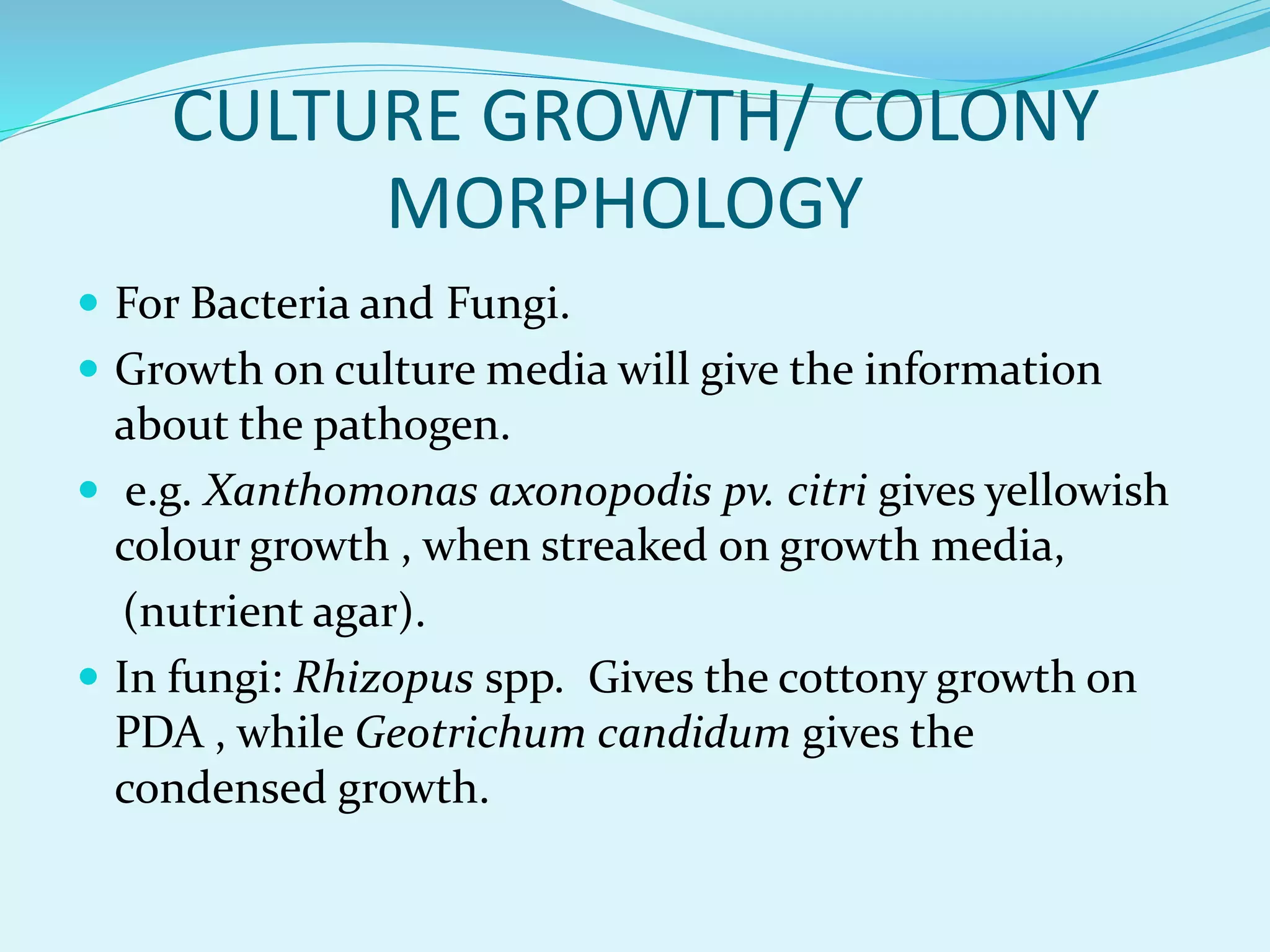
Identification of Bacteria
 On the basis of symptoms. (ooze production is the
characteristics symptom of plant pathogenic bacteria)
 Characteristics symptom of bacteria.
Dwarfing & stunting
Mosaic
Chlorosis
Necrosis
Ring spot
Enation or Tumor
Variegation
CULTURE GROWTH/ COLONY
MORPHOLOGY
 For Bacteria and Fungi.
 Growth on culture media will give the information
about the pathogen.
 e.g. Xanthomonas axonopodis pv. citri gives yellowish
colour growth , when streaked on growth media,
(nutrient agar).
 In fungi: Rhizopus spp. Gives the cottony growth on
PDA , while Geotrichum candidum gives the
condensed growth.
 Geotrichum spp. Rhizopus spp.
 xanthomonas
MOUNTS
 Temporary & Permanent.
 Used for fungi, nematodes, bacteria.
 Can detect the pathogen to observe it under
microscope or stereoscope.
MICROSCOPY
 To detect the pathogen on the basis of morphology.
 In case of fungi: reproductive structures, vegetative
structures, spores can be seen under microscope. From
which we can identify the fungus up to genera level.
 We can detect the nematodes after preparing slide
from suspension, and visualized it under microscope.
MICROSCOPY
STAINING
 Bacterial cells, fungi and nematodes can be colored with a
stain.
 Provide contrast with the background or to make cellular
organelles visible.
 SIMPLE STAINS: methylene blue, basic fuchsin,
and crystal violet.
BACTERIAL STAINNING
Staining a bacterial smear. (a) Pass the slide, smear side up, through
a flame three times. (b) Flood the smear with a stain and let stand
one minute. (c) Rinse the slide gently with water, making sure the
stream of water does not strike the smear directly. (d) Carefully blot
the slide dry.
Gram Stain
 The Gram stain separates almost all bacteria into two large
groups: the Gram-positive bacteria, which stain blue, and
the Gram-negative bacteria, which stain pink.
Gram staining
Gram-positive bacteria Gram-negative bacteria.
Differentiation on basis of bio-chemical properties
 A more precise method
is to determine whether
or not the bacteria
utilize a particular
biochemical pathway.
 Many bacteria use
carbohydrates as energy
sources.
Starch hydrolysis. Some bacteria do not
hydrolyze starch (left), while others do
(right), leaving a clear ring in the agar
around the bacterial culture.
Biochemical properties
Ability of different bacteria to
ferment the carbohydrate
dextrose.
Some bacteria produce acids as
end products of dextrose
fermentation(center). Others
produce both acid and gaseous
end products (left). Some cannot
ferment dextrose at all (right).

Different techniques for detection of plant pathogens.

  • 1.
    Zohaib ul Hassan Plantpathology (zuhaib1144@gmail.com)
  • 2.
    Plant pathogen  “Anentity that can incite the disease in plant”.  Disturb the normal physiological functioning of plant.  Take its nutrient from plant.
  • 3.
    Plant pathology  Itis the branch of Agriculture , which deals with The study of plant diseases.  It includes: importance, occurrence, symptoms, cause, etiology, disease cycle and management of diseases.
  • 4.
    Major plant pathogens Fungi  Bacteria  Nematodes  viruses
  • 5.
    ISOLATION & DETECTIONTECHNIQUES FOR PLANT PATHOGENS  Koch,s postulates: (1881-1882) I. Association II. Isolation , Purification III.Re-inoculation Compare the symptoms of diseased and healthy plants.
  • 6.
    Modification's in postulates E.F. Smith : (1903)  Re-isolation , was added by E.F. Smith.  For obligate parasites some modifications also done. 1. Study of bio-chemical properties for the particular virus. 2. Study of intrinsic properties.
  • 7.
    TECHNIQUES USED FORDETECTION OF PATHOGENS  Histopathological: ( on the basis of infected tissues) , mostly done in cases of fungi, bacteria and nematodes.  Serological (interaction between antigen and antibody)  Molecular techniques ( Nucleic acid based methods)  Serological and NA based techniques are mostly used for viruses.
  • 8.
    HISTOPATHOLOGICAL TECHNIQUES  Symptomology Visual observation through naked eye.  All plant pathogens can detect through characteristics symptoms, which they have produced in different plant parts.
  • 9.
  • 10.
  • 11.
    Identification of Bacteria On the basis of symptoms. (ooze production is the characteristics symptom of plant pathogenic bacteria)  Characteristics symptom of bacteria.
  • 12.
  • 13.
    CULTURE GROWTH/ COLONY MORPHOLOGY For Bacteria and Fungi.  Growth on culture media will give the information about the pathogen.  e.g. Xanthomonas axonopodis pv. citri gives yellowish colour growth , when streaked on growth media, (nutrient agar).  In fungi: Rhizopus spp. Gives the cottony growth on PDA , while Geotrichum candidum gives the condensed growth.
  • 14.
     Geotrichum spp.Rhizopus spp.  xanthomonas
  • 15.
    MOUNTS  Temporary &Permanent.  Used for fungi, nematodes, bacteria.  Can detect the pathogen to observe it under microscope or stereoscope.
  • 16.
    MICROSCOPY  To detectthe pathogen on the basis of morphology.  In case of fungi: reproductive structures, vegetative structures, spores can be seen under microscope. From which we can identify the fungus up to genera level.  We can detect the nematodes after preparing slide from suspension, and visualized it under microscope.
  • 17.
  • 18.
    STAINING  Bacterial cells,fungi and nematodes can be colored with a stain.  Provide contrast with the background or to make cellular organelles visible.  SIMPLE STAINS: methylene blue, basic fuchsin, and crystal violet.
  • 19.
    BACTERIAL STAINNING Staining abacterial smear. (a) Pass the slide, smear side up, through a flame three times. (b) Flood the smear with a stain and let stand one minute. (c) Rinse the slide gently with water, making sure the stream of water does not strike the smear directly. (d) Carefully blot the slide dry.
  • 20.
    Gram Stain  TheGram stain separates almost all bacteria into two large groups: the Gram-positive bacteria, which stain blue, and the Gram-negative bacteria, which stain pink.
  • 21.
    Gram staining Gram-positive bacteriaGram-negative bacteria.
  • 22.
    Differentiation on basisof bio-chemical properties  A more precise method is to determine whether or not the bacteria utilize a particular biochemical pathway.  Many bacteria use carbohydrates as energy sources. Starch hydrolysis. Some bacteria do not hydrolyze starch (left), while others do (right), leaving a clear ring in the agar around the bacterial culture.
  • 23.
    Biochemical properties Ability ofdifferent bacteria to ferment the carbohydrate dextrose. Some bacteria produce acids as end products of dextrose fermentation(center). Others produce both acid and gaseous end products (left). Some cannot ferment dextrose at all (right).

Editor's Notes

  • #7 Biochemical changes in plants, 2. thermal inactivation point, longevity in vitro (physical properties).