Course tittle:
Epidemiology and Forecasting of Plant Diseases
PAT 507 (2+1)
Presentation on : Types of Epidemics
Presented by :
ARUNKUMAR
PALB8315
UNIVERSITY OF AGRICULTURAL SCIENCES,
BENGALURU
COLLEGE OF AGRICULTURE, GKVK
EPIDEMIC
Epidemic: A disease which is more or less constantly
occurring year after year in a moderate to severe form
(OR)
Increase of disease in population
(OR)
A similar definition of an epidemic is the dynamics of change
in plant disease in time and space.
Epidemiology: Study of disease in populations
TYPES OF EPIDEMICS
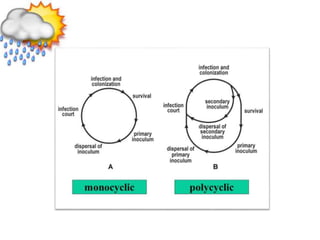
Monocyclic
Polycyclic
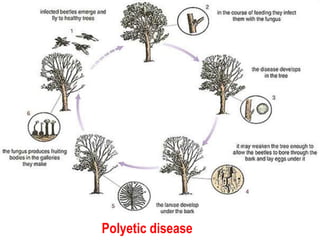
Polyetic
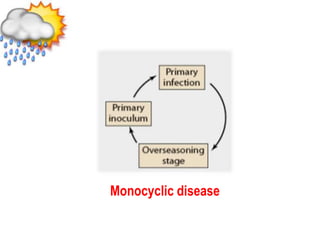
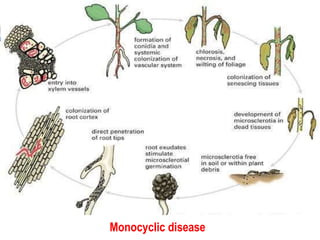
Monocyclic diseases :
 Pathogen completes just one cycle per season
 Primary inoculum is the only inoculum available for entire
season
 No secondary inoculum and infection
Monocyclic disease
 Pathogen has low birth rate and death rate
 No or low dispersal rate
 Soil borne diseases are typically monocyclic
Cotton wilt
Tomato wilt
 Amount of disease may slowly increase from year to
year
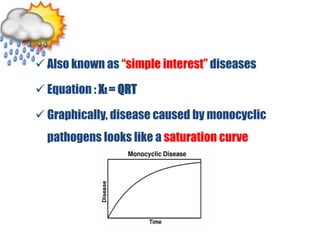
 Also known as “simple interest” diseases
 Equation : Xt = QRT
 Graphically, disease caused by monocyclic
pathogens looks like a saturation curve
Monocyclic disease
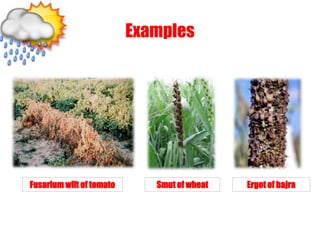
Examples
Fusarium wilt of tomato Smut of wheat Ergot of bajra
Polycyclic disease :
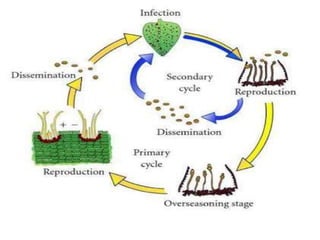
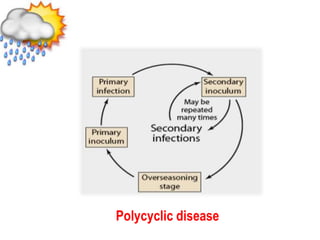
Pathogen completes several infection cycles per
season
Primary inoculum consists of sexual spores or
sclerotia
Once after primary infection, large amount of
asexual spores will be produced at each
infection cycle, which can cause new infection
Polycyclic disease
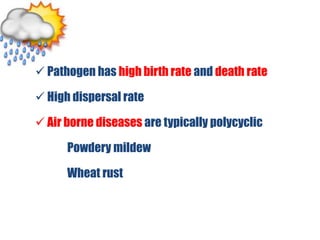
 Pathogen has high birth rate and death rate
 High dispersal rate
 Air borne diseases are typically polycyclic
Powdery mildew
Wheat rust
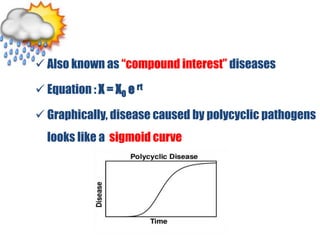
 Also known as “compound interest” diseases
 Equation : X = X0 e rt
 Graphically, disease caused by polycyclic pathogens
looks like a sigmoid curve
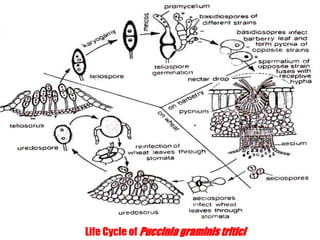
Life Cycle of Puccinia graminis tritici
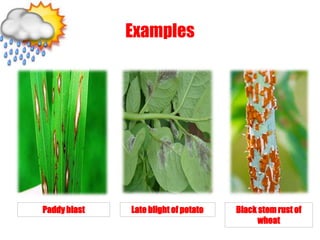
Examples
Paddy blast Late blight of potato Black stemrust of
wheat
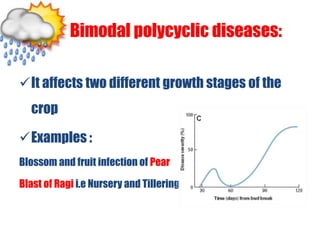
Bimodal polycyclic diseases:
It affects two different growth stages of the
crop
Examples :
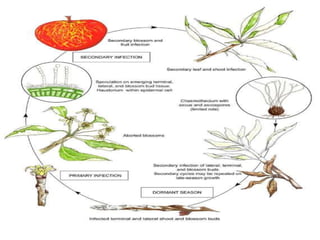
Blossom and fruit infection of Pear
Blast of Ragi i.e Nursery and Tillering
Polyetic disease :
 Some pathogens take several years to produce the
inoculum
 May not cause new infections in a year
 Amount of inoculum does not increase greatly within a
year
 Inoculum may increase steadily from year to year and
cause severe outbreaks
Also, known as “multiyear disease”
It is monocyclic disease over years
Pathogen survives on perennial hosts like
trees
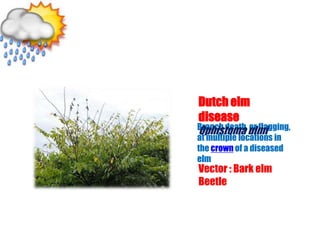
Polyetic disease
Branch death, or flagging,
at multiple locations in
the crown of a diseased
elm
Dutch elm
disease
Ophistoma ulmi
Vector : Bark elm
Beetle
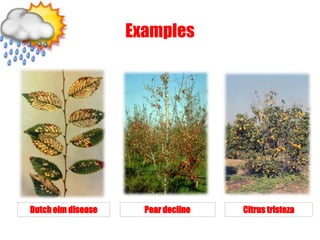
Examples
Dutch elm disease Pear decline Citrus tristeza
Conclusion
References :
Wikipedia
https://www.apsnet.org/edcenter/advanced/
topics
Plant disease Epidemiology
Subhashini sinha
Manjula varma
TYPES OF epidemiology

TYPES OF epidemiology