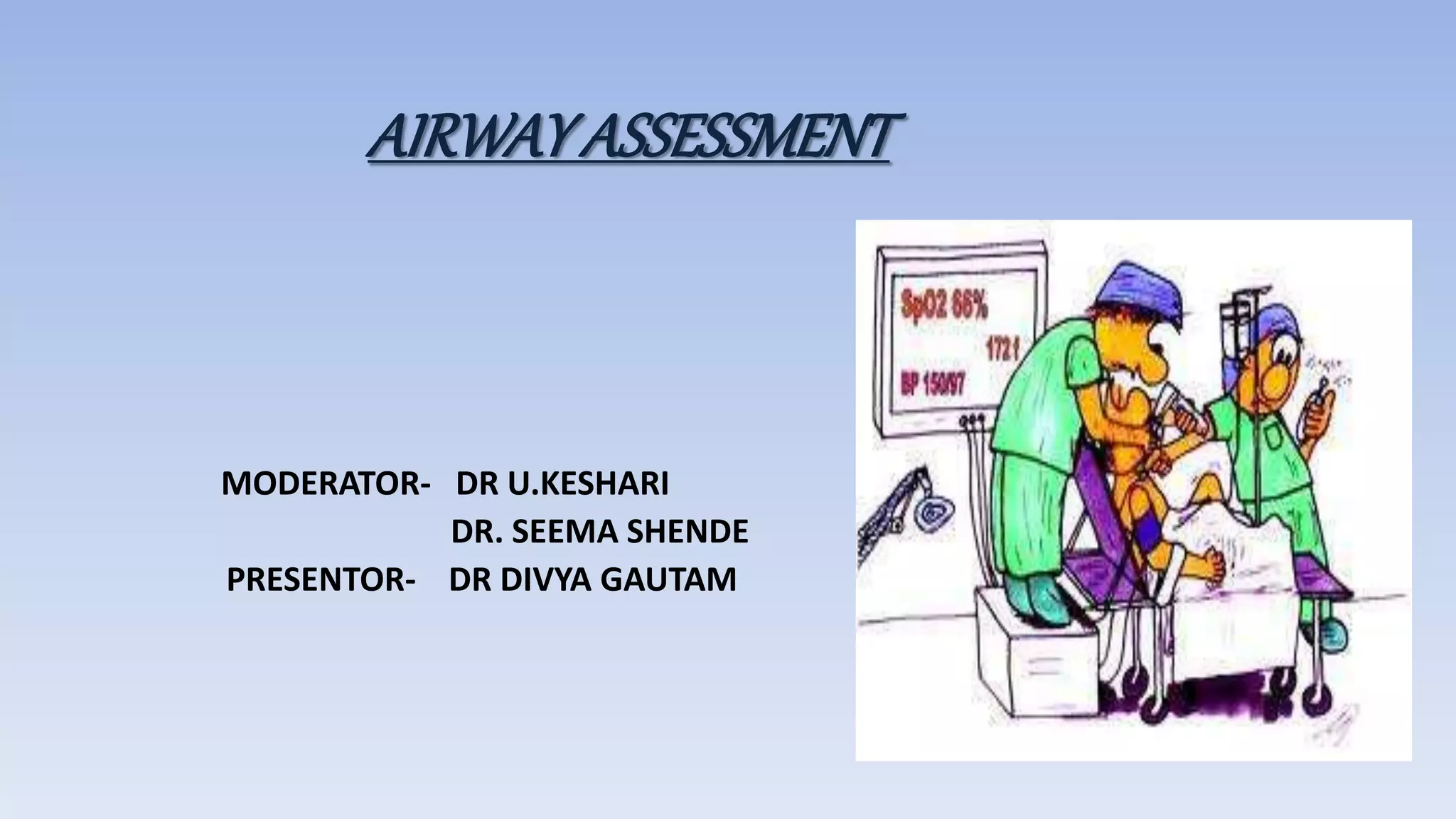
AIRWAYASSESSMENT
MODERATOR- DR U.KESHARI
DR. SEEMA SHENDE
PRESENTOR- DR DIVYA GAUTAM
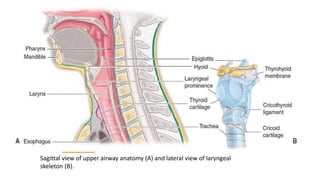
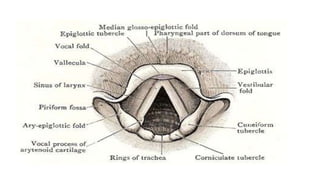
Sagittal view of upper airway anatomy (A) and lateral view of laryngeal
skeleton (B).
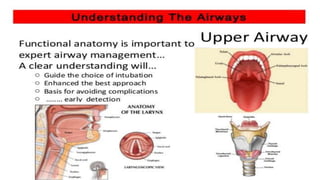
Anatomy:
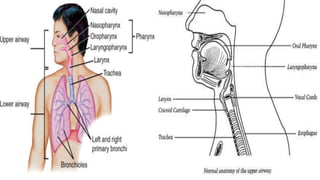
PARTS OF AIRWAY
Upper Airway:
a. Mouth- opening of oral cavity to anterior tonsillar pillar.
b. Nostrils- adult nose= anterior posterior diameter 1.5-2 cm
transverse diameter 0.5-1cm
c. Nasal Cavity- from nares to the end of the turbinates.
d. Nasopharynx- extends from posterior end of turbinates to the
posterior pharyngeal wall above the soft palate and consists of
the nasal cavity , septum, turbinates and adenoids.
Oropharynx- extends from soft palate above to epiglottis below and anteriorly from
anterior tonsillar pillar to posterior pharyngeal wall , it includes tonsil,uvula and the
epiglottis.
Pharynx-The pharynx is a U-shaped fibromuscular tube that extends from the base of
the skull to the cricoid cartilage. It is bounded anteriorly and superiorly by the nasal
cavity, followed more inferiorly by the mouth, and then the larynx. These borders divide
the pharynx into the nasopharynx, oropharynx, and laryngopharynx, respectively.
Larynx- extends form laryngeal inlet i.e C3-C4 to lower border of cricoid cartilage (C5-
C6)-[ Importance :Phonation and Swallowing ]
Contents :
Unpaired Cartilage = Thyroid , Cricoid and Epiglottis ,
Paired =Arytenoid , Corniculate and Cuneiform (most vulnerable area for obstruction
and trauma during laryngoscopy)
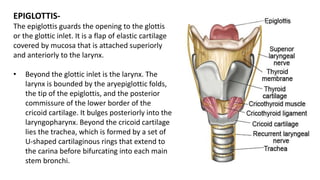
EPIGLOTTIS-
The epiglottis guards the opening to the glottis
or the glottic inlet. It is a flap of elastic cartilage
covered by mucosa that is attached superiorly
and anteriorly to the larynx.
• Beyond the glottic inlet is the larynx. The
larynx is bounded by the aryepiglottic folds,
the tip of the epiglottis, and the posterior
commissure of the lower border of the
cricoid cartilage. It bulges posteriorly into the
laryngopharynx. Beyond the cricoid cartilage
lies the trachea, which is formed by a set of
U-shaped cartilaginous rings that extend to
the carina before bifurcating into each main
stem bronchi.
Lower Airway :
a. Trachea :
extends from lower border of cricoid C6 to its division into the two main
bronchi i.e till T4 it is 11-13 cm long .(Importance : Endotracheal tube
lodges in the mid trachea)
b. Bronchi and Bronchioles : Made up of fibrocartilage and has
secretory bronchial gland cells. Constitutes 25% of volume of conducting
airways.
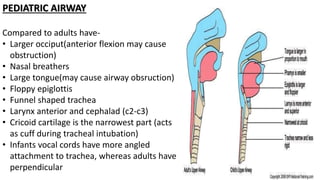
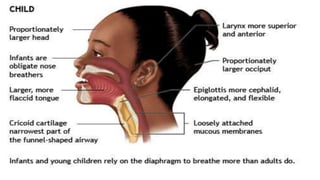
PEDIATRIC AIRWAY
Compared to adults have-
• Larger occiput(anterior flexion may cause
obstruction)
• Nasal breathers
• Large tongue(may cause airway obsruction)
• Floppy epiglottis
• Funnel shaped trachea
• Larynx anterior and cephalad (c2-c3)
• Cricoid cartilage is the narrowest part (acts
as cuff during tracheal intubation)
• Infants vocal cords have more angled
attachment to trachea, whereas adults have
perpendicular
Respiratory events are the most common anaesthetic
related injuries, following dental damage. Three main
causes:
- Inadequate ventilation
-Oesophageal intubation
-Difficult tracheal intubation
• Difficult tracheal intubation accounts for 17% of the
respiratory related injuries and results in significant morbidity
and mortality.
 Prediction of the difficult airway allows time for proper selection of
equipment, technique and personnel experienced in difficult airways
DIFFICULT MASK VENTILATION
• It is not possible for the unassisted anesthesiologist to
maintain SPO2>90% using 100% O2 and positive pressure mask
ventilation in a patient whose SPO2 was > 90% before
anesthetic intervention
and /0r
• It is not possible for the unassisted anesthesiologist to prevent
or reverse signs of inadequate ventilation during positive
pressure mask ventilation
BEST/OPTIMAL ATTEMPT LARYNGOSCOPY
“Laryngoscopy performed by a reasonably experienced
laryngoscopist with a patient in optimal sniff position having no
significant muscle tone and the laryngoscopist has an option of
change of blade type and length(one time each).”
SENSITIVITY- defined as “the percentage of correctly predicted
difficult intubations as a proportion of all intubations that were
truly difficult
(Sensitivity=true positives/true positive +false positives)
SPECIFICITY- defined as” the percentage of correctly predicted easy
intubations as a proportion of all intubations that were truly easy.
(Specificity= true negatives/true negatives+ false positives)
PREVALENCE
Difficult face mask- 0.1% - 5%
Difficult LMA- 0.2% - 1%
Difficult intubation
◦ 1-2% of normal surgical population
◦ 50% of rheumatic cervical disease
The purpose of airway assessment is to diagnose the potential
for difficult airway for:
• Optimal patient preparation
• Proper selection of equipment and technique
• Participation of personel experienced in difficult airway
management
Factors predisposing Difficult Airway:
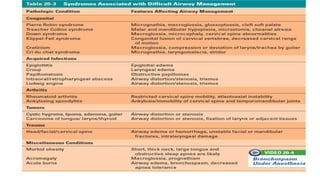
Congenital:
1.Pierre Robin Syndrome
2.Treacher Collins Syndrome
3.Downs Syndrome
4.Kippel Feil Syndrome
5.Goitre
Acquired:
Infections- Supraglottis, Croup, Abcess,
Ludwig’s Angina,
Sub Mucus Oral Fibrosis
-Arthritis:
• Rheumatoid arthritis
• Ankylosing Spondylitis
-Benign Tumor:
• Cystic Hygroma
• Lipoma
• Adenoma
-Malignant Tumor:
-Facial Injury
-Cervical Spine Injury
-Laryngeal/Tracheal Trauma
-Obesity
-Acromegaly
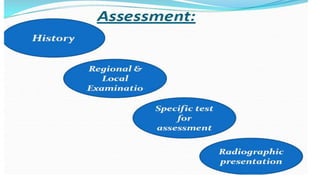
ASSESSMENT OF THE AIRWAY
• To identify areas of difficulty that may be encountered during
management of patients airway
• To formulate a strategy based on available resources and
expertise
• This involves focussed history, focussed general
examination and airway examination following line of sight
approach.
• History
patient notes /chart/ medic alert
• Surgery /burns
• Concurrent disease
• Reflex disease/recent meals
General examination
• Dentition[pominent upper incisors,receding chin]
• Distortion[ edema,blood,vomit,tumor,inection]
• Disproportion[short chin-to-larynx distance, bull neck,large tongue, small mouth]
• Dysmobility[TMJ and cervical spine]
• Massively obese or pregnant
• beards/tubes
Specific tests/indices
Investigations
• Nasoendoscopy/FLUROSCOPY
• X-ray, CT/MRI/USG
• Flow volume loop
Focused general physical examination
• General examination is done like assessing consciousness, gait,
posture, obesity ,pregnancy , listening to voice quality,
breathlessness on first approaching the patient.
Airway evaluation has 4 basic categories:
• 1)evaluation of tongue size relative to pharynx
• 2)Mandibular space
• 3)Assesment of glottic opening
• 4) Mobility of joints
• CAUSES OF DIFFICULT AIRWAY
• Stiffness
• arthritis of neck/jaw/larynx
• fixation devices
• scleroderma
• diabetes
• DEFORMITY
• cervical and craniofacial SWELLING
• Infections/trauma/tumor/burns
• Anaphylaxis/haematoma
• Acromegaly
REFLEXES
• cough/breath holding
• laryngospasm/regurgitation
salivation
• FOREIGN BODY
• OTHER -PREGNANCY,FULL
STOMACH
1.History:
Should be conducted when ever its feasible i.e. before
the initiation of anaesthetic care and airway
management in order to:
- Detect any medical, surgical and anaesthetic factors.
- Examination of previous medical records if available
2) General, Physical and regional Examination:
a.Patency of nares- tested by fogging test
b.Mouth Opening
c.Teeth: Look for Prominent upper Incisors, Canines
with or without over biting or edentulous state.
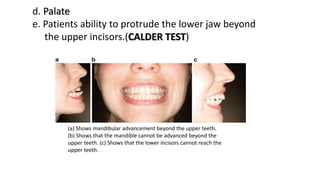
d. Palate
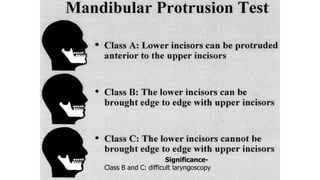
e. Patients ability to protrude the lower jaw beyond
the upper incisors.(CALDER TEST)
(a) Shows mandibular advancement beyond the upper teeth.
(b) Shows that the mandible cannot be advanced beyond the
upper teeth. (c) Shows that the lower incisors cannot reach the
upper teeth.
f. Temporo-mandibular joint movement: restricted in ankylosis,
tumors, fibrosis etc.
g. Measurement of Submental Space: atleast > 6cm
h. Patient’s Neck: For Sniffing Position i.e. ideal position for
intubation. Look for:
• Short Neck,Thick neck
• Mass present in the neck
• Extension of neck, Mobility of neck
i. Presence of Stridor/Hoarse voice or previous Tracheostomy may
suggest Stenosis
j. Systemic or Congenital Diseases
k. Infection of Airway
l. Physiologic Conditions: Pregnancy or Obesity
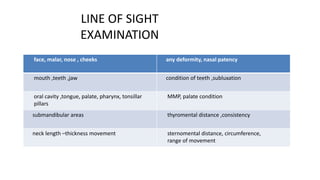
LINE OF SIGHT
EXAMINATION
face, malar, nose , cheeks any deformity, nasal patency
mouth ,teeth ,jaw condition of teeth ,subluxation
oral cavity ,tongue, palate, pharynx, tonsillar
pillars
MMP, palate condition
submandibular areas thyromental distance ,consistency
neck length –thickness movement sternomental distance, circumference,
range of movement
AIRWAY ASSESSMENT CHART
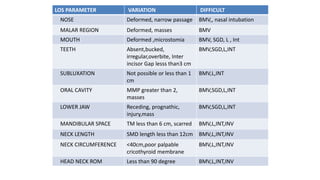
LOS PARAMETER VARIATION DIFFICULT
NOSE Deformed, narrow passage BMV,, nasal intubation
MALAR REGION Deformed, masses BMV
MOUTH Deformed ,microstomia BMV, SGD, L , Int
TEETH Absent,bucked,
irregular,overbite, Inter
incisor Gap lesss than3 cm
BMV,SGD,L,INT
SUBLUXATION Not possible or less than 1
cm
BMV,L,INT
ORAL CAVITY MMP greater than 2,
masses
BMV,SGD,L,INT
LOWER JAW Receding, prognathic,
injury,mass
BMV,SGD,L,INT
MANDIBULAR SPACE TM less than 6 cm, scarred BMV,L,INT,INV
NECK LENGTH SMD length less than 12cm BMV,L,INT,INV
NECK CIRCUMFERENCE <40cm,poor palpable
cricothyroid membrane
BMV,L,INT,INV
HEAD NECK ROM Less than 90 degree BMV,L,INT,INV
3. Specific tests for Assessment
A. Anatomical Criteria
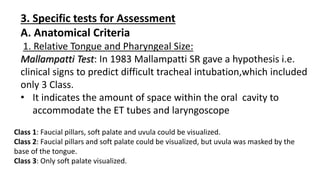
1. Relative Tongue and Pharyngeal Size:
Mallampatti Test: In 1983 Mallampatti SR gave a hypothesis i.e.
clinical signs to predict difficult tracheal intubation,which included
only 3 Class.
• It indicates the amount of space within the oral cavity to
accommodate the ET tubes and laryngoscope
Class 1: Faucial pillars, soft palate and uvula could be visualized.
Class 2: Faucial pillars and soft palate could be visualized, but uvula was masked by the
base of the tongue.
Class 3: Only soft palate visualized.
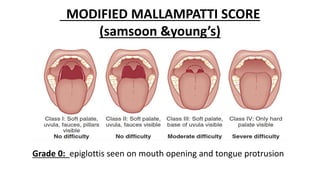
MODIFIED MALLAMPATTI SCORE
(samsoon &young’s)
Grade 0: epiglottis seen on mouth opening and tongue protrusion
• The assessment is performed with the patient sitting up straight,
mouth open and tongue maximally protruded, without speaking or
saying “ahh”, which lowers the grade by one step.
• Ensure the patient is sitting with head protruding forward, mimiking
the sniffing position.
• The observer’s eye should be at the level of patient’s open mouth.
EXTENDED MALLAMPATTI SCORE-
Mallampatti scoring done in full extended head position(craniocervical
extension)
It improves specificity and predictive value of evaluation.
SIGNIFICANCE OF MMP SCORE
 Class III or IV: signifies that the angle between the base of tongue
and laryngeal inlet is more
 acute and not conducive for easy laryngoscopy
 Note: To avoid false positive or false negative, this test should be
repeated twice
Limitations
o Poor interobserver reliability
o Limited accuracy
o Good predictor in pregnancy, obesity, acromegaly
Evaluation of submandibular space
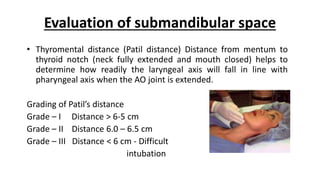
• Thyromental distance (Patil distance) Distance from mentum to
thyroid notch (neck fully extended and mouth closed) helps to
determine how readily the laryngeal axis will fall in line with
pharyngeal axis when the AO joint is extended.
Grading of Patil’s distance
Grade – I Distance > 6-5 cm
Grade – II Distance 6.0 – 6.5 cm
Grade – III Distance < 6 cm - Difficult
intubation
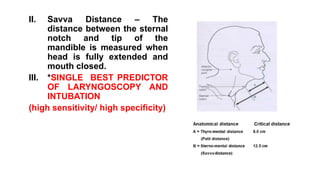
II. Savva Distance – The
distance between the sternal
notch and tip of the
mandible is measured when
head is fully extended and
mouth closed.
III. *SINGLE BEST PREDICTOR
OF LARYNGOSCOPY AND
INTUBATION
(high sensitivity/ high specificity)
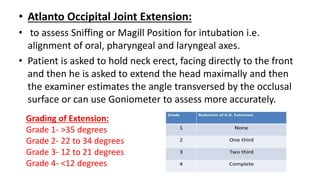
• Atlanto Occipital Joint Extension:
• to assess Sniffing or Magill Position for intubation i.e.
alignment of oral, pharyngeal and laryngeal axes.
• Patient is asked to hold neck erect, facing directly to the front
and then he is asked to extend the head maximally and then
the examiner estimates the angle transversed by the occlusal
surface or can use Goniometer to assess more accurately.
Grading of Extension:
Grade 1- >35 degrees
Grade 2- 22 to 34 degrees
Grade 3- 12 to 21 degrees
Grade 4- <12 degrees
ASSESSMENT OF TMJ FUNCTION
• 1)SUBLUXATION OF TMJ-
• middle finger of each hand posterior and inferior to the
patient’s earlobes, place your index fingers just anterior to
the tragus and instruct the patient to open mouth widely
Two distinct movements should be felt:
• the first is rotational,& the second involves advancement
of the condylar head .
• Listen and palpate for clicks and crepitus, both of which
indicate joint dysfunction.
2) INTER-INCISOR GAP ( Admits 3 finger)-
• Distance between upper and lower incisors(Normal- 4-6cms )
Significance :
• Positive results: Easy insertion of a 3 cm deep flange of the
laryngoscope blade
• < 3 cm: difficult laryngoscopy
• < 2 cm: difficult LMA insertion
• Affected by TMJ and upper cervical spine mobility
UPPER LIP BITE /CATCH TEST
Class I: Lower incisors can bite the upper lip above
vermilion line
Class II: can bite the upper lip below vermilion line
Class III: cannot bite the upper lip
Significance
• Assessment of mandibular movement and dental Architecture
• Less inter observer variability
SYMMETRY OF UPPER AND LOWER FACE- If the lower face is longer
than the upper part of face, then some degree of difficulty in lining
up structures should be anticipated.
Significance-
Class B and C: difficult laryngoscopy
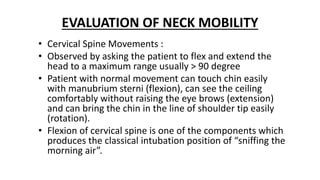
EVALUATION OF NECK MOBILITY
• Cervical Spine Movements :
• Observed by asking the patient to flex and extend the
head to a maximum range usually > 90 degree
• Patient with normal movement can touch chin easily
with manubrium sterni (flexion), can see the ceiling
comfortably without raising the eye brows (extension)
and can bring the chin in the line of shoulder tip easily
(rotation).
• Flexion of cervical spine is one of the components which
produces the classical intubation position of “sniffing the
morning air”.
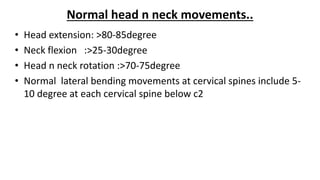
Normal head n neck movements..
• Head extension: >80-85degree
• Neck flexion :>25-30degree
• Head n neck rotation :>70-75degree
• Normal lateral bending movements at cervical spines include 5-
10 degree at each cervical spine below c2
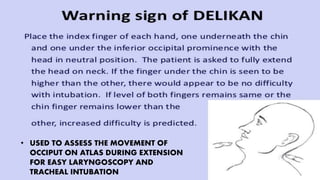
• USED TO ASSESS THE MOVEMENT OF
OCCIPUT ON ATLAS DURING EXTENSION
FOR EASY LARYNGOSCOPY AND
TRACHEAL INTUBATION
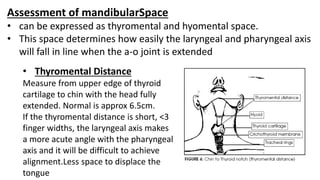
Assessment of mandibularSpace
• can be expressed as thyromental and hyomental space.
• This space determines how easily the laryngeal and pharyngeal axis
will fall in line when the a-o joint is extended
• Thyromental Distance
Measure from upper edge of thyroid
cartilage to chin with the head fully
extended. Normal is approx 6.5cm.
If the thyromental distance is short, <3
finger widths, the laryngeal axis makes
a more acute angle with the pharyngeal
axis and it will be difficult to achieve
alignment.Less space to displace the
tongue
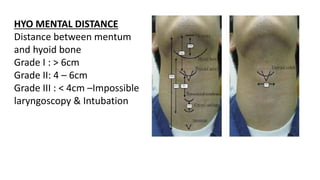
HYO MENTAL DISTANCE
Distance between mentum
and hyoid bone
Grade I : > 6cm
Grade II: 4 – 6cm
Grade III : < 4cm –Impossible
laryngoscopy & Intubation
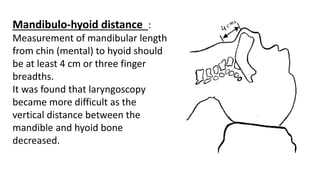
Mandibulo-hyoid distance :
Measurement of mandibular length
from chin (mental) to hyoid should
be at least 4 cm or three finger
breadths.
It was found that laryngoscopy
became more difficult as the
vertical distance between the
mandible and hyoid bone
decreased.
Quick airway assessment
1. Can the patient open the mouth widely?
- Indicative of TM joint movement.
2. Can the patient maximally protrude the tongue?
- Inspects posterior aspect of mouth/pharyngeal
structures.
3. Patient’s ability to move jaw forward?
- Indicates ease to manoeuver the laryngoscope.
4. Can patient fully bend/extend the head and move it
side wards?
- Indicates neck movements.
Assessment for quality of glottic viewing during laryngoscopy
Indirect mirror laryngoscopic view
Direct laryngoscopy awake look‘
-cormack and lehane grading
Grading ease of intubation
- POGO (percentage of glottic opening) scoring
INDIRECT MIRROR LARYNGOSCOPIC VIEW
GRADE1- COMPLETE VOCAL CORDS VISIBLE
GRADE2- POSTERIOR COMMISSURE VISIBLE
GRADE3- EPIGLOTTIS VISIBLE
GRADE4- NO GLOTTIC STRUCTURE VISIBLE
(CLOSELY RELATES TO CORMACK AND LEHANE’S VIEW)
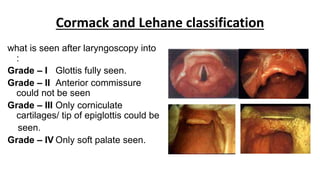
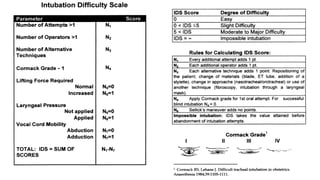
Cormack and Lehane classification
what is seen after laryngoscopy into
:
Grade – I Glottis fully seen.
Grade – II Anterior commissure
could not be seen
Grade – III Only corniculate
cartilages/ tip of epiglottis could be
seen.
Grade – IV Only soft palate seen.
GRADE LARYNGOSCOPIC VIEW WITH RIGID LARYNGOSCOPE
1 GLOTTIC OPENING CLEARLY VISUALIZED,POSTERIOR COMISSURE AND
ENTIRE LENGTH OF VOCAL CORDS SEEN
2A GLOTTIC OPENING PARTLY VISUALIZED,POSTERIOR COMISSURE AND
PART OF BOTH VOCAL CORD VISIBLE
2B POSTERIOR COMISSURE VISUALIZED BUT NO PORTION OF VOCAL
CORDS SEEN
3A ONLY EPIGLOTTIS VISUALIZED,LIFTABLE
3B ONLY EPIGLOTTIS VISUALIZED,NOT LIFTABLE
4 ONLY THE ROOT OF TONGUE VISUALIZED
COOK’S MODIFICATION OF CORMACK LEHANE GRADING
(1999)
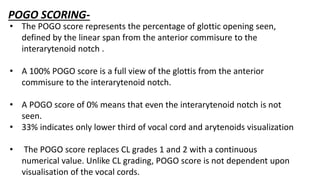
POGO SCORING-
• The POGO score represents the percentage of glottic opening seen,
defined by the linear span from the anterior commisure to the
interarytenoid notch .
• A 100% POGO score is a full view of the glottis from the anterior
commisure to the interarytenoid notch.
• A POGO score of 0% means that even the interarytenoid notch is not
seen.
• 33% indicates only lower third of vocal cord and arytenoids visualization
• The POGO score replaces CL grades 1 and 2 with a continuous
numerical value. Unlike CL grading, POGO score is not dependent upon
visualisation of the vocal cords.
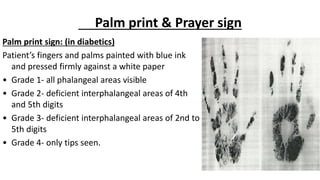
Palm print & Prayer sign
Palm print sign: (in diabetics)
Patient’s fingers and palms painted with blue ink
and pressed firmly against a white paper
• Grade 1- all phalangeal areas visible
• Grade 2- deficient interphalangeal areas of 4th
and 5th digits
• Grade 3- deficient interphalangeal areas of 2nd to
5th digits
• Grade 4- only tips seen.
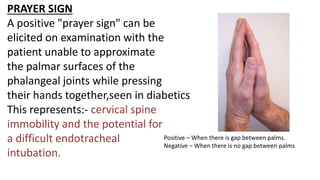
PRAYER SIGN
A positive "prayer sign" can be
elicited on examination with the
patient unable to approximate
the palmar surfaces of the
phalangeal joints while pressing
their hands together,seen in diabetics
This represents:- cervical spine
immobility and the potential for
a difficult endotracheal
intubation.
Positive – When there is gap between palms.
Negative – When there is no gap between palms
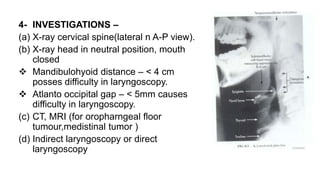
4- INVESTIGATIONS –
(a) X-ray cervical spine(lateral n A-P view).
(b) X-ray head in neutral position, mouth
closed
 Mandibulohyoid distance – < 4 cm
posses difficulty in laryngoscopy.
 Atlanto occipital gap – < 5mm causes
difficulty in laryngoscopy.
(c) CT, MRI (for oropharngeal floor
tumour,medistinal tumor )
(d) Indirect laryngoscopy or direct
laryngoscopy
OTHER TEST FOR
AIRWAY ASSESMENT
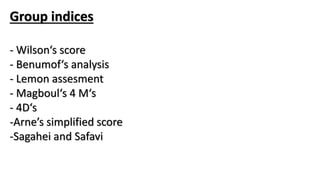
Group indices
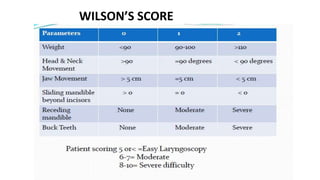
- Wilson‘s score
- Benumof‘s analysis
- Lemon assesment
- Magboul‘s 4 M‘s
- 4D‘s
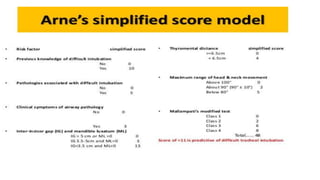
-Arne’s simplified score
-Sagahei and Safavi
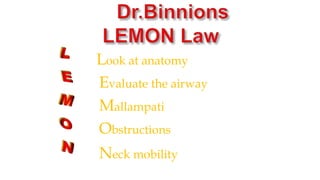
WILSON’S SCORE
Look at anatomy
Evaluate the airway
Mallampati
Obstructions
Neck mobility
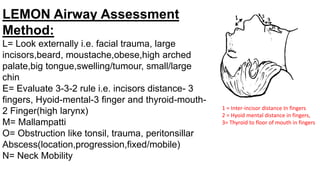
LEMON Airway Assessment
Method:
L= Look externally i.e. facial trauma, large
incisors,beard, moustache,obese,high arched
palate,big tongue,swelling/tumour, small/large
chin
E= Evaluate 3-3-2 rule i.e. incisors distance- 3
fingers, Hyoid-mental-3 finger and thyroid-mouth-
2 Finger(high larynx)
M= Mallampatti
O= Obstruction like tonsil, trauma, peritonsillar
Abscess(location,progression,fixed/mobile)
N= Neck Mobility
1 = Inter-incisor distance In fingers
2 = Hyoid mental distance in fingers,
3= Thyroid to floor of mouth in fingers
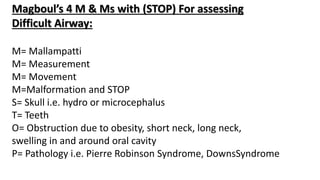
Magboul’s 4 M & Ms with (STOP) For assessing
Difficult Airway:
M= Mallampatti
M= Measurement
M= Movement
M=Malformation and STOP
S= Skull i.e. hydro or microcephalus
T= Teeth
O= Obstruction due to obesity, short neck, long neck,
swelling in and around oral cavity
P= Pathology i.e. Pierre Robinson Syndrome, DownsSyndrome
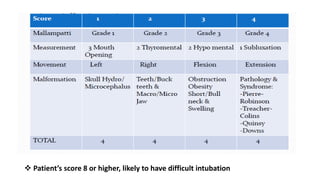
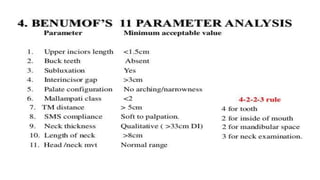
 Patient’s score 8 or higher, likely to have difficult intubation
- Weight > 80 kg
- T0ngue protrusion <3.2cm
- Mouth opening <5 cm
- Upper incisor length >1.5 cm
- Mallampati class >1
- Head extension < 70 degree
 Any 3 indices if present prolonged laryngoscopy
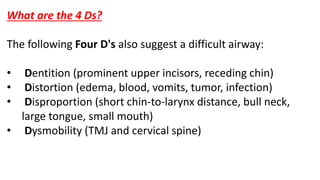
What are the 4 Ds?
The following Four D's also suggest a difficult airway:
• Dentition (prominent upper incisors, receding chin)
• Distortion (edema, blood, vomits, tumor, infection)
• Disproportion (short chin-to-larynx distance, bull neck,
large tongue, small mouth)
• Dysmobility (TMJ and cervical spine)
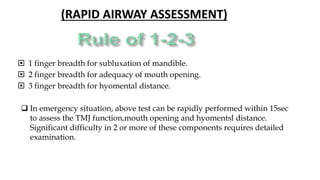
 1 finger breadth for subluxation of mandible.
 2 finger breadth for adequacy of mouth opening.
 3 finger breadth for hyomental distance.
 In emergency situation, above test can be rapidly performed within 15sec
to assess the TMJ function,mouth opening and hyomentsl distance.
Significant difficulty in 2 or more of these components requires detailed
examination.
(RAPID AIRWAY ASSESSMENT)
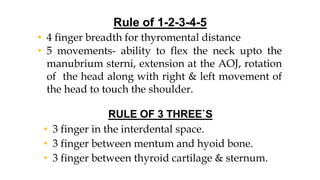
Rule of 1-2-3-4-5
• 4 finger breadth for thyromental distance
• 5 movements- ability to flex the neck upto the
manubrium sterni, extension at the AOJ, rotation
of the head along with right & left movement of
the head to touch the shoulder.
RULE OF 3 THREE`S
• 3 finger in the interdental space.
• 3 finger between mentum and hyoid bone.
• 3 finger between thyroid cartilage & sternum.
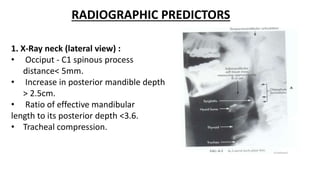
RADIOGRAPHIC PREDICTORS
1. X-Ray neck (lateral view) :
• Occiput - C1 spinous process
distance< 5mm.
• Increase in posterior mandible depth
> 2.5cm.
• Ratio of effective mandibular
length to its posterior depth <3.6.
• Tracheal compression.
i . Mandibulo-hyoid distance : An increase in the mandibulo-hyoid
distance resulted in an increase in difficult laryngoscopy.
i i . Atlanto-occipital gap : A-O gap is the major factor which limits the
extension of head on neck. Longer the A-O gap, more space is
available for mobility of head at that joint with good axis for
laryngoscopy and intubation. Radiologically there is reduced space
between C1 and occiput.
i i i . Relation of mandibular angle and hyoid bone with cervical
vertebra and laryngoscopy grading :
A definite increase in difficult laryngoscopy was observed when the
mandibular angle tended to be more rostral and hyoid bone to be
more caudal, position of mandibular angle being more important.
iv. Anterior/Posterior depth of the mandible :
White and Kander (1975)18 have shown that the posterior depth of the
mandible i.e, the distance between the bony alveolus immediately
behind the 3rd molar tooth and the lower border of the mandible is an
important measure In determining the ease or difficulty of
laryngoscopy.
v. C1-C2 gap
Calcified stylohyoid ligaments are manifested by crease over hyoid
bones on radiological examination. Laryngoscopy is difficult because of
inability to lift the epiglottis from posterior pharyngeal wall as it is
firmly attached to the hyoid bone by the hyo-epiglottic ligament.
2. CT Scan:
• Tumors of floor of mouth, pharynx, larynx
• Cervical spine trauma, inflammation
• Mediastinal mass
3. Helical CT (3D-reconstruction):
• Exact location and degree of airway compression
• Flow volume loop
• Acoustic response measurement
• Ultra sound guided
• CT / MRI
• Flexible bronchoscope
4. Ultrasound of the airway:
• to visualise anatomical structures in supraglottic, glottic and
subglottic region
• > 28 mm thickness of the pretracheal soft tissue & neck
circumference > 50 cm indicate difficult intubation
• Visualizes intra operative pnemothorax/locates cricothyroid
membrane.
Six basic problems
( 1) Difficulty with patient cooperation or consent,
(2) Difficult mask ventilation,
(3) Difficult SGA placement,
(4) Difficult laryngoscopy,
(5) Difficult intubation, and
(6) Difficult surgical airway access
Predictors of difficulty to face mask ventilate
1.The Obese (body mass index > 26 kg/m2)
2.The Bearded
3.The Elderly (older than 55 y)
4.The Snorers
5.The Edentulous
(=BONES)
Patients having 2 or more of above predictors likely to have
difficult mask ventilation
Predictors of difficulty to face mask ventilate (MOANS)
MOANS
This is identical to BONES except ‗M‘.
• -Mask seal difficult due to receding mandible, syndromes with
facial abnormalities, burn stricture etc.
• -Obesity, upper airway Obstruction
• -Advanced age
• -No teeth
• -Snorer
HAN’S SCALE OF DIFFICULT MASK VENTILATION
• Grade 1: ventilated by mask
• Grade2: ventilated by mask with oral/nasal airway with or without
muscle relaxants
• Grade 3: difficult ventilation with or without muscle relaxants
• Grade 4:unable to mask ventilate with or without relaxants
MIMS INDEX
• Male sex
• Increasing age
• Mallampatti class 4
• Snorers
RODS-
By HUNG &MURPHY (2004)
• FOR PREDICTING DIFFICULT PLACEMENT AND/OR SUBSEQUENT VENTILATION
WITH SUPRAGLOTTIC DEVICES
• RESTRICTED MOUTH OPENING
• OBSTRUCTION OF UPPER AIRWAY
• DISRUPTED UPPER AIRWAY(trauma/burn/mass)
• STIFF LUNG(poor compliance)
BANG-
MAY PREDICT DIFFICULTY IN PERFORMING SURGICAL AIRWAY
• B: BLEEDING TENDENCY(inherent/anticougulants)
• A: AGITATED PATIENT
• N: NECK DEFORMITY/SCARRING
• G: GROWTH/VASCULAR ABNORMALITY IN AREA OF SURGICAL AIRWAY
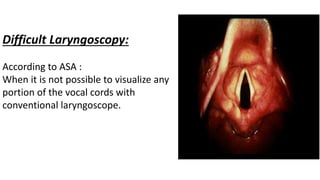
Difficult Laryngoscopy:
According to ASA :
When it is not possible to visualize any
portion of the vocal cords with
conventional laryngoscope.
Optimizing Laryngoscopy
• Optimum Positioning
• Optimum Use of Equipments
• Optimum Skill
• Strict Adherence to Guidelines
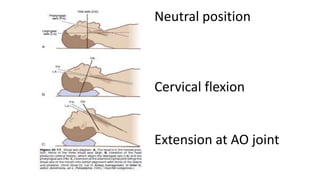
Positioning
• Bannister and Macbeth in 1944 proposed the classic model to describe anatomic
relationship necessary to achieve position for laryngoscopy
• It involves alignment of oral, pharyngeal and laryngeal axes which can be achieved
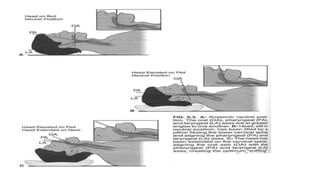
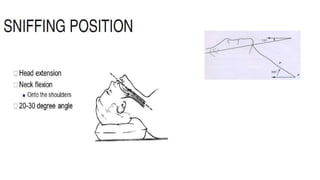
if the patient is placed in sniffing position.
• Cervical flexion aligns pharyngeal and laryngeal axes and maximal head extension at
the atlanto-occipital joint brings oral axis into alignment.
• 35 degree of cervical flexion can be achieved by 7-9cm elevation of head on a firm
cushion
• Obese patient need ramped position to achieve cervical position by using troop
elevation pillow(a device) or folded blankets.
• Horizontal aligment can be confirmed by aligning external auditory meatus and
sternal notch.
Neutral position
Cervical flexion
Extension at AO joint
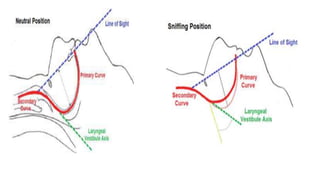
TWO CURVE THEORY
• The clinical application of the two-curve theory is best described
by separating direct laryngoscopy into a static and dynamic phase.
• The aim of the static phase of direct laryngoscopy is to orientate
the head and neck in the sniffing position so that the distance
between the vertex of the primary curve and the direct line of
sight is minimised. The dynamic phase of laryngoscopy involves
the use of a laryngoscope blade to compress and displace the
primary curve anterior to the line of sight, such that a direct view
of the glottis is procured.
• Subsequent tracheal intubation is facilitated by appropriate
positioning to flatten the secondary curve and align the line of
sight, laryngeal vestibule axis and the trachea
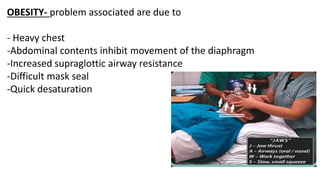
OBESITY- problem associated are due to
- Heavy chest
-Abdominal contents inhibit movement of the diaphragm
-Increased supraglottic airway resistance
-Difficult mask seal
-Quick desaturation
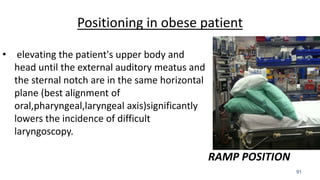
Positioning in obese patient
RAMP POSITION
91
• elevating the patient's upper body and
head until the external auditory meatus and
the sternal notch are in the same horizontal
plane (best alignment of
oral,pharyngeal,laryngeal axis)significantly
lowers the incidence of difficult
laryngoscopy.
Assessment of pediatric airway:
• Physical examination : It should focus on the anomalies of
face, head, neck and spine.
• Evaluate size and shape of head, gross features of the
face; size and symmetry of the mandible, presence of
sub-mandibular pathology, size of tongue, shape of palate,
prominence of upper incisors, range of motion of jaw, head
and neck.
• The presence of retractions-
(suprasternal/sternal/infrasternal/ intercostal) should be
sought for they usually are signs of airway obstruction.
• Breath sounds – Crowing on inspiration is indicative of
extrathoracic airway obstruction whereas, noise on exhalation
is usually due to intrathoracic lesions
• Noise on inspiration and expiration usually is due to lesion at
thoracic inlet.
• Obtaining blood gas and O2 saturation is important to
determine patient’s ability to compensate for airway problems.
• Transcutaneous CO2 determinations are very helpful in infants
and young children.
• JACKSONS POSITION- for intubation upto 8yrs of age
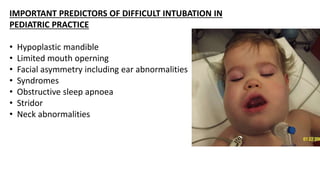
IMPORTANT PREDICTORS OF DIFFICULT INTUBATION IN
PEDIATRIC PRACTICE
• Hypoplastic mandible
• Limited mouth operning
• Facial asymmetry including ear abnormalities
• Syndromes
• Obstructive sleep apnoea
• Stridor
• Neck abnormalities
Several tests may be done to predict a difficult airway in children-
a. Plain radiography – For evaluation of nasopharynx, pharynx, subglottic lesion
and trachea.
b. CT scan and MRI can detect choanal atresia, lymphatic malformation of neck,
mediastinal masses etc.
c. Direct or indirect endoscopy of the upper and lower airway for functional
assessment and diagnosis of a pathology in nasopharynx, supraglottic, glottic
and subglottic areas.
d. Fluoroscopy – For assessment of dynamic pathology e.g. airway malacia
specially when stridor, cough and dysphagia are present.
e. USG studies – To assist in evaluation of functional and organic airway
disorders, assess the dynamic state of certain pathologies.
f. Pulmonary function studies can provide valuable information about patency
of airway passages
Airway assesment IN ANESTHESIA

Airway assesment IN ANESTHESIA

  • 1.
    AIRWAYASSESSMENT MODERATOR- DR U.KESHARI DR.SEEMA SHENDE PRESENTOR- DR DIVYA GAUTAM
  • 4.
    Sagittal view ofupper airway anatomy (A) and lateral view of laryngeal skeleton (B).
  • 5.
    Anatomy: PARTS OF AIRWAY UpperAirway: a. Mouth- opening of oral cavity to anterior tonsillar pillar. b. Nostrils- adult nose= anterior posterior diameter 1.5-2 cm transverse diameter 0.5-1cm c. Nasal Cavity- from nares to the end of the turbinates. d. Nasopharynx- extends from posterior end of turbinates to the posterior pharyngeal wall above the soft palate and consists of the nasal cavity , septum, turbinates and adenoids.
  • 6.
    Oropharynx- extends fromsoft palate above to epiglottis below and anteriorly from anterior tonsillar pillar to posterior pharyngeal wall , it includes tonsil,uvula and the epiglottis. Pharynx-The pharynx is a U-shaped fibromuscular tube that extends from the base of the skull to the cricoid cartilage. It is bounded anteriorly and superiorly by the nasal cavity, followed more inferiorly by the mouth, and then the larynx. These borders divide the pharynx into the nasopharynx, oropharynx, and laryngopharynx, respectively. Larynx- extends form laryngeal inlet i.e C3-C4 to lower border of cricoid cartilage (C5- C6)-[ Importance :Phonation and Swallowing ] Contents : Unpaired Cartilage = Thyroid , Cricoid and Epiglottis , Paired =Arytenoid , Corniculate and Cuneiform (most vulnerable area for obstruction and trauma during laryngoscopy)
  • 8.
    EPIGLOTTIS- The epiglottis guardsthe opening to the glottis or the glottic inlet. It is a flap of elastic cartilage covered by mucosa that is attached superiorly and anteriorly to the larynx. • Beyond the glottic inlet is the larynx. The larynx is bounded by the aryepiglottic folds, the tip of the epiglottis, and the posterior commissure of the lower border of the cricoid cartilage. It bulges posteriorly into the laryngopharynx. Beyond the cricoid cartilage lies the trachea, which is formed by a set of U-shaped cartilaginous rings that extend to the carina before bifurcating into each main stem bronchi.
  • 9.
    Lower Airway : a.Trachea : extends from lower border of cricoid C6 to its division into the two main bronchi i.e till T4 it is 11-13 cm long .(Importance : Endotracheal tube lodges in the mid trachea) b. Bronchi and Bronchioles : Made up of fibrocartilage and has secretory bronchial gland cells. Constitutes 25% of volume of conducting airways.
  • 10.
    PEDIATRIC AIRWAY Compared toadults have- • Larger occiput(anterior flexion may cause obstruction) • Nasal breathers • Large tongue(may cause airway obsruction) • Floppy epiglottis • Funnel shaped trachea • Larynx anterior and cephalad (c2-c3) • Cricoid cartilage is the narrowest part (acts as cuff during tracheal intubation) • Infants vocal cords have more angled attachment to trachea, whereas adults have perpendicular
  • 12.
    Respiratory events arethe most common anaesthetic related injuries, following dental damage. Three main causes: - Inadequate ventilation -Oesophageal intubation -Difficult tracheal intubation • Difficult tracheal intubation accounts for 17% of the respiratory related injuries and results in significant morbidity and mortality.  Prediction of the difficult airway allows time for proper selection of equipment, technique and personnel experienced in difficult airways
  • 14.
    DIFFICULT MASK VENTILATION •It is not possible for the unassisted anesthesiologist to maintain SPO2>90% using 100% O2 and positive pressure mask ventilation in a patient whose SPO2 was > 90% before anesthetic intervention and /0r • It is not possible for the unassisted anesthesiologist to prevent or reverse signs of inadequate ventilation during positive pressure mask ventilation
  • 16.
    BEST/OPTIMAL ATTEMPT LARYNGOSCOPY “Laryngoscopyperformed by a reasonably experienced laryngoscopist with a patient in optimal sniff position having no significant muscle tone and the laryngoscopist has an option of change of blade type and length(one time each).”
  • 17.
    SENSITIVITY- defined as“the percentage of correctly predicted difficult intubations as a proportion of all intubations that were truly difficult (Sensitivity=true positives/true positive +false positives) SPECIFICITY- defined as” the percentage of correctly predicted easy intubations as a proportion of all intubations that were truly easy. (Specificity= true negatives/true negatives+ false positives)
  • 18.
    PREVALENCE Difficult face mask-0.1% - 5% Difficult LMA- 0.2% - 1% Difficult intubation ◦ 1-2% of normal surgical population ◦ 50% of rheumatic cervical disease The purpose of airway assessment is to diagnose the potential for difficult airway for: • Optimal patient preparation • Proper selection of equipment and technique • Participation of personel experienced in difficult airway management
  • 20.
    Factors predisposing DifficultAirway: Congenital: 1.Pierre Robin Syndrome 2.Treacher Collins Syndrome 3.Downs Syndrome 4.Kippel Feil Syndrome 5.Goitre Acquired: Infections- Supraglottis, Croup, Abcess, Ludwig’s Angina, Sub Mucus Oral Fibrosis
  • 21.
    -Arthritis: • Rheumatoid arthritis •Ankylosing Spondylitis -Benign Tumor: • Cystic Hygroma • Lipoma • Adenoma -Malignant Tumor: -Facial Injury -Cervical Spine Injury -Laryngeal/Tracheal Trauma -Obesity -Acromegaly
  • 22.
    ASSESSMENT OF THEAIRWAY • To identify areas of difficulty that may be encountered during management of patients airway • To formulate a strategy based on available resources and expertise • This involves focussed history, focussed general examination and airway examination following line of sight approach.
  • 23.
    • History patient notes/chart/ medic alert • Surgery /burns • Concurrent disease • Reflex disease/recent meals General examination • Dentition[pominent upper incisors,receding chin] • Distortion[ edema,blood,vomit,tumor,inection] • Disproportion[short chin-to-larynx distance, bull neck,large tongue, small mouth] • Dysmobility[TMJ and cervical spine] • Massively obese or pregnant • beards/tubes Specific tests/indices Investigations • Nasoendoscopy/FLUROSCOPY • X-ray, CT/MRI/USG • Flow volume loop
  • 24.
    Focused general physicalexamination • General examination is done like assessing consciousness, gait, posture, obesity ,pregnancy , listening to voice quality, breathlessness on first approaching the patient. Airway evaluation has 4 basic categories: • 1)evaluation of tongue size relative to pharynx • 2)Mandibular space • 3)Assesment of glottic opening • 4) Mobility of joints
  • 25.
    • CAUSES OFDIFFICULT AIRWAY • Stiffness • arthritis of neck/jaw/larynx • fixation devices • scleroderma • diabetes • DEFORMITY • cervical and craniofacial SWELLING • Infections/trauma/tumor/burns • Anaphylaxis/haematoma • Acromegaly REFLEXES • cough/breath holding • laryngospasm/regurgitation salivation • FOREIGN BODY • OTHER -PREGNANCY,FULL STOMACH
  • 27.
    1.History: Should be conductedwhen ever its feasible i.e. before the initiation of anaesthetic care and airway management in order to: - Detect any medical, surgical and anaesthetic factors. - Examination of previous medical records if available 2) General, Physical and regional Examination: a.Patency of nares- tested by fogging test b.Mouth Opening c.Teeth: Look for Prominent upper Incisors, Canines with or without over biting or edentulous state.
  • 28.
    d. Palate e. Patientsability to protrude the lower jaw beyond the upper incisors.(CALDER TEST) (a) Shows mandibular advancement beyond the upper teeth. (b) Shows that the mandible cannot be advanced beyond the upper teeth. (c) Shows that the lower incisors cannot reach the upper teeth.
  • 29.
    f. Temporo-mandibular jointmovement: restricted in ankylosis, tumors, fibrosis etc. g. Measurement of Submental Space: atleast > 6cm h. Patient’s Neck: For Sniffing Position i.e. ideal position for intubation. Look for: • Short Neck,Thick neck • Mass present in the neck • Extension of neck, Mobility of neck i. Presence of Stridor/Hoarse voice or previous Tracheostomy may suggest Stenosis j. Systemic or Congenital Diseases k. Infection of Airway l. Physiologic Conditions: Pregnancy or Obesity
  • 30.
    LINE OF SIGHT EXAMINATION face,malar, nose , cheeks any deformity, nasal patency mouth ,teeth ,jaw condition of teeth ,subluxation oral cavity ,tongue, palate, pharynx, tonsillar pillars MMP, palate condition submandibular areas thyromental distance ,consistency neck length –thickness movement sternomental distance, circumference, range of movement
  • 31.
    AIRWAY ASSESSMENT CHART LOSPARAMETER VARIATION DIFFICULT NOSE Deformed, narrow passage BMV,, nasal intubation MALAR REGION Deformed, masses BMV MOUTH Deformed ,microstomia BMV, SGD, L , Int TEETH Absent,bucked, irregular,overbite, Inter incisor Gap lesss than3 cm BMV,SGD,L,INT SUBLUXATION Not possible or less than 1 cm BMV,L,INT ORAL CAVITY MMP greater than 2, masses BMV,SGD,L,INT LOWER JAW Receding, prognathic, injury,mass BMV,SGD,L,INT MANDIBULAR SPACE TM less than 6 cm, scarred BMV,L,INT,INV NECK LENGTH SMD length less than 12cm BMV,L,INT,INV NECK CIRCUMFERENCE <40cm,poor palpable cricothyroid membrane BMV,L,INT,INV HEAD NECK ROM Less than 90 degree BMV,L,INT,INV
  • 32.
    3. Specific testsfor Assessment A. Anatomical Criteria 1. Relative Tongue and Pharyngeal Size: Mallampatti Test: In 1983 Mallampatti SR gave a hypothesis i.e. clinical signs to predict difficult tracheal intubation,which included only 3 Class. • It indicates the amount of space within the oral cavity to accommodate the ET tubes and laryngoscope Class 1: Faucial pillars, soft palate and uvula could be visualized. Class 2: Faucial pillars and soft palate could be visualized, but uvula was masked by the base of the tongue. Class 3: Only soft palate visualized.
  • 33.
    MODIFIED MALLAMPATTI SCORE (samsoon&young’s) Grade 0: epiglottis seen on mouth opening and tongue protrusion
  • 34.
    • The assessmentis performed with the patient sitting up straight, mouth open and tongue maximally protruded, without speaking or saying “ahh”, which lowers the grade by one step. • Ensure the patient is sitting with head protruding forward, mimiking the sniffing position. • The observer’s eye should be at the level of patient’s open mouth. EXTENDED MALLAMPATTI SCORE- Mallampatti scoring done in full extended head position(craniocervical extension) It improves specificity and predictive value of evaluation.
  • 35.
    SIGNIFICANCE OF MMPSCORE  Class III or IV: signifies that the angle between the base of tongue and laryngeal inlet is more  acute and not conducive for easy laryngoscopy  Note: To avoid false positive or false negative, this test should be repeated twice Limitations o Poor interobserver reliability o Limited accuracy o Good predictor in pregnancy, obesity, acromegaly
  • 36.
    Evaluation of submandibularspace • Thyromental distance (Patil distance) Distance from mentum to thyroid notch (neck fully extended and mouth closed) helps to determine how readily the laryngeal axis will fall in line with pharyngeal axis when the AO joint is extended. Grading of Patil’s distance Grade – I Distance > 6-5 cm Grade – II Distance 6.0 – 6.5 cm Grade – III Distance < 6 cm - Difficult intubation
  • 37.
    II. Savva Distance– The distance between the sternal notch and tip of the mandible is measured when head is fully extended and mouth closed. III. *SINGLE BEST PREDICTOR OF LARYNGOSCOPY AND INTUBATION (high sensitivity/ high specificity)
  • 38.
    • Atlanto OccipitalJoint Extension: • to assess Sniffing or Magill Position for intubation i.e. alignment of oral, pharyngeal and laryngeal axes. • Patient is asked to hold neck erect, facing directly to the front and then he is asked to extend the head maximally and then the examiner estimates the angle transversed by the occlusal surface or can use Goniometer to assess more accurately. Grading of Extension: Grade 1- >35 degrees Grade 2- 22 to 34 degrees Grade 3- 12 to 21 degrees Grade 4- <12 degrees
  • 40.
    ASSESSMENT OF TMJFUNCTION • 1)SUBLUXATION OF TMJ- • middle finger of each hand posterior and inferior to the patient’s earlobes, place your index fingers just anterior to the tragus and instruct the patient to open mouth widely Two distinct movements should be felt: • the first is rotational,& the second involves advancement of the condylar head . • Listen and palpate for clicks and crepitus, both of which indicate joint dysfunction.
  • 41.
    2) INTER-INCISOR GAP( Admits 3 finger)- • Distance between upper and lower incisors(Normal- 4-6cms ) Significance : • Positive results: Easy insertion of a 3 cm deep flange of the laryngoscope blade • < 3 cm: difficult laryngoscopy • < 2 cm: difficult LMA insertion • Affected by TMJ and upper cervical spine mobility
  • 42.
    UPPER LIP BITE/CATCH TEST Class I: Lower incisors can bite the upper lip above vermilion line Class II: can bite the upper lip below vermilion line Class III: cannot bite the upper lip Significance • Assessment of mandibular movement and dental Architecture • Less inter observer variability SYMMETRY OF UPPER AND LOWER FACE- If the lower face is longer than the upper part of face, then some degree of difficulty in lining up structures should be anticipated.
  • 43.
    Significance- Class B andC: difficult laryngoscopy
  • 44.
    EVALUATION OF NECKMOBILITY • Cervical Spine Movements : • Observed by asking the patient to flex and extend the head to a maximum range usually > 90 degree • Patient with normal movement can touch chin easily with manubrium sterni (flexion), can see the ceiling comfortably without raising the eye brows (extension) and can bring the chin in the line of shoulder tip easily (rotation). • Flexion of cervical spine is one of the components which produces the classical intubation position of “sniffing the morning air”.
  • 45.
    Normal head nneck movements.. • Head extension: >80-85degree • Neck flexion :>25-30degree • Head n neck rotation :>70-75degree • Normal lateral bending movements at cervical spines include 5- 10 degree at each cervical spine below c2
  • 46.
    • USED TOASSESS THE MOVEMENT OF OCCIPUT ON ATLAS DURING EXTENSION FOR EASY LARYNGOSCOPY AND TRACHEAL INTUBATION
  • 47.
    Assessment of mandibularSpace •can be expressed as thyromental and hyomental space. • This space determines how easily the laryngeal and pharyngeal axis will fall in line when the a-o joint is extended • Thyromental Distance Measure from upper edge of thyroid cartilage to chin with the head fully extended. Normal is approx 6.5cm. If the thyromental distance is short, <3 finger widths, the laryngeal axis makes a more acute angle with the pharyngeal axis and it will be difficult to achieve alignment.Less space to displace the tongue
  • 48.
    HYO MENTAL DISTANCE Distancebetween mentum and hyoid bone Grade I : > 6cm Grade II: 4 – 6cm Grade III : < 4cm –Impossible laryngoscopy & Intubation
  • 49.
    Mandibulo-hyoid distance : Measurementof mandibular length from chin (mental) to hyoid should be at least 4 cm or three finger breadths. It was found that laryngoscopy became more difficult as the vertical distance between the mandible and hyoid bone decreased.
  • 50.
    Quick airway assessment 1.Can the patient open the mouth widely? - Indicative of TM joint movement. 2. Can the patient maximally protrude the tongue? - Inspects posterior aspect of mouth/pharyngeal structures. 3. Patient’s ability to move jaw forward? - Indicates ease to manoeuver the laryngoscope. 4. Can patient fully bend/extend the head and move it side wards? - Indicates neck movements.
  • 51.
    Assessment for qualityof glottic viewing during laryngoscopy Indirect mirror laryngoscopic view Direct laryngoscopy awake look‘ -cormack and lehane grading Grading ease of intubation - POGO (percentage of glottic opening) scoring
  • 52.
    INDIRECT MIRROR LARYNGOSCOPICVIEW GRADE1- COMPLETE VOCAL CORDS VISIBLE GRADE2- POSTERIOR COMMISSURE VISIBLE GRADE3- EPIGLOTTIS VISIBLE GRADE4- NO GLOTTIC STRUCTURE VISIBLE (CLOSELY RELATES TO CORMACK AND LEHANE’S VIEW)
  • 53.
    Cormack and Lehaneclassification what is seen after laryngoscopy into : Grade – I Glottis fully seen. Grade – II Anterior commissure could not be seen Grade – III Only corniculate cartilages/ tip of epiglottis could be seen. Grade – IV Only soft palate seen.
  • 54.
    GRADE LARYNGOSCOPIC VIEWWITH RIGID LARYNGOSCOPE 1 GLOTTIC OPENING CLEARLY VISUALIZED,POSTERIOR COMISSURE AND ENTIRE LENGTH OF VOCAL CORDS SEEN 2A GLOTTIC OPENING PARTLY VISUALIZED,POSTERIOR COMISSURE AND PART OF BOTH VOCAL CORD VISIBLE 2B POSTERIOR COMISSURE VISUALIZED BUT NO PORTION OF VOCAL CORDS SEEN 3A ONLY EPIGLOTTIS VISUALIZED,LIFTABLE 3B ONLY EPIGLOTTIS VISUALIZED,NOT LIFTABLE 4 ONLY THE ROOT OF TONGUE VISUALIZED COOK’S MODIFICATION OF CORMACK LEHANE GRADING (1999)
  • 55.
    POGO SCORING- • ThePOGO score represents the percentage of glottic opening seen, defined by the linear span from the anterior commisure to the interarytenoid notch . • A 100% POGO score is a full view of the glottis from the anterior commisure to the interarytenoid notch. • A POGO score of 0% means that even the interarytenoid notch is not seen. • 33% indicates only lower third of vocal cord and arytenoids visualization • The POGO score replaces CL grades 1 and 2 with a continuous numerical value. Unlike CL grading, POGO score is not dependent upon visualisation of the vocal cords.
  • 56.
    Palm print &Prayer sign Palm print sign: (in diabetics) Patient’s fingers and palms painted with blue ink and pressed firmly against a white paper • Grade 1- all phalangeal areas visible • Grade 2- deficient interphalangeal areas of 4th and 5th digits • Grade 3- deficient interphalangeal areas of 2nd to 5th digits • Grade 4- only tips seen.
  • 57.
    PRAYER SIGN A positive"prayer sign" can be elicited on examination with the patient unable to approximate the palmar surfaces of the phalangeal joints while pressing their hands together,seen in diabetics This represents:- cervical spine immobility and the potential for a difficult endotracheal intubation. Positive – When there is gap between palms. Negative – When there is no gap between palms
  • 58.
    4- INVESTIGATIONS – (a)X-ray cervical spine(lateral n A-P view). (b) X-ray head in neutral position, mouth closed  Mandibulohyoid distance – < 4 cm posses difficulty in laryngoscopy.  Atlanto occipital gap – < 5mm causes difficulty in laryngoscopy. (c) CT, MRI (for oropharngeal floor tumour,medistinal tumor ) (d) Indirect laryngoscopy or direct laryngoscopy
  • 59.
  • 60.
    Group indices - Wilson‘sscore - Benumof‘s analysis - Lemon assesment - Magboul‘s 4 M‘s - 4D‘s -Arne’s simplified score -Sagahei and Safavi
  • 61.
  • 63.
    Look at anatomy Evaluatethe airway Mallampati Obstructions Neck mobility
  • 64.
    LEMON Airway Assessment Method: L=Look externally i.e. facial trauma, large incisors,beard, moustache,obese,high arched palate,big tongue,swelling/tumour, small/large chin E= Evaluate 3-3-2 rule i.e. incisors distance- 3 fingers, Hyoid-mental-3 finger and thyroid-mouth- 2 Finger(high larynx) M= Mallampatti O= Obstruction like tonsil, trauma, peritonsillar Abscess(location,progression,fixed/mobile) N= Neck Mobility 1 = Inter-incisor distance In fingers 2 = Hyoid mental distance in fingers, 3= Thyroid to floor of mouth in fingers
  • 65.
    Magboul’s 4 M& Ms with (STOP) For assessing Difficult Airway: M= Mallampatti M= Measurement M= Movement M=Malformation and STOP S= Skull i.e. hydro or microcephalus T= Teeth O= Obstruction due to obesity, short neck, long neck, swelling in and around oral cavity P= Pathology i.e. Pierre Robinson Syndrome, DownsSyndrome
  • 66.
     Patient’s score8 or higher, likely to have difficult intubation
  • 68.
    - Weight >80 kg - T0ngue protrusion <3.2cm - Mouth opening <5 cm - Upper incisor length >1.5 cm - Mallampati class >1 - Head extension < 70 degree  Any 3 indices if present prolonged laryngoscopy
  • 69.
    What are the4 Ds? The following Four D's also suggest a difficult airway: • Dentition (prominent upper incisors, receding chin) • Distortion (edema, blood, vomits, tumor, infection) • Disproportion (short chin-to-larynx distance, bull neck, large tongue, small mouth) • Dysmobility (TMJ and cervical spine)
  • 70.
     1 fingerbreadth for subluxation of mandible.  2 finger breadth for adequacy of mouth opening.  3 finger breadth for hyomental distance.  In emergency situation, above test can be rapidly performed within 15sec to assess the TMJ function,mouth opening and hyomentsl distance. Significant difficulty in 2 or more of these components requires detailed examination. (RAPID AIRWAY ASSESSMENT)
  • 71.
    Rule of 1-2-3-4-5 •4 finger breadth for thyromental distance • 5 movements- ability to flex the neck upto the manubrium sterni, extension at the AOJ, rotation of the head along with right & left movement of the head to touch the shoulder. RULE OF 3 THREE`S • 3 finger in the interdental space. • 3 finger between mentum and hyoid bone. • 3 finger between thyroid cartilage & sternum.
  • 73.
    RADIOGRAPHIC PREDICTORS 1. X-Rayneck (lateral view) : • Occiput - C1 spinous process distance< 5mm. • Increase in posterior mandible depth > 2.5cm. • Ratio of effective mandibular length to its posterior depth <3.6. • Tracheal compression.
  • 74.
    i . Mandibulo-hyoiddistance : An increase in the mandibulo-hyoid distance resulted in an increase in difficult laryngoscopy. i i . Atlanto-occipital gap : A-O gap is the major factor which limits the extension of head on neck. Longer the A-O gap, more space is available for mobility of head at that joint with good axis for laryngoscopy and intubation. Radiologically there is reduced space between C1 and occiput. i i i . Relation of mandibular angle and hyoid bone with cervical vertebra and laryngoscopy grading : A definite increase in difficult laryngoscopy was observed when the mandibular angle tended to be more rostral and hyoid bone to be more caudal, position of mandibular angle being more important.
  • 75.
    iv. Anterior/Posterior depthof the mandible : White and Kander (1975)18 have shown that the posterior depth of the mandible i.e, the distance between the bony alveolus immediately behind the 3rd molar tooth and the lower border of the mandible is an important measure In determining the ease or difficulty of laryngoscopy. v. C1-C2 gap Calcified stylohyoid ligaments are manifested by crease over hyoid bones on radiological examination. Laryngoscopy is difficult because of inability to lift the epiglottis from posterior pharyngeal wall as it is firmly attached to the hyoid bone by the hyo-epiglottic ligament.
  • 76.
    2. CT Scan: •Tumors of floor of mouth, pharynx, larynx • Cervical spine trauma, inflammation • Mediastinal mass 3. Helical CT (3D-reconstruction): • Exact location and degree of airway compression • Flow volume loop • Acoustic response measurement • Ultra sound guided • CT / MRI • Flexible bronchoscope
  • 77.
    4. Ultrasound ofthe airway: • to visualise anatomical structures in supraglottic, glottic and subglottic region • > 28 mm thickness of the pretracheal soft tissue & neck circumference > 50 cm indicate difficult intubation • Visualizes intra operative pnemothorax/locates cricothyroid membrane.
  • 78.
    Six basic problems (1) Difficulty with patient cooperation or consent, (2) Difficult mask ventilation, (3) Difficult SGA placement, (4) Difficult laryngoscopy, (5) Difficult intubation, and (6) Difficult surgical airway access
  • 79.
    Predictors of difficultyto face mask ventilate 1.The Obese (body mass index > 26 kg/m2) 2.The Bearded 3.The Elderly (older than 55 y) 4.The Snorers 5.The Edentulous (=BONES) Patients having 2 or more of above predictors likely to have difficult mask ventilation
  • 80.
    Predictors of difficultyto face mask ventilate (MOANS) MOANS This is identical to BONES except ‗M‘. • -Mask seal difficult due to receding mandible, syndromes with facial abnormalities, burn stricture etc. • -Obesity, upper airway Obstruction • -Advanced age • -No teeth • -Snorer
  • 81.
    HAN’S SCALE OFDIFFICULT MASK VENTILATION • Grade 1: ventilated by mask • Grade2: ventilated by mask with oral/nasal airway with or without muscle relaxants • Grade 3: difficult ventilation with or without muscle relaxants • Grade 4:unable to mask ventilate with or without relaxants MIMS INDEX • Male sex • Increasing age • Mallampatti class 4 • Snorers
  • 82.
    RODS- By HUNG &MURPHY(2004) • FOR PREDICTING DIFFICULT PLACEMENT AND/OR SUBSEQUENT VENTILATION WITH SUPRAGLOTTIC DEVICES • RESTRICTED MOUTH OPENING • OBSTRUCTION OF UPPER AIRWAY • DISRUPTED UPPER AIRWAY(trauma/burn/mass) • STIFF LUNG(poor compliance) BANG- MAY PREDICT DIFFICULTY IN PERFORMING SURGICAL AIRWAY • B: BLEEDING TENDENCY(inherent/anticougulants) • A: AGITATED PATIENT • N: NECK DEFORMITY/SCARRING • G: GROWTH/VASCULAR ABNORMALITY IN AREA OF SURGICAL AIRWAY
  • 83.
    Difficult Laryngoscopy: According toASA : When it is not possible to visualize any portion of the vocal cords with conventional laryngoscope.
  • 84.
    Optimizing Laryngoscopy • OptimumPositioning • Optimum Use of Equipments • Optimum Skill • Strict Adherence to Guidelines
  • 85.
    Positioning • Bannister andMacbeth in 1944 proposed the classic model to describe anatomic relationship necessary to achieve position for laryngoscopy • It involves alignment of oral, pharyngeal and laryngeal axes which can be achieved if the patient is placed in sniffing position. • Cervical flexion aligns pharyngeal and laryngeal axes and maximal head extension at the atlanto-occipital joint brings oral axis into alignment. • 35 degree of cervical flexion can be achieved by 7-9cm elevation of head on a firm cushion • Obese patient need ramped position to achieve cervical position by using troop elevation pillow(a device) or folded blankets. • Horizontal aligment can be confirmed by aligning external auditory meatus and sternal notch.
  • 86.
  • 88.
    TWO CURVE THEORY •The clinical application of the two-curve theory is best described by separating direct laryngoscopy into a static and dynamic phase. • The aim of the static phase of direct laryngoscopy is to orientate the head and neck in the sniffing position so that the distance between the vertex of the primary curve and the direct line of sight is minimised. The dynamic phase of laryngoscopy involves the use of a laryngoscope blade to compress and displace the primary curve anterior to the line of sight, such that a direct view of the glottis is procured. • Subsequent tracheal intubation is facilitated by appropriate positioning to flatten the secondary curve and align the line of sight, laryngeal vestibule axis and the trachea
  • 90.
    OBESITY- problem associatedare due to - Heavy chest -Abdominal contents inhibit movement of the diaphragm -Increased supraglottic airway resistance -Difficult mask seal -Quick desaturation
  • 91.
    Positioning in obesepatient RAMP POSITION 91 • elevating the patient's upper body and head until the external auditory meatus and the sternal notch are in the same horizontal plane (best alignment of oral,pharyngeal,laryngeal axis)significantly lowers the incidence of difficult laryngoscopy.
  • 92.
    Assessment of pediatricairway: • Physical examination : It should focus on the anomalies of face, head, neck and spine. • Evaluate size and shape of head, gross features of the face; size and symmetry of the mandible, presence of sub-mandibular pathology, size of tongue, shape of palate, prominence of upper incisors, range of motion of jaw, head and neck. • The presence of retractions- (suprasternal/sternal/infrasternal/ intercostal) should be sought for they usually are signs of airway obstruction.
  • 93.
    • Breath sounds– Crowing on inspiration is indicative of extrathoracic airway obstruction whereas, noise on exhalation is usually due to intrathoracic lesions • Noise on inspiration and expiration usually is due to lesion at thoracic inlet. • Obtaining blood gas and O2 saturation is important to determine patient’s ability to compensate for airway problems. • Transcutaneous CO2 determinations are very helpful in infants and young children. • JACKSONS POSITION- for intubation upto 8yrs of age
  • 94.
    IMPORTANT PREDICTORS OFDIFFICULT INTUBATION IN PEDIATRIC PRACTICE • Hypoplastic mandible • Limited mouth operning • Facial asymmetry including ear abnormalities • Syndromes • Obstructive sleep apnoea • Stridor • Neck abnormalities
  • 95.
    Several tests maybe done to predict a difficult airway in children- a. Plain radiography – For evaluation of nasopharynx, pharynx, subglottic lesion and trachea. b. CT scan and MRI can detect choanal atresia, lymphatic malformation of neck, mediastinal masses etc. c. Direct or indirect endoscopy of the upper and lower airway for functional assessment and diagnosis of a pathology in nasopharynx, supraglottic, glottic and subglottic areas. d. Fluoroscopy – For assessment of dynamic pathology e.g. airway malacia specially when stridor, cough and dysphagia are present. e. USG studies – To assist in evaluation of functional and organic airway disorders, assess the dynamic state of certain pathologies. f. Pulmonary function studies can provide valuable information about patency of airway passages