Second order reaction
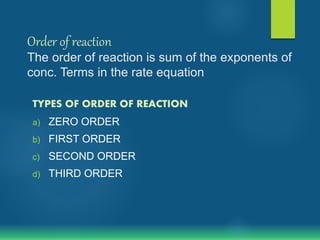
Order of reaction
The order of reaction is sum of the exponents of
conc. Terms in the rate equation
TYPES OF ORDER OF REACTION
a) ZERO ORDER
b) FIRST ORDER
c) SECOND ORDER
d) THIRD ORDER
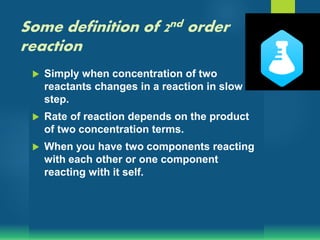
Some definition of 2nd order
reaction
 Simply when concentration of two
reactants changes in a reaction in slow
step.
 Rate of reaction depends on the product
of two concentration terms.
 When you have two components reacting
with each other or one component
reacting with it self.
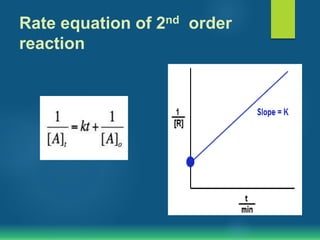
Rate equation of 2nd order
reaction
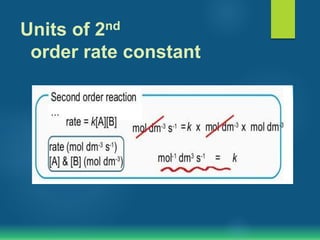
Units of 2nd
order rate constant
2nd order reaction with different initial
concentration of reactant
 Initial conc. of A and B are a and b and after time t
(a-x) and (b-x) are left , so
𝑑𝑥
𝑑𝑡
= 𝑘 𝐴 𝐵
𝑑𝑥
𝑑𝑡
= 𝑘 𝑎 − 𝑥 𝑏 − 𝑥
Then ,after integration
1
(𝑎−𝑏)
[ln
𝑏.(𝑎−𝑥)
𝑎.(𝑏−𝑥)
]= kt
2nd order reaction with equal
concentration of reactant
 Initial conc. of A and B are mole/dm-3 and after
time t (a-x) are left for both
𝑑𝑥
𝑑𝑡
= k [A][B]
𝑑𝑥
𝑑𝑡
= 𝑘 𝑎 − 𝑥 𝑎 − 𝑥
= k(𝑎 − 𝑥)2
Then, after integration
𝑥
𝑎(𝑎−𝑥)
= kt
Half life and second order
reaction
 If conc. Are same, then
 kt =
𝑥
𝑎(𝑎−𝑥)
t =
1
𝑘
.
when , x =
𝑎
2
𝑡ℎ𝑒𝑛, t=
𝑡
2
So, 𝑡2
1
=
1
𝑘
.
𝑎
2
𝑎(𝑎−
𝑎
2
)
[t1
2]2 =
1
𝑘𝑎
𝑥
𝑎(𝑎 − 𝑥)
The half life depends
on initial concentration
‘a’
If k and k’ are same
then order is second
Q.1.
One mole of ethyl acetate was hydrolyzed
with one mole of NaOH show that the
reaction is second order
T = 0 , 4 , 6
(a-x) = 8.04 , 5.3 , 4.58
K =
1
𝑡
.
𝑥
𝑎(𝑎−𝑥)
Examples of 2nd order reaction
 Hydrolysis of an ester by NaOH
Examples of 2nd order reaction
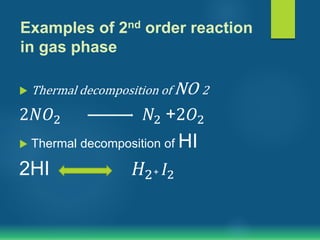
in gas phase
 Thermal decomposition of NO 2
2𝑁𝑂2 𝑁2 +2𝑂2
 Thermal decomposition of HI
2HI 𝐻2+ 𝐼2
Example of 2nd order reaction
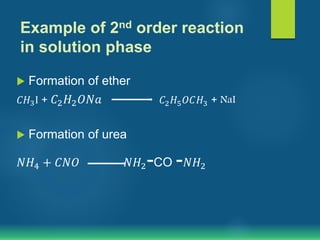
in solution phase
 Formation of ether
𝐶𝐻3I + 𝐶2 𝐻2 𝑂𝑁𝑎 𝐶2 𝐻5 𝑂𝐶𝐻3 + NaI
 Formation of urea
𝑁𝐻4 + 𝐶𝑁𝑂 𝑁𝐻2-CO - 𝑁𝐻2
2nd order reaction &
biological sciences
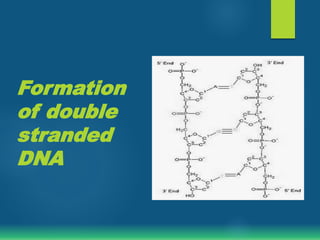
 Many important biological reactions, such
as the formation of double-stranded DNA
from two complementary strands, can be
described using second order kinetics.
Formation
of double
stranded
DNA
Thank you
Presented by
(2016-bs-008)
(2016-bs-011)
(2016-bs-020)
(2016-bs-022)

2nd order reaction

  • 1.
  • 2.
    Order of reaction Theorder of reaction is sum of the exponents of conc. Terms in the rate equation TYPES OF ORDER OF REACTION a) ZERO ORDER b) FIRST ORDER c) SECOND ORDER d) THIRD ORDER
  • 3.
    Some definition of2nd order reaction  Simply when concentration of two reactants changes in a reaction in slow step.  Rate of reaction depends on the product of two concentration terms.  When you have two components reacting with each other or one component reacting with it self.
  • 4.
    Rate equation of2nd order reaction
  • 5.
    Units of 2nd orderrate constant
  • 6.
    2nd order reactionwith different initial concentration of reactant  Initial conc. of A and B are a and b and after time t (a-x) and (b-x) are left , so 𝑑𝑥 𝑑𝑡 = 𝑘 𝐴 𝐵 𝑑𝑥 𝑑𝑡 = 𝑘 𝑎 − 𝑥 𝑏 − 𝑥 Then ,after integration 1 (𝑎−𝑏) [ln 𝑏.(𝑎−𝑥) 𝑎.(𝑏−𝑥) ]= kt
  • 7.
    2nd order reactionwith equal concentration of reactant  Initial conc. of A and B are mole/dm-3 and after time t (a-x) are left for both 𝑑𝑥 𝑑𝑡 = k [A][B] 𝑑𝑥 𝑑𝑡 = 𝑘 𝑎 − 𝑥 𝑎 − 𝑥 = k(𝑎 − 𝑥)2 Then, after integration 𝑥 𝑎(𝑎−𝑥) = kt
  • 8.
    Half life andsecond order reaction  If conc. Are same, then  kt = 𝑥 𝑎(𝑎−𝑥) t = 1 𝑘 . when , x = 𝑎 2 𝑡ℎ𝑒𝑛, t= 𝑡 2 So, 𝑡2 1 = 1 𝑘 . 𝑎 2 𝑎(𝑎− 𝑎 2 ) [t1 2]2 = 1 𝑘𝑎 𝑥 𝑎(𝑎 − 𝑥) The half life depends on initial concentration ‘a’ If k and k’ are same then order is second
  • 9.
    Q.1. One mole ofethyl acetate was hydrolyzed with one mole of NaOH show that the reaction is second order T = 0 , 4 , 6 (a-x) = 8.04 , 5.3 , 4.58 K = 1 𝑡 . 𝑥 𝑎(𝑎−𝑥)
  • 10.
    Examples of 2ndorder reaction  Hydrolysis of an ester by NaOH
  • 11.
    Examples of 2ndorder reaction in gas phase  Thermal decomposition of NO 2 2𝑁𝑂2 𝑁2 +2𝑂2  Thermal decomposition of HI 2HI 𝐻2+ 𝐼2
  • 12.
    Example of 2ndorder reaction in solution phase  Formation of ether 𝐶𝐻3I + 𝐶2 𝐻2 𝑂𝑁𝑎 𝐶2 𝐻5 𝑂𝐶𝐻3 + NaI  Formation of urea 𝑁𝐻4 + 𝐶𝑁𝑂 𝑁𝐻2-CO - 𝑁𝐻2
  • 13.
    2nd order reaction& biological sciences  Many important biological reactions, such as the formation of double-stranded DNA from two complementary strands, can be described using second order kinetics.
  • 14.
  • 15.