


Surgical Management on 
Complex Aortic Arch Pathology 
Dicky Aligheri, MD 
Cardiac & Vascular Surgeon 
National Cardiac & Vascular Centre Harapan Kita 
Jakarta 2014
• Disclosures : none
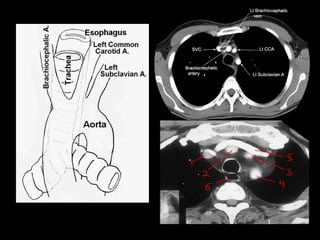
• Complex Aortic Arch Pathology 
– Mortality 
– Morbidity 
– Cost 
– Surgical skill 
When its involving the arch… its “complex” 
Bavaria, philadelphia 2013
• Complex Aortic Arch Pathology
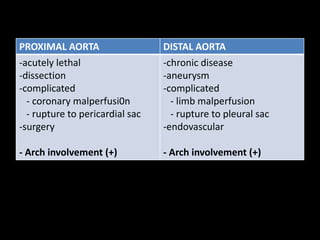
PROXIMAL AORTA DISTAL AORTA 
-acutely lethal 
-dissection 
-complicated 
- coronary malperfusi0n 
- rupture to pericardial sac 
-surgery 
- Arch involvement (+) 
-chronic disease 
-aneurysm 
-complicated 
- limb malperfusion 
- rupture to pleural sac 
-endovascular 
- Arch involvement (+)
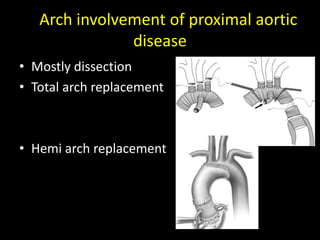
ArArch involvement of proximal aortic 
disease 
• Mostly dissection 
• Total arch replacement 
• Hemi arch replacement
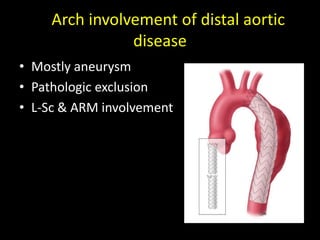
ArArch involvement of distal aortic 
disease 
• Mostly aneurysm 
• Pathologic exclusion 
• L-Sc & ARM involvement
Aortic Arch Surgery: Principles, Strategies and Outcomes. Edited By 
Joseph S. Coselli, Scott A. LeMaire. © 2008 Blackwell Publishing Ltd
5% 11% 0.7%
Aortic arch Surgery 
• Techniques 
– Conventional 
– Hybrid 
• Issues 
– Cerebral Protection 
– Hypothermic arrest 
– Intra operative monitoring 
– Elephant trunk & secondary procedures
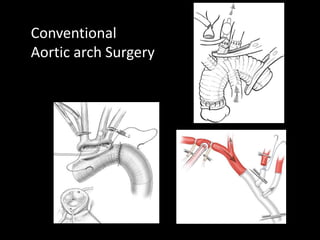
Conventional 
Aortic arch Surgery
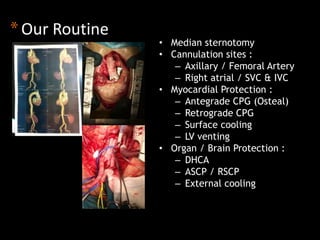
* Our Routine 
• Median sternotomy 
• Cannulation sites : 
– Axillary / Femoral Artery 
– Right atrial / SVC & IVC 
• Myocardial Protection : 
– Antegrade CPG (Osteal) 
– Retrograde CPG 
– Surface cooling 
– LV venting 
• Organ / Brain Protection : 
– DHCA 
– ASCP / RSCP 
– External cooling
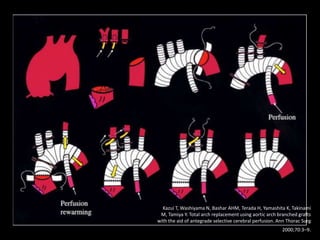
Kazui T, Washiyama N, Bashar AHM, Terada H, Yamashita K, Takinami 
M, Tamiya Y. Total arch replacement using aortic arch branched grafts 
with the aid of antegrade selective cerebral perfusion. Ann Thorac Surg 
2000;70:3–9.
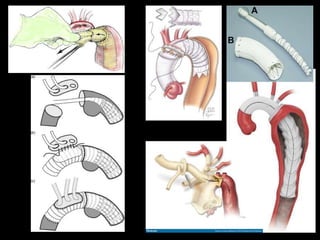
Antegrade selective cerebral perfusion
Retrograde Cerebral Perfusion
hYPOTHERMIC cIRCULATORY aRREST
Antegrade selective cerebral perfusion
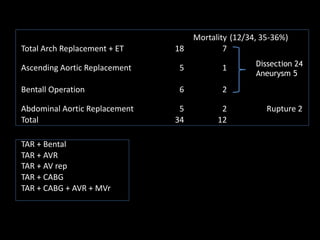
Mortality (12/34, 35-36%) 
Total Arch Replacement + ET 18 7 
Ascending Aortic Replacement 5 1 
Bentall Operation 6 2 
Abdominal Aortic Replacement 5 2 Rupture 2 
Total 34 12 
TAR + Bental 
TAR + AVR 
TAR + AV rep 
TAR + CABG 
TAR + CABG + AVR + MVr 
Dissection 24 
Aneurysm 5
Preoperative data 
No. of patients 29 
Mean age (years) 57.2 yo 
Median age (years) 59.7 yo 
Age range (years) 47 - 69 yo 
Age >65 years 1 
Sex (male/female) 15 / 14 
Ventilated 
preoperatively 2 
Aortic arch involvement 23 
Preoperative 
complications 
Myocardial ischemia 3 
Pericardial 
tamponade 2 
Hemodynamic 
instability 3 
Acute stroke 2 
Acute renal failure 1
Operative data 
R Axillary Artery involv 23 
Coronary artery 
involvement 3 
Cannulation sites 
Axillary artery 5 
Aortic arch 1 
CFA 23 
CPG Antegrade 16 
Retrograde 3 
A & Retrograde 10 
Type of cerebral perfusion 
Antegrade 16 97.4 min 22 - 202 min 
Retrograde 3 20.1 min 15 - 22 min 
Ante & Retro 10 
DHCA 29 116.1 min 34 - 214 min 
Temp 18 25 
Aortic valve intervention 6 3 R / 3 r 
Aortic root replacement 6 
Operative time 446 min 256 - 773min
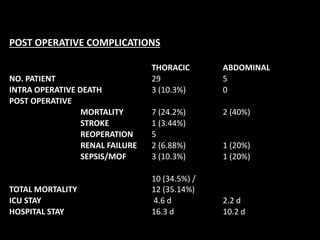
POST OPERATIVE COMPLICATIONS 
THORACIC ABDOMINAL 
NO. PATIENT 29 5 
INTRA OPERATIVE DEATH 3 (10.3%) 0 
POST OPERATIVE 
MORTALITY 7 (24.2%) 2 (40%) 
STROKE 1 (3.44%) 
REOPERATION 5 
RENAL FAILURE 2 (6.88%) 1 (20%) 
SEPSIS/MOF 3 (10.3%) 1 (20%) 
TOTAL MORTALITY 
10 (34.5%) / 
12 (35.14%) 
ICU STAY 4.6 d 2.2 d 
HOSPITAL STAY 16.3 d 10.2 d
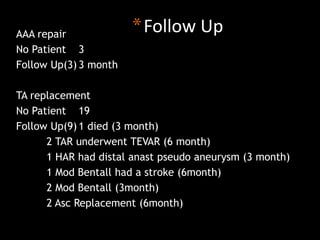
*Follow Up AAA repair 
No Patient 3 
Follow Up(3) 3 month 
TA replacement 
No Patient 19 
Follow Up(9) 1 died (3 month) 
2 TAR underwent TEVAR (6 month) 
1 HAR had distal anast pseudo aneurysm (3 month) 
1 Mod Bentall had a stroke (6month) 
2 Mod Bentall (3month) 
2 Asc Replacement (6month)
C A S E S 
• STRAIGHT FORWARD 
• COMPLICATED 
• COMPLICATION
Ann Cardiothorac Surg 2013;2(5):642-648
Ann Cardiothorac Surg 2013;2(3):247-260 
Ann Cardiothorac Surg 2013;2(5):642-648
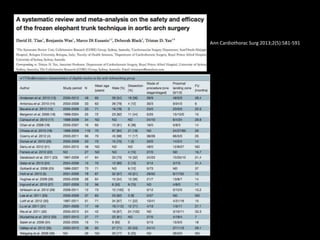
Ann Cardiothorac Surg 2013;2(5):581-591
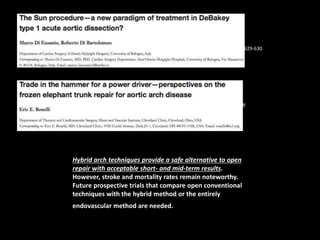
Ann Cardiothorac Surg 2013;2(5):629-630 
Ann Cardiothorac Surg 2013;2(5):633-639 
Hybrid arch techniques provide a safe alternative to open 
repair with acceptable short- and mid-term results. 
However, stroke and mortality rates remain noteworthy. 
Future prospective trials that compare open conventional 
techniques with the hybrid method or the entirely 
endovascular method are needed.
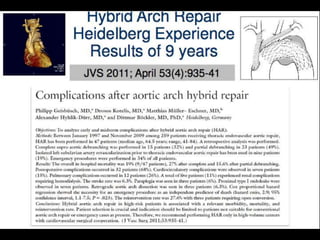
In summary, this study analyzed the mid-term results of endovascular repair of aortic arch aneurysm and dissection. 
The results are encouraging for endovascular aortic arch repair in combination with supra-aortic transposition in high 
risk cases. Combined treatment for high risk cases offers as good results as 
seen for conventional surgery for low risk patients.
Our Routine
Conclusions 
• Aortic arch surgery is the most challenging 
part. 
• Aortic arch should be considered in 
proximal/distal aortic procedures 
• Some advancement with few drawback
Thank you
Few tips
Complex Aortic Arch Surgery

Complex Aortic Arch Surgery

  • 1.
    Surgical Management on Complex Aortic Arch Pathology Dicky Aligheri, MD Cardiac & Vascular Surgeon National Cardiac & Vascular Centre Harapan Kita Jakarta 2014
  • 2.
  • 3.
    • Complex AorticArch Pathology – Mortality – Morbidity – Cost – Surgical skill When its involving the arch… its “complex” Bavaria, philadelphia 2013
  • 4.
    • Complex AorticArch Pathology
  • 5.
    PROXIMAL AORTA DISTALAORTA -acutely lethal -dissection -complicated - coronary malperfusi0n - rupture to pericardial sac -surgery - Arch involvement (+) -chronic disease -aneurysm -complicated - limb malperfusion - rupture to pleural sac -endovascular - Arch involvement (+)
  • 6.
    ArArch involvement ofproximal aortic disease • Mostly dissection • Total arch replacement • Hemi arch replacement
  • 8.
    ArArch involvement ofdistal aortic disease • Mostly aneurysm • Pathologic exclusion • L-Sc & ARM involvement
  • 9.
    Aortic Arch Surgery:Principles, Strategies and Outcomes. Edited By Joseph S. Coselli, Scott A. LeMaire. © 2008 Blackwell Publishing Ltd
  • 14.
  • 15.
    Aortic arch Surgery • Techniques – Conventional – Hybrid • Issues – Cerebral Protection – Hypothermic arrest – Intra operative monitoring – Elephant trunk & secondary procedures
  • 16.
  • 20.
    * Our Routine • Median sternotomy • Cannulation sites : – Axillary / Femoral Artery – Right atrial / SVC & IVC • Myocardial Protection : – Antegrade CPG (Osteal) – Retrograde CPG – Surface cooling – LV venting • Organ / Brain Protection : – DHCA – ASCP / RSCP – External cooling
  • 22.
    Kazui T, WashiyamaN, Bashar AHM, Terada H, Yamashita K, Takinami M, Tamiya Y. Total arch replacement using aortic arch branched grafts with the aid of antegrade selective cerebral perfusion. Ann Thorac Surg 2000;70:3–9.
  • 24.
  • 25.
  • 26.
  • 27.
  • 29.
    Mortality (12/34, 35-36%) Total Arch Replacement + ET 18 7 Ascending Aortic Replacement 5 1 Bentall Operation 6 2 Abdominal Aortic Replacement 5 2 Rupture 2 Total 34 12 TAR + Bental TAR + AVR TAR + AV rep TAR + CABG TAR + CABG + AVR + MVr Dissection 24 Aneurysm 5
  • 30.
    Preoperative data No.of patients 29 Mean age (years) 57.2 yo Median age (years) 59.7 yo Age range (years) 47 - 69 yo Age >65 years 1 Sex (male/female) 15 / 14 Ventilated preoperatively 2 Aortic arch involvement 23 Preoperative complications Myocardial ischemia 3 Pericardial tamponade 2 Hemodynamic instability 3 Acute stroke 2 Acute renal failure 1
  • 31.
    Operative data RAxillary Artery involv 23 Coronary artery involvement 3 Cannulation sites Axillary artery 5 Aortic arch 1 CFA 23 CPG Antegrade 16 Retrograde 3 A & Retrograde 10 Type of cerebral perfusion Antegrade 16 97.4 min 22 - 202 min Retrograde 3 20.1 min 15 - 22 min Ante & Retro 10 DHCA 29 116.1 min 34 - 214 min Temp 18 25 Aortic valve intervention 6 3 R / 3 r Aortic root replacement 6 Operative time 446 min 256 - 773min
  • 32.
    POST OPERATIVE COMPLICATIONS THORACIC ABDOMINAL NO. PATIENT 29 5 INTRA OPERATIVE DEATH 3 (10.3%) 0 POST OPERATIVE MORTALITY 7 (24.2%) 2 (40%) STROKE 1 (3.44%) REOPERATION 5 RENAL FAILURE 2 (6.88%) 1 (20%) SEPSIS/MOF 3 (10.3%) 1 (20%) TOTAL MORTALITY 10 (34.5%) / 12 (35.14%) ICU STAY 4.6 d 2.2 d HOSPITAL STAY 16.3 d 10.2 d
  • 33.
    *Follow Up AAArepair No Patient 3 Follow Up(3) 3 month TA replacement No Patient 19 Follow Up(9) 1 died (3 month) 2 TAR underwent TEVAR (6 month) 1 HAR had distal anast pseudo aneurysm (3 month) 1 Mod Bentall had a stroke (6month) 2 Mod Bentall (3month) 2 Asc Replacement (6month)
  • 34.
    C A SE S • STRAIGHT FORWARD • COMPLICATED • COMPLICATION
  • 37.
    Ann Cardiothorac Surg2013;2(5):642-648
  • 38.
    Ann Cardiothorac Surg2013;2(3):247-260 Ann Cardiothorac Surg 2013;2(5):642-648
  • 39.
    Ann Cardiothorac Surg2013;2(5):581-591
  • 40.
    Ann Cardiothorac Surg2013;2(5):629-630 Ann Cardiothorac Surg 2013;2(5):633-639 Hybrid arch techniques provide a safe alternative to open repair with acceptable short- and mid-term results. However, stroke and mortality rates remain noteworthy. Future prospective trials that compare open conventional techniques with the hybrid method or the entirely endovascular method are needed.
  • 41.
    In summary, thisstudy analyzed the mid-term results of endovascular repair of aortic arch aneurysm and dissection. The results are encouraging for endovascular aortic arch repair in combination with supra-aortic transposition in high risk cases. Combined treatment for high risk cases offers as good results as seen for conventional surgery for low risk patients.
  • 44.
  • 46.
    Conclusions • Aorticarch surgery is the most challenging part. • Aortic arch should be considered in proximal/distal aortic procedures • Some advancement with few drawback
  • 47.
  • 48.

Editor's Notes

  • #4 Data komplikasi aortic
  • #6 Gambar normal arch atau prox n distal yg involve senada
  • #7 Identik dengan disection …. Emg surgery Jurnal acs ttb arch n ttp preasure loading di arch
  • #9 Gambar n jurnal
  • #11 The relations of the arch to the airway and esophagus – shown in (a) anterior–posterior and (b) left lateral views – must be appreciated. In particular the proximity of the esophagus to the distal arch adjacent to the subclavian should serve as a warning to the surgeon not to be too aggressive with sutures posteriorly when reconstructing the distal arch. Because of this relation, many surgeons prefer to completely divide the arch at the level of the subclavian to permit direct visualization of each and every suture as placed.
  • #15 he most common variations in arch anatomy relate to branching patterns of the brachiocephalic vessels as shown. The reported frequency with which these patterns are observed is broad. The bovine configuration is most common. Separate origin of the vertebral artery from the arch between the left subclavian and left carotid is not uncommon. Separate origins of the brachiocephalic vessels may be associated with aberrant subclavian in approximately 1% of the population. Understanding the anatomy of the aortic arch and its branches, recognizing common anatomic variations, and identifying congenital anomalies are essential for success- fully treating patients with aortic arch disease. Strategies for perfusion, neuroprotection, open graft replacement, and endovascular exclusion are largely selected based
  • #23 Under SCP with systemic circulatory arrest, - the distal end of the arch graft is sutured to the descending aortic stump. - Antegrade perfusion is started from the side branch of the graft. - The left subclavian artery is sutured to the third branch of the arch graft.
  • #35 Complicati tingg.. Sebagian disengaja. Sebagian predictable. Cause.. Hostile / compleks natomy.. Therefor needs a hybrida. Straight forward.. Semakin lama semakin berkurang. Jd perlu hybrida. Jadi.. Mostly complicated DIRECT AORTIC REPLACEMENT… COPLICATED N PSEUDO ANEURYSM POST TOTAL ARCH WITHOUT EL TRUNK INSERTION
  • #36 Aortic arch anatomy and the landing zones dictate the type of arch hybrid repair. In a type I arch hybrid, the great vessels are debranched to enable Z0 stent grafting, followed by concomitant antegrade or delayed retrograde TEVAR. For arch aneurysm without a good proximal Z0, but an adequate Z3/Z4 distal landing zone, type II arch hybrid repair is performed involving not only great vessel debranching, but creation of a proximal Z0 by reconstructing the ascending aorta. More complex aortopathies such as mega-aorta syndrome require type III arch hybrid repair
  • #39 Hybrid approaches are classified into three types according to the extent of aortic arch lesion and the presence of the proximal and distal landing zone: (I) Type I: the debranching procedure consists of brachiocephalic bypass and endovascular repair of the aortic arch. This approach is reserved for patients with isolated aortic arch aneurysms that exhibit an adequate proximal landing zone in the ascending aorta and a distal landing zone in the descending thoracic aorta. (II) Type II: this hybrid approach is designed for patients with ascending aortic lesions with a limited extension into the distal arch. A type II repair entails an open ascending aorta reconstruction that “creates” an appropriate proximal landing zone, great vessel revascularization, and endoluminal aneurysm exclusion. (III) Type III: an elephant trunk procedure with a complete endovascular repair of the thoracoabdominal aorta. This technique is reserved for patients with extensive aortic lesions that involve the ascending, transverse arch, and descending thoracic aorta, or the “mega-aorta syndrome”. The majority of the patients (62.0%) underwent arch debranching attributable to degenerative aneurysms, with 28.6% attributable to aortic dissection, 2.2% attributable to a pseudoaneurysm or traumatic transection, and 7.2% attributable to other aortic pathologies such as penetrating ulcers, intramural hematomas, aortobronchial fistula, intracranial aneurysm, endoleak correction after thoracic aortic aneurysm, and floating thrombus in the aortic arch. Zone 0 was involved in 342/820 (41.7%) patients, Zone 1 in 237/820 (28.9%) patients, and Zone 2 in 241/820 (29.4%). Almost 74% of the patients were referred for elective treatment, with the remainder operated on in an emergent/ urgent setting. A single-stage approach was implemented in 52.9% of patients, while 47.1% underwent a staged procedure with a mean intra-procedural interval of 18.5 days (95% CI: 7.6-29.4 days). Cardiac arrest was utilized in 9.2% (67/731) of the patients. Mean ICU stay was 2 days (95% CI: 1.1- 3.0 days), and mean length of hospital stay was 12.1 days (95% CI: 8.2-15.9 days). Mean follow-up period was 22.1 months (95% CI: 18.2-26.1 months). With respect to the primary technical success, which was defined as complete aortic arch debranching and successful stent-graft deployment, the pooled estimate was 92.8% (95% CI: 89.1-95.3%) (Figure 3). Of the 894 patients for whom both stages of the procedure were completed, 149 (16.6%) experienced an endoleak. In particular, 165 endoleaks were detected in follow-up CT scans: 106 type I, 51 type II, and 8 type III. Among 17 studies which provided relative data, retrograde type A dissection was observed with a pooled rate of 4.5% (95% CI: 2.9-6.8%) (Figure S1).