
Open Aneurysm Repair
in Endovascular Era
Dicky A.Wartono, MD
Harapan Kita National Cardiovascular Centre
Jakarta 2016
•Disclosure : none
%
year
AAA 2005 - 2010
EVAR
OPEN
Vascular Surgery – Bologna University
Abdominal Aortic Aneurysm
• diameter ≥30 mm
• >50% increased diameter
• 55 mm
• symptomatic
• >10 mm/year
2014 ESC Guidelines on the diagnosis
and treatment of aortic diseases
2014 ESC Guidelines on the diagnosis
and treatment of aortic diseases
Ann Intern Med. 2005 Feb 1. 142(3):198-202
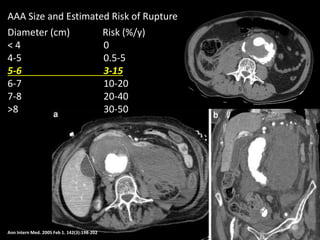
AAA Size and Estimated Risk of Rupture
Diameter (cm) Risk (%/y)
< 4 0
4-5 0.5-5
5-6 3-15
6-7 10-20
7-8 20-40
>8 30-50
Open Surgical Repair of AAA
• Up to 3-hour procedure
• Significant incision
• 20-30 minute cross-clamp
• 1–2 days in ICU, 7–14 day
hospitalization, 4–6 weeks
recovery time
• 5-10% operative mortality in
population based studies
• Contraindicated in many
patients
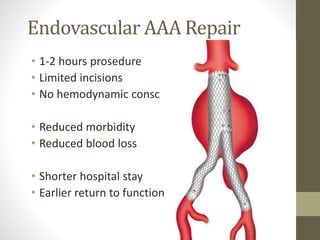
Endovascular AAA Repair
• 1-2 hours prosedure
• Limited incisions
• No hemodynamic consc
• Reduced morbidity
• Reduced blood loss
• Shorter hospital stay
• Earlier return to function
• In less than 3 decades, (EVAR) has been converted from an
escape procedure exclusively confined to high-risk patients to
a primary choice.
• Open surgery has increased in technical complexity in the new
endovascular era
• patients who are not anatomically suitable
• patients with EVAR failure
• conversion after stent-graft migration,
• persisting endoleak with aneurysm growth,
• stent-graft rupture, etc.)
• Higher surgical risks and raises new challenges
Systematic review and meta-analysis of the early and late outcomes
of open and endovascular repair of abdominal aortic aneurysm
P. W. Stather1, D. Sidloff1, N. Dattani1, E. Choke1, M. J. Bown1,2 and R.
D. Sayers1
%
year
AAA 2005 - 2010
EVAR
OPEN
Vascular Surgery – Bologna University
Is Open Surgery for AAA Repair
a Reason for Concern
in the EVAR Era?
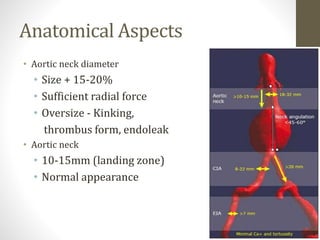
Anatomical Aspects
• Aortic neck diameter
• Size + 15-20%
• Sufficient radial force
• Oversize - Kinking,
thrombus form, endoleak
• Aortic neck
• 10-15mm (landing zone)
• Normal appearance
Anatomical Aspects
• Aortic neck
angulation
•<60°
Anatomical Aspects
• Iliac Arteries
• Minimal calcification /
tortuosity
• No stenosis or mural
thrombus
• Sufficient diameter & length
• If external Iliac art. = landing
zone, internal iliac art. should
be embolised (???)
Mechanisms of Evar Failure and new surveillance strategies
The rationale behind updating our surveillance protocols post-EVAR to decrease
patient risks, as well as costs.
By Jill K. Johnstone, MD, anD Gustavo s. oDerich, MD
Endovascular Today FEbruary 2014
Decrease in total aneurysm-related deaths in
the era of endovascular aneurysm repair. J
Vasc Surg. 2009;49(3):543-550.
Conclusion: Since the introduction of EVAR, the annual number of deaths from intact and
ruptured AAA has significantly decreased. This coincided with an increase in intact AAA
repair after the introduction of EVAR and a decrease in ruptured AAA diagnosis and repair
volume.
Anatomical Aspects
• Aortic neck diameter
• Size + 15-20%
• Sufficient radial force
• Oversize - Kinking,
thrombus form, endoleak
• Aortic neck
• 10-15mm (landing zone)
• Normal appearance
-80-yo female. Known for AAA
-electromechanical dissociation required
mechanical resuscitation
An 84-yo female
rapidly growing aortoiliac aneurysm
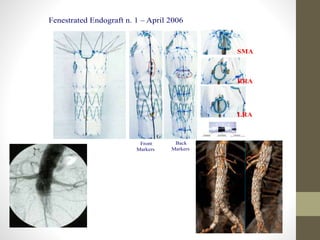
Front
Markers
Back
Markers
Fenestrated Endograft n. 1 – April 2006
SMA
RRA
LRA
aft n. 1 – April 2006
Vascular Surgery – Bologna University
Iuxtarenal AAA and fenestrated endografts
Results of the United States multicenter prospective study evaluating the
Zenith fenestrated endovascular graft for treatment of JAAA
Oderich GS et al
JVS 2014 ; 60: 1420-8
• Graft successfully implanted 67/67
• Patent target vessels 100%
• Perioperative mortality 1.5%
• Endoleak Type I and III at discharge 0%
Open repair of juxtarenal aortic aneurysms (JAA) remains
a safe option in the era of fenestrated endografts
Knott AW et al.
JVS 2008; 47: 695-701
• Negative predictive factors of cardiac complications
- age > 78 years
- male gender
- hypertension
- previuos myocardial infarction
- diabetes
• Negative predictive factors of renal insufficiency
- prolonged operative time
- prolonged renal ischemia
• Negative predictive factors of pulmonary complications
- renal artery revascularization
- prior MI
Conclusions: pts with a combination of physiologic and anatomic risk factors identified
on multivariate analysis may benefit from fenestrated endograft repair
- Open surgey has been the gold standard but with high mortality and
morbidity rate; today in low surgical risk patients
- Standard EVAR with SF in JAAA with straight neck lenght ≥ 7 mm in
patients unfit for OR and FEVAR is safe and effective
- FEVAR the future gold standard ? Today in high surgical risk patients and
hostile abdomen without large JAAA
- Ch-EVAR, initially used as a bailout procedure or in acute JAAA, gained
interest in centers where FEVAR was not yet available or reimbursed or in
patients unfit for OR with large JAAA
Anatomical Aspects
• Aortic neck
angulation
•<60°
http://ars.els-cdn.com/content/image/1-s2.0-
S1078588410006787-gr1.jpg
http://ars.els-cdn.com/content/image/1-s2.0-
S1078588410006787-gr1.jpg
Conclusion
Choosing flexible stent-graft system and various
alternative techniques may make the difficult cases
feasible, and achieve an encouraging early outcome.
Further long-term randomized studies are needed to
confirm the safety and durability of EVAR in patients
with hostile anatomy.
BMC Surgery (2015) 15:20 DOI 10
.1186/s12893-015-0005-5
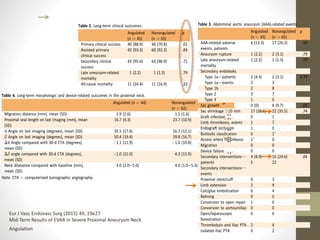
Eur J Vasc Endovasc Surg (2015) 49, 19e27
Mid-Term Results of EVAR in Severe Proximal Aneurysm Neck
Angulation
Eur J Vasc Endovasc Surg (2015) 49, 19e27
Mid-Term Results of EVAR in Severe Proximal Aneurysm Neck
Angulation
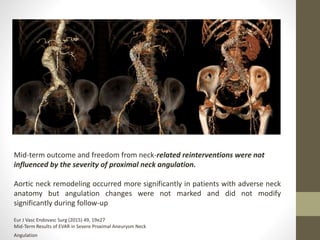
Mid-term outcome and freedom from neck-related reinterventions were not
influenced by the severity of proximal neck angulation.
Aortic neck remodeling occurred more significantly in patients with adverse neck
anatomy but angulation changes were not marked and did not modify
significantly during follow-up
Eur J Vasc Endovasc Surg (2015) 49, 19e27
Mid-Term Results of EVAR in Severe Proximal Aneurysm Neck
Angulation
Anatomical Aspects
• Iliac Arteries
• Minimal calcification /
tortuosity
• No stenosis or mural
thrombus
• Sufficient diameter & length
• If external Iliac art. = landing
zone, internal iliac art. should
be embolised (???)
A comparative study of the bell-bottom technique vs hypogastric exclusion for the treatment
of aneurysmal extension to the iliac bifurcation
( J Vasc Surg 2012;55:956-62.)
N : 260
Is Open Surgery for AAA Repair
a Reason for Concern
in the EVAR Era?
Costin JA, Watson DR, Duff SB, Edmonson-Holt A, Shaffer L, Blossom GB.
Evaluation of the complexity of open abdominal aneurysm repair in the era of endovascular
stent grafting. J Vasc Surg. 2006;43(5):915-920.
Evaluation of the complexity of open abdominal aneurysm repair in the era of
endovascular stent grafting. J Vasc Surg. 2006;43(5):915-920.
Evaluation of the complexity of open abdominal aneurysm repair in the era of
endovascular stent grafting. J Vasc Surg. 2006;43(5):915-920.
Conclusions: Octogenarians can tolerate OAR with acceptable rates of
perioperative mortality and morbidity. Although the complexity of OAR has
increased significantly in the era of EVAR, the perioperative outcome has not
changed.
Systematic review and meta-analysis of the early and late outcomes of open and endovascular repair of abdominal aortic
aneurysm
P. W. Stather1, D. Sidloff1, N. Dattani1, E. Choke1, M. J. Bown1,2 and R. D. Sayers1
1 Vascular Surgery Group, Department of Cardiovascular Sciences, University of Leicester, and 2 Leicester National Institute
for Health Research Cardiovascular Biomedical Research Unit, Leicester, UK
Correspondence to: Mr P. W. Stather, Vascular Surgery Group, Department of Cardiovascular Sciences, University of
Leicester, Leicester LE2 7LX, UK (e-mail: pws7@le.ac.uk)
Conclusion
There is no long-term survival benefit for patients who have
EVAR compared with open repair for AAA. There are also
significantly higher risks of reintervention and aneurysm
rupture after EVAR.
Systematic review and meta-analysis of the early and late outcomes of open and endovascular repair of abdominal aortic
aneurysm
P. W. Stather1, D. Sidloff1, N. Dattani1, E. Choke1, M. J. Bown1,2 and R. D. Sayers1
1 Vascular Surgery Group, Department of Cardiovascular Sciences, University of Leicester, and 2 Leicester National Institute
for Health Research Cardiovascular Biomedical Research Unit, Leicester, UK
Correspondence to: Mr P. W. Stather, Vascular Surgery Group, Department of Cardiovascular Sciences, University of
Leicester, Leicester LE2 7LX, UK (e-mail: pws7@le.ac.uk)
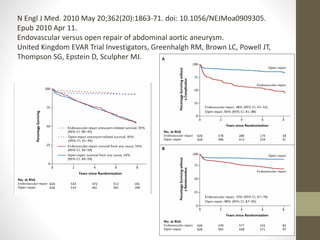
N Engl J Med. 2010 May 20;362(20):1863-71. doi: 10.1056/NEJMoa0909305.
Epub 2010 Apr 11.
Endovascular versus open repair of abdominal aortic aneurysm.
United Kingdom EVAR Trial Investigators, Greenhalgh RM, Brown LC, Powell JT,
Thompson SG, Epstein D, Sculpher MJ.
- EVAR was associated with a lower operative mortality
- However, no differences in total mortality or aneurysm-related
mortality
- In the long term
EVAR was associated with increased rates of :
- graft-related complications
- reinterventions
N Engl J Med. 2010 May 20;362(20):1863-71. doi: 10.1056/NEJMoa0909305.
Epub 2010 Apr 11.
Endovascular versus open repair of abdominal aortic aneurysm.
United Kingdom EVAR Trial Investigators, Greenhalgh RM, Brown LC, Powell JT,
Thompson SG, Epstein D, Sculpher MJ.
cost
Knott AW, Kalra M, Duncan AA, et al.
Open repair of juxtarenal aortic aneurysms (JAA) remains a safe option in the era
of fenestrated endografts. J Vasc Surg. 2008;47(4):695-701
Open abdominal aortic aneurysm repair in the
endovascular era: effect of clamp site on outcomes.
Landry G, Lau I, Liem T, Mitchell E, Moneta G.
Arch Surg. 2009;144(9):811-816.
Suprarenal cross-clamping is associated with increased rates of
complications but similar mortality rates
With the disappearance of straightforward open aneurysm repair,
trainees in vascular surgery will have to learn AAA repair almost
exclusively by operating on patients with complex AAAs.
Fewer surgeons will perform these repairs, and fewer fellows will be
able to complete the operation independently immediately after
training
Perioperative outcomes for elective open abdominal aortic aneurysm
repair since the adoption of endovascular grafting procedures. Eur J Vasc
Endovasc Surg. 2011;42(2):178-184.
Perioperative outcomes for elective open abdominal aortic aneurysm
repair since the adoption of endovascular grafting procedures. Eur J Vasc
Endovasc Surg. 2011;42(2):178-184.
Although the number of more complex OAR procedures increased in the EVAR era,
- the morbidity rates in the two groups were less effect on the perioperative outcome
than OAR in the EVAR era.
- OAR remains a valid procedure for AAA repair.
Is Open Surgery for AAA Repair
a Reason for Concern
in the EVAR Era?
Choosing the best management of AAA for individual pts.
Cronenwett JL – Lancet 2005;365:2156
Choosing the best management of AAA for individual pts.
Cronenwett JL – Lancet 2005;365:2156
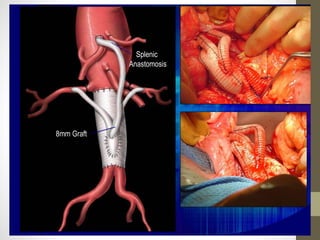
8mm Graft
Splenic
Anastomosis
Combined open and endovascular treatment of thoracoabdominal aortic pathologies: a
systematic review and meta-analysis
Konstantinos G. Moulakakis1,2, Spyridon N. Mylonas1, Constantinos N. Antonopoulos1,
Christos D. Liapis1
1Department of Vascular Surgery, Athens University Medical School, Attikon University
Hospital, Athens, Greece; 2The Systematic Review Unit, The Collaborative Research
(CORE) Group, Sydney, Australia
Success rate
Viceral Patency Rate
SCI rate
CRF rate
30d Mortality
• Hybrid procedures have several advantages over conventional open
repair
• avoiding thoracotomy,
• single-lung ventilation,
• aortic cross-clamping,
• minimizing end-organ ischemia
• the hybrid technique is still associated with
• a considerable morbidity and mortality rate.
• have a role in those patients anatomically unsuitable for fenestrated and side
branched endografts.
• good option for elderly, high-risk patients
• should be reserved for high volume centers with accumulated experience and
high standards of perioperative management
• further concern is the durability and long-term outcome which is
related either to endograft complications
Conclusion
• Despite the advantages of EVAR, open surgical repair skill
remains a valuable choice for AAA treatment also in the post-
EVAR era.
• The noteworthy shift in trends and complexity of AAA repair for
open surgery in this new EVAR era is supported by a number of
studies and may raise issues of concern
• One of the main advantages of current safety in performance of
both EVAR and open surgery for AAA is to allow the use of one
or the other technique as alternative (but not competitive)
THANK YOU

Survue daw 2016

  • 1.
    Open Aneurysm Repair inEndovascular Era Dicky A.Wartono, MD Harapan Kita National Cardiovascular Centre Jakarta 2016
  • 2.
  • 3.
    % year AAA 2005 -2010 EVAR OPEN Vascular Surgery – Bologna University
  • 4.
    Abdominal Aortic Aneurysm •diameter ≥30 mm • >50% increased diameter • 55 mm • symptomatic • >10 mm/year 2014 ESC Guidelines on the diagnosis and treatment of aortic diseases
  • 6.
    2014 ESC Guidelineson the diagnosis and treatment of aortic diseases
  • 7.
    Ann Intern Med.2005 Feb 1. 142(3):198-202 AAA Size and Estimated Risk of Rupture Diameter (cm) Risk (%/y) < 4 0 4-5 0.5-5 5-6 3-15 6-7 10-20 7-8 20-40 >8 30-50
  • 8.
    Open Surgical Repairof AAA • Up to 3-hour procedure • Significant incision • 20-30 minute cross-clamp • 1–2 days in ICU, 7–14 day hospitalization, 4–6 weeks recovery time • 5-10% operative mortality in population based studies • Contraindicated in many patients
  • 9.
    Endovascular AAA Repair •1-2 hours prosedure • Limited incisions • No hemodynamic consc • Reduced morbidity • Reduced blood loss • Shorter hospital stay • Earlier return to function
  • 11.
    • In lessthan 3 decades, (EVAR) has been converted from an escape procedure exclusively confined to high-risk patients to a primary choice. • Open surgery has increased in technical complexity in the new endovascular era • patients who are not anatomically suitable • patients with EVAR failure • conversion after stent-graft migration, • persisting endoleak with aneurysm growth, • stent-graft rupture, etc.) • Higher surgical risks and raises new challenges Systematic review and meta-analysis of the early and late outcomes of open and endovascular repair of abdominal aortic aneurysm P. W. Stather1, D. Sidloff1, N. Dattani1, E. Choke1, M. J. Bown1,2 and R. D. Sayers1
  • 12.
    % year AAA 2005 -2010 EVAR OPEN Vascular Surgery – Bologna University
  • 13.
    Is Open Surgeryfor AAA Repair a Reason for Concern in the EVAR Era?
  • 14.
    Anatomical Aspects • Aorticneck diameter • Size + 15-20% • Sufficient radial force • Oversize - Kinking, thrombus form, endoleak • Aortic neck • 10-15mm (landing zone) • Normal appearance
  • 15.
    Anatomical Aspects • Aorticneck angulation •<60°
  • 16.
    Anatomical Aspects • IliacArteries • Minimal calcification / tortuosity • No stenosis or mural thrombus • Sufficient diameter & length • If external Iliac art. = landing zone, internal iliac art. should be embolised (???)
  • 19.
    Mechanisms of EvarFailure and new surveillance strategies The rationale behind updating our surveillance protocols post-EVAR to decrease patient risks, as well as costs. By Jill K. Johnstone, MD, anD Gustavo s. oDerich, MD Endovascular Today FEbruary 2014
  • 20.
    Decrease in totalaneurysm-related deaths in the era of endovascular aneurysm repair. J Vasc Surg. 2009;49(3):543-550. Conclusion: Since the introduction of EVAR, the annual number of deaths from intact and ruptured AAA has significantly decreased. This coincided with an increase in intact AAA repair after the introduction of EVAR and a decrease in ruptured AAA diagnosis and repair volume.
  • 21.
    Anatomical Aspects • Aorticneck diameter • Size + 15-20% • Sufficient radial force • Oversize - Kinking, thrombus form, endoleak • Aortic neck • 10-15mm (landing zone) • Normal appearance
  • 24.
    -80-yo female. Knownfor AAA -electromechanical dissociation required mechanical resuscitation
  • 26.
    An 84-yo female rapidlygrowing aortoiliac aneurysm
  • 28.
    Front Markers Back Markers Fenestrated Endograft n.1 – April 2006 SMA RRA LRA aft n. 1 – April 2006 Vascular Surgery – Bologna University Iuxtarenal AAA and fenestrated endografts
  • 29.
    Results of theUnited States multicenter prospective study evaluating the Zenith fenestrated endovascular graft for treatment of JAAA Oderich GS et al JVS 2014 ; 60: 1420-8 • Graft successfully implanted 67/67 • Patent target vessels 100% • Perioperative mortality 1.5% • Endoleak Type I and III at discharge 0%
  • 30.
    Open repair ofjuxtarenal aortic aneurysms (JAA) remains a safe option in the era of fenestrated endografts Knott AW et al. JVS 2008; 47: 695-701 • Negative predictive factors of cardiac complications - age > 78 years - male gender - hypertension - previuos myocardial infarction - diabetes • Negative predictive factors of renal insufficiency - prolonged operative time - prolonged renal ischemia • Negative predictive factors of pulmonary complications - renal artery revascularization - prior MI Conclusions: pts with a combination of physiologic and anatomic risk factors identified on multivariate analysis may benefit from fenestrated endograft repair
  • 31.
    - Open surgeyhas been the gold standard but with high mortality and morbidity rate; today in low surgical risk patients - Standard EVAR with SF in JAAA with straight neck lenght ≥ 7 mm in patients unfit for OR and FEVAR is safe and effective - FEVAR the future gold standard ? Today in high surgical risk patients and hostile abdomen without large JAAA - Ch-EVAR, initially used as a bailout procedure or in acute JAAA, gained interest in centers where FEVAR was not yet available or reimbursed or in patients unfit for OR with large JAAA
  • 32.
    Anatomical Aspects • Aorticneck angulation •<60°
  • 33.
  • 34.
    Conclusion Choosing flexible stent-graftsystem and various alternative techniques may make the difficult cases feasible, and achieve an encouraging early outcome. Further long-term randomized studies are needed to confirm the safety and durability of EVAR in patients with hostile anatomy. BMC Surgery (2015) 15:20 DOI 10 .1186/s12893-015-0005-5
  • 35.
    Eur J VascEndovasc Surg (2015) 49, 19e27 Mid-Term Results of EVAR in Severe Proximal Aneurysm Neck Angulation
  • 36.
    Eur J VascEndovasc Surg (2015) 49, 19e27 Mid-Term Results of EVAR in Severe Proximal Aneurysm Neck Angulation
  • 37.
    Mid-term outcome andfreedom from neck-related reinterventions were not influenced by the severity of proximal neck angulation. Aortic neck remodeling occurred more significantly in patients with adverse neck anatomy but angulation changes were not marked and did not modify significantly during follow-up Eur J Vasc Endovasc Surg (2015) 49, 19e27 Mid-Term Results of EVAR in Severe Proximal Aneurysm Neck Angulation
  • 38.
    Anatomical Aspects • IliacArteries • Minimal calcification / tortuosity • No stenosis or mural thrombus • Sufficient diameter & length • If external Iliac art. = landing zone, internal iliac art. should be embolised (???)
  • 40.
    A comparative studyof the bell-bottom technique vs hypogastric exclusion for the treatment of aneurysmal extension to the iliac bifurcation ( J Vasc Surg 2012;55:956-62.) N : 260
  • 42.
    Is Open Surgeryfor AAA Repair a Reason for Concern in the EVAR Era?
  • 43.
    Costin JA, WatsonDR, Duff SB, Edmonson-Holt A, Shaffer L, Blossom GB. Evaluation of the complexity of open abdominal aneurysm repair in the era of endovascular stent grafting. J Vasc Surg. 2006;43(5):915-920.
  • 44.
    Evaluation of thecomplexity of open abdominal aneurysm repair in the era of endovascular stent grafting. J Vasc Surg. 2006;43(5):915-920.
  • 45.
    Evaluation of thecomplexity of open abdominal aneurysm repair in the era of endovascular stent grafting. J Vasc Surg. 2006;43(5):915-920. Conclusions: Octogenarians can tolerate OAR with acceptable rates of perioperative mortality and morbidity. Although the complexity of OAR has increased significantly in the era of EVAR, the perioperative outcome has not changed.
  • 46.
    Systematic review andmeta-analysis of the early and late outcomes of open and endovascular repair of abdominal aortic aneurysm P. W. Stather1, D. Sidloff1, N. Dattani1, E. Choke1, M. J. Bown1,2 and R. D. Sayers1 1 Vascular Surgery Group, Department of Cardiovascular Sciences, University of Leicester, and 2 Leicester National Institute for Health Research Cardiovascular Biomedical Research Unit, Leicester, UK Correspondence to: Mr P. W. Stather, Vascular Surgery Group, Department of Cardiovascular Sciences, University of Leicester, Leicester LE2 7LX, UK (e-mail: pws7@le.ac.uk)
  • 48.
    Conclusion There is nolong-term survival benefit for patients who have EVAR compared with open repair for AAA. There are also significantly higher risks of reintervention and aneurysm rupture after EVAR. Systematic review and meta-analysis of the early and late outcomes of open and endovascular repair of abdominal aortic aneurysm P. W. Stather1, D. Sidloff1, N. Dattani1, E. Choke1, M. J. Bown1,2 and R. D. Sayers1 1 Vascular Surgery Group, Department of Cardiovascular Sciences, University of Leicester, and 2 Leicester National Institute for Health Research Cardiovascular Biomedical Research Unit, Leicester, UK Correspondence to: Mr P. W. Stather, Vascular Surgery Group, Department of Cardiovascular Sciences, University of Leicester, Leicester LE2 7LX, UK (e-mail: pws7@le.ac.uk)
  • 49.
    N Engl JMed. 2010 May 20;362(20):1863-71. doi: 10.1056/NEJMoa0909305. Epub 2010 Apr 11. Endovascular versus open repair of abdominal aortic aneurysm. United Kingdom EVAR Trial Investigators, Greenhalgh RM, Brown LC, Powell JT, Thompson SG, Epstein D, Sculpher MJ.
  • 50.
    - EVAR wasassociated with a lower operative mortality - However, no differences in total mortality or aneurysm-related mortality - In the long term EVAR was associated with increased rates of : - graft-related complications - reinterventions N Engl J Med. 2010 May 20;362(20):1863-71. doi: 10.1056/NEJMoa0909305. Epub 2010 Apr 11. Endovascular versus open repair of abdominal aortic aneurysm. United Kingdom EVAR Trial Investigators, Greenhalgh RM, Brown LC, Powell JT, Thompson SG, Epstein D, Sculpher MJ. cost
  • 51.
    Knott AW, KalraM, Duncan AA, et al. Open repair of juxtarenal aortic aneurysms (JAA) remains a safe option in the era of fenestrated endografts. J Vasc Surg. 2008;47(4):695-701
  • 52.
    Open abdominal aorticaneurysm repair in the endovascular era: effect of clamp site on outcomes. Landry G, Lau I, Liem T, Mitchell E, Moneta G. Arch Surg. 2009;144(9):811-816. Suprarenal cross-clamping is associated with increased rates of complications but similar mortality rates With the disappearance of straightforward open aneurysm repair, trainees in vascular surgery will have to learn AAA repair almost exclusively by operating on patients with complex AAAs. Fewer surgeons will perform these repairs, and fewer fellows will be able to complete the operation independently immediately after training
  • 53.
    Perioperative outcomes forelective open abdominal aortic aneurysm repair since the adoption of endovascular grafting procedures. Eur J Vasc Endovasc Surg. 2011;42(2):178-184.
  • 54.
    Perioperative outcomes forelective open abdominal aortic aneurysm repair since the adoption of endovascular grafting procedures. Eur J Vasc Endovasc Surg. 2011;42(2):178-184.
  • 55.
    Although the numberof more complex OAR procedures increased in the EVAR era, - the morbidity rates in the two groups were less effect on the perioperative outcome than OAR in the EVAR era. - OAR remains a valid procedure for AAA repair.
  • 56.
    Is Open Surgeryfor AAA Repair a Reason for Concern in the EVAR Era?
  • 57.
    Choosing the bestmanagement of AAA for individual pts. Cronenwett JL – Lancet 2005;365:2156
  • 58.
    Choosing the bestmanagement of AAA for individual pts. Cronenwett JL – Lancet 2005;365:2156
  • 60.
  • 62.
    Combined open andendovascular treatment of thoracoabdominal aortic pathologies: a systematic review and meta-analysis Konstantinos G. Moulakakis1,2, Spyridon N. Mylonas1, Constantinos N. Antonopoulos1, Christos D. Liapis1 1Department of Vascular Surgery, Athens University Medical School, Attikon University Hospital, Athens, Greece; 2The Systematic Review Unit, The Collaborative Research (CORE) Group, Sydney, Australia
  • 63.
  • 64.
  • 66.
    • Hybrid procedureshave several advantages over conventional open repair • avoiding thoracotomy, • single-lung ventilation, • aortic cross-clamping, • minimizing end-organ ischemia • the hybrid technique is still associated with • a considerable morbidity and mortality rate. • have a role in those patients anatomically unsuitable for fenestrated and side branched endografts. • good option for elderly, high-risk patients • should be reserved for high volume centers with accumulated experience and high standards of perioperative management • further concern is the durability and long-term outcome which is related either to endograft complications
  • 67.
    Conclusion • Despite theadvantages of EVAR, open surgical repair skill remains a valuable choice for AAA treatment also in the post- EVAR era. • The noteworthy shift in trends and complexity of AAA repair for open surgery in this new EVAR era is supported by a number of studies and may raise issues of concern • One of the main advantages of current safety in performance of both EVAR and open surgery for AAA is to allow the use of one or the other technique as alternative (but not competitive)
  • 68.