

Dr. RAGHU PRASADA M S
MBBS,MD
ASSISTANT PROFESSOR
DEPT. OF PHARMACOLOGY
SSIMS & RC.
1
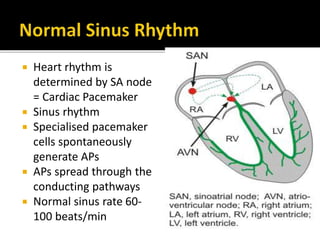
 Heart rhythm is
determined by SA node
= Cardiac Pacemaker
 Sinus rhythm
 Specialised pacemaker
cells spontaneously
generate APs
 APs spread through the
conducting pathways
 Normal sinus rate 60-
100 beats/min
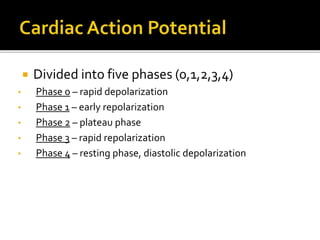
 Divided into five phases (0,1,2,3,4)
• Phase 0 – rapid depolarization
• Phase 1 – early repolarization
• Phase 2 – plateau phase
• Phase 3 – rapid repolarization
• Phase 4 – resting phase, diastolic depolarization
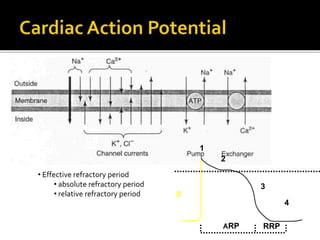
0 1 2 3 4
• Effective refractory period
• absolute refractory period
• relative refractory period
1
0
2
3
4
ARP RRP
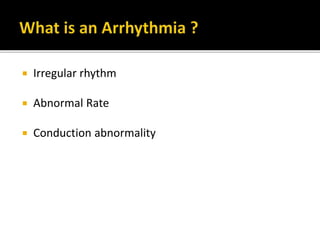
Irregular rhythm
Abnormal Rate
Conduction abnormality
Extrasystole
Paroxysmal supraventricular tachycardia
Atrial flutter 200-350
Atrial fibrillation 350-550
Ventricular tachycardia
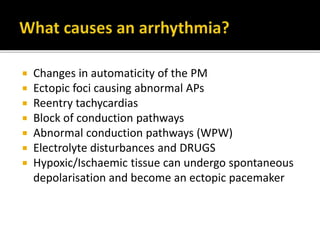
 Changes in automaticity of the PM
 Ectopic foci causing abnormal APs
 Reentry tachycardias
 Block of conduction pathways
 Abnormal conduction pathways (WPW)
 Electrolyte disturbances and DRUGS
 Hypoxic/Ischemic tissue can undergo spontaneous
depolarization and become an ectopic pacemaker
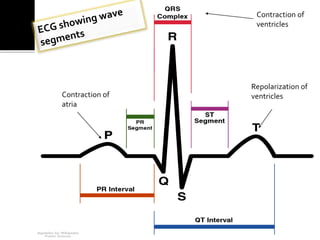
Contraction of
atria
Contraction of
ventricles
Repolarization of
ventricles
Class Mechanism Example
IA Na channel blockers
Moderately decrease dv/dt
QUINIDINE
PROCAINAMIDE
DISOPYRAMIDE
IB Na channel blockers
Little decrease in dv/dt
LIGNOCAINE
MEXILETINE
TOCAINIDE
PHENYTOIN
IC Na channel blockers
Marked decrease in dv/dt
FLECAINIDE
PROPAFENONE
ENCAINIDE
MORICIZINE
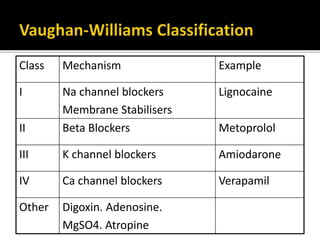
Class Mechanism Example
II Beta Blockers METOPROLOL
III K channel blockers AMIODARONE
DRONIDARONE
SOTOLOL
DOFETILIDE
IBUTILIDE
IV Ca channel blockers VERAPAMIL
Other Digoxin. Adenosine.
MgSO4. Atropine
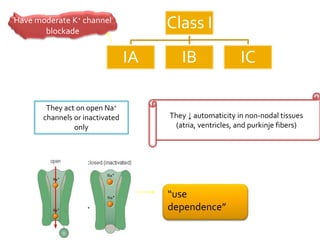
Class I
IA IB IC
They ↓ automaticity in non-nodal tissues
(atria, ventricles, and purkinje fibers)
They act on open Na+
channels or inactivated
only
“use
dependence”
Have moderate K+ channel
blockade
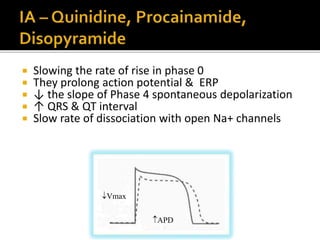
Slowing the rate of rise in phase 0
They prolong action potential & ERP
↓ the slope of Phase 4 spontaneous depolarization
↑ QRS & QT interval
Slow rate of dissociation with open Na+ channels
Vmax
APD
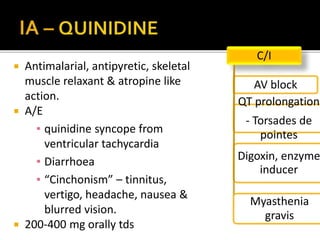
 Antimalarial, antipyretic, skeletal
muscle relaxant & atropine like
action.
 A/E
▪ quinidine syncope from
ventricular tachycardia
▪ Diarrhoea
▪ “Cinchonism” – tinnitus,
vertigo, headache, nausea &
blurred vision.
 200-400 mg orally tds
C/I
AV block
QT prolongation
- Torsades de
pointes
Digoxin, enzyme
inducer
Myasthenia gravis
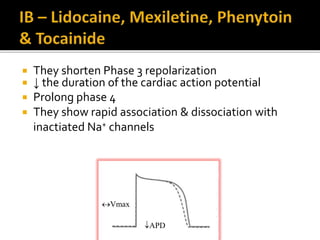
They shorten Phase 3 repolarization
↓ the dura on of the cardiac ac on poten al
Prolong phase 4
They show rapid association & dissociation with
inactivated Na+ channels
Vmax
APD
Used IV because of extensive 1st pass metabolism
No vagolytic effects
Least cardio toxic
CNS side effects
LD – 150-200mg for 15mins
MD – 1-4mg/min
Used for VT
Propranolol ↑ its toxicity
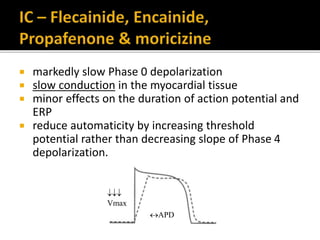
 markedly slow Phase 0 depolarization
 slow conduction in the myocardial tissue
 minor effects on the duration of action potential and
ERP
 reduce automaticity by increasing threshold
potential rather than decreasing slope of Phase 4
depolarization.

Vmax
APD
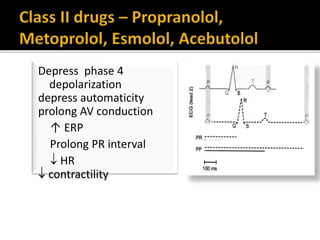
Depress phase 4 depolarization
depress automaticity
prolong AV conduction
↑ ERP
Prolong PR interval
 HR
 contractility
19
Propranolol Esmolol
Resistant v arrhythmia SVT
10 – 80 mg TDS LD 500mg / kg / min for 1 min
1 – 3 mg in 50ml 5%D – 1 min MD 50mg / kg / min for 4 min
Contraindication
Asthma
Sinus Bradycardia
AV block
Severe CHF
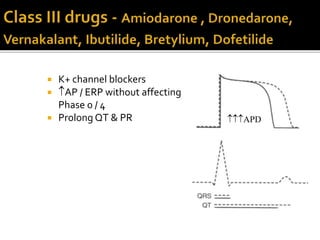
K+ channel blockers
AP / ERP without affecting
Phase 0 / 4
Prolong QT & PR APD
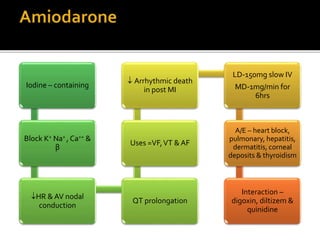
Iodine – containing
Block K+ Na+ , Ca++ & β
HR & AV nodal conduction, QT prolongation
 Arrhythmic death in post MI
Uses
VF, VT & AF
 LD-150mg slow IV
 MD-1mg/min for 6hrs
A/E – heart block, pulmonary, hepatitis, dermatitis,
corneal deposits & thyroidism
Interaction – digoxin, Diltiazem & quinidine
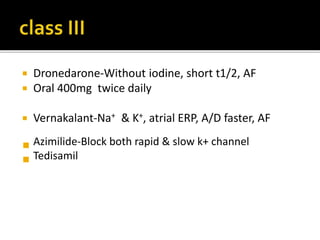
Dronedarone-Without iodine, short t1/2, AF
Oral 400mg twice daily
Vernakalant-Na+ & K+, atrial ERP, A/D faster, AF
Azimilide- block both rapid and slow K+ channel
Tedisamil
24
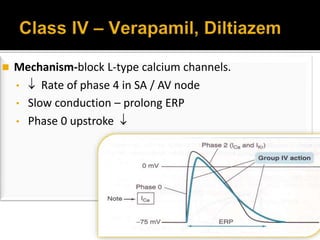
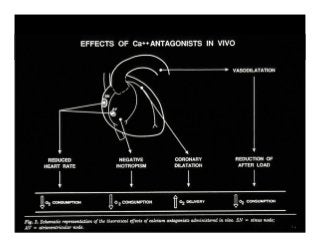
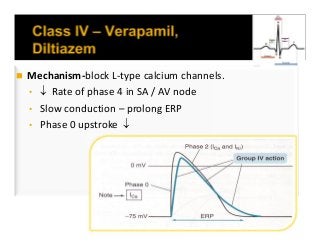
 Mechanism-block L-type calcium channels.
•  Rate of phase 4 in SA / AV node
• Slow conduction – prolong ERP
• Phase 0 upstroke 
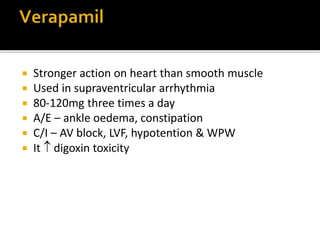
Stronger action on heart than smooth muscle
Used in supraventricular arrhythmia
80-120mg three times a day
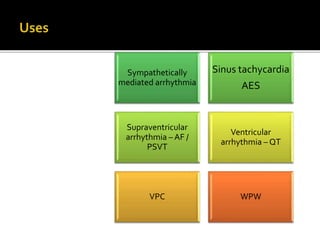
Uses
Sympathetically mediated arrhythmia
Sinus tachycardia
Supraventricular arrhythmia – AF / PSVT
Ventricular arrhythmia – QT
VPC, WPW
A/E – ankle oedema, constipation
C/I – AV block, LVF, hypotension & WPW
It  digoxin toxicity
Inhibits NaK/ATPase pump
Contractility increases as intracellular Ca, Na increases
and loss of intracellular K+
Digoxin toxicity- renal insufficiency, ischemia,
hypokalemia, calcium channel blockers, beta blockers,
cyclosporine and furosemide
Normal levels- 0.5-2ng/ml
Treatment of toxicity-charcoal. Correct potassium,
calcium IV, DIGIBIND antibodies
Naturally occurring nucleoside
Given rapid IV for reentrant supra ventricular
arrhythmias
Used to produce controlled hypotension for surgeries
Diagnosis of coronary artery disease
It activates ACH sensitive K+ CURRENT IN atrium, sinus
and AV node decreases action potential duration
and causes hyperpolarisation
Class antiarrhythmic drugs