Chapter 2 (continued)

Research Approaches and Methods
        of Data Collection


            9/11/2012
Roadmap
•   Confirm roster
•   Quick review of last class
•   Finish chapter 2 material
•   Where we’re headed:
    – Finish ch. 2 today
    – Chapter 3 on Thursday
    – Next Tuesday: Exam 1
Quick Review
• Variables in psychology research
  – Types
  – Roles
• Quantitative vs. Qualitative research
• Experimental research and causation
  – Requirements for claims of causation
• Settings for experimental research
  – Pros and cons
Where we left off…
• Reminder of qualitative vs. quantitative

• “zoom out”

• Other (non-experimental) quantitative
  research designs
Nonexperimental Quantitative
              Research
• A descriptive type of research study
• Defining characteristic: no IV manipulation
• Goals
  – Provide an accurate picture of phenomenon
  – Describe size and direction of relationships
    among variables

• Question: If we care so much about
  causation, why would we use this kind of
  research design?
Types of Nonexperimental
          Quantitative Research
• Correlational Studies

• Natural Manipulation

• Longitudinal and Cross-Sectional
Correlational Research
• A study that describes the relationship between
  two variables

• The goal is often to help with prediction.

• Remember the 3rd variable problem.
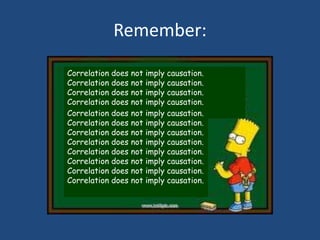
Remember:

Correlation does   not imply causation.
Natural Manipulation Research
          (a.k.a. quasi-experimental)
• Look at effects of variable(s) not actually under the
  experimenter’s control

• Examines the impact of individual difference
  variables on an outcome variable

• Individual difference variables are existing
  characteristics such as traits, characteristics,
  experiences*
  – Examples?
Longitudinal & Cross-Sectional Designs
• Zoom out: still non-experimental quantitative
  research
Longitudinal Research
• A study that repeatedly measures the same
  variables in a single sample of individuals over
  a set time

• The time period can vary greatly.

• At least two measurement points, but can be
  more
Cross-sectional Research
• Measure variable(s) across representative
  samples of individuals that differ on a
  characteristic

• Key: measure all at one time point
Comparing Longitudinal and
               Cross-Sectional
•   Both have benefits and drawbacks:
•   Time to complete the study
•   Feasibility to complete the study
•   Richness of data
•   Cohort issues
Cohort effects
• Different age groups have different
  experiences over time
 – Example:
   • A group of 10-15 year-olds have always used computers
   • A group of 60-65 year-olds did not routinely use
     computers until they were adults (and some still may not)
Cohort-Sequential Design
• A combination of longitudinal and cross-
  sectional designs

• Measures the same characteristics at several
  selected time intervals in groups at different
  age levels

• Benefits: less time, less cost, lower attrition
Example:
• Formation and maintenance of best-
  friendships in children as they advance from
  2nd grade to 5th grade

• What would this look like in a longitudinal
  study?

• Let’s see what a cohort-sequential design
  would look like
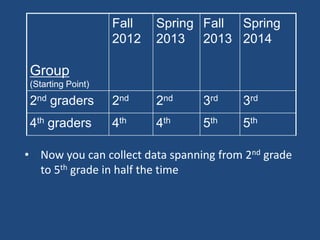
Fall   Spring Fall Spring
                   2012   2013 2013 2014

Group
(Starting Point)
2nd graders        2nd    2nd    3rd    3rd
4th graders        4th    4th    5th    5th

• Now you can collect data spanning from 2nd grade
  to 5th grade in half the time
QUALITATIVE RESEARCH
Qualitative Research
• Interpretive research approach relying on
  multiple types of subjective data

• Researcher’s goal: understand observations
  from the participant’s perspective
Features of Qualitative Research
• Generally occurs in the field or participant’s
  natural setting
• Triangulation
• deeper understanding of phenomena
• Research questions may evolve over course of
  data collection
Major Methods of Data collection
• Techniques used to physically gather information
  used to answer research questions
• Tests
• Questionnaires
• Interviews
• Focus groups
• Observation
• Existing/ Archival data
Tests
• Standardized or researcher-constructed instruments
  designed to measure:
   – Personality, aptitude, achievement, performance

• Information on reliability, validity, and norms usually
  available

• Table 2.3, page 55- benefits/weaknesses
Questionnaires
• Self-report data collection instrument
  – opinions, perceptions, attitudes

• Paper-and-pencil, computer, online

• Table 2.4, page 57
Interviews
• Data collection method in which an interviewer asks
  the interviewee a series of questions

• Face-to-face, telephone

• Table 2.5, page 58-benefits/weaknesses
Focus Groups
• Collection of data in a group situation in which
  a moderator leads a discussion with small
  group of participants.
• Especially useful for exploring how people
  think about an issue
  – The difficulties of focus groups
  – Table 2.6, page 59-benefits/weaknesses
Observation
• Researcher observes and records individuals’
  behavior

• Naturalistic—real-world setting

• Laboratory—in a lab or other controlled setting
  created by the researcher

• Table 2.7, page 60-benefits and weaknesses
Existing or Secondary data
• Collection of data left behind or originally used for
  another purpose.

• Documents

• Physical data

• *Archived research data

• Table 2.8, page 61-benefits and weaknesses

Chapter 2 class version b

  • 1.
    Chapter 2 (continued) ResearchApproaches and Methods of Data Collection 9/11/2012
  • 2.
    Roadmap • Confirm roster • Quick review of last class • Finish chapter 2 material • Where we’re headed: – Finish ch. 2 today – Chapter 3 on Thursday – Next Tuesday: Exam 1
  • 3.
    Quick Review • Variablesin psychology research – Types – Roles • Quantitative vs. Qualitative research • Experimental research and causation – Requirements for claims of causation • Settings for experimental research – Pros and cons
  • 4.
    Where we leftoff… • Reminder of qualitative vs. quantitative • “zoom out” • Other (non-experimental) quantitative research designs
  • 5.
    Nonexperimental Quantitative Research • A descriptive type of research study • Defining characteristic: no IV manipulation • Goals – Provide an accurate picture of phenomenon – Describe size and direction of relationships among variables • Question: If we care so much about causation, why would we use this kind of research design?
  • 6.
    Types of Nonexperimental Quantitative Research • Correlational Studies • Natural Manipulation • Longitudinal and Cross-Sectional
  • 7.
    Correlational Research • Astudy that describes the relationship between two variables • The goal is often to help with prediction. • Remember the 3rd variable problem.
  • 8.
    Remember: Correlation does not imply causation. Correlation does not imply causation. Correlation does not imply causation. Correlation does not imply causation. Correlation does not imply causation. Correlation does not imply causation. Correlation does not imply causation. Correlation does not imply causation. Correlation does not imply causation. Correlation does not imply causation. Correlation does not imply causation. Correlation does not imply causation.
  • 9.
    Natural Manipulation Research (a.k.a. quasi-experimental) • Look at effects of variable(s) not actually under the experimenter’s control • Examines the impact of individual difference variables on an outcome variable • Individual difference variables are existing characteristics such as traits, characteristics, experiences* – Examples?
  • 10.
    Longitudinal & Cross-SectionalDesigns • Zoom out: still non-experimental quantitative research
  • 11.
    Longitudinal Research • Astudy that repeatedly measures the same variables in a single sample of individuals over a set time • The time period can vary greatly. • At least two measurement points, but can be more
  • 12.
    Cross-sectional Research • Measurevariable(s) across representative samples of individuals that differ on a characteristic • Key: measure all at one time point
  • 13.
    Comparing Longitudinal and Cross-Sectional • Both have benefits and drawbacks: • Time to complete the study • Feasibility to complete the study • Richness of data • Cohort issues
  • 14.
    Cohort effects • Differentage groups have different experiences over time – Example: • A group of 10-15 year-olds have always used computers • A group of 60-65 year-olds did not routinely use computers until they were adults (and some still may not)
  • 15.
    Cohort-Sequential Design • Acombination of longitudinal and cross- sectional designs • Measures the same characteristics at several selected time intervals in groups at different age levels • Benefits: less time, less cost, lower attrition
  • 16.
    Example: • Formation andmaintenance of best- friendships in children as they advance from 2nd grade to 5th grade • What would this look like in a longitudinal study? • Let’s see what a cohort-sequential design would look like
  • 17.
    Fall Spring Fall Spring 2012 2013 2013 2014 Group (Starting Point) 2nd graders 2nd 2nd 3rd 3rd 4th graders 4th 4th 5th 5th • Now you can collect data spanning from 2nd grade to 5th grade in half the time
  • 18.
  • 19.
    Qualitative Research • Interpretiveresearch approach relying on multiple types of subjective data • Researcher’s goal: understand observations from the participant’s perspective
  • 20.
    Features of QualitativeResearch • Generally occurs in the field or participant’s natural setting • Triangulation • deeper understanding of phenomena • Research questions may evolve over course of data collection
  • 21.
    Major Methods ofData collection • Techniques used to physically gather information used to answer research questions • Tests • Questionnaires • Interviews • Focus groups • Observation • Existing/ Archival data
  • 22.
    Tests • Standardized orresearcher-constructed instruments designed to measure: – Personality, aptitude, achievement, performance • Information on reliability, validity, and norms usually available • Table 2.3, page 55- benefits/weaknesses
  • 23.
    Questionnaires • Self-report datacollection instrument – opinions, perceptions, attitudes • Paper-and-pencil, computer, online • Table 2.4, page 57
  • 24.
    Interviews • Data collectionmethod in which an interviewer asks the interviewee a series of questions • Face-to-face, telephone • Table 2.5, page 58-benefits/weaknesses
  • 25.
    Focus Groups • Collectionof data in a group situation in which a moderator leads a discussion with small group of participants. • Especially useful for exploring how people think about an issue – The difficulties of focus groups – Table 2.6, page 59-benefits/weaknesses
  • 26.
    Observation • Researcher observesand records individuals’ behavior • Naturalistic—real-world setting • Laboratory—in a lab or other controlled setting created by the researcher • Table 2.7, page 60-benefits and weaknesses
  • 27.
    Existing or Secondarydata • Collection of data left behind or originally used for another purpose. • Documents • Physical data • *Archived research data • Table 2.8, page 61-benefits and weaknesses