
Alfred Adler
Individual psychology
Alfred Adler
Born: February 7, 1870 near Vienna
Third child in seven children
Apparent physical comfort, but miserably in
childhood
Known for his efforts of outdoing his older brother
Received a medical degree in 1895
Influenced by Marx's philosophy
Joined feuds group then decided to leave the
group and formed "the society of individual
psychology”
Individual psychology
Focuses on uniqueness of each
person
Denies universal biological drives and
goals
We should see person as a whole
rather than a part
Feelings of inferiority
Always present as motivating force in behavior
Source of all human striving
Growth results from compensation: attempts to
overcome inferior feeling
Inferiority Complex
Inability to overcome inferiority feelings: helpless, poor self-
opinion
3 sources
Organic: physical deficits
Spoiling: immediate gratification, little regard for needs
of others
Neglect: lack of love, security, develop feeling of
worthlessness
Striving for Superiority
Ultimate goal in life
Drive to perfection
Not an attempted to be better than others
Fictional finalism: reach goals set in the future to
be complete, whole potential and guide
behavior
Superior complex
Overcompensate for feelings of inferiority
Exaggerated and opinion of ones ability
and accomplishments
Style of life
Expression of striving superiority to attain
goals
Learned from early social interactions
Guiding frameworks for all later behaviors
how people live life, how they handle
problems and interpersonal relation
Universal Problems and styles of life
dealing with problems
 Problems:
 Involving behavior towards others
 Occupational
 Relationship/love
 Styles of life:
 Dominant – little self-awareness
 Getting- Expect to receive satisfactions from others, becomes
dependent
 Avoiding- avoids life problems
 Socially useful- cooperates with others, shows social interests
Social interests
Innate potential to cooperate with others to
reach personal and societal goals
Individual must cooperate with and contribute
to society to achieve goals
Babies and small children often show
sympathy for others without having been
taught to do so.
Being useful to others
lacking in social interest including neurotics,
psychotics ,criminals ,drunkards ,problem,
children ,perverts are SOCIAL FAILURES
Neurosis
All neurosis is a matter of insufficient social
interest.
Three types:
1. Ruling type
2. Getting type
3. Avoiding type
1. The rulling type
From childhood, they are characterized by
a tendency to be rather aggressive and
dominant with others
The strength of their striving after personal
power is so great that they tend to push
over anything or anybody who gets in their
way.
These are BULLIES and SADIST
2. The getting type
They relatively passive: make
little effort to solve their own
problems
Instead, they rely on others to
take care of them
Frequently use charm to
persuade others to help them
3. The avoiding type
These have the lowest level of
energy and only survive by
essentially avoiding life
When pushed to the limits, they
tend to become psychotic,
retreating finally into their own
personal words
Childhood
 Like Freud, Adler saw personality or lifestyle s something established quite
early in life
 There were three basic childhood situations that most contribute to faulty
lifestyle.
1. Feeling of inferiority: if someone's does not come along to draw their
attention to others, these children will remain focused on themselves.
2. Pampering: many children are taught by the actions of others that they can
take without giving.
 They do not learn to do for themselves
 They don’t know of dealing with others than giving of commands
3. Neglect: the child who neglected or abused learns what the pampered child
learns, but learns it in a far direct manner
 They learn selfishness because they are taught to trust no one
Birth orders
Alder considered birth order, as another
one of those heuristic ideas—useful
fictions, that contribute to understanding
people but must be not taken too seriously.
Adler must be credited as the first theorist
to include the child's brothers and sisters as
an early influence on the child
1. Only child
 Family situation
 Birth is miracle
 Parents have no previous experience
 Retains 20% percent attention from the parents
 Can be over protected and spoiled
 Child’s Characteristic
 Likes being the center of attraction
 Often has difficulty sharing with siblings and peers
 Prefers adult company and uses adult language
2. eldest child
 Family situation
 Dethroned by next child
 Parents expectations are usually high
 Often given responsibility and expected to set an
example
 Childs characteristics
 May become authoritarian or strict
 Feels power in his hand
 Can become helpful; if encouraged
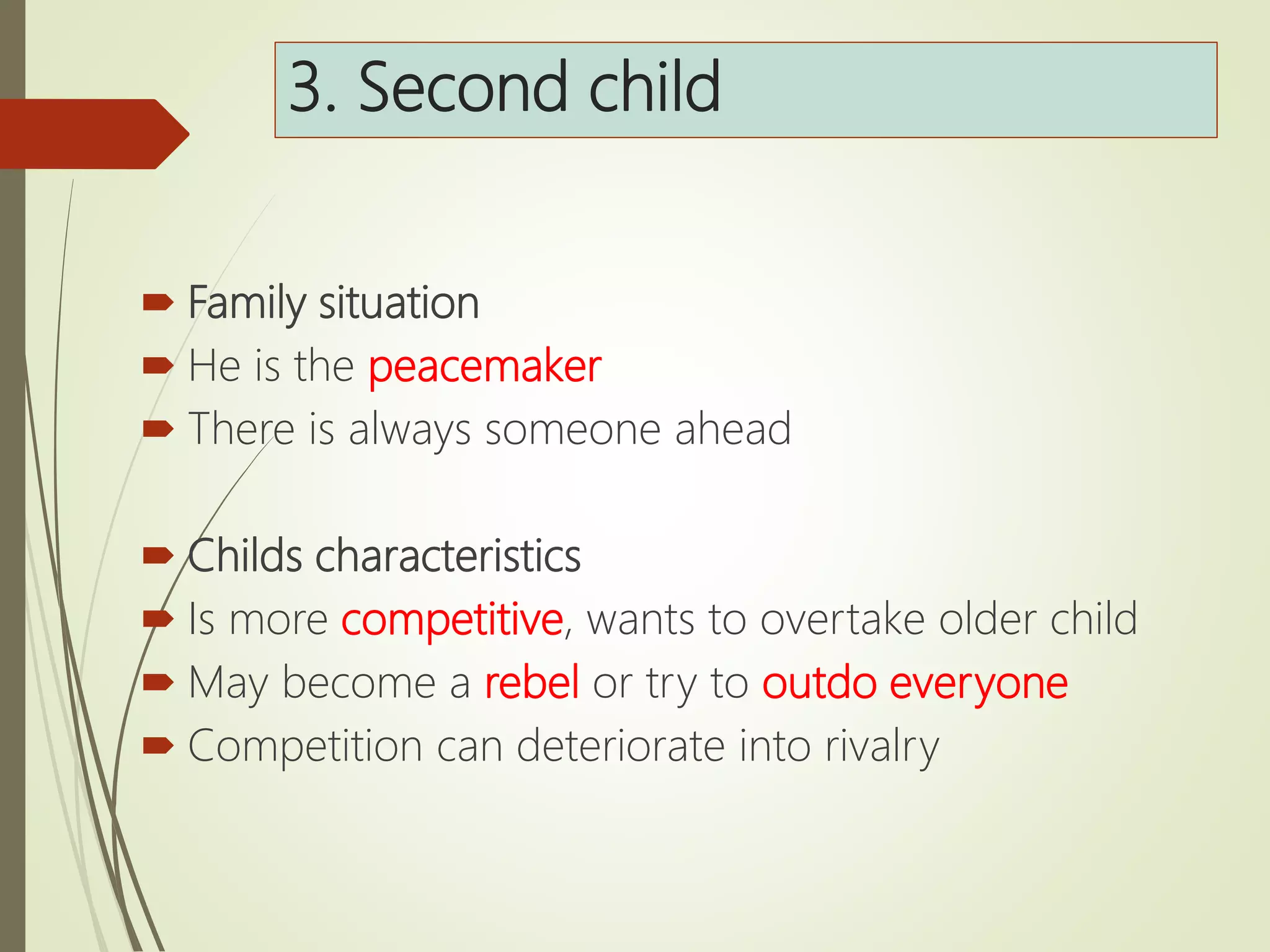
3. Second child
 Family situation
 He is the peacemaker
 There is always someone ahead
 Childs characteristics
 Is more competitive, wants to overtake older child
 May become a rebel or try to outdo everyone
 Competition can deteriorate into rivalry
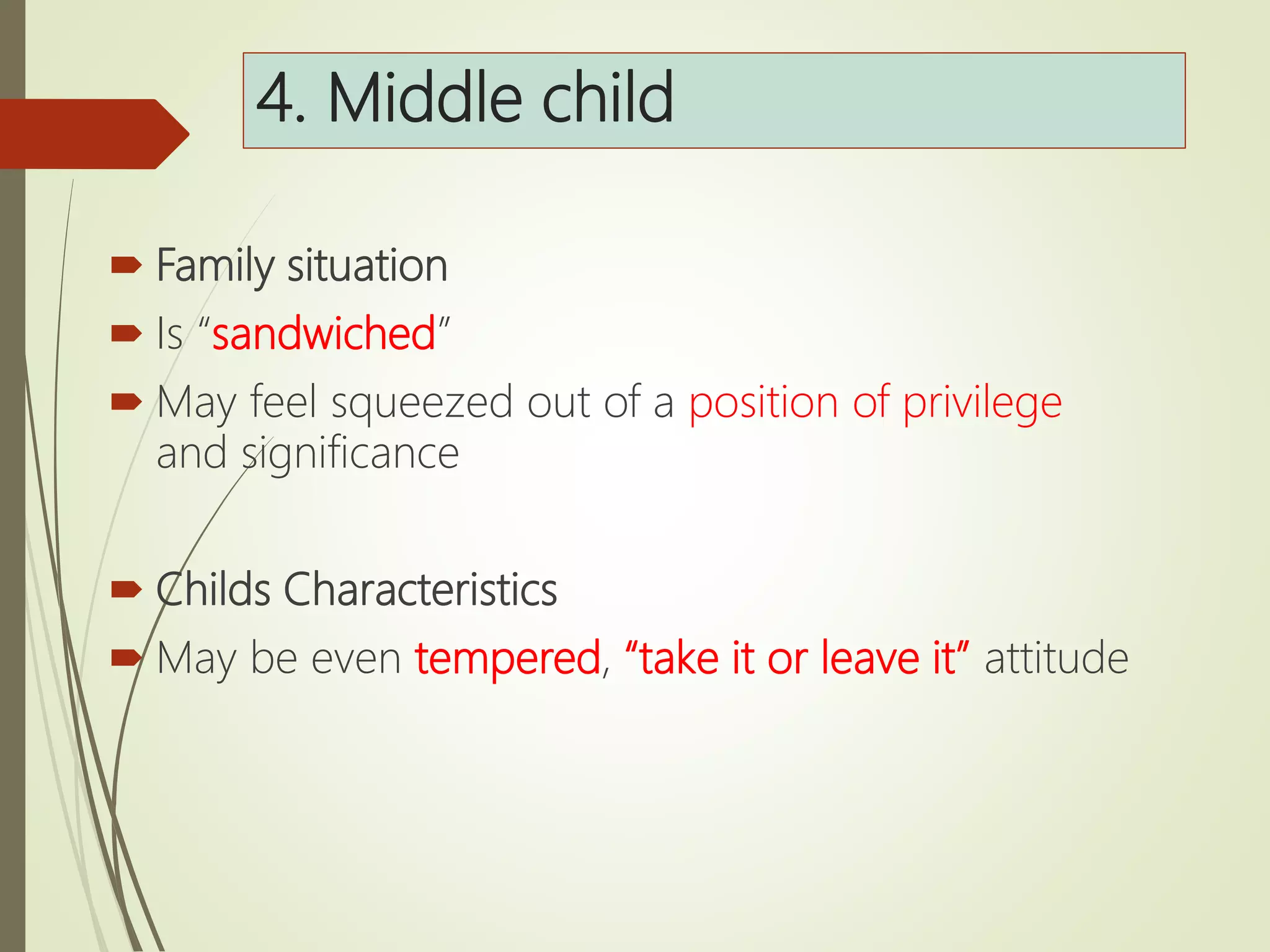
4. Middle child
 Family situation
 Is “sandwiched”
 May feel squeezed out of a position of privilege
and significance
 Childs Characteristics
 May be even tempered, “take it or leave it” attitude
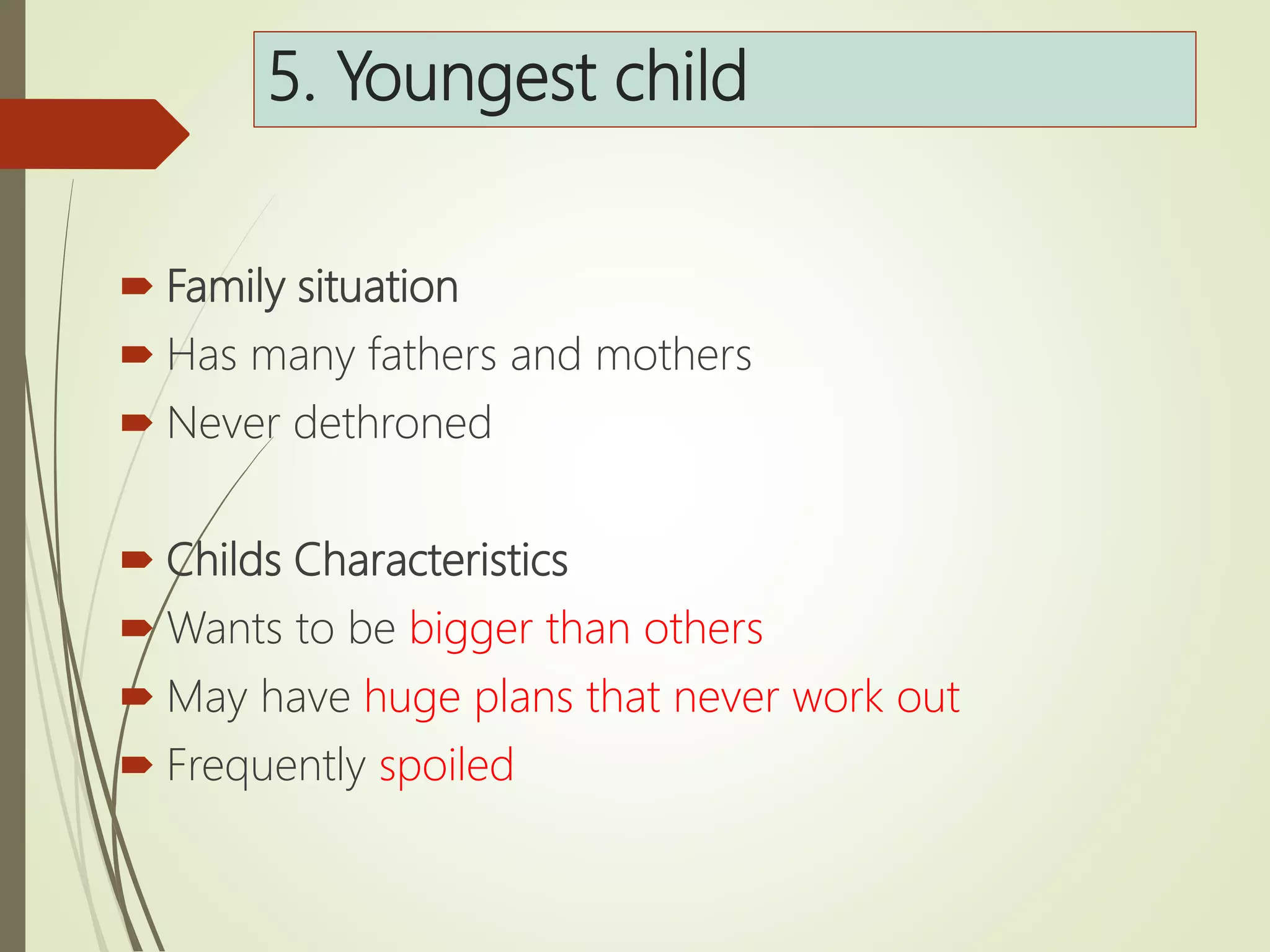
5. Youngest child
 Family situation
 Has many fathers and mothers
 Never dethroned
 Childs Characteristics
 Wants to be bigger than others
 May have huge plans that never work out
 Frequently spoiled
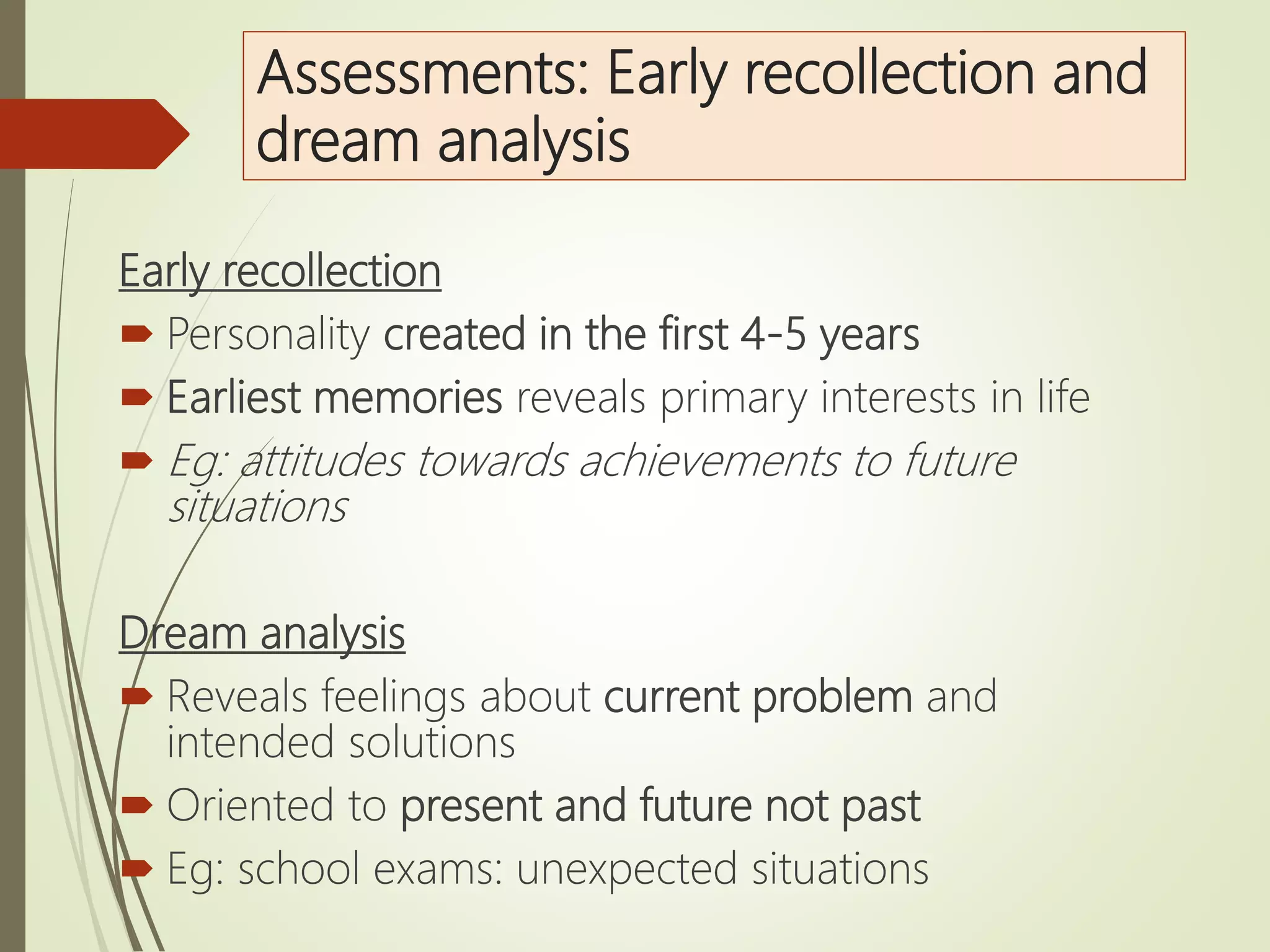
Assessments: Early recollection and
dream analysis
Early recollection
 Personality created in the first 4-5 years
 Earliest memories reveals primary interests in life
 Eg: attitudes towards achievements to future
situations
Dream analysis
 Reveals feelings about current problem and
intended solutions
 Oriented to present and future not past
 Eg: school exams: unexpected situations
Techniques of Individual Psychology
Therapy
 The counsellor must communicate that it is the client’s
responsibility to act and that from acting in a responsible
way he can expect progress and success.
i) Establishing the Relationship
ii) Exploring the Individuals Dynamics
iii) Encouraging Self-Understanding & Insight
iv) Helping with Reorientation
i) Establishing the Relationship
a) Supportive, collaborative, educational, encouraging process
b) Person-to-person contact with the client precedes identification of
the problem
 How clients present himself?
 How greets the therapist?
 How talks about himself or others?
 How handle new situation of therapy?
 Bitter et al., 1998 says:
 We often start an interview with “What do you want me to know
about you?” rather than “What brought you in?” or “What did you
want to talk about today?”. Meeting and valuing the person is
essential to positive change; the relationship may not be
everything that matters, but it is almost everything that matters.
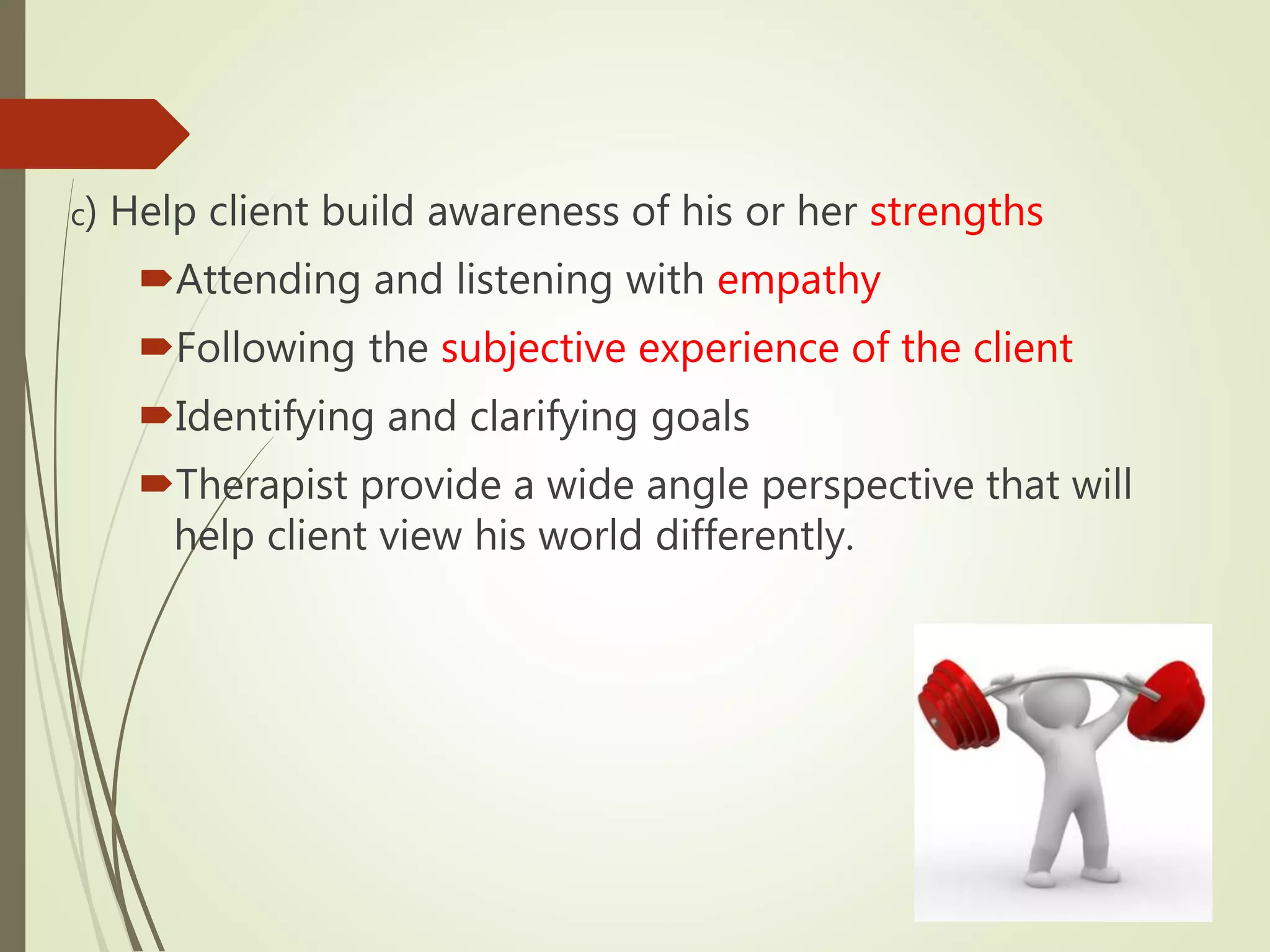
c) Help client build awareness of his or her strengths
Attending and listening with empathy
Following the subjective experience of the client
Identifying and clarifying goals
Therapist provide a wide angle perspective that will
help client view his world differently.
(ii) Exploring the Individuals Dynamics
i. Lifestyle assessment
 Family constellation
 Early childhood history
 Early memories
 Basic mistakes
i. Subjective interview
 Tell his story as completely as possible
 Therapist listens for clues of what client’s cope approach & pattern to life.
iii. Objective interview
 How problems in client’s life began
 Any precipitating events
 Medical history
 Reasons client chose therapy at this time
iii) Encouraging Self-Understanding & Insight
Human life has purpose
Interpret the findings of the assessment
Hidden goals and purposes of behavior are made conscious
Therapist offers interpretations to help clients gain insight into
their lifestyle.
Eg: Therapist guess by using statement “It seems to me that...”
“Could it be that…” “This is how it appears to me…”
 Encouragement instills self confidence by expecting
clients to assume responsibility for their lives and
embrace the fact that they can make changes
 Encouragement is the most powerful method available
for changing a person’s beliefs
Helps build self-confidence and stimulates courage
Discouragement is the basic condition that prevents
people from functioning
Clients are encouraged to recognize that they have
the power to choose and to act differently
iv) Helping with Reorientation
 Putting insights into practice.
 Discover new and more functional alternatives.
 Clients encouraged & challenged to develop courage to
take risks & make changes in life.
 Clients aware of their strengths, feel they belong and are
not alone, have sense of hope and see new possibilities
for themselves and daily living.
 Encouraged to act as if they were the people they want
to be.
Video
Applications of the Therapy
1. Class room management which fosters students self-discipline,
responsibility and belongingness;
2. Encouragement training which promotes self-esteem and self
acceptance;
3. Co-operation based on mutual respect and equality to prepare
students to live optimally in a democratic society;
4. The classroom as a key place for therapeutic learning (i.e.
understanding group dynamics, group guidance, structured class
meetings for problem solving, decision-making behaviour, conflict
resolution, encouragement and other related issues);
5. Raising awareness of community feeling by reaching out
to others through self acceptance and an understanding
of the tasks of life:
1. the task of communal life or social relationships;
2. the task of work or contributing in a useful way;
3. the task of sex, love and intimacy;
4. the task of self or relating with oneself, and
5. the task of one's relationship to God, the universe and
for finding meaning in life (i.e. the spiritual task).
Contributions of the Therapy
Focus on social interest,
pursuing meaning in life,
importance of family, goal
orientation and belonging
that is congruent with many
cultures.
Focus on in-person
environment allows for
cultural factors to be
explored.
Personality Disorders
 Personality disorders are specific
types of psychological disorders
that involve unhealthy
personality traits. In this lesson,
we'll examine how psychologists
diagnose personality disorders,
including the different clusters
of disorders and behavioral
characteristics associated with
each.
Lily has a problem. She thinks she's better, prettier, and
smarter than everyone else. She insists that she's always
right, and if others correct her she gets very angry and
defensive. If she wants something, she'll do whatever it
takes to get it, even if others get hurt. Lily's friends think
that she might have a personality disorder, which is a
psychological disorder that involves unhealthy and rigid
patters of thinking and behavior. There are many
different types of personality disorders, all of which look
a little different.
So does Lily have a personality disorder?
To figure that out, let's pretend we’re Lily's psychologist
and look at how we can diagnose personality disorders
and what the different disorders are.
How to Diagnose?
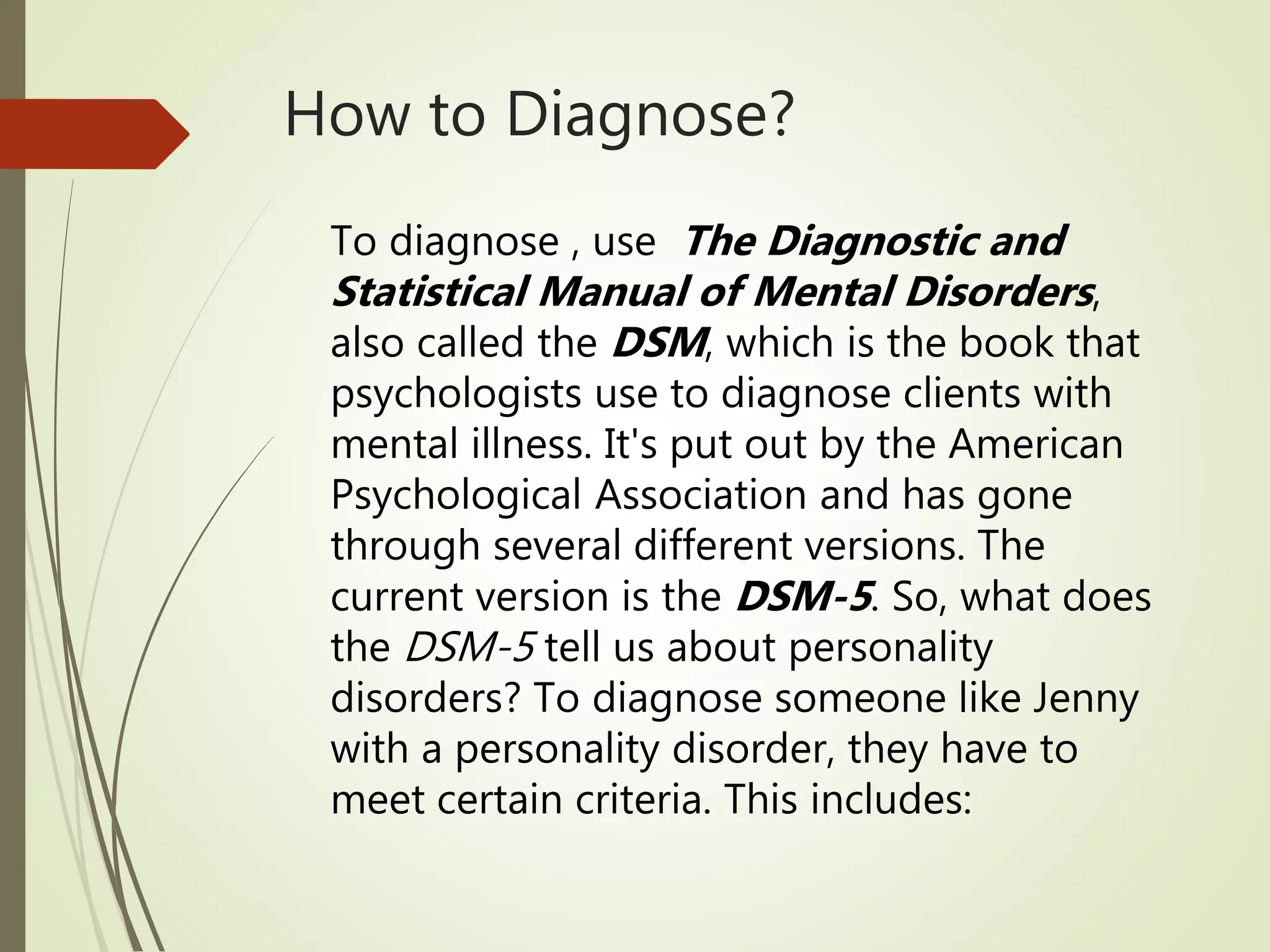
To diagnose , use The Diagnostic and
Statistical Manual of Mental Disorders,
also called the DSM, which is the book that
psychologists use to diagnose clients with
mental illness. It's put out by the American
Psychological Association and has gone
through several different versions. The
current version is the DSM-5. So, what does
the DSM-5 tell us about personality
disorders? To diagnose someone like Jenny
with a personality disorder, they have to
meet certain criteria. This includes:
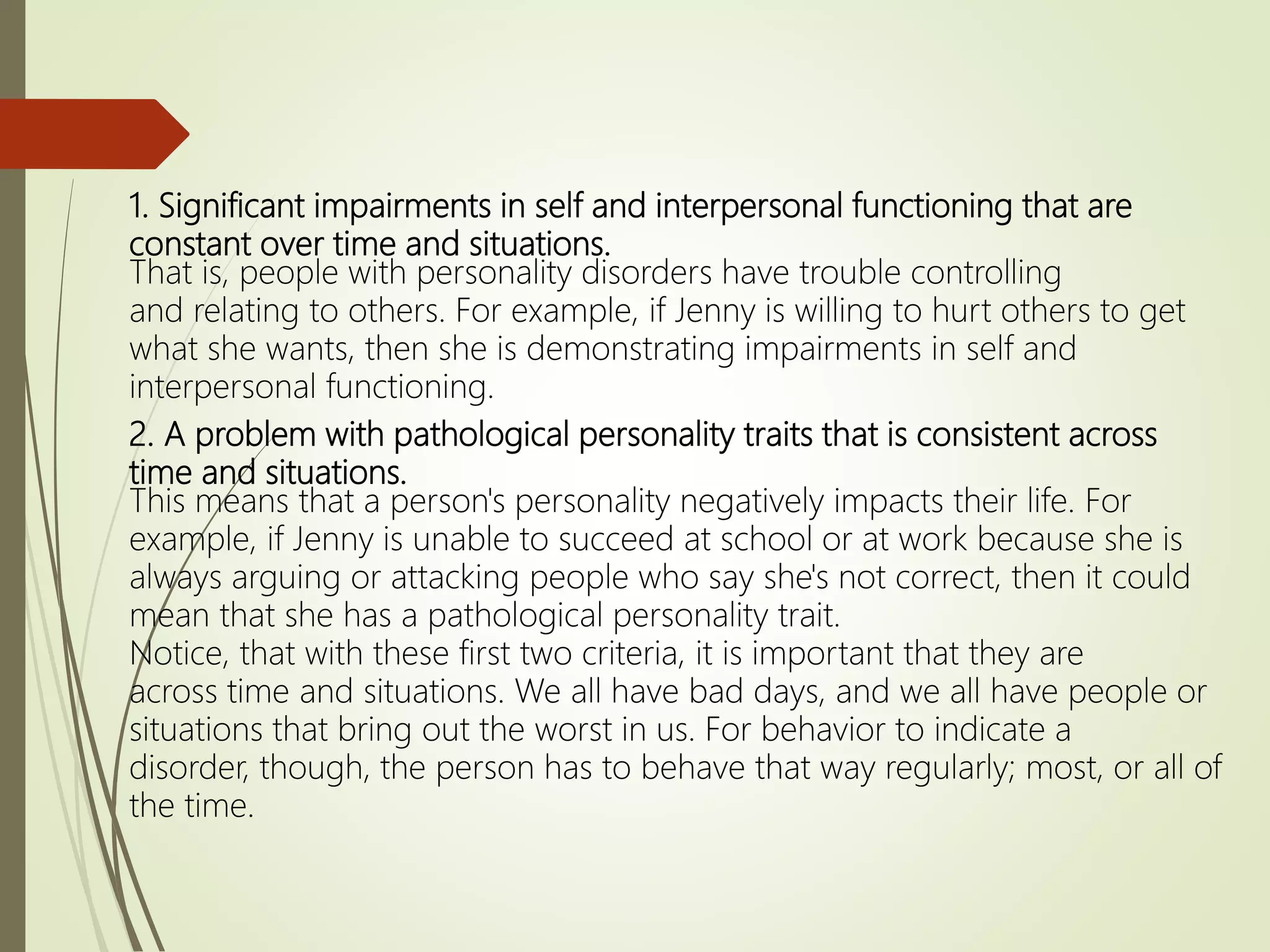
1. Significant impairments in self and interpersonal functioning that are
constant over time and situations.
That is, people with personality disorders have trouble controlling
and relating to others. For example, if Jenny is willing to hurt others to get
what she wants, then she is demonstrating impairments in self and
interpersonal functioning.
2. A problem with pathological personality traits that is consistent across
time and situations.
This means that a person's personality negatively impacts their life. For
example, if Jenny is unable to succeed at school or at work because she is
always arguing or attacking people who say she's not correct, then it could
mean that she has a pathological personality trait.
Notice, that with these first two criteria, it is important that they are
across time and situations. We all have bad days, and we all have people or
situations that bring out the worst in us. For behavior to indicate a
disorder, though, the person has to behave that way regularly; most, or all of
the time.
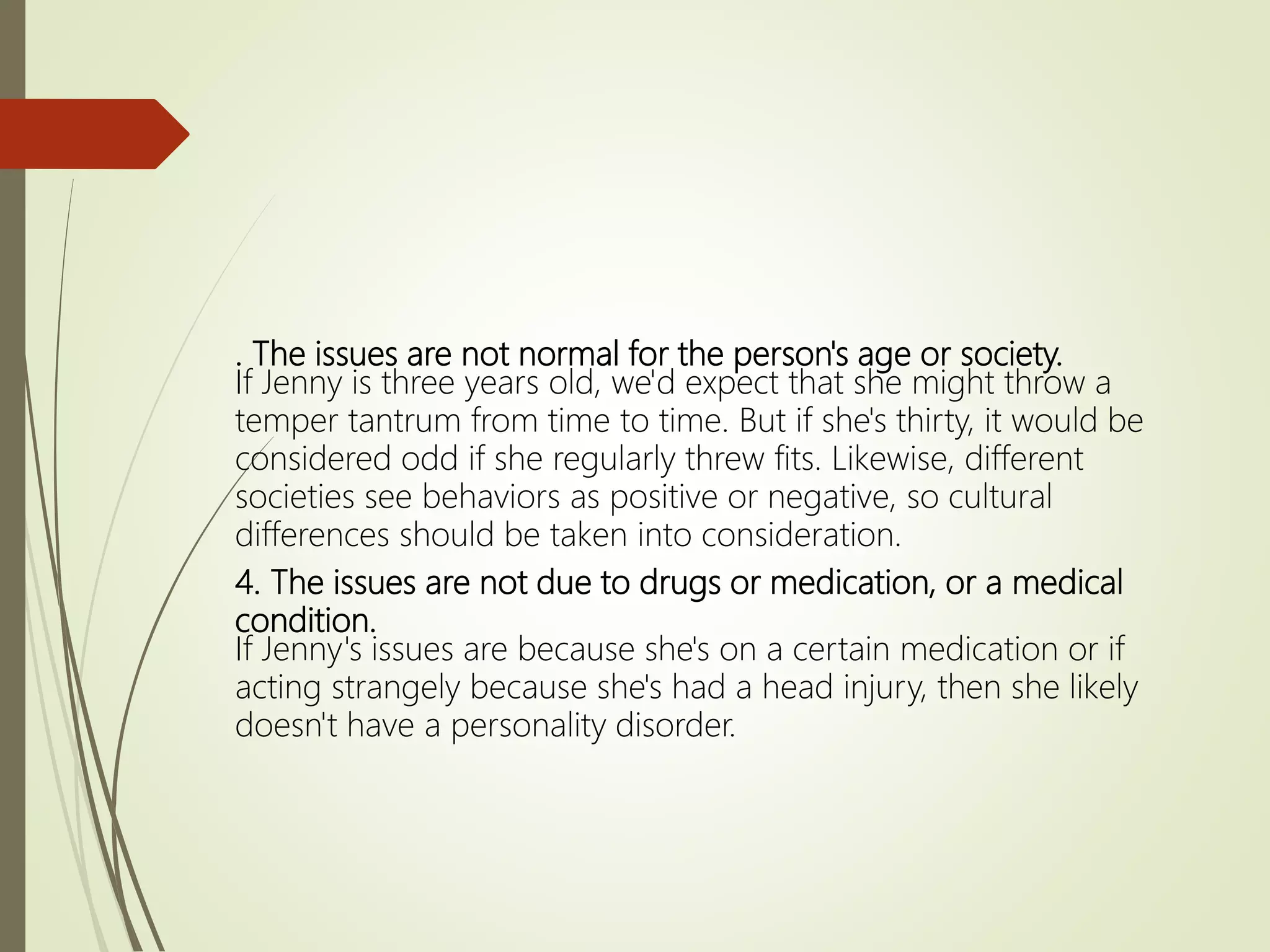
. The issues are not normal for the person's age or society.
If Jenny is three years old, we'd expect that she might throw a
temper tantrum from time to time. But if she's thirty, it would be
considered odd if she regularly threw fits. Likewise, different
societies see behaviors as positive or negative, so cultural
differences should be taken into consideration.
4. The issues are not due to drugs or medication, or a medical
condition.
If Jenny's issues are because she's on a certain medication or if
acting strangely because she's had a head injury, then she likely
doesn't have a personality disorder.
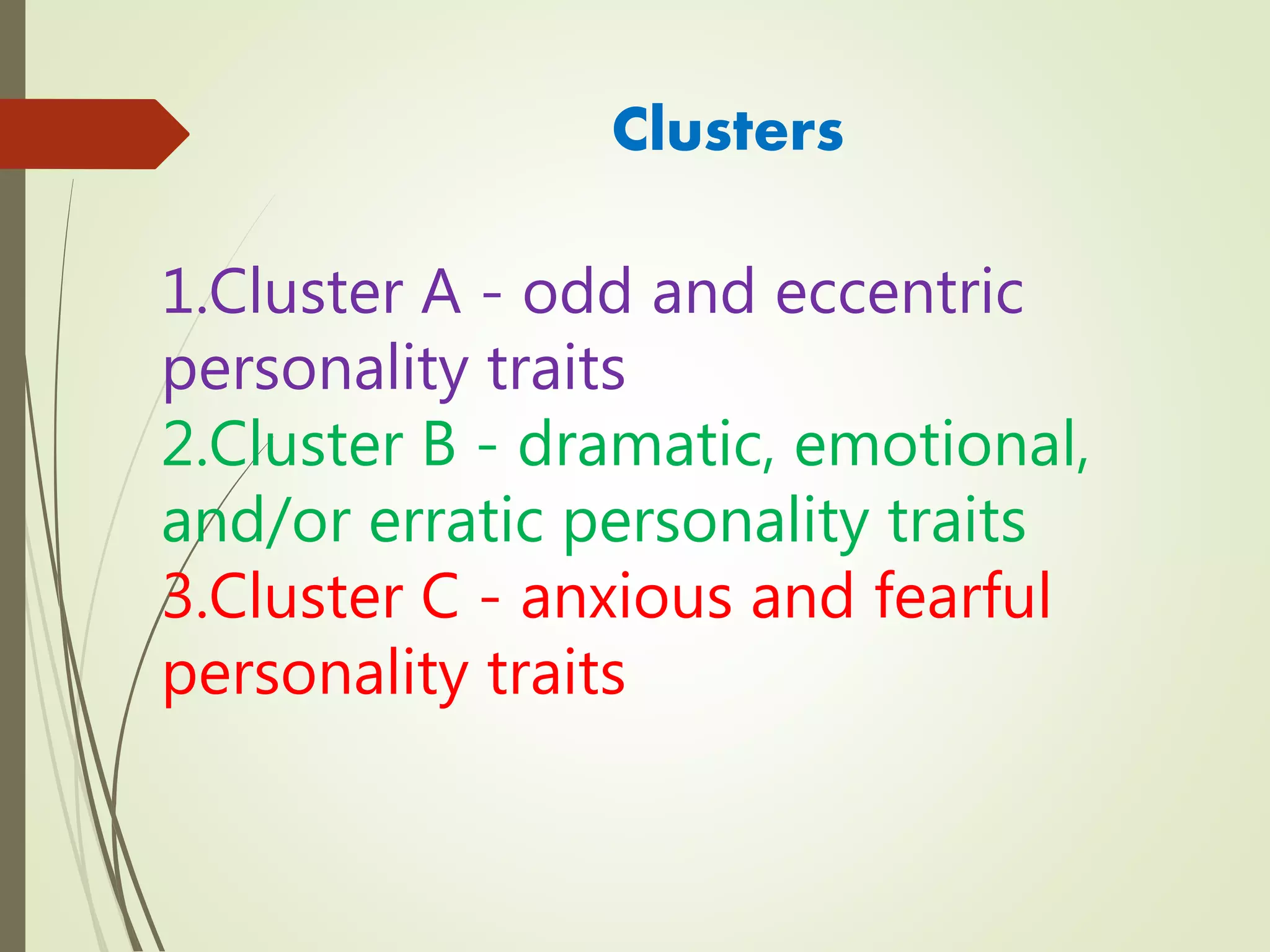
Clusters
1.Cluster A - odd and eccentric
personality traits
2.Cluster B - dramatic, emotional,
and/or erratic personality traits
3.Cluster C - anxious and fearful
personality traits

Theory of Personality Adlerian

  • 1.
  • 2.
    Alfred Adler Born: February7, 1870 near Vienna Third child in seven children Apparent physical comfort, but miserably in childhood Known for his efforts of outdoing his older brother Received a medical degree in 1895 Influenced by Marx's philosophy Joined feuds group then decided to leave the group and formed "the society of individual psychology”
  • 3.
    Individual psychology Focuses onuniqueness of each person Denies universal biological drives and goals We should see person as a whole rather than a part
  • 4.
    Feelings of inferiority Alwayspresent as motivating force in behavior Source of all human striving Growth results from compensation: attempts to overcome inferior feeling Inferiority Complex Inability to overcome inferiority feelings: helpless, poor self- opinion 3 sources Organic: physical deficits Spoiling: immediate gratification, little regard for needs of others Neglect: lack of love, security, develop feeling of worthlessness
  • 5.
    Striving for Superiority Ultimategoal in life Drive to perfection Not an attempted to be better than others Fictional finalism: reach goals set in the future to be complete, whole potential and guide behavior Superior complex Overcompensate for feelings of inferiority Exaggerated and opinion of ones ability and accomplishments
  • 6.
    Style of life Expressionof striving superiority to attain goals Learned from early social interactions Guiding frameworks for all later behaviors how people live life, how they handle problems and interpersonal relation
  • 7.
    Universal Problems andstyles of life dealing with problems  Problems:  Involving behavior towards others  Occupational  Relationship/love  Styles of life:  Dominant – little self-awareness  Getting- Expect to receive satisfactions from others, becomes dependent  Avoiding- avoids life problems  Socially useful- cooperates with others, shows social interests
  • 8.
    Social interests Innate potentialto cooperate with others to reach personal and societal goals Individual must cooperate with and contribute to society to achieve goals Babies and small children often show sympathy for others without having been taught to do so. Being useful to others lacking in social interest including neurotics, psychotics ,criminals ,drunkards ,problem, children ,perverts are SOCIAL FAILURES
  • 9.
    Neurosis All neurosis isa matter of insufficient social interest. Three types: 1. Ruling type 2. Getting type 3. Avoiding type
  • 10.
    1. The rullingtype From childhood, they are characterized by a tendency to be rather aggressive and dominant with others The strength of their striving after personal power is so great that they tend to push over anything or anybody who gets in their way. These are BULLIES and SADIST
  • 11.
    2. The gettingtype They relatively passive: make little effort to solve their own problems Instead, they rely on others to take care of them Frequently use charm to persuade others to help them
  • 12.
    3. The avoidingtype These have the lowest level of energy and only survive by essentially avoiding life When pushed to the limits, they tend to become psychotic, retreating finally into their own personal words
  • 13.
    Childhood  Like Freud,Adler saw personality or lifestyle s something established quite early in life  There were three basic childhood situations that most contribute to faulty lifestyle. 1. Feeling of inferiority: if someone's does not come along to draw their attention to others, these children will remain focused on themselves. 2. Pampering: many children are taught by the actions of others that they can take without giving.  They do not learn to do for themselves  They don’t know of dealing with others than giving of commands 3. Neglect: the child who neglected or abused learns what the pampered child learns, but learns it in a far direct manner  They learn selfishness because they are taught to trust no one
  • 14.
    Birth orders Alder consideredbirth order, as another one of those heuristic ideas—useful fictions, that contribute to understanding people but must be not taken too seriously. Adler must be credited as the first theorist to include the child's brothers and sisters as an early influence on the child
  • 15.
    1. Only child Family situation  Birth is miracle  Parents have no previous experience  Retains 20% percent attention from the parents  Can be over protected and spoiled  Child’s Characteristic  Likes being the center of attraction  Often has difficulty sharing with siblings and peers  Prefers adult company and uses adult language
  • 16.
    2. eldest child Family situation  Dethroned by next child  Parents expectations are usually high  Often given responsibility and expected to set an example  Childs characteristics  May become authoritarian or strict  Feels power in his hand  Can become helpful; if encouraged
  • 17.
    3. Second child Family situation  He is the peacemaker  There is always someone ahead  Childs characteristics  Is more competitive, wants to overtake older child  May become a rebel or try to outdo everyone  Competition can deteriorate into rivalry
  • 18.
    4. Middle child Family situation  Is “sandwiched”  May feel squeezed out of a position of privilege and significance  Childs Characteristics  May be even tempered, “take it or leave it” attitude
  • 19.
    5. Youngest child Family situation  Has many fathers and mothers  Never dethroned  Childs Characteristics  Wants to be bigger than others  May have huge plans that never work out  Frequently spoiled
  • 20.
    Assessments: Early recollectionand dream analysis Early recollection  Personality created in the first 4-5 years  Earliest memories reveals primary interests in life  Eg: attitudes towards achievements to future situations Dream analysis  Reveals feelings about current problem and intended solutions  Oriented to present and future not past  Eg: school exams: unexpected situations
  • 21.
    Techniques of IndividualPsychology Therapy  The counsellor must communicate that it is the client’s responsibility to act and that from acting in a responsible way he can expect progress and success. i) Establishing the Relationship ii) Exploring the Individuals Dynamics iii) Encouraging Self-Understanding & Insight iv) Helping with Reorientation
  • 22.
    i) Establishing theRelationship a) Supportive, collaborative, educational, encouraging process b) Person-to-person contact with the client precedes identification of the problem  How clients present himself?  How greets the therapist?  How talks about himself or others?  How handle new situation of therapy?  Bitter et al., 1998 says:  We often start an interview with “What do you want me to know about you?” rather than “What brought you in?” or “What did you want to talk about today?”. Meeting and valuing the person is essential to positive change; the relationship may not be everything that matters, but it is almost everything that matters.
  • 23.
    c) Help clientbuild awareness of his or her strengths Attending and listening with empathy Following the subjective experience of the client Identifying and clarifying goals Therapist provide a wide angle perspective that will help client view his world differently.
  • 24.
    (ii) Exploring theIndividuals Dynamics i. Lifestyle assessment  Family constellation  Early childhood history  Early memories  Basic mistakes i. Subjective interview  Tell his story as completely as possible  Therapist listens for clues of what client’s cope approach & pattern to life. iii. Objective interview  How problems in client’s life began  Any precipitating events  Medical history  Reasons client chose therapy at this time
  • 25.
    iii) Encouraging Self-Understanding& Insight Human life has purpose Interpret the findings of the assessment Hidden goals and purposes of behavior are made conscious Therapist offers interpretations to help clients gain insight into their lifestyle. Eg: Therapist guess by using statement “It seems to me that...” “Could it be that…” “This is how it appears to me…”
  • 26.
     Encouragement instillsself confidence by expecting clients to assume responsibility for their lives and embrace the fact that they can make changes  Encouragement is the most powerful method available for changing a person’s beliefs Helps build self-confidence and stimulates courage Discouragement is the basic condition that prevents people from functioning Clients are encouraged to recognize that they have the power to choose and to act differently
  • 27.
    iv) Helping withReorientation  Putting insights into practice.  Discover new and more functional alternatives.  Clients encouraged & challenged to develop courage to take risks & make changes in life.  Clients aware of their strengths, feel they belong and are not alone, have sense of hope and see new possibilities for themselves and daily living.  Encouraged to act as if they were the people they want to be.
  • 28.
  • 29.
    Applications of theTherapy 1. Class room management which fosters students self-discipline, responsibility and belongingness; 2. Encouragement training which promotes self-esteem and self acceptance; 3. Co-operation based on mutual respect and equality to prepare students to live optimally in a democratic society; 4. The classroom as a key place for therapeutic learning (i.e. understanding group dynamics, group guidance, structured class meetings for problem solving, decision-making behaviour, conflict resolution, encouragement and other related issues);
  • 30.
    5. Raising awarenessof community feeling by reaching out to others through self acceptance and an understanding of the tasks of life: 1. the task of communal life or social relationships; 2. the task of work or contributing in a useful way; 3. the task of sex, love and intimacy; 4. the task of self or relating with oneself, and 5. the task of one's relationship to God, the universe and for finding meaning in life (i.e. the spiritual task).
  • 31.
    Contributions of theTherapy Focus on social interest, pursuing meaning in life, importance of family, goal orientation and belonging that is congruent with many cultures. Focus on in-person environment allows for cultural factors to be explored.
  • 32.
    Personality Disorders  Personalitydisorders are specific types of psychological disorders that involve unhealthy personality traits. In this lesson, we'll examine how psychologists diagnose personality disorders, including the different clusters of disorders and behavioral characteristics associated with each.
  • 33.
    Lily has aproblem. She thinks she's better, prettier, and smarter than everyone else. She insists that she's always right, and if others correct her she gets very angry and defensive. If she wants something, she'll do whatever it takes to get it, even if others get hurt. Lily's friends think that she might have a personality disorder, which is a psychological disorder that involves unhealthy and rigid patters of thinking and behavior. There are many different types of personality disorders, all of which look a little different. So does Lily have a personality disorder? To figure that out, let's pretend we’re Lily's psychologist and look at how we can diagnose personality disorders and what the different disorders are.
  • 34.
    How to Diagnose? Todiagnose , use The Diagnostic and Statistical Manual of Mental Disorders, also called the DSM, which is the book that psychologists use to diagnose clients with mental illness. It's put out by the American Psychological Association and has gone through several different versions. The current version is the DSM-5. So, what does the DSM-5 tell us about personality disorders? To diagnose someone like Jenny with a personality disorder, they have to meet certain criteria. This includes:
  • 35.
    1. Significant impairmentsin self and interpersonal functioning that are constant over time and situations. That is, people with personality disorders have trouble controlling and relating to others. For example, if Jenny is willing to hurt others to get what she wants, then she is demonstrating impairments in self and interpersonal functioning. 2. A problem with pathological personality traits that is consistent across time and situations. This means that a person's personality negatively impacts their life. For example, if Jenny is unable to succeed at school or at work because she is always arguing or attacking people who say she's not correct, then it could mean that she has a pathological personality trait. Notice, that with these first two criteria, it is important that they are across time and situations. We all have bad days, and we all have people or situations that bring out the worst in us. For behavior to indicate a disorder, though, the person has to behave that way regularly; most, or all of the time.
  • 36.
    . The issuesare not normal for the person's age or society. If Jenny is three years old, we'd expect that she might throw a temper tantrum from time to time. But if she's thirty, it would be considered odd if she regularly threw fits. Likewise, different societies see behaviors as positive or negative, so cultural differences should be taken into consideration. 4. The issues are not due to drugs or medication, or a medical condition. If Jenny's issues are because she's on a certain medication or if acting strangely because she's had a head injury, then she likely doesn't have a personality disorder.
  • 37.
    Clusters 1.Cluster A -odd and eccentric personality traits 2.Cluster B - dramatic, emotional, and/or erratic personality traits 3.Cluster C - anxious and fearful personality traits