Research Methods
Variable
• Something subject to change
• Varies from person to person
Types of Variables
• Independent Variable
• Dependent Variable
Independent Variable
• The condition manipulated or selected by the
experimenter to determine its effect on behavior of
subjects.
• A variable that a researcher selects to change or
manipulate its values to determine its relationship with
other variables.
• Its termed as the presumed cause of change in
dependent variable.
Example
• In Organizations
• A researcher wants to determine if the color of an
office has any effect on worker productivity. In an
experiment, one group of workers performs a task in
a yellow room while another performs the same task
in a blue room. In this example, the color of the
office is the independent variable.
• Color of Office = IV
• Worker Productivity = DV
Dependent Variable
• A measure of the behavior of the subjects that is
affected by the change in IV.
• The variable that is affected by the change in IV
• IV is antecedent and DV is consequence.
Examples
You want to see the effect of studying or sleeping
on a test score. In the example, “test score” is the
dependent variable. “Studying” or “sleeping” is
the independent variable because these factors
impact how much a student scores on the test.
Studying or sleeping = IV
Test Scores = DV
Example
Education and Earnings
• A researcher wants to know if education level
impacts how much a person earns in their job. She
studies the amount of education a person has in
their life to their current earnings.
• independent variable - highest level of
educational attainment
• dependent variable - earnings (salary or wages)
Example
Time Spent Studying and Academic Success
• An educational researcher explores whether there is
a link between the amount of time someone spends
studying and the grade they get in a particular class.
• independent variable - amount of time spent
studying for a particular class
• dependent variable - grade in the class
Basic and Applied Research
• Basic research describe and explain phenomena. Basic
research aimed at description, explanation, and
prediction of phenomenon. The researches on sensation,
perception, learning and memory are basic researches.
• On the other hand, applied research is the research that
is designed to solve specific practical problem or answer
certain question. we apply behavior to solve problem.
The nature of basic research is theoretical while nature
of applied research is practical.
Quantitative Vs Qualitative Research
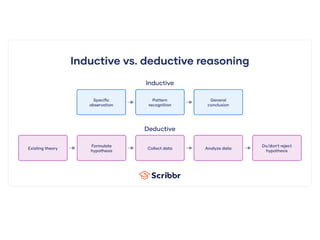
• In quantitative research, the data are collected and presented
in the form of numbers, percentages of people who do one
thing or another, graphs and tables of data, and so on.
• In recent years, however, a number of research psychologists
have begun doing what is known as qualitative research,
which may involve interview data, detailed case studies,
detailed observation etc. What these various forms of
qualitative research have in common is that results are
presented not as statistical summaries but as analytical
narratives that summarize the project’s main outcomes.
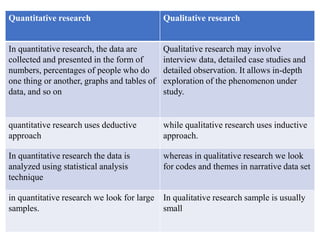
Quantitative research Qualitative research
In quantitative research, the data are
collected and presented in the form of
numbers, percentages of people who do
one thing or another, graphs and tables of
data, and so on
Qualitative research may involve
interview data, detailed case studies and
detailed observation. It allows in-depth
exploration of the phenomenon under
study.
quantitative research uses deductive
approach
while qualitative research uses inductive
approach.
In quantitative research the data is
analyzed using statistical analysis
technique
whereas in qualitative research we look
for codes and themes in narrative data set
in quantitative research we look for large
samples.
In qualitative research sample is usually
small
Survey Designs
What is survey research?
• Survey research designs are procedures in
quantitative research in which investigators
administer a survey to a sample or to the entire
population of people in order to describe the
attitudes, opinions, behaviors, or characteristics of
the population.
• A survey is a structured set of questions or
statements given to a group of people to measure
their attitudes, beliefs, values, or tendencies to act
Steps in conducting survey research
• Decide if a survey is the best deign to use
• Identify the research questions or hypotheses
• Identify the population and the sample
• Determine the survey design and data collection
procedures
• Develop or locate an instrument
• Administer the instrument
• Analyze the data to address the research questions or
hypotheses
• Write the report
Types of Survey Research
• In a cross-sectional study you collect
data from a population at a specific
point in time; in a longitudinal study
you repeatedly collect data from the
same sample over an extended period
of time.
Educational Research 2e: Creswell
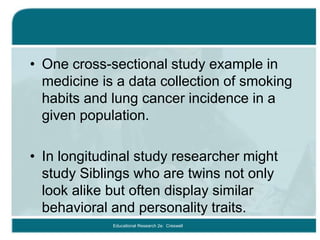
• One cross-sectional study example in
medicine is a data collection of smoking
habits and lung cancer incidence in a
given population.
• In longitudinal study researcher might
study Siblings who are twins not only
look alike but often display similar
behavioral and personality traits.
Educational Research 2e: Creswell
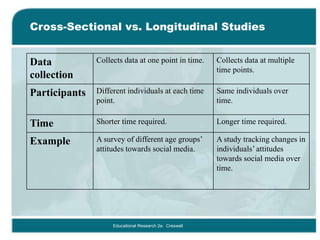
Cross-Sectional vs. Longitudinal Studies
Data
collection
Collects data at one point in time. Collects data at multiple
time points.
Participants Different individuals at each time
point.
Same individuals over
time.
Time Shorter time required. Longer time required.
Example A survey of different age groups’
attitudes towards social media.
A study tracking changes in
individuals’ attitudes
towards social media over
time.
Educational Research 2e: Creswell
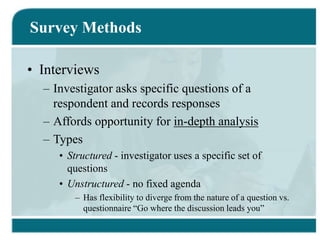
Survey Methods
• Interviews
– Investigator asks specific questions of a
respondent and records responses
– Affords opportunity for in-depth analysis
– Types
• Structured - investigator uses a specific set of
questions
• Unstructured - no fixed agenda
– Has flexibility to diverge from the nature of a question vs.
questionnaire “Go where the discussion leads you”
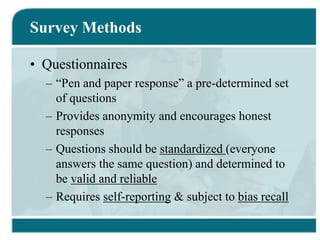
Survey Methods
• Questionnaires
– “Pen and paper response” a pre-determined set
of questions
– Provides anonymity and encourages honest
responses
– Questions should be standardized (everyone
answers the same question) and determined to
be valid and reliable
– Requires self-reporting & subject to bias recall
Correlational Research
• Correlation means whether one variable is
related to another.
• It is a type of associational research.
• In associational research, the relationship
between two or more variables are studied
without any attempt to influence them.
• The purpose of correlational research is to
discover relationships between two or more
naturally occurring variables with the goal of
identifying predictive relationship among them.
• It is also referred to as descriptive research
because it describes an existing relationship
between variables.
Correlational Research
• Correlational research observes whether an individuals
status on one variable tends to reflect his or her status
on the other.
• In correlational research one makes no attempt to
manipulate variables but observe them as they are.
• Main interest is to see whether two variables covary i.e.
whether change in one variable accompany change in
another variable.
Correlational Research
• To examine the possible existence of causation
• Is test anxiety the cause of decline in test
performance?
In correlational research you CAN NOT
absolutely say one variable causes something to
happen. This can only be done through
experimental research. You can only say one
variable might cause something else to happen.
Example
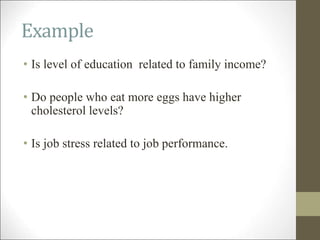
• Is level of education related to family income?
• Do people who eat more eggs have higher
cholesterol levels?
• Is job stress related to job performance.
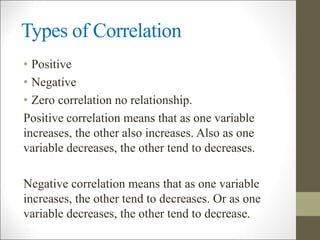
Types of Correlation
• Positive
• Negative
• Zero correlation no relationship.
Positive correlation means that as one variable
increases, the other also increases. Also as one
variable decreases, the other tend to decreases.
Negative correlation means that as one variable
increases, the other tend to decreases. Or as one
variable decreases, the other tend to decrease.
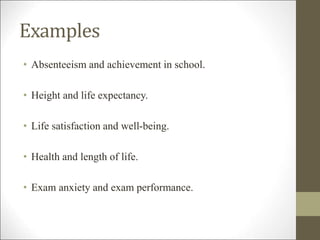
Examples
• Absenteeism and achievement in school.
• Height and life expectancy.
• Life satisfaction and well-being.
• Health and length of life.
• Exam anxiety and exam performance.
OBSERVATION
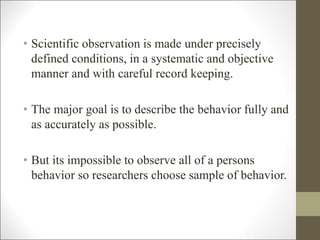
• Scientific observation is made under precisely
defined conditions, in a systematic and objective
manner and with careful record keeping.
• The major goal is to describe the behavior fully and
as accurately as possible.
• But its impossible to observe all of a persons
behavior so researchers choose sample of behavior.
Sampling Behavior
• When a complete record of behavior cannot be
obtained, researchers seek to obtain a representative
sample of behavior.
• External Validity of the research depends on how
behavior is sampled.
• Since the sample represents the larger population the
researcher chooses time, settings, conditions and
participants to enhance the generalizability of the
research.
• Time Sampling: researcher seek representative
sample by choosing various time intervals either
systematically or randomly.
Examples
• For example, a researcher may observe a group of
children for 10 seconds every 5 minutes for a specific
30-minutes period each day.
• The researcher could decide to only observe subjects
every morning for an hour.
• Event Sampling: the researcher observes each
event that meets a predetermined definition. Event
sampling can be kept track easily by marking on a
table when a behavior occurs if a specific
behavior is being identified.
Examples
• A researcher may record each episode of apnea
that occurs within a 9-hour period overnight while
a person sleeps.
• A teacher may record each time a student reacts
violently. Then, they can identify if there was a
trigger that caused the student to react violently
during each event, which can help them find the
root cause of the student's aggression.
• Situational Sampling: involves observing
behavior in as many different locations and under
as many different circumstances and conditions
as possible.
Example
• An example of this would be observing a child in
a classroom, home, and community setting to
determine if certain behaviors only occur in
certain settings.
Situationsamplingexample
• For example, a psychologist may observe how
their patient acts when they're alone at a park,
then they may observe how their client acts at a
party with several people. If the client acts
negatively at the party, though they act positively
when alone, then the psychologist can recognize
that the social situation may cause the negative
reaction.
• Subject Sampling: instead of recording
behavior of all the individuals present the
researcher either systematically or randomly
chooses the people to observe.
Types of Observation
Observation without Intervention
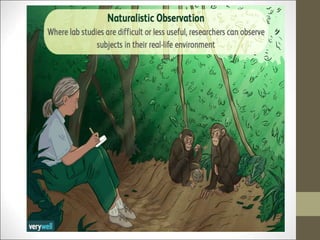
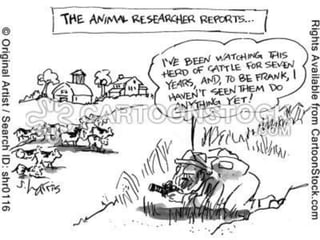
• Naturalistic Observation: the goal of
naturalistic observation is to describe the
behavior as it naturally occurs.
• Naturalistic observation is a research
method that involves observing clients
and customers in a natural environment
rather than a clinical setting.
Observation with Intervention
• Participant Observation: allows researcher to observe behaviors
that are not open to observation. The researcher plays a dual role
he/she observer's peoples behavior and they actively participate in
the situation.
1.Disguised (Rosenhan, 1973 study “On being sane in insane places”
2. Undisguised
• In disguised participant observation the observed individual
do not know that they are being observed.
• This technique is often used when researcher believes that the
individuals under observation may change their behavior as a
result of knowing that they were being recorded.
• In undisguised participant observation the individuals know
that they are being observed. This technique is often used to
understand the culture and behavior of groups or individuals.
Rosenhan, 1973 study “on being sane in
insane places “
the Rosenhan experiment or thud experiment was conducted to
determine the validity of psychiatric diagnosis in USA. 30 participants
were selected and sent to the psychiatrist facilities as a patient. they
feigned hallucinations (hearing sound of thud). they got admit and
many of them were given the diagnosis of schizophrenia, based on 1
symptom of auditory hallucination. But they after showed normal
behavior, spoke to other patients and staff members in an ordinary
manner. But not even psychiatrist nor assistant notice the individual
has recovered. The participants took notes of the behavior of doctors
and attendant. their normal behavior was also considered abnormal.
The hospital staff made this judgment without observing even one
actual symptom of schizophrenia. Rosenhan concluded that there is a
big overlap between sane and insane behavior. every person must feel
depressed at times. However, in the setting of psychiatrist hospitals,
these everyday human emotions and behaviors were interpreted as
result of having a mental illness.

Research Methods.ppt

  • 1.
  • 2.
    Variable • Something subjectto change • Varies from person to person
  • 3.
    Types of Variables •Independent Variable • Dependent Variable
  • 4.
    Independent Variable • Thecondition manipulated or selected by the experimenter to determine its effect on behavior of subjects. • A variable that a researcher selects to change or manipulate its values to determine its relationship with other variables. • Its termed as the presumed cause of change in dependent variable.
  • 5.
    Example • In Organizations •A researcher wants to determine if the color of an office has any effect on worker productivity. In an experiment, one group of workers performs a task in a yellow room while another performs the same task in a blue room. In this example, the color of the office is the independent variable. • Color of Office = IV • Worker Productivity = DV
  • 6.
    Dependent Variable • Ameasure of the behavior of the subjects that is affected by the change in IV. • The variable that is affected by the change in IV • IV is antecedent and DV is consequence.
  • 7.
    Examples You want tosee the effect of studying or sleeping on a test score. In the example, “test score” is the dependent variable. “Studying” or “sleeping” is the independent variable because these factors impact how much a student scores on the test. Studying or sleeping = IV Test Scores = DV
  • 8.
    Example Education and Earnings •A researcher wants to know if education level impacts how much a person earns in their job. She studies the amount of education a person has in their life to their current earnings. • independent variable - highest level of educational attainment • dependent variable - earnings (salary or wages)
  • 9.
    Example Time Spent Studyingand Academic Success • An educational researcher explores whether there is a link between the amount of time someone spends studying and the grade they get in a particular class. • independent variable - amount of time spent studying for a particular class • dependent variable - grade in the class
  • 10.
    Basic and AppliedResearch • Basic research describe and explain phenomena. Basic research aimed at description, explanation, and prediction of phenomenon. The researches on sensation, perception, learning and memory are basic researches. • On the other hand, applied research is the research that is designed to solve specific practical problem or answer certain question. we apply behavior to solve problem. The nature of basic research is theoretical while nature of applied research is practical.
  • 11.
    Quantitative Vs QualitativeResearch • In quantitative research, the data are collected and presented in the form of numbers, percentages of people who do one thing or another, graphs and tables of data, and so on. • In recent years, however, a number of research psychologists have begun doing what is known as qualitative research, which may involve interview data, detailed case studies, detailed observation etc. What these various forms of qualitative research have in common is that results are presented not as statistical summaries but as analytical narratives that summarize the project’s main outcomes.
  • 12.
    Quantitative research Qualitativeresearch In quantitative research, the data are collected and presented in the form of numbers, percentages of people who do one thing or another, graphs and tables of data, and so on Qualitative research may involve interview data, detailed case studies and detailed observation. It allows in-depth exploration of the phenomenon under study. quantitative research uses deductive approach while qualitative research uses inductive approach. In quantitative research the data is analyzed using statistical analysis technique whereas in qualitative research we look for codes and themes in narrative data set in quantitative research we look for large samples. In qualitative research sample is usually small
  • 14.
  • 15.
    What is surveyresearch? • Survey research designs are procedures in quantitative research in which investigators administer a survey to a sample or to the entire population of people in order to describe the attitudes, opinions, behaviors, or characteristics of the population. • A survey is a structured set of questions or statements given to a group of people to measure their attitudes, beliefs, values, or tendencies to act
  • 16.
    Steps in conductingsurvey research • Decide if a survey is the best deign to use • Identify the research questions or hypotheses • Identify the population and the sample • Determine the survey design and data collection procedures • Develop or locate an instrument • Administer the instrument • Analyze the data to address the research questions or hypotheses • Write the report
  • 17.
    Types of SurveyResearch • In a cross-sectional study you collect data from a population at a specific point in time; in a longitudinal study you repeatedly collect data from the same sample over an extended period of time. Educational Research 2e: Creswell
  • 18.
    • One cross-sectionalstudy example in medicine is a data collection of smoking habits and lung cancer incidence in a given population. • In longitudinal study researcher might study Siblings who are twins not only look alike but often display similar behavioral and personality traits. Educational Research 2e: Creswell
  • 19.
    Cross-Sectional vs. LongitudinalStudies Data collection Collects data at one point in time. Collects data at multiple time points. Participants Different individuals at each time point. Same individuals over time. Time Shorter time required. Longer time required. Example A survey of different age groups’ attitudes towards social media. A study tracking changes in individuals’ attitudes towards social media over time. Educational Research 2e: Creswell
  • 20.
    Survey Methods • Interviews –Investigator asks specific questions of a respondent and records responses – Affords opportunity for in-depth analysis – Types • Structured - investigator uses a specific set of questions • Unstructured - no fixed agenda – Has flexibility to diverge from the nature of a question vs. questionnaire “Go where the discussion leads you”
  • 21.
    Survey Methods • Questionnaires –“Pen and paper response” a pre-determined set of questions – Provides anonymity and encourages honest responses – Questions should be standardized (everyone answers the same question) and determined to be valid and reliable – Requires self-reporting & subject to bias recall
  • 22.
  • 23.
    Correlational Research • Correlationmeans whether one variable is related to another. • It is a type of associational research. • In associational research, the relationship between two or more variables are studied without any attempt to influence them.
  • 24.
    • The purposeof correlational research is to discover relationships between two or more naturally occurring variables with the goal of identifying predictive relationship among them. • It is also referred to as descriptive research because it describes an existing relationship between variables.
  • 25.
    Correlational Research • Correlationalresearch observes whether an individuals status on one variable tends to reflect his or her status on the other. • In correlational research one makes no attempt to manipulate variables but observe them as they are. • Main interest is to see whether two variables covary i.e. whether change in one variable accompany change in another variable.
  • 26.
    Correlational Research • Toexamine the possible existence of causation • Is test anxiety the cause of decline in test performance? In correlational research you CAN NOT absolutely say one variable causes something to happen. This can only be done through experimental research. You can only say one variable might cause something else to happen.
  • 27.
    Example • Is levelof education related to family income? • Do people who eat more eggs have higher cholesterol levels? • Is job stress related to job performance.
  • 28.
    Types of Correlation •Positive • Negative • Zero correlation no relationship. Positive correlation means that as one variable increases, the other also increases. Also as one variable decreases, the other tend to decreases. Negative correlation means that as one variable increases, the other tend to decreases. Or as one variable decreases, the other tend to decrease.
  • 29.
    Examples • Absenteeism andachievement in school. • Height and life expectancy. • Life satisfaction and well-being. • Health and length of life. • Exam anxiety and exam performance.
  • 30.
  • 31.
    • Scientific observationis made under precisely defined conditions, in a systematic and objective manner and with careful record keeping. • The major goal is to describe the behavior fully and as accurately as possible. • But its impossible to observe all of a persons behavior so researchers choose sample of behavior.
  • 32.
    Sampling Behavior • Whena complete record of behavior cannot be obtained, researchers seek to obtain a representative sample of behavior. • External Validity of the research depends on how behavior is sampled. • Since the sample represents the larger population the researcher chooses time, settings, conditions and participants to enhance the generalizability of the research.
  • 33.
    • Time Sampling:researcher seek representative sample by choosing various time intervals either systematically or randomly. Examples • For example, a researcher may observe a group of children for 10 seconds every 5 minutes for a specific 30-minutes period each day. • The researcher could decide to only observe subjects every morning for an hour.
  • 34.
    • Event Sampling:the researcher observes each event that meets a predetermined definition. Event sampling can be kept track easily by marking on a table when a behavior occurs if a specific behavior is being identified. Examples • A researcher may record each episode of apnea that occurs within a 9-hour period overnight while a person sleeps. • A teacher may record each time a student reacts violently. Then, they can identify if there was a trigger that caused the student to react violently during each event, which can help them find the root cause of the student's aggression.
  • 35.
    • Situational Sampling:involves observing behavior in as many different locations and under as many different circumstances and conditions as possible. Example • An example of this would be observing a child in a classroom, home, and community setting to determine if certain behaviors only occur in certain settings.
  • 36.
    Situationsamplingexample • For example,a psychologist may observe how their patient acts when they're alone at a park, then they may observe how their client acts at a party with several people. If the client acts negatively at the party, though they act positively when alone, then the psychologist can recognize that the social situation may cause the negative reaction.
  • 37.
    • Subject Sampling:instead of recording behavior of all the individuals present the researcher either systematically or randomly chooses the people to observe.
  • 38.
    Types of Observation Observationwithout Intervention • Naturalistic Observation: the goal of naturalistic observation is to describe the behavior as it naturally occurs. • Naturalistic observation is a research method that involves observing clients and customers in a natural environment rather than a clinical setting.
  • 41.
    Observation with Intervention •Participant Observation: allows researcher to observe behaviors that are not open to observation. The researcher plays a dual role he/she observer's peoples behavior and they actively participate in the situation. 1.Disguised (Rosenhan, 1973 study “On being sane in insane places” 2. Undisguised
  • 42.
    • In disguisedparticipant observation the observed individual do not know that they are being observed. • This technique is often used when researcher believes that the individuals under observation may change their behavior as a result of knowing that they were being recorded. • In undisguised participant observation the individuals know that they are being observed. This technique is often used to understand the culture and behavior of groups or individuals.
  • 43.
    Rosenhan, 1973 study“on being sane in insane places “ the Rosenhan experiment or thud experiment was conducted to determine the validity of psychiatric diagnosis in USA. 30 participants were selected and sent to the psychiatrist facilities as a patient. they feigned hallucinations (hearing sound of thud). they got admit and many of them were given the diagnosis of schizophrenia, based on 1 symptom of auditory hallucination. But they after showed normal behavior, spoke to other patients and staff members in an ordinary manner. But not even psychiatrist nor assistant notice the individual has recovered. The participants took notes of the behavior of doctors and attendant. their normal behavior was also considered abnormal. The hospital staff made this judgment without observing even one actual symptom of schizophrenia. Rosenhan concluded that there is a big overlap between sane and insane behavior. every person must feel depressed at times. However, in the setting of psychiatrist hospitals, these everyday human emotions and behaviors were interpreted as result of having a mental illness.