Epistasis
DAMBAR SINGH KHATRI MSC B.ED.
PRAKASH SECONDARY SCHOOL, BENI, MYAGDI
Behavioral objectives
 Students will be able to
 Define genetic interaction
 Define the term epistasis.
 Understand the meaning of dominant and recessive epistasis.
 Analyze the difference between dominant and recessive epistasis.
 Compute the dominant and recessive epistasis from Cucurbita pepo and coat
color in mice respectively.

5/11/2021
Dambar Singh Khatri
2
Contents
 Definition of Epistasis
 Types of Epistasis
 Epistasis in Drosophila
 Epistasis and Blood Groups in Man.
5/11/2021
Dambar Singh Khatri
3
Definition
 Due to the phenomenon of dominance a recessive allele remains obscure in the
hybrid. But when two different genes which are not alleles, both affect the same
character in such a way that the expression of one masks, inhibits or suppresses
the expression of the other gene, it is called epistasis.
 The gene that suppresses is said to be epistatic, and the gene which remains
obscure is hypostatic.
5/11/2021
Dambar Singh Khatri
4
Types
 Dominant epistasis
 Dominant epistasis happens when the dominant allele of
one gene masks the expression of all alleles of another gene.
If an organism inherits one or two copies of the dominant
allele, they will have the trait.
5/11/2021
Dambar Singh Khatri
5
Example
 Fruit and flower color in plants is a common example used to illustrate dominant
epistasis. For eg, the squash comes in 3 colors. Yellow (YY, Yy) is dominant over
green (gg). However, since squash color is polygenic, or determined by more
than one gene, Gene W also determines squash color. Because Gene W shows
epistasis, it is more important than Gene Y in determining squash color. This is an
example of a bully gene masking the expression of another gene.
5/11/2021
Dambar Singh Khatri
6
Example
5/11/2021
Dambar Singh Khatri
7
Recessive epistasis
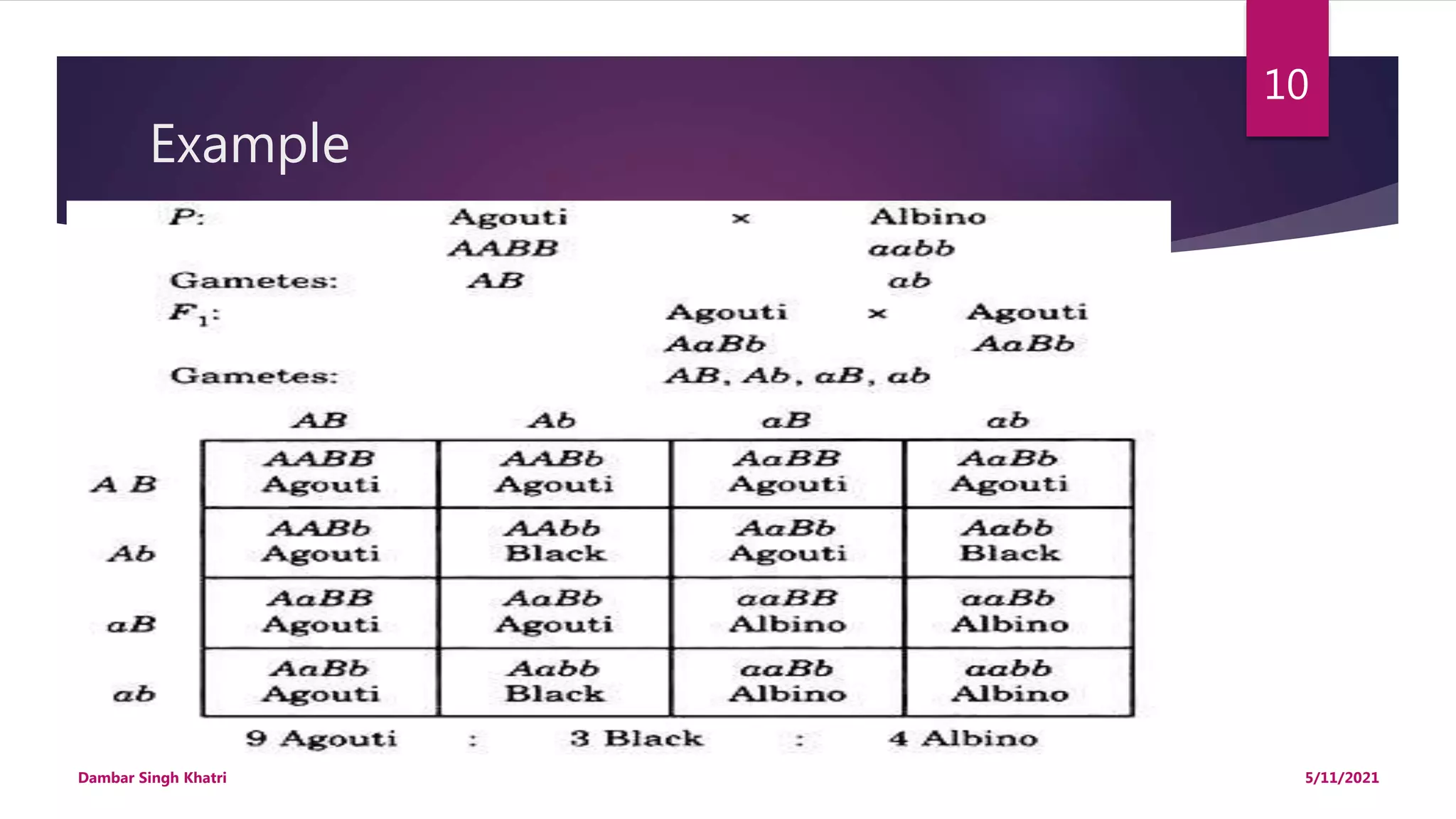
 Epistasis due to recessive genes is called recessive epistasis. In mice albinism
(white coat) is produced by a recessive gene aa. There is a different gene B which
in the dominant state (BB and Bb) produces grey coat colour called agouti, and
when recessive (bb) leads to black coat colour.
5/11/2021
Dambar Singh Khatri
8
 The recessive gene for albinism (aa) is found to be epistatic to the gene for agouti
(BB and Bb), and also to its recessive, homozygous allele (bb) for black. The
presence of the dominant allele (AA) of the epistatic gene allows expression of
gene B so that agouti (BB and Bb) and black (bb) coat colours can be produced.
5/11/2021
Dambar Singh Khatri
9
Example
5/11/2021
Dambar Singh Khatri
10
 The 9: 3: 4 ratio obtained is a modification of the classical 9: 3: 3 : 1 in which the
last two classes (3: 1) are phenotypically identical and are therefore added up
together. In human beings also the recessive gene for albinism shows epistasis in
a similar manner. Epistatic effect is usually only in one direction, from one
particular gene pair to another.
5/11/2021
Dambar Singh Khatri
11
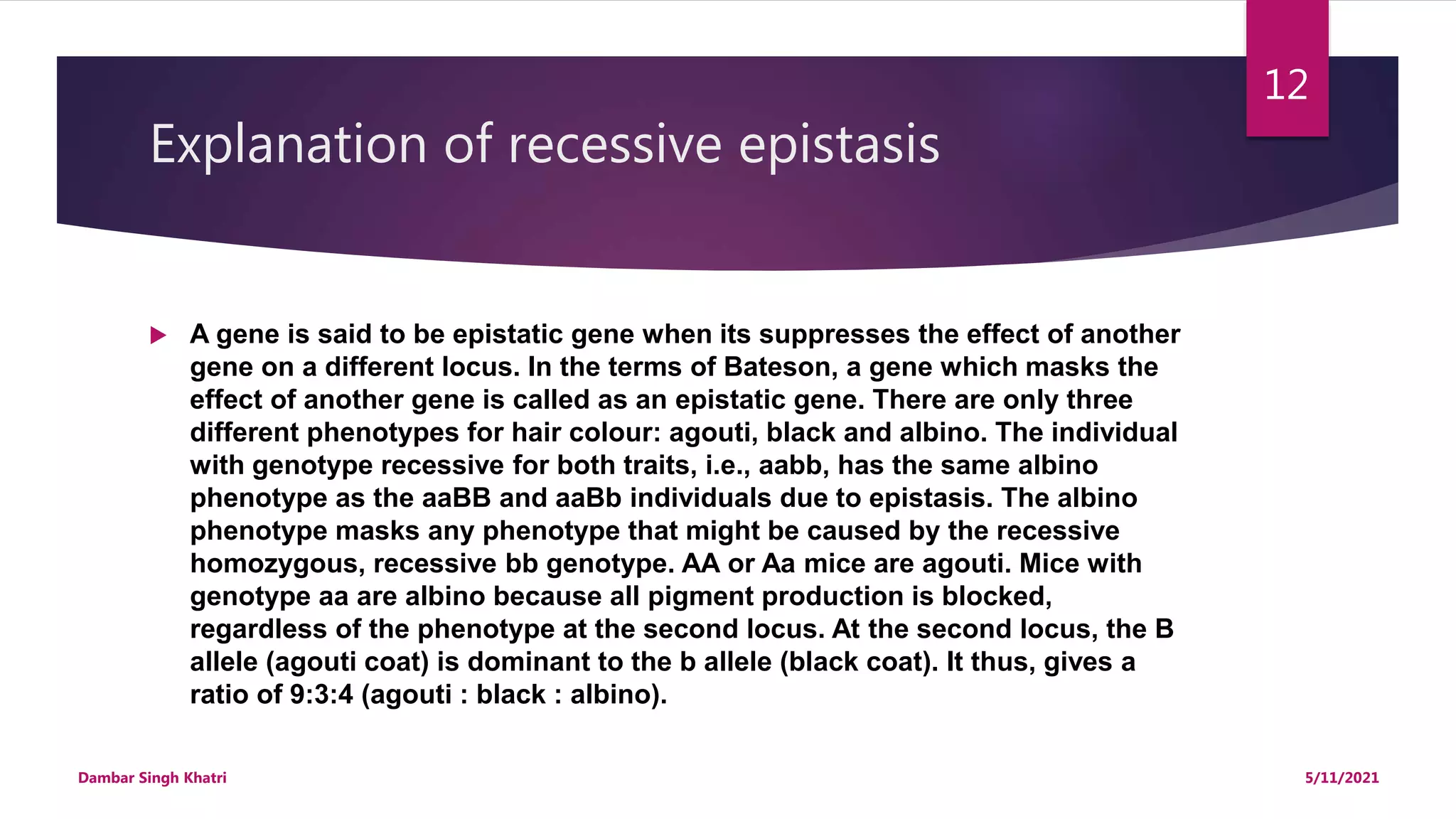
Explanation of recessive epistasis
 A gene is said to be epistatic gene when its suppresses the effect of another
gene on a different locus. In the terms of Bateson, a gene which masks the
effect of another gene is called as an epistatic gene. There are only three
different phenotypes for hair colour: agouti, black and albino. The individual
with genotype recessive for both traits, i.e., aabb, has the same albino
phenotype as the aaBB and aaBb individuals due to epistasis. The albino
phenotype masks any phenotype that might be caused by the recessive
homozygous, recessive bb genotype. AA or Aa mice are agouti. Mice with
genotype aa are albino because all pigment production is blocked,
regardless of the phenotype at the second locus. At the second locus, the B
allele (agouti coat) is dominant to the b allele (black coat). It thus, gives a
ratio of 9:3:4 (agouti : black : albino).
5/11/2021
Dambar Singh Khatri
12
Assessment
 What is genetic interaction?
 Define the term epistasis?
 Define the term dominant epistasis?
 Define the term recessive epistasis?
 What is the phenotypic ratio in dominant and recessive epistasis?
5/11/2021
Dambar Singh Khatri
13
Assignment
 Compute different crosses related with dominant , recessive and complementary
gene interaction by using text book, online search.
5/11/2021
Dambar Singh Khatri
14

Epistasis/class 12 biology

  • 1.
    Epistasis DAMBAR SINGH KHATRIMSC B.ED. PRAKASH SECONDARY SCHOOL, BENI, MYAGDI
  • 2.
    Behavioral objectives  Studentswill be able to  Define genetic interaction  Define the term epistasis.  Understand the meaning of dominant and recessive epistasis.  Analyze the difference between dominant and recessive epistasis.  Compute the dominant and recessive epistasis from Cucurbita pepo and coat color in mice respectively.  5/11/2021 Dambar Singh Khatri 2
  • 3.
    Contents  Definition ofEpistasis  Types of Epistasis  Epistasis in Drosophila  Epistasis and Blood Groups in Man. 5/11/2021 Dambar Singh Khatri 3
  • 4.
    Definition  Due tothe phenomenon of dominance a recessive allele remains obscure in the hybrid. But when two different genes which are not alleles, both affect the same character in such a way that the expression of one masks, inhibits or suppresses the expression of the other gene, it is called epistasis.  The gene that suppresses is said to be epistatic, and the gene which remains obscure is hypostatic. 5/11/2021 Dambar Singh Khatri 4
  • 5.
    Types  Dominant epistasis Dominant epistasis happens when the dominant allele of one gene masks the expression of all alleles of another gene. If an organism inherits one or two copies of the dominant allele, they will have the trait. 5/11/2021 Dambar Singh Khatri 5
  • 6.
    Example  Fruit andflower color in plants is a common example used to illustrate dominant epistasis. For eg, the squash comes in 3 colors. Yellow (YY, Yy) is dominant over green (gg). However, since squash color is polygenic, or determined by more than one gene, Gene W also determines squash color. Because Gene W shows epistasis, it is more important than Gene Y in determining squash color. This is an example of a bully gene masking the expression of another gene. 5/11/2021 Dambar Singh Khatri 6
  • 7.
  • 8.
    Recessive epistasis  Epistasisdue to recessive genes is called recessive epistasis. In mice albinism (white coat) is produced by a recessive gene aa. There is a different gene B which in the dominant state (BB and Bb) produces grey coat colour called agouti, and when recessive (bb) leads to black coat colour. 5/11/2021 Dambar Singh Khatri 8
  • 9.
     The recessivegene for albinism (aa) is found to be epistatic to the gene for agouti (BB and Bb), and also to its recessive, homozygous allele (bb) for black. The presence of the dominant allele (AA) of the epistatic gene allows expression of gene B so that agouti (BB and Bb) and black (bb) coat colours can be produced. 5/11/2021 Dambar Singh Khatri 9
  • 10.
  • 11.
     The 9:3: 4 ratio obtained is a modification of the classical 9: 3: 3 : 1 in which the last two classes (3: 1) are phenotypically identical and are therefore added up together. In human beings also the recessive gene for albinism shows epistasis in a similar manner. Epistatic effect is usually only in one direction, from one particular gene pair to another. 5/11/2021 Dambar Singh Khatri 11
  • 12.
    Explanation of recessiveepistasis  A gene is said to be epistatic gene when its suppresses the effect of another gene on a different locus. In the terms of Bateson, a gene which masks the effect of another gene is called as an epistatic gene. There are only three different phenotypes for hair colour: agouti, black and albino. The individual with genotype recessive for both traits, i.e., aabb, has the same albino phenotype as the aaBB and aaBb individuals due to epistasis. The albino phenotype masks any phenotype that might be caused by the recessive homozygous, recessive bb genotype. AA or Aa mice are agouti. Mice with genotype aa are albino because all pigment production is blocked, regardless of the phenotype at the second locus. At the second locus, the B allele (agouti coat) is dominant to the b allele (black coat). It thus, gives a ratio of 9:3:4 (agouti : black : albino). 5/11/2021 Dambar Singh Khatri 12
  • 13.
    Assessment  What isgenetic interaction?  Define the term epistasis?  Define the term dominant epistasis?  Define the term recessive epistasis?  What is the phenotypic ratio in dominant and recessive epistasis? 5/11/2021 Dambar Singh Khatri 13
  • 14.
    Assignment  Compute differentcrosses related with dominant , recessive and complementary gene interaction by using text book, online search. 5/11/2021 Dambar Singh Khatri 14