Double Fertilization
It is a complex fertilization mechanism in flowering plants.
It was discovered by Nawaschin in the liliaceous plants like Lilium and Fritillaria.
After a pollen grain has reached the surface of the stigma, it germinates and forms a
pollen tube , which penetrates the stigma, style, ovary chamber and then enters ovule. The
growth of pollen tube is guided by the chemical secreted by the synergids. It is usually enters
ovule through many ways.
It enters through the micropyle it is termed as Porogamy.
It enters through the chalaza it is termed as Chalazogamy.
It enters through the integuments it is termed as Mesogamy.
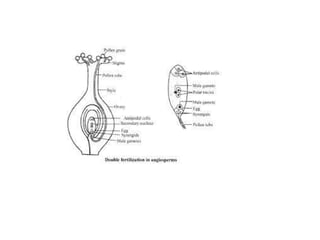
The pollen tube carrying male gametes penetrates in one of the synergids. Watery content
of syngerids are absorberd by pollen tube which then ruptures and release the contents,
including the two non motile male gametes. As non motile male gametes are carried through
hollow pollen tube , it is known as siphonogamy that ensures fertilization to take place.
Syngamy and triple fusion are the two events of sexual reproduction in a angiospermic
flowering plants. Syngamy is the fusion of haploid male gametes with haploid female gamete
(egg) to produce a diploid Zygote (2n). Where as in the triple fusion , second haploid male
gamete fuses with diploid secondary nucleus producing primary endosperm nucleus (PEN)
that develpos into triploid endosperm.
The zygote develops into an embryo . Syngamy is a type of generative fertilization where
as triple fusion ia a type of vegetative fertilization.
Post Fertilization Changes
Development of Endosperm and Its Types :
Endosperm is the nutritive tissue for the nourishment of developing embryo.
It is post fertilization product and triploid in nature.
Some time endosperm is totally consumed during embryo development so that the
mature seeds do not posses endosperm and such seeds are called as nonendospermic
or exalbuminous seed. E.g. Pea, Bean, Gram, Groundnut
Endospermic seed which consist of endosperm and it continues support to growth of
embryo during seed germination. Such seeds are called as endospermic or
albuminous seed. E.g Caster, Sunflower, Coconut and Maize , Wheat.
Depending upon the mode of development , there are three types of endopserm are
recognized.
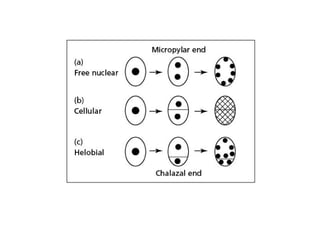
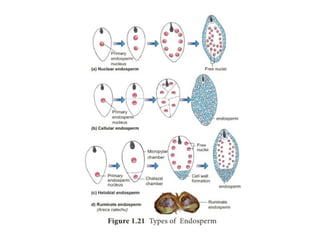
Nuclear Endosperm :
Most common type found in 161 angiospermic family.
Primary endosperm nucleus undergoes free nuclear division and formation of a large
number of triploid nuclei freely suspended in common cytoplasm of central cell.
Later on wall formation occurs around these nuclei in a centripetal manner to form a
cellular mass. It is the most common type of endosperm.
Cellular Endosperm :
Primary endosperm nucleus undergoes nuclear division which are followed by
cytokinesis. Development of endosperm occur in cellular from right from the
beginning. Iit is less common and seen mostly in dicots. 72 family, Balsam, Petunia,
Adoxa
Helobial Endosperm : First primary endosperm nucleus is followed by wall formation.
As a result the central cell is divided into a large micropylar and a small chalzal
chambers. In both further development of endosperm occurs as nuclear type.
Thus it is an intermediate type which is common in Helobiae series of monocots, hence
the name is given. E.g. Asphodelus
Mosaic Endosperm: Endosperm containing tissues of two different types is called as
mosaic endosperm. In plants like Corn the endosperm contians patches of two different
colours. It forms a sort of mosaic pattern.
Development of Embryo
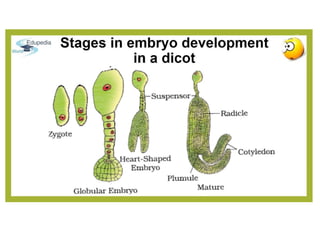
Zygote forms a wall around it is converted into oospore.
Oospore divides transversely to form a large basal cell towards micropyle and a small
apical cell.
From these two celled stage until the formation of organs the embryo is commonly called
as proembryo.
Basal cell divides transversely to form a row of cells called as Suspensor.
Suspensor pushes the developing embryo deeper in the endosperm for its proper nutrition.
Apical cell of the 2 celled pro embryo undergoes a transverse and two vertical division at
right angles to each other to form a octant stage.
Eight cell of octant proembryo undergo many divisions to form a spherical mass of cells.
This mass becomes Heart shaped and then horse shoe shaped .
Finally it gets different to form an embryonal axis with plumule , radicle and two
cotyledonos in dicot and single cotyledon in monocots.
Formation of Fruits and Seeds
After development of embryo and endosperm , ovary enlarge in size.
Sepals, petals, stamens, style, stigma fall off and ovary changes into fruit.
Ovary wall changes into pericarp – having three layer Epicarp, Mesocarp, Endocarp.
Pericarp is initially green in ccolour and on ripening becomes orange, red, purple and
yellow.
Each ovule in the ovary also enlarges in size.
Outer integuments is thick, hard and outer seed coat called as testa and inner
integument changes into thin inner seed coat called as tegmen.
After fertilization ovule change into seed.

Study of double fertilization and post fertilization changes.

  • 1.
    Double Fertilization It isa complex fertilization mechanism in flowering plants. It was discovered by Nawaschin in the liliaceous plants like Lilium and Fritillaria. After a pollen grain has reached the surface of the stigma, it germinates and forms a pollen tube , which penetrates the stigma, style, ovary chamber and then enters ovule. The growth of pollen tube is guided by the chemical secreted by the synergids. It is usually enters ovule through many ways. It enters through the micropyle it is termed as Porogamy. It enters through the chalaza it is termed as Chalazogamy. It enters through the integuments it is termed as Mesogamy. The pollen tube carrying male gametes penetrates in one of the synergids. Watery content of syngerids are absorberd by pollen tube which then ruptures and release the contents, including the two non motile male gametes. As non motile male gametes are carried through hollow pollen tube , it is known as siphonogamy that ensures fertilization to take place. Syngamy and triple fusion are the two events of sexual reproduction in a angiospermic flowering plants. Syngamy is the fusion of haploid male gametes with haploid female gamete (egg) to produce a diploid Zygote (2n). Where as in the triple fusion , second haploid male gamete fuses with diploid secondary nucleus producing primary endosperm nucleus (PEN) that develpos into triploid endosperm. The zygote develops into an embryo . Syngamy is a type of generative fertilization where as triple fusion ia a type of vegetative fertilization.
  • 3.
    Post Fertilization Changes Developmentof Endosperm and Its Types : Endosperm is the nutritive tissue for the nourishment of developing embryo. It is post fertilization product and triploid in nature. Some time endosperm is totally consumed during embryo development so that the mature seeds do not posses endosperm and such seeds are called as nonendospermic or exalbuminous seed. E.g. Pea, Bean, Gram, Groundnut Endospermic seed which consist of endosperm and it continues support to growth of embryo during seed germination. Such seeds are called as endospermic or albuminous seed. E.g Caster, Sunflower, Coconut and Maize , Wheat. Depending upon the mode of development , there are three types of endopserm are recognized. Nuclear Endosperm : Most common type found in 161 angiospermic family. Primary endosperm nucleus undergoes free nuclear division and formation of a large number of triploid nuclei freely suspended in common cytoplasm of central cell. Later on wall formation occurs around these nuclei in a centripetal manner to form a cellular mass. It is the most common type of endosperm. Cellular Endosperm : Primary endosperm nucleus undergoes nuclear division which are followed by cytokinesis. Development of endosperm occur in cellular from right from the beginning. Iit is less common and seen mostly in dicots. 72 family, Balsam, Petunia, Adoxa
  • 4.
    Helobial Endosperm :First primary endosperm nucleus is followed by wall formation. As a result the central cell is divided into a large micropylar and a small chalzal chambers. In both further development of endosperm occurs as nuclear type. Thus it is an intermediate type which is common in Helobiae series of monocots, hence the name is given. E.g. Asphodelus Mosaic Endosperm: Endosperm containing tissues of two different types is called as mosaic endosperm. In plants like Corn the endosperm contians patches of two different colours. It forms a sort of mosaic pattern. Development of Embryo Zygote forms a wall around it is converted into oospore. Oospore divides transversely to form a large basal cell towards micropyle and a small apical cell. From these two celled stage until the formation of organs the embryo is commonly called as proembryo. Basal cell divides transversely to form a row of cells called as Suspensor. Suspensor pushes the developing embryo deeper in the endosperm for its proper nutrition. Apical cell of the 2 celled pro embryo undergoes a transverse and two vertical division at right angles to each other to form a octant stage. Eight cell of octant proembryo undergo many divisions to form a spherical mass of cells. This mass becomes Heart shaped and then horse shoe shaped . Finally it gets different to form an embryonal axis with plumule , radicle and two cotyledonos in dicot and single cotyledon in monocots.
  • 8.
    Formation of Fruitsand Seeds After development of embryo and endosperm , ovary enlarge in size. Sepals, petals, stamens, style, stigma fall off and ovary changes into fruit. Ovary wall changes into pericarp – having three layer Epicarp, Mesocarp, Endocarp. Pericarp is initially green in ccolour and on ripening becomes orange, red, purple and yellow. Each ovule in the ovary also enlarges in size. Outer integuments is thick, hard and outer seed coat called as testa and inner integument changes into thin inner seed coat called as tegmen. After fertilization ovule change into seed.