






DEVELOPMENT OF
EDUCATIONAL GUIDANCE
PROGRAM
RUQAYA GILAL
2K17/M.ED/20
GUIDANCE
 Guidance is a process through which an
individual is able to solve their problems
and pursue a path suited to their abilities
and aspirations
 Arthur Jones “Guidance is a personal help
that is designed to assist a person to go
somewhere and do something”
 Guidance is continuous process of helping
the individual to develop to the maximum
of hid capacity in the direction , must
beneficial to himself and to society.
Purpose of guidance program
School Guidance Program
 The main purpose of guidance program to
give awareness to student about their
behavior attitude, abilities , potentialities
and their interest that which direction is
best for them.
 It enables the individual/person to take
right decision in each and every stage of
his life by overcoming the necessities and
incorporating the necessities.
Planning for Guidance
program
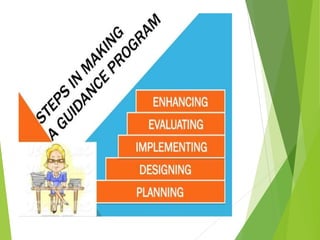
 the process of making plans for guidance
program.
 For making guidance program systematic
and effective
 To make guidance program effective and
acceptable, it has to be aimed at
benefiting every student.
NEEDS ASSESSMENT
 Definition :Discrepancy between what is and what should
be.
 Problems vs Need.
 Individual need vs Environmental need..
 A formal process which determines the gaps between what
is and what should be..
 Need assessment: can be done by using direct observation,
consultation with students, teachers, parents, focused
group discussion, psychological test.
PROGRAM GOALS AND OBJECTIVES
 Help in solving social and personal problems and
be able to adjust with oneself and the
environment.
 Exploring Self
 To help individual to understand and accept
the positive and negative aspects of his
personality, interests, aptitudes, attitudes
etc.
 Help make adjustment in the new life
situation.
 Help in facing the challenges of life and
manage tensions by realizing and accepting
the facts.
Selection of program structure
 After the needs of clients have been
determined the programm structure
should be described. A decision is then
made on which content needs are to be
addressed first.
 This then takes care of the school
Guidance and Counselling curriculum, as
topics are dealt with in a systematic way.
THE IDENTIFICATION OF
RESOURCES
 The program design and desired student
outcomes have a bearing on the allocation
of available resources, and may dictate
program design.
 Resources should be commensurate with
needs.
Resources Required for
Guidance Program
 Personnel: Identify people who will be involved on
basis of qualification, interest and understanding
of students as well as community.
 Finance: Prepare budget for one academic
session basing on different activities and benefits
for learners
 Facilities: ‱ Room should be neatly maintained
and furnished with comfortable furniture to create
pleasant ambience. ‱ Table, chairs, display board/
racks to display materials, posters and charts.
Guidance Calendar Purpose:
 To complement classroom activities –
 To take care of needs that cannot be met
of addressed in a class situation ∗
 Can be monthly, termly, quarterly or
yearly
 Should be governed by the needs of the
clients.
Implementation of the
Program
 Th ability to implement a plan of action
effectively goes a long way toward
determining the success of the program. For
any program to achieve its desired results, it
has to be effectively implemented. Even
though planning and design are done properly,
the failure to employ effective
implementation strategies may adversely
affect the program, and this will determine
the survival of the program.
FACTORS AFFECTING
IMPLEMENTATION
 Human Resources
 Financial Resources
 Political Resources
IMPLEMENTATION STRATEGIES
 It is at this point that the program leader
will have to prove himself/herself able to
run an effective program.
 General School Assembly
 Time Tabling
 Community Involvement
 Educational Tours
 Research Projects
 Career Fairs/Seminars
 Workshops
 Bulletin Board and the School Library
Evaluation
 should be an on-going process. It provides
an opportunity to modify the program
when necessary. Evaluation helps to check
 program effectiveness; -
 program response to changing needs
 strengths and limitations of the program;
 staff development; and - reporting and
follow-up
METHOD OF EVALUATION
 1. ‘Before and After’ Method
 2. Comparison Method
 3. The ‘How Do We Stand’ Method
EVALUATION TECHNIQUES
 ‱ Observations
 ‱ Interviews
 ‱ Questionnaires
THANK YOU

Development of Educational Guidance Program

  • 2.
  • 4.
    GUIDANCE  Guidance isa process through which an individual is able to solve their problems and pursue a path suited to their abilities and aspirations  Arthur Jones “Guidance is a personal help that is designed to assist a person to go somewhere and do something”  Guidance is continuous process of helping the individual to develop to the maximum of hid capacity in the direction , must beneficial to himself and to society.
  • 5.
  • 6.
    School Guidance Program The main purpose of guidance program to give awareness to student about their behavior attitude, abilities , potentialities and their interest that which direction is best for them.  It enables the individual/person to take right decision in each and every stage of his life by overcoming the necessities and incorporating the necessities.
  • 9.
    Planning for Guidance program the process of making plans for guidance program.  For making guidance program systematic and effective  To make guidance program effective and acceptable, it has to be aimed at benefiting every student.
  • 10.
    NEEDS ASSESSMENT  Definition:Discrepancy between what is and what should be.  Problems vs Need.  Individual need vs Environmental need..  A formal process which determines the gaps between what is and what should be..  Need assessment: can be done by using direct observation, consultation with students, teachers, parents, focused group discussion, psychological test.
  • 11.
    PROGRAM GOALS ANDOBJECTIVES  Help in solving social and personal problems and be able to adjust with oneself and the environment.  Exploring Self  To help individual to understand and accept the positive and negative aspects of his personality, interests, aptitudes, attitudes etc.  Help make adjustment in the new life situation.  Help in facing the challenges of life and manage tensions by realizing and accepting the facts.
  • 13.
    Selection of programstructure  After the needs of clients have been determined the programm structure should be described. A decision is then made on which content needs are to be addressed first.  This then takes care of the school Guidance and Counselling curriculum, as topics are dealt with in a systematic way.
  • 14.
    THE IDENTIFICATION OF RESOURCES The program design and desired student outcomes have a bearing on the allocation of available resources, and may dictate program design.  Resources should be commensurate with needs.
  • 15.
    Resources Required for GuidanceProgram  Personnel: Identify people who will be involved on basis of qualification, interest and understanding of students as well as community.  Finance: Prepare budget for one academic session basing on different activities and benefits for learners  Facilities: ‱ Room should be neatly maintained and furnished with comfortable furniture to create pleasant ambience. ‱ Table, chairs, display board/ racks to display materials, posters and charts.
  • 16.
    Guidance Calendar Purpose: To complement classroom activities –  To take care of needs that cannot be met of addressed in a class situation ∗  Can be monthly, termly, quarterly or yearly  Should be governed by the needs of the clients.
  • 18.
    Implementation of the Program Th ability to implement a plan of action effectively goes a long way toward determining the success of the program. For any program to achieve its desired results, it has to be effectively implemented. Even though planning and design are done properly, the failure to employ effective implementation strategies may adversely affect the program, and this will determine the survival of the program.
  • 19.
    FACTORS AFFECTING IMPLEMENTATION  HumanResources  Financial Resources  Political Resources
  • 20.
    IMPLEMENTATION STRATEGIES  Itis at this point that the program leader will have to prove himself/herself able to run an effective program.  General School Assembly  Time Tabling  Community Involvement  Educational Tours  Research Projects  Career Fairs/Seminars  Workshops  Bulletin Board and the School Library
  • 22.
    Evaluation  should bean on-going process. It provides an opportunity to modify the program when necessary. Evaluation helps to check  program effectiveness; -  program response to changing needs  strengths and limitations of the program;  staff development; and - reporting and follow-up
  • 23.
    METHOD OF EVALUATION 1. ‘Before and After’ Method  2. Comparison Method  3. The ‘How Do We Stand’ Method
  • 24.
    EVALUATION TECHNIQUES  ‱Observations  ‱ Interviews  ‱ Questionnaires
  • 25.