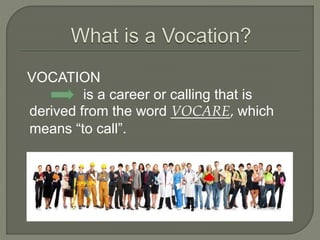
VOCATION
is a career or calling that is
derived from the word VOCARE, which
means “to call”.
Famous Proverbs:
“For round holes there should be
round pegs, and for square holes
there should be square pegs”
Frank Parsons
Founding Father of
Vocational Guidance
 In 1908 Parson opened the
Vocational Bureau of Boston with
the purpose of helping people learn
of careers
Wrote book called Choosing a
Vocation. First published 1990
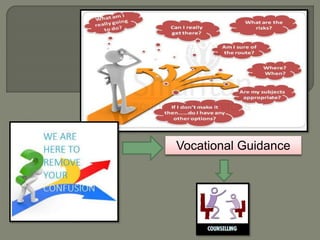
Vocational Guidance
the process of assisting an
individual to choose an occupation,
prepare for it, and progress in it.
-National Vocational Guidance Association-
a facilitative process, a service
rendered to the individual to aid him in
choosing and adjusting to an occupation.
-John D. Crites-
What are the Purposes of
Vocational Guidance?
1. To help adapt the schools to the needs of the
students and the community.
2. To assist the students in choosing, preparing
and training for, entering and making progress
in their chosen career or occupation.
3. To disseminate knowledge of competitive and
other problems of the business and
occupational world as well as their
characteristics.
4. To help workers understand their relationship
with other workers, and society as a whole.
5. To secure greater cooperation between the
school and various commercial, industrial,
and professional pursuits.
6. To encourage the establishment of courses of
study in educational institutions that will
harmoniously combine both cultural and
practical studies.
1. The Occupational Information Service
The following is an outline for the study of an occupation:
a. Importance of an occupation
b. Nature of the work
c. Work conditions
d. Personal Qualities needed
e. Preparations needed
f. Opportunities for advancement
g. Compensation
Methods of Teaching an Occupational Information
1. Each Learner is required to gather information
about occupations. Pamphlets, books, magazines,
news papers, and workers can be sources of
information.
2. Class debates are held on the merits of different
occupations
3. Dramatizations
4. Oral reports to the class
5. Written reports
2. The Self-Inventory Service
Means of Providing High School Youth with
Vocational Exploration Experience
1. Exploration by means of school subjects
2. Exploration for agricultural occupations
3. Exploration for business occupation
4. Explorations through household art courses
5. Explorations for industrial occupations
3. The Personal Data Collecting Service
Kinds of Personal Data needed
1. General Data – information that will be helpful in
locating the individual and in making contacts.
2. Physical Data- information concerning the
individual’s health and physical characteristics.
3. Psychological Data- information concerning the
individual’s mental characteristics.
4. Social environment- information concerning home
and social environment conditions.
5. Achievement Data- information concerning what
the individual has done both in school and outside
of it.
6. Data concerning the individual’s educational and
vocational plans.
Personality traits, some of which are
hereditary and some are results of training
and experience, have significance in vocational
planning.
Personality factors :
 Drive
 Emotional Stability
 Initiative
 Ambition
 Personal Disposition
Example of Personality Tests:
1. The Downey tests of will-temperament
a. Speed and fluidity of action
b. Forcefulness and decisiveness of reaction
c. Carefulness and persistence of reaction
2. Tests of trustworthiness
3. The Allport Ascendance-Submission Reaction
Study
4. Benreuter Personality Inventory
5. Bell Adjustment Inventory
Social Environment Data
a. Data concerning the home and familial
background
b. Data concerning the pupil’s association outside
the home
c. Data concerning:
- achievements
- entrance to college
- degree program desired
- particular occupation desired
- necessary preparation
4. The Vocational Counseling Service
Vocational counseling is not giving
vocational advice. It is not telling
individuals what occupation they should
follow. Vocational counseling leaves decisions
to the counseled individuals. Its DUTY is
performed when it helps these individuals to
follow a procedure in arriving at their own
decision, not when it tries to make decisions
for them.
5. The Vocational Preparatory Service
Types of Vocational Preparation
1. Preparation before employment begins
2. Preparation in connection with
employment
3. Preparation for change of employment
Preparation before employment begins for
a. Business pursuits
b. Homemaking
c. Agricultural pursuits
d. Industrial pursuits
Preparation in connection with employment
a. The learners are under the supervision of the
school
b. A worker and the school aid them in preparing
better for the work.
c. The learner acquires skill and knowledge on the
job without spending any time in school.
Preparation for change of employment
Conditions at work are not satisfying,
detrimental to the worker’s physical and
mental health; salary is low and not
commensurate to the job.
6. The Placement Service
The school placement service aids the
graduates in finding jobs through:
1. Establishing linkages or consultations with
agencies, firms, industry and business, etc.
2. Helping the individuals find suitable
occupations and helping them find an
opportunity for their continued development
Vocational Guidance

Vocational Guidance

  • 2.
    VOCATION is a careeror calling that is derived from the word VOCARE, which means “to call”.
  • 3.
    Famous Proverbs: “For roundholes there should be round pegs, and for square holes there should be square pegs”
  • 4.
    Frank Parsons Founding Fatherof Vocational Guidance  In 1908 Parson opened the Vocational Bureau of Boston with the purpose of helping people learn of careers Wrote book called Choosing a Vocation. First published 1990
  • 5.
  • 6.
    the process ofassisting an individual to choose an occupation, prepare for it, and progress in it. -National Vocational Guidance Association- a facilitative process, a service rendered to the individual to aid him in choosing and adjusting to an occupation. -John D. Crites-
  • 7.
    What are thePurposes of Vocational Guidance?
  • 8.
    1. To helpadapt the schools to the needs of the students and the community. 2. To assist the students in choosing, preparing and training for, entering and making progress in their chosen career or occupation. 3. To disseminate knowledge of competitive and other problems of the business and occupational world as well as their characteristics.
  • 9.
    4. To helpworkers understand their relationship with other workers, and society as a whole. 5. To secure greater cooperation between the school and various commercial, industrial, and professional pursuits. 6. To encourage the establishment of courses of study in educational institutions that will harmoniously combine both cultural and practical studies.
  • 10.
    1. The OccupationalInformation Service The following is an outline for the study of an occupation: a. Importance of an occupation b. Nature of the work c. Work conditions d. Personal Qualities needed e. Preparations needed f. Opportunities for advancement g. Compensation
  • 11.
    Methods of Teachingan Occupational Information 1. Each Learner is required to gather information about occupations. Pamphlets, books, magazines, news papers, and workers can be sources of information. 2. Class debates are held on the merits of different occupations 3. Dramatizations 4. Oral reports to the class 5. Written reports
  • 12.
    2. The Self-InventoryService Means of Providing High School Youth with Vocational Exploration Experience 1. Exploration by means of school subjects 2. Exploration for agricultural occupations 3. Exploration for business occupation 4. Explorations through household art courses 5. Explorations for industrial occupations
  • 13.
    3. The PersonalData Collecting Service Kinds of Personal Data needed 1. General Data – information that will be helpful in locating the individual and in making contacts. 2. Physical Data- information concerning the individual’s health and physical characteristics. 3. Psychological Data- information concerning the individual’s mental characteristics.
  • 14.
    4. Social environment-information concerning home and social environment conditions. 5. Achievement Data- information concerning what the individual has done both in school and outside of it. 6. Data concerning the individual’s educational and vocational plans.
  • 15.
    Personality traits, someof which are hereditary and some are results of training and experience, have significance in vocational planning. Personality factors :  Drive  Emotional Stability  Initiative  Ambition  Personal Disposition
  • 16.
    Example of PersonalityTests: 1. The Downey tests of will-temperament a. Speed and fluidity of action b. Forcefulness and decisiveness of reaction c. Carefulness and persistence of reaction 2. Tests of trustworthiness 3. The Allport Ascendance-Submission Reaction Study 4. Benreuter Personality Inventory 5. Bell Adjustment Inventory
  • 17.
    Social Environment Data a.Data concerning the home and familial background b. Data concerning the pupil’s association outside the home c. Data concerning: - achievements - entrance to college - degree program desired - particular occupation desired - necessary preparation
  • 18.
    4. The VocationalCounseling Service Vocational counseling is not giving vocational advice. It is not telling individuals what occupation they should follow. Vocational counseling leaves decisions to the counseled individuals. Its DUTY is performed when it helps these individuals to follow a procedure in arriving at their own decision, not when it tries to make decisions for them.
  • 19.
    5. The VocationalPreparatory Service Types of Vocational Preparation 1. Preparation before employment begins 2. Preparation in connection with employment 3. Preparation for change of employment
  • 20.
    Preparation before employmentbegins for a. Business pursuits b. Homemaking c. Agricultural pursuits d. Industrial pursuits Preparation in connection with employment a. The learners are under the supervision of the school b. A worker and the school aid them in preparing better for the work. c. The learner acquires skill and knowledge on the job without spending any time in school.
  • 21.
    Preparation for changeof employment Conditions at work are not satisfying, detrimental to the worker’s physical and mental health; salary is low and not commensurate to the job.
  • 22.
    6. The PlacementService The school placement service aids the graduates in finding jobs through: 1. Establishing linkages or consultations with agencies, firms, industry and business, etc. 2. Helping the individuals find suitable occupations and helping them find an opportunity for their continued development