Dr Tasnia Mahmud
Trainee in Otolaryngology
CMH, Dhaka
TESTS FOR FACIAL NERVE
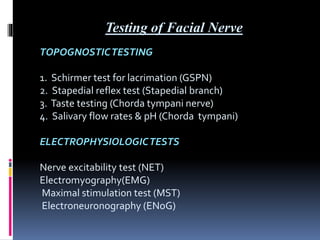
TOPOGNOSTICTESTING
1. Schirmer test for lacrimation (GSPN)
2. Stapedial reflex test (Stapedial branch)
3. Taste testing (Chorda tympani nerve)
4. Salivary flow rates & pH (Chorda tympani)
ELECTROPHYSIOLOGICTESTS
Nerve excitability test (NET)
Electromyography(EMG)
Maximal stimulation test (MST)
Electroneuronography (ENoG)
Testing of Facial Nerve
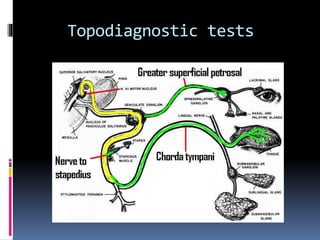
Topographic Diagnosis
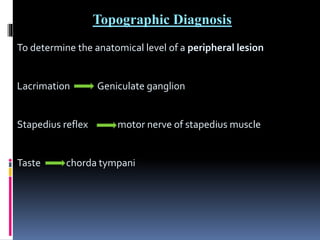
To determine the anatomical level of a peripheral lesion
Lacrimation Geniculate ganglion
Stapedius reflex motor nerve of stapedius muscle
Taste chorda tympani
Topodiagnostic tests
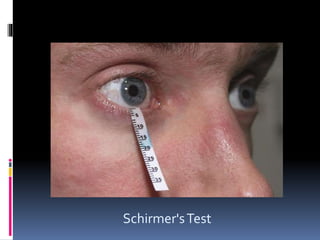
Schirmer'sTest
Schirmer's Test
Geniculate ganglion & petrosal nerve function test
Schirmer’s test +ve when
Affected side shows less than half the amount of lacrimation seen
on the normal side
Sum of the lengths of wetted filter paper for both eyes less than 25
mm
Lesion at or proximal to the geniculate ganglion
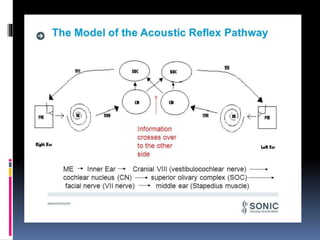
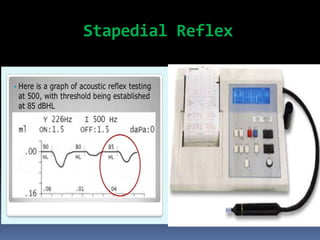
Stapedius reflex
Nerve to stapedius muscle test
Impedence audiometry can record the presence or absence
of stapedius muscle contraction to sound stimuli 70 to 100 db
above hearing threshold
An absence reflex or a reflex less than half the amplitude is
due to a lesion proximal to stapedius nerve
Stapedial Reflex
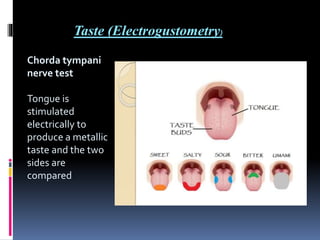
Taste (Electrogustometry)
Chorda tympani
nerve test
Tongue is
stimulated
electrically to
produce a metallic
taste and the two
sides are
compared
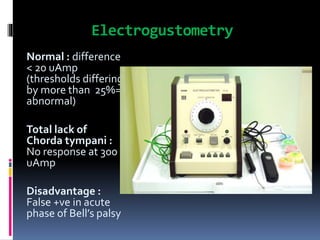
Electrogustometry
Normal : difference
< 20 uAmp
(thresholds differing
by more than 25%=
abnormal)
Total lack of
Chorda tympani :
No response at 300
uAmp
Disadvantage :
False +ve in acute
phase of Bell’s palsy
Salivary Flow Test
 Chorda tympani
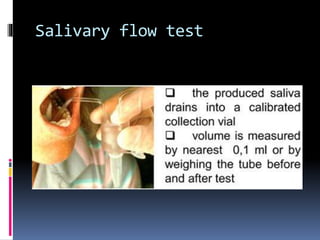
 Warthins ducts are cannulated and salivary flow is
measured over time following a gustatory stimulus
 65% citric acid on anterior part of tongue
 <25% considered abnormal
Salivary flow test
ThankYou

Assessment of facial nerve function

  • 1.
    Dr Tasnia Mahmud Traineein Otolaryngology CMH, Dhaka TESTS FOR FACIAL NERVE
  • 2.
    TOPOGNOSTICTESTING 1. Schirmer testfor lacrimation (GSPN) 2. Stapedial reflex test (Stapedial branch) 3. Taste testing (Chorda tympani nerve) 4. Salivary flow rates & pH (Chorda tympani) ELECTROPHYSIOLOGICTESTS Nerve excitability test (NET) Electromyography(EMG) Maximal stimulation test (MST) Electroneuronography (ENoG) Testing of Facial Nerve
  • 3.
    Topographic Diagnosis To determinethe anatomical level of a peripheral lesion Lacrimation Geniculate ganglion Stapedius reflex motor nerve of stapedius muscle Taste chorda tympani
  • 4.
  • 5.
  • 6.
    Schirmer's Test Geniculate ganglion& petrosal nerve function test Schirmer’s test +ve when Affected side shows less than half the amount of lacrimation seen on the normal side Sum of the lengths of wetted filter paper for both eyes less than 25 mm Lesion at or proximal to the geniculate ganglion
  • 7.
    Stapedius reflex Nerve tostapedius muscle test Impedence audiometry can record the presence or absence of stapedius muscle contraction to sound stimuli 70 to 100 db above hearing threshold An absence reflex or a reflex less than half the amplitude is due to a lesion proximal to stapedius nerve
  • 9.
  • 10.
    Taste (Electrogustometry) Chorda tympani nervetest Tongue is stimulated electrically to produce a metallic taste and the two sides are compared
  • 11.
    Electrogustometry Normal : difference <20 uAmp (thresholds differing by more than 25%= abnormal) Total lack of Chorda tympani : No response at 300 uAmp Disadvantage : False +ve in acute phase of Bell’s palsy
  • 12.
    Salivary Flow Test Chorda tympani  Warthins ducts are cannulated and salivary flow is measured over time following a gustatory stimulus  65% citric acid on anterior part of tongue  <25% considered abnormal
  • 13.
  • 14.