Development of Ear
20-04-2015
Dr. Laxman Khanal
Assistant Professor
Department of Human Anatomy
External ear- sound collection
Pinna, EAM and outer layer of TM
Middle ear- sound conduction
Ear ossicles and inner layer of TM
Internal ear
•Sound wave to nerve impulse
•Equilibrium
Labyrinth (bony and membranous)
Q. Vestibulocochlear ganglia is derived from
a.Otic vesicle
b.Neural crest cells
c. Both a and b
d.Neuroectoderm of hindbrain
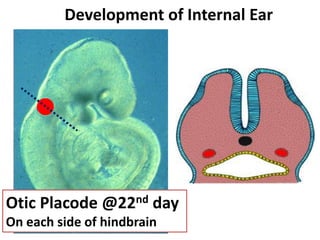
Development of Internal Ear
Otic Placode @22nd day
On each side of hindbrain
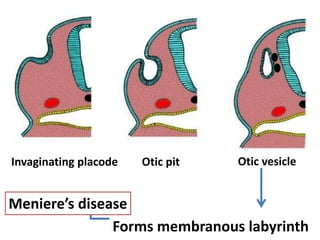
Invaginating placode Otic pit Otic vesicle
Forms membranous labyrinth
Q. Ductus reunion connect
a.Utricluar to saccular portion
b.Utricle to Semicircular duct
c. Cochlear duct to saccule
d.Membranous labyrinth to bony labyrinth
Ventral part
Saccules
Cochlear duct
Dorsal part
Semicircular duct
Utricle
Endolymphatic duct
Utriculo-saccular duct
Cochlear duct
Ductus reunions
Q. Which of the following parts of SCD fused during
opening to utricle ?
a. Dilated part of ant and post SCD
b. Non-dilated part of ant and post SCD
c. Dilated part of post and lat SCD
d. Non-dilated part of post and lat SCD
Development of Utricle and SCD
(Dorsal Part of Otic vesicle)
SCDs appear as flat out pocketing of Utricular portion
of Otic vesicle.
•Three pairs of SCD are formed –Ant/Post/Lat
One end of SCD form dilatation (Crus Ampullare) and
the other does not widen (Crus Nonampulare)
 Because two crus nonampullare fuse, there will be
3 crus ampullare and 2 crus nonampullare
Formation of Cochlea
• Mesenchyme surrounding CD Differentiate
into cartilage.
• Cartilage undergo vacuolization and form
Scala vestibuli and scala tympani.
• Lateral part of CD attached to the cartilage by
Spiral ligament and medial edge is attached
and supported by modiolus.
Q. Epithelium of which of the following part of
CD forms the Organ of Corti?
a. Outer ridge
b. Inner ridge
c. Endolymph
d. All of the above
Epithelium of CD form two ridge.
• inner ridge
•Outer ridge
Outer ridge forms inner
and outer rows of hair
cells covered by
tectorial membrane -
Organ of Corti
Q. Middle ear cavity develops from.
a.First pharyngeal pouch
b.Second pharyngeal pouch
c. First pharyngeal cleft
d.Second pharyngeal cleft
Development
of Middle Ear
Q. What is the motor nerve to stapedius muscle?
a.Mandibular nerve
b.Facial nerve
c. Glossopharyngeal nerve
d.Vagus nerve
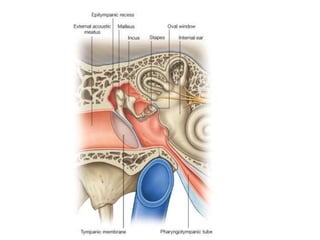
First pharyngeal pouch
Distal part- tympanic cavity
Proximal part- auditory tube
Malleus /Incus and Tensor Tympani- 1st Arch
Stapes and Stapedius muscle- 2nd arch
Development of ext ear
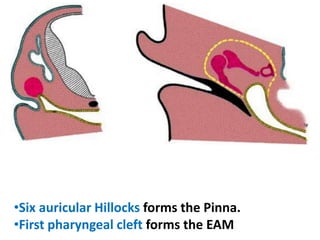
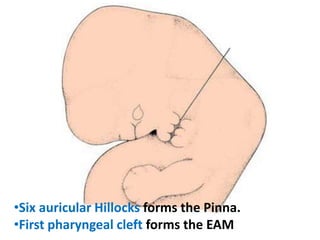
•Six auricular Hillocks forms the Pinna.
•First pharyngeal cleft forms the EAM
•Six auricular Hillocks forms the Pinna.
•First pharyngeal cleft forms the EAM
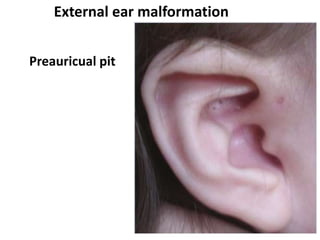
External ear malformation
Preauricual pit
External ear malformation
Microtia
External ear malformation
Preauricualr
appendages
External ear malformation
Anotia
Congenital deafness
• Genetic cause
 Down’s syndrome
 Crouzon syndrome
 Treacher collin syndrome
• Retention of meatal plug
• Rubella infection
• Cytomegalo virus infection
• Malformation of middle and internal ear
Q. Vestibulocochlear ganglia is derived from
a.Otic vesicle
b.Neural crest cells
c. Both a and b
d.Neuroectoderm of hindbrain
Q. Ductus reunion connect
a.Utriclar to saccular portion
b.Utricle to Semicircular duct
c. Cochlear duct to saccule
d.Membranous labyrinth to bony labyrinth
Q. Which of the following parts of SCD fused during
opening to utricle ?
a. Dilated part of ant and post SCD
b. Non-dilated part of ant and post SCD
c. Dilated part of post and lat SCD
d. Non-dilated part of post and lat SCD
Q. Epithelium of which of the following part of
CD forms the Organ of Corti?
a. Outer ridge
b. Inner ridge
c. Endolymph
d. All of the above
Q. Middle ear cavity develops from.
a.First pharyngeal pouch
b.Second pharyngeal pouch
c. First pharyngeal cleft
d.Second pharyngeal cleft
Q. What is the motor nerve to stapedius muscle?
a.Mandibular nerve
b.Facial nerve
c. Glossopharyngeal nerve
d.Vagus nerve
Embryonic
structure
Adult derivative
Otic vesicle
Saccular portion
Utricular portion
Saccule, CD, Spiral ganglion
Utricle, SCD, vestibular ganglion and
endolymphatic duct
Pharyngeal
membrane 1
Tympanic membrane
Arch 1 Malleus, Incus, Tensor tympani
Arch 2 Stapes, Stapedius
Pouch 1 Middle ear cavity and auditory tube
Pharyngeal cleft 1 External acoustic meatus
6 auricular hillocks Pinna
MiddlearExtearInternalear
Development of Ear

Development of Ear

  • 1.
    Development of Ear 20-04-2015 Dr.Laxman Khanal Assistant Professor Department of Human Anatomy
  • 3.
    External ear- soundcollection Pinna, EAM and outer layer of TM Middle ear- sound conduction Ear ossicles and inner layer of TM Internal ear •Sound wave to nerve impulse •Equilibrium Labyrinth (bony and membranous)
  • 4.
    Q. Vestibulocochlear gangliais derived from a.Otic vesicle b.Neural crest cells c. Both a and b d.Neuroectoderm of hindbrain
  • 5.
    Development of InternalEar Otic Placode @22nd day On each side of hindbrain
  • 6.
    Invaginating placode Oticpit Otic vesicle Forms membranous labyrinth
  • 7.
    Q. Ductus reunionconnect a.Utricluar to saccular portion b.Utricle to Semicircular duct c. Cochlear duct to saccule d.Membranous labyrinth to bony labyrinth
  • 8.
    Ventral part Saccules Cochlear duct Dorsalpart Semicircular duct Utricle Endolymphatic duct Utriculo-saccular duct Cochlear duct Ductus reunions
  • 9.
    Q. Which ofthe following parts of SCD fused during opening to utricle ? a. Dilated part of ant and post SCD b. Non-dilated part of ant and post SCD c. Dilated part of post and lat SCD d. Non-dilated part of post and lat SCD
  • 10.
    Development of Utricleand SCD (Dorsal Part of Otic vesicle) SCDs appear as flat out pocketing of Utricular portion of Otic vesicle. •Three pairs of SCD are formed –Ant/Post/Lat One end of SCD form dilatation (Crus Ampullare) and the other does not widen (Crus Nonampulare)  Because two crus nonampullare fuse, there will be 3 crus ampullare and 2 crus nonampullare
  • 12.
    Formation of Cochlea •Mesenchyme surrounding CD Differentiate into cartilage. • Cartilage undergo vacuolization and form Scala vestibuli and scala tympani. • Lateral part of CD attached to the cartilage by Spiral ligament and medial edge is attached and supported by modiolus.
  • 13.
    Q. Epithelium ofwhich of the following part of CD forms the Organ of Corti? a. Outer ridge b. Inner ridge c. Endolymph d. All of the above
  • 14.
    Epithelium of CDform two ridge. • inner ridge •Outer ridge Outer ridge forms inner and outer rows of hair cells covered by tectorial membrane - Organ of Corti
  • 15.
    Q. Middle earcavity develops from. a.First pharyngeal pouch b.Second pharyngeal pouch c. First pharyngeal cleft d.Second pharyngeal cleft
  • 17.
  • 18.
    Q. What isthe motor nerve to stapedius muscle? a.Mandibular nerve b.Facial nerve c. Glossopharyngeal nerve d.Vagus nerve
  • 19.
    First pharyngeal pouch Distalpart- tympanic cavity Proximal part- auditory tube Malleus /Incus and Tensor Tympani- 1st Arch Stapes and Stapedius muscle- 2nd arch
  • 21.
  • 22.
    •Six auricular Hillocksforms the Pinna. •First pharyngeal cleft forms the EAM
  • 23.
    •Six auricular Hillocksforms the Pinna. •First pharyngeal cleft forms the EAM
  • 24.
  • 25.
  • 26.
  • 27.
  • 28.
    Congenital deafness • Geneticcause  Down’s syndrome  Crouzon syndrome  Treacher collin syndrome • Retention of meatal plug • Rubella infection • Cytomegalo virus infection • Malformation of middle and internal ear
  • 29.
    Q. Vestibulocochlear gangliais derived from a.Otic vesicle b.Neural crest cells c. Both a and b d.Neuroectoderm of hindbrain
  • 30.
    Q. Ductus reunionconnect a.Utriclar to saccular portion b.Utricle to Semicircular duct c. Cochlear duct to saccule d.Membranous labyrinth to bony labyrinth
  • 31.
    Q. Which ofthe following parts of SCD fused during opening to utricle ? a. Dilated part of ant and post SCD b. Non-dilated part of ant and post SCD c. Dilated part of post and lat SCD d. Non-dilated part of post and lat SCD
  • 32.
    Q. Epithelium ofwhich of the following part of CD forms the Organ of Corti? a. Outer ridge b. Inner ridge c. Endolymph d. All of the above
  • 33.
    Q. Middle earcavity develops from. a.First pharyngeal pouch b.Second pharyngeal pouch c. First pharyngeal cleft d.Second pharyngeal cleft
  • 34.
    Q. What isthe motor nerve to stapedius muscle? a.Mandibular nerve b.Facial nerve c. Glossopharyngeal nerve d.Vagus nerve
  • 35.
    Embryonic structure Adult derivative Otic vesicle Saccularportion Utricular portion Saccule, CD, Spiral ganglion Utricle, SCD, vestibular ganglion and endolymphatic duct Pharyngeal membrane 1 Tympanic membrane Arch 1 Malleus, Incus, Tensor tympani Arch 2 Stapes, Stapedius Pouch 1 Middle ear cavity and auditory tube Pharyngeal cleft 1 External acoustic meatus 6 auricular hillocks Pinna MiddlearExtearInternalear