Developing an SOA Strategy Jon Plax, salesforce.com Saideep Raj, Accenture Track: IT Executives
Safe Harbor Statement “ Safe harbor” statement under the Private Securities Litigation Reform Act of 1995: This presentation may contain forward-looking statements the achievement of which involves risks, uncertainties and assumptions. If any such risks or uncertainties materialize or if any of the assumptions proves incorrect, our results could differ materially from the results expressed or implied by the forward-looking statements we make.  All statements other than statements of historical fact could be deemed forward-looking, including any projections of subscriber growth, earnings, revenues, or other financial items and any statements regarding strategies or plans of management for future operations, statements of belief, any statements concerning new, planned, or upgraded services or technology developments and customer contracts or use of our services. The risks and uncertainties referred to above include - but are not limited to - risks associated with the integration of Sendia Corporation’s technology, operations, infrastructure and personnel with ours; unexpected costs or delays incurred in integrating Sendia with salesforce.com, which could adversely affect our operating results and rate of growth; any unknown errors or limitations in the Sendia technology; any third party intellectual property claims arising from the Sendia technology; customer and partner acceptance and deployment of the AppExchange and AppExchange Mobile platforms; interruptions or delays in our service or our Web hosting; our new business model; breach of our security measures; possible fluctuations in our operating results and rate of growth; the emerging market in which we operate; our relatively limited operating history; our ability to hire, retain and motivate our employees and manage our growth; competition; our ability to continue to release and gain customer acceptance of new and improved versions of our CRM service; unanticipated changes in our effective tax rate; fluctuations in the number of shares outstanding; the price of such shares; foreign currency exchange rates and interest rates. Further information on these and other factors that could affect our financial results is included in the reports on Forms 10-K, 10-Q and 8-K and in other filings we make with the Securities and Exchange Commission from time to time, including our Form 10-K for the fiscal year ended January 31, 2006. These documents are available on the SEC Filings section of the Investor Information section of our website at  www.salesforce.com/investor . Any unreleased services or features referenced in this or other press releases or public statements are not currently available and may not be delivered on time or at all.  Customers who purchase our services should make purchase decisions based upon features that are currently available.  Salesforce.com, inc. assumes no obligation and does not intend to update these forward-looking statements, except as required by law.
Jon Plax Senior Program Manager, Global Integration Services [email_address] Developing an SOA Strategy Track: IT Executives
Agenda What and Why SOA? Successful Strategies Case Study
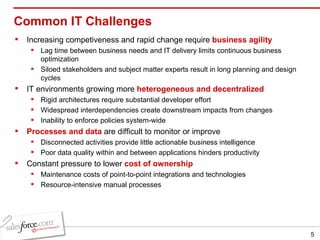
Common IT Challenges Increasing competiveness and rapid change require  business agility Lag time between business needs and IT delivery limits continuous business optimization Siloed stakeholders and subject matter experts result in long planning and design cycles IT environments growing more  heterogeneous and decentralized Rigid architectures require substantial developer effort Widespread interdependencies create downstream impacts from changes Inability to enforce policies system-wide Processes and data  are difficult to monitor or improve Disconnected activities provide little actionable business intelligence Poor data quality within and between applications hinders productivity Constant pressure to lower  cost of ownership Maintenance costs of point-to-point integrations and technologies Resource-intensive manual processes
The main objective with SOA initiatives is to enable a more  agile, flexible and standardized approach  to designing, developing and deploying functionality that is often scattered throughout established IT systems.   —  Gartner, Inc., "Benefits and Challenges of SOA in Business Terms", September 2005 “   ”
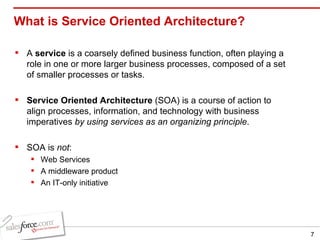
What is Service Oriented Architecture? A  service  is a coarsely defined business function, often playing a role in one or more larger business processes, composed of a set of smaller processes or tasks. Service Oriented Architecture  (SOA) is a course of action to align processes, information, and technology with business imperatives  by using   services as an organizing principle . SOA is  not : Web Services A middleware product An IT-only initiative
Benefits of SOA SOA speeds business change. In its core design strategy of packaging applications into business units of work, service orientation reflects and models business processes. As the business changes, developers can  more easily map business process changes to applications  and then implement the appropriate IT changes. SOA facilitates business connections. With your business processes packaged as modular, accessible business services, you can connect them where and when they are needed to  optimize processes across customers, partners, suppliers, and your own internal applications SOA enhances business control. Because services model business processes, the flow of data and transactions through service-oriented applications is  valuable business data . SOA infrastructure actively manages service flows and can provide flexible and dynamic access to this data, which you can use to  analyze and optimize business results and process costs . -- Forrester, “Your Strategic SOA Platform Vision,” March 2005
Guiding Principles of SOA Incremental improvement Cost-benefit analysis Driving to commonality and reuse Focus on areas of high volatility Focus on most essential services
Saideep Raj Partner, CRM Global Service Line [email_address] Developing an SOA Strategy Track: IT Executives
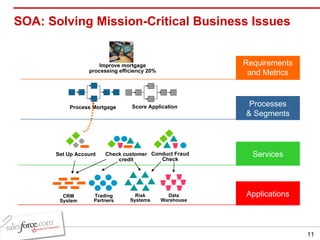
SOA: Solving Mission-Critical Business Issues Improve mortgage processing efficiency 20% Requirements and Metrics Process Mortgage Score Application Processes & Segments Conduct Fraud Check Check customer credit Set Up Account Services Data Warehouse CRM System Risk Systems Trading Partners Applications
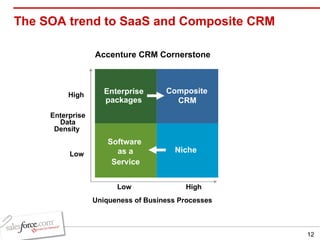
The SOA trend to SaaS and Composite CRM  Accenture CRM Cornerstone Enterprise  packages Software  as a  Service Niche Composite  CRM Low High High Low Enterprise Data Density  Uniqueness of Business Processes
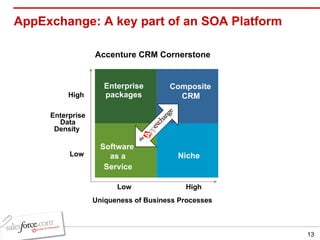
AppExchange: A key part of an SOA Platform  Accenture CRM Cornerstone Enterprise  packages Software  as a  Service Niche Composite  CRM Low High High Low Enterprise Data Density  Uniqueness of Business Processes
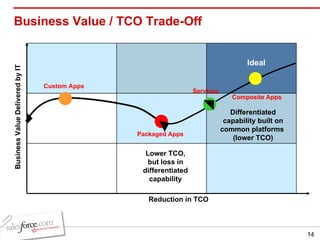
Business Value / TCO Trade-Off Reduction in TCO Business Value Delivered by IT Lower TCO, but loss in differentiated capability Differentiated capability built on common platforms  (lower TCO) Custom Apps Packaged Apps Services Composite Apps Ideal
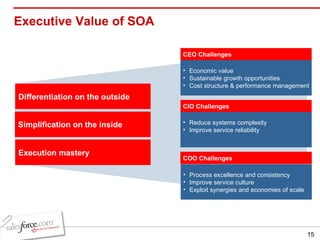
Executive Value of SOA CEO Challenges Economic value  Sustainable growth opportunities  Cost structure & performance management CIO Challenges Reduce systems complexity  Improve service reliability  COO Challenges Process excellence and consistency Improve service culture Exploit synergies and economies of scale Simplification on the inside Execution mastery Differentiation on the outside
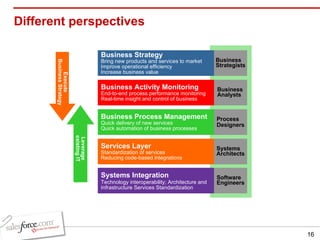
Different perspectives Systems Integration Technology interoperability; Architecture and  Infrastructure Services Standardization Software Engineers Services Layer Standardization of services Reducing code-based integrations Systems Architects Business Analysts Business Activity Monitoring End-to-end process performance monitoring  Real-time insight and control of business Business  Strategists Business Strategy Bring new products and services to market Improve operational efficiency Increase business value Execute  Business Strategy Leverage existing IT Process Designers Business Process Management Quick delivery of new services Quick automation of business processes
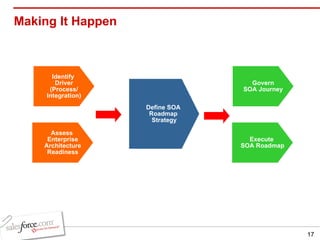
Making It Happen Identify  Driver (Process/ Integration) Assess  Enterprise Architecture Readiness Define SOA  Roadmap  Strategy Execute  SOA Roadmap Govern SOA Journey
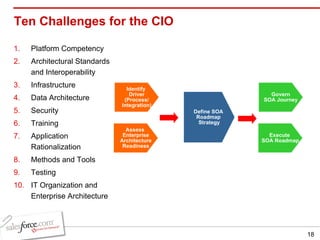
Ten Challenges for the CIO Platform Competency Architectural Standards and Interoperability Infrastructure Data Architecture Security Training Application Rationalization Methods and Tools Testing IT Organization and Enterprise Architecture Identify  Driver (Process/ Integration) Assess  Enterprise Architecture Readiness Define SOA  Roadmap  Strategy Execute  SOA Roadmap Govern SOA Journey
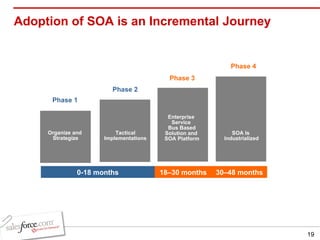
Adoption of SOA is an Incremental Journey Phase 1 Phase 2 Phase 3 Phase 4 Organize and  Strategize Tactical Implementations Enterprise  Service  Bus Based Solution and  SOA Platform SOA Is Industrialized 0-18 months   18–30 months 30–48 months
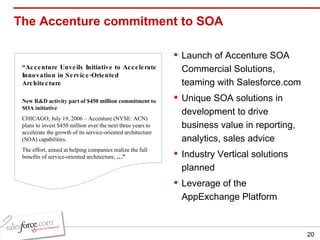
The Accenture commitment to SOA “ Accenture Unveils Initiative to Accelerate Innovation in Service-Oriented Architecture New R&D activity part of $450 million commitment to SOA initiative CHICAGO; July 19, 2006 – Accenture (NYSE: ACN) plans to invest $450 million over the next three years to accelerate the growth of its service-oriented architecture (SOA) capabilities.  The effort, aimed at helping companies realize the full benefits of service-oriented architecture,  …” Launch of Accenture SOA Commercial Solutions, teaming with Salesforce.com Unique SOA solutions in development to drive business value in reporting, analytics, sales advice Industry Vertical solutions planned Leverage of the AppExchange Platform
Jon Plax Senior Program Manager, Global Integration Services [email_address] Case Study Developing an SOA Strategy Track: IT Executives
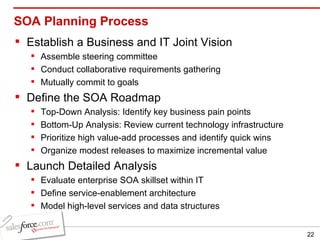
SOA Planning Process Establish a Business and IT Joint Vision Assemble steering committee Conduct collaborative requirements gathering Mutually commit to goals Define the SOA Roadmap Top-Down Analysis: Identify key business pain points Bottom-Up Analysis: Review current technology infrastructure Prioritize high value-add processes and identify quick wins Organize modest releases to maximize incremental value Launch Detailed Analysis Evaluate enterprise SOA skillset within IT Define service-enablement architecture Model high-level services and data structures
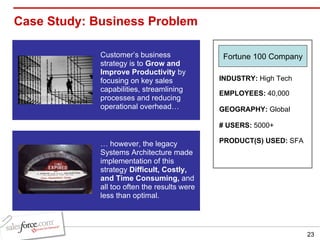
Case Study: Business Problem Customer’s business strategy is to  Grow and Improve Productivity  by focusing on key sales capabilities, streamlining processes and reducing operational overhead… …  however, the legacy Systems Architecture made implementation of this strategy  Difficult, Costly, and Time Consuming,  and all too often the results were less than optimal. INDUSTRY:  High Tech EMPLOYEES:  40,000 GEOGRAPHY:  Global Fortune 100 Company PRODUCT(S) USED:  SFA # USERS:  5000+
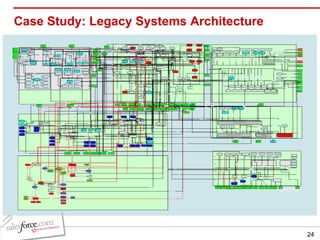
Case Study: Legacy Systems Architecture
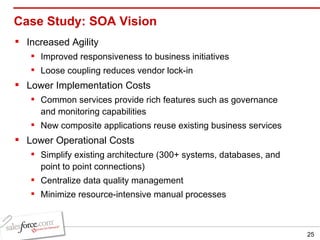
Case Study: SOA Vision Increased Agility Improved responsiveness to business initiatives Loose coupling reduces vendor lock-in Lower Implementation Costs Common services provide rich features such as governance and monitoring capabilities New composite applications reuse existing business services Lower Operational Costs Simplify existing architecture (300+ systems, databases, and point to point connections) Centralize data quality management Minimize resource-intensive manual processes
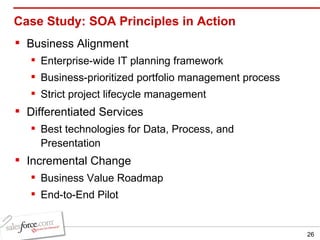
Case Study: SOA Principles in Action Business Alignment Enterprise-wide IT planning framework Business-prioritized portfolio management process Strict project lifecycle management Differentiated Services Best technologies for Data, Process, and Presentation Incremental Change Business Value Roadmap End-to-End Pilot
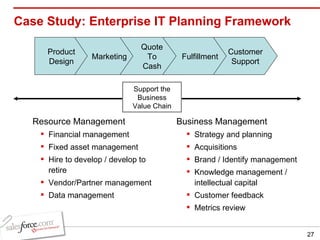
Case Study: Enterprise IT Planning Framework Resource Management Financial management Fixed asset management Hire to develop / develop to retire Vendor/Partner management Data management Business Management Strategy and planning Acquisitions Brand / Identify management Knowledge management / intellectual capital Customer feedback Metrics review Product Design Support the Business Value Chain Marketing Quote To Cash Fulfillment Customer Support
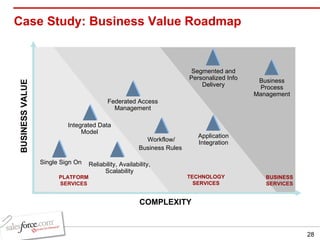
Case Study: Business Value Roadmap Reliability, Availability, Scalability Single Sign On Integrated Data Model Application Integration Segmented and Personalized Info Delivery Federated Access Management Business Process Management Workflow/ Business Rules  COMPLEXITY BUSINESS VALUE PLATFORM SERVICES TECHNOLOGY SERVICES BUSINESS SERVICES
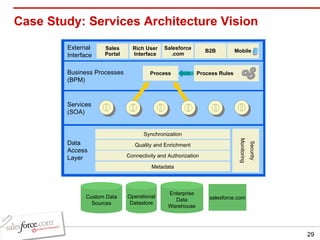
Case Study: Services Architecture Vision External Interface Business Processes (BPM) Services (SOA) salesforce.com Custom Data Sources Operational Datastore Enterprise Data Warehouse Data Access Layer Quality and Enrichment Security Monitoring Sales Portal Rich User Interface Salesforce .com B2B Process Process Rules Mobile Synchronization Connectivity and Authorization Metadata
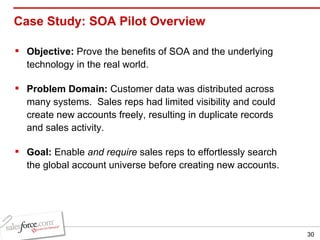
Case Study: SOA Pilot Overview Objective:  Prove the benefits of SOA and the underlying technology in the real world. Problem Domain:  Customer data was distributed across many systems.  Sales reps had limited visibility and could create new accounts freely, resulting in duplicate records and sales activity. Goal:  Enable  and require  sales reps to effortlessly search the global account universe before creating new accounts.
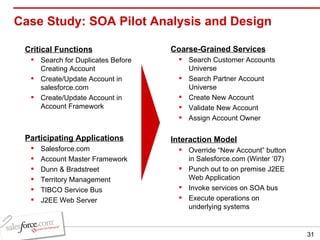
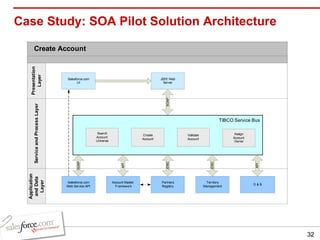
Case Study: SOA Pilot Analysis and Design Critical Functions Search for Duplicates Before Creating Account Create/Update Account in salesforce.com Create/Update Account in Account Framework Participating Applications Salesforce.com Account Master Framework Dunn & Bradstreet Territory Management TIBCO Service Bus J2EE Web Server Coarse-Grained Services Search Customer Accounts Universe Search Partner Account Universe Create New Account  Validate New Account Assign Account Owner Interaction Model Override “New Account” button in Salesforce.com (Winter ’07) Punch out to on premise J2EE Web Application Invoke services on SOA bus Execute operations on underlying systems
Case Study: SOA Pilot Solution Architecture
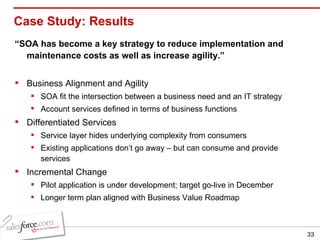
Case Study: Results “ SOA has become a key strategy to reduce implementation and maintenance costs as well as increase agility.” Business Alignment and Agility SOA fit the intersection between a business need and an IT strategy Account services defined in terms of business functions Differentiated Services Service layer hides underlying complexity from consumers Existing applications don’t go away – but can consume and provide services Incremental Change Pilot application is under development; target go-live in December Longer term plan aligned with Business Value Roadmap
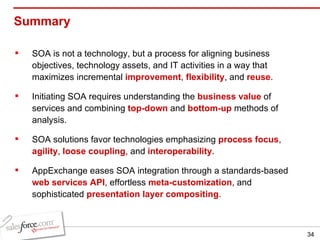
Summary SOA is not a technology, but a process for aligning business objectives, technology assets, and IT activities in a way that maximizes incremental  improvement ,  flexibility , and  reuse . Initiating SOA requires understanding the  business value  of services and combining  top-down  and  bottom-up  methods of analysis. SOA solutions favor technologies emphasizing  process focus ,  agility ,  loose coupling , and  interoperability .  AppExchange eases SOA integration through a standards-based  web services API , effortless  meta-customization , and sophisticated  presentation layer compositing .
Saideep Raj Partner, CRM Global Service Line Jon Plax Senior Program Manager, Integration Services QUESTION & ANSWER PERIOD Accenture salesforce.com Developing an SOA Strategy Track: IT Executives
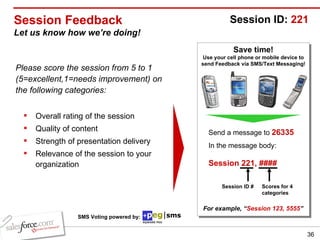
Session Feedback Let us know how we’re doing! Please score the session from 5 to 1 (5=excellent,1=needs improvement) on the following categories: Overall rating of the session Quality of content Strength of presentation delivery Relevance of the session to your organization Save time! Use your cell phone or mobile device to send Feedback via SMS/Text Messaging! Send a message to  26335 In the message body:   Session 221, ####   For example, “ Session 123, 5555 ” Session ID:  221 Session ID # Scores for 4 categories SMS Voting powered by:

Developing an SOA Strategy

  • 1.
    Developing an SOAStrategy Jon Plax, salesforce.com Saideep Raj, Accenture Track: IT Executives
  • 2.
    Safe Harbor Statement“ Safe harbor” statement under the Private Securities Litigation Reform Act of 1995: This presentation may contain forward-looking statements the achievement of which involves risks, uncertainties and assumptions. If any such risks or uncertainties materialize or if any of the assumptions proves incorrect, our results could differ materially from the results expressed or implied by the forward-looking statements we make.  All statements other than statements of historical fact could be deemed forward-looking, including any projections of subscriber growth, earnings, revenues, or other financial items and any statements regarding strategies or plans of management for future operations, statements of belief, any statements concerning new, planned, or upgraded services or technology developments and customer contracts or use of our services. The risks and uncertainties referred to above include - but are not limited to - risks associated with the integration of Sendia Corporation’s technology, operations, infrastructure and personnel with ours; unexpected costs or delays incurred in integrating Sendia with salesforce.com, which could adversely affect our operating results and rate of growth; any unknown errors or limitations in the Sendia technology; any third party intellectual property claims arising from the Sendia technology; customer and partner acceptance and deployment of the AppExchange and AppExchange Mobile platforms; interruptions or delays in our service or our Web hosting; our new business model; breach of our security measures; possible fluctuations in our operating results and rate of growth; the emerging market in which we operate; our relatively limited operating history; our ability to hire, retain and motivate our employees and manage our growth; competition; our ability to continue to release and gain customer acceptance of new and improved versions of our CRM service; unanticipated changes in our effective tax rate; fluctuations in the number of shares outstanding; the price of such shares; foreign currency exchange rates and interest rates. Further information on these and other factors that could affect our financial results is included in the reports on Forms 10-K, 10-Q and 8-K and in other filings we make with the Securities and Exchange Commission from time to time, including our Form 10-K for the fiscal year ended January 31, 2006. These documents are available on the SEC Filings section of the Investor Information section of our website at www.salesforce.com/investor . Any unreleased services or features referenced in this or other press releases or public statements are not currently available and may not be delivered on time or at all.  Customers who purchase our services should make purchase decisions based upon features that are currently available.  Salesforce.com, inc. assumes no obligation and does not intend to update these forward-looking statements, except as required by law.
  • 3.
    Jon Plax SeniorProgram Manager, Global Integration Services [email_address] Developing an SOA Strategy Track: IT Executives
  • 4.
    Agenda What andWhy SOA? Successful Strategies Case Study
  • 5.
    Common IT ChallengesIncreasing competiveness and rapid change require business agility Lag time between business needs and IT delivery limits continuous business optimization Siloed stakeholders and subject matter experts result in long planning and design cycles IT environments growing more heterogeneous and decentralized Rigid architectures require substantial developer effort Widespread interdependencies create downstream impacts from changes Inability to enforce policies system-wide Processes and data are difficult to monitor or improve Disconnected activities provide little actionable business intelligence Poor data quality within and between applications hinders productivity Constant pressure to lower cost of ownership Maintenance costs of point-to-point integrations and technologies Resource-intensive manual processes
  • 6.
    The main objectivewith SOA initiatives is to enable a more agile, flexible and standardized approach to designing, developing and deploying functionality that is often scattered throughout established IT systems. — Gartner, Inc., "Benefits and Challenges of SOA in Business Terms", September 2005 “ ”
  • 7.
    What is ServiceOriented Architecture? A service is a coarsely defined business function, often playing a role in one or more larger business processes, composed of a set of smaller processes or tasks. Service Oriented Architecture (SOA) is a course of action to align processes, information, and technology with business imperatives by using services as an organizing principle . SOA is not : Web Services A middleware product An IT-only initiative
  • 8.
    Benefits of SOASOA speeds business change. In its core design strategy of packaging applications into business units of work, service orientation reflects and models business processes. As the business changes, developers can more easily map business process changes to applications and then implement the appropriate IT changes. SOA facilitates business connections. With your business processes packaged as modular, accessible business services, you can connect them where and when they are needed to optimize processes across customers, partners, suppliers, and your own internal applications SOA enhances business control. Because services model business processes, the flow of data and transactions through service-oriented applications is valuable business data . SOA infrastructure actively manages service flows and can provide flexible and dynamic access to this data, which you can use to analyze and optimize business results and process costs . -- Forrester, “Your Strategic SOA Platform Vision,” March 2005
  • 9.
    Guiding Principles ofSOA Incremental improvement Cost-benefit analysis Driving to commonality and reuse Focus on areas of high volatility Focus on most essential services
  • 10.
    Saideep Raj Partner,CRM Global Service Line [email_address] Developing an SOA Strategy Track: IT Executives
  • 11.
    SOA: Solving Mission-CriticalBusiness Issues Improve mortgage processing efficiency 20% Requirements and Metrics Process Mortgage Score Application Processes & Segments Conduct Fraud Check Check customer credit Set Up Account Services Data Warehouse CRM System Risk Systems Trading Partners Applications
  • 12.
    The SOA trendto SaaS and Composite CRM Accenture CRM Cornerstone Enterprise packages Software as a Service Niche Composite CRM Low High High Low Enterprise Data Density Uniqueness of Business Processes
  • 13.
    AppExchange: A keypart of an SOA Platform Accenture CRM Cornerstone Enterprise packages Software as a Service Niche Composite CRM Low High High Low Enterprise Data Density Uniqueness of Business Processes
  • 14.
    Business Value /TCO Trade-Off Reduction in TCO Business Value Delivered by IT Lower TCO, but loss in differentiated capability Differentiated capability built on common platforms (lower TCO) Custom Apps Packaged Apps Services Composite Apps Ideal
  • 15.
    Executive Value ofSOA CEO Challenges Economic value Sustainable growth opportunities Cost structure & performance management CIO Challenges Reduce systems complexity Improve service reliability COO Challenges Process excellence and consistency Improve service culture Exploit synergies and economies of scale Simplification on the inside Execution mastery Differentiation on the outside
  • 16.
    Different perspectives SystemsIntegration Technology interoperability; Architecture and Infrastructure Services Standardization Software Engineers Services Layer Standardization of services Reducing code-based integrations Systems Architects Business Analysts Business Activity Monitoring End-to-end process performance monitoring Real-time insight and control of business Business Strategists Business Strategy Bring new products and services to market Improve operational efficiency Increase business value Execute Business Strategy Leverage existing IT Process Designers Business Process Management Quick delivery of new services Quick automation of business processes
  • 17.
    Making It HappenIdentify Driver (Process/ Integration) Assess Enterprise Architecture Readiness Define SOA Roadmap Strategy Execute SOA Roadmap Govern SOA Journey
  • 18.
    Ten Challenges forthe CIO Platform Competency Architectural Standards and Interoperability Infrastructure Data Architecture Security Training Application Rationalization Methods and Tools Testing IT Organization and Enterprise Architecture Identify Driver (Process/ Integration) Assess Enterprise Architecture Readiness Define SOA Roadmap Strategy Execute SOA Roadmap Govern SOA Journey
  • 19.
    Adoption of SOAis an Incremental Journey Phase 1 Phase 2 Phase 3 Phase 4 Organize and Strategize Tactical Implementations Enterprise Service Bus Based Solution and SOA Platform SOA Is Industrialized 0-18 months 18–30 months 30–48 months
  • 20.
    The Accenture commitmentto SOA “ Accenture Unveils Initiative to Accelerate Innovation in Service-Oriented Architecture New R&D activity part of $450 million commitment to SOA initiative CHICAGO; July 19, 2006 – Accenture (NYSE: ACN) plans to invest $450 million over the next three years to accelerate the growth of its service-oriented architecture (SOA) capabilities. The effort, aimed at helping companies realize the full benefits of service-oriented architecture, …” Launch of Accenture SOA Commercial Solutions, teaming with Salesforce.com Unique SOA solutions in development to drive business value in reporting, analytics, sales advice Industry Vertical solutions planned Leverage of the AppExchange Platform
  • 21.
    Jon Plax SeniorProgram Manager, Global Integration Services [email_address] Case Study Developing an SOA Strategy Track: IT Executives
  • 22.
    SOA Planning ProcessEstablish a Business and IT Joint Vision Assemble steering committee Conduct collaborative requirements gathering Mutually commit to goals Define the SOA Roadmap Top-Down Analysis: Identify key business pain points Bottom-Up Analysis: Review current technology infrastructure Prioritize high value-add processes and identify quick wins Organize modest releases to maximize incremental value Launch Detailed Analysis Evaluate enterprise SOA skillset within IT Define service-enablement architecture Model high-level services and data structures
  • 23.
    Case Study: BusinessProblem Customer’s business strategy is to Grow and Improve Productivity by focusing on key sales capabilities, streamlining processes and reducing operational overhead… … however, the legacy Systems Architecture made implementation of this strategy Difficult, Costly, and Time Consuming, and all too often the results were less than optimal. INDUSTRY: High Tech EMPLOYEES: 40,000 GEOGRAPHY: Global Fortune 100 Company PRODUCT(S) USED: SFA # USERS: 5000+
  • 24.
    Case Study: LegacySystems Architecture
  • 25.
    Case Study: SOAVision Increased Agility Improved responsiveness to business initiatives Loose coupling reduces vendor lock-in Lower Implementation Costs Common services provide rich features such as governance and monitoring capabilities New composite applications reuse existing business services Lower Operational Costs Simplify existing architecture (300+ systems, databases, and point to point connections) Centralize data quality management Minimize resource-intensive manual processes
  • 26.
    Case Study: SOAPrinciples in Action Business Alignment Enterprise-wide IT planning framework Business-prioritized portfolio management process Strict project lifecycle management Differentiated Services Best technologies for Data, Process, and Presentation Incremental Change Business Value Roadmap End-to-End Pilot
  • 27.
    Case Study: EnterpriseIT Planning Framework Resource Management Financial management Fixed asset management Hire to develop / develop to retire Vendor/Partner management Data management Business Management Strategy and planning Acquisitions Brand / Identify management Knowledge management / intellectual capital Customer feedback Metrics review Product Design Support the Business Value Chain Marketing Quote To Cash Fulfillment Customer Support
  • 28.
    Case Study: BusinessValue Roadmap Reliability, Availability, Scalability Single Sign On Integrated Data Model Application Integration Segmented and Personalized Info Delivery Federated Access Management Business Process Management Workflow/ Business Rules COMPLEXITY BUSINESS VALUE PLATFORM SERVICES TECHNOLOGY SERVICES BUSINESS SERVICES
  • 29.
    Case Study: ServicesArchitecture Vision External Interface Business Processes (BPM) Services (SOA) salesforce.com Custom Data Sources Operational Datastore Enterprise Data Warehouse Data Access Layer Quality and Enrichment Security Monitoring Sales Portal Rich User Interface Salesforce .com B2B Process Process Rules Mobile Synchronization Connectivity and Authorization Metadata
  • 30.
    Case Study: SOAPilot Overview Objective: Prove the benefits of SOA and the underlying technology in the real world. Problem Domain: Customer data was distributed across many systems. Sales reps had limited visibility and could create new accounts freely, resulting in duplicate records and sales activity. Goal: Enable and require sales reps to effortlessly search the global account universe before creating new accounts.
  • 31.
    Case Study: SOAPilot Analysis and Design Critical Functions Search for Duplicates Before Creating Account Create/Update Account in salesforce.com Create/Update Account in Account Framework Participating Applications Salesforce.com Account Master Framework Dunn & Bradstreet Territory Management TIBCO Service Bus J2EE Web Server Coarse-Grained Services Search Customer Accounts Universe Search Partner Account Universe Create New Account Validate New Account Assign Account Owner Interaction Model Override “New Account” button in Salesforce.com (Winter ’07) Punch out to on premise J2EE Web Application Invoke services on SOA bus Execute operations on underlying systems
  • 32.
    Case Study: SOAPilot Solution Architecture
  • 33.
    Case Study: Results“ SOA has become a key strategy to reduce implementation and maintenance costs as well as increase agility.” Business Alignment and Agility SOA fit the intersection between a business need and an IT strategy Account services defined in terms of business functions Differentiated Services Service layer hides underlying complexity from consumers Existing applications don’t go away – but can consume and provide services Incremental Change Pilot application is under development; target go-live in December Longer term plan aligned with Business Value Roadmap
  • 34.
    Summary SOA isnot a technology, but a process for aligning business objectives, technology assets, and IT activities in a way that maximizes incremental improvement , flexibility , and reuse . Initiating SOA requires understanding the business value of services and combining top-down and bottom-up methods of analysis. SOA solutions favor technologies emphasizing process focus , agility , loose coupling , and interoperability . AppExchange eases SOA integration through a standards-based web services API , effortless meta-customization , and sophisticated presentation layer compositing .
  • 35.
    Saideep Raj Partner,CRM Global Service Line Jon Plax Senior Program Manager, Integration Services QUESTION & ANSWER PERIOD Accenture salesforce.com Developing an SOA Strategy Track: IT Executives
  • 36.
    Session Feedback Letus know how we’re doing! Please score the session from 5 to 1 (5=excellent,1=needs improvement) on the following categories: Overall rating of the session Quality of content Strength of presentation delivery Relevance of the session to your organization Save time! Use your cell phone or mobile device to send Feedback via SMS/Text Messaging! Send a message to 26335 In the message body: Session 221, #### For example, “ Session 123, 5555 ” Session ID: 221 Session ID # Scores for 4 categories SMS Voting powered by: