SOA Lessons Learned
Charlie Wade
CWade80292@gmail.com
Discussion
• Background on a previous SOA Deployment
• Lessons Learned/Solution
• Summary
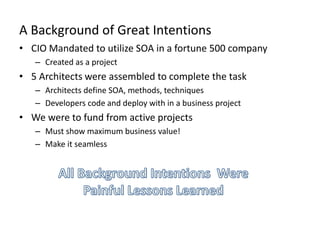
A Background of Great Intentions
• CIO Mandated to utilize SOA in a fortune 500 company
– Created as a project
• 5 Architects were assembled to complete the task
– Architects define SOA, methods, techniques
– Developers code and deploy with in a business project
• We were to fund from active projects
– Must show maximum business value!
– Make it seamless
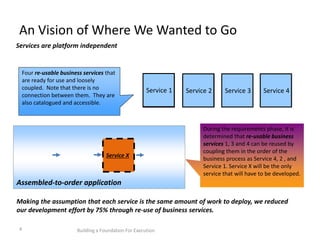
An Vision of Where We Wanted to Go
Building a Foundation For Execution4
Assembled-to-order application
During the requirements phase, it is
determined that re-usable business
services 1, 3 and 4 can be reused by
coupling them in the order of the
business process as Service 4, 2 , and
Service 1. Service X will be the only
service that will have to be developed.
Four re-usable business services that
are ready for use and loosely
coupled. Note that there is no
connection between them. They are
also catalogued and accessible.
Making the assumption that each service is the same amount of work to deploy, we reduced
our development effort by 75% through re-use of business services.
Services are platform independent
Service 1 Service 2 Service 3 Service 4Service 1 Service 2
Service X
Service 4
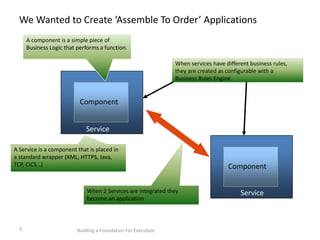
We Wanted to Create ‘Assemble To Order’ Applications
Building a Foundation For Execution5
Component
A component is a simple piece of
Business Logic that performs a function.
Component
Service
ServiceWhen 2 Services are integrated they
become an application
When services have different business rules,
they are created as configurable with a
Business Rules Engine
A Service is a component that is placed in
a standard wrapper (XML, HTTPS, Java,
TCP, CICS…)
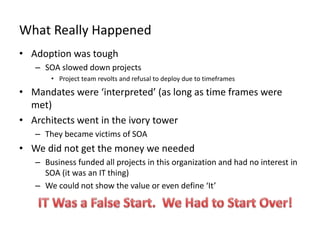
What Really Happened
• Adoption was tough
– SOA slowed down projects
• Project team revolts and refusal to deploy due to timeframes
• Mandates were ‘interpreted’ (as long as time frames were
met)
• Architects went in the ivory tower
– They became victims of SOA
• We did not get the money we needed
– Business funded all projects in this organization and had no interest in
SOA (it was an IT thing)
– We could not show the value or even define ‘It’
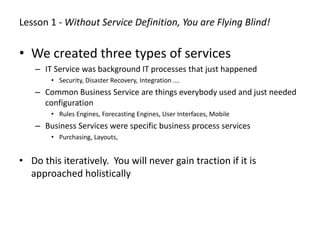
Lesson 1 - Without Service Definition, You are Flying Blind!
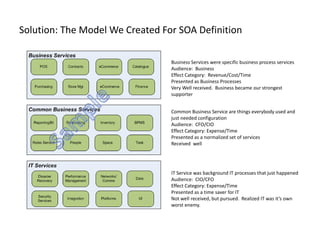
• We created three types of services
– IT Service was background IT processes that just happened
• Security, Disaster Recovery, Integration ….
– Common Business Service are things everybody used and just needed
configuration
• Rules Engines, Forecasting Engines, User Interfaces, Mobile
– Business Services were specific business process services
• Purchasing, Layouts,
• Do this iteratively. You will never gain traction if it is
approached holistically
Solution: The Model We Created For SOA Definition
Business Services were specific business process services
Audience: Business
Effect Category: Revenue/Cost/Time
Presented as Business Processes
Very Well received. Business became our strongest
supporter
Common Business Service are things everybody used and
just needed configuration
Audience: CFO/CIO
Effect Category: Expense/Time
Presented as a normalized set of services
Received well
IT Service was background IT processes that just happened
Audience: CIO/CFO
Effect Category: Expense/Time
Presented as a time saver for IT
Not well received, but pursued. Realized IT was it’s own
worst enemy.
Lesson 2 – SOA is Org Change, Not Just Technology
“Even those who fancy themselves the most progressive will fight against other kinds
of progress, for each of us is convinced that our way is the best way.“ Louis L'Amour
The Lonely Men
Current: I have to solve and control the whole problem
Future: I will fix what I am best at with a team of experts assisting for
their areas of expertise!
Current: I will code the customized solution for you.
Future: I will assemble a solution for you and fill the gaps as needed.
Current: That will not work for my customer so I’ll build a new one that is
special.
Future: I will customize and configure the existing components to fit my
customers needs.
"The hardest thing [about SOAs] is the cultural change where you align the IT and business
capabilities.” Tom Rosamilia, IBM's general manager for WebSphere software.
Solution: What We Did to Org Change
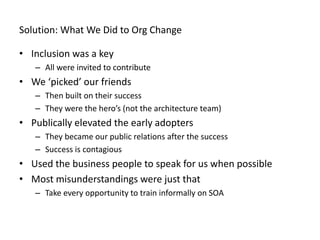
• Inclusion was a key
– All were invited to contribute
• We ‘picked’ our friends
– Then built on their success
– They were the hero’s (not the architecture team)
• Publically elevated the early adopters
– They became our public relations after the success
– Success is contagious
• Used the business people to speak for us when possible
• Most misunderstandings were just that
– Take every opportunity to train informally on SOA
Facility Architecture of the
Future
ACME
11
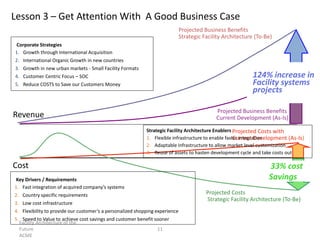
Revenue
Cost
Projected Costs with
Current Development (As-Is)
Projected Business Benefits
Strategic Facility Architecture (To-Be)
Projected Costs
Strategic Facility Architecture (To-Be)
Corporate Strategies
1. Growth through International Acquisition
2. International Organic Growth in new countries
3. Growth in new urban markets - Small Facility Formats
4. Customer Centric Focus – SOC
5. Reduce COSTS to Save our Customers Money
Key Drivers / Requirements
1. Fast integration of acquired company’s systems
2. Country specific requirements
3. Low cost infrastructure
4. Flexibility to provide our customer’s a personalized shopping experience
5. Speed to Value to achieve cost savings and customer benefit sooner
Strategic Facility Architecture Enablers
1. Flexible infrastructure to enable faster integration
2. Adaptable infrastructure to allow market level customization
3. Reuse of assets to hasten development cycle and take costs out
124% increase in
Facility systems
projects
Projected Business Benefits
Current Development (As-Is)
33% cost
Savings
Lesson 3 – Get Attention With A Good Business Case
Lesson 4 – Build the Infrastructure First!
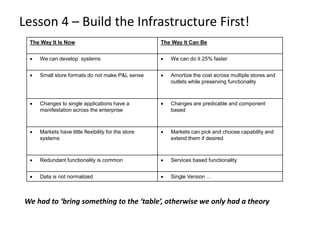
The Way It Is Now The Way It Can Be
 We can develop systems  We can do it 25% faster
 Small store formats do not make P&L sense  Amortize the cost across multiple stores and
outlets while preserving functionality
 Changes to single applications have a
manifestation across the enterprise
 Changes are predicable and component
based
 Markets have little flexibility for the store
systems
 Markets can pick and choose capability and
extend them if desired
 Redundant functionality is common  Services based functionality
 Data is not normalized  Single Version …
We had to ‘bring something to the ‘table’, otherwise we only had a theory
13
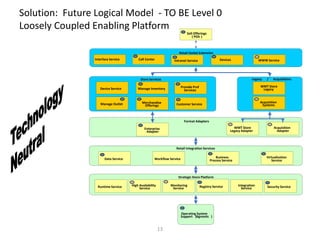
Solution: Future Logical Model - TO BE Level 0
Loosely Coupled Enabling Platform
Store Services
Manage Inventory
Merchandise
Offerings
Sell Offerings
( POS )
Provide Prof
Services
Manage Outlet
Call Center
Device Service
WWW Service
Retail Outlet Extension
Legacy / Acquisitions
Acquisition
Systems
WMT Store
Legacy
Enterprise
Adapter
Format Adapters
WMT Store
Legacy Adapter
Acquisition
Adapter
Data Service
Retail Integration Services
Business
Process Service
Virtualization
ServiceWorkflow Service
Runtime Service
Strategic Store Platform
Registry Service Security ServiceHigh Availability
Service
Integration
Service
Monitoring
Service
Operating System
Support (Agnostic )
Intranet Service
Customer Service
Interface Service Call Center Devices
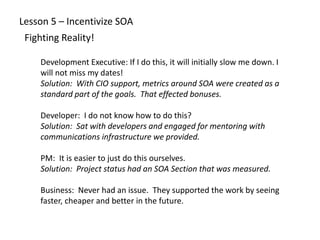
Lesson 5 – Incentivize SOA
Fighting Reality!
Development Executive: If I do this, it will initially slow me down. I
will not miss my dates!
Solution: With CIO support, metrics around SOA were created as a
standard part of the goals. That effected bonuses.
Developer: I do not know how to do this?
Solution: Sat with developers and engaged for mentoring with
communications infrastructure we provided.
PM: It is easier to just do this ourselves.
Solution: Project status had an SOA Section that was measured.
Business: Never had an issue. They supported the work by seeing
faster, cheaper and better in the future.
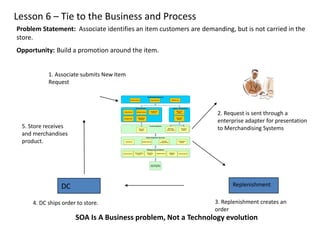
Problem Statement: Associate identifies an item customers are demanding, but is not carried in the
store.
Opportunity: Build a promotion around the item.
Store Services
Manage Inventory
Merchandise
Offerings
Provide Prof
Services
Manage Outlet
Interface Service
Device Service
WWW Service
Retail Outlet Extension
Intranet Service
Legacy / Acquisitions
Acquisition
Systems
WMT Store
Legacy
ISP, POS, SAPS, RXP
Enterprise
Adapter
Format Adapters
WMT Store
Legacy Adapter
Acquisition
Adapter
Data Service
Retail Integration Services
Business
Process Service
Virtualization
Service
Workflow Service
Runtime Service
Strategic Store Platform
Registry Service Security Service
High Availibility
Service
Integration
Service
Monitoring
Service
Operating System
Support (Agnostic)
ReplenishmentDC
1. Associate submits New Item
Request
2. Request is sent through a
enterprise adapter for presentation
to Merchandising Systems
3. Replenishment creates an
order
4. DC ships order to store.
5. Store receives
and merchandises
product.
Lesson 6 – Tie to the Business and Process
SOA Is A Business problem, Not a Technology evolution
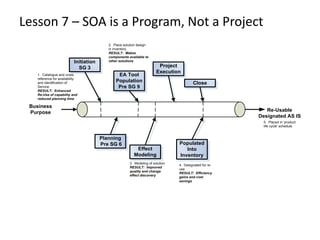
Lesson 7 – SOA is a Program, Not a Project
Initiation
SG 3 Project
Execution
Planning
Pre SG 6 Populated
Into
Inventory
Business
Purpose Re-Usable
Designated AS IS
EA Tool
Population
Pre SG 9
Effect
Modeling
Close
1. Catalogue and cross
reference for availability
and identification of
Service.
RESULT: Enhanced
Re-Use of capability and
reduced planning time
2. Place solution design
in inventory.
RESULT: Makes
components available to
other solutions
3. Modeling of solution
RESULT: Improved
quality and change
effect discovery
4. Designated for re-
use
RESULT: Efficiency
gains and cost
savings
5. Placed in ‘product
life cycle’ schedule
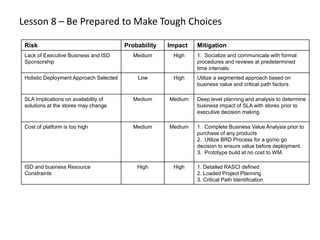
Lesson 8 – Be Prepared to Make Tough Choices
Risk Probability Impact Mitigation
Lack of Executive Business and ISD
Sponsorship
Medium High 1. Socialize and communicate with formal
procedures and reviews at predetermined
time intervals.
Holistic Deployment Approach Selected Low High Utilize a segmented approach based on
business value and critical path factors
SLA Implications on availability of
solutions at the stores may change
Medium Medium Deep level planning and analysis to determine
business impact of SLA with stores prior to
executive decision making.
Cost of platform is too high Medium Medium 1. Complete Business Value Analysis prior to
purchase of any products
2. Utilize BRD Process for a go/no go
decision to ensure value before deployment.
3. Prototype build at no cost to WM.
ISD and business Resource
Constraints
High High 1. Detailed RASCI defined
2. Loaded Project Planning
3. Critical Path Identification
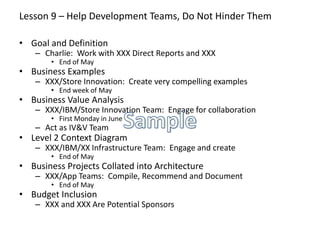
Lesson 9 – Help Development Teams, Do Not Hinder Them
• Goal and Definition
– Charlie: Work with XXX Direct Reports and XXX
• End of May
• Business Examples
– XXX/Store Innovation: Create very compelling examples
• End week of May
• Business Value Analysis
– XXX/IBM/Store Innovation Team: Engage for collaboration
• First Monday in June
– Act as IV&V Team
• Level 2 Context Diagram
– XXX/IBM/XX Infrastructure Team: Engage and create
• End of May
• Business Projects Collated into Architecture
– XXX/App Teams: Compile, Recommend and Document
• End of May
• Budget Inclusion
– XXX and XXX Are Potential Sponsors
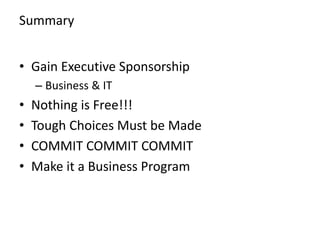
Summary
• Gain Executive Sponsorship
– Business & IT
• Nothing is Free!!!
• Tough Choices Must be Made
• COMMIT COMMIT COMMIT
• Make it a Business Program

Soa Lessons learned

  • 1.
    SOA Lessons Learned CharlieWade CWade80292@gmail.com
  • 2.
    Discussion • Background ona previous SOA Deployment • Lessons Learned/Solution • Summary
  • 3.
    A Background ofGreat Intentions • CIO Mandated to utilize SOA in a fortune 500 company – Created as a project • 5 Architects were assembled to complete the task – Architects define SOA, methods, techniques – Developers code and deploy with in a business project • We were to fund from active projects – Must show maximum business value! – Make it seamless
  • 4.
    An Vision ofWhere We Wanted to Go Building a Foundation For Execution4 Assembled-to-order application During the requirements phase, it is determined that re-usable business services 1, 3 and 4 can be reused by coupling them in the order of the business process as Service 4, 2 , and Service 1. Service X will be the only service that will have to be developed. Four re-usable business services that are ready for use and loosely coupled. Note that there is no connection between them. They are also catalogued and accessible. Making the assumption that each service is the same amount of work to deploy, we reduced our development effort by 75% through re-use of business services. Services are platform independent Service 1 Service 2 Service 3 Service 4Service 1 Service 2 Service X Service 4
  • 5.
    We Wanted toCreate ‘Assemble To Order’ Applications Building a Foundation For Execution5 Component A component is a simple piece of Business Logic that performs a function. Component Service ServiceWhen 2 Services are integrated they become an application When services have different business rules, they are created as configurable with a Business Rules Engine A Service is a component that is placed in a standard wrapper (XML, HTTPS, Java, TCP, CICS…)
  • 6.
    What Really Happened •Adoption was tough – SOA slowed down projects • Project team revolts and refusal to deploy due to timeframes • Mandates were ‘interpreted’ (as long as time frames were met) • Architects went in the ivory tower – They became victims of SOA • We did not get the money we needed – Business funded all projects in this organization and had no interest in SOA (it was an IT thing) – We could not show the value or even define ‘It’
  • 7.
    Lesson 1 -Without Service Definition, You are Flying Blind! • We created three types of services – IT Service was background IT processes that just happened • Security, Disaster Recovery, Integration …. – Common Business Service are things everybody used and just needed configuration • Rules Engines, Forecasting Engines, User Interfaces, Mobile – Business Services were specific business process services • Purchasing, Layouts, • Do this iteratively. You will never gain traction if it is approached holistically
  • 8.
    Solution: The ModelWe Created For SOA Definition Business Services were specific business process services Audience: Business Effect Category: Revenue/Cost/Time Presented as Business Processes Very Well received. Business became our strongest supporter Common Business Service are things everybody used and just needed configuration Audience: CFO/CIO Effect Category: Expense/Time Presented as a normalized set of services Received well IT Service was background IT processes that just happened Audience: CIO/CFO Effect Category: Expense/Time Presented as a time saver for IT Not well received, but pursued. Realized IT was it’s own worst enemy.
  • 9.
    Lesson 2 –SOA is Org Change, Not Just Technology “Even those who fancy themselves the most progressive will fight against other kinds of progress, for each of us is convinced that our way is the best way.“ Louis L'Amour The Lonely Men Current: I have to solve and control the whole problem Future: I will fix what I am best at with a team of experts assisting for their areas of expertise! Current: I will code the customized solution for you. Future: I will assemble a solution for you and fill the gaps as needed. Current: That will not work for my customer so I’ll build a new one that is special. Future: I will customize and configure the existing components to fit my customers needs. "The hardest thing [about SOAs] is the cultural change where you align the IT and business capabilities.” Tom Rosamilia, IBM's general manager for WebSphere software.
  • 10.
    Solution: What WeDid to Org Change • Inclusion was a key – All were invited to contribute • We ‘picked’ our friends – Then built on their success – They were the hero’s (not the architecture team) • Publically elevated the early adopters – They became our public relations after the success – Success is contagious • Used the business people to speak for us when possible • Most misunderstandings were just that – Take every opportunity to train informally on SOA
  • 11.
    Facility Architecture ofthe Future ACME 11 Revenue Cost Projected Costs with Current Development (As-Is) Projected Business Benefits Strategic Facility Architecture (To-Be) Projected Costs Strategic Facility Architecture (To-Be) Corporate Strategies 1. Growth through International Acquisition 2. International Organic Growth in new countries 3. Growth in new urban markets - Small Facility Formats 4. Customer Centric Focus – SOC 5. Reduce COSTS to Save our Customers Money Key Drivers / Requirements 1. Fast integration of acquired company’s systems 2. Country specific requirements 3. Low cost infrastructure 4. Flexibility to provide our customer’s a personalized shopping experience 5. Speed to Value to achieve cost savings and customer benefit sooner Strategic Facility Architecture Enablers 1. Flexible infrastructure to enable faster integration 2. Adaptable infrastructure to allow market level customization 3. Reuse of assets to hasten development cycle and take costs out 124% increase in Facility systems projects Projected Business Benefits Current Development (As-Is) 33% cost Savings Lesson 3 – Get Attention With A Good Business Case
  • 12.
    Lesson 4 –Build the Infrastructure First! The Way It Is Now The Way It Can Be  We can develop systems  We can do it 25% faster  Small store formats do not make P&L sense  Amortize the cost across multiple stores and outlets while preserving functionality  Changes to single applications have a manifestation across the enterprise  Changes are predicable and component based  Markets have little flexibility for the store systems  Markets can pick and choose capability and extend them if desired  Redundant functionality is common  Services based functionality  Data is not normalized  Single Version … We had to ‘bring something to the ‘table’, otherwise we only had a theory
  • 13.
    13 Solution: Future LogicalModel - TO BE Level 0 Loosely Coupled Enabling Platform Store Services Manage Inventory Merchandise Offerings Sell Offerings ( POS ) Provide Prof Services Manage Outlet Call Center Device Service WWW Service Retail Outlet Extension Legacy / Acquisitions Acquisition Systems WMT Store Legacy Enterprise Adapter Format Adapters WMT Store Legacy Adapter Acquisition Adapter Data Service Retail Integration Services Business Process Service Virtualization ServiceWorkflow Service Runtime Service Strategic Store Platform Registry Service Security ServiceHigh Availability Service Integration Service Monitoring Service Operating System Support (Agnostic ) Intranet Service Customer Service Interface Service Call Center Devices
  • 14.
    Lesson 5 –Incentivize SOA Fighting Reality! Development Executive: If I do this, it will initially slow me down. I will not miss my dates! Solution: With CIO support, metrics around SOA were created as a standard part of the goals. That effected bonuses. Developer: I do not know how to do this? Solution: Sat with developers and engaged for mentoring with communications infrastructure we provided. PM: It is easier to just do this ourselves. Solution: Project status had an SOA Section that was measured. Business: Never had an issue. They supported the work by seeing faster, cheaper and better in the future.
  • 15.
    Problem Statement: Associateidentifies an item customers are demanding, but is not carried in the store. Opportunity: Build a promotion around the item. Store Services Manage Inventory Merchandise Offerings Provide Prof Services Manage Outlet Interface Service Device Service WWW Service Retail Outlet Extension Intranet Service Legacy / Acquisitions Acquisition Systems WMT Store Legacy ISP, POS, SAPS, RXP Enterprise Adapter Format Adapters WMT Store Legacy Adapter Acquisition Adapter Data Service Retail Integration Services Business Process Service Virtualization Service Workflow Service Runtime Service Strategic Store Platform Registry Service Security Service High Availibility Service Integration Service Monitoring Service Operating System Support (Agnostic) ReplenishmentDC 1. Associate submits New Item Request 2. Request is sent through a enterprise adapter for presentation to Merchandising Systems 3. Replenishment creates an order 4. DC ships order to store. 5. Store receives and merchandises product. Lesson 6 – Tie to the Business and Process SOA Is A Business problem, Not a Technology evolution
  • 16.
    Lesson 7 –SOA is a Program, Not a Project Initiation SG 3 Project Execution Planning Pre SG 6 Populated Into Inventory Business Purpose Re-Usable Designated AS IS EA Tool Population Pre SG 9 Effect Modeling Close 1. Catalogue and cross reference for availability and identification of Service. RESULT: Enhanced Re-Use of capability and reduced planning time 2. Place solution design in inventory. RESULT: Makes components available to other solutions 3. Modeling of solution RESULT: Improved quality and change effect discovery 4. Designated for re- use RESULT: Efficiency gains and cost savings 5. Placed in ‘product life cycle’ schedule
  • 17.
    Lesson 8 –Be Prepared to Make Tough Choices Risk Probability Impact Mitigation Lack of Executive Business and ISD Sponsorship Medium High 1. Socialize and communicate with formal procedures and reviews at predetermined time intervals. Holistic Deployment Approach Selected Low High Utilize a segmented approach based on business value and critical path factors SLA Implications on availability of solutions at the stores may change Medium Medium Deep level planning and analysis to determine business impact of SLA with stores prior to executive decision making. Cost of platform is too high Medium Medium 1. Complete Business Value Analysis prior to purchase of any products 2. Utilize BRD Process for a go/no go decision to ensure value before deployment. 3. Prototype build at no cost to WM. ISD and business Resource Constraints High High 1. Detailed RASCI defined 2. Loaded Project Planning 3. Critical Path Identification
  • 18.
    Lesson 9 –Help Development Teams, Do Not Hinder Them • Goal and Definition – Charlie: Work with XXX Direct Reports and XXX • End of May • Business Examples – XXX/Store Innovation: Create very compelling examples • End week of May • Business Value Analysis – XXX/IBM/Store Innovation Team: Engage for collaboration • First Monday in June – Act as IV&V Team • Level 2 Context Diagram – XXX/IBM/XX Infrastructure Team: Engage and create • End of May • Business Projects Collated into Architecture – XXX/App Teams: Compile, Recommend and Document • End of May • Budget Inclusion – XXX and XXX Are Potential Sponsors
  • 19.
    Summary • Gain ExecutiveSponsorship – Business & IT • Nothing is Free!!! • Tough Choices Must be Made • COMMIT COMMIT COMMIT • Make it a Business Program