SOA Six Domain Model Byungwook Cho K. 2006-07-05
Agenda Introduction Business Strategy and Process Architecture Cost and Benefit Project and Applications Building Blocks Organization and Governance
Introduction What is SOA? Is an IT strategy that organizes the discrete functions contained in enterprise applications into interoperable,standard based services that can be combined and reused quickly to meet the business needs. Benefit is Improves productivity, agility and speed for both Business and IT. Allows IT to deliver services faster and align closer co-work with business. Allows the business to respond quicker and deliver optimal user experience. 6 Domain Model is Encapsulates these practices with six domains, each of which must be considered equally to provide a focused framework for SOA. 6 Domains are interrelated and interdependent Executing on each domain with equal focus is fundamental for the success of SOA.
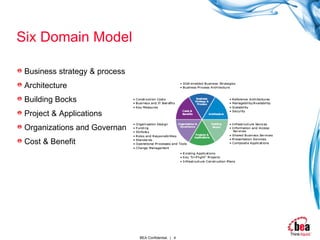
Six Domain Model Business strategy & process Architecture Building Bocks Project & Applications Organizations and Governance Cost & Benefit
Business Strategy and Process Challenge is to close the gap between IT and Business. A gap from realization IT from business Business strategy is long term, IT strategy is a short term    As a result IT doesn’t support the enterprise as a whole SOA Program Promoting the sharing and understanding of the  whole business strategy , so that  decision are made with an enterprise level  view. Owning overall SOA strategy of the enterprise so that appropriate emphasis is given to each of  six domain of SOA throughout a multi-year roadmap . Dynamic,responsive and standard-based architecture Cost effect delivery  by  identifying and optimizing business process  – that is consists of  re-usable services and avoiding duplication of functionally  by mining legacy applications. Deciding on the  priorities for service development & deployment  and  choosing increments and when they will be delivered. Establish organization and governance to ensure that proceses,policies and standard. Encourage change by incentive and publicity. Ensure  measurement that provide cost-benefit analysis  and  continuous feedback  loop  to check up the vialility of the program
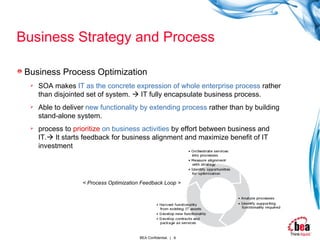
Business Strategy and Process Business Process Optimization SOA makes  IT as the   concrete expression of whole enterprise process  rather than disjointed set of system.    IT fully encapsulate business process. Able to deliver  new functionality by extending process  rather than by building stand-alone system. process to  prioritize  on business activities  by effort between business and IT.   It starts feedback for business alignment and maximize benefit of IT investment  < Process Optimization Feedback Loop >
Business Strategy and Process Business Process Optimization Contracts  that govern the services provides the mechanism to  measure   overall performance, performance against key business indicator, and compliance with SLA     provide opportunities  to  complete feedback  and  aligning IT with business . Optimization  is multi year roadmap. This process will require a number of cycles over time.
Architecture Service Based Traditional approach to sharing functionality have failed by  project-by-project focus     failed to reuse, duplicated SOA provide this by service Reduce cost Faster delivery Responsiveness to needs of change The way to fund and governance have to be changed and functional packaging and deployment have to be changed also Standard Based Traditional application is developed by most appropriate method to satisfy requirement.    No standard It makes problem when exchange information    Integration problem. Standard based SOA is platform agnostic
Architecture Enterprise Focus In indivisual business project , it is  hard to gain [ visibility and management ] of [ information or process  ] was difficult. The  organization group  that not only focus on technology but also get governance, define, deploy , monitor and manage access to enterprise functionality is needed  Business Focus In traditional IT,  there were a lot of applications & interface from each different requirement .    training  overhead , over-reliance on specialist skills, duplicate data entry and lack of visibility and lack of control of overall business process. SOA aimed at providing functionality to the business  at the level  where  business users conceive of the business ,  making easier for the user to understand, specify,test  and operate on a daily basis.
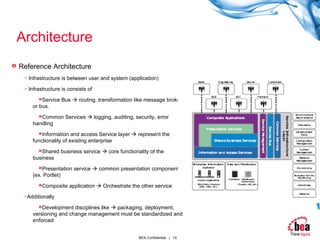
Architecture Reference Architecture Infrastructure is between user and system (application) Infrastructure is consists of Service Bus    routing, transformation like message broker or bus. Common Services    logging, auditing, security, error handling Information and access Service layer    represent the functionality of existing enterprise Shared business service    core functionality of the business Presentation service    common presentation components (ex. Portlet) Composite application    Orchestrate the other service Additionally Development disciplines like    packaging, deployment, versioning and change management must be standardized and enforced
Cost and Benefit Justifying SOA program is different from traditional IT, because benefit of SOA is from enterprise wide range. Up front cost of establishing and SOA program yields benefits that accumulate and accelerate substantially over time. Benefit Business side approach    IT accountability to business strategy is improved. And how the cost and benefit of functionality can be tracked IT side approach Improvement in delivery capability through incremental deployment The reuse of services for faster deployment Standardization Benefits in skill set portability Lower skill set requirements in standardized environment. Metric for aligning IT value to business value. If these metrics are identified as the beginning of the SOA planning process, work can be prioritized to realize early value. The goals and strategy of the business, taken together with the inventory of available functionality and the IT activities required to support the strategy, yield the information necessary to develop a roadmap for SOA implementation that prioritizes for value. The execution of this roadmap is the joint responsibility of the business stakeholders and IT. Prioritizing for value provides the early gains necessary to ensure the long-term sustainabilityof the SOA program.
Cost and Benefit Managing the Costs of SOA After service is used, ROI is manifested Through reuse of standard functionality Operational improvement Decommissioning of older applications Similar IT-related payback factors The initial impact of investing in SOA can be minimized by carefully selecting the right capabilities to spearhead the migration to SOA As SOA is matured,
Questions?

Soa Six Domain Model Part I

  • 1.
    SOA Six DomainModel Byungwook Cho K. 2006-07-05
  • 2.
    Agenda Introduction BusinessStrategy and Process Architecture Cost and Benefit Project and Applications Building Blocks Organization and Governance
  • 3.
    Introduction What isSOA? Is an IT strategy that organizes the discrete functions contained in enterprise applications into interoperable,standard based services that can be combined and reused quickly to meet the business needs. Benefit is Improves productivity, agility and speed for both Business and IT. Allows IT to deliver services faster and align closer co-work with business. Allows the business to respond quicker and deliver optimal user experience. 6 Domain Model is Encapsulates these practices with six domains, each of which must be considered equally to provide a focused framework for SOA. 6 Domains are interrelated and interdependent Executing on each domain with equal focus is fundamental for the success of SOA.
  • 4.
    Six Domain ModelBusiness strategy & process Architecture Building Bocks Project & Applications Organizations and Governance Cost & Benefit
  • 5.
    Business Strategy andProcess Challenge is to close the gap between IT and Business. A gap from realization IT from business Business strategy is long term, IT strategy is a short term  As a result IT doesn’t support the enterprise as a whole SOA Program Promoting the sharing and understanding of the whole business strategy , so that decision are made with an enterprise level view. Owning overall SOA strategy of the enterprise so that appropriate emphasis is given to each of six domain of SOA throughout a multi-year roadmap . Dynamic,responsive and standard-based architecture Cost effect delivery by identifying and optimizing business process – that is consists of re-usable services and avoiding duplication of functionally by mining legacy applications. Deciding on the priorities for service development & deployment and choosing increments and when they will be delivered. Establish organization and governance to ensure that proceses,policies and standard. Encourage change by incentive and publicity. Ensure measurement that provide cost-benefit analysis and continuous feedback loop to check up the vialility of the program
  • 6.
    Business Strategy andProcess Business Process Optimization SOA makes IT as the concrete expression of whole enterprise process rather than disjointed set of system.  IT fully encapsulate business process. Able to deliver new functionality by extending process rather than by building stand-alone system. process to prioritize on business activities by effort between business and IT.  It starts feedback for business alignment and maximize benefit of IT investment < Process Optimization Feedback Loop >
  • 7.
    Business Strategy andProcess Business Process Optimization Contracts that govern the services provides the mechanism to measure overall performance, performance against key business indicator, and compliance with SLA  provide opportunities to complete feedback and aligning IT with business . Optimization is multi year roadmap. This process will require a number of cycles over time.
  • 8.
    Architecture Service BasedTraditional approach to sharing functionality have failed by project-by-project focus  failed to reuse, duplicated SOA provide this by service Reduce cost Faster delivery Responsiveness to needs of change The way to fund and governance have to be changed and functional packaging and deployment have to be changed also Standard Based Traditional application is developed by most appropriate method to satisfy requirement.  No standard It makes problem when exchange information  Integration problem. Standard based SOA is platform agnostic
  • 9.
    Architecture Enterprise FocusIn indivisual business project , it is hard to gain [ visibility and management ] of [ information or process ] was difficult. The organization group that not only focus on technology but also get governance, define, deploy , monitor and manage access to enterprise functionality is needed Business Focus In traditional IT, there were a lot of applications & interface from each different requirement .  training overhead , over-reliance on specialist skills, duplicate data entry and lack of visibility and lack of control of overall business process. SOA aimed at providing functionality to the business at the level where business users conceive of the business , making easier for the user to understand, specify,test and operate on a daily basis.
  • 10.
    Architecture Reference ArchitectureInfrastructure is between user and system (application) Infrastructure is consists of Service Bus  routing, transformation like message broker or bus. Common Services  logging, auditing, security, error handling Information and access Service layer  represent the functionality of existing enterprise Shared business service  core functionality of the business Presentation service  common presentation components (ex. Portlet) Composite application  Orchestrate the other service Additionally Development disciplines like  packaging, deployment, versioning and change management must be standardized and enforced
  • 11.
    Cost and BenefitJustifying SOA program is different from traditional IT, because benefit of SOA is from enterprise wide range. Up front cost of establishing and SOA program yields benefits that accumulate and accelerate substantially over time. Benefit Business side approach  IT accountability to business strategy is improved. And how the cost and benefit of functionality can be tracked IT side approach Improvement in delivery capability through incremental deployment The reuse of services for faster deployment Standardization Benefits in skill set portability Lower skill set requirements in standardized environment. Metric for aligning IT value to business value. If these metrics are identified as the beginning of the SOA planning process, work can be prioritized to realize early value. The goals and strategy of the business, taken together with the inventory of available functionality and the IT activities required to support the strategy, yield the information necessary to develop a roadmap for SOA implementation that prioritizes for value. The execution of this roadmap is the joint responsibility of the business stakeholders and IT. Prioritizing for value provides the early gains necessary to ensure the long-term sustainabilityof the SOA program.
  • 12.
    Cost and BenefitManaging the Costs of SOA After service is used, ROI is manifested Through reuse of standard functionality Operational improvement Decommissioning of older applications Similar IT-related payback factors The initial impact of investing in SOA can be minimized by carefully selecting the right capabilities to spearhead the migration to SOA As SOA is matured,
  • 13.