Architectural Patterns Multi-Tier, MVC, MVP, MVVM, IoC, DI, SOA Svetlin Nakov Telerik Corporation www.telerik.com
Table of Contents What is Software Architecture? Client-Server Architecture 3-Tier / Multi-Tier Architectures MVC (Model-View-Controller) MVP (Model-View-Presenter) MVVM (Model-View-ViewModel) IoC (Inversion of Control) and DI (Dependency Injection) Architectural Principals SOA (Service-Oriented Architecture)
What is Software Architecture?
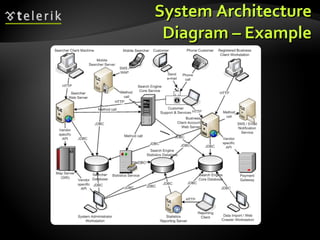
Software Architecture Software architecture  is a technical blueprint explaining how the system will be structured The  system architecture   describes : How the system will be decomposed into subsystems (modules) Responsibilities of each module Interaction between the modules Platforms and technologies Each module could also implement a certain architectural model / pattern
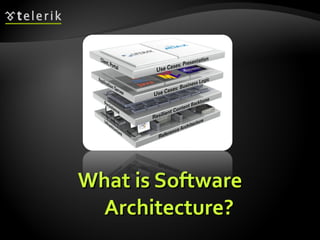
System Architecture Diagram – Example
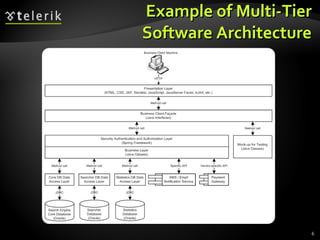
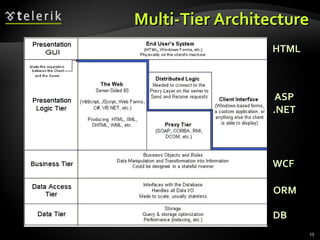
Example of Multi-Tier Software Architecture
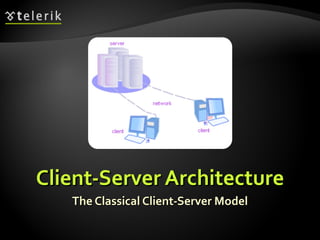
Client-Server Architecture The Classical Client-Server Model
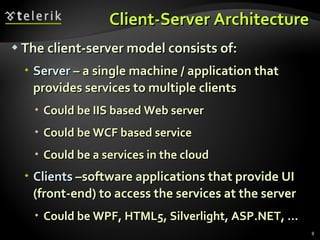
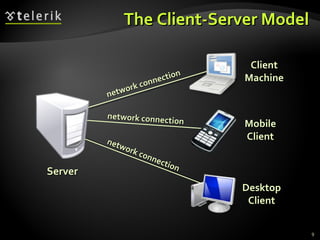
Client-Server Architecture The client-server model consists of: Server  – a single machine / application that provides services to multiple clients Could be IIS based Web server Could be WCF based service Could be a services in the cloud Clients  –software applications that provide UI (front-end) to access the services at the server Could be WPF, HTML5, Silverlight, ASP.NET, …
The Client-Server Model Server Desktop Client Mobile Client Client Machine network connection network connection network connection
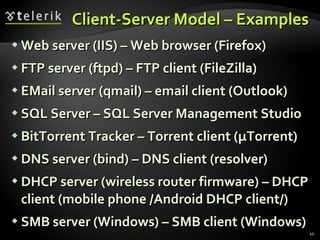
Client-Server Model – Examples Web server (IIS) – Web browser (Firefox) FTP server (ftpd) – FTP client (FileZilla) EMail server (qmail) – email client (Outlook) SQL Server – SQL Server Management Studio BitTorrent Tracker – Torrent client ( μ Torrent) DNS server (bind) – DNS client (resolver) DHCP server (wireless router firmware) – DHCP client (mobile phone /Android DHCP client/) SMB server (Windows) – SMB client (Windows)
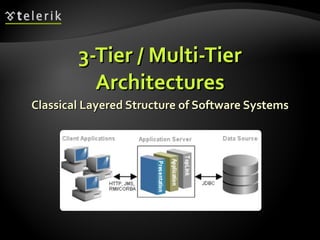
3-Tier / Multi-Tier Architectures Classical Layered Structure of Software Systems
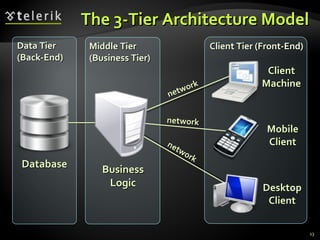
The 3-Tier Architecture The  3-tier architecture  consists of the following tiers (layers): Front-end  (client layer) Client   software – provides the UI of the system Middle tier  (business layer) Server software – provides the core system logic Implements the business processes / services Back-end  (data layer) Manages the data of the system (database / cloud)
The 3-Tier Architecture Model Business Logic Desktop Client Mobile Client Client Machine network network network Database Data Tier (Back-End) Middle Tier (Business Tier) Client Tier (Front-End)
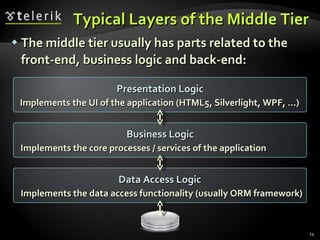
Typical Layers of the Middle Tier The middle tier usually has parts related to the front-end, business logic and back-end: Presentation Logic Implements the UI of the application (HTML5, Silverlight, WPF, …) Business Logic Implements the core processes / services of the application Data Access Logic Implements the data access functionality (usually ORM framework)
Multi-Tier Architecture DB ORM WCF ASP .NET HTML
MVC (Model- View-Controller) What is MVC and How It Works?
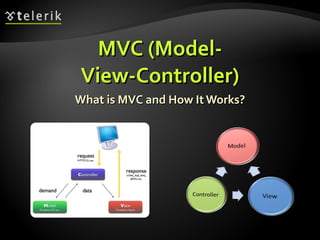
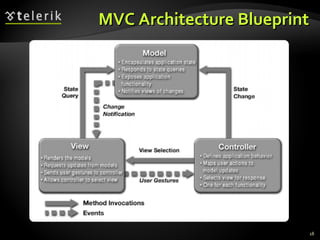
Model-View-Controller (MVC) Model-View-Controller (MVC)  architecture  Separates the business logic from application data and presentation Model Keeps the application state (data) View Displays the data to the user (shows UI) Controller Handles the interaction with the user
MVC Architecture Blueprint
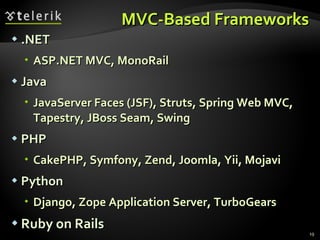
MVC-Based Frameworks .NET ASP.NET MVC, MonoRail Java JavaServer Faces (JSF), Struts, Spring Web MVC, Tapestry, JBoss Seam, Swing PHP CakePHP, Symfony, Zend ,  Joomla ,  Yii, Mojavi Python Django, Zope Application Server, TurboGears Ruby on Rails
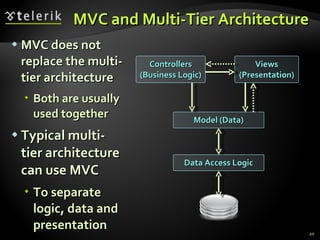
MVC and Multi-Tier Architecture MVC does not replace the multi-tier architecture Both are usually used together Typical multi-tier architecture can use MVC To separate logic, data and presentation Model (Data) Data Access Logic Views (Presentation) Controllers (Business Logic)
MVP (Model-View-Presenter) What is MVP Architecture and How it Works?
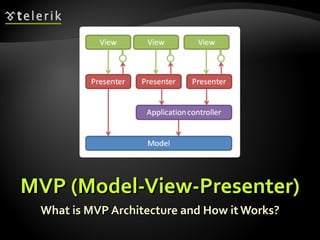
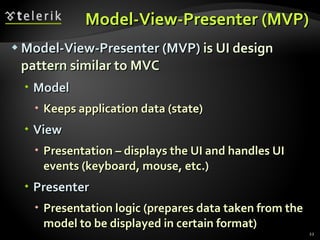
Model-View-Presenter (MVP) Model-View-Presenter (MVP)  is UI design pattern similar to MVC Model Keeps application data (state) View Presentation – displays the UI and handles UI events (keyboard, mouse, etc.) Presenter Presentation logic (prepares data taken from the model to be displayed in certain format)
Presentation-Abstraction-Control (PAC) What is PAC and How It Works?
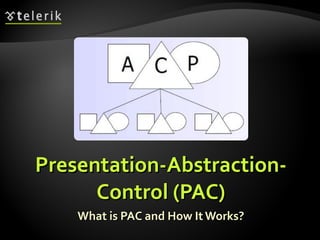
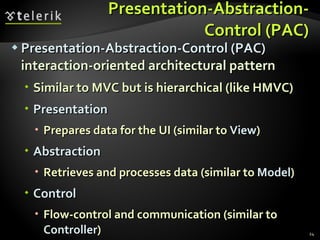
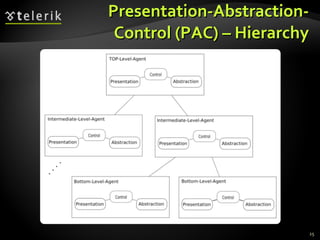
Presentation-Abstraction-Control (PAC) Presentation-Abstraction-Control (PAC)  interaction-oriented architectural pattern Similar to MVC but is hierarchical (like HMVC) Presentation Prepares data for the UI (similar to  View ) Abstraction Retrieves and processes data (similar to  Model ) Control Flow-control and communication (similar to  Controller )
Presentation-Abstraction-Control (PAC) – Hierarchy
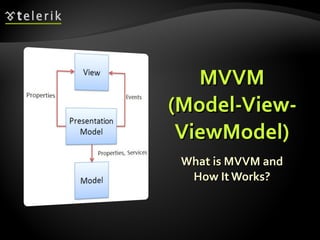
MVVM ( Model-View-ViewModel ) What is MVVM and How It Works?
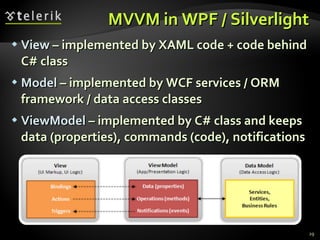
Model-View- ViewModel  (MVVM) Model-View-ViewModel  (MVVM)  is architectural pattern for modern UI development Invented by Microsoft for use in WPF and Silverlight Based on  MVC ,  MVP  and Martin Fowler's  Presentation Model  pattern Officially published in the Prism project (Composite Application Guidance for WPF and Silverlight) Separates the " view layer " (state and behavior) from the rest of the application
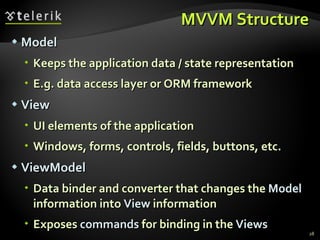
MVVM Structure Model Keeps the application data / state representation E.g. data access layer or ORM framework View UI elements of the application Windows, forms, controls, fields, buttons, etc. ViewModel Data binder and converter that changes the  Model  information into  View  information Exposes  commands  for binding in the  Views
MVVM in WPF / Silverlight View  – implemented by XAML code + code behind C# class Model  – implemented by WCF services / ORM framework / data access classes ViewModel   – implemented by C# class and keeps data (properties), commands (code), notifications
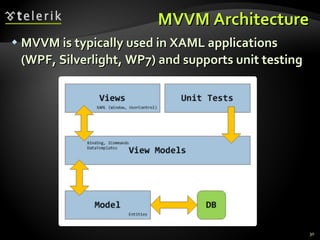
MVVM Architecture MVVM is typically used in XAML applications (WPF, Silverlight, WP7) and supports unit testing
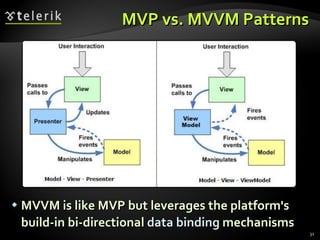
MVP vs. MVVM Patterns MVVM is like MVP but leverages the platform's build-in bi-directional  data binding  mechanisms
IoC (Inversion of Control) and DI (Dependency Injection) Architectural Principals or Design Patterns?
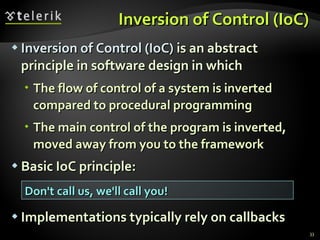
Inversion of Control (IoC) Inversion of Control (IoC)  is an abstract principle in software design in which The flow of control of a system is inverted compared to procedural programming The main control of the program is inverted, moved away from you to the framework Basic IoC principle: Implementations typically rely on callbacks Don't call us, we'll call you!
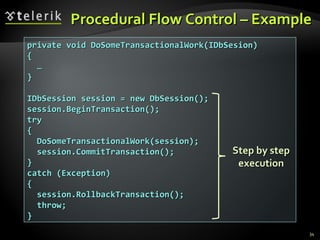
Procedural Flow Control – Example private void DoSomeTransactionalWork(IDbSesion) { … } IDbSession session = new DbSession(); session.BeginTransaction();  try { DoSomeTransactionalWork(session); session.CommitTransaction(); } catch (Exception) { session.RollbackTransaction(); throw; } Step by step execution
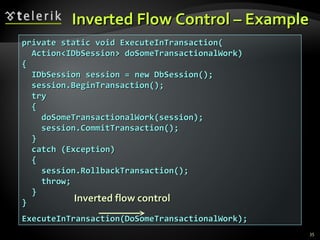
Inverted Flow Control – Example private static void ExecuteInTransaction( Action<IDbSession> doSomeTransactionalWork) { IDbSession session = new DbSession(); session.BeginTransaction(); try { doSomeTransactionalWork(session); session.CommitTransaction(); } catch (Exception) { session.RollbackTransaction(); throw; } } ExecuteInTransaction(DoSomeTransactionalWork); Inverted flow control
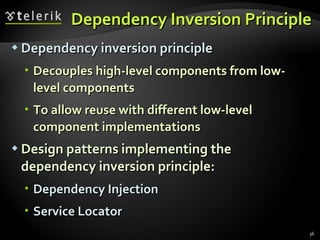
Dependency Inversion Principle Dependency inversion principle Decouples high-level components from low-level components To allow reuse with different low-level component implementations Design patterns implementing the dependency inversion principle: Dependency Injection Service Locator
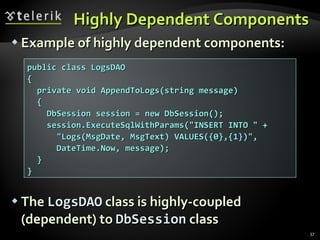
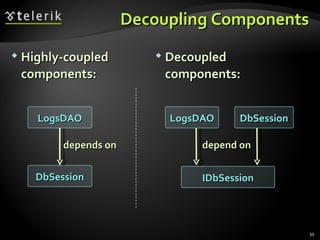
Highly Dependent Components Example of highly dependent components: The  LogsDAO  class is highly-coupled (dependent) to  DbSession  class public class LogsDAO { private void AppendToLogs(string message) { DbSession session = new DbSession(); session.ExecuteSqlWithParams(&quot;INSERT INTO &quot; +  &quot;Logs(MsgDate, MsgText) VALUES({0},{1})&quot;, DateTime.Now, message); } }
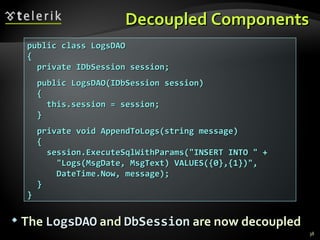
Decoupled Components public class LogsDAO { private IDbSession session; public LogsDAO(IDbSession session) { this.session = session; } private void AppendToLogs(string message) { session.ExecuteSqlWithParams(&quot;INSERT INTO &quot; +  &quot;Logs(MsgDate, MsgText) VALUES({0},{1})&quot;, DateTime.Now, message); } } The  LogsDAO  and  DbSession  are now decoupled
Decoupling Components LogsDAO DbSession depends on LogsDAO IDbSession depend on DbSession Highly-coupled components: Decoupled components:
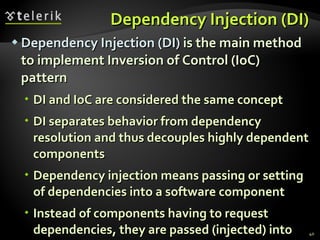
Dependency Injection (DI) Dependency Injection (DI)  is the main method to implement Inversion of Control (IoC) pattern DI and IoC are considered the same concept DI separates behavior from dependency resolution and thus decouples highly dependent components Dependency injection means passing or setting of dependencies into a software component Instead of components having to request dependencies, they are passed (injected) into the component
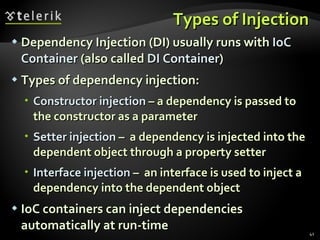
Types of Injection Dependency Injection (DI) usually runs with  IoC Container  (also called  DI Container ) Types of dependency injection: Constructor injection  – a dependency is passed to the constructor as a parameter Setter injection  –  a dependency is injected into the dependent object through a property setter Interface injection  –  an interface is used to inject a dependency into the dependent object IoC containers can inject dependencies automatically at run-time
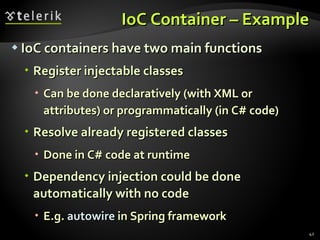
IoC Container – Example IoC containers have two main functions Register injectable classes Can be done declaratively (with XML or attributes) or programmatically (in C# code) Resolve already registered classes Done in C# code at runtime Dependency injection could be done automatically with no code E.g.  autowire  in Spring framework
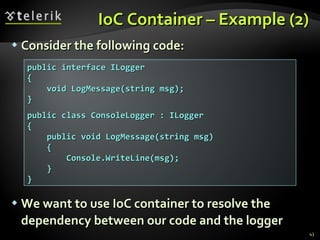
IoC Container – Example (2) Consider the following code: We want to use IoC container to resolve the dependency between our code and the logger public interface ILogger { void LogMessage(string msg); } public class ConsoleLogger : ILogger { public void LogMessage(string msg) { Console.WriteLine(msg); } }
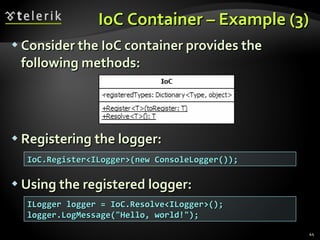
IoC Container – Example (3) Consider the IoC container provides the following methods: Registering the logger: Using the registered logger: IoC.Register<ILogger>(new ConsoleLogger()); ILogger logger = IoC.Resolve<ILogger>(); logger.LogMessage(&quot;Hello, world!&quot;);
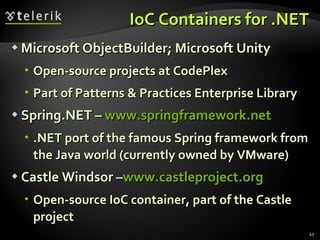
IoC Containers for .NET Microsoft ObjectBuilder; Microsoft Unity Open-source projects at CodePlex Part of Patterns & Practices Enterprise Library Spring.NET –  www.springframework.net .NET port of the famous Spring framework from the Java world (currently owned by VMware) Castle Windsor – www.castleproject.org Open-source IoC container, part of the Castle project
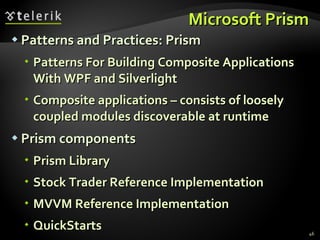
Microsoft Prism Patterns and Practices: Prism Patterns For Building Composite Applications With WPF and Silverlight Composite applications – consists of loosely coupled modules discoverable at runtime Prism components Prism Library Stock Trader Reference Implementation  MVVM Reference Implementation QuickStarts
Managed Extensibility Framework (MEF) Managed Extensibility Framework (MEF) Simplifies the design of extensible applications and components Official part of .NET Framework 4 Allows developers to discover and use extensions with no configuration at runtime lets extension developers easily encapsulate code and avoid fragile hard dependencies
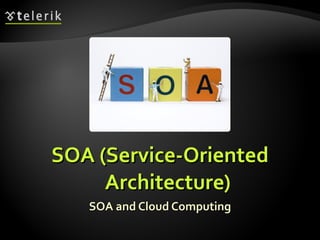
SOA (Service-Oriented Architecture) SOA and Cloud Computing
What is SOA? Service-Oriented Architecture (SOA)  is a concept for development of software systems Using reusable building blocks (components) called &quot;services&quot; Services in SOA are: Autonomous, stateless business functions Accept requests and return responses Use well-defined, standard interface
SOA Services Autonomous Each service operates autonomously Without any awareness that other services exist Statelessa Have no memory, do not remember state Easy to scale Request-response model Client asks, server returns answer
SOA Services (2) Communication through standard protocols XML, SOAP, JSON, RSS, ATOM, ... HTTP, FTP, SMTP, RPC, ... Not dependent on OS, platforms, programming languages Discoverable Service registries Could be hosted &quot;in the cloud&quot; (e.g. in Azure)
What is Cloud Computing? Cloud computing  is a modern approach in the IT infrastructure that provides : Software applications, services, hardware and system resources Hosts the applications and user data in remote servers called &quot;the cloud&quot; Cloud computing models : IaaS – infrastructure as a service (virtual servers) PaaS – platform as a service (full stack of technologies for UI , application logic, data storage) SaaS – software as a service (e.g. Google Docs)
Loose Coupling Loose coupling  is the main concept of SOA Loosely coupled components: Exhibits single function Independent of other functions Through a well-defined interface Loose coupling programming evolves: Structural programming Object-oriented programming Service-oriented architecture (SOA)
SOA Design Patterns SOA Patterns –  www.soapatterns.org Inventory Foundation, Logical Layer, Implementation, Governance Patterns Service Foundational, Implementation, Security, Contract ,  Governance ,  Messaging Patterns Legacy Encapsulation Patterns Capability Composition Patterns Composition Implementation Patterns Transformation Patterns Common Compound Design Patterns
Architectural Patterns Questions?

Architectural Patterns and Software Architectures: Client-Server, Multi-Tier, MVC, MVP, MVVM, IoC, DI, SOA, Cloud Computing

  • 1.
    Architectural Patterns Multi-Tier,MVC, MVP, MVVM, IoC, DI, SOA Svetlin Nakov Telerik Corporation www.telerik.com
  • 2.
    Table of ContentsWhat is Software Architecture? Client-Server Architecture 3-Tier / Multi-Tier Architectures MVC (Model-View-Controller) MVP (Model-View-Presenter) MVVM (Model-View-ViewModel) IoC (Inversion of Control) and DI (Dependency Injection) Architectural Principals SOA (Service-Oriented Architecture)
  • 3.
    What is SoftwareArchitecture?
  • 4.
    Software Architecture Softwarearchitecture is a technical blueprint explaining how the system will be structured The system architecture describes : How the system will be decomposed into subsystems (modules) Responsibilities of each module Interaction between the modules Platforms and technologies Each module could also implement a certain architectural model / pattern
  • 5.
  • 6.
    Example of Multi-TierSoftware Architecture
  • 7.
    Client-Server Architecture TheClassical Client-Server Model
  • 8.
    Client-Server Architecture Theclient-server model consists of: Server – a single machine / application that provides services to multiple clients Could be IIS based Web server Could be WCF based service Could be a services in the cloud Clients –software applications that provide UI (front-end) to access the services at the server Could be WPF, HTML5, Silverlight, ASP.NET, …
  • 9.
    The Client-Server ModelServer Desktop Client Mobile Client Client Machine network connection network connection network connection
  • 10.
    Client-Server Model –Examples Web server (IIS) – Web browser (Firefox) FTP server (ftpd) – FTP client (FileZilla) EMail server (qmail) – email client (Outlook) SQL Server – SQL Server Management Studio BitTorrent Tracker – Torrent client ( μ Torrent) DNS server (bind) – DNS client (resolver) DHCP server (wireless router firmware) – DHCP client (mobile phone /Android DHCP client/) SMB server (Windows) – SMB client (Windows)
  • 11.
    3-Tier / Multi-TierArchitectures Classical Layered Structure of Software Systems
  • 12.
    The 3-Tier ArchitectureThe 3-tier architecture consists of the following tiers (layers): Front-end (client layer) Client software – provides the UI of the system Middle tier (business layer) Server software – provides the core system logic Implements the business processes / services Back-end (data layer) Manages the data of the system (database / cloud)
  • 13.
    The 3-Tier ArchitectureModel Business Logic Desktop Client Mobile Client Client Machine network network network Database Data Tier (Back-End) Middle Tier (Business Tier) Client Tier (Front-End)
  • 14.
    Typical Layers ofthe Middle Tier The middle tier usually has parts related to the front-end, business logic and back-end: Presentation Logic Implements the UI of the application (HTML5, Silverlight, WPF, …) Business Logic Implements the core processes / services of the application Data Access Logic Implements the data access functionality (usually ORM framework)
  • 15.
    Multi-Tier Architecture DBORM WCF ASP .NET HTML
  • 16.
    MVC (Model- View-Controller)What is MVC and How It Works?
  • 17.
    Model-View-Controller (MVC) Model-View-Controller(MVC) architecture Separates the business logic from application data and presentation Model Keeps the application state (data) View Displays the data to the user (shows UI) Controller Handles the interaction with the user
  • 18.
  • 19.
    MVC-Based Frameworks .NETASP.NET MVC, MonoRail Java JavaServer Faces (JSF), Struts, Spring Web MVC, Tapestry, JBoss Seam, Swing PHP CakePHP, Symfony, Zend , Joomla , Yii, Mojavi Python Django, Zope Application Server, TurboGears Ruby on Rails
  • 20.
    MVC and Multi-TierArchitecture MVC does not replace the multi-tier architecture Both are usually used together Typical multi-tier architecture can use MVC To separate logic, data and presentation Model (Data) Data Access Logic Views (Presentation) Controllers (Business Logic)
  • 21.
    MVP (Model-View-Presenter) Whatis MVP Architecture and How it Works?
  • 22.
    Model-View-Presenter (MVP) Model-View-Presenter(MVP) is UI design pattern similar to MVC Model Keeps application data (state) View Presentation – displays the UI and handles UI events (keyboard, mouse, etc.) Presenter Presentation logic (prepares data taken from the model to be displayed in certain format)
  • 23.
  • 24.
    Presentation-Abstraction-Control (PAC) Presentation-Abstraction-Control(PAC) interaction-oriented architectural pattern Similar to MVC but is hierarchical (like HMVC) Presentation Prepares data for the UI (similar to View ) Abstraction Retrieves and processes data (similar to Model ) Control Flow-control and communication (similar to Controller )
  • 25.
  • 26.
    MVVM ( Model-View-ViewModel) What is MVVM and How It Works?
  • 27.
    Model-View- ViewModel (MVVM) Model-View-ViewModel (MVVM) is architectural pattern for modern UI development Invented by Microsoft for use in WPF and Silverlight Based on MVC , MVP and Martin Fowler's Presentation Model pattern Officially published in the Prism project (Composite Application Guidance for WPF and Silverlight) Separates the &quot; view layer &quot; (state and behavior) from the rest of the application
  • 28.
    MVVM Structure ModelKeeps the application data / state representation E.g. data access layer or ORM framework View UI elements of the application Windows, forms, controls, fields, buttons, etc. ViewModel Data binder and converter that changes the Model information into View information Exposes commands for binding in the Views
  • 29.
    MVVM in WPF/ Silverlight View – implemented by XAML code + code behind C# class Model – implemented by WCF services / ORM framework / data access classes ViewModel – implemented by C# class and keeps data (properties), commands (code), notifications
  • 30.
    MVVM Architecture MVVMis typically used in XAML applications (WPF, Silverlight, WP7) and supports unit testing
  • 31.
    MVP vs. MVVMPatterns MVVM is like MVP but leverages the platform's build-in bi-directional data binding mechanisms
  • 32.
    IoC (Inversion ofControl) and DI (Dependency Injection) Architectural Principals or Design Patterns?
  • 33.
    Inversion of Control(IoC) Inversion of Control (IoC) is an abstract principle in software design in which The flow of control of a system is inverted compared to procedural programming The main control of the program is inverted, moved away from you to the framework Basic IoC principle: Implementations typically rely on callbacks Don't call us, we'll call you!
  • 34.
    Procedural Flow Control– Example private void DoSomeTransactionalWork(IDbSesion) { … } IDbSession session = new DbSession(); session.BeginTransaction(); try { DoSomeTransactionalWork(session); session.CommitTransaction(); } catch (Exception) { session.RollbackTransaction(); throw; } Step by step execution
  • 35.
    Inverted Flow Control– Example private static void ExecuteInTransaction( Action<IDbSession> doSomeTransactionalWork) { IDbSession session = new DbSession(); session.BeginTransaction(); try { doSomeTransactionalWork(session); session.CommitTransaction(); } catch (Exception) { session.RollbackTransaction(); throw; } } ExecuteInTransaction(DoSomeTransactionalWork); Inverted flow control
  • 36.
    Dependency Inversion PrincipleDependency inversion principle Decouples high-level components from low-level components To allow reuse with different low-level component implementations Design patterns implementing the dependency inversion principle: Dependency Injection Service Locator
  • 37.
    Highly Dependent ComponentsExample of highly dependent components: The LogsDAO class is highly-coupled (dependent) to DbSession class public class LogsDAO { private void AppendToLogs(string message) { DbSession session = new DbSession(); session.ExecuteSqlWithParams(&quot;INSERT INTO &quot; + &quot;Logs(MsgDate, MsgText) VALUES({0},{1})&quot;, DateTime.Now, message); } }
  • 38.
    Decoupled Components publicclass LogsDAO { private IDbSession session; public LogsDAO(IDbSession session) { this.session = session; } private void AppendToLogs(string message) { session.ExecuteSqlWithParams(&quot;INSERT INTO &quot; + &quot;Logs(MsgDate, MsgText) VALUES({0},{1})&quot;, DateTime.Now, message); } } The LogsDAO and DbSession are now decoupled
  • 39.
    Decoupling Components LogsDAODbSession depends on LogsDAO IDbSession depend on DbSession Highly-coupled components: Decoupled components:
  • 40.
    Dependency Injection (DI)Dependency Injection (DI) is the main method to implement Inversion of Control (IoC) pattern DI and IoC are considered the same concept DI separates behavior from dependency resolution and thus decouples highly dependent components Dependency injection means passing or setting of dependencies into a software component Instead of components having to request dependencies, they are passed (injected) into the component
  • 41.
    Types of InjectionDependency Injection (DI) usually runs with IoC Container (also called DI Container ) Types of dependency injection: Constructor injection – a dependency is passed to the constructor as a parameter Setter injection – a dependency is injected into the dependent object through a property setter Interface injection – an interface is used to inject a dependency into the dependent object IoC containers can inject dependencies automatically at run-time
  • 42.
    IoC Container –Example IoC containers have two main functions Register injectable classes Can be done declaratively (with XML or attributes) or programmatically (in C# code) Resolve already registered classes Done in C# code at runtime Dependency injection could be done automatically with no code E.g. autowire in Spring framework
  • 43.
    IoC Container –Example (2) Consider the following code: We want to use IoC container to resolve the dependency between our code and the logger public interface ILogger { void LogMessage(string msg); } public class ConsoleLogger : ILogger { public void LogMessage(string msg) { Console.WriteLine(msg); } }
  • 44.
    IoC Container –Example (3) Consider the IoC container provides the following methods: Registering the logger: Using the registered logger: IoC.Register<ILogger>(new ConsoleLogger()); ILogger logger = IoC.Resolve<ILogger>(); logger.LogMessage(&quot;Hello, world!&quot;);
  • 45.
    IoC Containers for.NET Microsoft ObjectBuilder; Microsoft Unity Open-source projects at CodePlex Part of Patterns & Practices Enterprise Library Spring.NET – www.springframework.net .NET port of the famous Spring framework from the Java world (currently owned by VMware) Castle Windsor – www.castleproject.org Open-source IoC container, part of the Castle project
  • 46.
    Microsoft Prism Patternsand Practices: Prism Patterns For Building Composite Applications With WPF and Silverlight Composite applications – consists of loosely coupled modules discoverable at runtime Prism components Prism Library Stock Trader Reference Implementation MVVM Reference Implementation QuickStarts
  • 47.
    Managed Extensibility Framework(MEF) Managed Extensibility Framework (MEF) Simplifies the design of extensible applications and components Official part of .NET Framework 4 Allows developers to discover and use extensions with no configuration at runtime lets extension developers easily encapsulate code and avoid fragile hard dependencies
  • 48.
    SOA (Service-Oriented Architecture)SOA and Cloud Computing
  • 49.
    What is SOA?Service-Oriented Architecture (SOA) is a concept for development of software systems Using reusable building blocks (components) called &quot;services&quot; Services in SOA are: Autonomous, stateless business functions Accept requests and return responses Use well-defined, standard interface
  • 50.
    SOA Services AutonomousEach service operates autonomously Without any awareness that other services exist Statelessa Have no memory, do not remember state Easy to scale Request-response model Client asks, server returns answer
  • 51.
    SOA Services (2)Communication through standard protocols XML, SOAP, JSON, RSS, ATOM, ... HTTP, FTP, SMTP, RPC, ... Not dependent on OS, platforms, programming languages Discoverable Service registries Could be hosted &quot;in the cloud&quot; (e.g. in Azure)
  • 52.
    What is CloudComputing? Cloud computing is a modern approach in the IT infrastructure that provides : Software applications, services, hardware and system resources Hosts the applications and user data in remote servers called &quot;the cloud&quot; Cloud computing models : IaaS – infrastructure as a service (virtual servers) PaaS – platform as a service (full stack of technologies for UI , application logic, data storage) SaaS – software as a service (e.g. Google Docs)
  • 53.
    Loose Coupling Loosecoupling is the main concept of SOA Loosely coupled components: Exhibits single function Independent of other functions Through a well-defined interface Loose coupling programming evolves: Structural programming Object-oriented programming Service-oriented architecture (SOA)
  • 54.
    SOA Design PatternsSOA Patterns – www.soapatterns.org Inventory Foundation, Logical Layer, Implementation, Governance Patterns Service Foundational, Implementation, Security, Contract , Governance , Messaging Patterns Legacy Encapsulation Patterns Capability Composition Patterns Composition Implementation Patterns Transformation Patterns Common Compound Design Patterns
  • 55.