Notes accompany this presentation. Please select Notes Page view.
These materials can be reproduced only with written approval from Gartner.
Such approvals must be requested via e-mail: vendor.relations@gartner.com.
Gartner is a registered trademark of Gartner, Inc. or its affiliates.
Practitioner's Guide: Best
Practices in Enterprisewide SOA
Initiatives
Massimo Pezzini
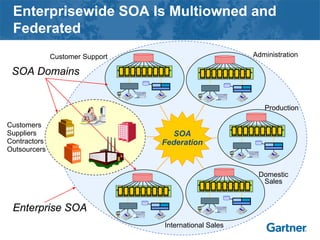
Enterprisewide SOA Is Multiowned and
Federated
Domestic
Sales
Administration
Production
International Sales
Customer Support
Customers
Suppliers
Contractors
Outsourcers
Enterprise SOA
SOA
Federation
Enterprise SOA
SOA Domains
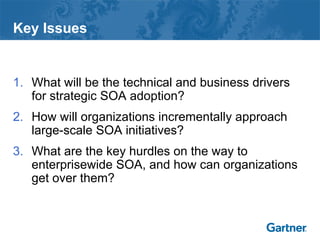
Key Issues
1. What will be the technical and business drivers
for strategic SOA adoption?
2. How will organizations incrementally approach
large-scale SOA initiatives?
3. What are the key hurdles on the way to
enterprisewide SOA, and how can organizations
get over them?
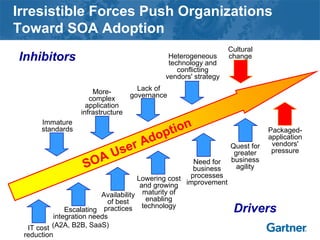
Irresistible Forces Push Organizations
Toward SOA Adoption
SOA User Adoption
IT cost
reduction
Escalating
integration needs
(A2A, B2B, SaaS)
Need for
business
processes
improvement
Quest for
greater
business
agility
Lowering cost
and growing
maturity of
enabling
technology
Availability
of best
practices
Packaged-
application
vendors'
pressure
Cultural
change
More-
complex
application
infrastructure
Immature
standards
Heterogeneous
technology and
conflicting
vendors' strategy
Lack of
governance
Drivers
Inhibitors
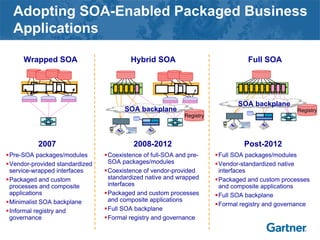
Adopting SOA-Enabled Packaged Business
Applications
Registry
SOA backplane Registry
SOA backplane
Wrapped SOA Hybrid SOA Full SOA
2007 2008-2012 Post-2012
Pre-SOA packages/modules
Vendor-provided standardized
service-wrapped interfaces
Packaged and custom
processes and composite
applications
Minimalist SOA backplane
Informal registry and
governance
Coexistence of full-SOA and pre-
SOA packages/modules
Coexistence of vendor-provided
standardized native and wrapped
interfaces
Packaged and custom processes
and composite applications
Full SOA backplane
Formal registry and governance
Full SOA packages/modules
Vendor-standardized native
interfaces
Packaged and custom processes
and composite applications
Full SOA backplane
Formal registry and governance
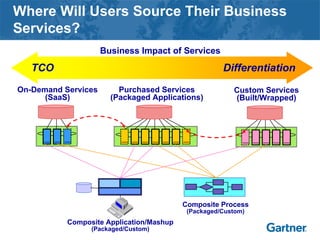
Where Will Users Source Their Business
Services?
TCO Differentiation
On-Demand Services
(SaaS)
Purchased Services
(Packaged Applications)
Custom Services
(Built/Wrapped)
Composite Application/Mashup
(Packaged/Custom)
Composite Process
(Packaged/Custom)
Business Impact of Services
SOA hasn't been ordered by the doctor: You can live
without it.
SOA adoption should be justified by balancing (certain) costs and
(potential) benefits.
However, most organizations will be forced to SOA by their
packaged-application vendors.
Investigate the SOA strategy of your packaged-application
vendors and plan for a gradual adoption.
SOA services and applications will be multisourced. SaaS
and SOA go hand in hand.
If you're planning for SaaS, you need to plan for SOA as well
(and possibly vice versa).
Bottom Line
What will be the technical and business drivers for strategic
SOA adoption?
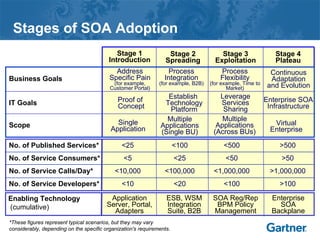
Stages of SOA Adoption
Stage 1
Introduction
Stage 2
Spreading
Stage 3
Exploitation
Stage 4
Plateau
IT Goals Proof of
Concept
Establish
Technology
Platform
Leverage
Services
Sharing
Enterprise SOA
Infrastructure
Business Goals
Address
Specific Pain
(for example,
Customer Portal)
Process
Integration
(for example, B2B)
Process
Flexibility
(for example, Time to
Market)
Continuous
Adaptation
and Evolution
Single
Application
Multiple
Applications
(Single BU)
Multiple
Applications
(Across BUs)
Virtual
Enterprise
Scope
<25 <100 <500 >500
<5 <25 <50 >50
<10,000 <100,000 <1,000,000 >1,000,000
<10 <20 <100 >100
No. of Published Services*
No. of Service Consumers*
No. of Service Calls/Day*
No. of Service Developers*
Enabling Technology
(cumulative)
Application
Server, Portal,
Adapters
ESB, WSM
Integration
Suite, B2B
SOA Reg/Rep
BPM Policy
Management
Enterprise
SOA
Backplane
*These figures represent typical scenarios, but they may vary
considerably, depending on the specific organization's requirements.
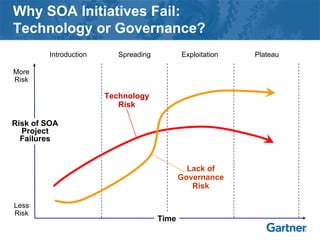
Why SOA Initiatives Fail:
Technology or Governance?
Introduction Spreading Exploitation Plateau
Risk of SOA
Project
Failures
Lack of
Governance
Risk
Technology
Risk
Less
Risk
More
Risk
Time
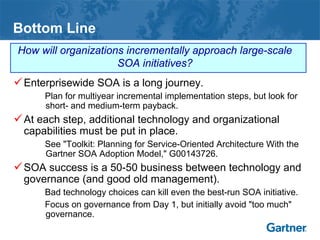
Enterprisewide SOA is a long journey.
Plan for multiyear incremental implementation steps, but look for
short- and medium-term payback.
At each step, additional technology and organizational
capabilities must be put in place.
See "Toolkit: Planning for Service-Oriented Architecture With the
Gartner SOA Adoption Model," G00143726.
SOA success is a 50-50 business between technology and
governance (and good old management).
Bad technology choices can kill even the best-run SOA initiative.
Focus on governance from Day 1, but initially avoid "too much"
governance.
Bottom Line
How will organizations incrementally approach large-scale
SOA initiatives?
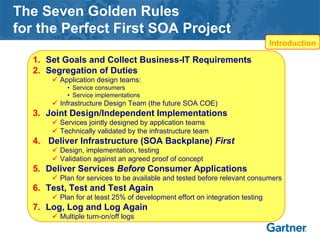
The Seven Golden Rules
for the Perfect First SOA Project
1. Set Goals and Collect Business-IT Requirements
2. Segregation of Duties
Application design teams:
• Service consumers
• Service implementations
Infrastructure Design Team (the future SOA COE)
3. Joint Design/Independent Implementations
Services jointly designed by application teams
Technically validated by the infrastructure team
4. Deliver Infrastructure (SOA Backplane) First
Design, implementation, testing
Validation against an agreed proof of concept
5. Deliver Services Before Consumer Applications
Plan for services to be available and tested before relevant consumers
6. Test, Test and Test Again
Plan for at least 25% of development effort on integration testing
7. Log, Log and Log Again
Multiple turn-on/off logs
Introduction
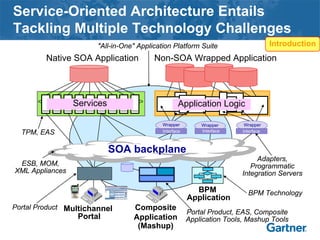
Service-Oriented Architecture Entails
Tackling Multiple Technology Challenges
Non-SOA Wrapped Application
Multichannel
Portal
Composite
Application
(Mashup)
WrapperWrapper
Services Application Logic
Native SOA Application
Interface Interface Interface
SOA backplane
BPM
Application
Wrapper
BPM Technology
Portal Product, EAS, Composite
Application Tools, Mashup Tools
Portal Product
Adapters,
Programmatic
Integration Servers
TPM, EAS
"All-in-One" Application Platform Suite
ESB, MOM,
XML Appliances
Introduction
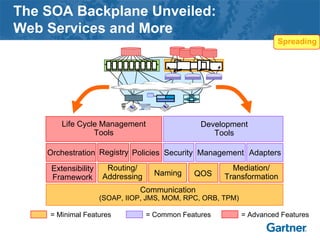
The SOA Backplane Unveiled:
Web Services and More
= Common Features = Advanced Features= Minimal Features
Security Management Adapters
Development
Tools
Life Cycle Management
Tools
Orchestration Policies
Extensibility
Framework
Communication
(SOAP, IIOP, JMS, MOM, RPC, ORB, TPM)
Mediation/
Transformation
Routing/
Addressing Naming QOS
Registry
Spreading
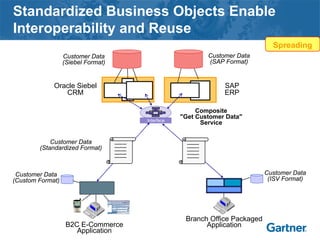
Standardized Business Objects Enable
Interoperability and Reuse
B2C E-Commerce
Application
Branch Office Packaged
Application
Interface
Spreading
SAP
ERP
Oracle Siebel
CRM
Customer Data
(SAP Format)
Customer Data
(Siebel Format)
Customer Data
(ISV Format)
Customer Data
(Custom Format)
Customer Data
(Standardized Format)
Composite
"Get Customer Data"
Service
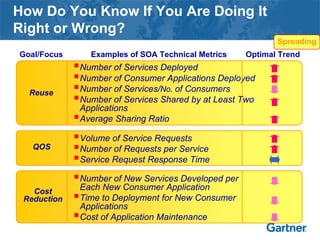
How Do You Know If You Are Doing It
Right or Wrong?
Spreading
Number of Services Deployed
Number of Consumer Applications Deployed
Number of Services/No. of Consumers
Number of Services Shared by at Least Two
Applications
Average Sharing Ratio
Optimal Trend
Volume of Service Requests
Number of Requests per Service
Service Request Response Time
Number of New Services Developed per
Each New Consumer Application
Time to Deployment for New Consumer
Applications
Cost of Application Maintenance
Examples of SOA Technical Metrics
Reuse
QOS
Cost
Reduction
Goal/Focus
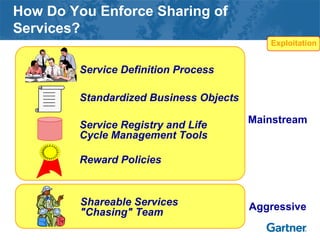
How Do You Enforce Sharing of
Services?
Exploitation
Service Definition Process
Service Registry and Life
Cycle Management Tools
Reward Policies
Shareable Services
"Chasing" Team
Mainstream
Aggressive
Standardized Business Objects
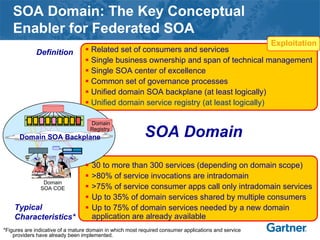
SOA Domain: The Key Conceptual
Enabler for Federated SOA
Domain SOA Backplane
Domain
Registry
Related set of consumers and services
Single business ownership and span of technical management
Single SOA center of excellence
Common set of governance processes
Unified domain SOA backplane (at least logically)
Unified domain service registry (at least logically)
30 to more than 300 services (depending on domain scope)
>80% of service invocations are intradomain
>75% of service consumer apps call only intradomain services
Up to 35% of domain services shared by multiple consumers
Up to 75% of domain services needed by a new domain
application are already available
SOA Domain
Definition
Typical
Characteristics*
*Figures are indicative of a mature domain in which most required consumer applications and service
providers have already been implemented.
Domain
SOA COE
Exploitation
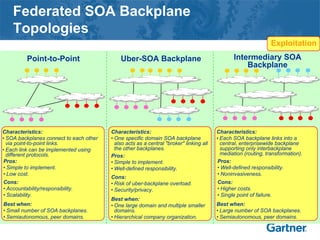
Federated SOA Backplane
Topologies
Point-to-Point Uber-SOA Backplane Intermediary SOA
Backplane
Characteristics:
• SOA backplanes connect to each other
via point-to-point links.
• Each link can be implemented using
different protocols.
Pros:
• Simple to implement.
• Low cost.
Cons:
• Accountability/responsibility.
• Scalability.
Best when:
• Small number of SOA backplanes.
• Semiautonomous, peer domains.
Characteristics:
• One specific domain SOA backplane
also acts as a central "broker" linking all
the other backplanes.
Pros:
• Simple to implement.
• Well-defined responsibility.
Cons:
• Risk of uber-backplane overload.
• Security/privacy.
Best when:
• One large domain and multiple smaller
domains.
• Hierarchical company organization.
Characteristics:
• Each SOA backplane links into a
central, enterprisewide backplane
supporting only interbackplane
mediation (routing, transformation).
Pros:
• Well-defined responsibility.
• Noninvasiveness.
Cons:
• Higher costs.
• Single point of failure.
Best when:
• Large number of SOA backplanes.
• Semiautonomous, peer domains.
Exploitation
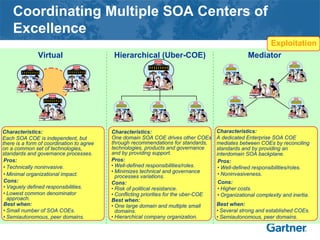
Coordinating Multiple SOA Centers of
Excellence
Virtual Hierarchical (Uber-COE) Mediator
Characteristics:
Each SOA COE is independent, but
there is a form of coordination to agree
on a common set of technologies,
standards and governance processes.
Pros:
• Technically noninvasive.
• Minimal organizational impact.
Cons:
• Vaguely defined responsibilities.
• Lowest common denominator
approach.
Best when:
• Small number of SOA COEs.
• Semiautonomous, peer domains.
Characteristics:
One domain SOA COE drives other COEs
through recommendations for standards,
technologies, products and governance
and by providing support.
Pros:
• Well-defined responsibilities/roles.
• Minimizes technical and governance
processes variations.
Cons:
• Risk of political resistance.
• Conflicting priorities for the uber-COE
Best when:
• One large domain and multiple small
domains.
• Hierarchical company organization.
Characteristics:
A dedicated Enterprise SOA COE
mediates between COEs by reconciling
standards and by providing an
interdomain SOA backplane.
Pros:
• Well-defined responsibilities/roles.
• Noninvasiveness.
Cons:
• Higher costs.
• Organizational complexity and inertia.
Best when:
• Several strong and established COEs.
• Semiautonomous, peer domains.
Exploitation
Even in SOA, "Well begun is half done."
Leverage the first project to lay down the foundation for the SOA
backplane, SOA governance and SOA center of excellence.
SOA doesn't happen by magic.
Use a sound combination of "stick" and "carrot" to achieve
alignment with SOA goals and principles.
Federation is the most-natural approach to systematic,
enterprisewide SOA.
Proactively adopt a federated approach to diffuse SOA benefits
across the entire enterprise.
Bottom Line
Which are the key hurdles on the way to enterprisewide SOA,
and how can organizations get over them?

Soa best practice

  • 1.
    Notes accompany thispresentation. Please select Notes Page view. These materials can be reproduced only with written approval from Gartner. Such approvals must be requested via e-mail: vendor.relations@gartner.com. Gartner is a registered trademark of Gartner, Inc. or its affiliates. Practitioner's Guide: Best Practices in Enterprisewide SOA Initiatives Massimo Pezzini
  • 2.
    Enterprisewide SOA IsMultiowned and Federated Domestic Sales Administration Production International Sales Customer Support Customers Suppliers Contractors Outsourcers Enterprise SOA SOA Federation Enterprise SOA SOA Domains
  • 3.
    Key Issues 1. Whatwill be the technical and business drivers for strategic SOA adoption? 2. How will organizations incrementally approach large-scale SOA initiatives? 3. What are the key hurdles on the way to enterprisewide SOA, and how can organizations get over them?
  • 4.
    Irresistible Forces PushOrganizations Toward SOA Adoption SOA User Adoption IT cost reduction Escalating integration needs (A2A, B2B, SaaS) Need for business processes improvement Quest for greater business agility Lowering cost and growing maturity of enabling technology Availability of best practices Packaged- application vendors' pressure Cultural change More- complex application infrastructure Immature standards Heterogeneous technology and conflicting vendors' strategy Lack of governance Drivers Inhibitors
  • 5.
    Adopting SOA-Enabled PackagedBusiness Applications Registry SOA backplane Registry SOA backplane Wrapped SOA Hybrid SOA Full SOA 2007 2008-2012 Post-2012 Pre-SOA packages/modules Vendor-provided standardized service-wrapped interfaces Packaged and custom processes and composite applications Minimalist SOA backplane Informal registry and governance Coexistence of full-SOA and pre- SOA packages/modules Coexistence of vendor-provided standardized native and wrapped interfaces Packaged and custom processes and composite applications Full SOA backplane Formal registry and governance Full SOA packages/modules Vendor-standardized native interfaces Packaged and custom processes and composite applications Full SOA backplane Formal registry and governance
  • 6.
    Where Will UsersSource Their Business Services? TCO Differentiation On-Demand Services (SaaS) Purchased Services (Packaged Applications) Custom Services (Built/Wrapped) Composite Application/Mashup (Packaged/Custom) Composite Process (Packaged/Custom) Business Impact of Services
  • 7.
    SOA hasn't beenordered by the doctor: You can live without it. SOA adoption should be justified by balancing (certain) costs and (potential) benefits. However, most organizations will be forced to SOA by their packaged-application vendors. Investigate the SOA strategy of your packaged-application vendors and plan for a gradual adoption. SOA services and applications will be multisourced. SaaS and SOA go hand in hand. If you're planning for SaaS, you need to plan for SOA as well (and possibly vice versa). Bottom Line What will be the technical and business drivers for strategic SOA adoption?
  • 8.
    Stages of SOAAdoption Stage 1 Introduction Stage 2 Spreading Stage 3 Exploitation Stage 4 Plateau IT Goals Proof of Concept Establish Technology Platform Leverage Services Sharing Enterprise SOA Infrastructure Business Goals Address Specific Pain (for example, Customer Portal) Process Integration (for example, B2B) Process Flexibility (for example, Time to Market) Continuous Adaptation and Evolution Single Application Multiple Applications (Single BU) Multiple Applications (Across BUs) Virtual Enterprise Scope <25 <100 <500 >500 <5 <25 <50 >50 <10,000 <100,000 <1,000,000 >1,000,000 <10 <20 <100 >100 No. of Published Services* No. of Service Consumers* No. of Service Calls/Day* No. of Service Developers* Enabling Technology (cumulative) Application Server, Portal, Adapters ESB, WSM Integration Suite, B2B SOA Reg/Rep BPM Policy Management Enterprise SOA Backplane *These figures represent typical scenarios, but they may vary considerably, depending on the specific organization's requirements.
  • 9.
    Why SOA InitiativesFail: Technology or Governance? Introduction Spreading Exploitation Plateau Risk of SOA Project Failures Lack of Governance Risk Technology Risk Less Risk More Risk Time
  • 10.
    Enterprisewide SOA isa long journey. Plan for multiyear incremental implementation steps, but look for short- and medium-term payback. At each step, additional technology and organizational capabilities must be put in place. See "Toolkit: Planning for Service-Oriented Architecture With the Gartner SOA Adoption Model," G00143726. SOA success is a 50-50 business between technology and governance (and good old management). Bad technology choices can kill even the best-run SOA initiative. Focus on governance from Day 1, but initially avoid "too much" governance. Bottom Line How will organizations incrementally approach large-scale SOA initiatives?
  • 11.
    The Seven GoldenRules for the Perfect First SOA Project 1. Set Goals and Collect Business-IT Requirements 2. Segregation of Duties Application design teams: • Service consumers • Service implementations Infrastructure Design Team (the future SOA COE) 3. Joint Design/Independent Implementations Services jointly designed by application teams Technically validated by the infrastructure team 4. Deliver Infrastructure (SOA Backplane) First Design, implementation, testing Validation against an agreed proof of concept 5. Deliver Services Before Consumer Applications Plan for services to be available and tested before relevant consumers 6. Test, Test and Test Again Plan for at least 25% of development effort on integration testing 7. Log, Log and Log Again Multiple turn-on/off logs Introduction
  • 12.
    Service-Oriented Architecture Entails TacklingMultiple Technology Challenges Non-SOA Wrapped Application Multichannel Portal Composite Application (Mashup) WrapperWrapper Services Application Logic Native SOA Application Interface Interface Interface SOA backplane BPM Application Wrapper BPM Technology Portal Product, EAS, Composite Application Tools, Mashup Tools Portal Product Adapters, Programmatic Integration Servers TPM, EAS "All-in-One" Application Platform Suite ESB, MOM, XML Appliances Introduction
  • 13.
    The SOA BackplaneUnveiled: Web Services and More = Common Features = Advanced Features= Minimal Features Security Management Adapters Development Tools Life Cycle Management Tools Orchestration Policies Extensibility Framework Communication (SOAP, IIOP, JMS, MOM, RPC, ORB, TPM) Mediation/ Transformation Routing/ Addressing Naming QOS Registry Spreading
  • 14.
    Standardized Business ObjectsEnable Interoperability and Reuse B2C E-Commerce Application Branch Office Packaged Application Interface Spreading SAP ERP Oracle Siebel CRM Customer Data (SAP Format) Customer Data (Siebel Format) Customer Data (ISV Format) Customer Data (Custom Format) Customer Data (Standardized Format) Composite "Get Customer Data" Service
  • 15.
    How Do YouKnow If You Are Doing It Right or Wrong? Spreading Number of Services Deployed Number of Consumer Applications Deployed Number of Services/No. of Consumers Number of Services Shared by at Least Two Applications Average Sharing Ratio Optimal Trend Volume of Service Requests Number of Requests per Service Service Request Response Time Number of New Services Developed per Each New Consumer Application Time to Deployment for New Consumer Applications Cost of Application Maintenance Examples of SOA Technical Metrics Reuse QOS Cost Reduction Goal/Focus
  • 16.
    How Do YouEnforce Sharing of Services? Exploitation Service Definition Process Service Registry and Life Cycle Management Tools Reward Policies Shareable Services "Chasing" Team Mainstream Aggressive Standardized Business Objects
  • 17.
    SOA Domain: TheKey Conceptual Enabler for Federated SOA Domain SOA Backplane Domain Registry Related set of consumers and services Single business ownership and span of technical management Single SOA center of excellence Common set of governance processes Unified domain SOA backplane (at least logically) Unified domain service registry (at least logically) 30 to more than 300 services (depending on domain scope) >80% of service invocations are intradomain >75% of service consumer apps call only intradomain services Up to 35% of domain services shared by multiple consumers Up to 75% of domain services needed by a new domain application are already available SOA Domain Definition Typical Characteristics* *Figures are indicative of a mature domain in which most required consumer applications and service providers have already been implemented. Domain SOA COE Exploitation
  • 18.
    Federated SOA Backplane Topologies Point-to-PointUber-SOA Backplane Intermediary SOA Backplane Characteristics: • SOA backplanes connect to each other via point-to-point links. • Each link can be implemented using different protocols. Pros: • Simple to implement. • Low cost. Cons: • Accountability/responsibility. • Scalability. Best when: • Small number of SOA backplanes. • Semiautonomous, peer domains. Characteristics: • One specific domain SOA backplane also acts as a central "broker" linking all the other backplanes. Pros: • Simple to implement. • Well-defined responsibility. Cons: • Risk of uber-backplane overload. • Security/privacy. Best when: • One large domain and multiple smaller domains. • Hierarchical company organization. Characteristics: • Each SOA backplane links into a central, enterprisewide backplane supporting only interbackplane mediation (routing, transformation). Pros: • Well-defined responsibility. • Noninvasiveness. Cons: • Higher costs. • Single point of failure. Best when: • Large number of SOA backplanes. • Semiautonomous, peer domains. Exploitation
  • 19.
    Coordinating Multiple SOACenters of Excellence Virtual Hierarchical (Uber-COE) Mediator Characteristics: Each SOA COE is independent, but there is a form of coordination to agree on a common set of technologies, standards and governance processes. Pros: • Technically noninvasive. • Minimal organizational impact. Cons: • Vaguely defined responsibilities. • Lowest common denominator approach. Best when: • Small number of SOA COEs. • Semiautonomous, peer domains. Characteristics: One domain SOA COE drives other COEs through recommendations for standards, technologies, products and governance and by providing support. Pros: • Well-defined responsibilities/roles. • Minimizes technical and governance processes variations. Cons: • Risk of political resistance. • Conflicting priorities for the uber-COE Best when: • One large domain and multiple small domains. • Hierarchical company organization. Characteristics: A dedicated Enterprise SOA COE mediates between COEs by reconciling standards and by providing an interdomain SOA backplane. Pros: • Well-defined responsibilities/roles. • Noninvasiveness. Cons: • Higher costs. • Organizational complexity and inertia. Best when: • Several strong and established COEs. • Semiautonomous, peer domains. Exploitation
  • 20.
    Even in SOA,"Well begun is half done." Leverage the first project to lay down the foundation for the SOA backplane, SOA governance and SOA center of excellence. SOA doesn't happen by magic. Use a sound combination of "stick" and "carrot" to achieve alignment with SOA goals and principles. Federation is the most-natural approach to systematic, enterprisewide SOA. Proactively adopt a federated approach to diffuse SOA benefits across the entire enterprise. Bottom Line Which are the key hurdles on the way to enterprisewide SOA, and how can organizations get over them?