Department of Computer Engineering
Sandip Foundation's
Sandip Institute of Technology and Research Centre, Nashik
Savitribai Phule Pune University
BE PROJECT
Year 2019 – 2020
Under the Guidance
Prof.
Vivek Waghmare
DEVELOPING AIR
CONDITIONING SYSTEM
USING FUZZY LOGIC
PRESENTED BY:- G23
- Sunil Rajput Exam No: 71720728F
- Ashish kumar Singh Exam No: 71324943K
- Ashish Yadav Exam No: 71741665J
- Mayank Patil Exam No: 71550097L
TABLE OF CONTENT
ABSTRACT
INTRODUCTION
OBJECTIVE
BASIC CONCEPTS OF FUZZY LOGIC
RULES
FUZZY CONTROL SYSTEM
AIR CONDITIONER
APPLICATION
LIMITATION
CONCLUSION
REFERENCE'S
ABSTRACT
Fuzzy logic control was developed to control the compressor
motor speed , fan speed , fin direction and operation mode to maintain
the room temperature at or closed to the set point temperature and
save energy and keep devices from damage. This paper describes the
development of Fuzzy logic algorithm for Air Condition control system.
This system consists of four sensors for feedback control: first for input
electric volt which used to save devices from damage due to alternated
voltages, second for temperature and third for humidity and fourth for
dew point. Simulation of the Fuzzy logic algorithm for Air Condition
controlling system is carried out based on MATLAB.
INTRODUCTION
First proposed in 1965 by Lotfi Zadeh as a
way to process imprecise data.
• Fuzzy Logic (FL) controlling system is based
on a set of rules established by an expert.
• These rules are translated into mathematical steps used to
realize a physical controller.
• FL controllers can be physically realized in different forms.
• We adopt look up tables and function realizations
Lotfi Aliasker Zadeh
muruganm1@gmail.com
• Instead of using complex mathematical equations
fuzzy logic uses linguistic description to define
the relationship between the input information
and the output action.
• Just as fuzzy logic can be described simply
as “Computing with words rather than
numbers”, fuzzy control can be described
simply as “Control with sentences rather
than equations”.
What is Fuzzy
Logic?
muruganm1@gmail.com
Rules :-
Fuzzy logic usually uses IF-THEN rules, or
constructs that are equivalent.
-IF variable is property THEN action
Example:-
A simple temperature regulator that uses a fan might
look like this:
IF temperature is very cold THEN stop fan
IF temperature is cold THEN turn down fan
IF temperature is normal THEN maintain level
IF temperature is hot THEN speed up fan
Fuzzy Control System
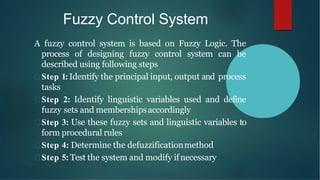
A fuzzy control system is based on Fuzzy Logic. The
process of designing fuzzy control system can be
described using following steps
Step 1:Identify the principal input, output and process
tasks
Step 2: Identify linguistic variables used and define
fuzzy sets and membershipsaccordingly
Step 3: Use these fuzzy sets and linguistic variables to
form procedural rules
Step 4: Determine the defuzzificationmethod
Step 5: Test the system and modify ifnecessary
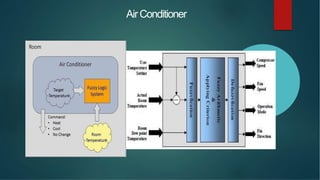
AirConditioner
Controller Structure
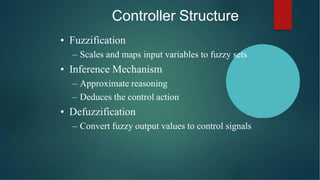
• Fuzzification
– Scales and maps input variables to fuzzy sets
• Inference Mechanism
– Approximate reasoning
– Deduces the control action
• Defuzzification
– Convert fuzzy output values to control signals
Operations
A B
A  B A  B A
Rule Base
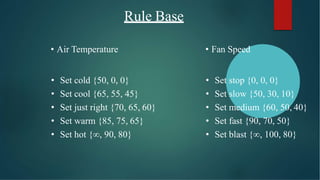
• Air Temperature
• Set cold {50, 0, 0}
• Set cool {65, 55, 45}
• Set just right {70, 65, 60}
• Set warm {85, 75, 65}
• Set hot {, 90, 80}
• Fan Speed
• Set stop {0, 0, 0}
• Set slow {50, 30, 10}
• Set medium {60, 50, 40}
• Set fast {90, 70, 50}
• Set blast {, 100, 80}
Rules in Matlab
Rules and Membership Function via
Matlab
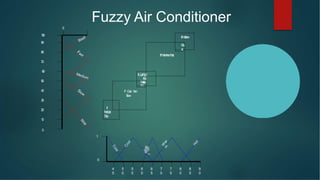
Fuzzy Air Conditioner
10
0
20
30
40
50
60
70
80
90
100
0
if
Coldthen
Stop
IFCool then
Slow
IfJustRight
the
nMediu
m
IfWarmthenFast
IfHotthen
Bla
st
1
4
5
5
0
5
5
6
0
6
5
7
0
7
5
8
0
0
8
5
9
0
APPLICATIONS
1
6
WashingMachines
Anti-Lock BrakingSystem
Anti sway cranecontrol
Flight Control in planes
In Air-Conditioning
Cutting force optimization in machining
Limitations of Fuzzy Systems
Fuzzy systems lack the capability of machine learning
as-well-as neural network type pattern recognition
Verification and validation of a fuzzy knowledge-based
system require extensive testing withhardware
Determining exact fuzzy rules and membership
functions is a hard task
Stability is an important concern for fuzzycontrol
CONCLUSION
 Fuzzy Logic provides a completelydifferent, way to approach a control problem.
 Focus on what the system should dorather than trying to understand how it
works.
 Leads to quicker, cheapersolutions.
 In case of the Air-Conditioning system, fuzzy logic helped solve a complex
problem without getting involved in intricate relationships between physical
variables. Intuitive knowledge about input and output parameters was enough to
design an optimally performing system. With most of the problems encountered
in day to day life falling in this category, like washing machines, vacuum
cleaners, etc, fuzzy logic is sure to make a great impact in human life.
• Set up the one input system as a proof of concept. We are
in the process of building the hardware set up.
• Based on the first system, make a selection of the
microcontroller models appropriate for a two and three input
system
FUTURE SCOPE
REFERENCES
John Yen, Reza Langari, Fuzzy Logic Intelligence, control and Information, Prentice-Hall Inc, 1999
Ali Dr. I.M., 2012. Developing of a Fuzzy Logic Controller for Air Conditioning System, Anbar
Journal for Engineering Sciences, Vol 5, 180-187.
Aprea C., Mastrullu R. and Rrenno C.,2004. Fuzzy control of compressor speed in refrigerant
plant, Int J Refrigerat., Vol 2, pp.134-143.
Arima M., Hara E. H., and Katzberg J. D., 1995. A fuzzy logic and rough sets controller for HVAC
system, IEEE WESCANEX’95, Vol 95, pp 133-138.
Batayneh W., Araidah O. and Bataineh K., 2010. Fuzzy logic approach to provide safe and
comfortable indoor environment, International Journal of Engineering, Science and Technology,
Vol. 2, pp. 65-72.
Becker M., OestreichD., Hasse Hand Litz L 1994. Fuzzy control for temperature and Humidity in
refrigeration systems, IEEE transact, Vol FM-4-2, pp 1607-1611.
Calvino F., Gennusa M. L., Rizzo G., 2004. The control of indoor thermal comfort conditions:
introducing fuzzy adaptive controller, Ener Build, Vol 36, pp. 97-102

DEVELOPING Air Conditioner Controller using MATLAB Fuzzy logic presentation

  • 1.
    Department of ComputerEngineering Sandip Foundation's Sandip Institute of Technology and Research Centre, Nashik Savitribai Phule Pune University BE PROJECT Year 2019 – 2020 Under the Guidance Prof. Vivek Waghmare
  • 2.
    DEVELOPING AIR CONDITIONING SYSTEM USINGFUZZY LOGIC PRESENTED BY:- G23 - Sunil Rajput Exam No: 71720728F - Ashish kumar Singh Exam No: 71324943K - Ashish Yadav Exam No: 71741665J - Mayank Patil Exam No: 71550097L
  • 3.
    TABLE OF CONTENT ABSTRACT INTRODUCTION OBJECTIVE BASICCONCEPTS OF FUZZY LOGIC RULES FUZZY CONTROL SYSTEM AIR CONDITIONER APPLICATION LIMITATION CONCLUSION REFERENCE'S
  • 4.
    ABSTRACT Fuzzy logic controlwas developed to control the compressor motor speed , fan speed , fin direction and operation mode to maintain the room temperature at or closed to the set point temperature and save energy and keep devices from damage. This paper describes the development of Fuzzy logic algorithm for Air Condition control system. This system consists of four sensors for feedback control: first for input electric volt which used to save devices from damage due to alternated voltages, second for temperature and third for humidity and fourth for dew point. Simulation of the Fuzzy logic algorithm for Air Condition controlling system is carried out based on MATLAB.
  • 5.
    INTRODUCTION First proposed in1965 by Lotfi Zadeh as a way to process imprecise data. • Fuzzy Logic (FL) controlling system is based on a set of rules established by an expert. • These rules are translated into mathematical steps used to realize a physical controller. • FL controllers can be physically realized in different forms. • We adopt look up tables and function realizations Lotfi Aliasker Zadeh
  • 6.
    muruganm1@gmail.com • Instead ofusing complex mathematical equations fuzzy logic uses linguistic description to define the relationship between the input information and the output action. • Just as fuzzy logic can be described simply as “Computing with words rather than numbers”, fuzzy control can be described simply as “Control with sentences rather than equations”. What is Fuzzy Logic?
  • 7.
    muruganm1@gmail.com Rules :- Fuzzy logicusually uses IF-THEN rules, or constructs that are equivalent. -IF variable is property THEN action Example:- A simple temperature regulator that uses a fan might look like this: IF temperature is very cold THEN stop fan IF temperature is cold THEN turn down fan IF temperature is normal THEN maintain level IF temperature is hot THEN speed up fan
  • 8.
    Fuzzy Control System Afuzzy control system is based on Fuzzy Logic. The process of designing fuzzy control system can be described using following steps Step 1:Identify the principal input, output and process tasks Step 2: Identify linguistic variables used and define fuzzy sets and membershipsaccordingly Step 3: Use these fuzzy sets and linguistic variables to form procedural rules Step 4: Determine the defuzzificationmethod Step 5: Test the system and modify ifnecessary
  • 9.
  • 10.
    Controller Structure • Fuzzification –Scales and maps input variables to fuzzy sets • Inference Mechanism – Approximate reasoning – Deduces the control action • Defuzzification – Convert fuzzy output values to control signals
  • 11.
    Operations A B A B A  B A
  • 12.
    Rule Base • AirTemperature • Set cold {50, 0, 0} • Set cool {65, 55, 45} • Set just right {70, 65, 60} • Set warm {85, 75, 65} • Set hot {, 90, 80} • Fan Speed • Set stop {0, 0, 0} • Set slow {50, 30, 10} • Set medium {60, 50, 40} • Set fast {90, 70, 50} • Set blast {, 100, 80}
  • 13.
  • 14.
    Rules and MembershipFunction via Matlab
  • 15.
    Fuzzy Air Conditioner 10 0 20 30 40 50 60 70 80 90 100 0 if Coldthen Stop IFCoolthen Slow IfJustRight the nMediu m IfWarmthenFast IfHotthen Bla st 1 4 5 5 0 5 5 6 0 6 5 7 0 7 5 8 0 0 8 5 9 0
  • 16.
    APPLICATIONS 1 6 WashingMachines Anti-Lock BrakingSystem Anti swaycranecontrol Flight Control in planes In Air-Conditioning Cutting force optimization in machining
  • 17.
    Limitations of FuzzySystems Fuzzy systems lack the capability of machine learning as-well-as neural network type pattern recognition Verification and validation of a fuzzy knowledge-based system require extensive testing withhardware Determining exact fuzzy rules and membership functions is a hard task Stability is an important concern for fuzzycontrol
  • 18.
    CONCLUSION  Fuzzy Logicprovides a completelydifferent, way to approach a control problem.  Focus on what the system should dorather than trying to understand how it works.  Leads to quicker, cheapersolutions.  In case of the Air-Conditioning system, fuzzy logic helped solve a complex problem without getting involved in intricate relationships between physical variables. Intuitive knowledge about input and output parameters was enough to design an optimally performing system. With most of the problems encountered in day to day life falling in this category, like washing machines, vacuum cleaners, etc, fuzzy logic is sure to make a great impact in human life.
  • 19.
    • Set upthe one input system as a proof of concept. We are in the process of building the hardware set up. • Based on the first system, make a selection of the microcontroller models appropriate for a two and three input system FUTURE SCOPE
  • 20.
    REFERENCES John Yen, RezaLangari, Fuzzy Logic Intelligence, control and Information, Prentice-Hall Inc, 1999 Ali Dr. I.M., 2012. Developing of a Fuzzy Logic Controller for Air Conditioning System, Anbar Journal for Engineering Sciences, Vol 5, 180-187. Aprea C., Mastrullu R. and Rrenno C.,2004. Fuzzy control of compressor speed in refrigerant plant, Int J Refrigerat., Vol 2, pp.134-143. Arima M., Hara E. H., and Katzberg J. D., 1995. A fuzzy logic and rough sets controller for HVAC system, IEEE WESCANEX’95, Vol 95, pp 133-138. Batayneh W., Araidah O. and Bataineh K., 2010. Fuzzy logic approach to provide safe and comfortable indoor environment, International Journal of Engineering, Science and Technology, Vol. 2, pp. 65-72. Becker M., OestreichD., Hasse Hand Litz L 1994. Fuzzy control for temperature and Humidity in refrigeration systems, IEEE transact, Vol FM-4-2, pp 1607-1611. Calvino F., Gennusa M. L., Rizzo G., 2004. The control of indoor thermal comfort conditions: introducing fuzzy adaptive controller, Ener Build, Vol 36, pp. 97-102