Adaptive Neural Fuzzy 
Inference Systems (ANFIS): 
Analysis and Applications 
©Copyright 2002 by Piero P. Bonissone 1
©Copyright 2002 by Piero P. Bonissone 2 
Outline 
• Objective 
• Fuzzy Control 
– Background, Technology & Typology 
• ANFIS: 
– as a Type III Fuzzy Control 
– as a fuzzification of CART 
– Characteristics 
– Pros and Cons 
– Opportunities 
– Applications 
– References
ANFIS Objective 
• To integrate the best features of Fuzzy 
Systems and Neural Networks: 
– From FS: Representation of prior knowledge into 
a set of constraints (network topology) to reduce 
the optimization search space 
– From NN: Adaptation of backpropagation to 
structured network to automate FC parametric 
tuning 
• ANFIS application to synthesize: 
– controllers (automated FC tuning) 
– models (to explain past data and predict future 
behavior) 
©Copyright 2002 by Piero P. Bonissone 3
FC Technology & Typology 
• Fuzzy Control 
– A high level representation language with 
local semantics and an interpreter/compiler 
to synthesize non-linear (control) surfaces 
– A Universal Functional Approximator 
• FC Types 
– Type I: RHS is a monotonic function 
– Type II: RHS is a fuzzy set 
– Type III: RHS is a (linear) function of state 
©Copyright 2002 by Piero P. Bonissone 4
FC Technology (Background) 
• Fuzzy KB representation 
– Scaling factors, Termsets, Rules 
• Rule inference (generalized modus ponens) 
• Development & Deployment 
– Interpreters, Tuners, Compilers, Run-time 
– Synthesis of control surface 
• FC Types I, II, III 
©Copyright 2002 by Piero P. Bonissone 5
FC of Type II, III, and ANFIS 
• Type II Fuzzy Control must be tuned manually 
• Type III Fuzzy Control (Takagi-Sugeno type) 
have an automatic Right Hand Side (RHS) 
tuning 
• ANFIS will provide both: 
– RHS tuning, by implementing the TSK controller 
as a network 
– and LHS tuning, by using back-propagation 
©Copyright 2002 by Piero P. Bonissone 6
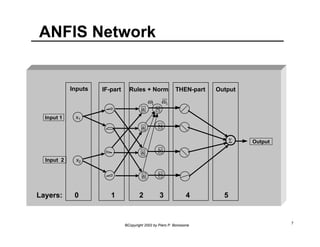
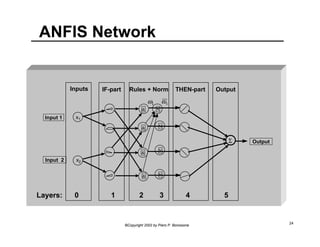
Inputs IF-part Rules + Norm THEN-part Output 
N 
©Copyright 2002 by Piero P. Bonissone 7 
x1 
x2 
Input 1 
Input 2 
& 
& 
& 
& 
Σ Output 
ANFIS Network 
N 
N 
N 
ω1 
1 ω 
Layers: 0 1 2 3 4 5
ANFIS Neurons: Clarification note 
• Note that neurons in ANFIS have different 
structures: 
– Values [ Membership function defined by parameterized 
soft trapezoids (Generalized Bell Functions) ] 
– Rules [ Differentiable T-norm - usually product ] 
– Normalization [ Sum and arithmetic division ] 
– Functions [ Linear regressions and multiplication with 
, i.e., normalized weights ω, ] 
– Output [ Algebraic Sum ] 
©Copyright 2002 by Piero P. Bonissone 8 
ω
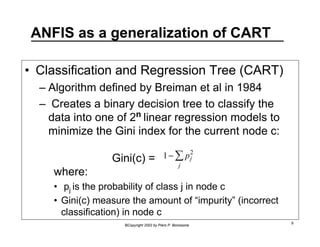
ANFIS as a generalization of CART 
• Classification and Regression Tree (CART) 
– Algorithm defined by Breiman et al in 1984 
– Creates a binary decision tree to classify the 
data into one of 2n linear regression models to 
minimize the Gini index for the current node c: 
Gini(c) = 
2 
j Σ 
1 − pj 
where: 
• pj is the probability of class j in node c 
• Gini(c) measure the amount of “impurity” (incorrect 
classification) in node c 
©Copyright 2002 by Piero P. Bonissone 9
CART Problems 
• Discontinuity 
• Lack of locality (sign of coefficients) 
©Copyright 2002 by Piero P. Bonissone 10
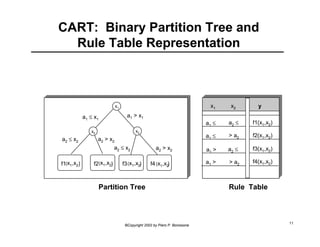
CART: Binary Partition Tree and 
Rule Table Representation 
x1 x2 y 
a1 ≤ a2 ≤ f1(x1,x2) 
a1 ≤ > a2 
f2(x1,x2) 
a1 > a2 ≤ 
f3(x1,x2) 
a1> > a2 
f4(x1,x2) 
a1 ≤ x1 
a1 > x1 
a2 ≤ x2 a2 > x2 
a2 > x2 a2 ≤ x2 
Partition Tree Rule Table 
©Copyright 2002 by Piero P. Bonissone 11 
x1 
x2 x2 
f1(x1,x2) f2(x1,x2) f3(x1,x2) f4 (x1,x2)
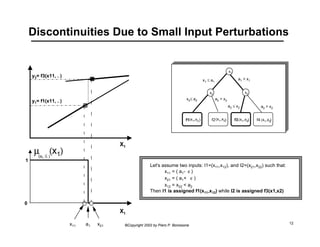
Discontinuities Due to Small Input Perturbations 
x1 ≤ a1 
a1 > x1 
x2≤ a2 a2 > x2 
a2 > x2 a2 ≤ x2 
Let's assume two inputs: I1=(x11,x12), and I2=(x21,x22) such that: 
x11 = ( a1- ε ) 
x21 = ( a1+ ε ) 
x12 = x22 < a2 
Then I1 is assigned f1(x11,x12) while I2 is assigned f3(x1,x2) 
X1 
©Copyright 2002 by Piero P. Bonissone 12 
y1= f1(x11, . ) 
(a1 ≤ ) μ (x1) 
x11 a1 x21 
y3= f3(x11, . ) 
1 
0 
X1 
x1 
x2 x2 
f1(x1,x2) f2(x1,x2) f3 (x1,x2) f4 (x1,x2)
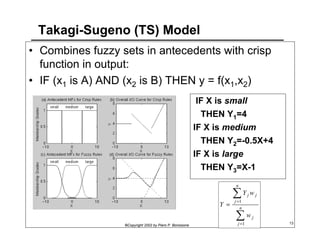
Takagi-Sugeno (TS) Model 
• Combines fuzzy sets in antecedents with crisp 
function in output: 
• IF (x1 
is A) AND (x2 is B) THEN y = f(x1,x2) 
IF X is small 
THEN Y1=4 
IF X is medium 
THEN Y2=-0.5X+4 
IF X is large 
THEN Y3=X-1 
Σ 
= =n 
Y w 
Σ 
= 
©Copyright 2002 by Piero P. Bonissone j 
13 
j 
n 
j 
j j 
w 
Y 
1 
1
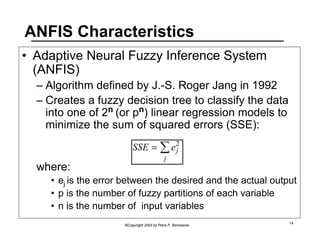
ANFIS Characteristics 
• Adaptive Neural Fuzzy Inference System 
(ANFIS) 
– Algorithm defined by J.-S. Roger Jang in 1992 
– Creates a fuzzy decision tree to classify the data 
into one of 2n (or pn) linear regression models to 
minimize the sum of squared errors (SSE): 
j Σ 
SSE = ej 2 
©Copyright 2002 by Piero P. Bonissone 14 
where: 
• ej is the error between the desired and the actual output 
• p is the number of fuzzy partitions of each variable 
• n is the number of input variables
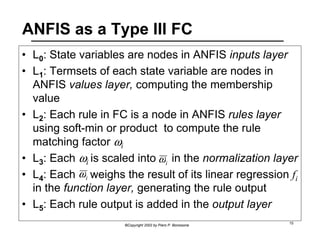
ANFIS as a Type III FC 
• L0: State variables are nodes in ANFIS inputs layer 
• L1: Termsets of each state variable are nodes in 
ANFIS values layer, computing the membership 
value 
• L2: Each rule in FC is a node in ANFIS rules layer 
using soft-min or product to compute the rule 
matching factor ωi 
• L3: Each ωi 
is scaled into in the normalization layer 
i ω 
• L4: Each weighs the result of its linear regression fi 
in the function layer, generating the rule output 
• L5: Each rule output is added in the output layer 
©Copyright 2002 by Piero P. Bonissone 15 
i ω
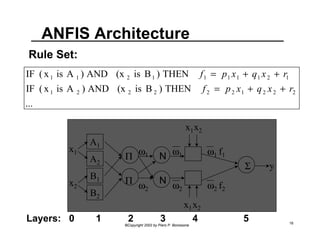
ANFIS Architecture 
Rule Set: 
IF ( x is A ) AND (x is B ) THEN 
= + + 
f p x q x r 
1 1 2 1 1 1 1 1 2 1 
IF ( x is A ) AND (x is B ) THEN 
= + + 
f p x q x r 
x2 
©Copyright 2002 by Piero P. Bonissone 16 
... 
1 2 2 2 2 2 1 2 2 2 
x1 
x2 
A1 
A2 
B1 
B2 
Π 
Π 
ω N 1 
ω2 
N 
ω1 
ω2 
ω1 f1 
ω2 f2 
Σ y 
x1 
x1 x2 
Layers: 0 1 2 3 4 5
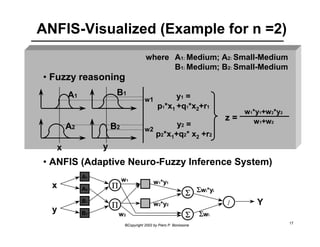
ANFIS-Visualized (Example for n =2) 
• Fuzzy reasoning 
A1 B1 
where A1: Medium; A2: Small-Medium 
B1: Medium; B2: Small-Medium 
w1*y1+w2*y2 
©Copyright 2002 by Piero P. Bonissone 17 
A2 B2 
w1 
w2 
y1 = 
p1*x1 +q1*x2+r1 
y2 = 
p2*x1+q2* x2 +r2 
z = w1+w2 
x y 
• ANFIS (Adaptive Neuro-Fuzzy Inference System) 
A1 
A2 
B1 
B2 
Π 
Π 
Σ 
Σ 
/ 
x 
y 
w1 
w2 
w1*y1 
w2*y2 
Σwi*yi 
Σwi 
Y
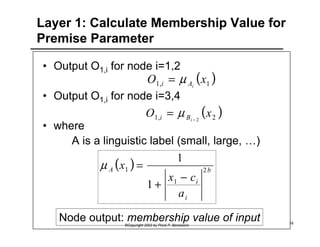
Layer 1: Calculate Membership Value for 
Premise Parameter 
• Output O1,i for node i=1,2 
( ) 1, 1 O x 
i Ai = μ 
• Output O1,i for node i=3,4 
( ) 1, 2 2 
i Bi − = μ 
O x 
x 2 
x c 
©Copyright 2002 by Piero P. Bonissone 18 
• where 
A is a linguistic label (small, large, …) 
( ) b 
i 
i 
A 
a 
1 
1 
1 
1 
+ − 
μ = 
Node output: membership value of input
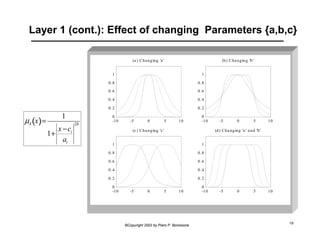
Layer 1 (cont.): Effect of changing Parameters {a,b,c} 
(a ) Cha nging 'a ' 
1 
0.8 
0.6 
0.4 
0.2 
0 
(b) Cha nging 'b' 
(c ) Cha nging 'c ' 
1 
0.8 
0.6 
0.4 
0.2 
0 
(d) Cha nging 'a ' a nd 'b' 
©Copyright 2002 by Piero P. Bonissone 19 
μA 
(x)= 1 
1+ x −ci 
ai 
2b 
1 
0.8 
0.6 
0.4 
0.2 
0 
-10 -5 0 5 10 
-10 -5 0 5 10 
1 
0.8 
0.6 
0.4 
0.2 
0 
-10 -5 0 5 10 
-10 -5 0 5 10
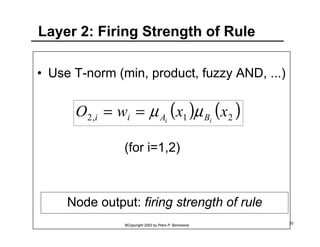
Layer 2: Firing Strength of Rule 
• Use T-norm (min, product, fuzzy AND, ...) 
( ) ( ) 2, 1 2 O w x x 
i i Ai Bi = = μ μ 
(for i=1,2) 
Node output: firing strength of rule 
©Copyright 2002 by Piero P. Bonissone 20
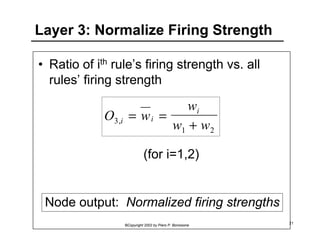
Layer 3: Normalize Firing Strength 
• Ratio of ith rule’s firing strength vs. all 
rules’ firing strength 
O w 
w 
i 
i i w w 
(for i=1,2) 
©Copyright 2002 by Piero P. Bonissone 21 
3 
1 2 
, = = 
+ 
Node output: Normalized firing strengths
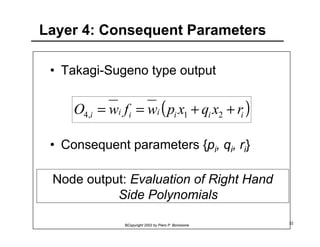
Layer 4: Consequent Parameters 
• Takagi-Sugeno type output 
( )i i i i i i i O = w f = w p x + q x + r 4, 1 2 
• Consequent parameters {pi, qi, ri} 
Node output: Evaluation of Right Hand 
Side Polynomials 
©Copyright 2002 by Piero P. Bonissone 22
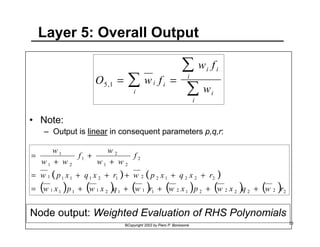
Layer 5: Overall Output 
Σ 
Σ 
w f 
w i i 
5,1= Σ = 
O wf 
i 
i i 
i 
i 
i 
2 
2 
w 
+ 
w w 
1 2 
f 
f 
w 
+ 
w w 
+ 
= + + + + + 
w p x q x r w p x q x r 
= + + + + + 
©Copyright 2002 by Piero P. Bonissone 23 
• Note: 
– Output is linear in consequent parameters p,q,r: 
1 
1 
1 2 
1 ( 1 1 1 2 1 ) 2 ( 2 1 2 2 2 
) 
( w 1 x 1 ) p 1 ( w 1 x 2 ) q 1 ( w 1 ) r 1 ( w 2 x 1 ) p 2 ( w 2 x 2 ) q 2 ( w 2 )r 
2 
= 
Node output: Weighted Evaluation of RHS Polynomials
Inputs IF-part Rules + Norm THEN-part Output 
N 
©Copyright 2002 by Piero P. Bonissone 24 
x1 
x2 
Input 1 
Input 2 
& 
& 
& 
& 
Σ Output 
ANFIS Network 
N 
N 
N 
ω1 
1 ω 
Layers: 0 1 2 3 4 5
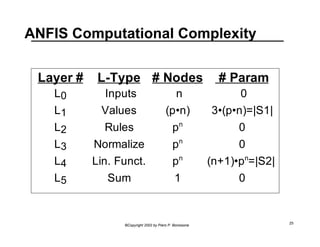
ANFIS Computational Complexity 
Layer # L-Type # Nodes # Param 
L0 Inputs n 0 
L1 Values (p•n) 3•(p•n)=|S1| 
L2 Rules pn 0 
L3 Normalize pn 0 
L4 Lin. Funct. pn (n+1)•pn=|S2| 
L5 Sum 1 0 
©Copyright 2002 by Piero P. Bonissone 25
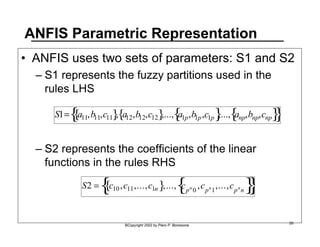
ANFIS Parametric Representation 
• ANFIS uses two sets of parameters: S1 and S2 
– S1 represents the fuzzy partitions used in the 
rules LHS 
S1= a11,b11,c11 { }, a12,b12,c12 { },..., a1p,b1p,c1p { },..., anp,bnp,cnp { { }} 
– S2 represents the coefficients of the linear 
functions in the rules RHS 
S2 = c10,c11,...,c1n { },..., cpn 0 ,cpn1,...,cpnn { { }} 
©Copyright 2002 by Piero P. Bonissone 26
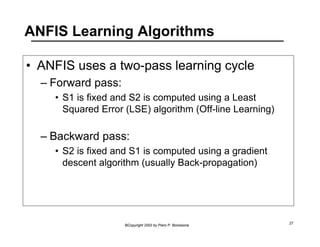
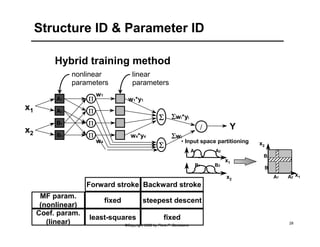
ANFIS Learning Algorithms 
• ANFIS uses a two-pass learning cycle 
©Copyright 2002 by Piero P. Bonissone 27 
– Forward pass: 
• S1 is fixed and S2 is computed using a Least 
Squared Error (LSE) algorithm (Off-line Learning) 
– Backward pass: 
• S2 is fixed and S1 is computed using a gradient 
descent algorithm (usually Back-propagation)
Structure ID & Parameter ID 
Hybrid training method 
Forward stroke Backward stroke 
B2 
©Copyright 2002 by Piero P. Bonissone 28 
A1 
A2 
B1 
B2 
Σ 
Σ 
/ 
x1 
nonlinear 
parameters 
w1 
w4 
w1*y1 
w4*y4 
Σwi*yi 
Σwi 
Y 
Π 
Π 
Π 
Π 
linear 
parameters 
fixed 
least-squares 
steepest descent 
fixed 
MF param. 
(nonlinear) 
Coef. param. 
(linear) 
• Input space partitioning 
A1 
B1 
A2 
B2 
x1 
x1 
x2 
A1 A2 
B1 
x2 
x2
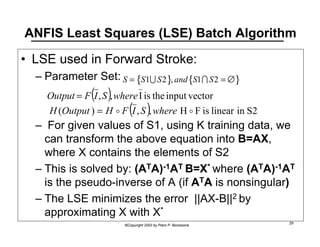
ANFIS Least Squares (LSE) Batch Algorithm 
• LSE used in Forward Stroke: 
S  = {S1US2}, and{S1IS2 = ∅} 
Output = F(I ,S),where I is the input vector 
H(Output ) = H o F(I , S ),where H o F is linear in S2 
©Copyright 2002 by Piero P. Bonissone 29 
– Parameter Set: 
– For given values of S1, using K training data, we 
can transform the above equation into B=AX, 
where X contains the elements of S2 
– This is solved by: (ATA)-1AT B=X* where (ATA)-1AT 
is the pseudo-inverse of A (if ATA is nonsingular) 
– The LSE minimizes the error ||AX-B||2 by 
approximating X with X*
ANFIS LSE Batch Algorithm (cont.) 
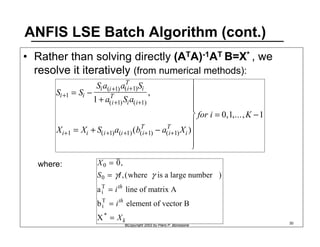
• Rather than solving directly (ATA)-1AT B=X* , we 
resolve it iteratively (from numerical methods): 
T Si 
T Sia(i+1) 
T − a(i+1) 
 
 
 
 
 
 
 
©Copyright 2002 by Piero P. Bonissone 30 
Si+1 = Si − 
Sia(i+1)a(i+1) 
1 + a(i+1) 
, 
Xi+1 = Xi + S(i+1)a(i+1)(b(i+1) 
T Xi ) 
 
 
 
for i = 0,1,...,K −1 
X0 = 0, 
S0 = γ I , (where γ is a large number ) 
a i 
T = ith line of matrix A 
bi 
T = ith element of vector B 
X* = Xk 
where:
ANFIS Back-propagation 
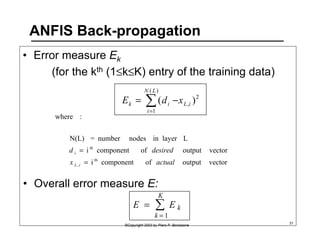
• Error measure Ek 
(for the kth (1≤k≤K) entry of the training data) 
( ) 
E k = Σ= 
d i − 
x ( )2 
, 
N L 
1 
L i 
i 
N(L) = number nodes in layer L 
i component of output vector 
d desired 
KΣ vector output of component i 
i 
• Overall error measure E: 
E = E k 
k = 1 
©Copyright 2002 by Piero P. Bonissone 31 
where : 
th 
, 
th 
x actual 
L i 
= 
=
ANFIS Back-propagation (cont.) 
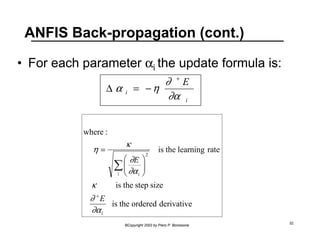
• For each parameter αi the update formula is: 
E 
i 
α η ∂ 
Δ = − 
i 
+ 
∂α 
is the learning rate 
η κ 
∂ 
 
 
is the step size 
is the ordered derivative 
©Copyright 2002 by Piero P. Bonissone 32 
where : 
i 
2 
i 
i 
E 
E 
κ 
∂ 
∂α 
∂α 
+ 
Σ   
  
=
ANFIS Pros and Cons 
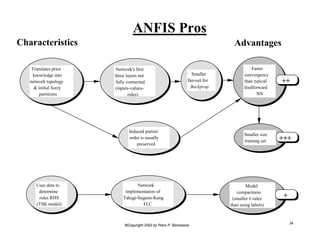
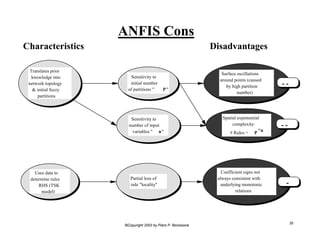
• ANFIS is one of the best tradeoff between 
neural and fuzzy systems, providing: 
– smoothness, due to the FC interpolation 
– adaptability, due to the NN Backpropagation 
• ANFIS however has strong computational 
complexity restrictions 
©Copyright 2002 by Piero P. Bonissone 33
ANFIS Pros 
Characteristics Advantages 
++ 
©Copyright 2002 by Piero P. Bonissone 34 
Translates prior 
knowledge into 
network topology 
& initial fuzzy 
partitions 
Network's first 
three layers not 
fully connected 
(inputs-values-rules) 
Induced partial-order 
is usually 
preserved 
Uses data to 
determine 
rules RHS 
(TSK model) 
Network 
implementation of 
Takagi-Sugeno-Kang 
FLC 
Smaller 
fan-out for 
Backprop 
Faster 
convergency 
than typical 
feedforward 
NN 
Smaller size 
training set 
Model 
compactness 
(smaller # rules 
than using labels) 
+++ 
+
Characteristics Disadvantages 
- - 
©Copyright 2002 by Piero P. Bonissone 35 
Translates prior 
knowledge into 
network topology 
& initial fuzzy 
partitions 
ANFIS Cons 
Sensitivity to 
initial number 
of partitions " P" 
Uses data to 
determine rules 
RHS (TSK 
model) 
Partial loss of 
rule "locality" 
Surface oscillations 
around points (caused 
by high partition 
number) 
Coefficient signs not 
always consistent with 
underlying monotonic 
relations 
Sensitivity to 
number of input 
variables " n" 
Spatial exponential 
complexity: 
# Rules = P^n 
- - 
-
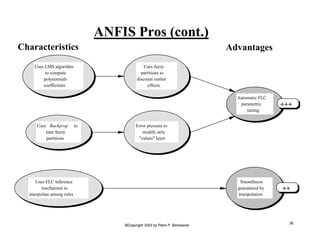
Characteristics Advantages 
+++ 
©Copyright 2002 by Piero P. Bonissone 36 
Uses LMS algorithm 
to compute 
polynomials 
coefficients 
Uses Backprop to 
tune fuzzy 
partitions 
Uses fuzzy 
partitions to 
discount outlier 
effects 
Automatic FLC 
parametric 
tuning 
Error pressure to 
modify only 
"values" layer 
Smoothness 
guaranteed by 
interpolation 
ANFIS Pros (cont.) 
Uses FLC inference 
mechanism to 
interpolate among rules 
++
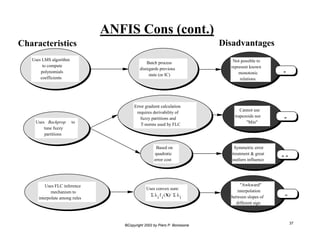
ANFIS Cons (cont.) 
Characteristics Disadvantages 
©Copyright 2002 by Piero P. Bonissone 37 
Uses LMS algorithm 
to compute 
polynomials 
coefficients 
Uses Backprop to 
tune fuzzy 
partitions 
Batch process 
disregards previous 
state (or IC) 
Uses FLC inference 
mechanism to 
interpolate among rules 
Not possible to 
represent known 
monotonic 
relations 
Error gradient calculation 
requires derivability of 
fuzzy partitions and 
T-norms used by FLC 
Uses convex sum: 
Σ λi f i (X)/ Σ λ i 
Cannot use 
trapezoids nor 
"Min" 
"Awkward" 
interpolation 
between slopes of 
different sign 
Based on 
quadratic 
error cost 
function 
Symmetric error 
treatment & great 
outliers influence 
- 
- 
- - 
-
ANFIS Opportunities 
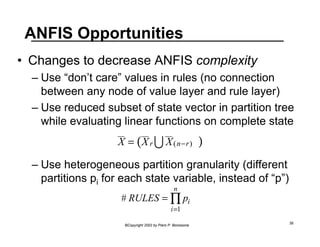
• Changes to decrease ANFIS complexity 
– Use “don’t care” values in rules (no connection 
between any node of value layer and rule layer) 
– Use reduced subset of state vector in partition tree 
while evaluating linear functions on complete state 
– Use heterogeneous partition granularity (different 
partitions pi for each state variable, instead of “p”) 
nΠ 
# RULES = pi 
i=1 
©Copyright 2002 by Piero P. Bonissone 38 
  X 
= (XrU X(n−r) )
ANFIS Opportunities (cont.) 
• Changes to extend ANFIS applicability 
– Use other cost function (rather than SSE) to 
represent the user’s utility values of the error 
(error asymmetry, saturation effects of 
outliers,etc.) 
– Use other type of aggregation function (rather than 
convex sum) to better handle slopes of different 
signs. 
©Copyright 2002 by Piero P. Bonissone 39
ANFIS Applications at GE 
• Margoil Oil Thickness Estimator 
• Voltage Instability Predictor (Smart Relay) 
• Collateral Evaluation for Mortgage Approval 
• Prediction of Time-to-Break for Paper Web 
©Copyright 2002 by Piero P. Bonissone 40
ANFIS References 
• “ANFIS: Adaptive-Network-Based Fuzzy Inference System”, 
J.S.R. Jang, IEEE Trans. Systems, Man, Cybernetics, 
23(5/6):665-685, 1993. 
• “Neuro-Fuzzy Modeling and Control”, J.S.R. Jang and C.-T. 
Sun, Proceedings of the IEEE, 83(3):378-406 
• “Industrial Applications of Fuzzy Logic at General Electric”, 
Bonissone, Badami, Chiang, Khedkar, Marcelle, Schutten, 
Proceedings of the IEEE, 83(3):450-465 
• The Fuzzy Logic Toolbox for use with MATLAB, J.S.R. Jang 
and N. Gulley, Natick, MA: The MathWorks Inc., 1995 
• Machine Learning, Neural and Statistical Classification 
Michie, Spiegelhart & Taylor (Eds.), NY: Ellis Horwood 1994 
• Classification and Regression Trees, Breiman, Friedman, 
Olshen & Stone, Monterey, CA: Wadsworth and Brooks, 1985 
©Copyright 2002 by Piero P. Bonissone 41

Anfis.rpi04

  • 1.
    Adaptive Neural Fuzzy Inference Systems (ANFIS): Analysis and Applications ©Copyright 2002 by Piero P. Bonissone 1
  • 2.
    ©Copyright 2002 byPiero P. Bonissone 2 Outline • Objective • Fuzzy Control – Background, Technology & Typology • ANFIS: – as a Type III Fuzzy Control – as a fuzzification of CART – Characteristics – Pros and Cons – Opportunities – Applications – References
  • 3.
    ANFIS Objective •To integrate the best features of Fuzzy Systems and Neural Networks: – From FS: Representation of prior knowledge into a set of constraints (network topology) to reduce the optimization search space – From NN: Adaptation of backpropagation to structured network to automate FC parametric tuning • ANFIS application to synthesize: – controllers (automated FC tuning) – models (to explain past data and predict future behavior) ©Copyright 2002 by Piero P. Bonissone 3
  • 4.
    FC Technology &Typology • Fuzzy Control – A high level representation language with local semantics and an interpreter/compiler to synthesize non-linear (control) surfaces – A Universal Functional Approximator • FC Types – Type I: RHS is a monotonic function – Type II: RHS is a fuzzy set – Type III: RHS is a (linear) function of state ©Copyright 2002 by Piero P. Bonissone 4
  • 5.
    FC Technology (Background) • Fuzzy KB representation – Scaling factors, Termsets, Rules • Rule inference (generalized modus ponens) • Development & Deployment – Interpreters, Tuners, Compilers, Run-time – Synthesis of control surface • FC Types I, II, III ©Copyright 2002 by Piero P. Bonissone 5
  • 6.
    FC of TypeII, III, and ANFIS • Type II Fuzzy Control must be tuned manually • Type III Fuzzy Control (Takagi-Sugeno type) have an automatic Right Hand Side (RHS) tuning • ANFIS will provide both: – RHS tuning, by implementing the TSK controller as a network – and LHS tuning, by using back-propagation ©Copyright 2002 by Piero P. Bonissone 6
  • 7.
    Inputs IF-part Rules+ Norm THEN-part Output N ©Copyright 2002 by Piero P. Bonissone 7 x1 x2 Input 1 Input 2 & & & & Σ Output ANFIS Network N N N ω1 1 ω Layers: 0 1 2 3 4 5
  • 8.
    ANFIS Neurons: Clarificationnote • Note that neurons in ANFIS have different structures: – Values [ Membership function defined by parameterized soft trapezoids (Generalized Bell Functions) ] – Rules [ Differentiable T-norm - usually product ] – Normalization [ Sum and arithmetic division ] – Functions [ Linear regressions and multiplication with , i.e., normalized weights ω, ] – Output [ Algebraic Sum ] ©Copyright 2002 by Piero P. Bonissone 8 ω
  • 9.
    ANFIS as ageneralization of CART • Classification and Regression Tree (CART) – Algorithm defined by Breiman et al in 1984 – Creates a binary decision tree to classify the data into one of 2n linear regression models to minimize the Gini index for the current node c: Gini(c) = 2 j Σ 1 − pj where: • pj is the probability of class j in node c • Gini(c) measure the amount of “impurity” (incorrect classification) in node c ©Copyright 2002 by Piero P. Bonissone 9
  • 10.
    CART Problems •Discontinuity • Lack of locality (sign of coefficients) ©Copyright 2002 by Piero P. Bonissone 10
  • 11.
    CART: Binary PartitionTree and Rule Table Representation x1 x2 y a1 ≤ a2 ≤ f1(x1,x2) a1 ≤ > a2 f2(x1,x2) a1 > a2 ≤ f3(x1,x2) a1> > a2 f4(x1,x2) a1 ≤ x1 a1 > x1 a2 ≤ x2 a2 > x2 a2 > x2 a2 ≤ x2 Partition Tree Rule Table ©Copyright 2002 by Piero P. Bonissone 11 x1 x2 x2 f1(x1,x2) f2(x1,x2) f3(x1,x2) f4 (x1,x2)
  • 12.
    Discontinuities Due toSmall Input Perturbations x1 ≤ a1 a1 > x1 x2≤ a2 a2 > x2 a2 > x2 a2 ≤ x2 Let's assume two inputs: I1=(x11,x12), and I2=(x21,x22) such that: x11 = ( a1- ε ) x21 = ( a1+ ε ) x12 = x22 < a2 Then I1 is assigned f1(x11,x12) while I2 is assigned f3(x1,x2) X1 ©Copyright 2002 by Piero P. Bonissone 12 y1= f1(x11, . ) (a1 ≤ ) μ (x1) x11 a1 x21 y3= f3(x11, . ) 1 0 X1 x1 x2 x2 f1(x1,x2) f2(x1,x2) f3 (x1,x2) f4 (x1,x2)
  • 13.
    Takagi-Sugeno (TS) Model • Combines fuzzy sets in antecedents with crisp function in output: • IF (x1 is A) AND (x2 is B) THEN y = f(x1,x2) IF X is small THEN Y1=4 IF X is medium THEN Y2=-0.5X+4 IF X is large THEN Y3=X-1 Σ = =n Y w Σ = ©Copyright 2002 by Piero P. Bonissone j 13 j n j j j w Y 1 1
  • 14.
    ANFIS Characteristics •Adaptive Neural Fuzzy Inference System (ANFIS) – Algorithm defined by J.-S. Roger Jang in 1992 – Creates a fuzzy decision tree to classify the data into one of 2n (or pn) linear regression models to minimize the sum of squared errors (SSE): j Σ SSE = ej 2 ©Copyright 2002 by Piero P. Bonissone 14 where: • ej is the error between the desired and the actual output • p is the number of fuzzy partitions of each variable • n is the number of input variables
  • 15.
    ANFIS as aType III FC • L0: State variables are nodes in ANFIS inputs layer • L1: Termsets of each state variable are nodes in ANFIS values layer, computing the membership value • L2: Each rule in FC is a node in ANFIS rules layer using soft-min or product to compute the rule matching factor ωi • L3: Each ωi is scaled into in the normalization layer i ω • L4: Each weighs the result of its linear regression fi in the function layer, generating the rule output • L5: Each rule output is added in the output layer ©Copyright 2002 by Piero P. Bonissone 15 i ω
  • 16.
    ANFIS Architecture RuleSet: IF ( x is A ) AND (x is B ) THEN = + + f p x q x r 1 1 2 1 1 1 1 1 2 1 IF ( x is A ) AND (x is B ) THEN = + + f p x q x r x2 ©Copyright 2002 by Piero P. Bonissone 16 ... 1 2 2 2 2 2 1 2 2 2 x1 x2 A1 A2 B1 B2 Π Π ω N 1 ω2 N ω1 ω2 ω1 f1 ω2 f2 Σ y x1 x1 x2 Layers: 0 1 2 3 4 5
  • 17.
    ANFIS-Visualized (Example forn =2) • Fuzzy reasoning A1 B1 where A1: Medium; A2: Small-Medium B1: Medium; B2: Small-Medium w1*y1+w2*y2 ©Copyright 2002 by Piero P. Bonissone 17 A2 B2 w1 w2 y1 = p1*x1 +q1*x2+r1 y2 = p2*x1+q2* x2 +r2 z = w1+w2 x y • ANFIS (Adaptive Neuro-Fuzzy Inference System) A1 A2 B1 B2 Π Π Σ Σ / x y w1 w2 w1*y1 w2*y2 Σwi*yi Σwi Y
  • 18.
    Layer 1: CalculateMembership Value for Premise Parameter • Output O1,i for node i=1,2 ( ) 1, 1 O x i Ai = μ • Output O1,i for node i=3,4 ( ) 1, 2 2 i Bi − = μ O x x 2 x c ©Copyright 2002 by Piero P. Bonissone 18 • where A is a linguistic label (small, large, …) ( ) b i i A a 1 1 1 1 + − μ = Node output: membership value of input
  • 19.
    Layer 1 (cont.):Effect of changing Parameters {a,b,c} (a ) Cha nging 'a ' 1 0.8 0.6 0.4 0.2 0 (b) Cha nging 'b' (c ) Cha nging 'c ' 1 0.8 0.6 0.4 0.2 0 (d) Cha nging 'a ' a nd 'b' ©Copyright 2002 by Piero P. Bonissone 19 μA (x)= 1 1+ x −ci ai 2b 1 0.8 0.6 0.4 0.2 0 -10 -5 0 5 10 -10 -5 0 5 10 1 0.8 0.6 0.4 0.2 0 -10 -5 0 5 10 -10 -5 0 5 10
  • 20.
    Layer 2: FiringStrength of Rule • Use T-norm (min, product, fuzzy AND, ...) ( ) ( ) 2, 1 2 O w x x i i Ai Bi = = μ μ (for i=1,2) Node output: firing strength of rule ©Copyright 2002 by Piero P. Bonissone 20
  • 21.
    Layer 3: NormalizeFiring Strength • Ratio of ith rule’s firing strength vs. all rules’ firing strength O w w i i i w w (for i=1,2) ©Copyright 2002 by Piero P. Bonissone 21 3 1 2 , = = + Node output: Normalized firing strengths
  • 22.
    Layer 4: ConsequentParameters • Takagi-Sugeno type output ( )i i i i i i i O = w f = w p x + q x + r 4, 1 2 • Consequent parameters {pi, qi, ri} Node output: Evaluation of Right Hand Side Polynomials ©Copyright 2002 by Piero P. Bonissone 22
  • 23.
    Layer 5: OverallOutput Σ Σ w f w i i 5,1= Σ = O wf i i i i i i 2 2 w + w w 1 2 f f w + w w + = + + + + + w p x q x r w p x q x r = + + + + + ©Copyright 2002 by Piero P. Bonissone 23 • Note: – Output is linear in consequent parameters p,q,r: 1 1 1 2 1 ( 1 1 1 2 1 ) 2 ( 2 1 2 2 2 ) ( w 1 x 1 ) p 1 ( w 1 x 2 ) q 1 ( w 1 ) r 1 ( w 2 x 1 ) p 2 ( w 2 x 2 ) q 2 ( w 2 )r 2 = Node output: Weighted Evaluation of RHS Polynomials
  • 24.
    Inputs IF-part Rules+ Norm THEN-part Output N ©Copyright 2002 by Piero P. Bonissone 24 x1 x2 Input 1 Input 2 & & & & Σ Output ANFIS Network N N N ω1 1 ω Layers: 0 1 2 3 4 5
  • 25.
    ANFIS Computational Complexity Layer # L-Type # Nodes # Param L0 Inputs n 0 L1 Values (p•n) 3•(p•n)=|S1| L2 Rules pn 0 L3 Normalize pn 0 L4 Lin. Funct. pn (n+1)•pn=|S2| L5 Sum 1 0 ©Copyright 2002 by Piero P. Bonissone 25
  • 26.
    ANFIS Parametric Representation • ANFIS uses two sets of parameters: S1 and S2 – S1 represents the fuzzy partitions used in the rules LHS S1= a11,b11,c11 { }, a12,b12,c12 { },..., a1p,b1p,c1p { },..., anp,bnp,cnp { { }} – S2 represents the coefficients of the linear functions in the rules RHS S2 = c10,c11,...,c1n { },..., cpn 0 ,cpn1,...,cpnn { { }} ©Copyright 2002 by Piero P. Bonissone 26
  • 27.
    ANFIS Learning Algorithms • ANFIS uses a two-pass learning cycle ©Copyright 2002 by Piero P. Bonissone 27 – Forward pass: • S1 is fixed and S2 is computed using a Least Squared Error (LSE) algorithm (Off-line Learning) – Backward pass: • S2 is fixed and S1 is computed using a gradient descent algorithm (usually Back-propagation)
  • 28.
    Structure ID &Parameter ID Hybrid training method Forward stroke Backward stroke B2 ©Copyright 2002 by Piero P. Bonissone 28 A1 A2 B1 B2 Σ Σ / x1 nonlinear parameters w1 w4 w1*y1 w4*y4 Σwi*yi Σwi Y Π Π Π Π linear parameters fixed least-squares steepest descent fixed MF param. (nonlinear) Coef. param. (linear) • Input space partitioning A1 B1 A2 B2 x1 x1 x2 A1 A2 B1 x2 x2
  • 29.
    ANFIS Least Squares(LSE) Batch Algorithm • LSE used in Forward Stroke: S = {S1US2}, and{S1IS2 = ∅} Output = F(I ,S),where I is the input vector H(Output ) = H o F(I , S ),where H o F is linear in S2 ©Copyright 2002 by Piero P. Bonissone 29 – Parameter Set: – For given values of S1, using K training data, we can transform the above equation into B=AX, where X contains the elements of S2 – This is solved by: (ATA)-1AT B=X* where (ATA)-1AT is the pseudo-inverse of A (if ATA is nonsingular) – The LSE minimizes the error ||AX-B||2 by approximating X with X*
  • 30.
    ANFIS LSE BatchAlgorithm (cont.) • Rather than solving directly (ATA)-1AT B=X* , we resolve it iteratively (from numerical methods): T Si T Sia(i+1) T − a(i+1)        ©Copyright 2002 by Piero P. Bonissone 30 Si+1 = Si − Sia(i+1)a(i+1) 1 + a(i+1) , Xi+1 = Xi + S(i+1)a(i+1)(b(i+1) T Xi )    for i = 0,1,...,K −1 X0 = 0, S0 = γ I , (where γ is a large number ) a i T = ith line of matrix A bi T = ith element of vector B X* = Xk where:
  • 31.
    ANFIS Back-propagation •Error measure Ek (for the kth (1≤k≤K) entry of the training data) ( ) E k = Σ= d i − x ( )2 , N L 1 L i i N(L) = number nodes in layer L i component of output vector d desired KΣ vector output of component i i • Overall error measure E: E = E k k = 1 ©Copyright 2002 by Piero P. Bonissone 31 where : th , th x actual L i = =
  • 32.
    ANFIS Back-propagation (cont.) • For each parameter αi the update formula is: E i α η ∂ Δ = − i + ∂α is the learning rate η κ ∂   is the step size is the ordered derivative ©Copyright 2002 by Piero P. Bonissone 32 where : i 2 i i E E κ ∂ ∂α ∂α + Σ     =
  • 33.
    ANFIS Pros andCons • ANFIS is one of the best tradeoff between neural and fuzzy systems, providing: – smoothness, due to the FC interpolation – adaptability, due to the NN Backpropagation • ANFIS however has strong computational complexity restrictions ©Copyright 2002 by Piero P. Bonissone 33
  • 34.
    ANFIS Pros CharacteristicsAdvantages ++ ©Copyright 2002 by Piero P. Bonissone 34 Translates prior knowledge into network topology & initial fuzzy partitions Network's first three layers not fully connected (inputs-values-rules) Induced partial-order is usually preserved Uses data to determine rules RHS (TSK model) Network implementation of Takagi-Sugeno-Kang FLC Smaller fan-out for Backprop Faster convergency than typical feedforward NN Smaller size training set Model compactness (smaller # rules than using labels) +++ +
  • 35.
    Characteristics Disadvantages -- ©Copyright 2002 by Piero P. Bonissone 35 Translates prior knowledge into network topology & initial fuzzy partitions ANFIS Cons Sensitivity to initial number of partitions " P" Uses data to determine rules RHS (TSK model) Partial loss of rule "locality" Surface oscillations around points (caused by high partition number) Coefficient signs not always consistent with underlying monotonic relations Sensitivity to number of input variables " n" Spatial exponential complexity: # Rules = P^n - - -
  • 36.
    Characteristics Advantages +++ ©Copyright 2002 by Piero P. Bonissone 36 Uses LMS algorithm to compute polynomials coefficients Uses Backprop to tune fuzzy partitions Uses fuzzy partitions to discount outlier effects Automatic FLC parametric tuning Error pressure to modify only "values" layer Smoothness guaranteed by interpolation ANFIS Pros (cont.) Uses FLC inference mechanism to interpolate among rules ++
  • 37.
    ANFIS Cons (cont.) Characteristics Disadvantages ©Copyright 2002 by Piero P. Bonissone 37 Uses LMS algorithm to compute polynomials coefficients Uses Backprop to tune fuzzy partitions Batch process disregards previous state (or IC) Uses FLC inference mechanism to interpolate among rules Not possible to represent known monotonic relations Error gradient calculation requires derivability of fuzzy partitions and T-norms used by FLC Uses convex sum: Σ λi f i (X)/ Σ λ i Cannot use trapezoids nor "Min" "Awkward" interpolation between slopes of different sign Based on quadratic error cost function Symmetric error treatment & great outliers influence - - - - -
  • 38.
    ANFIS Opportunities •Changes to decrease ANFIS complexity – Use “don’t care” values in rules (no connection between any node of value layer and rule layer) – Use reduced subset of state vector in partition tree while evaluating linear functions on complete state – Use heterogeneous partition granularity (different partitions pi for each state variable, instead of “p”) nΠ # RULES = pi i=1 ©Copyright 2002 by Piero P. Bonissone 38 X = (XrU X(n−r) )
  • 39.
    ANFIS Opportunities (cont.) • Changes to extend ANFIS applicability – Use other cost function (rather than SSE) to represent the user’s utility values of the error (error asymmetry, saturation effects of outliers,etc.) – Use other type of aggregation function (rather than convex sum) to better handle slopes of different signs. ©Copyright 2002 by Piero P. Bonissone 39
  • 40.
    ANFIS Applications atGE • Margoil Oil Thickness Estimator • Voltage Instability Predictor (Smart Relay) • Collateral Evaluation for Mortgage Approval • Prediction of Time-to-Break for Paper Web ©Copyright 2002 by Piero P. Bonissone 40
  • 41.
    ANFIS References •“ANFIS: Adaptive-Network-Based Fuzzy Inference System”, J.S.R. Jang, IEEE Trans. Systems, Man, Cybernetics, 23(5/6):665-685, 1993. • “Neuro-Fuzzy Modeling and Control”, J.S.R. Jang and C.-T. Sun, Proceedings of the IEEE, 83(3):378-406 • “Industrial Applications of Fuzzy Logic at General Electric”, Bonissone, Badami, Chiang, Khedkar, Marcelle, Schutten, Proceedings of the IEEE, 83(3):450-465 • The Fuzzy Logic Toolbox for use with MATLAB, J.S.R. Jang and N. Gulley, Natick, MA: The MathWorks Inc., 1995 • Machine Learning, Neural and Statistical Classification Michie, Spiegelhart & Taylor (Eds.), NY: Ellis Horwood 1994 • Classification and Regression Trees, Breiman, Friedman, Olshen & Stone, Monterey, CA: Wadsworth and Brooks, 1985 ©Copyright 2002 by Piero P. Bonissone 41