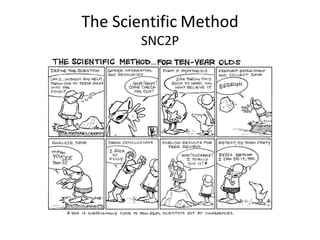
The Scientific Method
SNC2P
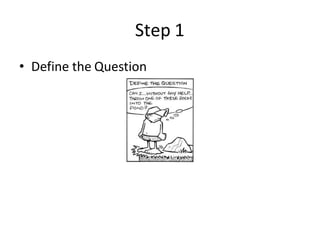
Step 1
• Define the Question
Scientific Questions
A scientific question is any question that can
be answered using the scientific method (by
experiment or observation).
Scientific Questions
A scientific question is any question that can
be answered using the scientific method (by
experiment or observation).
“What is the meaning of life” is not a scientific
question.
Scientific Questions
A scientific question is any question that can
be answered using the scientific method (by
experiment or observation).
“Is there life on Mars?” is a scientific
question. It can be answered by
experiment or observation.
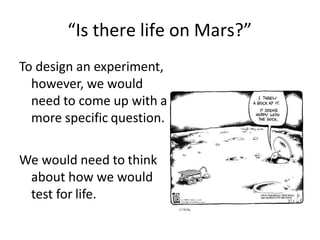
“Is there life on Mars?”
To design an experiment,
however, we would
need to come up with a
more specific question.
We would need to think
about how we would
test for life.
“Is there methane on Mars?”
For example, methane is an unstable gas that is
produced by biological processes. Significant
levels of methane in the Martian atmosphere
would be evidence that there may be life.
Step 2
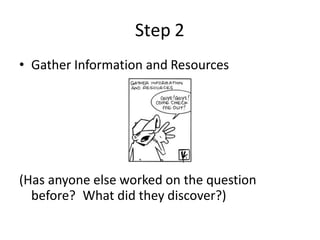
• Gather Information and Resources
(Has anyone else worked on the question
before? What did they discover?)
Step 3
• Form a Hypothesis
A hypothesis is a prediction.
Step 3
A hypothesis is not just a
guess.
It is based on the
information gathered.
Step 4
• Perform Experiment and Collect Data
Variables
A variable is anything in an experiment that may
be changed.
Variables
Most experiments change only two:
• the manipulated variable
(also called the independent variable)
is the variable changed by the experimenter.
Variables
Most experiments change only two:
• the responding variable
(also called the dependent variable)
is the variable measured by the experimenter.
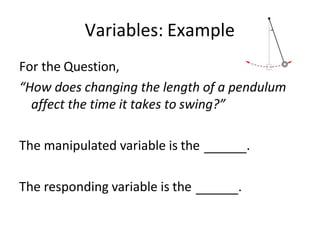
Variables: Example
For the Question,
“How does changing the length of a pendulum
affect the time it takes to swing?”
The manipulated variable is the .
The responding variable is the .
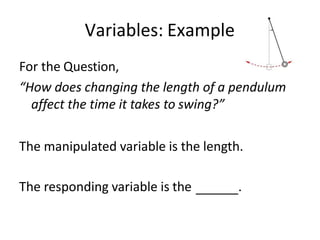
Variables: Example
For the Question,
“How does changing the length of a pendulum
affect the time it takes to swing?”
The manipulated variable is the length.
The responding variable is the .
Variables: Example
For the Question,
“How does changing the length of a pendulum
affect the time it takes to swing?”
The manipulated variable is the length.
The responding variable is the time.
Variables
All other variables that are kept the same are
called controlled variables.
Variables
All other variables that are kept the same are
called controlled variables.
In the pendulum experiment, what would you
have to control?
Variables
All other variables that are kept the same are
called controlled variables.
In the pendulum experiment, what would you
have to control?
the angle from which the pendulum is
dropped, the mass of the pendulum, etc.
Experimental Error
Because you can never control everything
completely (what if there’s a wobble in the
pendulum?), you should perform multiple
trials and average the results.
This reduces the effect of experimental error
(error beyond the experimenter’s control).
Paper Helicopters
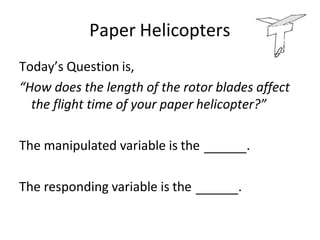
Today’s Question is,
“How does the length of the rotor blades affect
the flight time of your paper helicopter?”
The manipulated variable is the .
The responding variable is the .
Paper Helicopters
Today’s Question is,
“How does the length of the rotor blades affect
the flight time of your paper helicopter?”
The manipulated variable is the blade length.
The responding variable is the .
Paper Helicopters
Today’s Question is,
“How does the length of the rotor blades affect
the flight time of your paper helicopter?”
The manipulated variable is the blade length.
The responding variable is the flight time.
Paper Helicopters
Today’s Question is,
“How does the length of the rotor blades affect
the flight time of your paper helicopter?”
What variables would you have to control?
Paper Helicopters
Today’s Question is,
“How does the length of the rotor blades affect
the flight time of your paper helicopter?”
What variables would you have to control?
design, drop height, etc.
Step 5
• Analyze Data
(often using graphs)
Step 6
• Draw Conclusions
(Your conclusion should answer the Question.)

scientific method

  • 1.
  • 2.
    Step 1 • Definethe Question
  • 3.
    Scientific Questions A scientificquestion is any question that can be answered using the scientific method (by experiment or observation).
  • 4.
    Scientific Questions A scientificquestion is any question that can be answered using the scientific method (by experiment or observation). “What is the meaning of life” is not a scientific question.
  • 5.
    Scientific Questions A scientificquestion is any question that can be answered using the scientific method (by experiment or observation). “Is there life on Mars?” is a scientific question. It can be answered by experiment or observation.
  • 6.
    “Is there lifeon Mars?” To design an experiment, however, we would need to come up with a more specific question. We would need to think about how we would test for life.
  • 7.
    “Is there methaneon Mars?” For example, methane is an unstable gas that is produced by biological processes. Significant levels of methane in the Martian atmosphere would be evidence that there may be life.
  • 8.
    Step 2 • GatherInformation and Resources (Has anyone else worked on the question before? What did they discover?)
  • 9.
    Step 3 • Forma Hypothesis A hypothesis is a prediction.
  • 10.
    Step 3 A hypothesisis not just a guess. It is based on the information gathered.
  • 11.
    Step 4 • PerformExperiment and Collect Data
  • 12.
    Variables A variable isanything in an experiment that may be changed.
  • 13.
    Variables Most experiments changeonly two: • the manipulated variable (also called the independent variable) is the variable changed by the experimenter.
  • 14.
    Variables Most experiments changeonly two: • the responding variable (also called the dependent variable) is the variable measured by the experimenter.
  • 15.
    Variables: Example For theQuestion, “How does changing the length of a pendulum affect the time it takes to swing?” The manipulated variable is the . The responding variable is the .
  • 16.
    Variables: Example For theQuestion, “How does changing the length of a pendulum affect the time it takes to swing?” The manipulated variable is the length. The responding variable is the .
  • 17.
    Variables: Example For theQuestion, “How does changing the length of a pendulum affect the time it takes to swing?” The manipulated variable is the length. The responding variable is the time.
  • 18.
    Variables All other variablesthat are kept the same are called controlled variables.
  • 19.
    Variables All other variablesthat are kept the same are called controlled variables. In the pendulum experiment, what would you have to control?
  • 20.
    Variables All other variablesthat are kept the same are called controlled variables. In the pendulum experiment, what would you have to control? the angle from which the pendulum is dropped, the mass of the pendulum, etc.
  • 21.
    Experimental Error Because youcan never control everything completely (what if there’s a wobble in the pendulum?), you should perform multiple trials and average the results. This reduces the effect of experimental error (error beyond the experimenter’s control).
  • 22.
    Paper Helicopters Today’s Questionis, “How does the length of the rotor blades affect the flight time of your paper helicopter?” The manipulated variable is the . The responding variable is the .
  • 23.
    Paper Helicopters Today’s Questionis, “How does the length of the rotor blades affect the flight time of your paper helicopter?” The manipulated variable is the blade length. The responding variable is the .
  • 24.
    Paper Helicopters Today’s Questionis, “How does the length of the rotor blades affect the flight time of your paper helicopter?” The manipulated variable is the blade length. The responding variable is the flight time.
  • 25.
    Paper Helicopters Today’s Questionis, “How does the length of the rotor blades affect the flight time of your paper helicopter?” What variables would you have to control?
  • 26.
    Paper Helicopters Today’s Questionis, “How does the length of the rotor blades affect the flight time of your paper helicopter?” What variables would you have to control? design, drop height, etc.
  • 27.
    Step 5 • AnalyzeData (often using graphs)
  • 28.
    Step 6 • DrawConclusions (Your conclusion should answer the Question.)