ADVANCE RESEARCH METHODOLOGY

 The word hypothesis is derived form the Greek
words“hypotithenai” means to put under or
suppose Plural is Hypothesis
 A researcher calls these assumptions, assertions, or
statements they become the basis of an inquiry.
 In most cases, the hypothesis will be based upon
either previous studies or the researcher’s own or
someone else’s observations
Defining the word

 A tentative statement about something, the validity of
which is usually unknown (Black, James A & Dean J
Champion, Method and Issues in Social Research, New
York: John Wiley & Sons, Inc, 1976
 Hypothesis is proposition that is stated in a testable form
and that predicts a particular relationship between two or
more variable (Baily, Kenneth D, Methods of Social
Research, 3rd edition, New York: The Free Press, 1978)
 A hypothesis is written in such a way that it can be
proven or disproven by valid and reliable data (Grinnell,
Richard, Jr. Social Work Research and Evaluation, 3rd
edition, Itasca, Illinois, F.E. Peacock Publishers, 988)
Definition of Hypothesis

A problem is formulated in the form of a
question;
A hypothesis is a suggested solution to a
problem.
A problem (question) cannot be directly tested,
whereas a hypothesis can be tested and verified.
The Difference between
Hypothesis & Problem

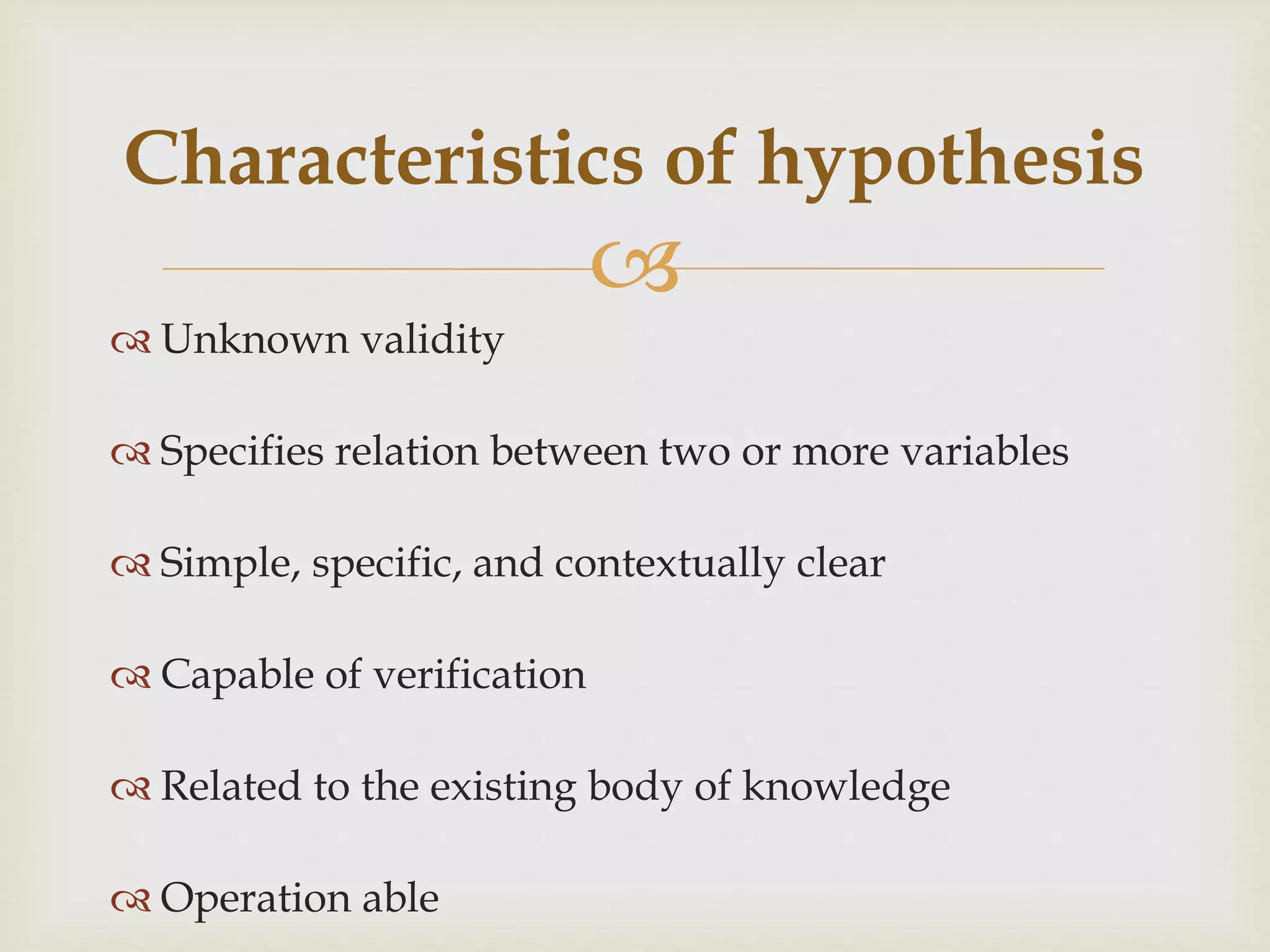
 Unknown validity
 Specifies relation between two or more variables
 Simple, specific, and contextually clear
 Capable of verification
 Related to the existing body of knowledge
 Operation able
Characteristics of hypothesis

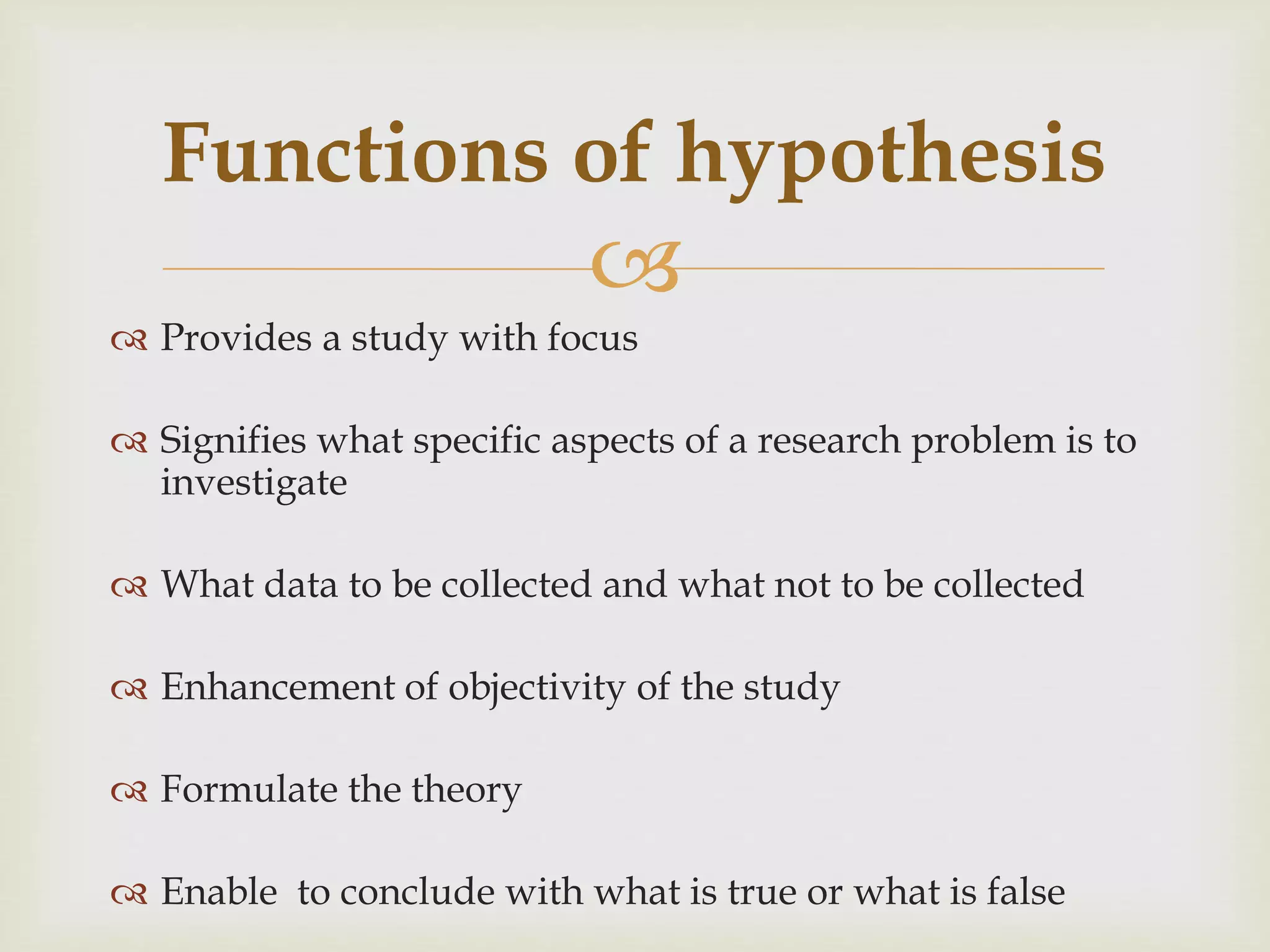
 Provides a study with focus
 Signifies what specific aspects of a research problem is to
investigate
 What data to be collected and what not to be collected
 Enhancement of objectivity of the study
 Formulate the theory
 Enable to conclude with what is true or what is false
Functions of hypothesis

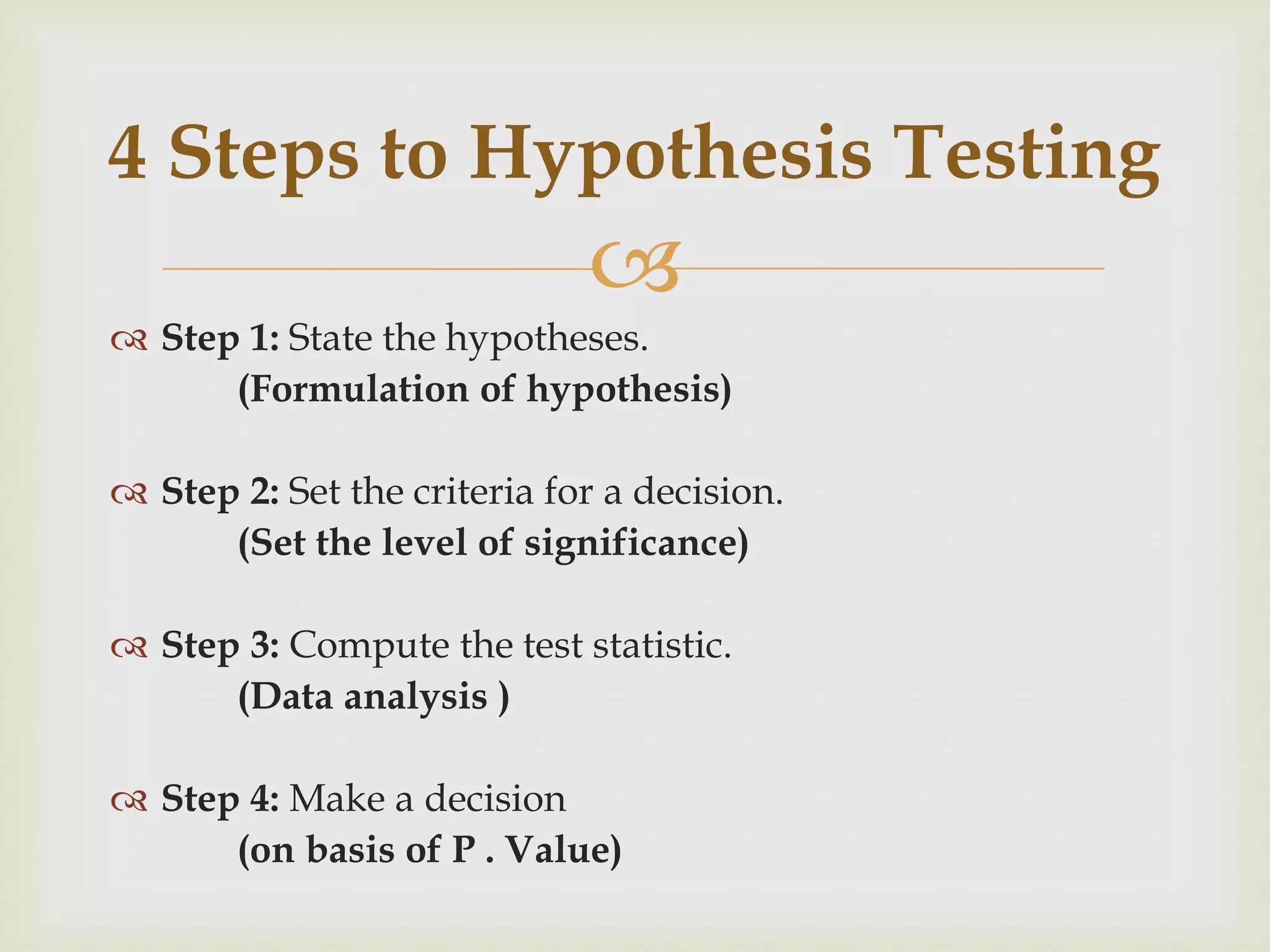
 Step 1: State the hypotheses.
(Formulation of hypothesis)
 Step 2: Set the criteria for a decision.
(Set the level of significance)
 Step 3: Compute the test statistic.
(Data analysis )
 Step 4: Make a decision
(on basis of P . Value)
4 Steps to Hypothesis Testing

 Working hypothesis
Null hypothesis
 Research hypothesis
Type of hypothesis

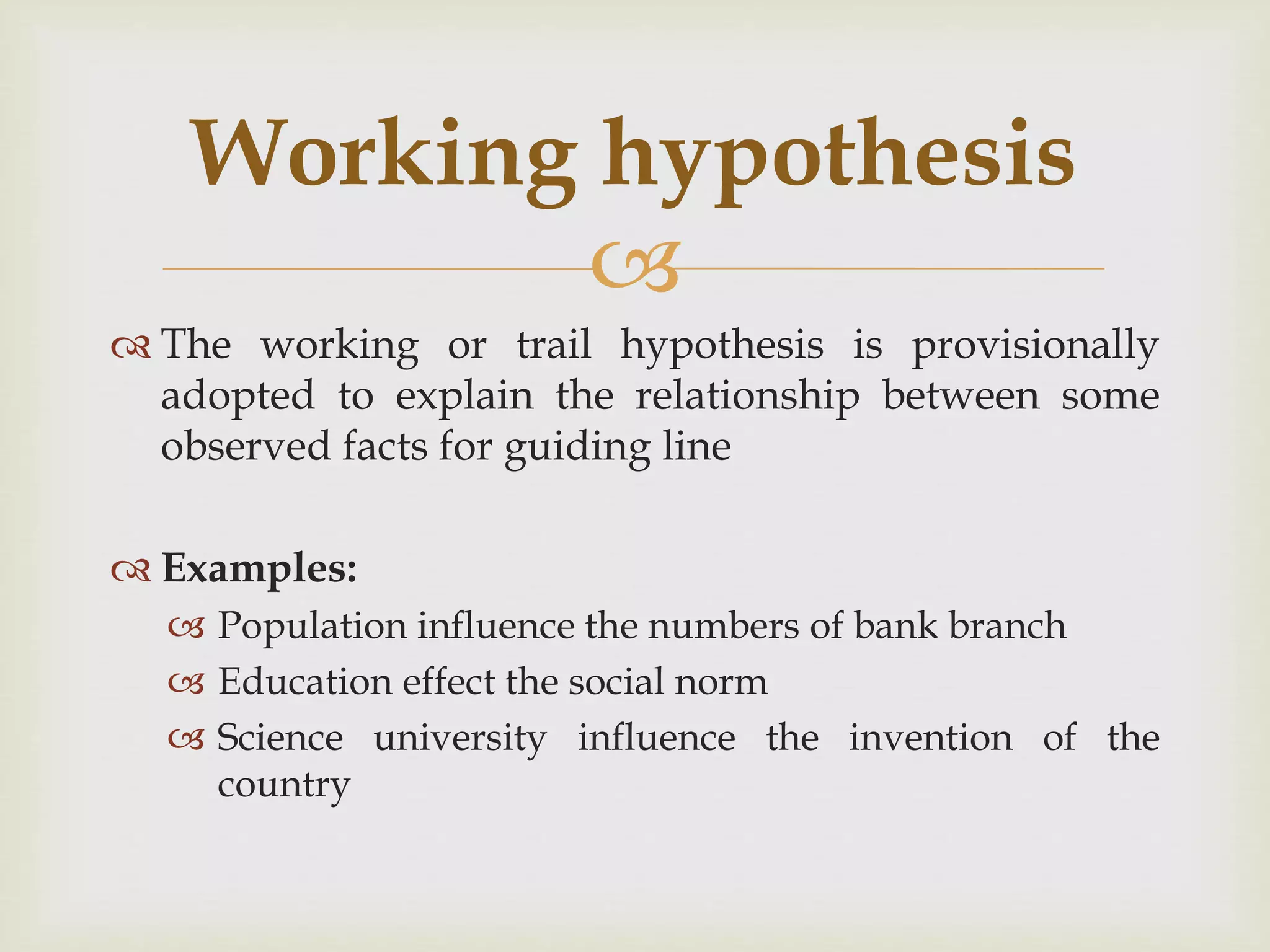
 The working or trail hypothesis is provisionally
adopted to explain the relationship between some
observed facts for guiding line
 Examples:
 Population influence the numbers of bank branch
 Education effect the social norm
 Science university influence the invention of the
country
Working hypothesis

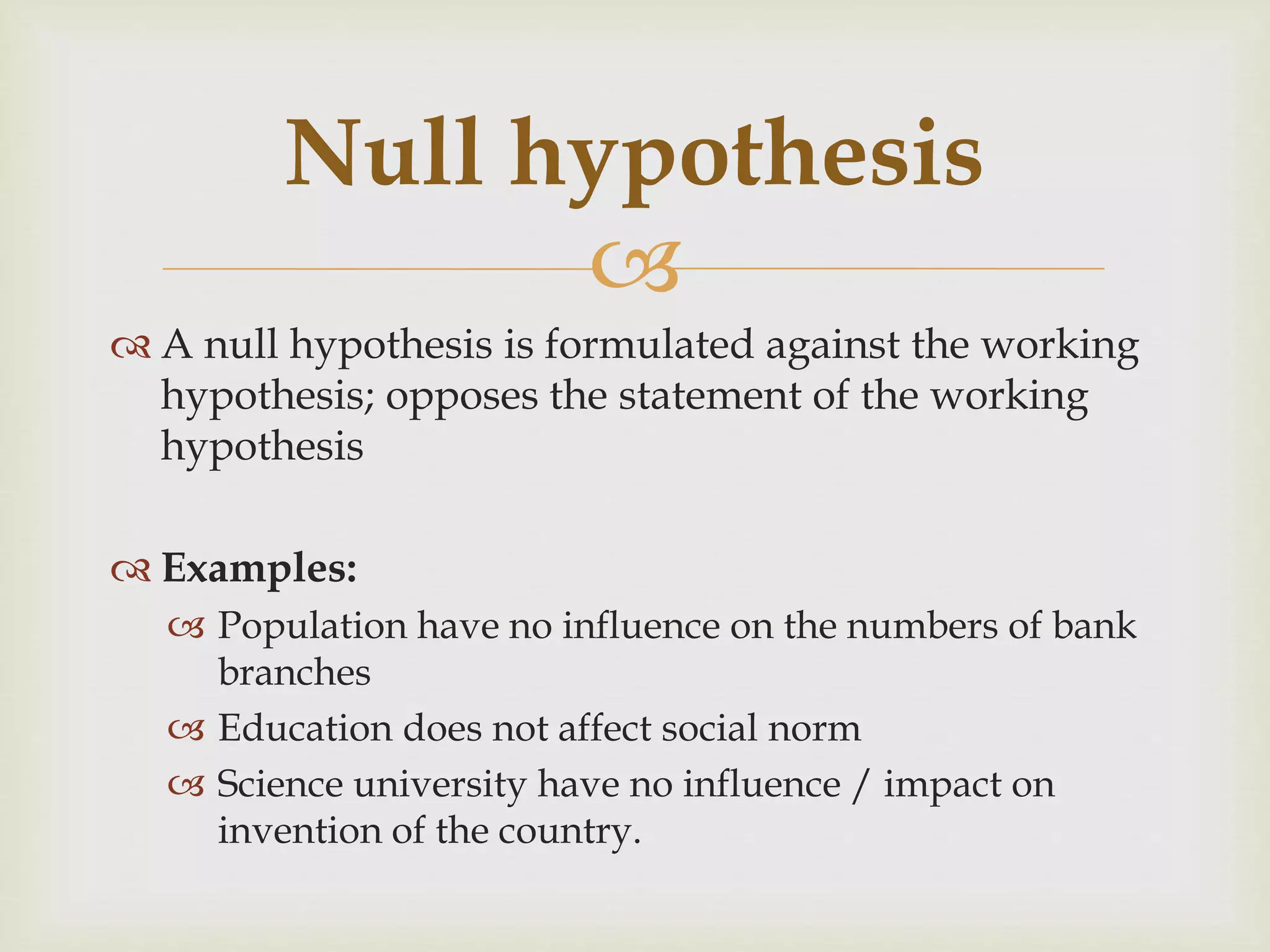
 A null hypothesis is formulated against the working
hypothesis; opposes the statement of the working
hypothesis
 Examples:
 Population have no influence on the numbers of bank
branches
 Education does not affect social norm
 Science university have no influence / impact on
invention of the country.
Null hypothesis

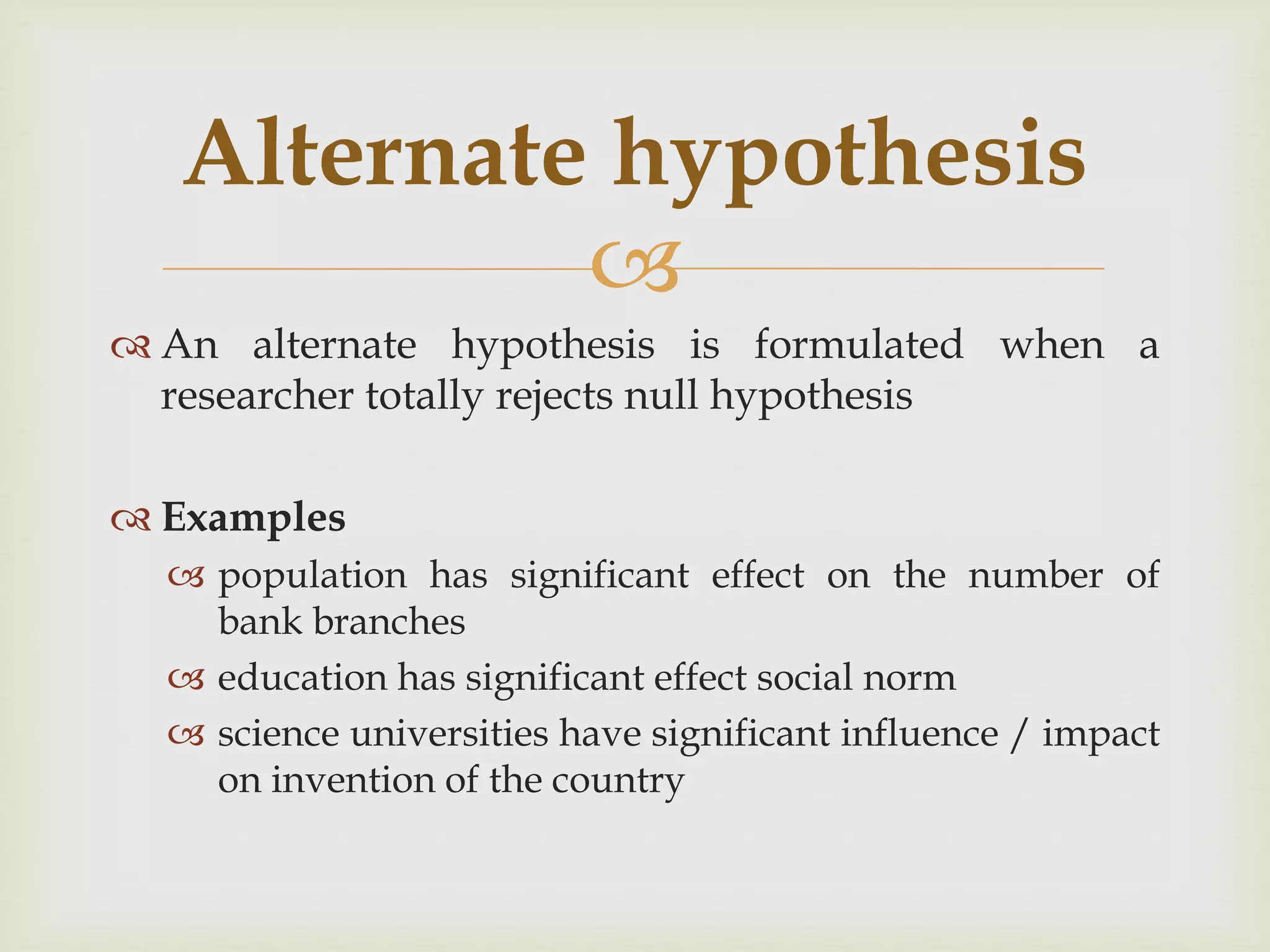
 An alternate hypothesis is formulated when a
researcher totally rejects null hypothesis
 Examples
 population has significant effect on the number of
bank branches
 education has significant effect social norm
 science universities have significant influence / impact
on invention of the country
Alternate hypothesis

 Interval estimation
 t-state
chi-square
Hypothesis Testing
Types of Tests

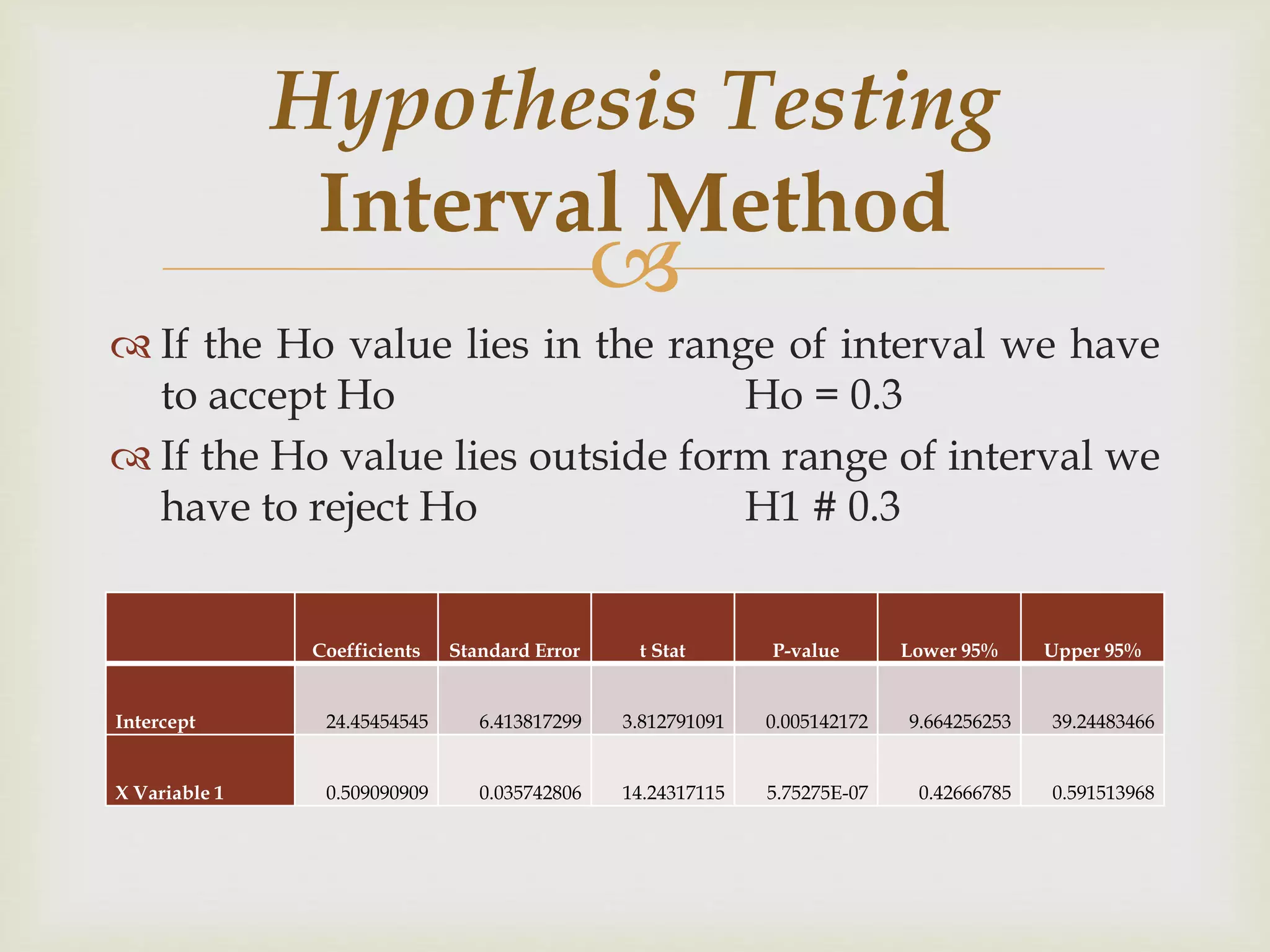
 If the Ho value lies in the range of interval we have
to accept Ho Ho = 0.3
 If the Ho value lies outside form range of interval we
have to reject Ho H1 # 0.3
Hypothesis Testing
Interval Method
Coefficients Standard Error t Stat P-value Lower 95% Upper 95%
Intercept 24.45454545 6.413817299 3.812791091 0.005142172 9.664256253 39.24483466
X Variable 1 0.509090909 0.035742806 14.24317115 5.75275E-07 0.42666785 0.591513968

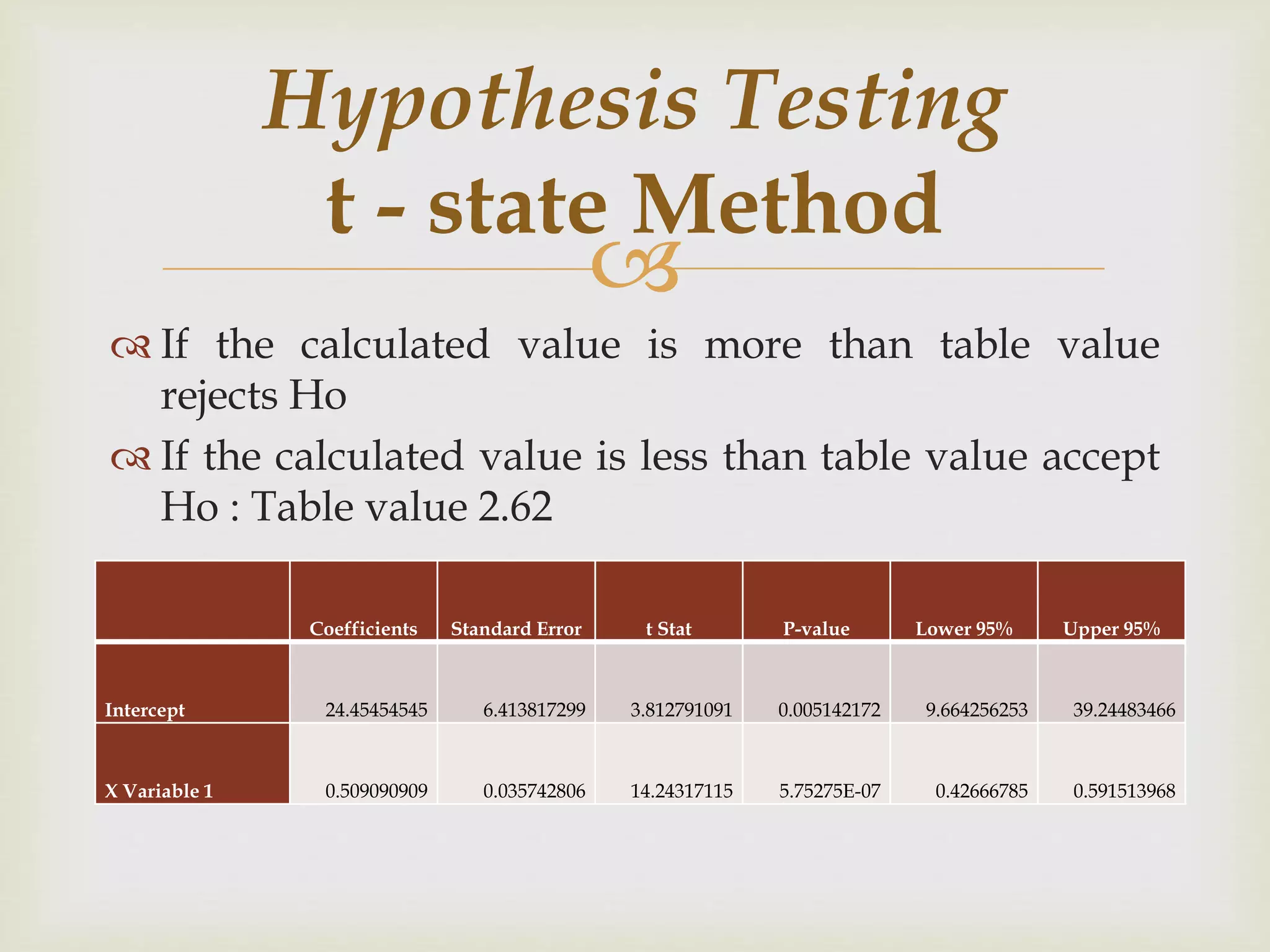
 If the calculated value is more than table value
rejects Ho
 If the calculated value is less than table value accept
Ho : Table value 2.62
Hypothesis Testing
t - state Method
Coefficients Standard Error t Stat P-value Lower 95% Upper 95%
Intercept 24.45454545 6.413817299 3.812791091 0.005142172 9.664256253 39.24483466
X Variable 1 0.509090909 0.035742806 14.24317115 5.75275E-07 0.42666785 0.591513968

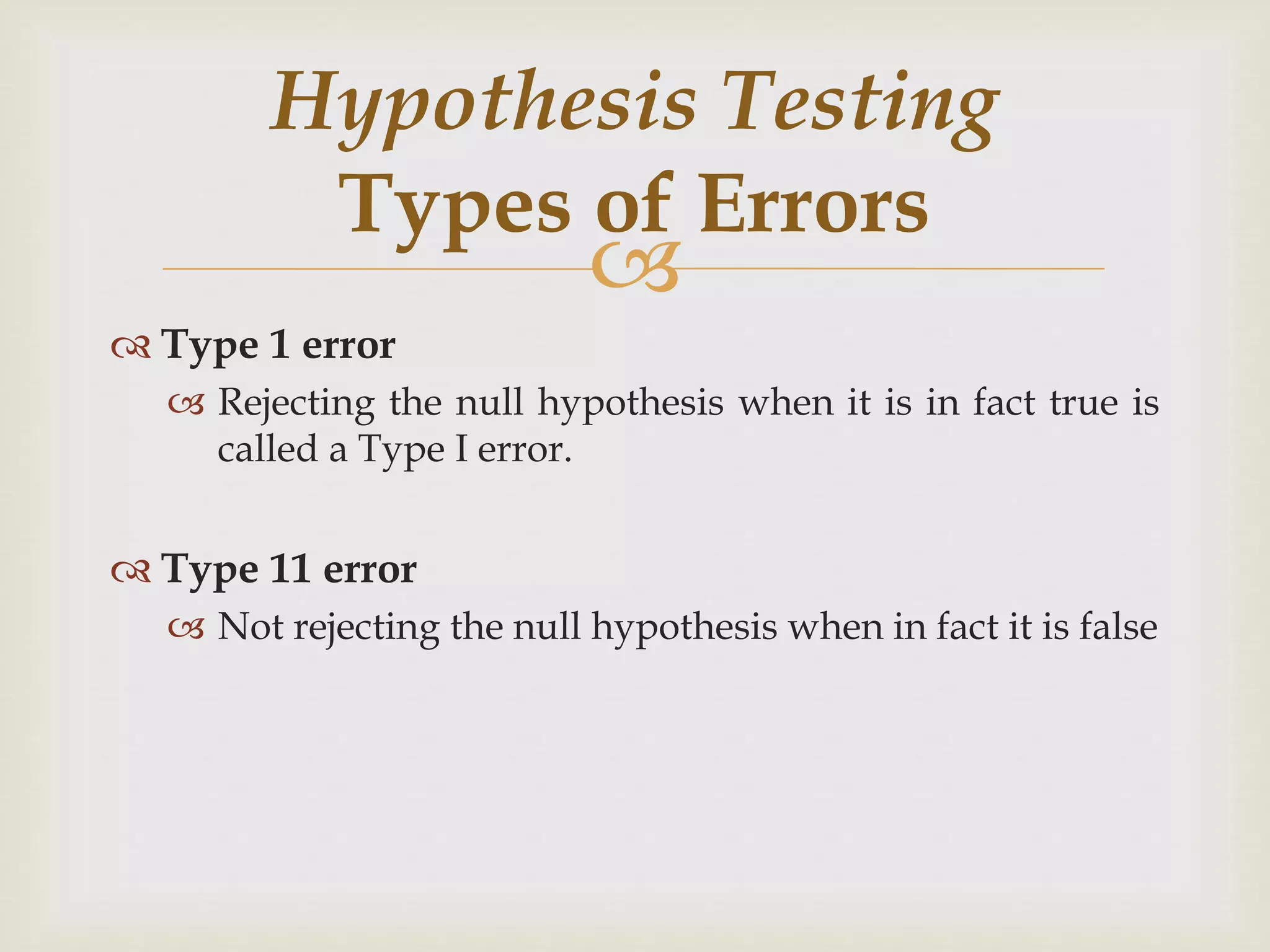
 Type 1 error
 Rejecting the null hypothesis when it is in fact true is
called a Type I error.
 Type 11 error
 Not rejecting the null hypothesis when in fact it is false
Hypothesis Testing
Types of Errors

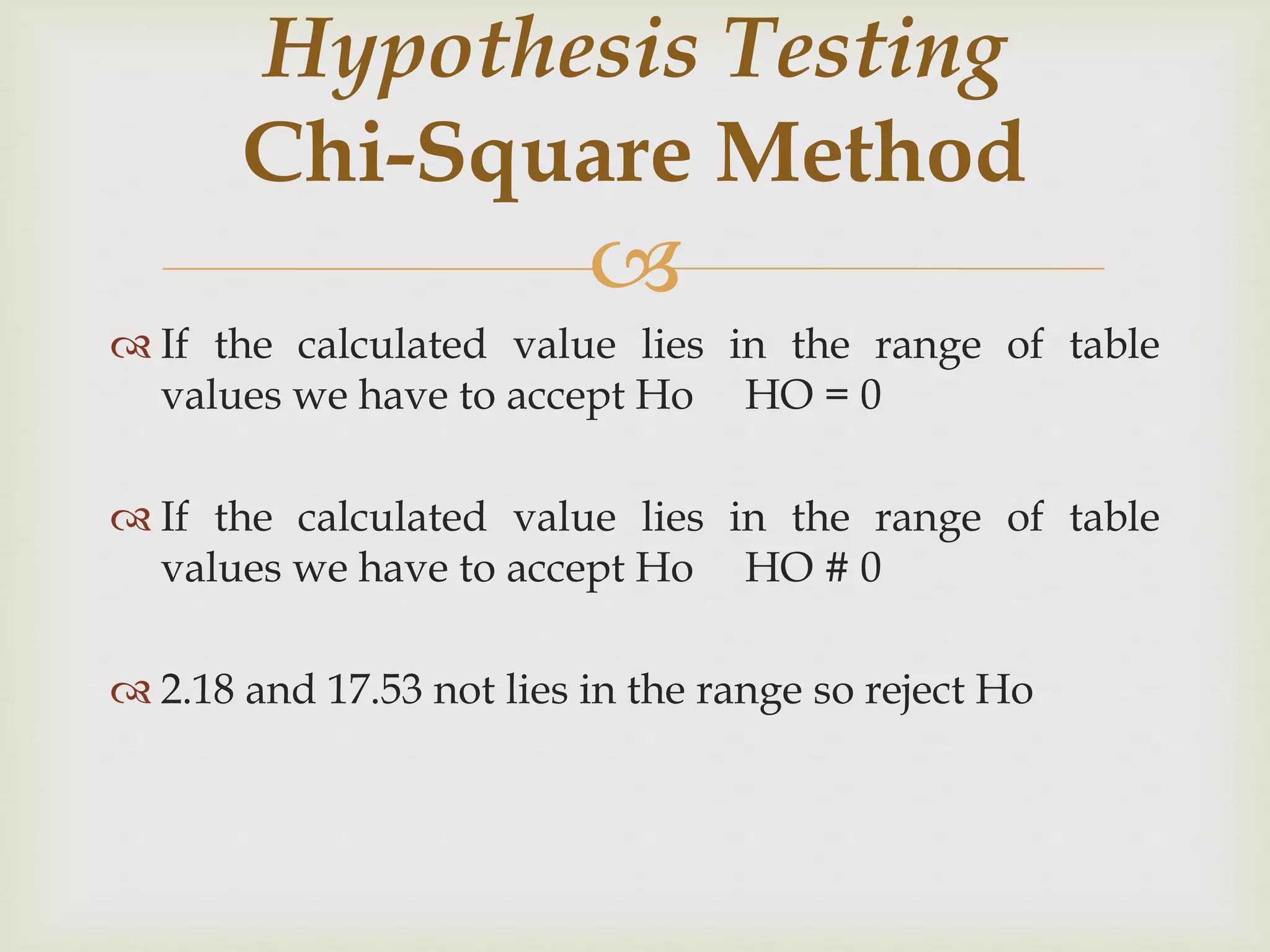
 If the calculated value lies in the range of table
values we have to accept Ho HO = 0
 If the calculated value lies in the range of table
values we have to accept Ho HO # 0
 2.18 and 17.53 not lies in the range so reject Ho
Hypothesis Testing
Chi-Square Method

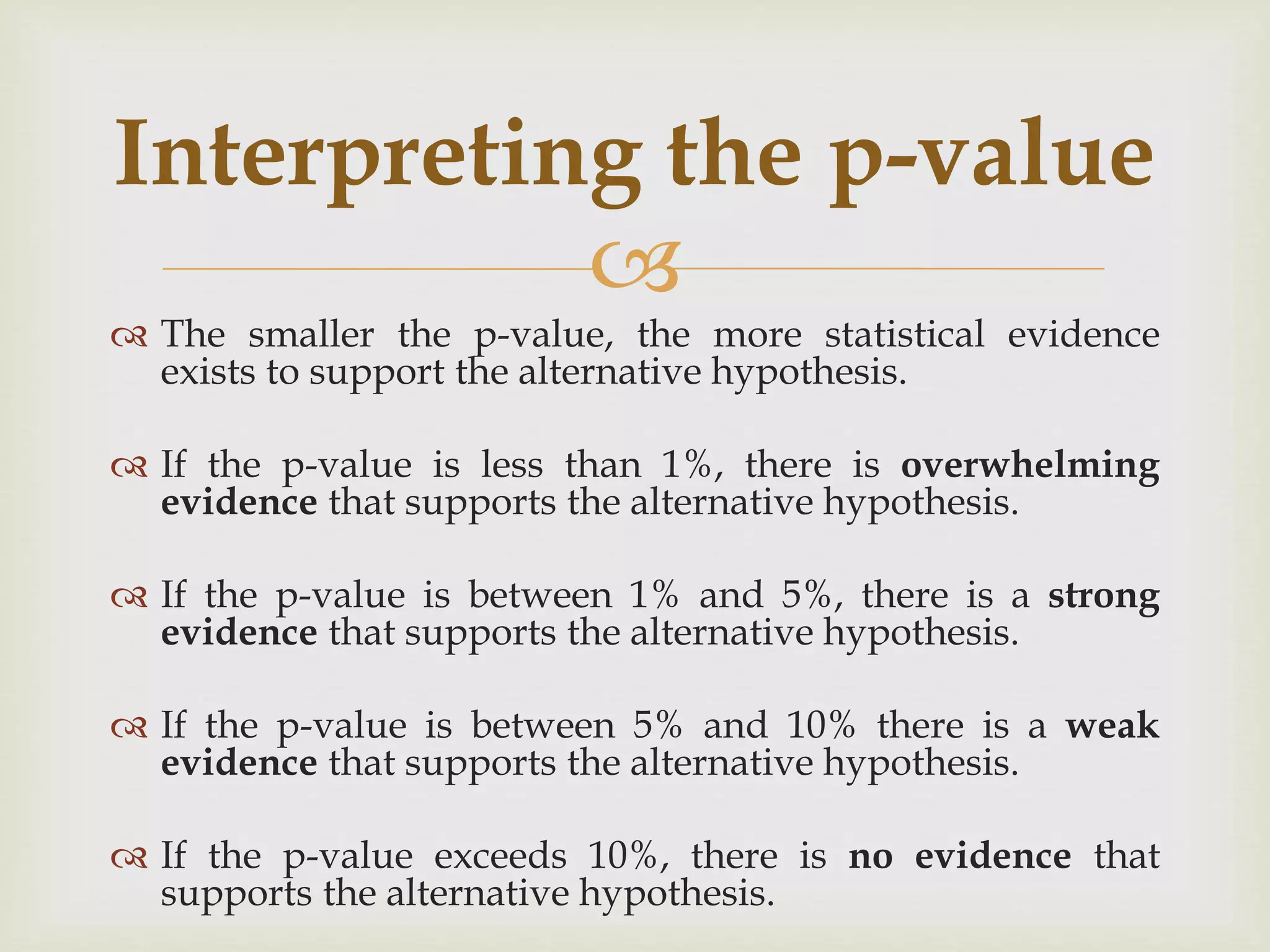
 The smaller the p-value, the more statistical evidence
exists to support the alternative hypothesis.
 If the p-value is less than 1%, there is overwhelming
evidence that supports the alternative hypothesis.
 If the p-value is between 1% and 5%, there is a strong
evidence that supports the alternative hypothesis.
 If the p-value is between 5% and 10% there is a weak
evidence that supports the alternative hypothesis.
 If the p-value exceeds 10%, there is no evidence that
supports the alternative hypothesis.
Interpreting the p-value

Types of Hypothesis-Advance Research Methodology

  • 1.
  • 2.
      The wordhypothesis is derived form the Greek words“hypotithenai” means to put under or suppose Plural is Hypothesis  A researcher calls these assumptions, assertions, or statements they become the basis of an inquiry.  In most cases, the hypothesis will be based upon either previous studies or the researcher’s own or someone else’s observations Defining the word
  • 3.
      A tentativestatement about something, the validity of which is usually unknown (Black, James A & Dean J Champion, Method and Issues in Social Research, New York: John Wiley & Sons, Inc, 1976  Hypothesis is proposition that is stated in a testable form and that predicts a particular relationship between two or more variable (Baily, Kenneth D, Methods of Social Research, 3rd edition, New York: The Free Press, 1978)  A hypothesis is written in such a way that it can be proven or disproven by valid and reliable data (Grinnell, Richard, Jr. Social Work Research and Evaluation, 3rd edition, Itasca, Illinois, F.E. Peacock Publishers, 988) Definition of Hypothesis
  • 4.
     A problem isformulated in the form of a question; A hypothesis is a suggested solution to a problem. A problem (question) cannot be directly tested, whereas a hypothesis can be tested and verified. The Difference between Hypothesis & Problem
  • 5.
      Unknown validity Specifies relation between two or more variables  Simple, specific, and contextually clear  Capable of verification  Related to the existing body of knowledge  Operation able Characteristics of hypothesis
  • 6.
      Provides astudy with focus  Signifies what specific aspects of a research problem is to investigate  What data to be collected and what not to be collected  Enhancement of objectivity of the study  Formulate the theory  Enable to conclude with what is true or what is false Functions of hypothesis
  • 7.
      Step 1:State the hypotheses. (Formulation of hypothesis)  Step 2: Set the criteria for a decision. (Set the level of significance)  Step 3: Compute the test statistic. (Data analysis )  Step 4: Make a decision (on basis of P . Value) 4 Steps to Hypothesis Testing
  • 8.
      Working hypothesis Nullhypothesis  Research hypothesis Type of hypothesis
  • 9.
      The workingor trail hypothesis is provisionally adopted to explain the relationship between some observed facts for guiding line  Examples:  Population influence the numbers of bank branch  Education effect the social norm  Science university influence the invention of the country Working hypothesis
  • 10.
      A nullhypothesis is formulated against the working hypothesis; opposes the statement of the working hypothesis  Examples:  Population have no influence on the numbers of bank branches  Education does not affect social norm  Science university have no influence / impact on invention of the country. Null hypothesis
  • 11.
      An alternatehypothesis is formulated when a researcher totally rejects null hypothesis  Examples  population has significant effect on the number of bank branches  education has significant effect social norm  science universities have significant influence / impact on invention of the country Alternate hypothesis
  • 12.
      Interval estimation t-state chi-square Hypothesis Testing Types of Tests
  • 13.
      If theHo value lies in the range of interval we have to accept Ho Ho = 0.3  If the Ho value lies outside form range of interval we have to reject Ho H1 # 0.3 Hypothesis Testing Interval Method Coefficients Standard Error t Stat P-value Lower 95% Upper 95% Intercept 24.45454545 6.413817299 3.812791091 0.005142172 9.664256253 39.24483466 X Variable 1 0.509090909 0.035742806 14.24317115 5.75275E-07 0.42666785 0.591513968
  • 14.
      If thecalculated value is more than table value rejects Ho  If the calculated value is less than table value accept Ho : Table value 2.62 Hypothesis Testing t - state Method Coefficients Standard Error t Stat P-value Lower 95% Upper 95% Intercept 24.45454545 6.413817299 3.812791091 0.005142172 9.664256253 39.24483466 X Variable 1 0.509090909 0.035742806 14.24317115 5.75275E-07 0.42666785 0.591513968
  • 15.
      Type 1error  Rejecting the null hypothesis when it is in fact true is called a Type I error.  Type 11 error  Not rejecting the null hypothesis when in fact it is false Hypothesis Testing Types of Errors
  • 16.
      If thecalculated value lies in the range of table values we have to accept Ho HO = 0  If the calculated value lies in the range of table values we have to accept Ho HO # 0  2.18 and 17.53 not lies in the range so reject Ho Hypothesis Testing Chi-Square Method
  • 17.
      The smallerthe p-value, the more statistical evidence exists to support the alternative hypothesis.  If the p-value is less than 1%, there is overwhelming evidence that supports the alternative hypothesis.  If the p-value is between 1% and 5%, there is a strong evidence that supports the alternative hypothesis.  If the p-value is between 5% and 10% there is a weak evidence that supports the alternative hypothesis.  If the p-value exceeds 10%, there is no evidence that supports the alternative hypothesis. Interpreting the p-value