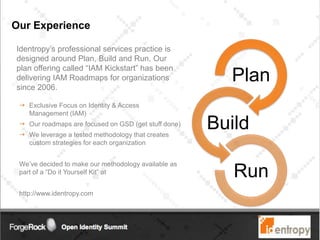
Our Experience
Plan
Build
Run
Identropy’s professional services practice is
designed around Plan, Build and Run. Our
plan offering called “IAM Kickstart” has been
delivering IAM Roadmaps for organizations
since 2006.
 Exclusive Focus on Identity & Access
Management (IAM)
 Our roadmaps are focused on GSD (get stuff done)
 We leverage a tested methodology that creates
custom strategies for each organization
We’ve decided to make our methodology available as
part of a “Do it Yourself Kit” at
http://www.identropy.com
Kickstart Program – 7 Step Approach
7 Present Findings
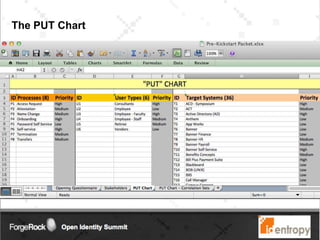
1 P.U.T. Chart
2 Onsite Interviews
3 IAM Capability Assessment
4 Research and Follow-up
5 Architecture and Recommendations
6 Roadmap and Budget Estimates
DELIVERABLES
 IAM Capability Benchmark
 High-Level Architecture
 Initiative Roadmap
 Editable Project Plan
 Executive Presentation
PUT Chart & Pre-work
•PUT Chart
•Schedule Interviews / Develop
Agenda
•Gather collateral
• Recent Audit findings
• Governance Structures
• Org or IT strategies
• Documented IAM Policies and
Procedures
•Hold Interviews
• Sample questions
• Take Notes (look for quotes)
The PUT Chart
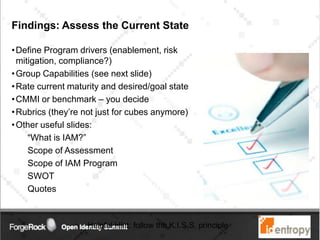
Findings: Assess the Current State
•Define Program drivers (enablement, risk
mitigation, compliance?)
•Group Capabilities (see next slide)
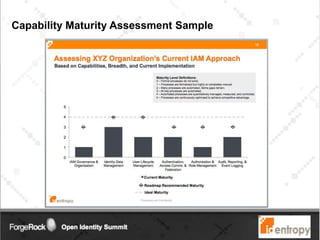
•Rate current maturity and desired/goal state
•CMMI or benchmark – you decide
•Rubrics (they’re not just for cubes anymore)
•Other useful slides:
“What is IAM?”
Scope of Assessment
Scope of IAM Program
SWOT
Quotes
Helpful Hint: follow the K.I.S.S. principle
Capability Maturity Assessment Sample
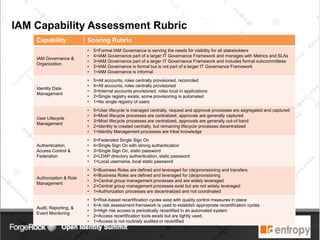
IAM Capability Assessment Rubric
Capability Scoring Rubric
IAM Governance &
Organization
• 5=Formal IAM Governance is serving the needs for visibility for all stakeholders
• 4=IAM Governance part of a larger IT Governance Framework and manages with Metrics and SLAs
• 3=IAM Governance part of a larger IT Governance Framework and includes formal subcommittees
• 2=IAM Governance is formal but is not part of a larger IT Governance Framework
• 1=IAM Governance is informal
Identity Data
Management
• 5=All accounts, roles centrally provisioned, reconciled
• 4=All accounts, roles centrally provisioned
• 3=Internal accounts provisioned, roles local in applications
• 2=Single registry exists, some provisioning is automated
• 1=No single registry of users
User Lifecycle
Management
• 5=User lifecycle is managed centrally, request and approval processes are segregated and captured
• 4=Most lifecycle processes are centralized, approvals are generally captured
• 3=Most lifecycle processes are centralized, approvals are generally out-of band
• 2=Identity is created centrally, but remaining lifecycle processes decentralized
• 1=Identity Management processes are tribal knowledge
Authentication,
Access Control &
Federation
• 5=Federated Single Sign On
• 4=Single Sign On with strong authentication
• 3=Single Sign On, static password
• 2=LDAP directory authentication, static password
• 1=Local username, local static password
Authorization & Role
Management
• 5=Business Roles are defined and leveraged for (de)provisioning and transfers
• 4=Business Roles are defined and leveraged for (de)provisioning
• 3=Central group management processes and are widely leveraged
• 2=Central group management processes exist but are not widely leveraged
• 1=Authorization processes are decentralized and not coordinated
Audit, Reporting, &
Event Monitoring
• 5=Risk-based recertification cycles exist with quality control measures in place
• 4=A risk assessment framework is used to establish appropriate recertification cycles
• 3=High risk access is periodically recertified in an automated system
• 2=Access recertification tools exists but are lightly used.
• 1=Access is not routinely audited or recertified
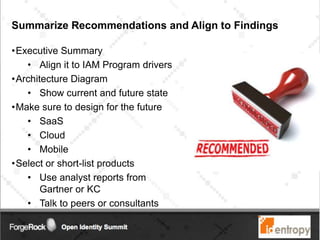
Summarize Recommendations and Align to Findings
•Executive Summary
• Align it to IAM Program drivers
•Architecture Diagram
• Show current and future state
•Make sure to design for the future
• SaaS
• Cloud
• Mobile
•Select or short-list products
• Use analyst reports from
Gartner or KC
• Talk to peers or consultants
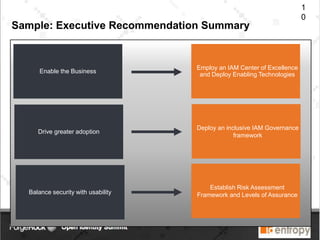
1
0
Enable the Business
Employ an IAM Center of Excellence
and Deploy Enabling Technologies
Deploy an inclusive IAM Governance
framework
Drive greater adoption
Balance security with usability
Establish Risk Assessment
Framework and Levels of Assurance
Sample: Executive Recommendation Summary
Sample Recommendations – What to do
Pull together
enterprise
identity data into
a central identity
repository
Deploy a tool to
provide delegated
group management
Replace Custom
IAM with packaged
software
Implement coarse-
grained policy
enforcement with
OpenAM
Bolster application
and cloud
provisioning tools
Offer BYOId for
loose affiliations and
low risk access
Require strong
second factor for
certain high-risk
access
Employ an IAM
Center of Excellence
and Deploy Enabling
Technologies
Establish Risk
Assessment
Framework and
Levels of Assurance
Deploy an inclusive
IAM Governance
framework
Inventory Risk at the
Application and Group
level
Adopt existing LOA
framework, such as the
InCommon Assurance
Program
Apply security controls
based on risk
Increase stakeholder
involvement through
Technical and Business
Advisory Groups
Define Structure and
Process for improved
decision making and
mission alignment
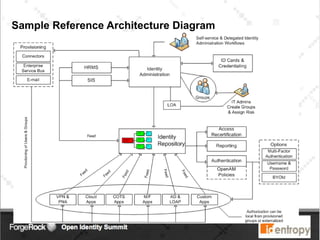
Sample Reference Architecture Diagram
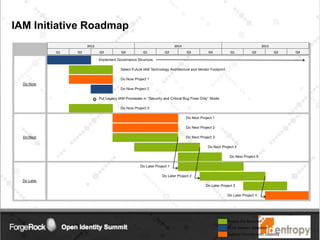
Develop a Roadmap (timeline)
•Do Now, Do Next, Do Later…
& Down the Road
•Develop a resource plan (using internal
resources, consultants, or mix)
•Estimate costs
• Understand your fiscal calendar
• Break-out Capital vs. Expense
• This often favors SaaS or Open
Source
• If you need estimates – lean on
vendors (consulting and product)
• This is all relevant even if you must
do an RFP
IAM Initiative Roadmap
Enable the Business
Drive Greater Adoption
Balance Security with Usability
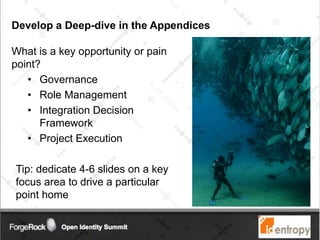
Develop a Deep-dive in the Appendices
What is a key opportunity or pain
point?
• Governance
• Role Management
• Integration Decision
Framework
• Project Execution
Tip: dedicate 4-6 slides on a key
focus area to drive a particular
point home
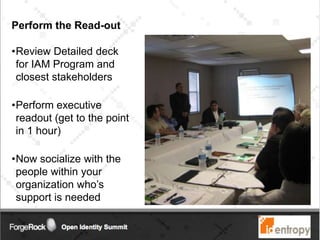
Perform the Read-out
•Review Detailed deck
for IAM Program and
closest stakeholders
•Perform executive
readout (get to the point
in 1 hour)
•Now socialize with the
people within your
organization who’s
support is needed
Thanks and Good Luck!
Developing an IAM Roadmap that Fits Your Business

Developing an IAM Roadmap that Fits Your Business

  • 2.
    Our Experience Plan Build Run Identropy’s professionalservices practice is designed around Plan, Build and Run. Our plan offering called “IAM Kickstart” has been delivering IAM Roadmaps for organizations since 2006.  Exclusive Focus on Identity & Access Management (IAM)  Our roadmaps are focused on GSD (get stuff done)  We leverage a tested methodology that creates custom strategies for each organization We’ve decided to make our methodology available as part of a “Do it Yourself Kit” at http://www.identropy.com
  • 3.
    Kickstart Program –7 Step Approach 7 Present Findings 1 P.U.T. Chart 2 Onsite Interviews 3 IAM Capability Assessment 4 Research and Follow-up 5 Architecture and Recommendations 6 Roadmap and Budget Estimates DELIVERABLES  IAM Capability Benchmark  High-Level Architecture  Initiative Roadmap  Editable Project Plan  Executive Presentation
  • 4.
    PUT Chart &Pre-work •PUT Chart •Schedule Interviews / Develop Agenda •Gather collateral • Recent Audit findings • Governance Structures • Org or IT strategies • Documented IAM Policies and Procedures •Hold Interviews • Sample questions • Take Notes (look for quotes)
  • 5.
  • 6.
    Findings: Assess theCurrent State •Define Program drivers (enablement, risk mitigation, compliance?) •Group Capabilities (see next slide) •Rate current maturity and desired/goal state •CMMI or benchmark – you decide •Rubrics (they’re not just for cubes anymore) •Other useful slides: “What is IAM?” Scope of Assessment Scope of IAM Program SWOT Quotes Helpful Hint: follow the K.I.S.S. principle
  • 7.
  • 8.
    IAM Capability AssessmentRubric Capability Scoring Rubric IAM Governance & Organization • 5=Formal IAM Governance is serving the needs for visibility for all stakeholders • 4=IAM Governance part of a larger IT Governance Framework and manages with Metrics and SLAs • 3=IAM Governance part of a larger IT Governance Framework and includes formal subcommittees • 2=IAM Governance is formal but is not part of a larger IT Governance Framework • 1=IAM Governance is informal Identity Data Management • 5=All accounts, roles centrally provisioned, reconciled • 4=All accounts, roles centrally provisioned • 3=Internal accounts provisioned, roles local in applications • 2=Single registry exists, some provisioning is automated • 1=No single registry of users User Lifecycle Management • 5=User lifecycle is managed centrally, request and approval processes are segregated and captured • 4=Most lifecycle processes are centralized, approvals are generally captured • 3=Most lifecycle processes are centralized, approvals are generally out-of band • 2=Identity is created centrally, but remaining lifecycle processes decentralized • 1=Identity Management processes are tribal knowledge Authentication, Access Control & Federation • 5=Federated Single Sign On • 4=Single Sign On with strong authentication • 3=Single Sign On, static password • 2=LDAP directory authentication, static password • 1=Local username, local static password Authorization & Role Management • 5=Business Roles are defined and leveraged for (de)provisioning and transfers • 4=Business Roles are defined and leveraged for (de)provisioning • 3=Central group management processes and are widely leveraged • 2=Central group management processes exist but are not widely leveraged • 1=Authorization processes are decentralized and not coordinated Audit, Reporting, & Event Monitoring • 5=Risk-based recertification cycles exist with quality control measures in place • 4=A risk assessment framework is used to establish appropriate recertification cycles • 3=High risk access is periodically recertified in an automated system • 2=Access recertification tools exists but are lightly used. • 1=Access is not routinely audited or recertified
  • 9.
    Summarize Recommendations andAlign to Findings •Executive Summary • Align it to IAM Program drivers •Architecture Diagram • Show current and future state •Make sure to design for the future • SaaS • Cloud • Mobile •Select or short-list products • Use analyst reports from Gartner or KC • Talk to peers or consultants
  • 10.
    1 0 Enable the Business Employan IAM Center of Excellence and Deploy Enabling Technologies Deploy an inclusive IAM Governance framework Drive greater adoption Balance security with usability Establish Risk Assessment Framework and Levels of Assurance Sample: Executive Recommendation Summary
  • 11.
    Sample Recommendations –What to do Pull together enterprise identity data into a central identity repository Deploy a tool to provide delegated group management Replace Custom IAM with packaged software Implement coarse- grained policy enforcement with OpenAM Bolster application and cloud provisioning tools Offer BYOId for loose affiliations and low risk access Require strong second factor for certain high-risk access Employ an IAM Center of Excellence and Deploy Enabling Technologies Establish Risk Assessment Framework and Levels of Assurance Deploy an inclusive IAM Governance framework Inventory Risk at the Application and Group level Adopt existing LOA framework, such as the InCommon Assurance Program Apply security controls based on risk Increase stakeholder involvement through Technical and Business Advisory Groups Define Structure and Process for improved decision making and mission alignment
  • 12.
  • 13.
    Develop a Roadmap(timeline) •Do Now, Do Next, Do Later… & Down the Road •Develop a resource plan (using internal resources, consultants, or mix) •Estimate costs • Understand your fiscal calendar • Break-out Capital vs. Expense • This often favors SaaS or Open Source • If you need estimates – lean on vendors (consulting and product) • This is all relevant even if you must do an RFP
  • 14.
    IAM Initiative Roadmap Enablethe Business Drive Greater Adoption Balance Security with Usability
  • 15.
    Develop a Deep-divein the Appendices What is a key opportunity or pain point? • Governance • Role Management • Integration Decision Framework • Project Execution Tip: dedicate 4-6 slides on a key focus area to drive a particular point home
  • 16.
    Perform the Read-out •ReviewDetailed deck for IAM Program and closest stakeholders •Perform executive readout (get to the point in 1 hour) •Now socialize with the people within your organization who’s support is needed
  • 17.

Editor's Notes

  • #15 Do now – foundational itemsDo next – heavier lifting that is highest priorityDo later – more heavy lifting