
SAMPLING
DESIGNS
CHAPTER 6:
Presenter: Jerra Niña L. Puracan
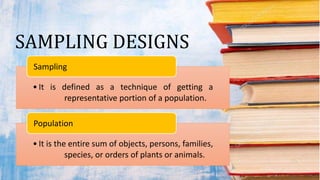
SAMPLING DESIGNS
• It is defined as a technique of getting a
representative portion of a population.
Sampling
• It is the entire sum of objects, persons, families,
species, or orders of plants or animals.
Population
BENEFITS
OF SAMPLING
1. Sampling is economical, cheaper, and faster.
2. It saves time, money, and effort.
3. It is more accurate.
4. It gives more comprehensive information.
5. It is more effective.
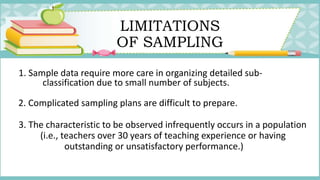
LIMITATIONS
OF SAMPLING
1. Sample data require more care in organizing detailed sub-
classification due to small number of subjects.
2. Complicated sampling plans are difficult to prepare.
3. The characteristic to be observed infrequently occurs in a population
(i.e., teachers over 30 years of teaching experience or having
outstanding or unsatisfactory performance.)
LIMITATIONS
OF SAMPLING
4. If sampling plan is not accurately designed and followed, the results
may give wrong impression.
5. Sampling requires experts to conduct the study in an area. If this is
lacking, the results may be invalid.
PLANNING A
SAMPLE SURVEY
1. State the objectives of the study.
2. Define the population.
3. Choose the sampling individual.
4. Find and choose the source list of particular individuals involved in
the sample.
5. Decide the sampling design to be used that fits the study, either
scientific or unscientific sampling.
PLANNING A
SAMPLE SURVEY
6. Determine the sample size by using the formula:
NV + [Se2 x (1-p)]
Ss = ----------------------------
NSe + [V2 x p(1-p)]
where Ss stands for sample size; N, population; V, standard value
(2.58) of 1 percent level of probability with 0.99 reliability level; Se,
sampling error (0.01); and p, largest possible population.
PLANNING A
SAMPLE SURVEY
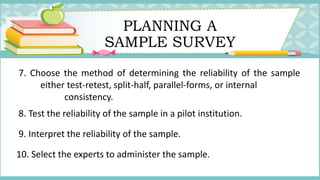
7. Choose the method of determining the reliability of the sample
either test-retest, split-half, parallel-forms, or internal
consistency.
8. Test the reliability of the sample in a pilot institution.
9. Interpret the reliability of the sample.
10. Select the experts to administer the sample.
DETERMINATION
OF SAMPLE SIZE
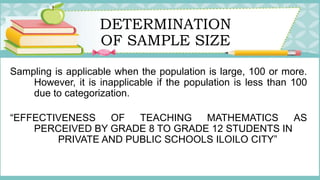
Sampling is applicable when the population is large, 100 or more.
However, it is inapplicable if the population is less than 100
due to categorization.
“EFFECTIVENESS OF TEACHING MATHEMATICS AS
PERCEIVED BY GRADE 8 TO GRADE 12 STUDENTS IN
PRIVATE AND PUBLIC SCHOOLS ILOILO CITY”
DETERMINATION
OF SAMPLE SIZE
How are students as subjects of the study categorized?
1. as a whole;
2. into year level;
3. private and public schools;
4. gender; and so on.
 It is necessary to have larger number of samples in each
categorization to arrive at reliable results.
DETERMINATION
OF SAMPLE SIZE
Step 1. Determine the total population (N) as assumed subjects of
the study.
Step 2. Get the value (V = 2.58), Se (0.01), and p (0.50).
Step 3. Compute the sample size using the formula.
NV + [Se2 x (1-p)]
Ss = ----------------------------
NSe + [V2 x p(1-p)]
NV + [Se2 x (1-p)]
Ss = ----------------------------
NSe + [V2 x p(1-p)]
For instance, the total population (N) is 850; the standard value at 1
percent of probability is 2.58 with 99 percent reliability with
Sampling error (Se) at 1 percent (1%) or 0.01 and the proportion
(p) of a target population is 50 percent (50%) or 0.50. Then, the
sample size is computed as follows:
Given: N = 850 Se = 0.01
V = 2.58 p = 0.50
Computed Sample Size for Different Population (N) at 0.01 Level of
Probability to a Proportion of .50
N Sample Size N Sample Size
100 97 450 188
125 111 475 191
150 122 500 194
175 132 525 196
200 148 575 200
225 148 600 202
250 155 625 204
275 161 650 205
300 166 675 207
325 171 700 208
350 175 725 210
375 179 750 211
425 185 775 212
Sampling designs

Sampling designs

  • 1.
  • 2.
    SAMPLING DESIGNS • Itis defined as a technique of getting a representative portion of a population. Sampling • It is the entire sum of objects, persons, families, species, or orders of plants or animals. Population
  • 3.
    BENEFITS OF SAMPLING 1. Samplingis economical, cheaper, and faster. 2. It saves time, money, and effort. 3. It is more accurate. 4. It gives more comprehensive information. 5. It is more effective.
  • 4.
    LIMITATIONS OF SAMPLING 1. Sampledata require more care in organizing detailed sub- classification due to small number of subjects. 2. Complicated sampling plans are difficult to prepare. 3. The characteristic to be observed infrequently occurs in a population (i.e., teachers over 30 years of teaching experience or having outstanding or unsatisfactory performance.)
  • 5.
    LIMITATIONS OF SAMPLING 4. Ifsampling plan is not accurately designed and followed, the results may give wrong impression. 5. Sampling requires experts to conduct the study in an area. If this is lacking, the results may be invalid.
  • 6.
    PLANNING A SAMPLE SURVEY 1.State the objectives of the study. 2. Define the population. 3. Choose the sampling individual. 4. Find and choose the source list of particular individuals involved in the sample. 5. Decide the sampling design to be used that fits the study, either scientific or unscientific sampling.
  • 7.
    PLANNING A SAMPLE SURVEY 6.Determine the sample size by using the formula: NV + [Se2 x (1-p)] Ss = ---------------------------- NSe + [V2 x p(1-p)] where Ss stands for sample size; N, population; V, standard value (2.58) of 1 percent level of probability with 0.99 reliability level; Se, sampling error (0.01); and p, largest possible population.
  • 8.
    PLANNING A SAMPLE SURVEY 7.Choose the method of determining the reliability of the sample either test-retest, split-half, parallel-forms, or internal consistency. 8. Test the reliability of the sample in a pilot institution. 9. Interpret the reliability of the sample. 10. Select the experts to administer the sample.
  • 9.
    DETERMINATION OF SAMPLE SIZE Samplingis applicable when the population is large, 100 or more. However, it is inapplicable if the population is less than 100 due to categorization. “EFFECTIVENESS OF TEACHING MATHEMATICS AS PERCEIVED BY GRADE 8 TO GRADE 12 STUDENTS IN PRIVATE AND PUBLIC SCHOOLS ILOILO CITY”
  • 10.
    DETERMINATION OF SAMPLE SIZE Howare students as subjects of the study categorized? 1. as a whole; 2. into year level; 3. private and public schools; 4. gender; and so on.  It is necessary to have larger number of samples in each categorization to arrive at reliable results.
  • 11.
    DETERMINATION OF SAMPLE SIZE Step1. Determine the total population (N) as assumed subjects of the study. Step 2. Get the value (V = 2.58), Se (0.01), and p (0.50). Step 3. Compute the sample size using the formula. NV + [Se2 x (1-p)] Ss = ---------------------------- NSe + [V2 x p(1-p)]
  • 12.
    NV + [Se2x (1-p)] Ss = ---------------------------- NSe + [V2 x p(1-p)] For instance, the total population (N) is 850; the standard value at 1 percent of probability is 2.58 with 99 percent reliability with Sampling error (Se) at 1 percent (1%) or 0.01 and the proportion (p) of a target population is 50 percent (50%) or 0.50. Then, the sample size is computed as follows: Given: N = 850 Se = 0.01 V = 2.58 p = 0.50
  • 13.
    Computed Sample Sizefor Different Population (N) at 0.01 Level of Probability to a Proportion of .50 N Sample Size N Sample Size 100 97 450 188 125 111 475 191 150 122 500 194 175 132 525 196 200 148 575 200 225 148 600 202 250 155 625 204 275 161 650 205 300 166 675 207 325 171 700 208 350 175 725 210 375 179 750 211 425 185 775 212