Population and
Sample
Sample and Population
Determine which choice is a sample or a population.
1. A beverage company wanted to see if people in the
Philippines liked their new logo. Which choice best
represents a population?
A. A selection of logo artists.
B. Every person in the Philippines.
C. A selection of shoppers from different regions.
D. 3,800 children age 5 – 15
Answer: B
Sample and Population.
2. An OPM artist wanted to see what people who bought
his last album thought about the songs. Which choice
best represents a sample?
A. Every person who bought the album.
B. A selection of people who didn't want to buy the
album.
C. 250 girls who bought the album.
D. A selection of 3,294 people who bought the album.
Answer: D
Sample and Population.
3. Before the barangay election, a polling place was
trying to see who would win. Which choice best
represents a sample?
A. A selection of voters over age 50.
B. A selection of male voters.
C. A selection of voters of different ages.
D. All voters.
Answer: C
Sample and Population.
4. A toy store owner tracking how much kids spend
each month on toys. Which choice best represents a
population?
A. All of the kids who buy toys.
B. 227 rich kids.
C. 228 boys age 7 - 15
D. 235 kids from age 10 to 15.
Answer: A
Sample and Population.
5. A governor wanted to see if the people in his
province thought he was doing a good job. Which
choice best represents a sample?
A. 1,000 unemployed voters.
B. The governor's family.
C. The residents of the province.
D. 242 voters in the province.
Answer: D
Biased
and
Unbiased Samples
Samples
Biased Sample is a non – random sample of a
population in which all individuals or instances
were not equally likely to have been selected.
Examples:
1. The principal wanted to know if school
discipline procedures were fair. He asked only
the students in the in-school suspension class.
Biased Sample
2. A teacher would like to know how students
feel about the new uniform. She teaches grade
10 and asks all of her classes only.
3. A student is doing a survey to find out what
is the favorite food of students at the school.
He survey only his classes-he is in the grade 7.
Samples
Unbiased Sample is a random sample of a
population in which all individuals or instances
were equally likely to have been selected.
Examples:
1. Let’s say you’re trying to figure out the average
amount every Filipino spend on food per week. You
can’t survey the whole population of over 110 million,
so you take a sample of around 1 000 individual.
Unbiased Sample
2. Akram wants to know how many students in
Montalban use the internet for learning
purposes. He randomly selected a few schools
and colleges in the town to conduct the
survey.
Sample
Determine if the chosen sample is BIASED or UNBIASED
SAMPLE.
1. What is your favorite sport?
Sample is chosen from people attending a basketball
game.
Answer: Biased
2. What is your favorite soft drink?
Sample is chosen by picking names out of a telephone
book.
Answer: Unbiased
Sample
3. Should more money be put into athletic programs or
music programs at school?
Sample is chosen from students in the music program
class.
Answer: Biased
4. What is your favorite vacation destination?
Sample is chosen by asking every student in the school.
Answer: Unbiased
5. What is your favorite snack serve in the school canteen?
Sample is chosen by asking every student in the school.
Answer: Unbiased
Finding the Sample “n”
from the Population “N”
using Slovin’s Formula
Sample and Population.
 Sample size can be foundusingtheSlovin’sFormula
n = N
1 + Ne2
Where: n = samplesize
N = population
e = marginof error
Sample and Population
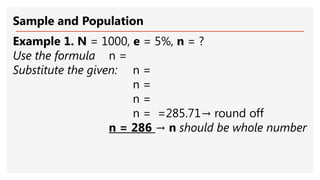
Example 1. N = 1000, e = 5%, n = ?
Use the formula n =
Substitute the given: n =
n =
n =
n = =285.71 round off
→
n = 286 → n should be whole number
Sample and Population
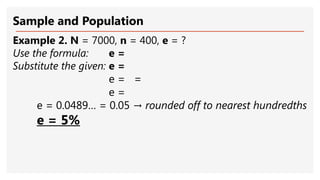
Example 2. N = 7000, n = 400, e = ?
Use the formula: e =
Substitute the given: e =
e = =
e =
e = 0.0489… = 0.05 → rounded off to nearest hundredths
e = 5%
Sample and Population
Example 3. N = 11000, e = 3%, n = ?
Solution:
n =
n =
n =
n = =1009.174…
n = 1009 → n should be whole number
Sample and Population
Example 4. N = 9000, n = 500, e = ?
e =
e =
e =
e = 0.0435… = 0.04 → rounded off to nearest hundredths
e = 4%
Sample and Population
Answer the following: (Google Form)
For numbers 1 – 5, find the sample size
1. N = 8,000 e = 5% n = _____
2. N = 20,000 e = 5% n = _____
3. N = 6,000 e = 1% n = _____
4. N = 40,000 e = 1% n = _____
5. N = 15,000 e = 5% n = _____
For numbers 6 – 10, find e in whole number
6. N = 5,000 n = 200 e = ____%_
7. N = 8,000 n = 1,000 e = ____%_
8. N = 20,000 n = 3,000 e = ____%_
9. N = 10,000 n = 600 e = ____%_
10. N = 12,000 n = 6,000 e = ____%_

Finding-sample-using-Slovins-formula.pptx

  • 1.
  • 2.
    Sample and Population Determinewhich choice is a sample or a population. 1. A beverage company wanted to see if people in the Philippines liked their new logo. Which choice best represents a population? A. A selection of logo artists. B. Every person in the Philippines. C. A selection of shoppers from different regions. D. 3,800 children age 5 – 15 Answer: B
  • 3.
    Sample and Population. 2.An OPM artist wanted to see what people who bought his last album thought about the songs. Which choice best represents a sample? A. Every person who bought the album. B. A selection of people who didn't want to buy the album. C. 250 girls who bought the album. D. A selection of 3,294 people who bought the album. Answer: D
  • 4.
    Sample and Population. 3.Before the barangay election, a polling place was trying to see who would win. Which choice best represents a sample? A. A selection of voters over age 50. B. A selection of male voters. C. A selection of voters of different ages. D. All voters. Answer: C
  • 5.
    Sample and Population. 4.A toy store owner tracking how much kids spend each month on toys. Which choice best represents a population? A. All of the kids who buy toys. B. 227 rich kids. C. 228 boys age 7 - 15 D. 235 kids from age 10 to 15. Answer: A
  • 6.
    Sample and Population. 5.A governor wanted to see if the people in his province thought he was doing a good job. Which choice best represents a sample? A. 1,000 unemployed voters. B. The governor's family. C. The residents of the province. D. 242 voters in the province. Answer: D
  • 7.
  • 8.
    Samples Biased Sample isa non – random sample of a population in which all individuals or instances were not equally likely to have been selected. Examples: 1. The principal wanted to know if school discipline procedures were fair. He asked only the students in the in-school suspension class.
  • 9.
    Biased Sample 2. Ateacher would like to know how students feel about the new uniform. She teaches grade 10 and asks all of her classes only. 3. A student is doing a survey to find out what is the favorite food of students at the school. He survey only his classes-he is in the grade 7.
  • 10.
    Samples Unbiased Sample isa random sample of a population in which all individuals or instances were equally likely to have been selected. Examples: 1. Let’s say you’re trying to figure out the average amount every Filipino spend on food per week. You can’t survey the whole population of over 110 million, so you take a sample of around 1 000 individual.
  • 11.
    Unbiased Sample 2. Akramwants to know how many students in Montalban use the internet for learning purposes. He randomly selected a few schools and colleges in the town to conduct the survey.
  • 12.
    Sample Determine if thechosen sample is BIASED or UNBIASED SAMPLE. 1. What is your favorite sport? Sample is chosen from people attending a basketball game. Answer: Biased 2. What is your favorite soft drink? Sample is chosen by picking names out of a telephone book. Answer: Unbiased
  • 13.
    Sample 3. Should moremoney be put into athletic programs or music programs at school? Sample is chosen from students in the music program class. Answer: Biased 4. What is your favorite vacation destination? Sample is chosen by asking every student in the school. Answer: Unbiased 5. What is your favorite snack serve in the school canteen? Sample is chosen by asking every student in the school. Answer: Unbiased
  • 14.
    Finding the Sample“n” from the Population “N” using Slovin’s Formula
  • 15.
    Sample and Population. Sample size can be foundusingtheSlovin’sFormula n = N 1 + Ne2 Where: n = samplesize N = population e = marginof error
  • 16.
    Sample and Population Example1. N = 1000, e = 5%, n = ? Use the formula n = Substitute the given: n = n = n = n = =285.71 round off → n = 286 → n should be whole number
  • 17.
    Sample and Population Example2. N = 7000, n = 400, e = ? Use the formula: e = Substitute the given: e = e = = e = e = 0.0489… = 0.05 → rounded off to nearest hundredths e = 5%
  • 18.
    Sample and Population Example3. N = 11000, e = 3%, n = ? Solution: n = n = n = n = =1009.174… n = 1009 → n should be whole number
  • 19.
    Sample and Population Example4. N = 9000, n = 500, e = ? e = e = e = e = 0.0435… = 0.04 → rounded off to nearest hundredths e = 4%
  • 20.
    Sample and Population Answerthe following: (Google Form) For numbers 1 – 5, find the sample size 1. N = 8,000 e = 5% n = _____ 2. N = 20,000 e = 5% n = _____ 3. N = 6,000 e = 1% n = _____ 4. N = 40,000 e = 1% n = _____ 5. N = 15,000 e = 5% n = _____ For numbers 6 – 10, find e in whole number 6. N = 5,000 n = 200 e = ____%_ 7. N = 8,000 n = 1,000 e = ____%_ 8. N = 20,000 n = 3,000 e = ____%_ 9. N = 10,000 n = 600 e = ____%_ 10. N = 12,000 n = 6,000 e = ____%_