© drtamil@gmail.com, 2014
Sample size calculation
Research Week 2014
Health Cluster UKM
© drtamil@gmail.com, 2014
Introduction
• This is an abbreviated set of slides on how to
calculate sample size.
• It will focus on those with
– Measuring prevalence/incidence for outcome
– Qualitative outcome (i.e. Dead vs Alive)
– Continuous outcome (i.e. drop of BP in mm Hg)
for commonly used study designs in PPUKM.
• Those who want the complete set of slides for
calculating sample size, please refer to next page;
© drtamil@gmail.com, 2014
Sample Size Calculation on Slideshare
1. Why do we need to calculate sample size?
2. Tools to calculate sample size
3. Calculate sample size for prevalence studies
4. Calculate sample size for cross-sectional studies
5. Calculate sample size for case-control studies
6. Calculate sample size for cohort studies
7. Calculate sample size for clinical trials
8. Calculate sample size for clinical trials (continuous
outcome)
9. Calculate sample size for diagnostic study
10. eBook
© drtamil@gmail.com, 2014
Measuring prevalence
Calculate sample size
© drtamil@gmail.com, 2014
Prevalence
• If the objective of your study is to measure the
prevalence of the outcome of interest, then
you will be conducting a cross-sectional study.
So you will only take a sample of your
population. The number of sample selected
depends on the expected prevalence rate.
• To estimate the expected prevalence rate, you
will need to do a literature review, hopefully
similar to your own population.
© drtamil@gmail.com, 2014
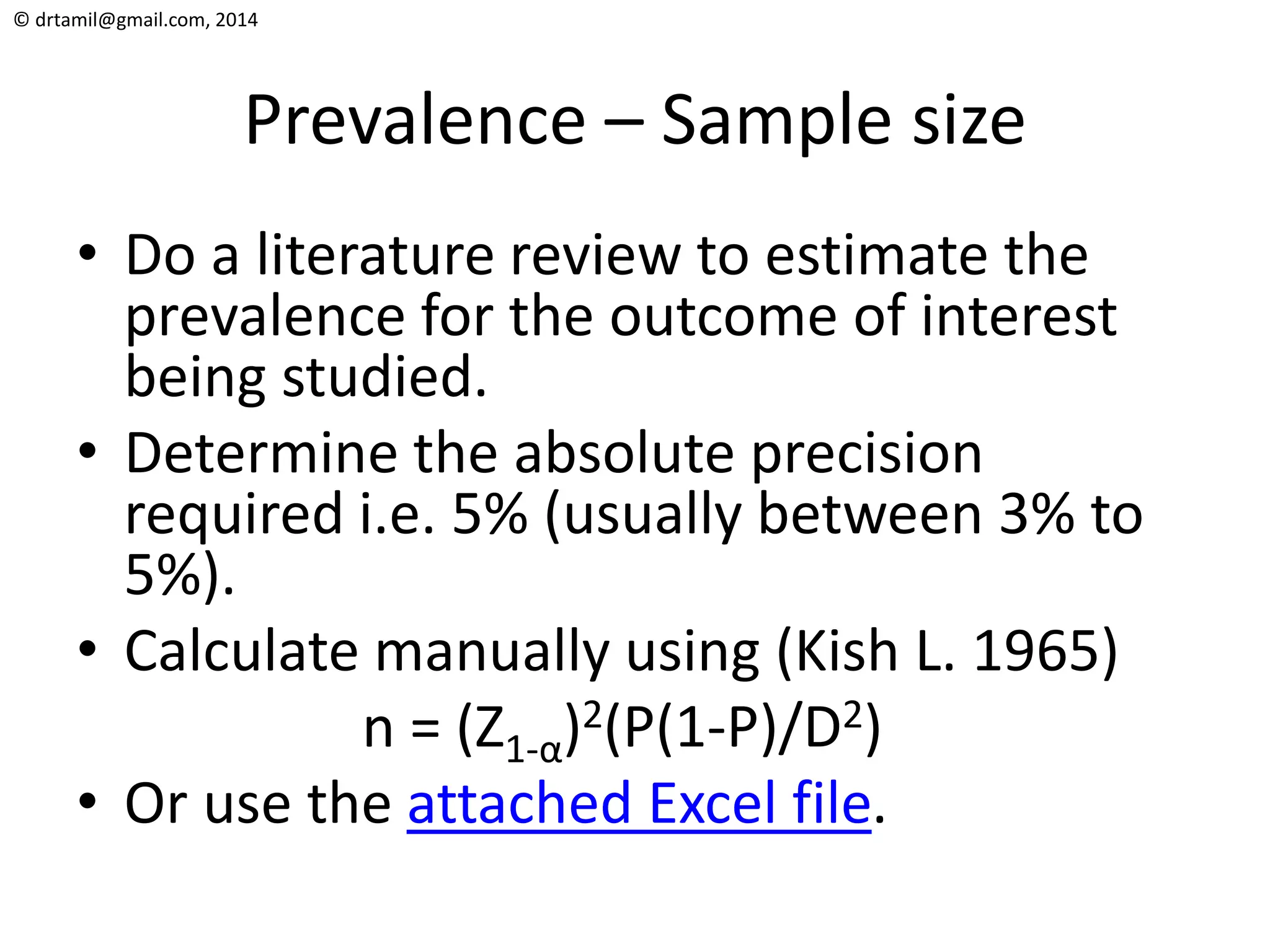
Prevalence – Sample size
• Do a literature review to estimate the
prevalence for the outcome of interest
being studied.
• Determine the absolute precision
required i.e. 5% (usually between 3% to
5%).
• Calculate manually using (Kish L. 1965)
n = (Z1-α)2(P(1-P)/D2)
• Or use the attached Excel file.
© drtamil@gmail.com, 2014
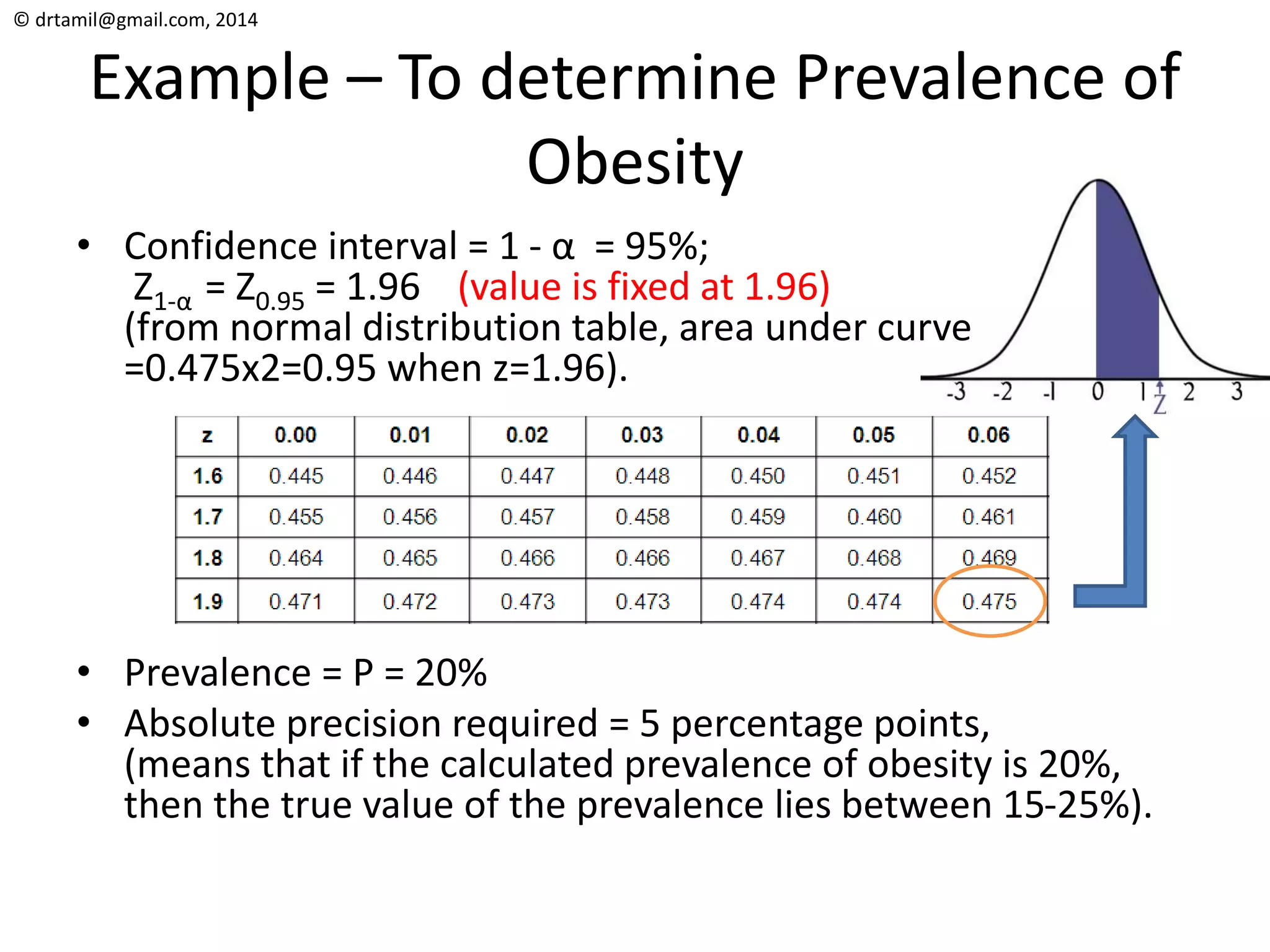
Example – To determine Prevalence of
Obesity
• Confidence interval = 1 - α = 95%;
Z1-α = Z0.95 = 1.96 (value is fixed at 1.96)
(from normal distribution table, area under curve
=0.475x2=0.95 when z=1.96).
• Prevalence = P = 20%
• Absolute precision required = 5 percentage points,
(means that if the calculated prevalence of obesity is 20%,
then the true value of the prevalence lies between 15-25%).
© drtamil@gmail.com, 2014
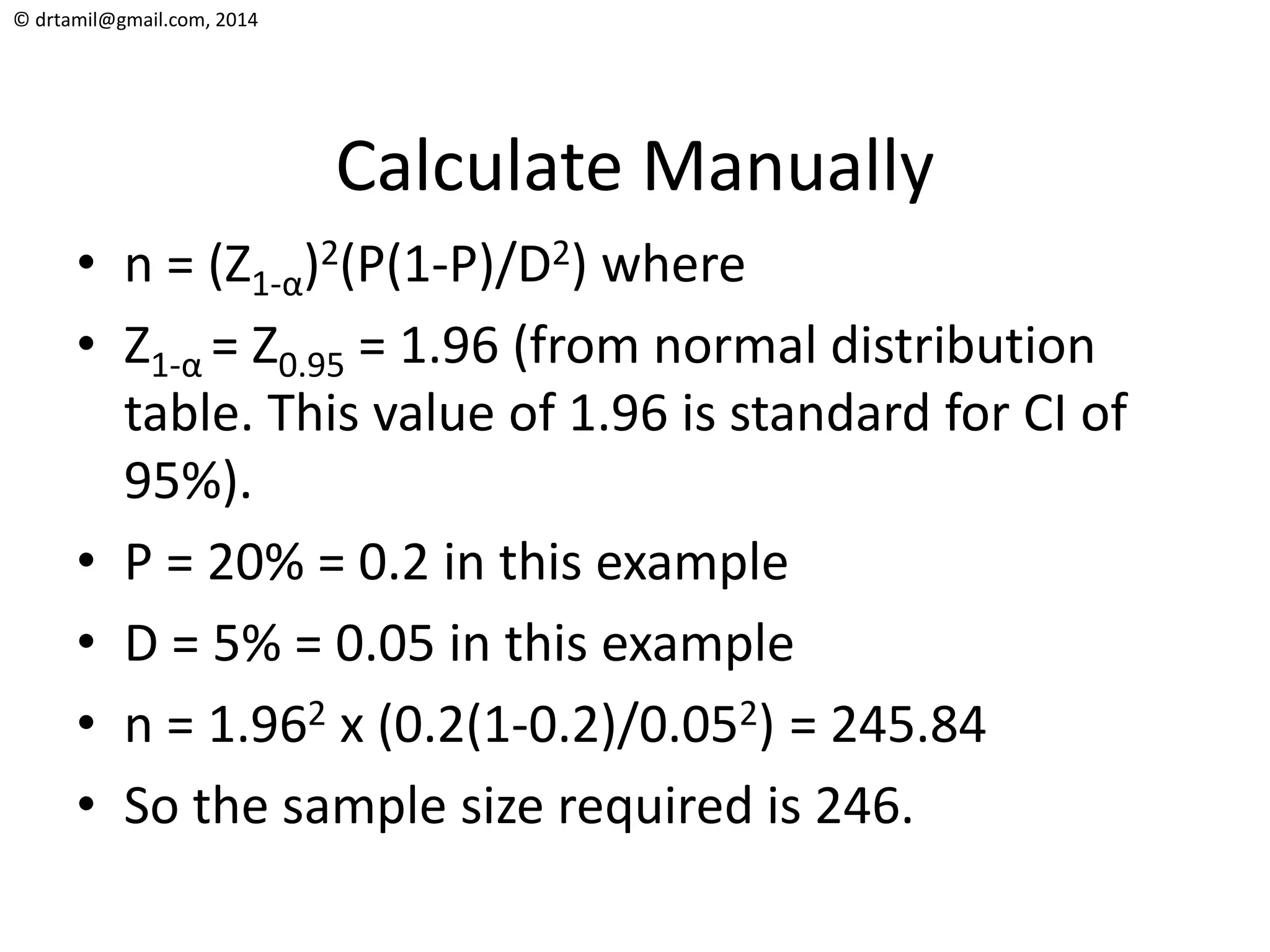
Calculate Manually
• n = (Z1-α)2(P(1-P)/D2) where
• Z1-α = Z0.95 = 1.96 (from normal distribution
table. This value of 1.96 is standard for CI of
95%).
• P = 20% = 0.2 in this example
• D = 5% = 0.05 in this example
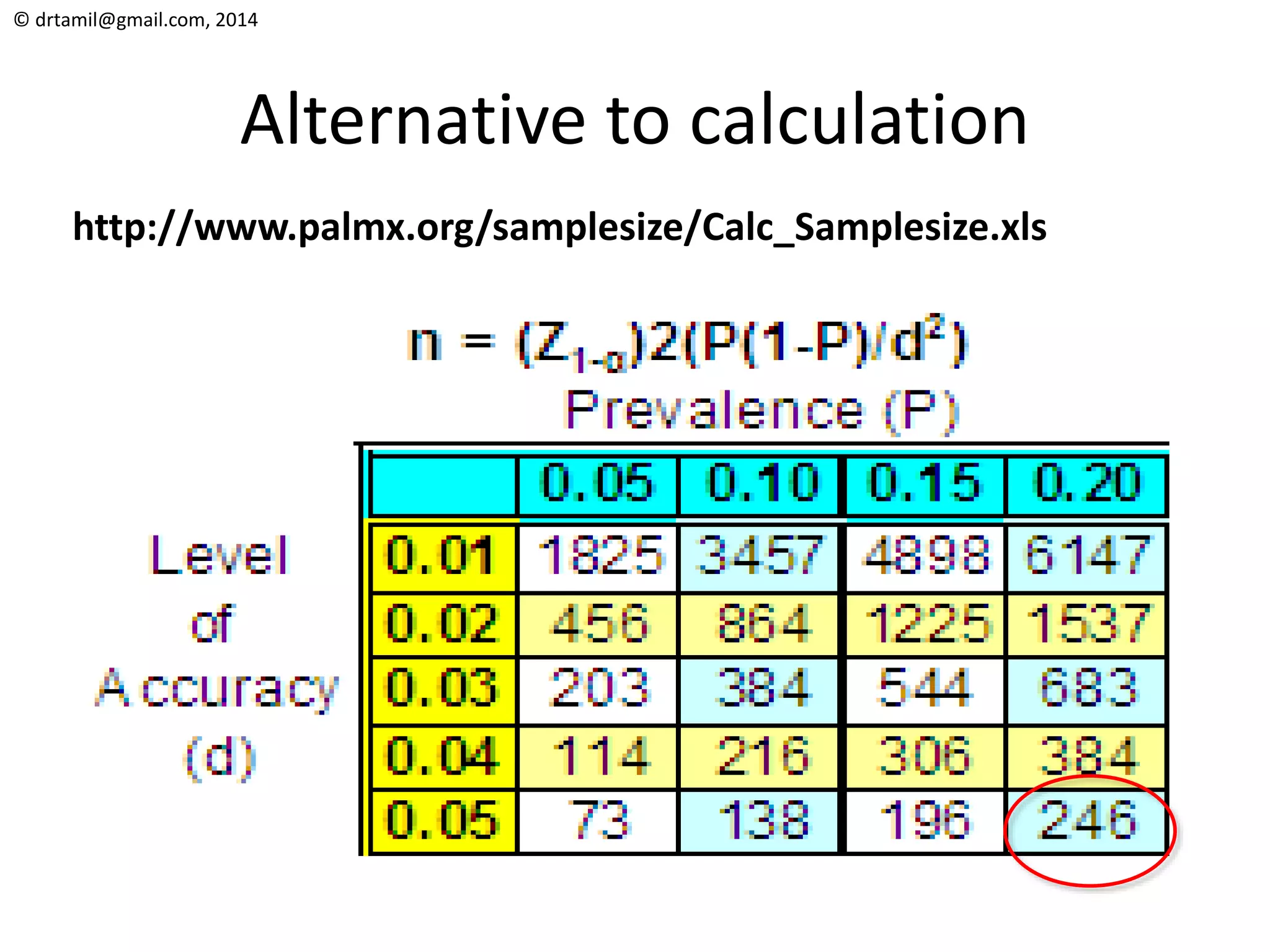
• n = 1.962 x (0.2(1-0.2)/0.052) = 245.84
• So the sample size required is 246.
© drtamil@gmail.com, 2014
Alternative to calculation
http://www.palmx.org/samplesize/Calc_Samplesize.xls
© drtamil@gmail.com, 2014
Reminder
• If the prevalence for the outcome of interest is
less than 5%, you should not be doing a cross-
sectional study, instead you should be doing a
case-control study.
• If your supervisor still insists that you do x-
sectional study, then the level of precision
should be half of the prevalence; i.e. prevalence
of HIV among STD patients is 4% therefore
accuracy (d) must be set at 2%. Therefore the
required sample size would be 369, not 59.
© drtamil@gmail.com, 2014
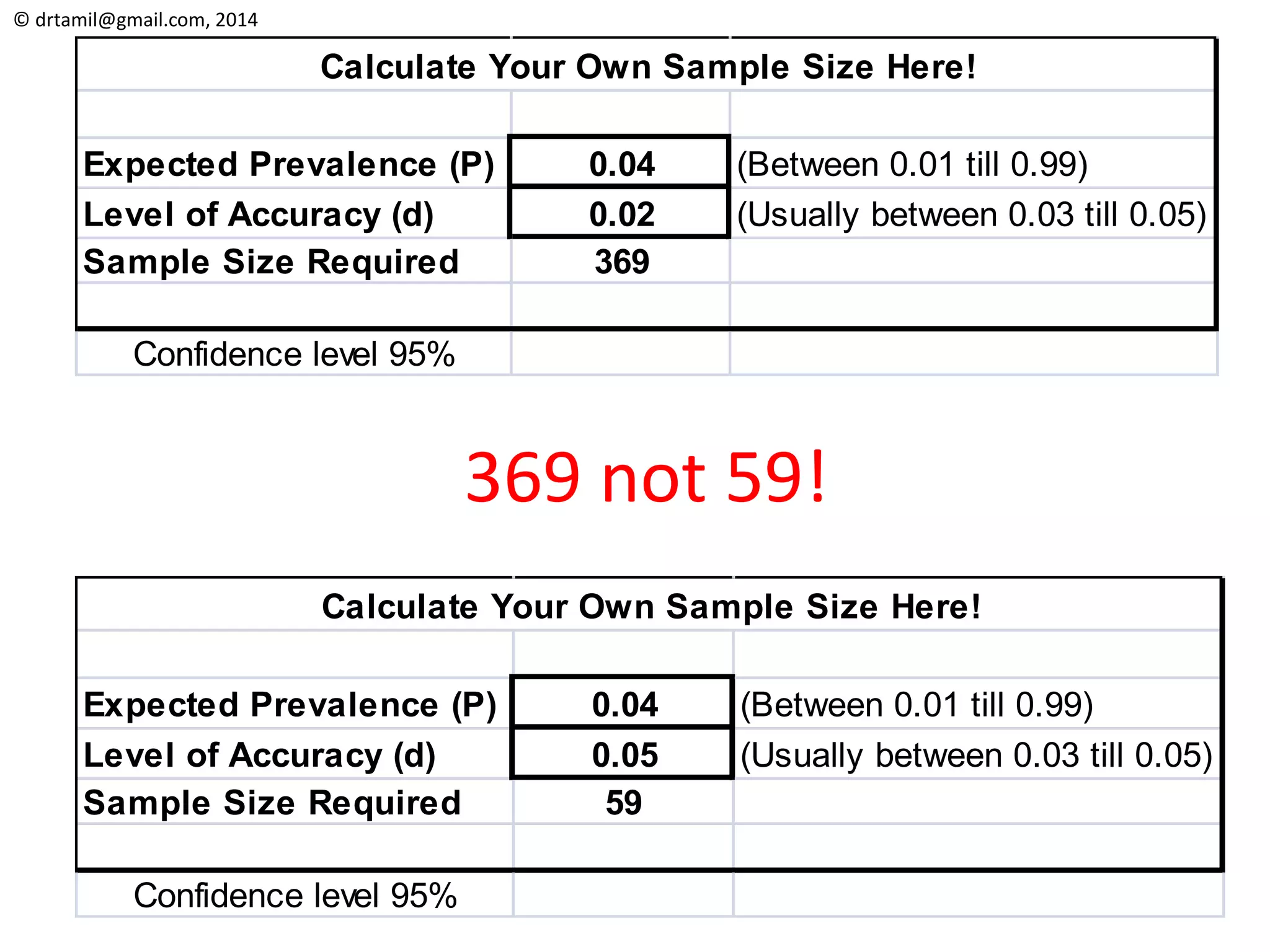
Expected Prevalence (P) 0.04 (Between 0.01 till 0.99)
Level of Accuracy (d) 0.02 (Usually between 0.03 till 0.05)
Sample Size Required 369
Confidence level 95%
Calculate Your Own Sample Size Here!
Expected Prevalence (P) 0.04 (Between 0.01 till 0.99)
Level of Accuracy (d) 0.05 (Usually between 0.03 till 0.05)
Sample Size Required 59
Confidence level 95%
Calculate Your Own Sample Size Here!
369 not 59!
© drtamil@gmail.com, 2014
Dichotomous Qualitative
Outcome
Calculate sample size
© drtamil@gmail.com, 2014
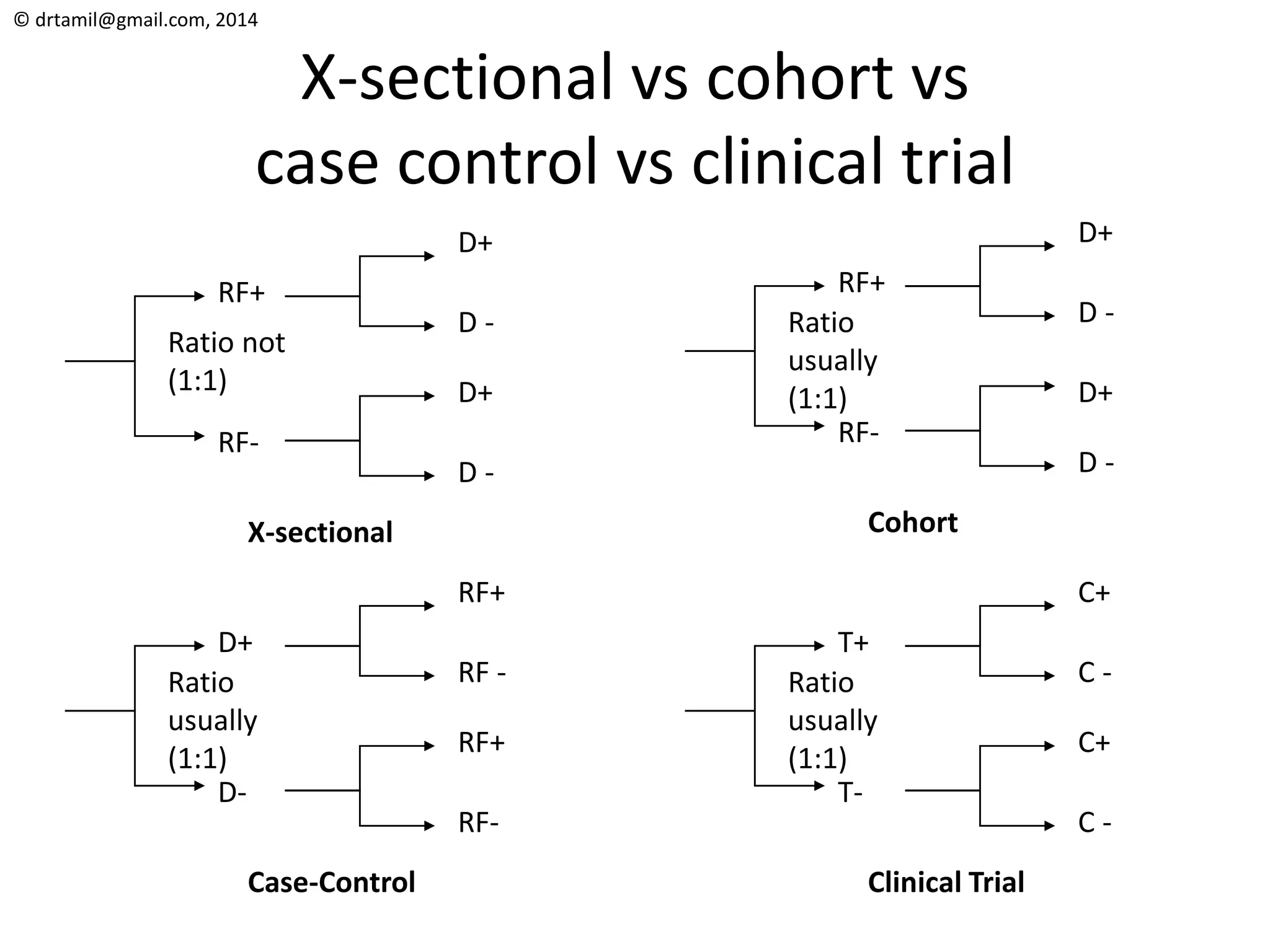
X-sectional vs cohort vs
case control vs clinical trial
D+
RF+
RF-
D -
D+
D -
Ratio not
(1:1)
X-sectional
D+
D-
RF -
RF+
RF-
Ratio
usually
(1:1)
Case-Control
D -
RF+
RF-
D -
D+
Ratio
usually
(1:1)
Cohort
D+
RF+
T+
T-
C -
C+
C -
Ratio
usually
(1:1)
Clinical Trial
C+
© drtamil@gmail.com, 2014
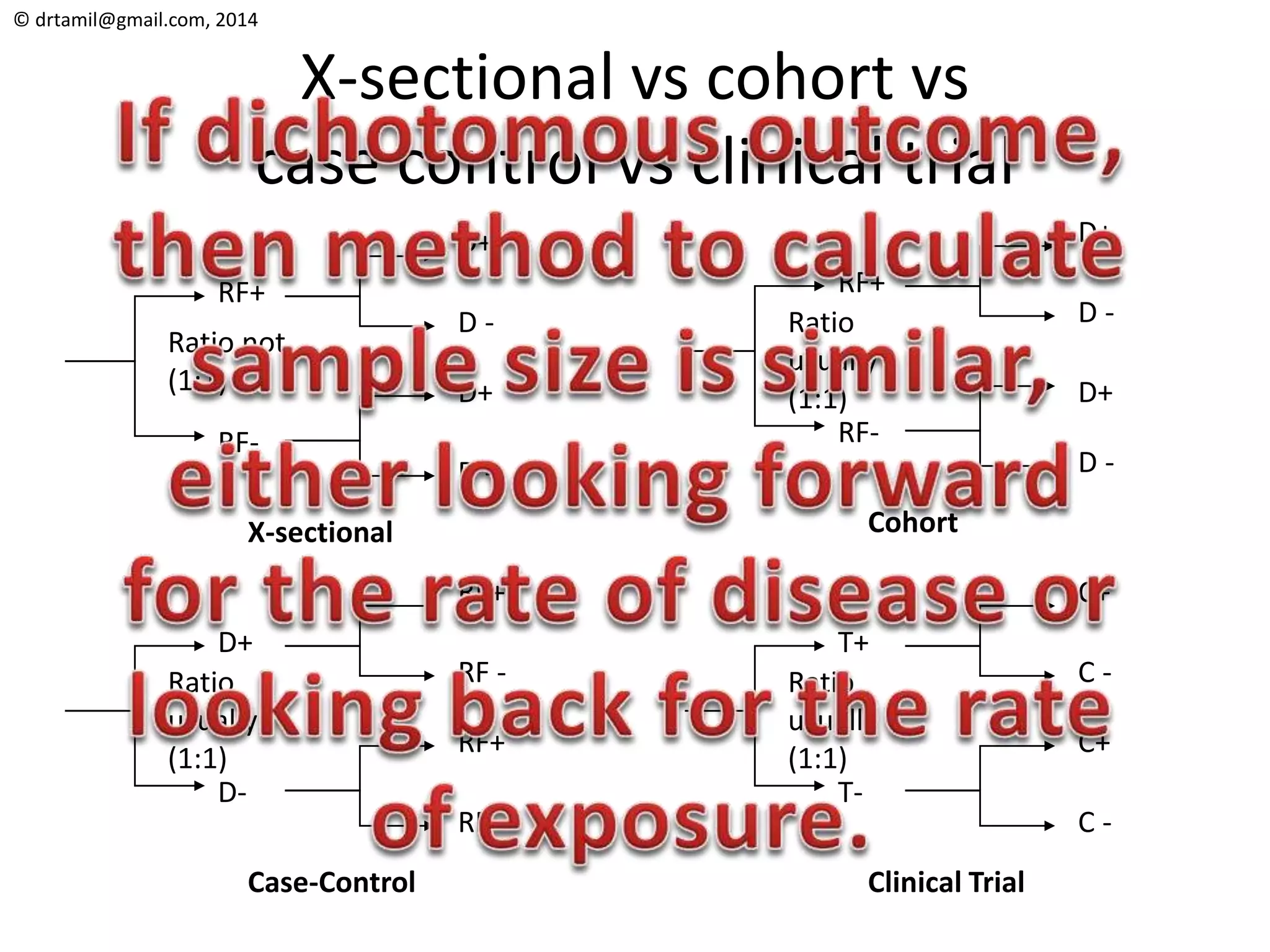
X-sectional vs cohort vs
case control vs clinical trial
D+
RF+
RF-
D -
D+
D -
Ratio not
(1:1)
X-sectional
D+
D-
RF -
RF+
RF-
Ratio
usually
(1:1)
Case-Control
D -
RF+
RF-
D -
D+
Ratio
usually
(1:1)
Cohort
D+
RF+
T+
T-
C -
C+
C -
Ratio
usually
(1:1)
Clinical Trial
C+
© drtamil@gmail.com, 2014
Example – overweight have higher risk
of DM
From literature review, identify the rate of disease among
those with & without the risk factor.
• Ratio of unexposed (Normal) vs exposed (Overweight);
1:1
• Equal ratio therefore equal proportion of sample from
no-risk (Normal) and from at-risk (Overweight)
population.
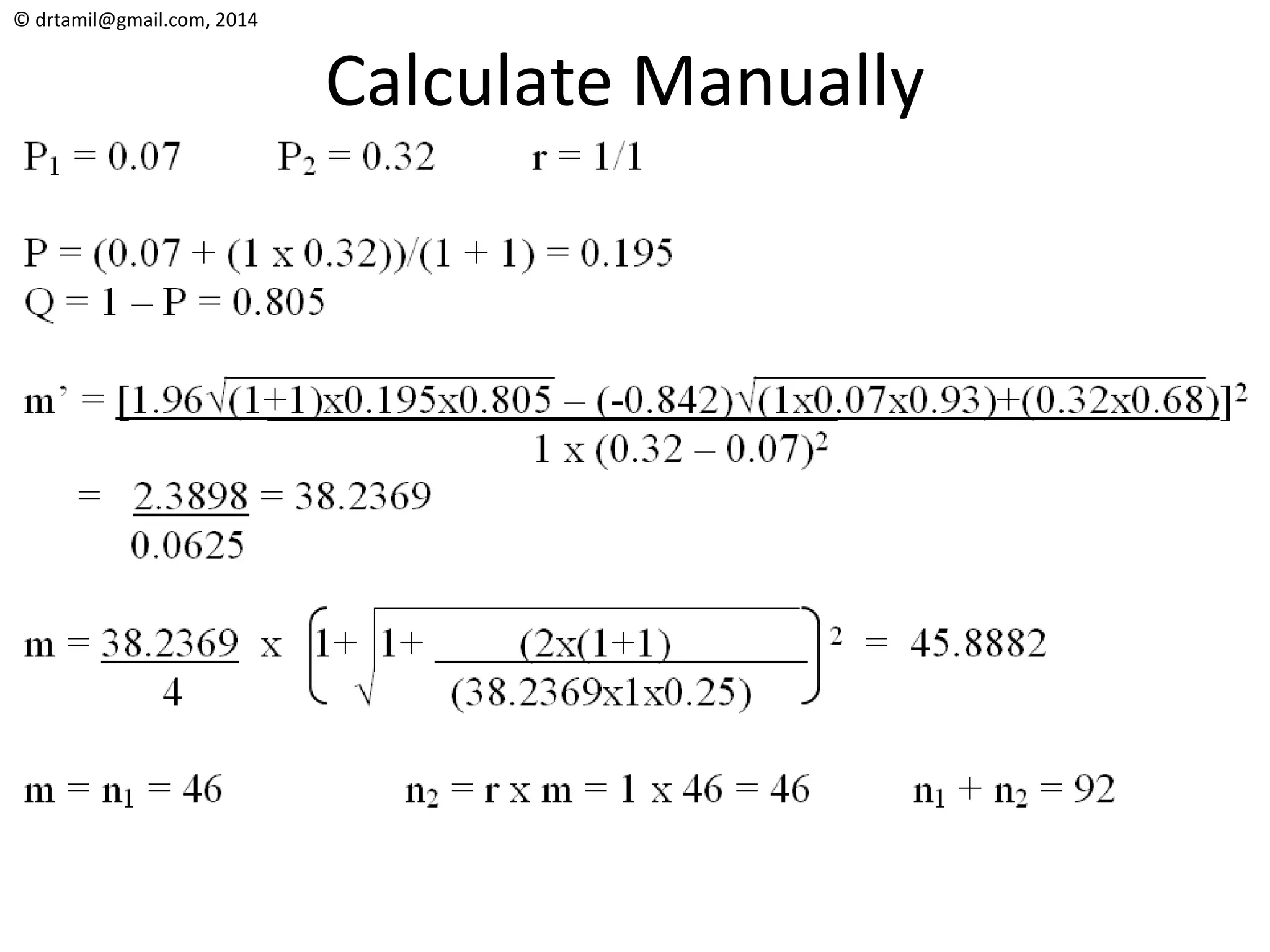
• P1=true proportion of DM in no-risk (Normal) population
= 7%
• P2=true proportion of DM in at-risk (Overweight)
population =32%
• (Rifas-Shiman SL et al, 2008.Diabetes and lipid screening
among patients in primary care: A cohort study. BMC
Health Services Research.)
© drtamil@gmail.com, 2014
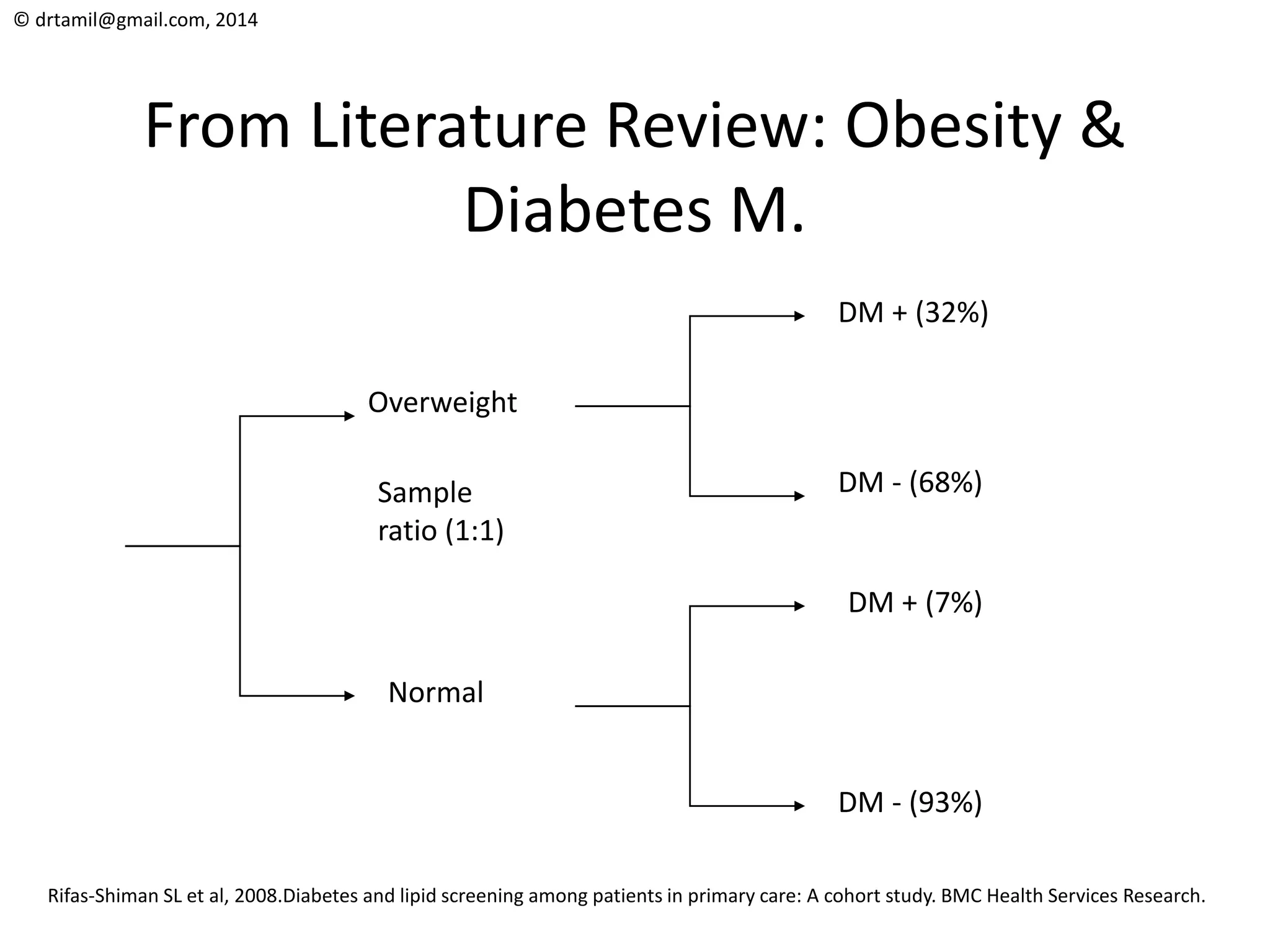
From Literature Review: Obesity &
Diabetes M.
Normal
Overweight
DM - (68%)
DM + (32%)
DM + (7%)
DM - (93%)
Sample
ratio (1:1)
Rifas-Shiman SL et al, 2008.Diabetes and lipid screening among patients in primary care: A cohort study. BMC Health Services Research.
© drtamil@gmail.com, 2014
Calculate Manually
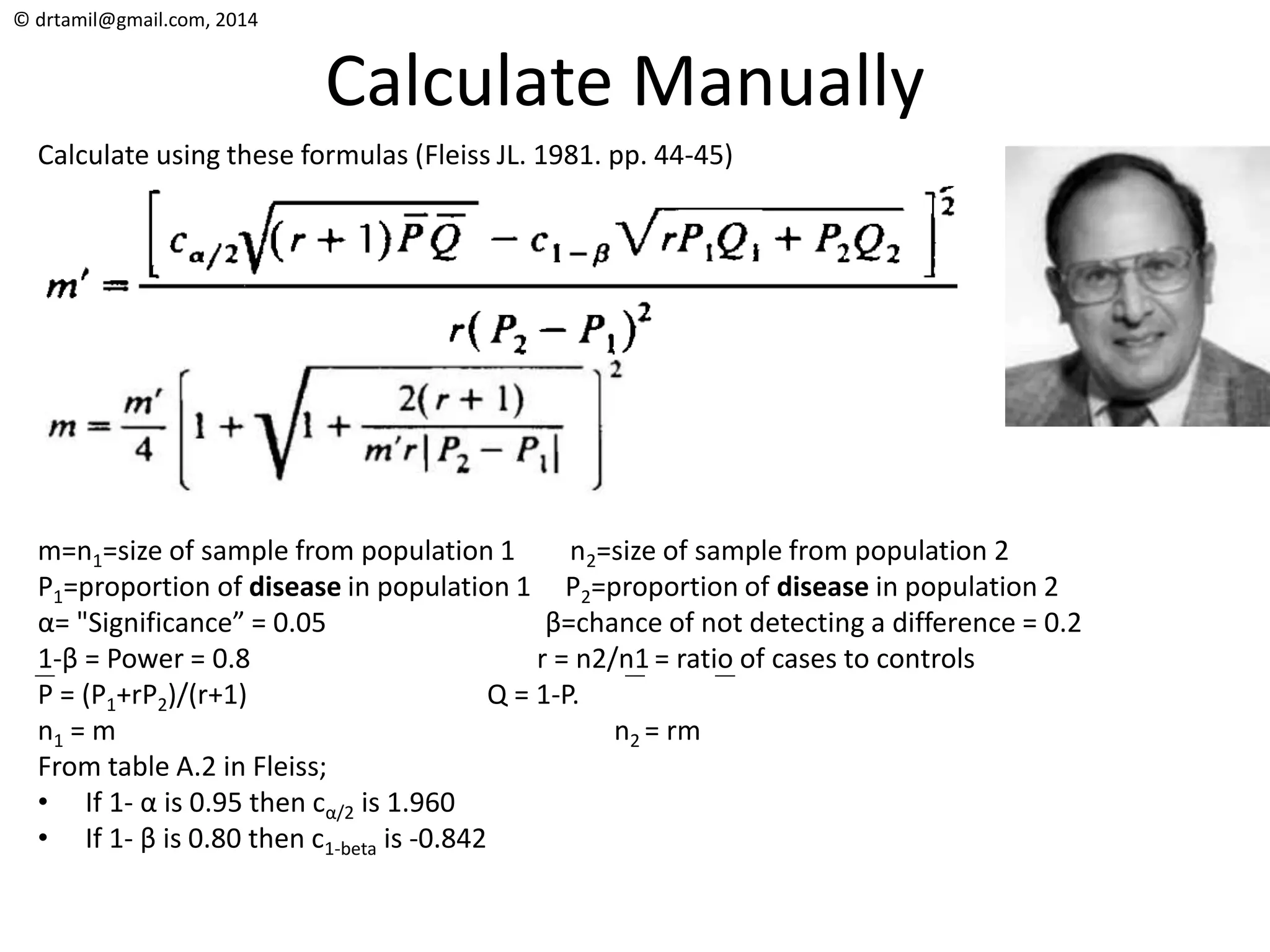
Calculate using these formulas (Fleiss JL. 1981. pp. 44-45)
m=n1=size of sample from population 1 n2=size of sample from population 2
P1=proportion of disease in population 1 P2=proportion of disease in population 2
α= "Significance” = 0.05 β=chance of not detecting a difference = 0.2
1-β = Power = 0.8 r = n2/n1 = ratio of cases to controls
P = (P1+rP2)/(r+1) Q = 1-P.
n1 = m n2 = rm
From table A.2 in Fleiss;
• If 1- α is 0.95 then cα/2 is 1.960
• If 1- β is 0.80 then c1-beta is -0.842
© drtamil@gmail.com, 2014
Calculate Manually
© drtamil@gmail.com, 2014
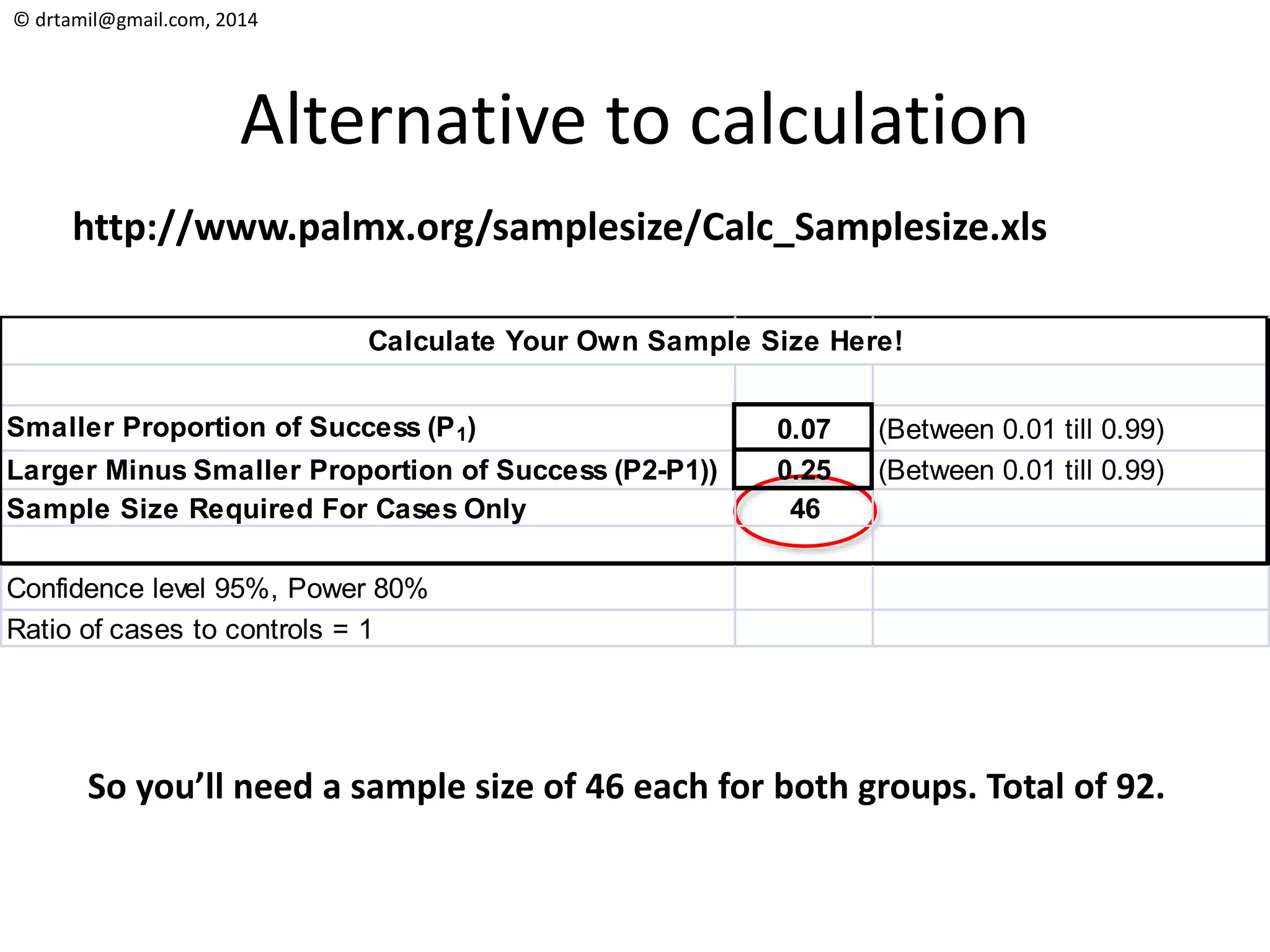
Alternative to calculation
http://www.palmx.org/samplesize/Calc_Samplesize.xls
Smaller Proportion of Success (P1) 0.07 (Between 0.01 till 0.99)
Larger Minus Smaller Proportion of Success (P2-P1)) 0.25 (Between 0.01 till 0.99)
Sample Size Required For Cases Only 46
Confidence level 95%, Power 80%
Ratio of cases to controls = 1
Calculate Your Own Sample Size Here!
So you’ll need a sample size of 46 each for both groups. Total of 92.
© drtamil@gmail.com, 2014
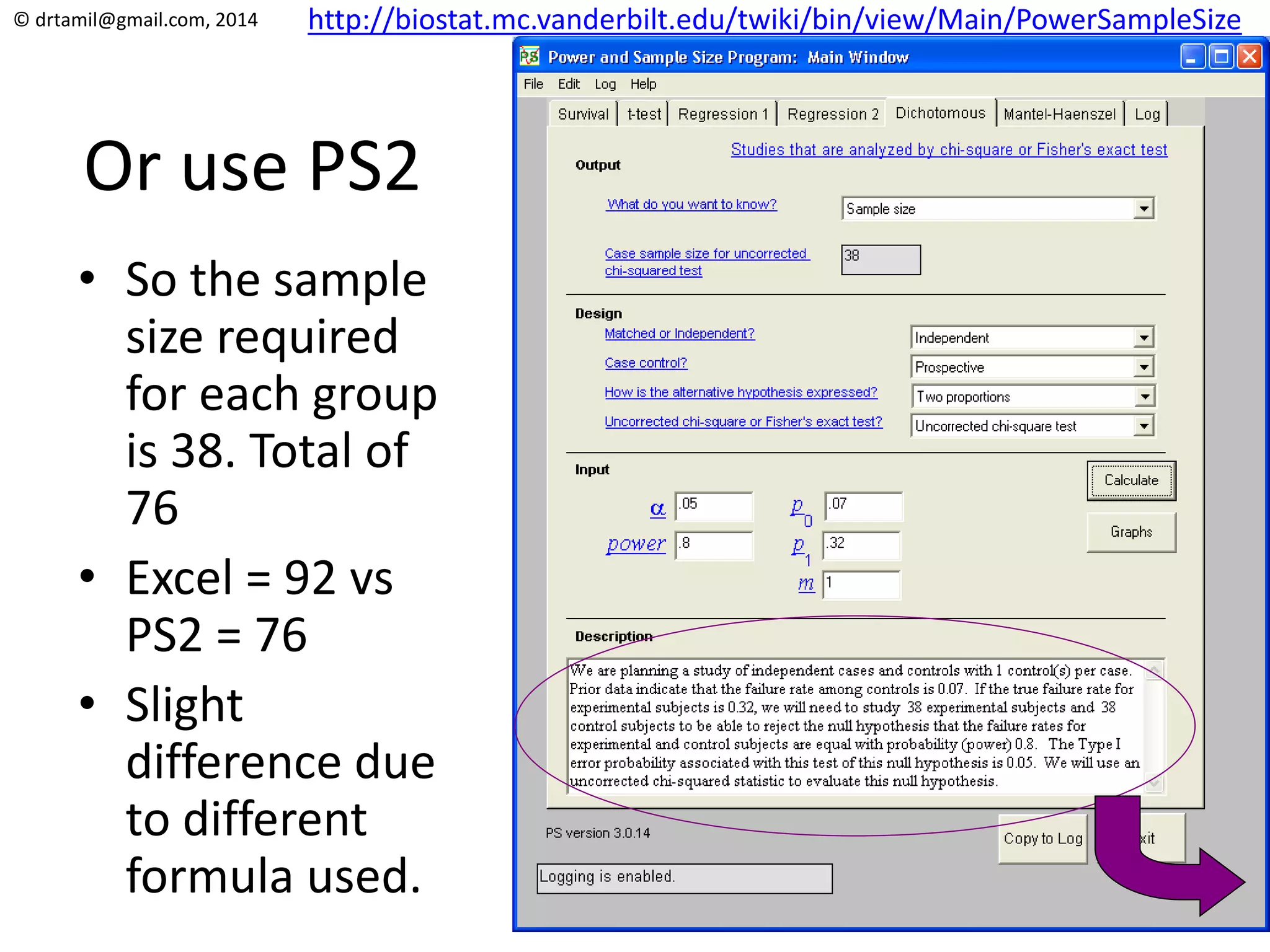
Or use PS2
• So the sample
size required
for each group
is 38. Total of
76
• Excel = 92 vs
PS2 = 76
• Slight
difference due
to different
formula used.
http://biostat.mc.vanderbilt.edu/twiki/bin/view/Main/PowerSampleSize
© drtamil@gmail.com, 2014
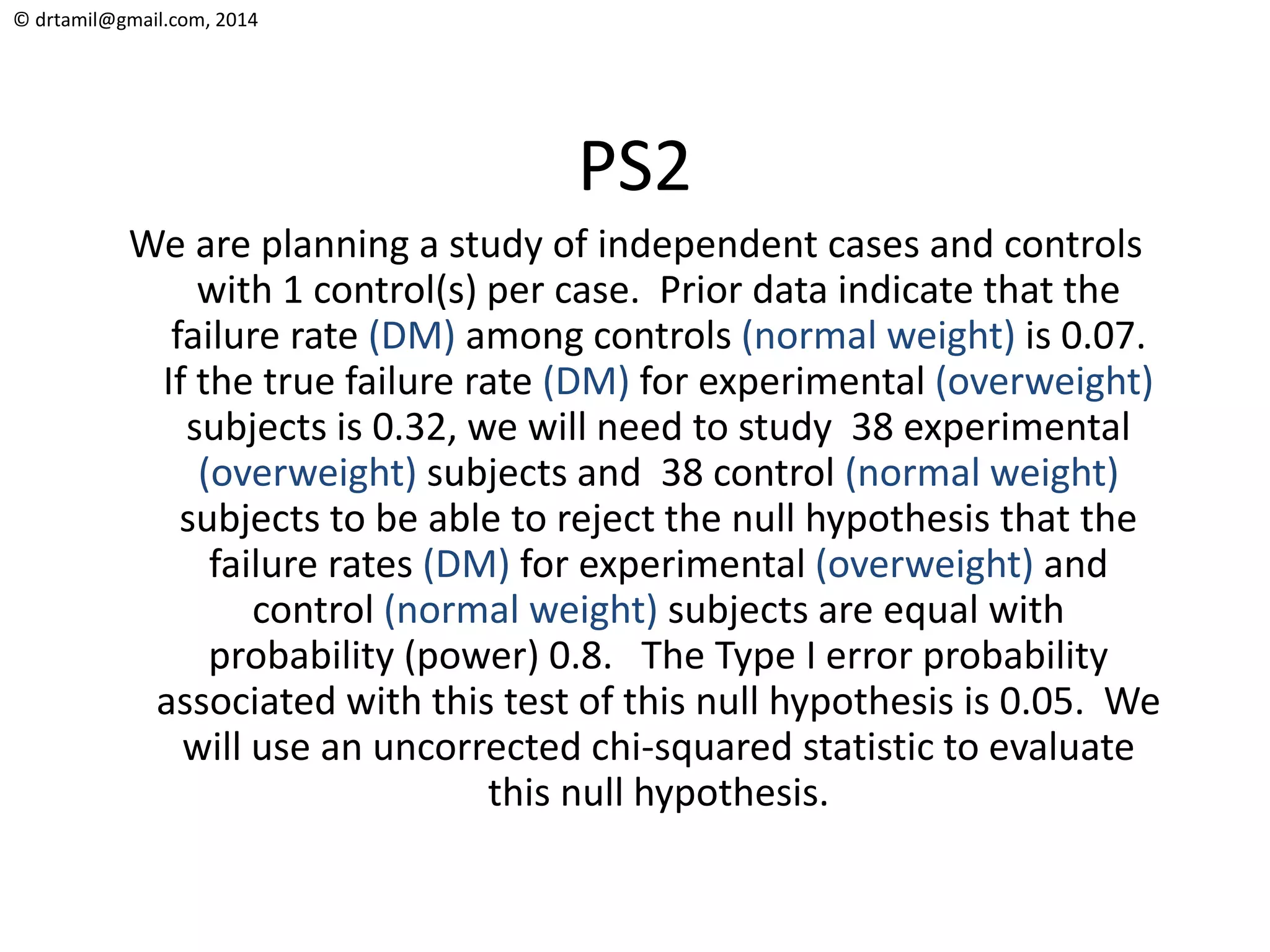
PS2
We are planning a study of independent cases and controls
with 1 control(s) per case. Prior data indicate that the
failure rate (DM) among controls (normal weight) is 0.07.
If the true failure rate (DM) for experimental (overweight)
subjects is 0.32, we will need to study 38 experimental
(overweight) subjects and 38 control (normal weight)
subjects to be able to reject the null hypothesis that the
failure rates (DM) for experimental (overweight) and
control (normal weight) subjects are equal with
probability (power) 0.8. The Type I error probability
associated with this test of this null hypothesis is 0.05. We
will use an uncorrected chi-squared statistic to evaluate
this null hypothesis.
© drtamil@gmail.com, 2014
Sample size calculation -
Outcome is continuous data
Jones SR, Carley S & Harrison M.
An introduction to power and sample size estimation.
Emergency Medical Journal 2003;20;453-458. 2003
© drtamil@gmail.com, 2014
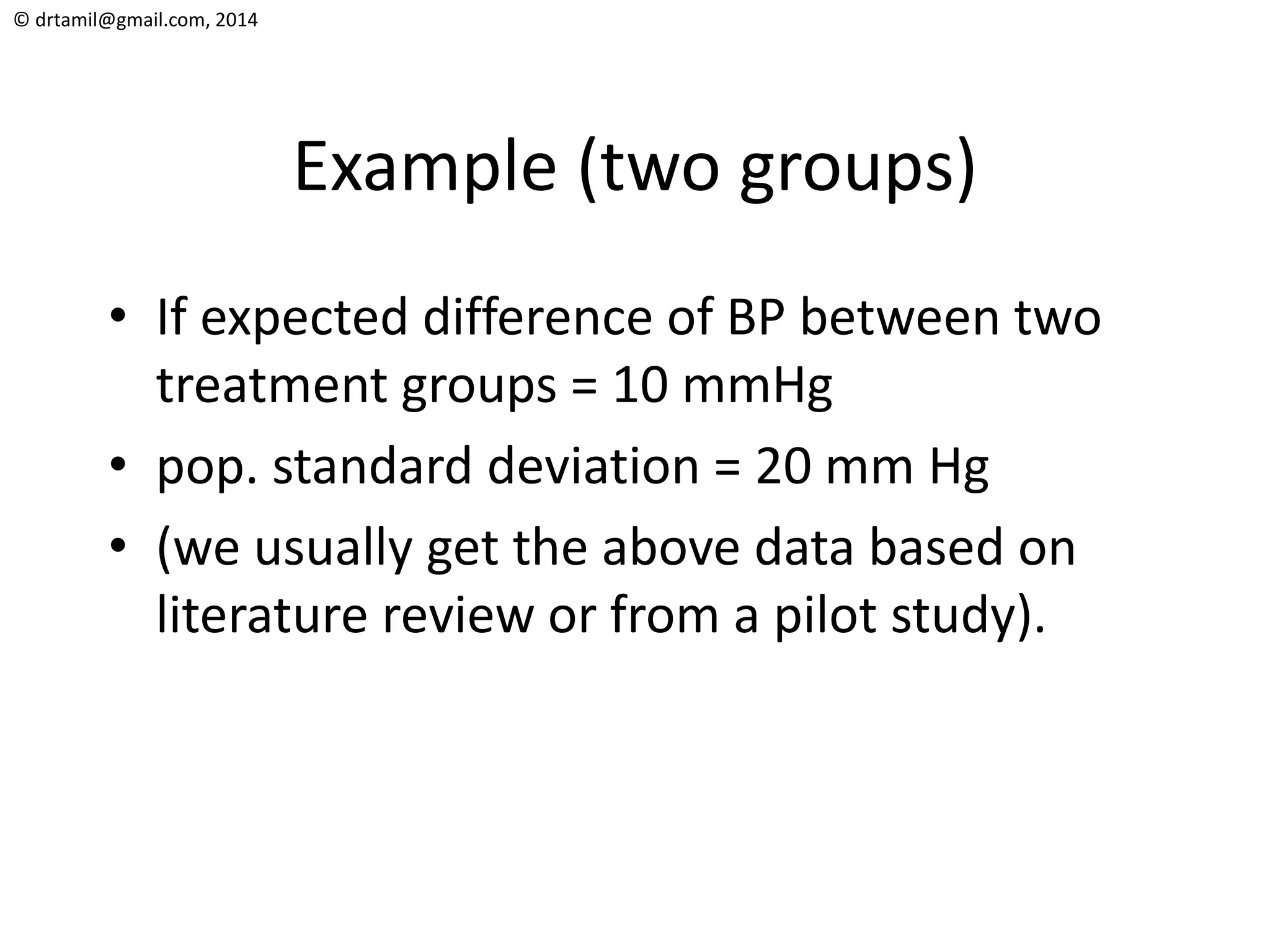
Example (two groups)
• If expected difference of BP between two
treatment groups = 10 mmHg
• pop. standard deviation = 20 mm Hg
• (we usually get the above data based on
literature review or from a pilot study).
© drtamil@gmail.com, 2014
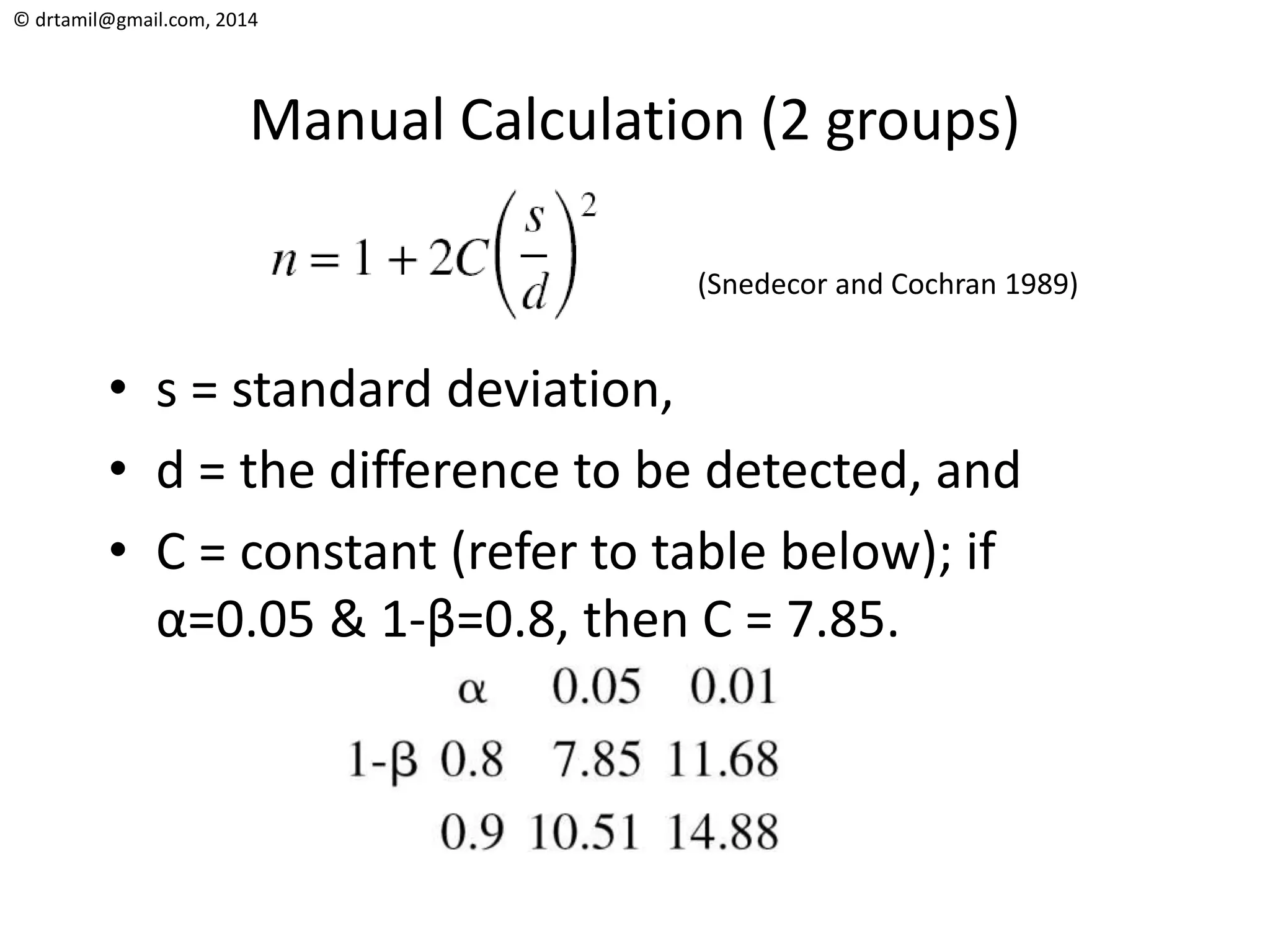
Manual Calculation (2 groups)
• s = standard deviation,
• d = the difference to be detected, and
• C = constant (refer to table below); if
α=0.05 & 1-β=0.8, then C = 7.85.
(Snedecor and Cochran 1989)
© drtamil@gmail.com, 2014
Manual Calculation
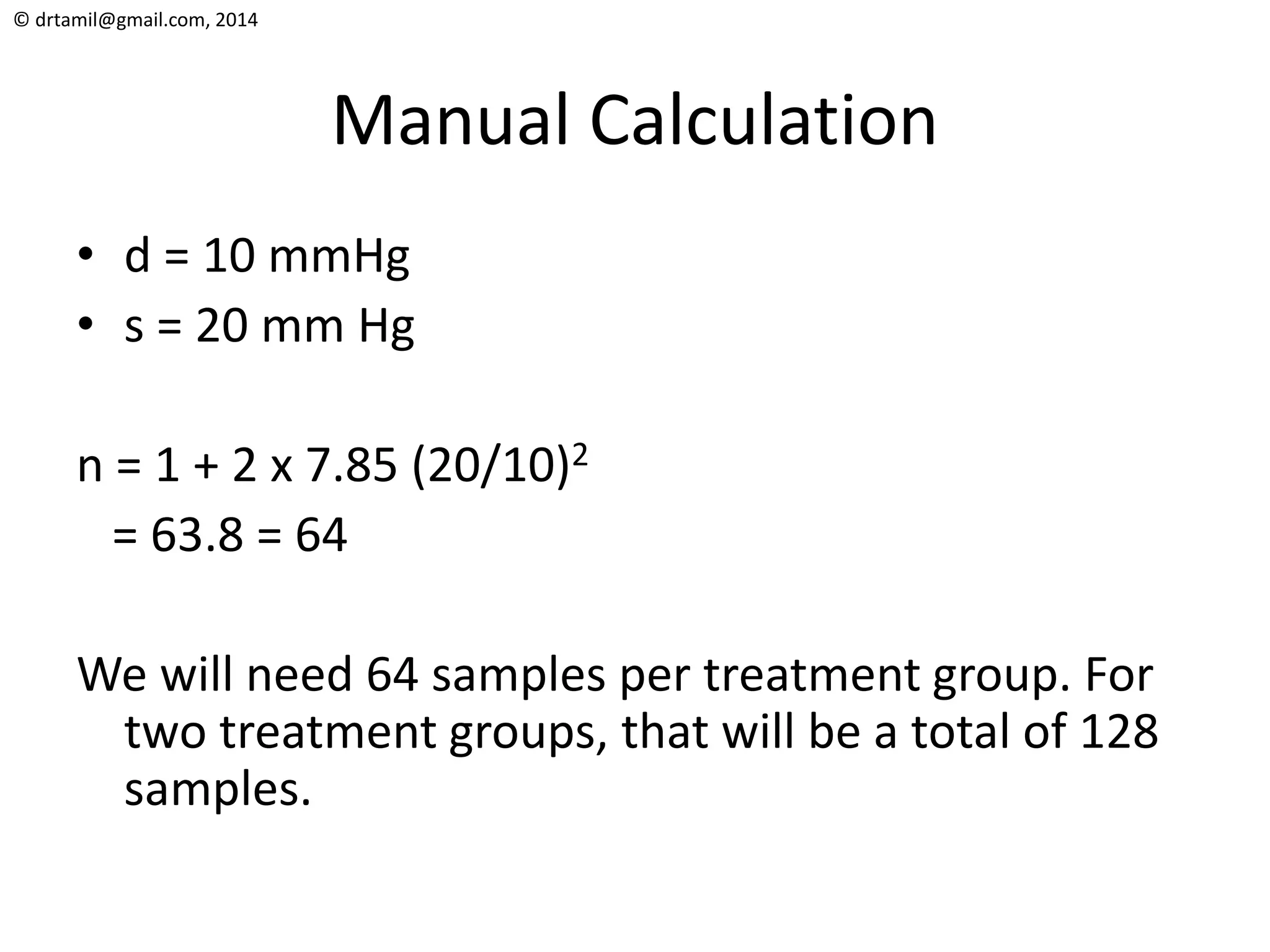
• d = 10 mmHg
• s = 20 mm Hg
n = 1 + 2 x 7.85 (20/10)2
= 63.8 = 64
We will need 64 samples per treatment group. For
two treatment groups, that will be a total of 128
samples.
© drtamil@gmail.com, 2014
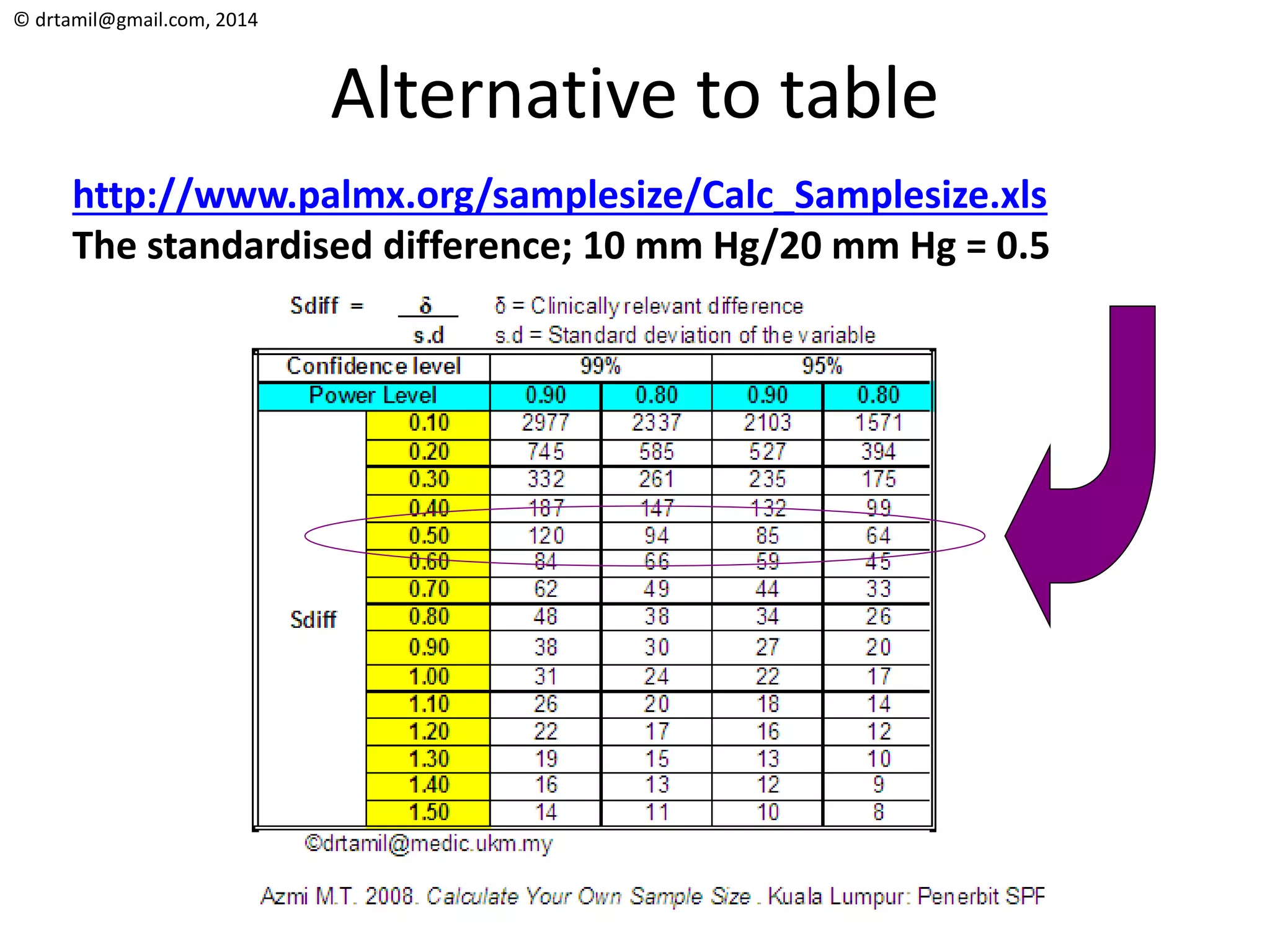
Alternative to table
http://www.palmx.org/samplesize/Calc_Samplesize.xls
The standardised difference; 10 mm Hg/20 mm Hg = 0.5
© drtamil@gmail.com, 2014
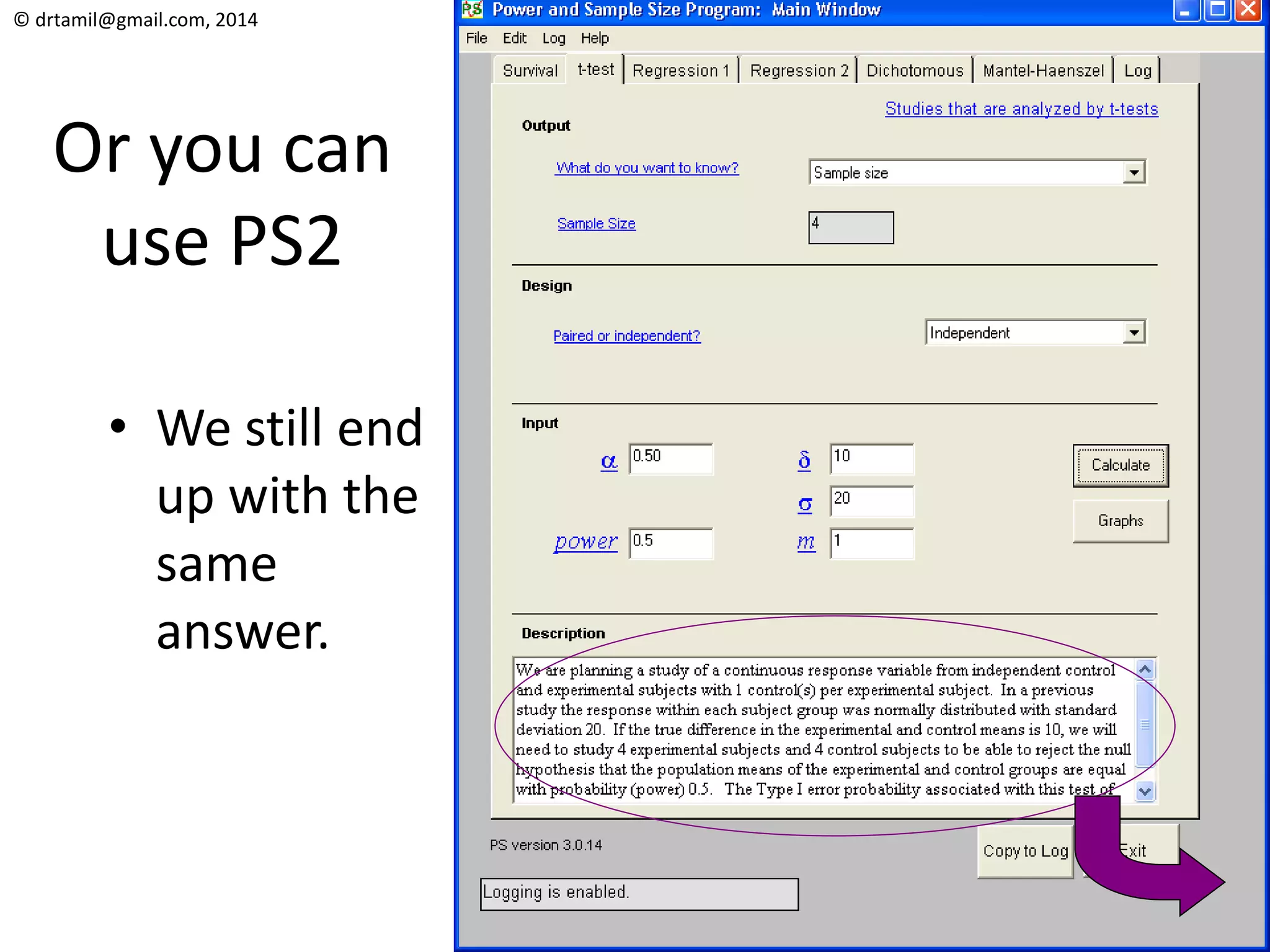
Or you can
use PS2
• We still end
up with the
same
answer.
© drtamil@gmail.com, 2014
PS2
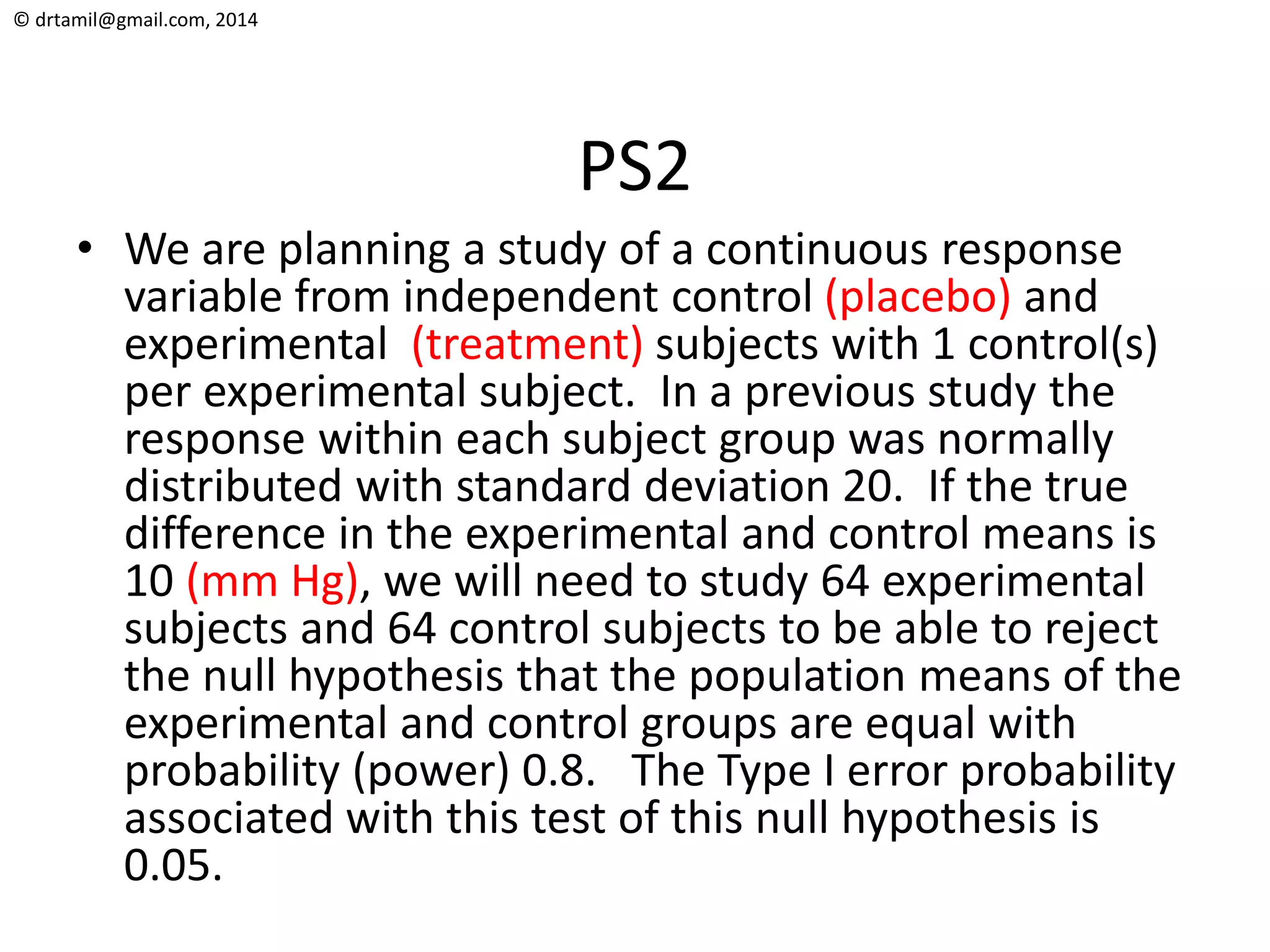
• We are planning a study of a continuous response
variable from independent control (placebo) and
experimental (treatment) subjects with 1 control(s)
per experimental subject. In a previous study the
response within each subject group was normally
distributed with standard deviation 20. If the true
difference in the experimental and control means is
10 (mm Hg), we will need to study 64 experimental
subjects and 64 control subjects to be able to reject
the null hypothesis that the population means of the
experimental and control groups are equal with
probability (power) 0.8. The Type I error probability
associated with this test of this null hypothesis is
0.05.
© drtamil@gmail.com, 2014
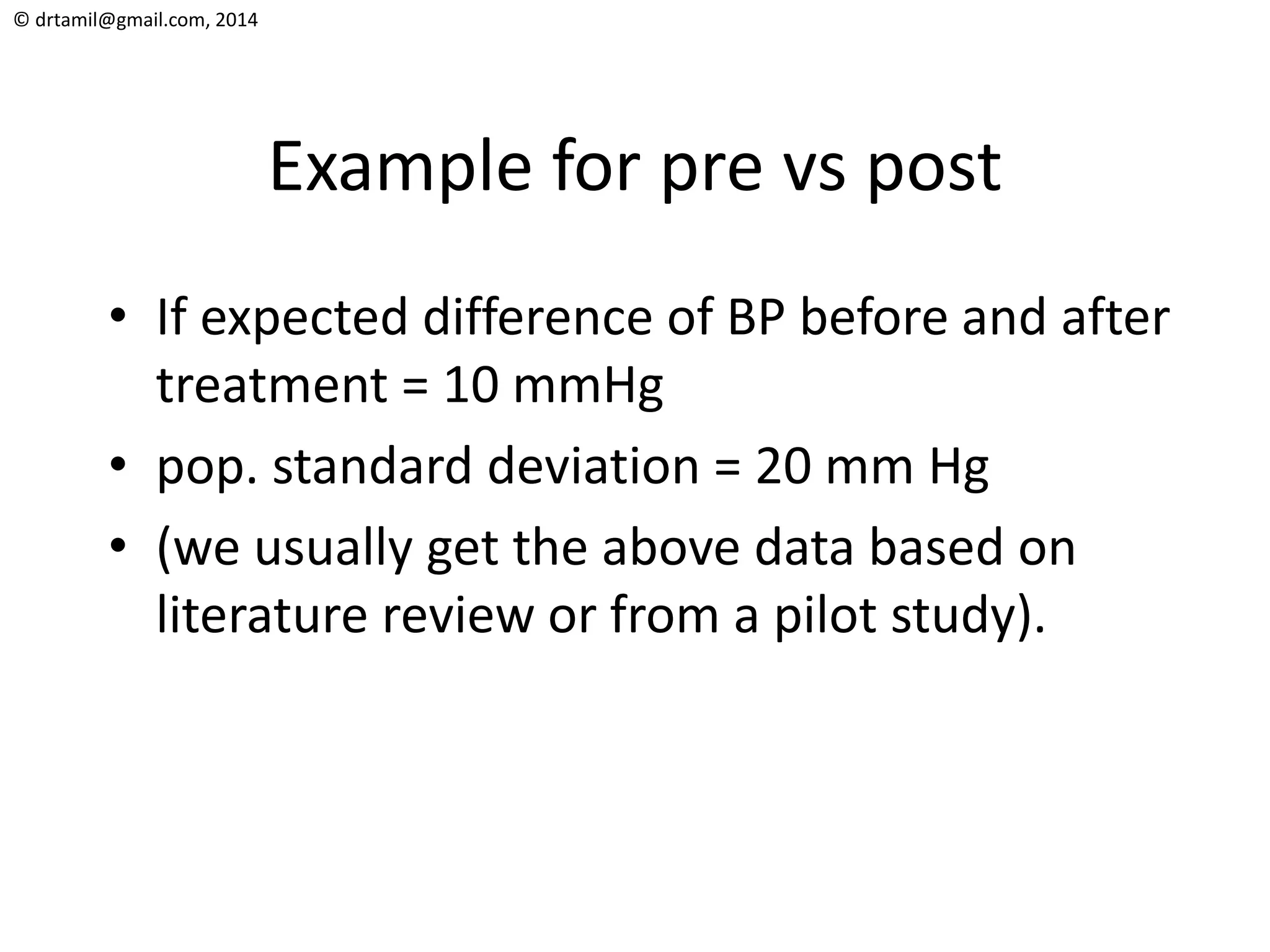
Example for pre vs post
• If expected difference of BP before and after
treatment = 10 mmHg
• pop. standard deviation = 20 mm Hg
• (we usually get the above data based on
literature review or from a pilot study).
© drtamil@gmail.com, 2014
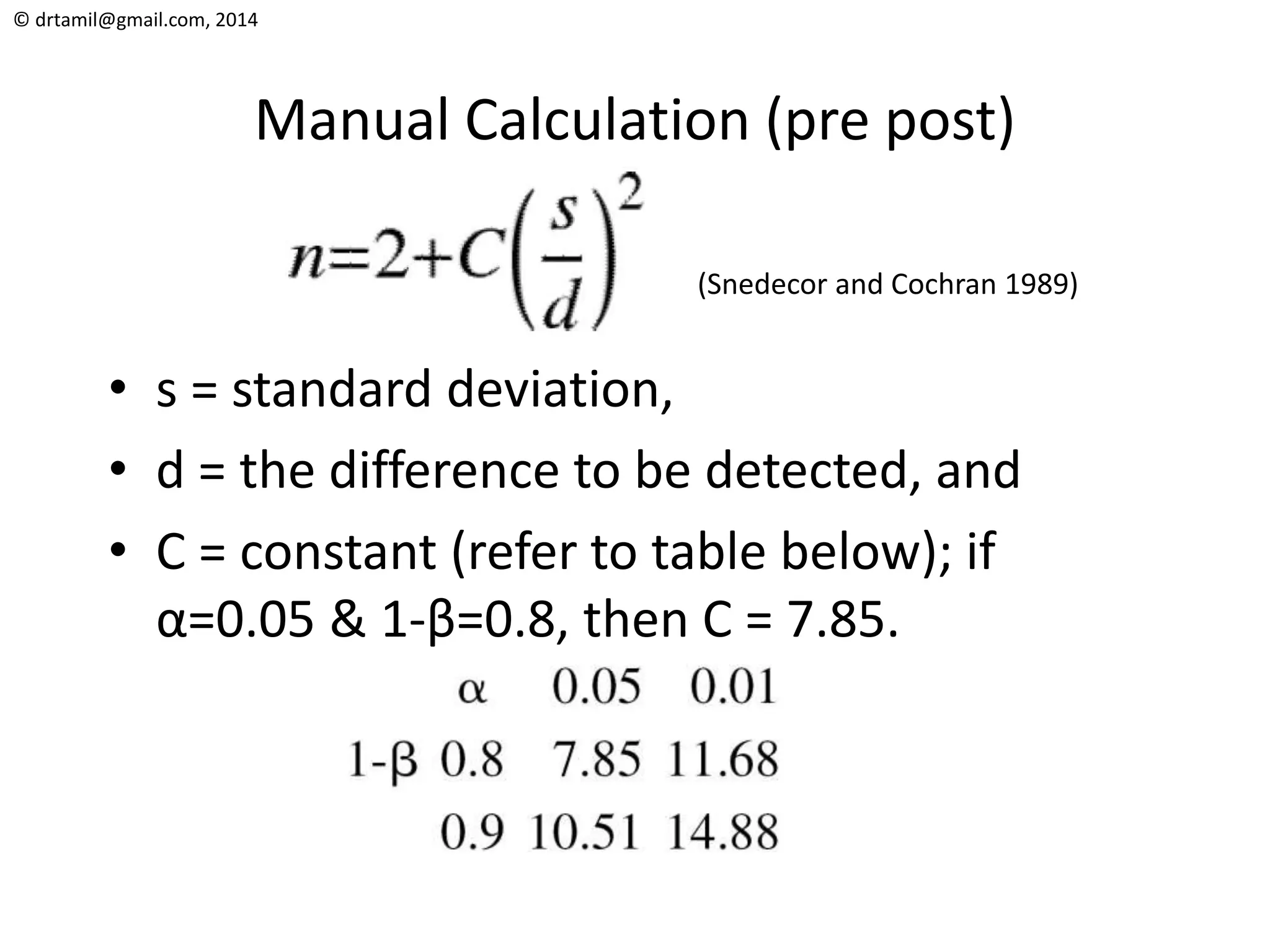
Manual Calculation (pre post)
• s = standard deviation,
• d = the difference to be detected, and
• C = constant (refer to table below); if
α=0.05 & 1-β=0.8, then C = 7.85.
(Snedecor and Cochran 1989)
© drtamil@gmail.com, 2014
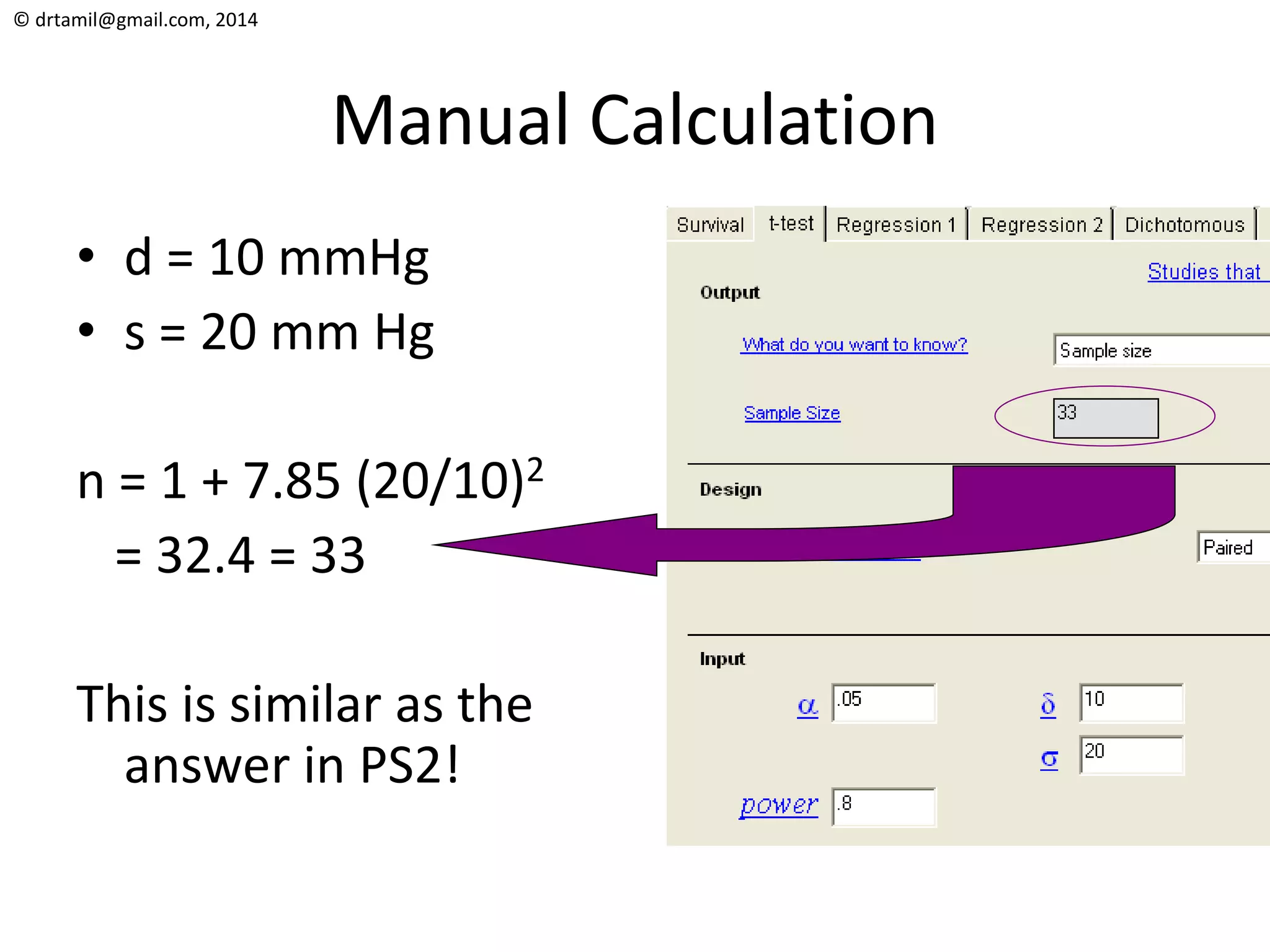
Manual Calculation
• d = 10 mmHg
• s = 20 mm Hg
n = 1 + 7.85 (20/10)2
= 32.4 = 33
This is similar as the
answer in PS2!
© drtamil@gmail.com, 2014
Next
Exploring your data

Sample size calculation - a brief overview

  • 1.
    © drtamil@gmail.com, 2014 Samplesize calculation Research Week 2014 Health Cluster UKM
  • 2.
    © drtamil@gmail.com, 2014 Introduction •This is an abbreviated set of slides on how to calculate sample size. • It will focus on those with – Measuring prevalence/incidence for outcome – Qualitative outcome (i.e. Dead vs Alive) – Continuous outcome (i.e. drop of BP in mm Hg) for commonly used study designs in PPUKM. • Those who want the complete set of slides for calculating sample size, please refer to next page;
  • 3.
    © drtamil@gmail.com, 2014 SampleSize Calculation on Slideshare 1. Why do we need to calculate sample size? 2. Tools to calculate sample size 3. Calculate sample size for prevalence studies 4. Calculate sample size for cross-sectional studies 5. Calculate sample size for case-control studies 6. Calculate sample size for cohort studies 7. Calculate sample size for clinical trials 8. Calculate sample size for clinical trials (continuous outcome) 9. Calculate sample size for diagnostic study 10. eBook
  • 4.
    © drtamil@gmail.com, 2014 Measuringprevalence Calculate sample size
  • 5.
    © drtamil@gmail.com, 2014 Prevalence •If the objective of your study is to measure the prevalence of the outcome of interest, then you will be conducting a cross-sectional study. So you will only take a sample of your population. The number of sample selected depends on the expected prevalence rate. • To estimate the expected prevalence rate, you will need to do a literature review, hopefully similar to your own population.
  • 6.
    © drtamil@gmail.com, 2014 Prevalence– Sample size • Do a literature review to estimate the prevalence for the outcome of interest being studied. • Determine the absolute precision required i.e. 5% (usually between 3% to 5%). • Calculate manually using (Kish L. 1965) n = (Z1-α)2(P(1-P)/D2) • Or use the attached Excel file.
  • 7.
    © drtamil@gmail.com, 2014 Example– To determine Prevalence of Obesity • Confidence interval = 1 - α = 95%; Z1-α = Z0.95 = 1.96 (value is fixed at 1.96) (from normal distribution table, area under curve =0.475x2=0.95 when z=1.96). • Prevalence = P = 20% • Absolute precision required = 5 percentage points, (means that if the calculated prevalence of obesity is 20%, then the true value of the prevalence lies between 15-25%).
  • 8.
    © drtamil@gmail.com, 2014 CalculateManually • n = (Z1-α)2(P(1-P)/D2) where • Z1-α = Z0.95 = 1.96 (from normal distribution table. This value of 1.96 is standard for CI of 95%). • P = 20% = 0.2 in this example • D = 5% = 0.05 in this example • n = 1.962 x (0.2(1-0.2)/0.052) = 245.84 • So the sample size required is 246.
  • 9.
    © drtamil@gmail.com, 2014 Alternativeto calculation http://www.palmx.org/samplesize/Calc_Samplesize.xls
  • 10.
    © drtamil@gmail.com, 2014 Reminder •If the prevalence for the outcome of interest is less than 5%, you should not be doing a cross- sectional study, instead you should be doing a case-control study. • If your supervisor still insists that you do x- sectional study, then the level of precision should be half of the prevalence; i.e. prevalence of HIV among STD patients is 4% therefore accuracy (d) must be set at 2%. Therefore the required sample size would be 369, not 59.
  • 11.
    © drtamil@gmail.com, 2014 ExpectedPrevalence (P) 0.04 (Between 0.01 till 0.99) Level of Accuracy (d) 0.02 (Usually between 0.03 till 0.05) Sample Size Required 369 Confidence level 95% Calculate Your Own Sample Size Here! Expected Prevalence (P) 0.04 (Between 0.01 till 0.99) Level of Accuracy (d) 0.05 (Usually between 0.03 till 0.05) Sample Size Required 59 Confidence level 95% Calculate Your Own Sample Size Here! 369 not 59!
  • 12.
    © drtamil@gmail.com, 2014 DichotomousQualitative Outcome Calculate sample size
  • 13.
    © drtamil@gmail.com, 2014 X-sectionalvs cohort vs case control vs clinical trial D+ RF+ RF- D - D+ D - Ratio not (1:1) X-sectional D+ D- RF - RF+ RF- Ratio usually (1:1) Case-Control D - RF+ RF- D - D+ Ratio usually (1:1) Cohort D+ RF+ T+ T- C - C+ C - Ratio usually (1:1) Clinical Trial C+
  • 14.
    © drtamil@gmail.com, 2014 X-sectionalvs cohort vs case control vs clinical trial D+ RF+ RF- D - D+ D - Ratio not (1:1) X-sectional D+ D- RF - RF+ RF- Ratio usually (1:1) Case-Control D - RF+ RF- D - D+ Ratio usually (1:1) Cohort D+ RF+ T+ T- C - C+ C - Ratio usually (1:1) Clinical Trial C+
  • 15.
    © drtamil@gmail.com, 2014 Example– overweight have higher risk of DM From literature review, identify the rate of disease among those with & without the risk factor. • Ratio of unexposed (Normal) vs exposed (Overweight); 1:1 • Equal ratio therefore equal proportion of sample from no-risk (Normal) and from at-risk (Overweight) population. • P1=true proportion of DM in no-risk (Normal) population = 7% • P2=true proportion of DM in at-risk (Overweight) population =32% • (Rifas-Shiman SL et al, 2008.Diabetes and lipid screening among patients in primary care: A cohort study. BMC Health Services Research.)
  • 16.
    © drtamil@gmail.com, 2014 FromLiterature Review: Obesity & Diabetes M. Normal Overweight DM - (68%) DM + (32%) DM + (7%) DM - (93%) Sample ratio (1:1) Rifas-Shiman SL et al, 2008.Diabetes and lipid screening among patients in primary care: A cohort study. BMC Health Services Research.
  • 17.
    © drtamil@gmail.com, 2014 CalculateManually Calculate using these formulas (Fleiss JL. 1981. pp. 44-45) m=n1=size of sample from population 1 n2=size of sample from population 2 P1=proportion of disease in population 1 P2=proportion of disease in population 2 α= "Significance” = 0.05 β=chance of not detecting a difference = 0.2 1-β = Power = 0.8 r = n2/n1 = ratio of cases to controls P = (P1+rP2)/(r+1) Q = 1-P. n1 = m n2 = rm From table A.2 in Fleiss; • If 1- α is 0.95 then cα/2 is 1.960 • If 1- β is 0.80 then c1-beta is -0.842
  • 18.
  • 19.
    © drtamil@gmail.com, 2014 Alternativeto calculation http://www.palmx.org/samplesize/Calc_Samplesize.xls Smaller Proportion of Success (P1) 0.07 (Between 0.01 till 0.99) Larger Minus Smaller Proportion of Success (P2-P1)) 0.25 (Between 0.01 till 0.99) Sample Size Required For Cases Only 46 Confidence level 95%, Power 80% Ratio of cases to controls = 1 Calculate Your Own Sample Size Here! So you’ll need a sample size of 46 each for both groups. Total of 92.
  • 20.
    © drtamil@gmail.com, 2014 Oruse PS2 • So the sample size required for each group is 38. Total of 76 • Excel = 92 vs PS2 = 76 • Slight difference due to different formula used. http://biostat.mc.vanderbilt.edu/twiki/bin/view/Main/PowerSampleSize
  • 21.
    © drtamil@gmail.com, 2014 PS2 Weare planning a study of independent cases and controls with 1 control(s) per case. Prior data indicate that the failure rate (DM) among controls (normal weight) is 0.07. If the true failure rate (DM) for experimental (overweight) subjects is 0.32, we will need to study 38 experimental (overweight) subjects and 38 control (normal weight) subjects to be able to reject the null hypothesis that the failure rates (DM) for experimental (overweight) and control (normal weight) subjects are equal with probability (power) 0.8. The Type I error probability associated with this test of this null hypothesis is 0.05. We will use an uncorrected chi-squared statistic to evaluate this null hypothesis.
  • 22.
    © drtamil@gmail.com, 2014 Samplesize calculation - Outcome is continuous data Jones SR, Carley S & Harrison M. An introduction to power and sample size estimation. Emergency Medical Journal 2003;20;453-458. 2003
  • 23.
    © drtamil@gmail.com, 2014 Example(two groups) • If expected difference of BP between two treatment groups = 10 mmHg • pop. standard deviation = 20 mm Hg • (we usually get the above data based on literature review or from a pilot study).
  • 24.
    © drtamil@gmail.com, 2014 ManualCalculation (2 groups) • s = standard deviation, • d = the difference to be detected, and • C = constant (refer to table below); if α=0.05 & 1-β=0.8, then C = 7.85. (Snedecor and Cochran 1989)
  • 25.
    © drtamil@gmail.com, 2014 ManualCalculation • d = 10 mmHg • s = 20 mm Hg n = 1 + 2 x 7.85 (20/10)2 = 63.8 = 64 We will need 64 samples per treatment group. For two treatment groups, that will be a total of 128 samples.
  • 26.
    © drtamil@gmail.com, 2014 Alternativeto table http://www.palmx.org/samplesize/Calc_Samplesize.xls The standardised difference; 10 mm Hg/20 mm Hg = 0.5
  • 27.
    © drtamil@gmail.com, 2014 Oryou can use PS2 • We still end up with the same answer.
  • 28.
    © drtamil@gmail.com, 2014 PS2 •We are planning a study of a continuous response variable from independent control (placebo) and experimental (treatment) subjects with 1 control(s) per experimental subject. In a previous study the response within each subject group was normally distributed with standard deviation 20. If the true difference in the experimental and control means is 10 (mm Hg), we will need to study 64 experimental subjects and 64 control subjects to be able to reject the null hypothesis that the population means of the experimental and control groups are equal with probability (power) 0.8. The Type I error probability associated with this test of this null hypothesis is 0.05.
  • 29.
    © drtamil@gmail.com, 2014 Examplefor pre vs post • If expected difference of BP before and after treatment = 10 mmHg • pop. standard deviation = 20 mm Hg • (we usually get the above data based on literature review or from a pilot study).
  • 30.
    © drtamil@gmail.com, 2014 ManualCalculation (pre post) • s = standard deviation, • d = the difference to be detected, and • C = constant (refer to table below); if α=0.05 & 1-β=0.8, then C = 7.85. (Snedecor and Cochran 1989)
  • 31.
    © drtamil@gmail.com, 2014 ManualCalculation • d = 10 mmHg • s = 20 mm Hg n = 1 + 7.85 (20/10)2 = 32.4 = 33 This is similar as the answer in PS2!
  • 32.