Random Sampling
Techniques
Learning Outcomes
Students should be
able to define essential
concepts in sampling.
Students should be
able to identify
different sampling
methods.
1 2
Topics for Discussion
Definition of Terms
Advantages of Sampling
Non-Probability Sampling
1
2
3
4
Probability Sampling
It refers to a collection of individuals who share one or more
noteworthy traits that are of interest to the researcher. The
population may be all the individuals belonging to a specific
category or a narrower subset within that larger group.
POPULATION
It is a small portion of the population selected for observation
and analysis.
SAMPLE
It is the procedure of getting a small portion of the population
for research.
SAMPLING
Definition of
Terms
Advantages of
Sampling
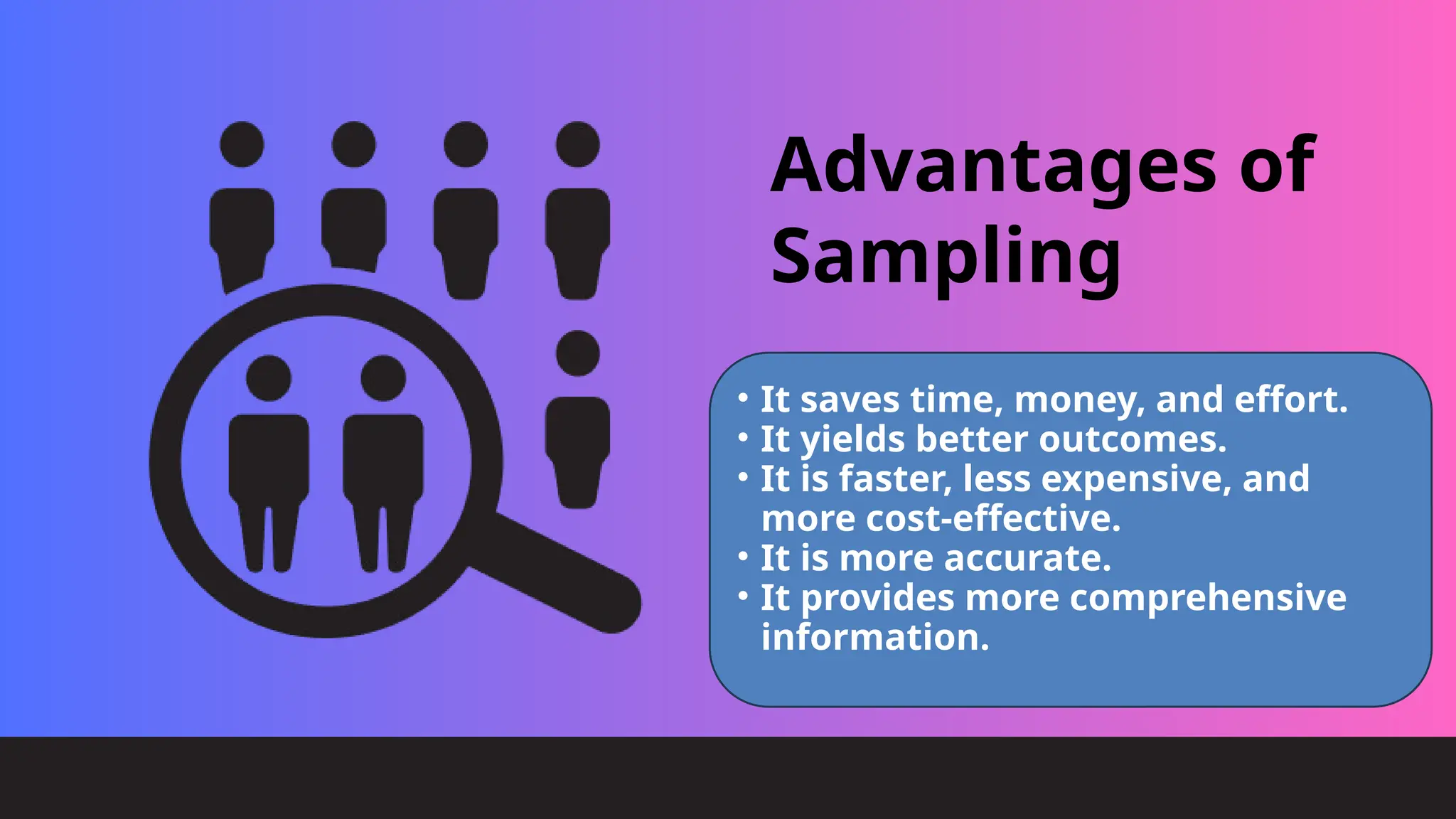
• It saves time, money, and effort.
• It yields better outcomes.
• It is faster, less expensive, and
more cost-effective.
• It is more accurate.
• It provides more comprehensive
information.
Random
Sampling
Every member of the population has a
probability of being selected or included
in the sample.
Random Sampling
It is a sampling method of choosing
representatives from the population
wherein every sample has an equal
chance of being selected. Accurate
data can be collected using random
sampling techniques.
Random Sampling Techniques
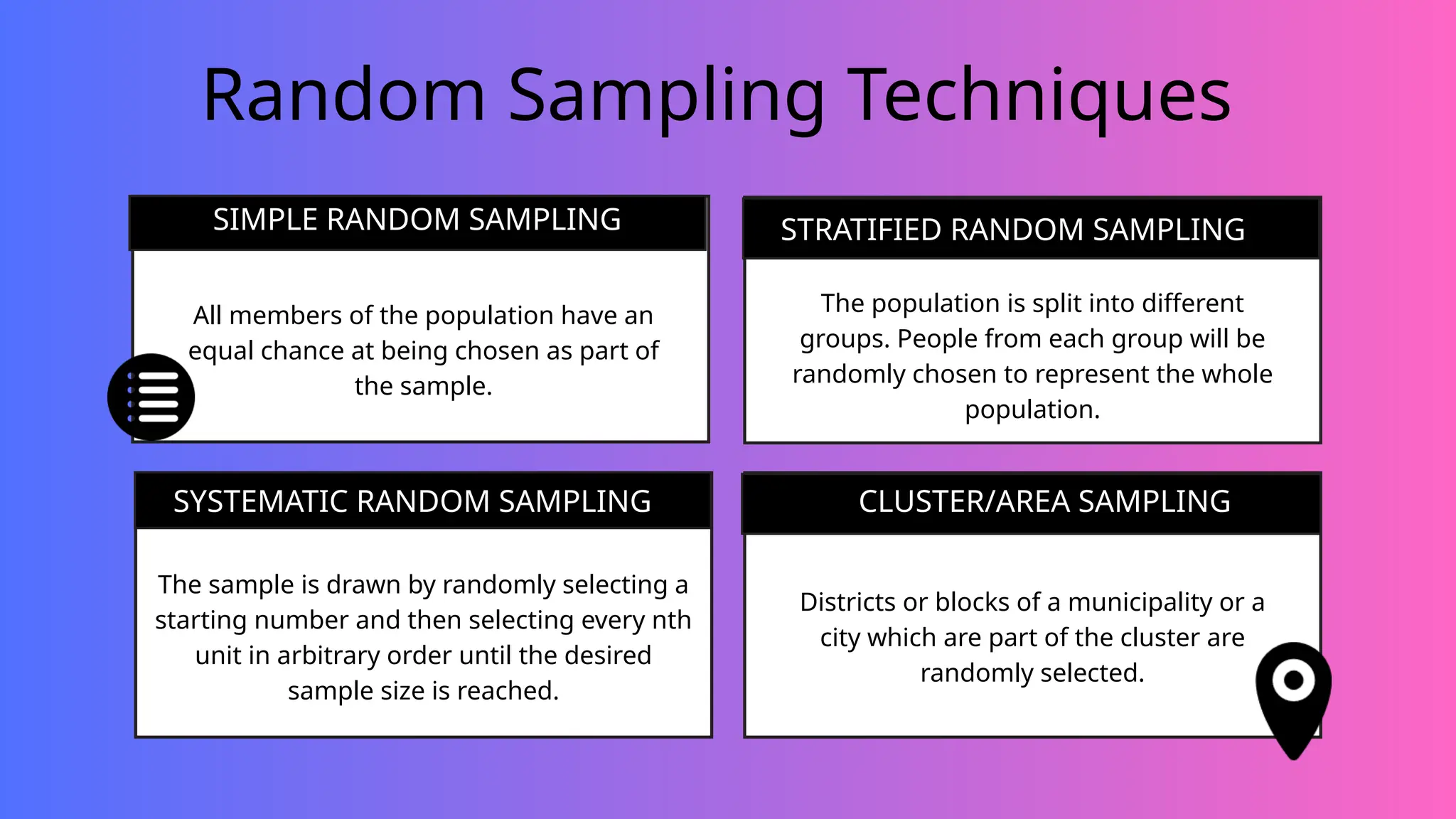
SIMPLE RANDOM SAMPLING
All members of the population have an
equal chance at being chosen as part of
the sample.
STRATIFIED RANDOM SAMPLING
The population is split into different
groups. People from each group will be
randomly chosen to represent the whole
population.
The sample is drawn by randomly selecting a
starting number and then selecting every nth
unit in arbitrary order until the desired
sample size is reached.
SYSTEMATIC RANDOM SAMPLING CLUSTER/AREA SAMPLING
Districts or blocks of a municipality or a
city which are part of the cluster are
randomly selected.
SIMPLE RANDOM SAMPLING
Systematic Random Sampling
This can be done by listing all the elements in the
population and selecting every kth element in your
population list. This is equally precise as the simple
random sampling. It is often used on long population list.
To determine the interval to be used in identifying the
samples to who will participate in the study, use the
formula; K=N/n (population/sample).
Non-Probability
Sampling
The sampling technique that does not
involve random selection of data.
Participants are intentionally selected based
on certain identified factors.
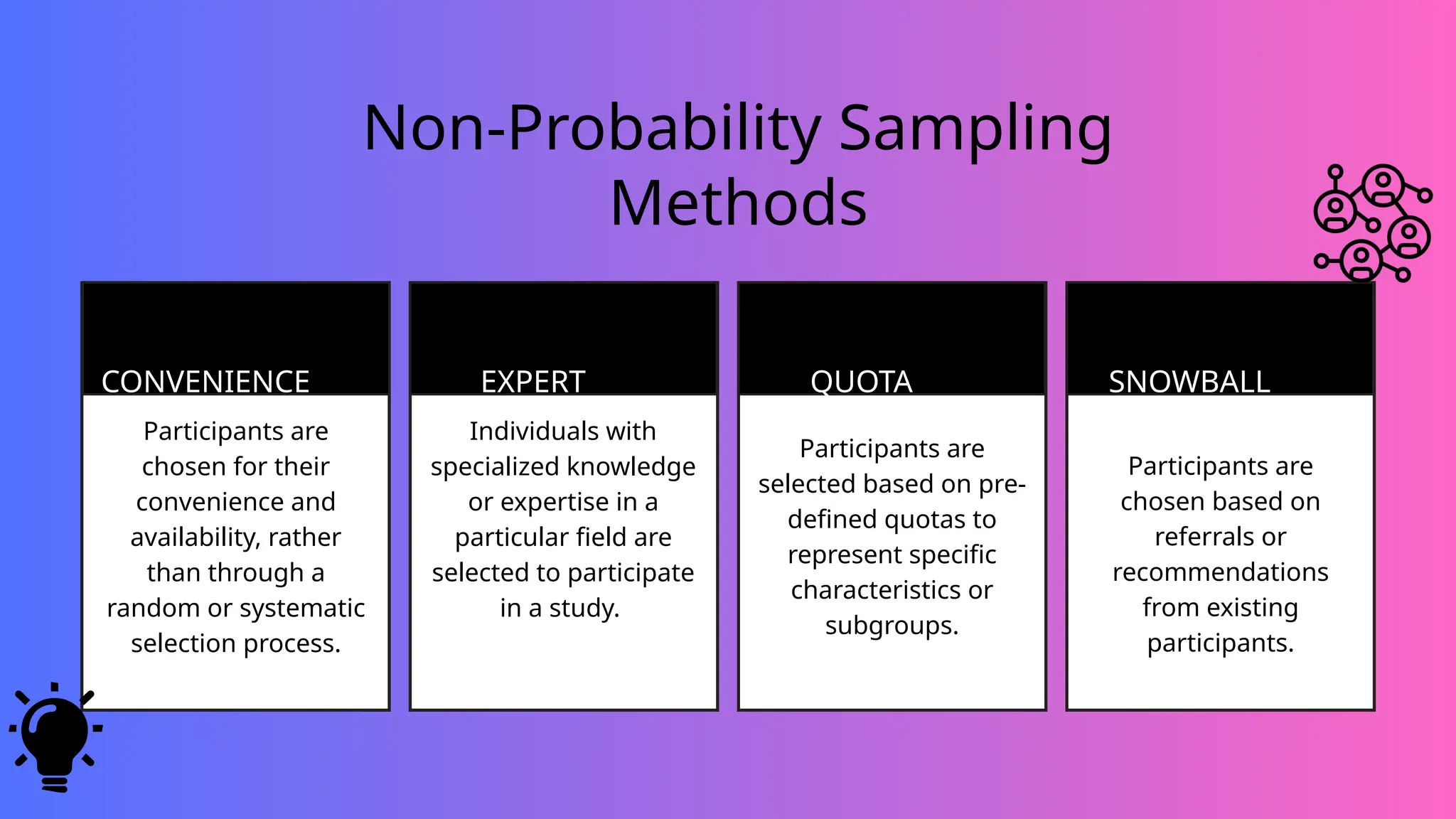
Non-Probability Sampling
Methods
CONVENIENCE
SAMPLING
Participants are
chosen for their
convenience and
availability, rather
than through a
random or systematic
selection process.
EXPERT
SAMPLING
QUOTA
SAMPLING
SNOWBALL
SAMPLING
Individuals with
specialized knowledge
or expertise in a
particular field are
selected to participate
in a study.
Participants are
selected based on pre-
defined quotas to
represent specific
characteristics or
subgroups.
Participants are
chosen based on
referrals or
recommendations
from existing
participants.
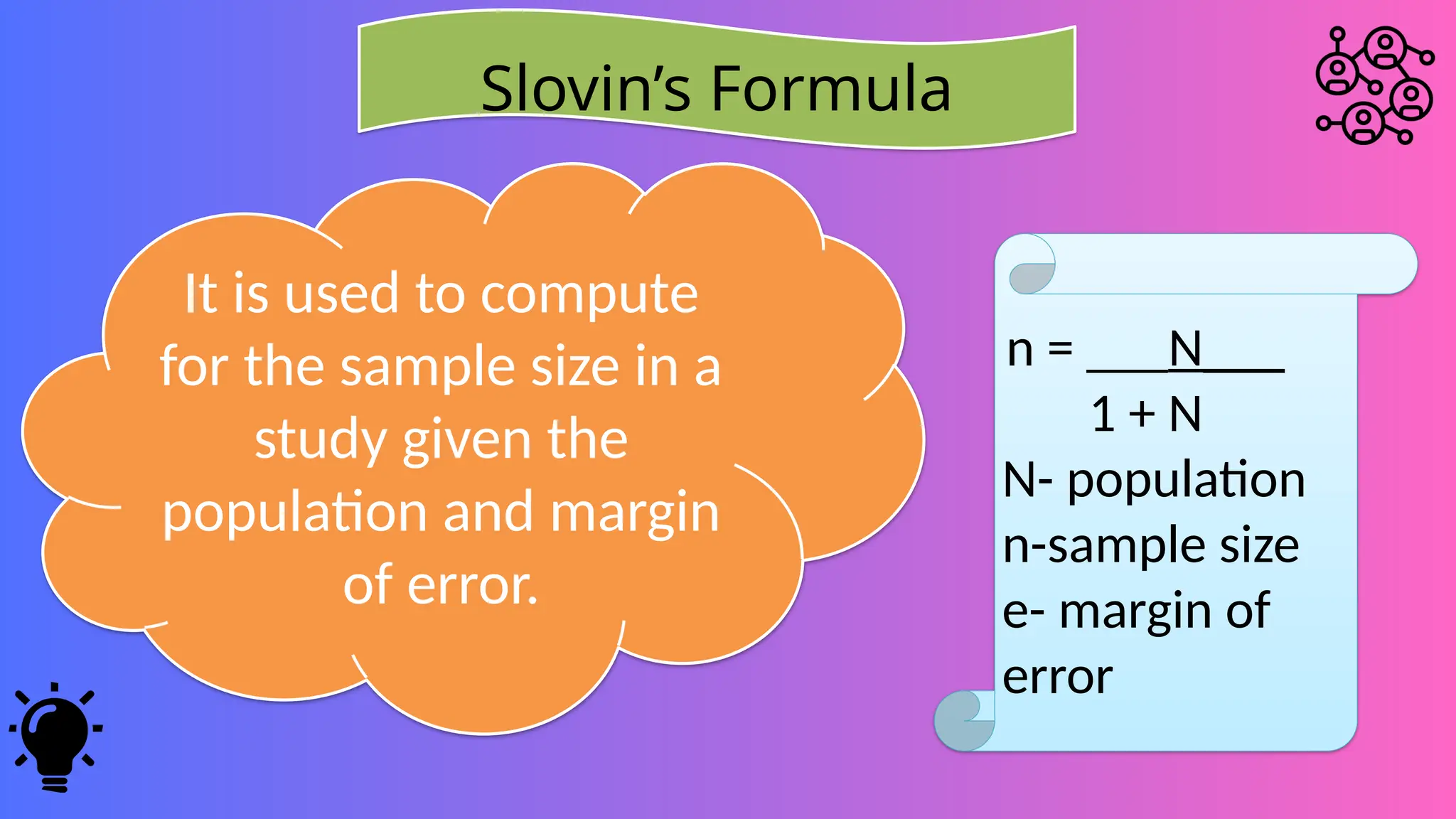
Slovin’s Formula
It is used to compute
for the sample size in a
study given the
population and margin
of error.
n = ___N___
1 + N
N- population
n-sample size
e- margin of
error
Slovin’s Formula
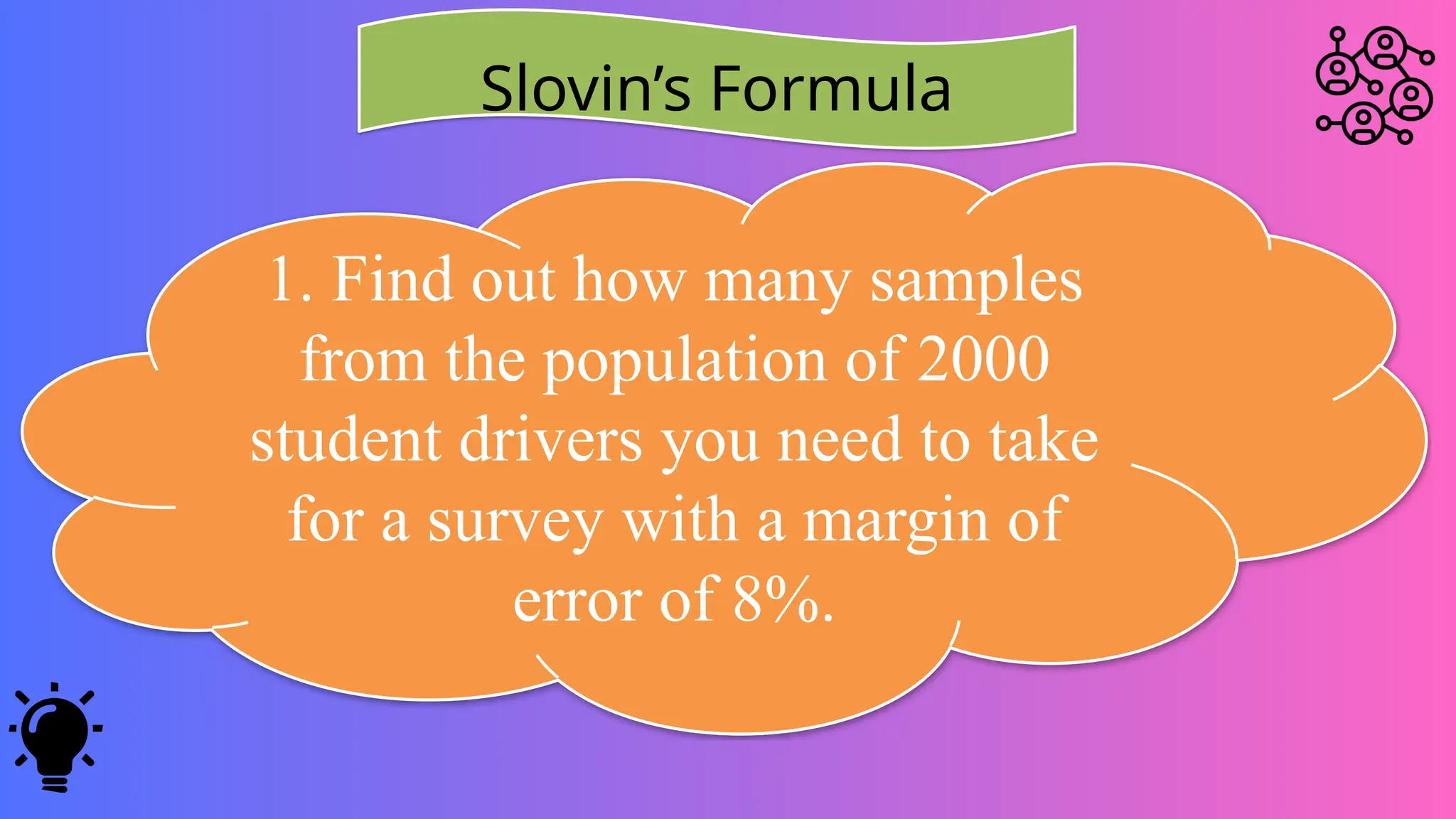
1. Find out how many samples
from the population of 2000
student drivers you need to take
for a survey with a margin of
error of 8%.
Slovin’s Formula
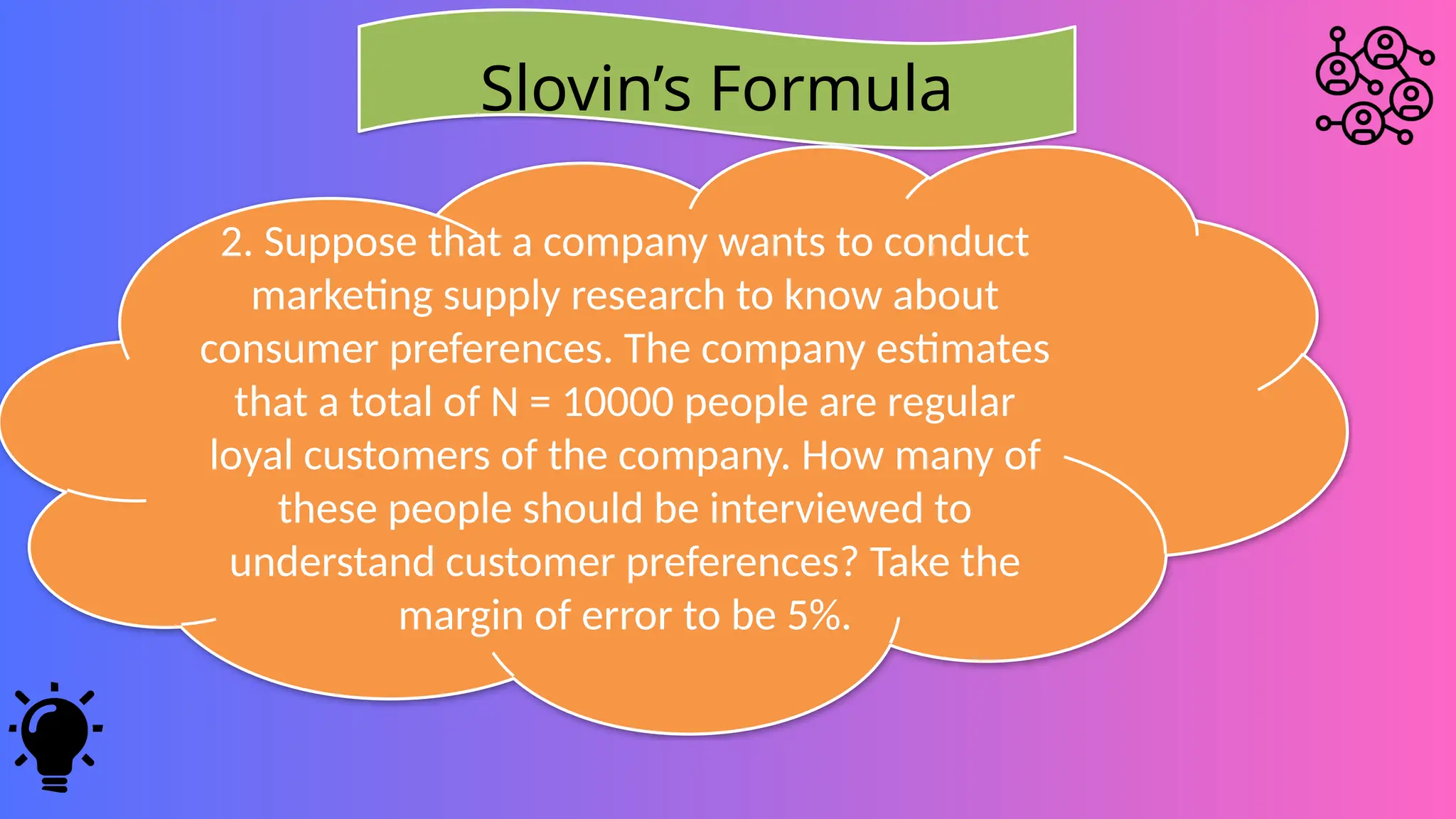
2. Suppose that a company wants to conduct
marketing supply research to know about
consumer preferences. The company estimates
that a total of N = 10000 people are regular
loyal customers of the company. How many of
these people should be interviewed to
understand customer preferences? Take the
margin of error to be 5%.
Activity
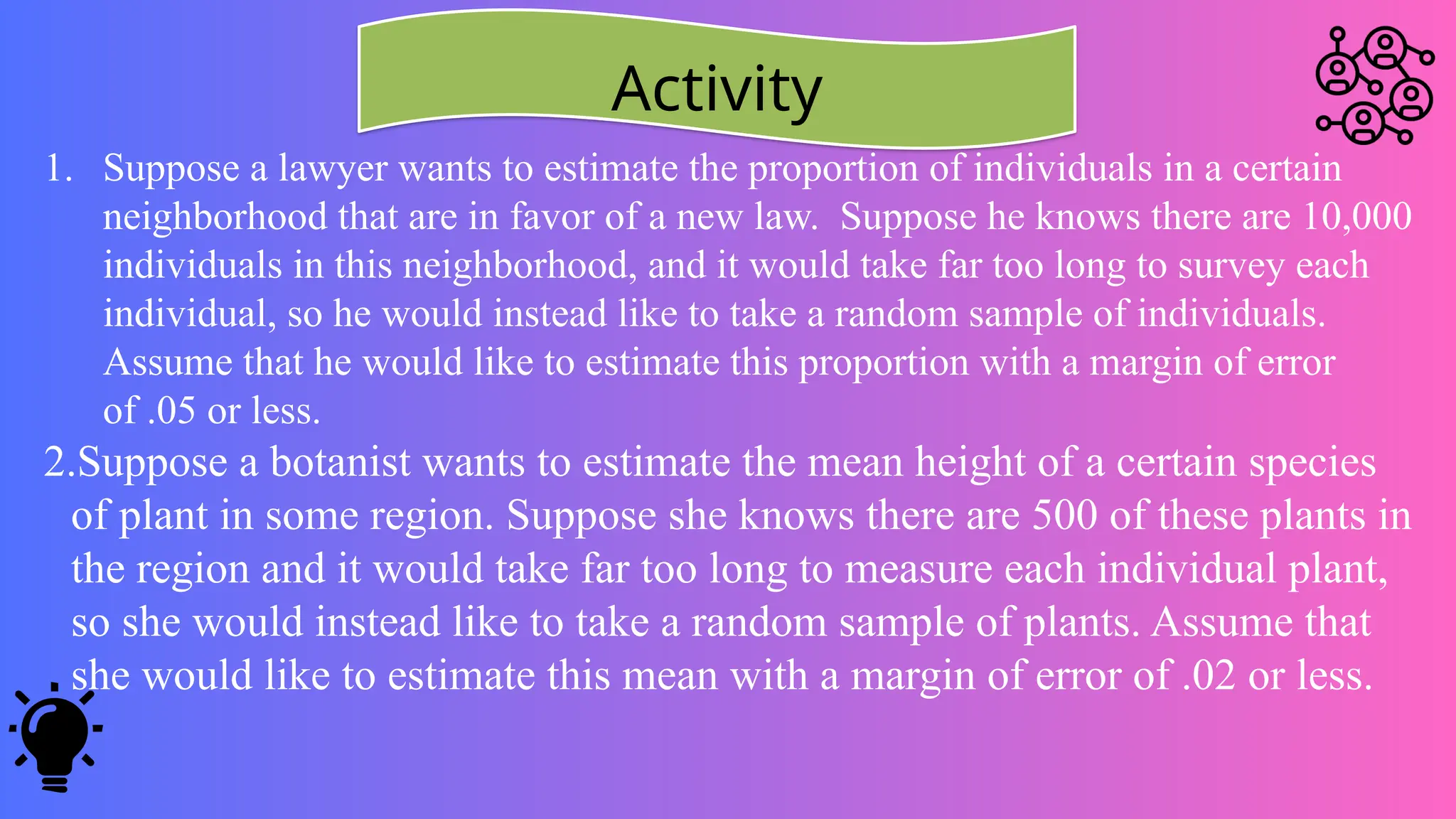
1. Suppose a lawyer wants to estimate the proportion of individuals in a certain
neighborhood that are in favor of a new law. Suppose he knows there are 10,000
individuals in this neighborhood, and it would take far too long to survey each
individual, so he would instead like to take a random sample of individuals.
Assume that he would like to estimate this proportion with a margin of error
of .05 or less.
2.Suppose a botanist wants to estimate the mean height of a certain species
of plant in some region. Suppose she knows there are 500 of these plants in
the region and it would take far too long to measure each individual plant,
so she would instead like to take a random sample of plants. Assume that
she would like to estimate this mean with a margin of error of .02 or less.
Thank you for
listening!

Random Sampling Techniques for SHS Grade 11

  • 1.
  • 2.
    Learning Outcomes Students shouldbe able to define essential concepts in sampling. Students should be able to identify different sampling methods. 1 2
  • 3.
    Topics for Discussion Definitionof Terms Advantages of Sampling Non-Probability Sampling 1 2 3 4 Probability Sampling
  • 4.
    It refers toa collection of individuals who share one or more noteworthy traits that are of interest to the researcher. The population may be all the individuals belonging to a specific category or a narrower subset within that larger group. POPULATION It is a small portion of the population selected for observation and analysis. SAMPLE It is the procedure of getting a small portion of the population for research. SAMPLING Definition of Terms
  • 5.
    Advantages of Sampling • Itsaves time, money, and effort. • It yields better outcomes. • It is faster, less expensive, and more cost-effective. • It is more accurate. • It provides more comprehensive information.
  • 6.
    Random Sampling Every member ofthe population has a probability of being selected or included in the sample.
  • 7.
    Random Sampling It isa sampling method of choosing representatives from the population wherein every sample has an equal chance of being selected. Accurate data can be collected using random sampling techniques.
  • 8.
    Random Sampling Techniques SIMPLERANDOM SAMPLING All members of the population have an equal chance at being chosen as part of the sample. STRATIFIED RANDOM SAMPLING The population is split into different groups. People from each group will be randomly chosen to represent the whole population. The sample is drawn by randomly selecting a starting number and then selecting every nth unit in arbitrary order until the desired sample size is reached. SYSTEMATIC RANDOM SAMPLING CLUSTER/AREA SAMPLING Districts or blocks of a municipality or a city which are part of the cluster are randomly selected. SIMPLE RANDOM SAMPLING
  • 9.
    Systematic Random Sampling Thiscan be done by listing all the elements in the population and selecting every kth element in your population list. This is equally precise as the simple random sampling. It is often used on long population list. To determine the interval to be used in identifying the samples to who will participate in the study, use the formula; K=N/n (population/sample).
  • 10.
    Non-Probability Sampling The sampling techniquethat does not involve random selection of data. Participants are intentionally selected based on certain identified factors.
  • 11.
    Non-Probability Sampling Methods CONVENIENCE SAMPLING Participants are chosenfor their convenience and availability, rather than through a random or systematic selection process. EXPERT SAMPLING QUOTA SAMPLING SNOWBALL SAMPLING Individuals with specialized knowledge or expertise in a particular field are selected to participate in a study. Participants are selected based on pre- defined quotas to represent specific characteristics or subgroups. Participants are chosen based on referrals or recommendations from existing participants.
  • 12.
    Slovin’s Formula It isused to compute for the sample size in a study given the population and margin of error. n = ___N___ 1 + N N- population n-sample size e- margin of error
  • 13.
    Slovin’s Formula 1. Findout how many samples from the population of 2000 student drivers you need to take for a survey with a margin of error of 8%.
  • 14.
    Slovin’s Formula 2. Supposethat a company wants to conduct marketing supply research to know about consumer preferences. The company estimates that a total of N = 10000 people are regular loyal customers of the company. How many of these people should be interviewed to understand customer preferences? Take the margin of error to be 5%.
  • 15.
    Activity 1. Suppose alawyer wants to estimate the proportion of individuals in a certain neighborhood that are in favor of a new law. Suppose he knows there are 10,000 individuals in this neighborhood, and it would take far too long to survey each individual, so he would instead like to take a random sample of individuals. Assume that he would like to estimate this proportion with a margin of error of .05 or less. 2.Suppose a botanist wants to estimate the mean height of a certain species of plant in some region. Suppose she knows there are 500 of these plants in the region and it would take far too long to measure each individual plant, so she would instead like to take a random sample of plants. Assume that she would like to estimate this mean with a margin of error of .02 or less.
  • 16.