Designing Productive Meetings 
Brown bag Session 
Presented by: Salah Elleithy
Salah Elleithy 
salah@sparkagility.com @selleithy 410.262.5550 
Enabling organizational agility and 
enhancing team capabilities 
serving as a Project Manager, Scrum 
Master, Business analyst, Team Facilitator 
and Agile Coach. 
15 years 
Senior Principal Consultant 
Agile Coach & Trainer 
Certified Trainer in 
Training from the 
Back of the Room 
Masters in Info Systems & 
Financial Management
• How 
Where 
do 
we 
stand? 
much 
&me 
do 
we 
spend 
in 
mee,ngs 
daily, 
weekly 
or 
monthly? 
• How 
do 
we 
avoid 
‘unnecessary’ 
mee,ngs? 
• How 
much 
do 
‘unnecessary’ 
mee,ngs 
cost?
How 
much 
&me 
we 
spend 
in 
mee,ngs? 
How 
do 
we 
avoid 
‘unnecessary’ 
mee,ngs? 
How 
much 
do 
‘unnecessary’ 
mee&ngs 
cost? 
I 
wonder 
how 
much 
it 
would 
be 
if 
we 
added 
‘unproduc&ve’ 
mee,ngs?!! 
Source: 
h8ps://www.atlassian.com/,me-­‐was,ng-­‐at-­‐work-­‐infographic
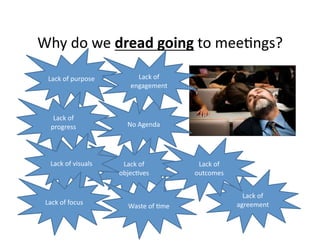
Why 
do 
we 
dread 
going 
to 
mee,ngs? 
Lack 
of 
purpose 
No 
Agenda 
Lack 
of 
progress 
Lack 
of 
objec,ves 
Lack 
of 
visuals 
Lack 
of 
agreement 
Lack 
of 
engagement 
Lack 
of 
outcomes 
Lack 
of 
focus 
Waste 
of 
,me
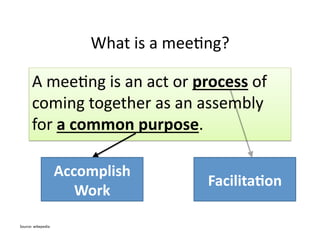
What 
is 
a 
mee,ng? 
A 
mee,ng 
is 
an 
act 
or 
process 
of 
coming 
together 
as 
an 
assembly 
for 
a 
common 
purpose. 
Source: 
wikepedia 
Accomplish 
Work 
Facilita&on
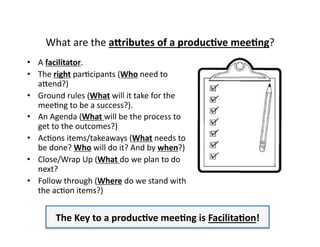
What 
are 
the 
a>ributes 
of 
a 
produc&ve 
mee&ng? 
• A 
facilitator. 
• The 
right 
par,cipants 
(Who 
need 
to 
a8end?) 
• Ground 
rules 
(What 
will 
it 
take 
for 
the 
mee,ng 
to 
be 
a 
success?). 
• An 
Agenda 
(What 
will 
be 
the 
process 
to 
get 
to 
the 
outcomes?) 
• Ac,ons 
items/takeaways 
(What 
needs 
to 
be 
done? 
Who 
will 
do 
it? 
And 
by 
when?) 
• Close/Wrap 
Up 
(What 
do 
we 
plan 
to 
do 
next? 
• Follow 
through 
(Where 
do 
we 
stand 
with 
the 
ac,on 
items?) 
The 
Key 
to 
a 
produc&ve 
mee&ng 
is 
Facilita&on!
What 
is 
Facilita&on? 
Facilita,on 
is 
the 
art 
of 
leading 
people 
through 
processes 
toward 
agreed-­‐ 
upon 
outcomes 
in 
a 
manner 
that 
encourages 
par&cipa&on, 
ownership 
and 
crea&vity 
from 
all 
involved. 
-­‐ 
The 
Grove 
Consultants 
Interna,onal
The 
right 
par,cipants 
(Who 
needs 
to 
a8end?) 
• Iden,fy 
the 
right 
par,cipants. 
• Know 
the 
par,cipants 
role 
and 
what 
makes 
the 
mee,ng 
important 
to 
them. 
• Ensure 
they 
are 
available 
and 
ready 
for 
the 
mee,ng.
Ground 
Rules 
(What 
will 
it 
take 
for 
the 
mee,ng 
to 
be 
a 
success?) 
• Be 
open 
minded. 
• Be 
honest. 
• Respect 
each 
other. 
• Give 
everyone 
a 
chance 
to 
speak. 
• Agree 
to 
disagree. 
• Stay 
focused 
(No 
mul,tasking).
Designing 
the 
Agenda 
• Purpose/Objec,ve 
(Why 
are 
we 
here? 
And 
where 
are 
we 
trying 
to 
go?) 
• Process 
(How 
are 
going 
to 
get 
to 
where 
we 
want 
to 
go?) 
• Desired 
outcomes 
(What 
are 
we 
trying 
to 
get 
out 
of 
this 
mee,ng?)
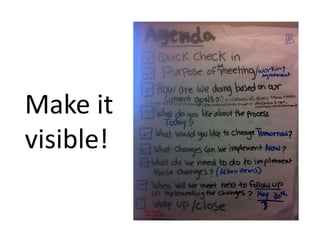
Make 
it 
visible!
Ac,ons 
items/takeaways 
(What 
needs 
to 
be 
done? 
Who 
will 
do 
it? 
And 
by 
when?) 
• Be 
ac&onable 
(Ex: 
Define, 
Complete, 
Research, 
etc.). 
• Have 
only 
one 
owner. 
• Have 
a 
follow-­‐up 
date.
Close/Wrap-­‐Up 
(What 
do 
we 
plan 
to 
do 
next?) 
• Review 
agenda 
and 
outcomes. 
• Agree 
on 
next 
steps. 
• Thank 
everyone 
for 
their 
par,cipa,on.
Follow 
through 
(Where 
do 
we 
stand 
with 
the 
ac,on 
items?) 
• Send 
mee&ng 
notes 
right 
aYer 
the 
mee,ng 
(no 
more 
than 
24-­‐48 
hours). 
• Follow-­‐up 
on 
ac,on 
items 
by 
dates 
agreed-­‐upon 
during 
the 
mee,ng. 
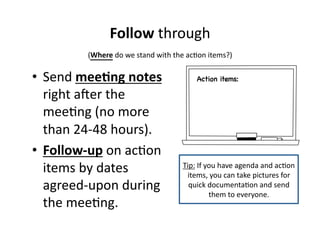
Action items: 
Tip: 
If 
you 
have 
agenda 
and 
ac,on 
items, 
you 
can 
take 
pictures 
for 
quick 
documenta,on 
and 
send 
them 
to 
everyone.
Mee,ng 
Materials 
• White 
board 
or 
Flipcharts 
• S,cky 
Notes 
• Sharpies
Mee,ng 
Tools: 
Parking 
Lot 
• Parking 
Lot: 
used 
as 
a 
placeholder 
for 
topics 
that 
could 
come 
up 
but 
may 
not 
be 
relevant 
to 
discuss 
during 
the 
mee,ng.
Mee,ng 
Tools: 
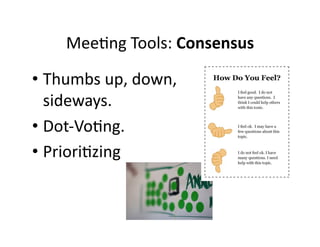
Consensus 
• Thumbs 
up, 
down, 
sideways. 
• Dot-­‐Vo,ng. 
• Priori,zing
Virtual 
mee,ngs 
• Talk 
a 
roll-­‐call. 
• Same 
rules 
apply. 
• Agree 
to 
NO 
mul&-­‐ 
tasking! 
• Start 
and 
end 
on 
&me.
Common 
PiOalls 
• Group 
think 
(Seeking 
ar,ficial 
harmony 
over 
healthy 
debate). 
• Dominant 
par,cipant. 
• Quite 
par,cipant.
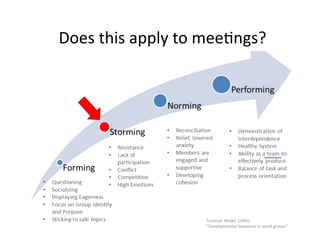
Does 
this 
apply 
to 
mee,ngs?
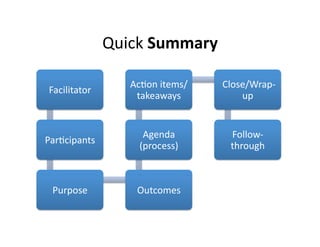
Quick 
Summary 
Facilitator 
Par,cipants 
Ac,on 
items/ 
takeaways 
Agenda 
(process) 
Purpose 
Outcomes 
Close/Wrap-­‐ 
up 
Follow-­‐ 
through

Designing productive meetings

  • 1.
    Designing Productive Meetings Brown bag Session Presented by: Salah Elleithy
  • 2.
    Salah Elleithy salah@sparkagility.com@selleithy 410.262.5550 Enabling organizational agility and enhancing team capabilities serving as a Project Manager, Scrum Master, Business analyst, Team Facilitator and Agile Coach. 15 years Senior Principal Consultant Agile Coach & Trainer Certified Trainer in Training from the Back of the Room Masters in Info Systems & Financial Management
  • 3.
    • How Where do we stand? much &me do we spend in mee,ngs daily, weekly or monthly? • How do we avoid ‘unnecessary’ mee,ngs? • How much do ‘unnecessary’ mee,ngs cost?
  • 4.
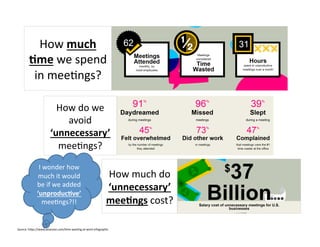
    How much &me we spend in mee,ngs? How do we avoid ‘unnecessary’ mee,ngs? How much do ‘unnecessary’ mee&ngs cost? I wonder how much it would be if we added ‘unproduc&ve’ mee,ngs?!! Source: h8ps://www.atlassian.com/,me-­‐was,ng-­‐at-­‐work-­‐infographic
  • 5.
    Why do we dread going to mee,ngs? Lack of purpose No Agenda Lack of progress Lack of objec,ves Lack of visuals Lack of agreement Lack of engagement Lack of outcomes Lack of focus Waste of ,me
  • 6.
    What is a mee,ng? A mee,ng is an act or process of coming together as an assembly for a common purpose. Source: wikepedia Accomplish Work Facilita&on
  • 7.
    What are the a>ributes of a produc&ve mee&ng? • A facilitator. • The right par,cipants (Who need to a8end?) • Ground rules (What will it take for the mee,ng to be a success?). • An Agenda (What will be the process to get to the outcomes?) • Ac,ons items/takeaways (What needs to be done? Who will do it? And by when?) • Close/Wrap Up (What do we plan to do next? • Follow through (Where do we stand with the ac,on items?) The Key to a produc&ve mee&ng is Facilita&on!
  • 8.
    What is Facilita&on? Facilita,on is the art of leading people through processes toward agreed-­‐ upon outcomes in a manner that encourages par&cipa&on, ownership and crea&vity from all involved. -­‐ The Grove Consultants Interna,onal
  • 9.
    The right par,cipants (Who needs to a8end?) • Iden,fy the right par,cipants. • Know the par,cipants role and what makes the mee,ng important to them. • Ensure they are available and ready for the mee,ng.
  • 10.
    Ground Rules (What will it take for the mee,ng to be a success?) • Be open minded. • Be honest. • Respect each other. • Give everyone a chance to speak. • Agree to disagree. • Stay focused (No mul,tasking).
  • 11.
    Designing the Agenda • Purpose/Objec,ve (Why are we here? And where are we trying to go?) • Process (How are going to get to where we want to go?) • Desired outcomes (What are we trying to get out of this mee,ng?)
  • 12.
  • 13.
    Ac,ons items/takeaways (What needs to be done? Who will do it? And by when?) • Be ac&onable (Ex: Define, Complete, Research, etc.). • Have only one owner. • Have a follow-­‐up date.
  • 14.
    Close/Wrap-­‐Up (What do we plan to do next?) • Review agenda and outcomes. • Agree on next steps. • Thank everyone for their par,cipa,on.
  • 15.
    Follow through (Where do we stand with the ac,on items?) • Send mee&ng notes right aYer the mee,ng (no more than 24-­‐48 hours). • Follow-­‐up on ac,on items by dates agreed-­‐upon during the mee,ng. Action items: Tip: If you have agenda and ac,on items, you can take pictures for quick documenta,on and send them to everyone.
  • 16.
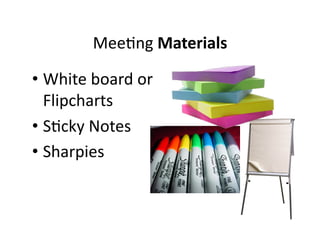
    Mee,ng Materials •White board or Flipcharts • S,cky Notes • Sharpies
  • 17.
    Mee,ng Tools: Parking Lot • Parking Lot: used as a placeholder for topics that could come up but may not be relevant to discuss during the mee,ng.
  • 18.
    Mee,ng Tools: Consensus • Thumbs up, down, sideways. • Dot-­‐Vo,ng. • Priori,zing
  • 19.
    Virtual mee,ngs •Talk a roll-­‐call. • Same rules apply. • Agree to NO mul&-­‐ tasking! • Start and end on &me.
  • 20.
    Common PiOalls •Group think (Seeking ar,ficial harmony over healthy debate). • Dominant par,cipant. • Quite par,cipant.
  • 21.
    Does this apply to mee,ngs?
  • 22.
    Quick Summary Facilitator Par,cipants Ac,on items/ takeaways Agenda (process) Purpose Outcomes Close/Wrap-­‐ up Follow-­‐ through