Meeting Management
        Spring 2011
          Beth Filar-Williams
             Mike Crumpton
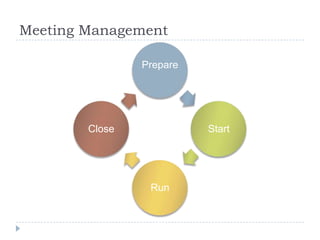
Meeting Management

                Prepare


        Close             Start


                 Run
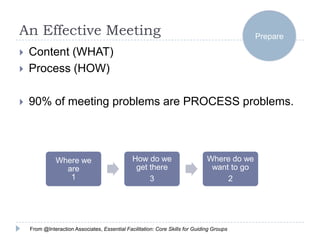
An Effective Meeting                                                                         Prepare

   Content (WHAT)
   Process (HOW)

   90% of meeting problems are PROCESS problems.


              Where we                         How do we                       Where do we
                are                             get there                       want to go
                 1                                  3                               2


    From @Interaction Associates, Essential Facilitation: Core Skills for Guiding Groups
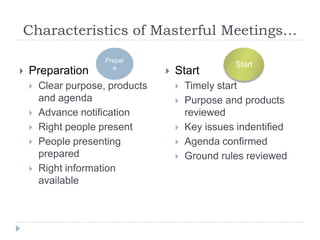
Characteristics of Masterful Meetings…
                      Prepar
                        e                           Start
   Preparation                      Start
       Clear purpose, products          Timely start
        and agenda                       Purpose and products
       Advance notification              reviewed
       Right people present             Key issues indentified
       People presenting                Agenda confirmed
        prepared                         Ground rules reviewed
       Right information
        available
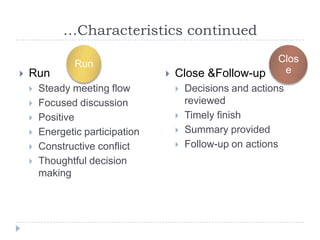
…Characteristics continued

                Run                                          Clos
   Run                              Close &Follow-up        e
       Steady meeting flow              Decisions and actions
       Focused discussion                reviewed
       Positive                         Timely finish
       Energetic participation          Summary provided
       Constructive conflict            Follow-up on actions
       Thoughtful decision
        making
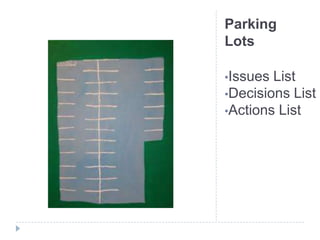
Parking
Lots

•Issues List
•Decisions List
•Actions List
Prepare

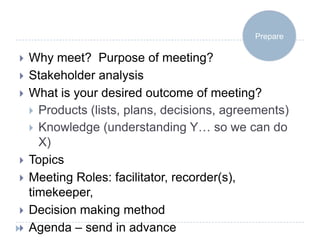
   Why meet? Purpose of meeting?
   Stakeholder analysis
   What is your desired outcome of meeting?
     Products (lists, plans, decisions, agreements)
     Knowledge (understanding Y… so we can do
      X)
   Topics
   Meeting Roles: facilitator, recorder(s),
    timekeeper,
   Decision making method
   Agenda – send in advance
Develop the Agenda   Prepare


   Issue resolution
   Process improvement
   Project planning
   Status meetings
   Strategic planning
   Team development
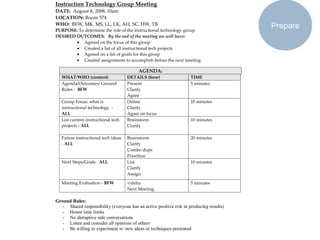
Instruction Technology Group Meeting
DATE: August 8, 2008, 10am
LOCATION: Room 574
WHO: BFW, MK, MS, LL, LK, AH, SC, HW, TB
PURPOSE: To determine the role of the instructional technology group
                                                                                         Prepare
DESIRED OUTCOMES: By the end of the meeting we will have:
           Agreed on the focus of this group
           Created a list of all instructional tech projects
           Agreed on a list of goals for this group
           Created assignments to accomplish before the next meeting

                                          AGENDA:
   WHAT/WHO (content)                DETAILS (how)                   TIME
   Agenda/Outcomes/ Ground           Present                         5 minutes
   Rules - BFW                       Clarify
                                     Agree
   Group Focus: what is              Define                          10 minutes
   instructional technology -        Clarity
   ALL                               Agree on focus
   List current instructional tech   Brainstorm                      10 minutes
   projects - ALL                    Clarify

   Future instructional tech ideas   Brainstorm                      20 minutes
   - ALL                             Clarify
                                     Combo dups
                                     Prioritize
   Next Steps/Goals- ALL             List                            10 minutes
                                     Clarify
                                     Assign

   Meeting Evaluation - BFW          +/delta                         5 minutes
                                     Next Meeting

Ground Rules:
   - Shared responsibility (everyone has an active positive role in producing results)
   - Honor time limits
   - No disruptive side conversations
   - Listen and consider all opinions of others
   - Be willing to experiment w/ new ideas or techniques presented
Getting started                     Start


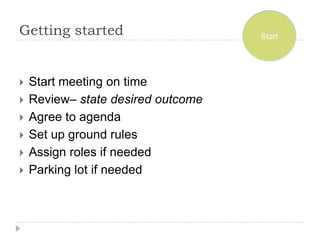
   Start meeting on time
   Review– state desired outcome
   Agree to agenda
   Set up ground rules
   Assign roles if needed
   Parking lot if needed
Example Ground Rules                               Start


Shared responsibility (everyone has an active positive role
  in producing results)
Honor time limits
No disruptive side conversations
Listen and consider all opinions of others
Be willing to experiment w/ new ideas or techniques
  presented
Cell phones on silent
Prepare


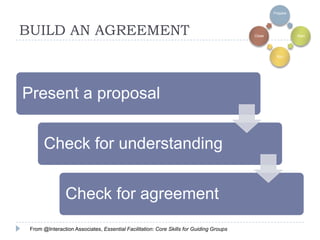
BUILD AN AGREEMENT                                                                      Close             Start


                                                                                                 Run


Present a proposal


      Check for understanding


                Check for agreement
 From @Interaction Associates, Essential Facilitation: Core Skills for Guiding Groups
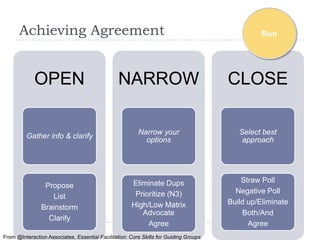
Achieving Agreement                                                                        Run


             OPEN                               NARROW                                 CLOSE

                                                         Narrow your                      Select best
         Gather info & clarify
                                                           options                         approach


                                                      Eliminate Dups                       Straw Poll
                 Propose
                                                       Prioritize (N3)                   Negative Poll
                   List
                                                      High/Low Matrix                  Build up/Eliminate
                Brainstorm
                                                         Advocate                          Both/And
                  Clarify
                                                           Agree                             Agree
From @Interaction Associates, Essential Facilitation: Core Skills for Guiding Groups
Preventions                                  Run


   Keep to agenda and keep on track
   Refer to ground rules
   Participants can help keep group focused too
   Ask open ended questions to generate
    participation
   Request people reserve judgment
   Build an agreement (again and again)
   Make process suggestions to keep flow
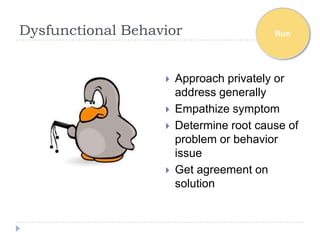
Dysfunctional Behavior                   Run


                      Approach privately or
                       address generally
                      Empathize symptom
                      Determine root cause of
                       problem or behavior
                       issue
                      Get agreement on
                       solution
Interventions                              Run

   Boomerang
   Regain Focus
   Ask/Say What’s going on?
   Enforce Process Agreements
   Accept/Legitimize/Deal With or Defer
   Walk near or by person; Make eye contact
   Talk to them during break/afterwards
Listening & Reconciling Differences
                                      Run

 Bracket your opinions
 Repeat/mirroring or paraphrase
 Perception check
 Open ended, probing questions
 Find common ground
 Propose options w/o commitment
 Build small agreements
Big Finish                        Closing


   Evaluate +/delta
   Clarify action items
   Review Parking lot
   Give acknowledgments
   Send meeting minutes to all
   Communicate w/ stakeholders
   Celebrate accomplishments
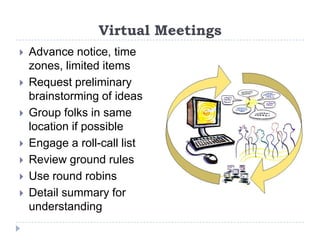
Virtual Meetings
   Advance notice, time
    zones, limited items
   Request preliminary
    brainstorming of ideas
   Group folks in same
    location if possible
   Engage a roll-call list
   Review ground rules
   Use round robins
   Detail summary for
    understanding
Closing


Remember that you are facilitating another person’s
process. It is not your process. Do not intrude. Do not
control. Do not force your own needs and insights into
                     the foreground.
When the work is done, the group will say: We did it
                       ourselves.”

            Lao Tzu, The Tao Te Ching
References and Suggested Reading
   The Secrets to Masterful Meetings
       Michael Wilkinson, Leadership Strategies


   Managing Meetings
       Tim Hindle, DK Publishing


   Essential Facilitation: Core Skills for Guiding Groups
       Interaction Associates
       http://www.interactionassociates.com/services/essential-facilitation

Meeting Management Workshop

  • 1.
    Meeting Management Spring 2011 Beth Filar-Williams Mike Crumpton
  • 3.
    Meeting Management Prepare Close Start Run
  • 4.
    An Effective Meeting Prepare  Content (WHAT)  Process (HOW)  90% of meeting problems are PROCESS problems. Where we How do we Where do we are get there want to go 1 3 2 From @Interaction Associates, Essential Facilitation: Core Skills for Guiding Groups
  • 5.
    Characteristics of MasterfulMeetings… Prepar e Start  Preparation  Start  Clear purpose, products  Timely start and agenda  Purpose and products  Advance notification reviewed  Right people present  Key issues indentified  People presenting  Agenda confirmed prepared  Ground rules reviewed  Right information available
  • 6.
    …Characteristics continued Run Clos  Run  Close &Follow-up e  Steady meeting flow  Decisions and actions  Focused discussion reviewed  Positive  Timely finish  Energetic participation  Summary provided  Constructive conflict  Follow-up on actions  Thoughtful decision making
  • 7.
  • 8.
    Prepare  Why meet? Purpose of meeting?  Stakeholder analysis  What is your desired outcome of meeting?  Products (lists, plans, decisions, agreements)  Knowledge (understanding Y… so we can do X)  Topics  Meeting Roles: facilitator, recorder(s), timekeeper,  Decision making method  Agenda – send in advance
  • 9.
    Develop the Agenda Prepare  Issue resolution  Process improvement  Project planning  Status meetings  Strategic planning  Team development
  • 10.
    Instruction Technology GroupMeeting DATE: August 8, 2008, 10am LOCATION: Room 574 WHO: BFW, MK, MS, LL, LK, AH, SC, HW, TB PURPOSE: To determine the role of the instructional technology group Prepare DESIRED OUTCOMES: By the end of the meeting we will have: Agreed on the focus of this group Created a list of all instructional tech projects Agreed on a list of goals for this group Created assignments to accomplish before the next meeting AGENDA: WHAT/WHO (content) DETAILS (how) TIME Agenda/Outcomes/ Ground Present 5 minutes Rules - BFW Clarify Agree Group Focus: what is Define 10 minutes instructional technology - Clarity ALL Agree on focus List current instructional tech Brainstorm 10 minutes projects - ALL Clarify Future instructional tech ideas Brainstorm 20 minutes - ALL Clarify Combo dups Prioritize Next Steps/Goals- ALL List 10 minutes Clarify Assign Meeting Evaluation - BFW +/delta 5 minutes Next Meeting Ground Rules: - Shared responsibility (everyone has an active positive role in producing results) - Honor time limits - No disruptive side conversations - Listen and consider all opinions of others - Be willing to experiment w/ new ideas or techniques presented
  • 11.
    Getting started Start  Start meeting on time  Review– state desired outcome  Agree to agenda  Set up ground rules  Assign roles if needed  Parking lot if needed
  • 12.
    Example Ground Rules Start Shared responsibility (everyone has an active positive role in producing results) Honor time limits No disruptive side conversations Listen and consider all opinions of others Be willing to experiment w/ new ideas or techniques presented Cell phones on silent
  • 13.
    Prepare BUILD AN AGREEMENT Close Start Run Present a proposal Check for understanding Check for agreement From @Interaction Associates, Essential Facilitation: Core Skills for Guiding Groups
  • 14.
    Achieving Agreement Run OPEN NARROW CLOSE Narrow your Select best Gather info & clarify options approach Eliminate Dups Straw Poll Propose Prioritize (N3) Negative Poll List High/Low Matrix Build up/Eliminate Brainstorm Advocate Both/And Clarify Agree Agree From @Interaction Associates, Essential Facilitation: Core Skills for Guiding Groups
  • 15.
    Preventions Run  Keep to agenda and keep on track  Refer to ground rules  Participants can help keep group focused too  Ask open ended questions to generate participation  Request people reserve judgment  Build an agreement (again and again)  Make process suggestions to keep flow
  • 16.
    Dysfunctional Behavior Run  Approach privately or address generally  Empathize symptom  Determine root cause of problem or behavior issue  Get agreement on solution
  • 17.
    Interventions Run  Boomerang  Regain Focus  Ask/Say What’s going on?  Enforce Process Agreements  Accept/Legitimize/Deal With or Defer  Walk near or by person; Make eye contact  Talk to them during break/afterwards
  • 18.
    Listening & ReconcilingDifferences Run  Bracket your opinions  Repeat/mirroring or paraphrase  Perception check  Open ended, probing questions  Find common ground  Propose options w/o commitment  Build small agreements
  • 19.
    Big Finish Closing  Evaluate +/delta  Clarify action items  Review Parking lot  Give acknowledgments  Send meeting minutes to all  Communicate w/ stakeholders  Celebrate accomplishments
  • 20.
    Virtual Meetings  Advance notice, time zones, limited items  Request preliminary brainstorming of ideas  Group folks in same location if possible  Engage a roll-call list  Review ground rules  Use round robins  Detail summary for understanding
  • 21.
    Closing Remember that youare facilitating another person’s process. It is not your process. Do not intrude. Do not control. Do not force your own needs and insights into the foreground. When the work is done, the group will say: We did it ourselves.” Lao Tzu, The Tao Te Ching
  • 22.
    References and SuggestedReading  The Secrets to Masterful Meetings  Michael Wilkinson, Leadership Strategies  Managing Meetings  Tim Hindle, DK Publishing  Essential Facilitation: Core Skills for Guiding Groups  Interaction Associates  http://www.interactionassociates.com/services/essential-facilitation

Editor's Notes

  • #5 Effective meetings involve both the WHAT – content and the PROCESS. Like instructional design… where we are and where we want to be at the end of the session/meeting, use processes to get there. Most problems lie in the process or lack of. –Process is whatsguides the meeting through the agenda, w/ people focused & participating.
  • #8 Unrelated topicsPark informationReview at beginning
  • #11 This will help you avoid potential conflicts.
  • #12 Preparation and starting the meeting right will help avoid conflicts.
  • #13 Ground rules are impt! Set them up, build an agreement on them, and everyone has shared responsibility to follow. Participants can now call people out on ground rules! This helps to avoid conflict!
  • #14 This concept can be used throughout meeting and in life. Problems occur in the understanding. Someone presents an idea, people don’t hear it well, misinterpret, have their own opinions and perceptions, etc… then we move forward in meeting and people are in different places. Check for understand maybe restate what was said, does everyone understand this? Then “can everyone live with this?” as you check for agreement. This process will happen many times again and again in your meetings. This build an agreement process will help w/ avoid conflicts.
  • #15 OPEN:Proposal – “Jim you have thoughta lot of this issues, can you define the prob for us?” Or “who has an issue/suggestion we need the group to consider?”List – “lets list 4 or 5 things …” Or “ I have a list of potential ideas but lets add a few more”Brainstorm –(GUIDELINES: all ideas are OK at this point, defer judging them, build on ideas) “first lets get all our ideas out w/o evaluating them in the next 10 mins” Clarify – (NOTE: you can spend 2/3 of meeting on this but make sure you do it!) “take 5 mins to review this list we generated. Do any need clarification? Does everyone understand them?” NARROWEliminate Dups – (NOTE: if there are any issues on combo from people keep them separate) “any ideas here similar enough that we can combo them?”Prioritize N/3 - Number of items/3 = # of choices per participant. ‘lets try prioritizing the list to see where interest is.” Can use dot stickers or do it out loud.High/Low matrix – rank items into box matrix with 2 sides for low- high impact and low-high effortAdvocate – “we still have several options…. Lets take a few minute to influence each others thinking… bob, tell us whey you think this option you mentioned is a good choice” This can help people really understand this item and lead to compromise.CLOSEStraw poll - tests the level of agreement w/o making a final decision: “ok lets see how we all feel about this… how many want to continue working in this issue today? Looks like most are - anyone not willing to go another ½ hour? Great!” Negative Poll – reach quick agreement on something you suspect everyone supports: “is anyone opposed to taking off #4 from our list?” Build up/Eliminate – facilitates agreement “what could we add to option A to make it work for you?” “is there any way you could combo A &B to get to an agreement?”Both/And – “do we need to choose btw both options or can we try both?”
  • #16 Make process suggestions: suggest a better path or process if group gets stuck – can also ask group to assist with this; “we seem stuck? Is there a process to help gets up to our end goal?” or even take a breakListen and watch for: Are the agreements clear?Are process suggestions being followed?Are people asking questions?Are there enough creative ideas?How are disagreements being solved?What is the group’s energy level?Are people listening to each other?
  • #17 Example of interrupter
  • #18 “kat – you wanted to know whey we are adding extra hours… can anyone explain why to Kat?“Matt you are bringing up a new issue here. I don’t think we we are finsihed with the other one yet. Can you focus on this and then move on to your question next?”“My sense is not everyone agrees? Does anyone else have this feeling?”“We said we were only going to spend 10 mins on this and we are at 20min? Can we table this and move on?” OR “we agreed to brainstorm now and you are starting to evaluate. Lets stay on target”“I hear what you are saying and its impt, but we don’t have enough info to solve the issue so lets wait and defer for next meeting”Sometimes you might just need to talk to someone one on one during a break or after a meeting
  • #19 Bracket: Internally acknowledge and set aside your own judgment and point of view to hear what the speaker has to say Repeat:“I believe we should stop the project”  “ So you think we should stop the project”Paraphrase: “There are no better bananas then those from Hawaii”  “so you are saying Hawaian bananas are the best in the world?”perception check: “Last months stats were worse than ever before”  “ it sounds like you are disappointed. Is that so?” or You sound confused?”Probing questions: Why? What do you hope to gain or fear?Find common ground by realizing the real issues: issue – position – interest (EX: overtime pay – “i should be paid time and half for this” – I want to be treated fairly)Propose options “ruth given your respective interests, what approach to project planning might be effective? Is there a way for you both to agree on a project guidelines and then like jim run w/ it?”
  • #20 + (what worked)Delta (what could be changed or improved)