RUNNING SUCCESSFUL
AGILE COLLABORATIVE
      SESSIONS 
     Las Vegas IIBA Meeting

           July 7, 2009


          Steve Blash, PMP

          Greta Blash, PMP

        Blash Enterprises, Inc.

            702 917-2444
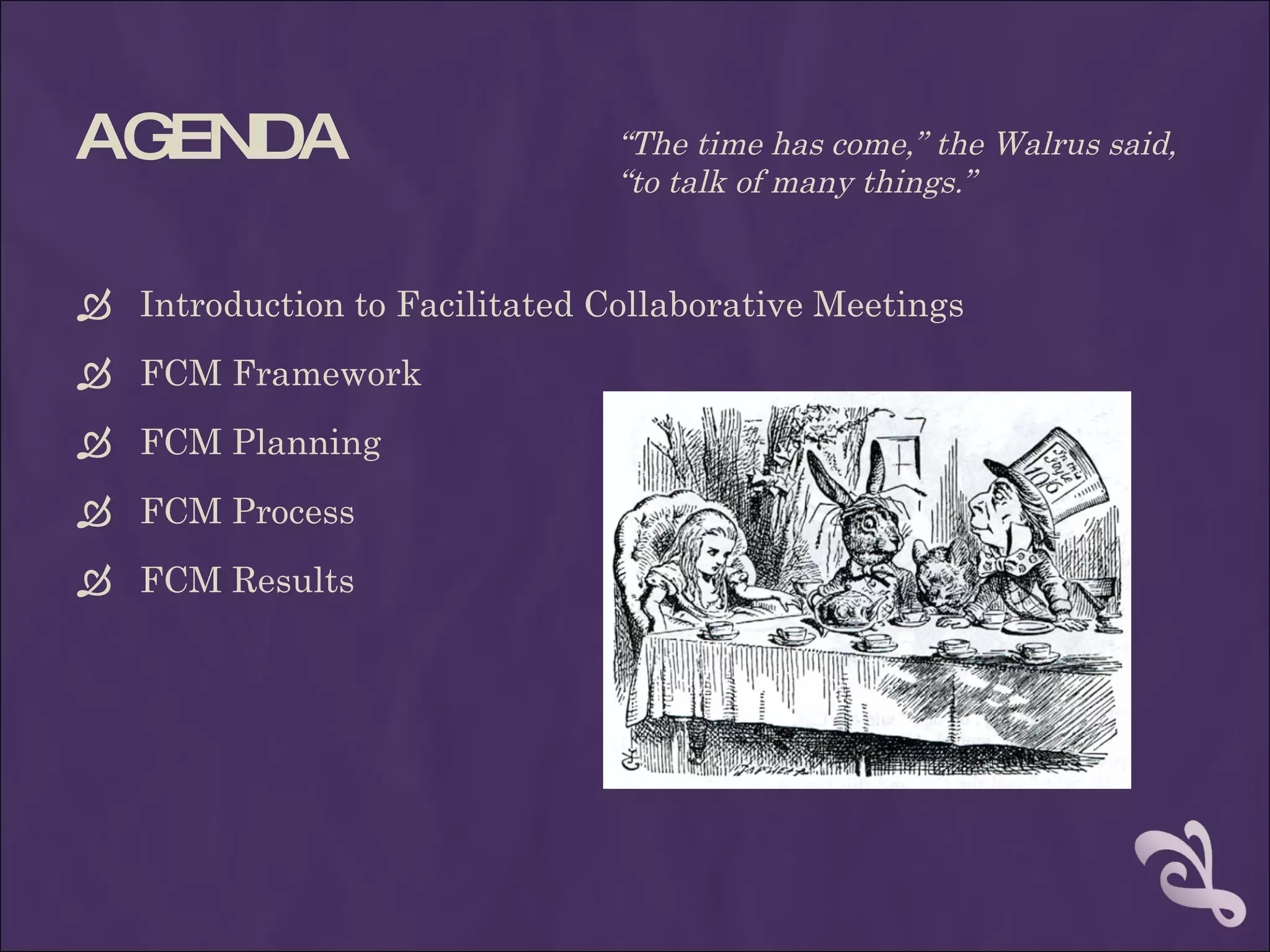
AGENDA                         “The time has come,” the Walrus said,
                               “to talk of many things.”


 Introduction to Facilitated Collaborative Meetings
 FCM Framework
 FCM Planning
 FCM Process
 FCM Results
INTRODUCTION TO FACILITATED
COLLABORATIVE MEETINGS (FCM)
       Background

        … JAD
            Chuck Morris, IBM Raleigh and

              Tony Crawford, IBM Toronto - 1970s

        … SCRUM
            Hirotaka Takeuchi and Ikujiro Nonaka -
             1986
BENEFITS

       Accelerated Sessions
       Improved Communication
       Increased Quality
       Enhanced Teamwork
       Reduced Wasted Time
       Superior Documentation
MEETING CATEGORIES              “It would have made a dreadfully
                                ugly child: but it makes rather
                                a handsome pig, I think”
      Informational
        …   One-time

        …   Recurring

      Training/Coaching
      Decision Making
      Problem-Solving
        …   Single session

        …   Multiple sessions
FC FRAMEW
  M      ORK

      Planning
      Executing
      Monitoring and Control
      Closure/Results
FC P
  M LANNING
                   “Would you tell me, please,
                   which way I ought to go from here?”

                   “That depends a good deal on where
                   you want to get to,” said the Cat.


    Why - Purpose
    What – Content and Outcome
    Who – Roles
    How - Techniques
    When and Where - Logistics
MEETING CONTENT
     •   Subject matter of the meeting
     •   Purpose of meeting related to subject matter
     •   Medium used
         •   High Tech
         •   Low Tech

     •   Content must be:
         - Defined before or created in meeting
         - Stated and written for all to view
         - Discussed and understood by all participants
         - Refined or modified to meet expectations
PARTIC ANTS
      IP
      Team oriented individuals
      Have the most important role
      Are responsible for what transpires in meeting
      Perform the work
      Make decisions
      Solve problems
MEETING ROLES
      Participants must:

        - Play a role in the meeting
        - Understand the responsibility of each role
        - Control the quality of the content
        - Have a profile on their background related to
        the meeting
FC EXEC
  M    UTION

      Needs to be controlled
      Needs to be orchestrated 
      Requires participants to speak and listen
      Needs rules regulating behavior of participants
ELICITATION TECHNIQUES

       Flip-charting
       Brainstorming
       Facilitated Dialogue
       Nominal Group
       Affinity Analysis
                                    “Curiouser and curiouser,”
       Prioritization Techniques
       Break-out Groups
MEETING SESSIONS

       Opening
         …   Ground rules

         …   Process review

       Content Preparation
         …   Build

         …   Review

       Closing
TEAM MEMBERS
     •   Presenter: Presents the context of meeting
     •   Facilitator: Conducts and controls meeting
     •   Recorder: Responsible for documenting content, issues
         and notes of meeting
     •   Participants:
         –   Generates meeting content
         –   Identify issues
         –   Assure the quality of meeting
     •   Stakeholder: Advocates meetings
     •   Observers: View meeting, but does not participate
     •   Mentor (optional)
FC MONITOR/C
  M         ONTROL
      Facilitator must ensure that the meeting content
       is related to the:
        - Purpose of the meeting
        - Meeting objectives
        - Meeting agenda
        - Meeting deliverables
WORKSHOPBEHAVIOR RULES (1 OF
3)
     •   Meeting Process Rules
         – Don't talk on top of others
         – Be aware of time
         – The facilitator is in charge


         “Take care of the sense, and the sounds will take care
           of themselves”
WORKSHOPBEHAVIOR RULES (2OF 3)
    •   Meeting Content Rules
        – Listen attentively to others
        – Focus on subject matter
        – Don't worry about correcting spelling
          or grammar errors 
WORKSHOPBEHAVIOR RULES (3OF 3)
    •   Participant Rules
        – Limit side conversations
        – Each person has the right to speak
        – All team members are equal
        – Criticize the work, not the person
        – If you can't be nice, don't participate
        – What's said - stays in the room (not
          only in Vegas)
FC C
  M LOSURE/RESULTS

      The artifacts of the meeting must include:

        … Planning documents
        … Session conversation
        … Finalized deliverables
        … Review/feedback
SUMMARY
     FCM can be used to improve problem-solving or
      creative meetings
     Planning, Execution, Monitoring and Control and
      Closure are essential for success


     - “Begin at the beginning,” the King said, very
      gravely, “and go on till you come to the end: then
      stop.”
Thank You
For more information please feel free to contact us:

Steve Blash, PMP
Greta Blash, PMP
greta@blashenterprises.com
steve@blashenterprises.com
702 917-2444
Graphics : http://victorianweb.org/art/illustration/tenniel
WORKSHOPBEHAVIOR RULES
     •   Meeting Process Rules

         –        Don't talk on top of others


         –        Be aware of time


         –        The facilitator is in charge


     •   Meeting Content Rules

         –        Listen attentively to others


         –        Focus on subject matter


         –        Don't worry about correcting spelling or grammar errors 


     •   Participant Rules

         –        Limit side conversations


         –        Each person has the right to speak


         –        All team members are equal


         –        Criticize the work, not the person


         –        It's O.K. to disagree


         –        If you can't be nice, don't participate


         –        What's said - stays in the room (not only in Vegas)

I I B A V2007

  • 1.
    RUNNING SUCCESSFUL AGILE COLLABORATIVE SESSIONS  Las Vegas IIBA Meeting July 7, 2009 Steve Blash, PMP Greta Blash, PMP Blash Enterprises, Inc. 702 917-2444
  • 2.
    AGENDA “The time has come,” the Walrus said, “to talk of many things.”  Introduction to Facilitated Collaborative Meetings  FCM Framework  FCM Planning  FCM Process  FCM Results
  • 3.
    INTRODUCTION TO FACILITATED COLLABORATIVEMEETINGS (FCM)  Background … JAD  Chuck Morris, IBM Raleigh and Tony Crawford, IBM Toronto - 1970s … SCRUM  Hirotaka Takeuchi and Ikujiro Nonaka - 1986
  • 4.
    BENEFITS  Accelerated Sessions  Improved Communication  Increased Quality  Enhanced Teamwork  Reduced Wasted Time  Superior Documentation
  • 5.
    MEETING CATEGORIES “It would have made a dreadfully ugly child: but it makes rather a handsome pig, I think”  Informational … One-time … Recurring  Training/Coaching  Decision Making  Problem-Solving … Single session … Multiple sessions
  • 6.
    FC FRAMEW M ORK  Planning  Executing  Monitoring and Control  Closure/Results
  • 7.
    FC P M LANNING “Would you tell me, please, which way I ought to go from here?” “That depends a good deal on where you want to get to,” said the Cat.  Why - Purpose  What – Content and Outcome  Who – Roles  How - Techniques  When and Where - Logistics
  • 8.
    MEETING CONTENT • Subject matter of the meeting • Purpose of meeting related to subject matter • Medium used • High Tech • Low Tech • Content must be: - Defined before or created in meeting - Stated and written for all to view - Discussed and understood by all participants - Refined or modified to meet expectations
  • 9.
    PARTIC ANTS IP  Team oriented individuals  Have the most important role  Are responsible for what transpires in meeting  Perform the work  Make decisions  Solve problems
  • 10.
    MEETING ROLES  Participants must: - Play a role in the meeting - Understand the responsibility of each role - Control the quality of the content - Have a profile on their background related to the meeting
  • 11.
    FC EXEC M UTION  Needs to be controlled  Needs to be orchestrated   Requires participants to speak and listen  Needs rules regulating behavior of participants
  • 12.
    ELICITATION TECHNIQUES  Flip-charting  Brainstorming  Facilitated Dialogue  Nominal Group  Affinity Analysis “Curiouser and curiouser,”  Prioritization Techniques  Break-out Groups
  • 13.
    MEETING SESSIONS  Opening … Ground rules … Process review  Content Preparation … Build … Review  Closing
  • 14.
    TEAM MEMBERS • Presenter: Presents the context of meeting • Facilitator: Conducts and controls meeting • Recorder: Responsible for documenting content, issues and notes of meeting • Participants: – Generates meeting content – Identify issues – Assure the quality of meeting • Stakeholder: Advocates meetings • Observers: View meeting, but does not participate • Mentor (optional)
  • 15.
    FC MONITOR/C M ONTROL  Facilitator must ensure that the meeting content is related to the: - Purpose of the meeting - Meeting objectives - Meeting agenda - Meeting deliverables
  • 16.
    WORKSHOPBEHAVIOR RULES (1OF 3) • Meeting Process Rules – Don't talk on top of others – Be aware of time – The facilitator is in charge “Take care of the sense, and the sounds will take care of themselves”
  • 17.
    WORKSHOPBEHAVIOR RULES (2OF3) • Meeting Content Rules – Listen attentively to others – Focus on subject matter – Don't worry about correcting spelling or grammar errors 
  • 18.
    WORKSHOPBEHAVIOR RULES (3OF3) • Participant Rules – Limit side conversations – Each person has the right to speak – All team members are equal – Criticize the work, not the person – If you can't be nice, don't participate – What's said - stays in the room (not only in Vegas)
  • 19.
    FC C M LOSURE/RESULTS  The artifacts of the meeting must include: … Planning documents … Session conversation … Finalized deliverables … Review/feedback
  • 20.
    SUMMARY  FCM can be used to improve problem-solving or creative meetings  Planning, Execution, Monitoring and Control and Closure are essential for success  - “Begin at the beginning,” the King said, very gravely, “and go on till you come to the end: then stop.”
  • 21.
    Thank You For moreinformation please feel free to contact us: Steve Blash, PMP Greta Blash, PMP greta@blashenterprises.com steve@blashenterprises.com 702 917-2444 Graphics : http://victorianweb.org/art/illustration/tenniel
  • 22.
    WORKSHOPBEHAVIOR RULES • Meeting Process Rules – Don't talk on top of others – Be aware of time – The facilitator is in charge • Meeting Content Rules – Listen attentively to others – Focus on subject matter – Don't worry about correcting spelling or grammar errors  • Participant Rules – Limit side conversations – Each person has the right to speak – All team members are equal – Criticize the work, not the person – It's O.K. to disagree – If you can't be nice, don't participate – What's said - stays in the room (not only in Vegas)