MLP & Machine Learning Presentation 2003.12.10 정규준 민혜진 Shang, Y.L. Face Image Compression and Handwritten data recognizer
Overview Face Image Compression Problem using MLP Handwritten Digit Recognition
Face Image Compression Problem(1/2) Get training vectors from face images Discrete Cosine Transform (DCT) image per 8 by 8 block People can not easily recognize the distortion of the signal because of sensitiveness of the low frequency criteria Neural Network Structure Tool  Matlab training function - Resilient back propagation,  performance goal - 0.002
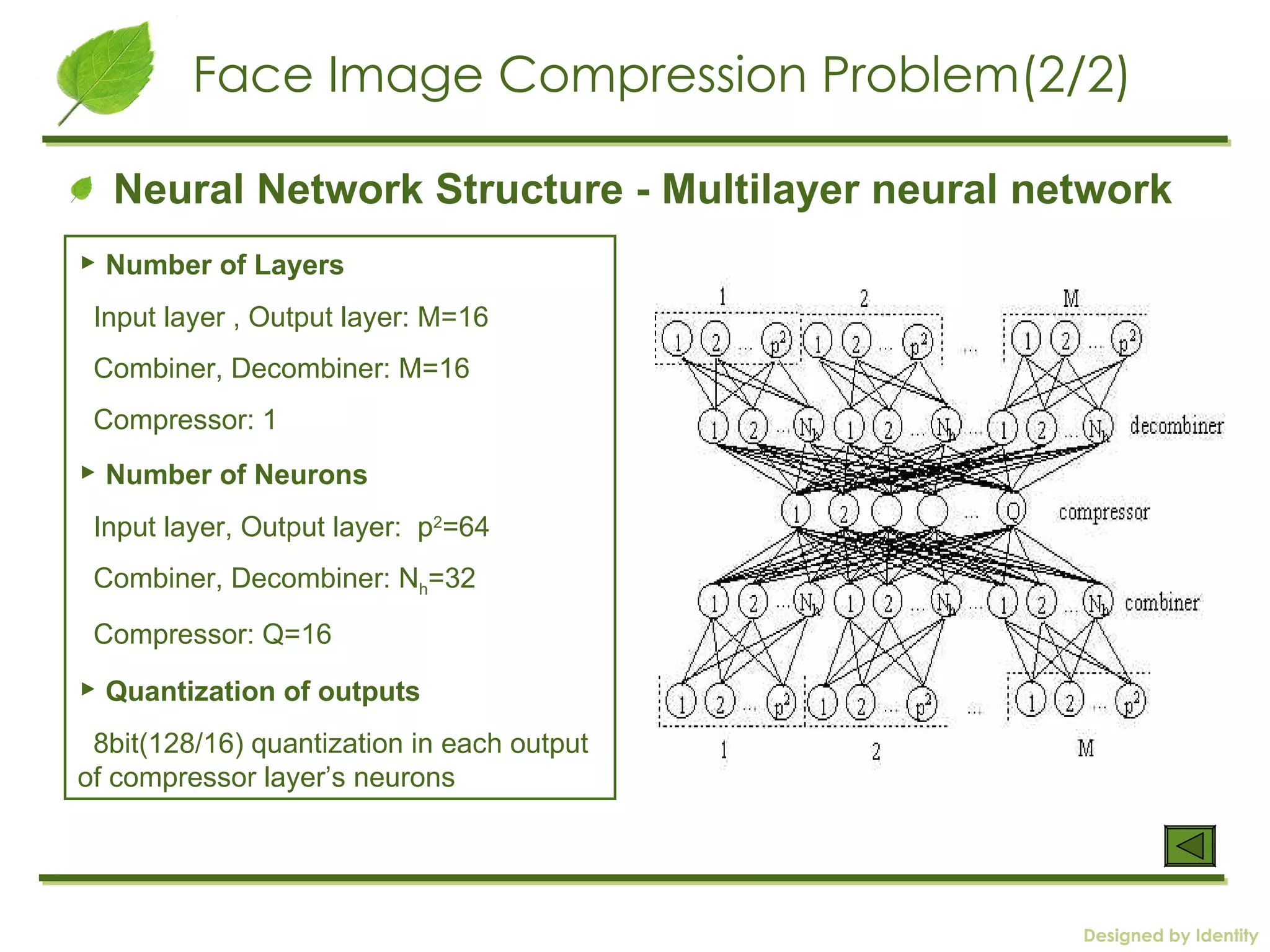
Face Image Compression Problem(2/2) Neural Network Structure - Multilayer neural network ▶  Number of Layers Input layer , Output layer: M=16 Combiner, Decombiner: M=16 Compressor: 1 ▶  Number of Neurons  Input layer, Output layer:  p 2 =64 Combiner, Decombiner: N h =32  Compressor: Q=16   ▶  Quantization of outputs   8bit(128/16) quantization in each output of compressor layer’s neurons
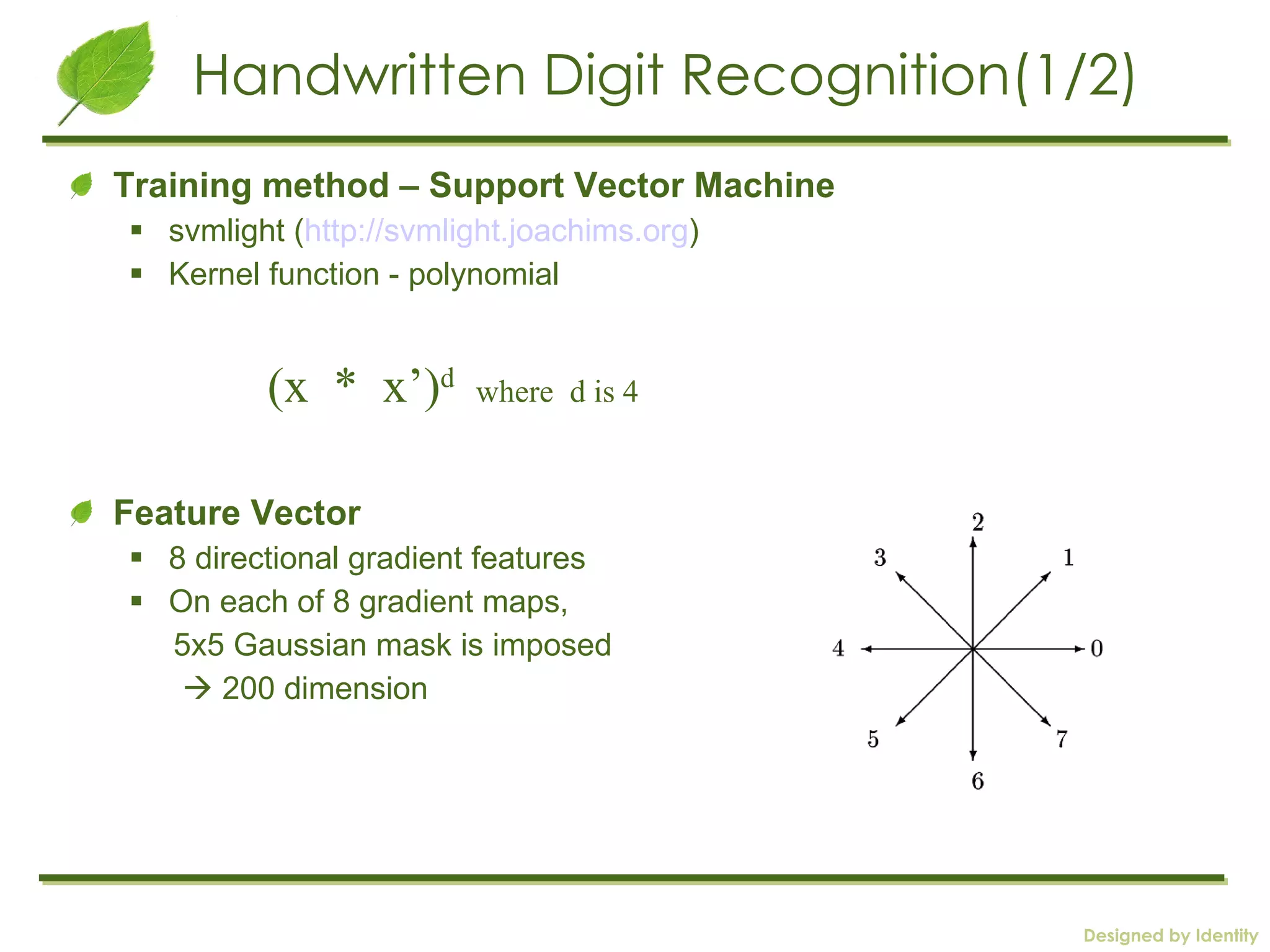
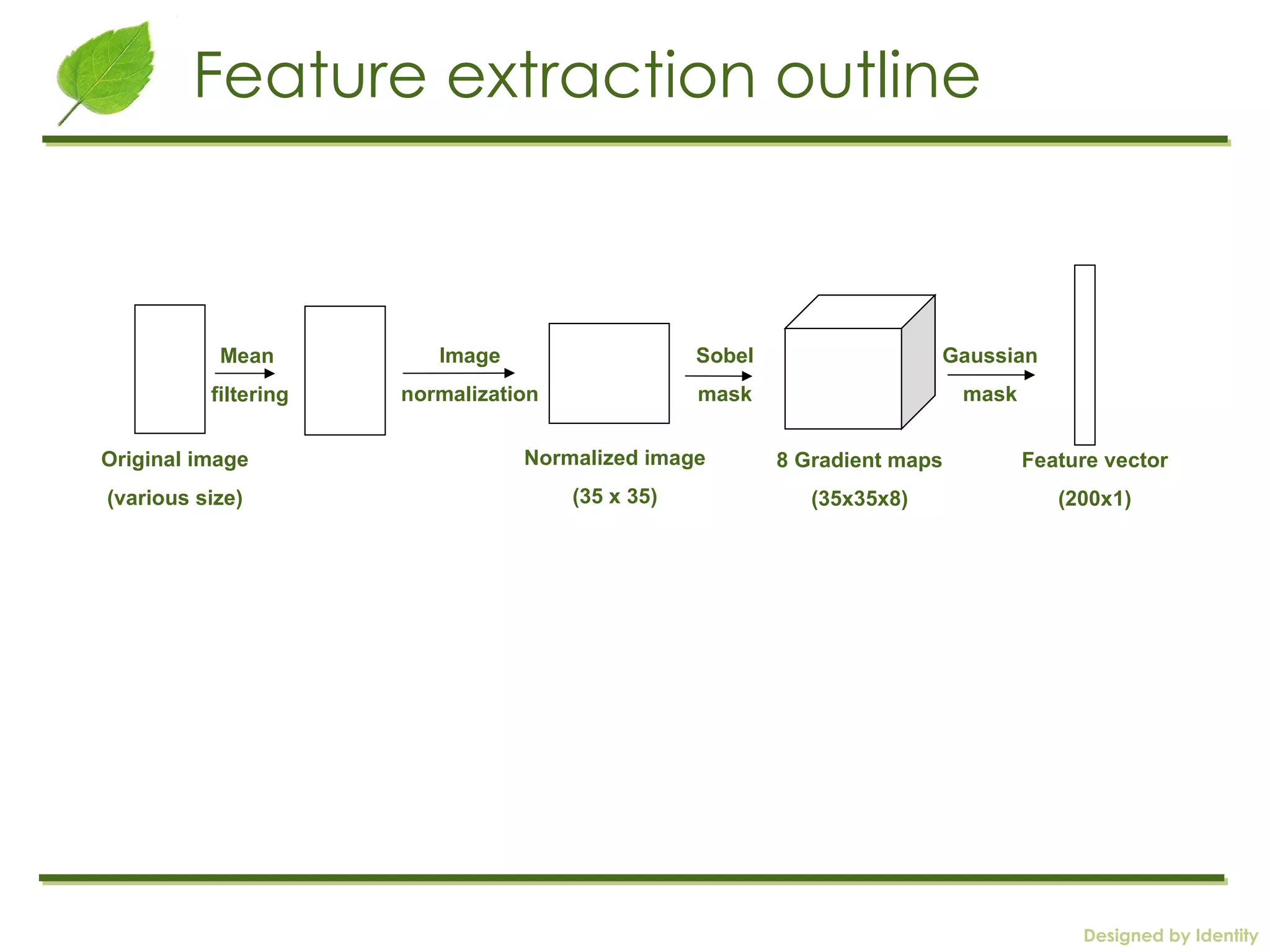
Handwritten Digit Recognition(1/2) Training method – Support Vector Machine svmlight ( http://svmlight.joachims.org )  Kernel function - polynomial Feature Vector  8 directional gradient features On each of 8 gradient maps,  5x5 Gaussian mask is imposed    200 dimension (x  *  x’) d   where  d is 4
Feature extraction outline Original image (various size) Normalized image (35 x 35) Sobel mask Mean  filtering Image normalization 8 Gradient maps (35x35x8) Gaussian mask Feature vector (200x1)
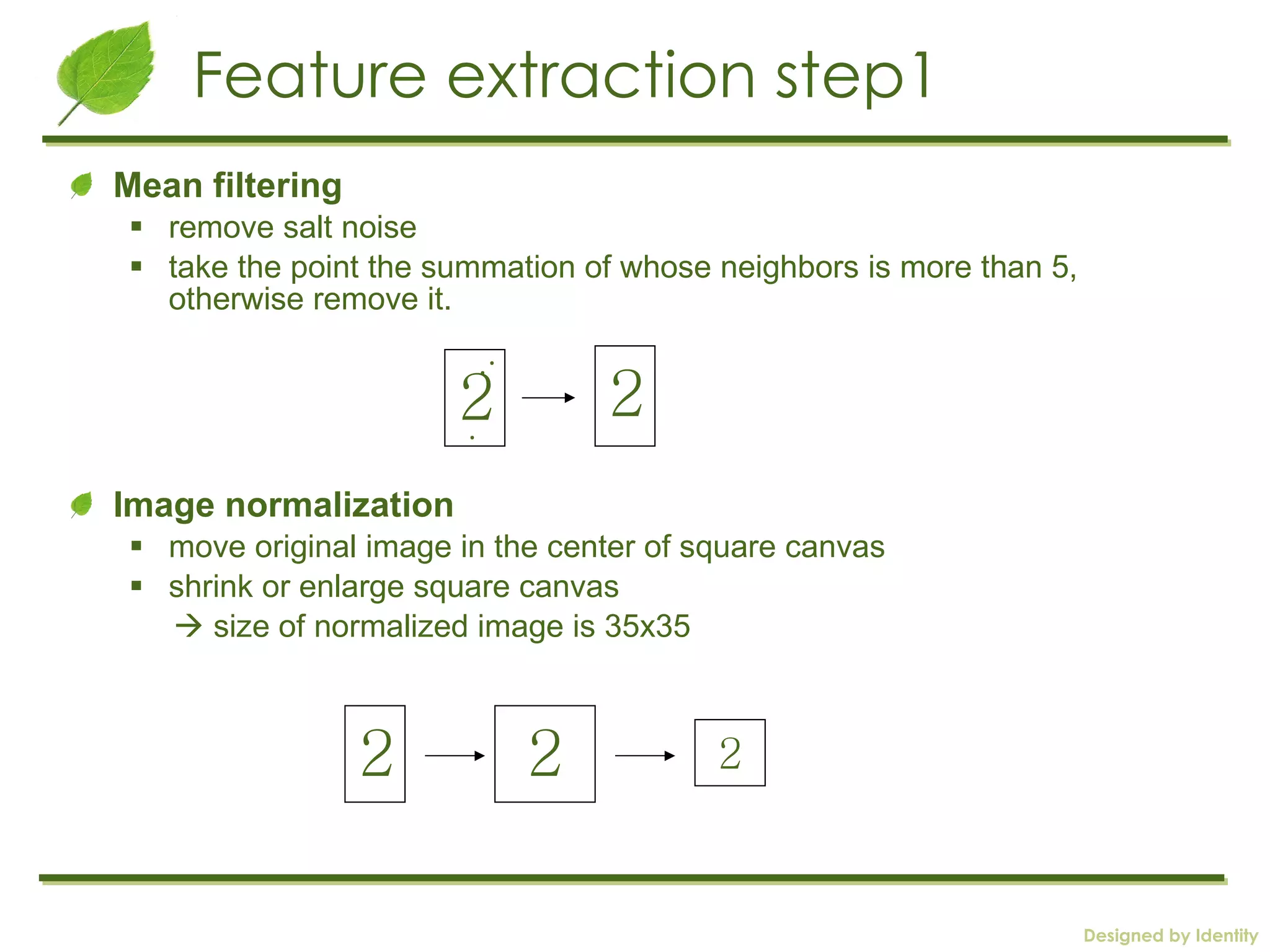
Feature extraction step1 Mean filtering remove salt noise take the point the summation of whose neighbors is more than 5, otherwise remove it. Image normalization move original image in the center of square canvas shrink or enlarge square canvas     size of normalized image is 35x35 2 . . . 2 2 2 2
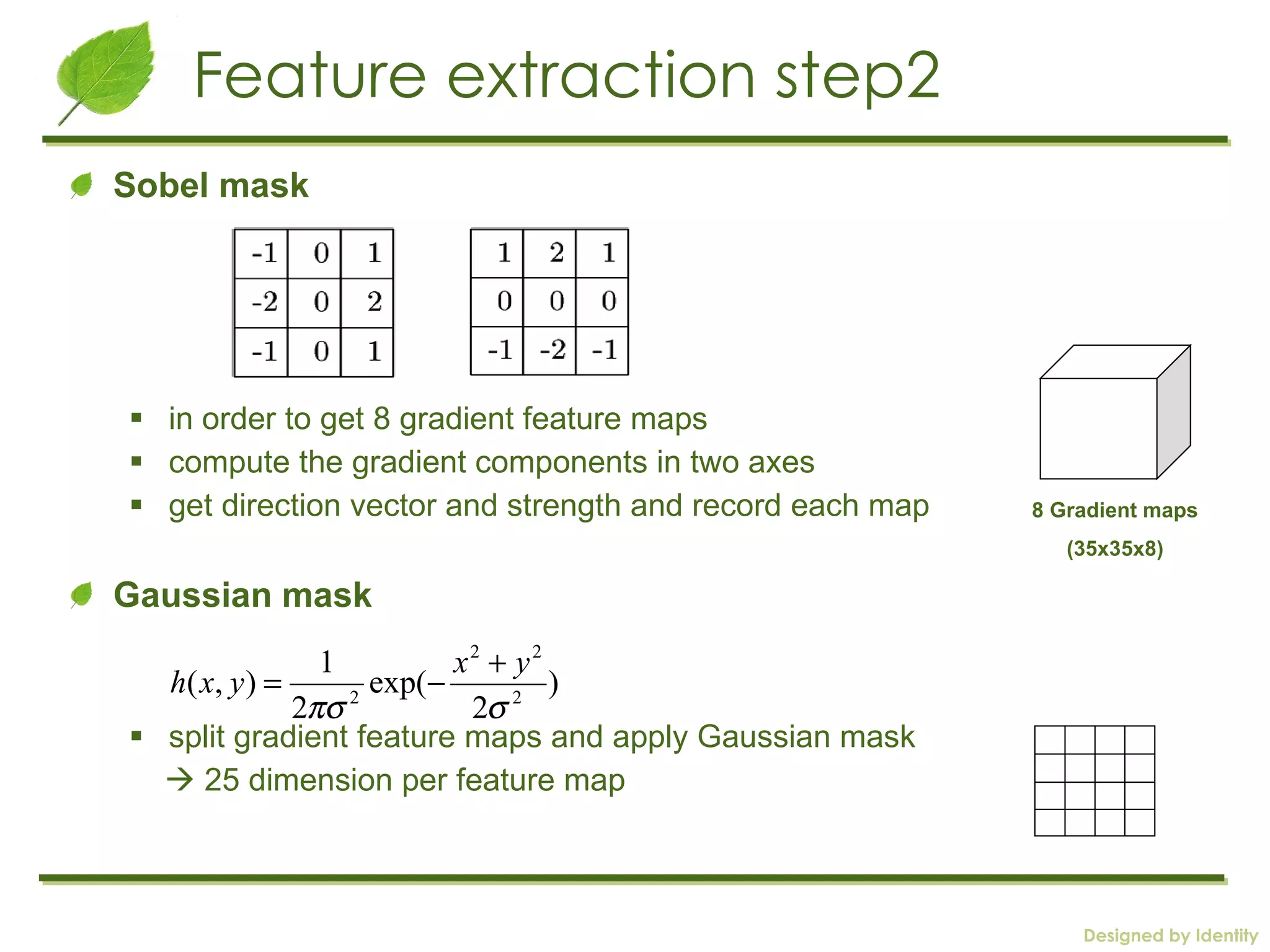
Feature extraction step2 Sobel mask  in order to get 8 gradient feature maps compute the gradient components in two axes get direction vector and strength and record each map Gaussian mask split gradient feature maps and apply Gaussian mask    25 dimension per feature map 8 Gradient maps (35x35x8)
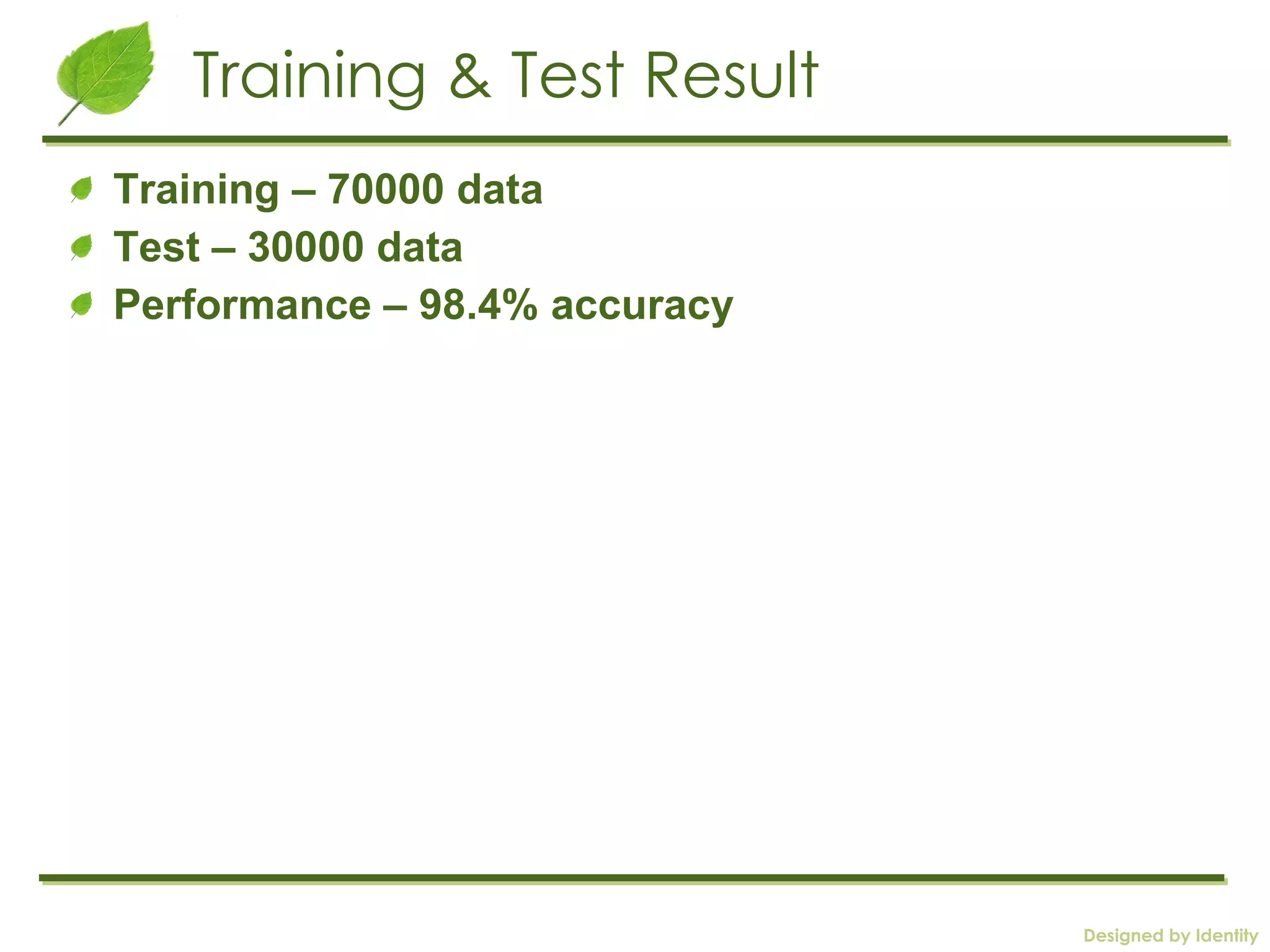
Training & Test Result Training – 70000 data  Test – 30000 data Performance – 98.4% accuracy

Designed by Identity MLP

  • 1.
    MLP & MachineLearning Presentation 2003.12.10 정규준 민혜진 Shang, Y.L. Face Image Compression and Handwritten data recognizer
  • 2.
    Overview Face ImageCompression Problem using MLP Handwritten Digit Recognition
  • 3.
    Face Image CompressionProblem(1/2) Get training vectors from face images Discrete Cosine Transform (DCT) image per 8 by 8 block People can not easily recognize the distortion of the signal because of sensitiveness of the low frequency criteria Neural Network Structure Tool Matlab training function - Resilient back propagation, performance goal - 0.002
  • 4.
    Face Image CompressionProblem(2/2) Neural Network Structure - Multilayer neural network ▶ Number of Layers Input layer , Output layer: M=16 Combiner, Decombiner: M=16 Compressor: 1 ▶ Number of Neurons Input layer, Output layer: p 2 =64 Combiner, Decombiner: N h =32 Compressor: Q=16 ▶ Quantization of outputs 8bit(128/16) quantization in each output of compressor layer’s neurons
  • 5.
    Handwritten Digit Recognition(1/2)Training method – Support Vector Machine svmlight ( http://svmlight.joachims.org ) Kernel function - polynomial Feature Vector 8 directional gradient features On each of 8 gradient maps, 5x5 Gaussian mask is imposed  200 dimension (x * x’) d where d is 4
  • 6.
    Feature extraction outlineOriginal image (various size) Normalized image (35 x 35) Sobel mask Mean filtering Image normalization 8 Gradient maps (35x35x8) Gaussian mask Feature vector (200x1)
  • 7.
    Feature extraction step1Mean filtering remove salt noise take the point the summation of whose neighbors is more than 5, otherwise remove it. Image normalization move original image in the center of square canvas shrink or enlarge square canvas  size of normalized image is 35x35 2 . . . 2 2 2 2
  • 8.
    Feature extraction step2Sobel mask in order to get 8 gradient feature maps compute the gradient components in two axes get direction vector and strength and record each map Gaussian mask split gradient feature maps and apply Gaussian mask  25 dimension per feature map 8 Gradient maps (35x35x8)
  • 9.
    Training & TestResult Training – 70000 data Test – 30000 data Performance – 98.4% accuracy