Knowledge Extraction for Educational Planning
Christopher Eliot
Beverly Woolf
Victor Lessor
Department of Computer Science
University of Massachusetts
Amherst, Mass 01002
eliot@cs.umass.edu
Abstract. Digital libraries promise to provide rapid access to immense
knowledge resources, but the quality and organization will vary. We will
implement and evaluate software to construct high quality courseware using
resources from a Digital Library. We propose to use context sensitive planning
methods to create educational plans using digital library resources. These plans
will be customized for individual students, using a student model, and optimized,
using machine learning methods to evaluate the learning value of digital
resources.
1. Educational Use of Digital Libraries
Digital Libraries have organized thousands of instructional objects that vary from intelligent
tutors [Woolf & Hall, 1995], to online lectures and papers, Table 1. More than 27,000 college-
level courses were delivered over the Internet and more than 1.6 million students enrolled in a
distance education course in 1997-1998 [Boettcher, 2000]. As these numbers increase serious
problems of efficiency will develop unless novel mechanisms are implemented to manage the
resources and interactions. Search engines can find these resources but no technology exists to
assist students in organizing and scheduling online learning.
We are developing a system to select and customize educational resources from a Digital
Library in order to support the needs of individual students and teachers. Digital resources will be
assembled into courses designed to enable students to achieve specific learning goals, subject to
constraints on pedagogy, quality, cost or duration. The system will also support teachers in the
development of curriculum plans. The system will exploit a combination of manual and
automatic evaluation mechanisms to optimize the course plans.
This research will address the following questions:
• How much planning knowledge can be extracted from an existing digital library?
• Can software automatically determine the content and approach of a teaching resource?
• What evaluation data is useful for optimizing course assembly?
• Can automatically constructed course plans compare with human authored plans?
2. State of the Art
Conventional search engines do not organize results. The number of specialized collections is
growing so rapidly that manually created directories (e.g. Yahoo) cannot keep up. Many high-
quality sites are extremely specialized: searchable indices to the complete works of Darwin,
nutritional information for foods, historical hydrological information in Western Washington, etc.
3. Proposed Approach
The core of our approach is the use
of context sensitive planning
methods to develop student
specific courses optimized on the
basis of feedback from prior
student usage. Machine learning
and statistical methods will be used
to evaluate learning resources.
Evaluation data will help refine,
prioritize and schedule the selected
resources. Information retrieval
methods will be used to construct
formal representations of available
learning resources.
Resources will be managed by
three conceptual modules: Course
Assembly Agents will be
responsible for resource selection
and planning; and Evaluation
Agents will monitor instruction and
assist with course optimization and
Ontology Agents will extract planning knowledge from the Digital Library
3.1 Course Assembly Agents
A student1
presents a query and the system determines which educational resource, or
combination of resources are relevant. Course Assembly Agents will use information about the
student, resources and topics, to construct an optimized course. When a consistent and complete
plan is found, it will be presented to the student for approval. Further search may yield a more
optimal plan, by exploring more options or as a result of unexpected changes in the availability or
quality of learning resources.
The course planner will use well known planning techniques. Each learning resource will be
described using an IF-THEN rule2
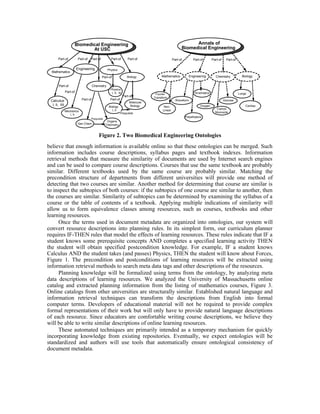
. In Figure 1, RULE-1 describes a Calculus course and RULE-2
describes a physics course. (In practice, the course assembly system will use many rules that
describe learning resources much smaller than a course.) As shown, a goal to know about forces
can be achieved by taking a course on Calculus followed by a course on Physics, assuming the
student already knows Algebra. A student who didn’t already know Algebra would first have to
take that course, while a student who already knows Calculus only needs the Physics course. Our
system will create curriculum plans by finding a chain of planning rules that connect the intended
final learning goal with the student’s prior knowledge.
After planning has selected learning resources and partially determined their order, a specific
“best” solution will be extracted, using TÆMS, a heuristic scheduling system [Wagner et al.,
1999]. TÆMS produces a comprehensive linear instantiation of one possible solution to the
problem, based on constraints, such as preferred time, quality or cost of the teaching materials.
TÆMS will generate an initial solution and then enable the student to alter the parameters to
retrieve a second solution. Given the constraints supplied by the student, TÆMS will offer a
variety of solutions. We believe it is important to present plans with all variables fully
instantiated since many people have difficulty reasoning about abstractions.
1
Teachers and instructional designers, will develop courses for entire classes and job trainers might use the system to
develop personalized courses for employees. For simplicity we call all of these uses student queries.
2
This paper describes IF-THEN rules for simplicity; in practice, more general planning operators will be supported.
Table 1. Existing Instructional Repositories
COURSES:
E-College, www.ecollege.com, thousands of courses, one hundred
degree programs
California Virtual University, www.cvc.edu, 1569 courses.
Western Governor’s University, www.wgu.edu, 275 courses.
Southern Regional Education, www.-srec.sreb.org, 300 courses,
OBJECTS:
Educational Object Economy, www.eoe.org, 2600 learning objects
NEEDS engineering database, www.needs.org, 863 Modules
LIBRARIES:
Chemistry, www.chem.ucla.edu/chempointers.html
Mathematics, www.forum.swarthmore.edu
DATABASES
NASA, www.nasa.gov/gallery/index.html
Human Genome, www.ncbi.nlm.hih.gov/genemap99
CLEARING HOUSES, PORTALS, CHANNELS
American Distance Education Consortium,www.deal.unl.edu
The Gateway to Educational Materials, www.thegateway.org,
Ask-ERIC, www.askeric.org
Advanced Distributed Learning www.adlnet.org
3.2 Evaluation Agents
Once a specific plan has been approved
and scheduled, the student will be given
access to the selected resources, one at a
time, interacting via a browser or other
interface. As the student finishes using
each resource, the student model is
modified to track learning progress,
until the student reaches the intended
learning goal, or abandons it as a goal.
Difficulties encountered along the way
are handled by re-planning.
The student model will record the
completion of each learning resource
and any grades given by the resource. Different resources may potentially (claim to) teach the
same topic. Evaluation must determine the relative effectiveness of different educational
resources.
A key observation is that the planning knowledge defines producer consumer relationships
among learning resources. Resources that assume students have satisfied a precondition are
consumers of the students who are produced by resources teaching the prerequisite knowledge.
Performance of students learning from an advanced educational resource can be correlated with
the resources used to satisfy the preconditions. If prerequisite knowledge (as measured by
producers) does not correlate with success in a consumer resource (e.g., time spent and mastery)
then the precondition can be dropped. If the average performance of students from one producer
is different than the performance of students from another producer, then the two producer
resources can be given a relative evaluation.
3.3 Ontology Agents
The Ontology Agent is designed to extract planning knowledge from existing repositories using
information retrieval methods. Many sources of data can be searched to obtain planning
information, including university course catalogs, online textbooks and technical ontologies.
Specialized Ontology Agents will be developed for specialized sources of information.
This knowledge will be extracted in two parts. First, the terms in the prerequisites and
postconditions will be isolated and organized into a collection of ontologies. Second, the specific
descriptions of learning resources will be created, using the ontologies as a target language.
Planning rules are abstracted from the descriptions of learning resources.
The terms used as preconditions and postconditions can be found in existing taxonomy
databases and other texts. The Web has over 30 taxonomies of teaching topics varying from
stable and mature taxonomies, such as the Library of Congress classification
(http://lcweb.loc.gov) and Dewey Decimal Classification (http://www.oclc.org/oclc/fp/) to
homegrown and unstable taxonomies. Within these taxonomies, higher education topics are
broken into sub-topics. For example, general chemistry includes chemistry of mixtures, solutions,
reactions, titrations etc. In the case of new or evolving subjects, ontologies may be abstracted
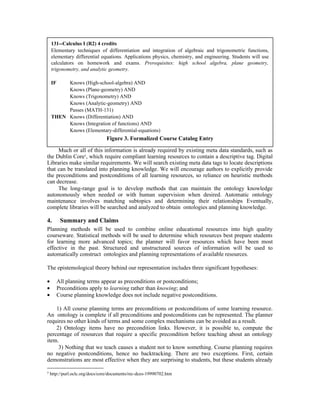
from structured documents. Figure 2 shows two ontologies, one derived from the Department of
Biomedical Engineering at the USC3
and the other from the Annals of Biomedical Engineering,4
using a table of contents keywords and abstracts from the six most recent papers in the journal.
These ontologies will be extracted and merged for use during course planning.
The use of multiple ontologies requires consideration of merging similar terms. We have
explored this issue in terms of the ontologies implicitly defined by college course catalogs. We
3
http://www.usc.edu/dept/biomed/
4
http://nsr.bioeng.washington.edu/ABME/annals.html
RULE-1: IF Knows(Algebra) AND
Passes(Calculus)
THEN
Knows(Integration)
RULE-2: IF Knows(Integration) AND
Passes(Physics)
THEN
Knows(Forces)
Goal: Knows(Forces)
Solution: Passes(Calculus), Passes(Physics)
Figure 1. A Trivial Course Planning Problem.
believe that enough information is available online so that these ontologies can be merged. Such
information includes course descriptions, syllabus pages and textbook indexes. Information
retrieval methods that measure the similarity of documents are used by Internet search engines
and can be used to compare course descriptions. Courses that use the same textbook are probably
similar. Different textbooks used by the same course are probably similar. Matching the
precondition structure of departments from different universities will provide one method of
detecting that two courses are similar. Another method for determining that course are similar is
to inspect the subtopics of both courses: if the subtopics of one course are similar to another, then
the courses are similar. Similarity of subtopics can be determined by examining the syllabus of a
course or the table of contents of a textbook. Applying multiple indications of similarity will
allow us to form equivalence classes among resources, such as courses, textbooks and other
learning resources.
Once the terms used in document metadata are organized into ontologies, our system will
convert resource descriptions into planning rules. In its simplest form, our curriculum planner
requires IF-THEN rules that model the effects of learning resources. These rules indicate that IF a
student knows some prerequisite concepts AND completes a specified learning activity THEN
the student will obtain specified postcondition knowledge. For example, IF a student knows
Calculus AND the student takes (and passes) Physics, THEN the student will know about Forces,
Figure 1. The precondition and postconditions of learning resources will be extracted using
information retrieval methods to search meta data tags and other descriptions of the resources.
Planning knowledge will be formalized using terms from the ontology, by analyzing meta
data descriptions of learning resources. We analyzed the University of Massachusetts online
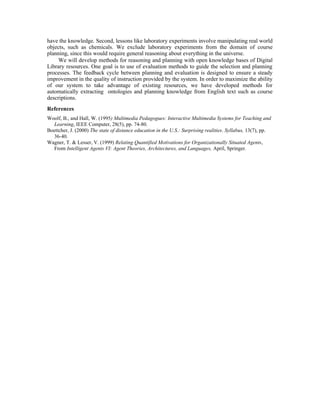
catalog and extracted planning information from the listing of mathematics courses, Figure 3.
Online catalogs from other universities are structurally similar. Established natural language and
information retrieval techniques can transform the descriptions from English into formal
computer terms. Developers of educational material will not be required to provide complex
formal representations of their work but will only have to provide natural language descriptions
of each resource. Since educators are comfortable writing course descriptions, we believe they
will be able to write similar descriptions of online learning resources.
These automated techniques are primarily intended as a temporary mechanism for quickly
incorporating knowledge from existing repositories. Eventually, we expect ontologies will be
standardized and authors will use tools that automatically ensure ontological consistency of
document metadata.
Biology
I, II
Calculus
I, II, IIII
Gen Chem
Physics
Mathematics
Prequisite
Part-of
Part-of
Biology
Engineering
Organic
Chemistry
Physics
I, II, III
Mechanics
I, II
Molecular
Biology Non-
Linear
LungsKinematics
CardiacOxygen
Waveform Glucose
Fourier
Transform
Polyethylene
Carbon
Monoxide
Mathematics BiologyEngineering
Biomedical Engineering
At USC
Annals of
Biomedical Engineering
Part-ofPart-of Part-ofPart-of
Part-of
Part-of Part-of
Part-of
Prequisite
Part-of
Chemistry
Chemistry
Part-ofPart-of Part-ofPart-of
Figure 2. Two Biomedical Engineering Ontologies
Much or all of this information is already required by existing meta data standards, such as
the Dublin Core5
, which require compliant learning resources to contain a descriptive tag. Digital
Libraries make similar requirements. We will search existing meta data tags to locate descriptions
that can be translated into planning knowledge. We will encourage authors to explicitly provide
the preconditions and postconditions of all learning resources, so reliance on heuristic methods
can decrease.
The long-range goal is to develop methods that can maintain the ontology knowledge
autonomously when needed or with human supervision when desired. Automatic ontology
maintenance involves matching subtopics and determining their relationships Eventually,
complete libraries will be searched and analyzed to obtain ontologies and planning knowledge.
4. Summary and Claims
Planning methods will be used to combine online educational resources into high quality
courseware. Statistical methods will be used to determine which resources best prepare students
for learning more advanced topics; the planner will favor resources which have been most
effective in the past. Structured and unstructured sources of information will be used to
automatically construct ontologies and planning representations of available resources.
The epistemological theory behind our representation includes three significant hypotheses:
• All planning terms appear as preconditions or postconditions;
• Preconditions apply to learning rather than knowing; and
• Course planning knowledge does not include negative postconditions.
1) All course planning terms are preconditions or postconditions of some learning resource.
An ontology is complete if all preconditions and postconditions can be represented. The planner
requires no other kinds of terms and some complex mechanisms can be avoided as a result.
2) Ontology items have no precondition links. However, it is possible to, compute the
percentage of resources that require a specific precondition before teaching about an ontology
item.
3) Nothing that we teach causes a student not to know something. Course planning requires
no negative postconditions, hence no backtracking. There are two exceptions. First, certain
demonstrations are most effective when they are surprising to students, but these students already
5
http://purl.oclc.org/docs/core/documents/rec-dces-19990702.htm
131--Calculus I (R2) 4 credits
Elementary techniques of differentiation and integration of algebraic and trigonometric functions,
elementary differential equations. Applications physics, chemistry, and engineering. Students will use
calculators on homework and exams. Prerequisites: high school algebra, plane geometry,
trigonometry, and analytic geometry.
IF Knows (High-school-algebra) AND
Knows (Plane-geometry) AND
Knows (Trigonometry) AND
Knows (Analytic-geometry) AND
Passes (MATH-131)
THEN Knows (Differentiation) AND
Knows (Integration of functions) AND
Knows (Elementary-differential-equations)
Figure 3. Formalized Course Catalog Entry
have the knowledge. Second, lessons like laboratory experiments involve manipulating real world
objects, such as chemicals. We exclude laboratory experiments from the domain of course
planning, since this would require general reasoning about everything in the universe.
We will develop methods for reasoning and planning with open knowledge bases of Digital
Library resources. One goal is to use of evaluation methods to guide the selection and planning
processes. The feedback cycle between planning and evaluation is designed to ensure a steady
improvement in the quality of instruction provided by the system. In order to maximize the ability
of our system to take advantage of existing resources, we have developed methods for
automatically extracting ontologies and planning knowledge from English text such as course
descriptions.
References
Woolf, B., and Hall, W. (1995) Multimedia Pedagogues: Interactive Multimedia Systems for Teaching and
Learning, IEEE Computer, 28(5), pp. 74-80.
Boettcher, J. (2000) The state of distance education in the U.S.: Surprising realities. Syllabus, 13(7), pp.
36-40.
Wagner, T. & Lesser, V. (1999) Relating Quantified Motivations for Organizationally Situated Agents,
From Intelligent Agents VI: Agent Theories, Architectures, and Languages, April, Springer.
have the knowledge. Second, lessons like laboratory experiments involve manipulating real world
objects, such as chemicals. We exclude laboratory experiments from the domain of course
planning, since this would require general reasoning about everything in the universe.
We will develop methods for reasoning and planning with open knowledge bases of Digital
Library resources. One goal is to use of evaluation methods to guide the selection and planning
processes. The feedback cycle between planning and evaluation is designed to ensure a steady
improvement in the quality of instruction provided by the system. In order to maximize the ability
of our system to take advantage of existing resources, we have developed methods for
automatically extracting ontologies and planning knowledge from English text such as course
descriptions.
References
Woolf, B., and Hall, W. (1995) Multimedia Pedagogues: Interactive Multimedia Systems for Teaching and
Learning, IEEE Computer, 28(5), pp. 74-80.
Boettcher, J. (2000) The state of distance education in the U.S.: Surprising realities. Syllabus, 13(7), pp.
36-40.
Wagner, T. & Lesser, V. (1999) Relating Quantified Motivations for Organizationally Situated Agents,
From Intelligent Agents VI: Agent Theories, Architectures, and Languages, April, Springer.

eliot.doc

  • 1.
    Knowledge Extraction forEducational Planning Christopher Eliot Beverly Woolf Victor Lessor Department of Computer Science University of Massachusetts Amherst, Mass 01002 eliot@cs.umass.edu Abstract. Digital libraries promise to provide rapid access to immense knowledge resources, but the quality and organization will vary. We will implement and evaluate software to construct high quality courseware using resources from a Digital Library. We propose to use context sensitive planning methods to create educational plans using digital library resources. These plans will be customized for individual students, using a student model, and optimized, using machine learning methods to evaluate the learning value of digital resources. 1. Educational Use of Digital Libraries Digital Libraries have organized thousands of instructional objects that vary from intelligent tutors [Woolf & Hall, 1995], to online lectures and papers, Table 1. More than 27,000 college- level courses were delivered over the Internet and more than 1.6 million students enrolled in a distance education course in 1997-1998 [Boettcher, 2000]. As these numbers increase serious problems of efficiency will develop unless novel mechanisms are implemented to manage the resources and interactions. Search engines can find these resources but no technology exists to assist students in organizing and scheduling online learning. We are developing a system to select and customize educational resources from a Digital Library in order to support the needs of individual students and teachers. Digital resources will be assembled into courses designed to enable students to achieve specific learning goals, subject to constraints on pedagogy, quality, cost or duration. The system will also support teachers in the development of curriculum plans. The system will exploit a combination of manual and automatic evaluation mechanisms to optimize the course plans. This research will address the following questions: • How much planning knowledge can be extracted from an existing digital library? • Can software automatically determine the content and approach of a teaching resource? • What evaluation data is useful for optimizing course assembly? • Can automatically constructed course plans compare with human authored plans? 2. State of the Art Conventional search engines do not organize results. The number of specialized collections is growing so rapidly that manually created directories (e.g. Yahoo) cannot keep up. Many high- quality sites are extremely specialized: searchable indices to the complete works of Darwin, nutritional information for foods, historical hydrological information in Western Washington, etc.
  • 2.
    3. Proposed Approach Thecore of our approach is the use of context sensitive planning methods to develop student specific courses optimized on the basis of feedback from prior student usage. Machine learning and statistical methods will be used to evaluate learning resources. Evaluation data will help refine, prioritize and schedule the selected resources. Information retrieval methods will be used to construct formal representations of available learning resources. Resources will be managed by three conceptual modules: Course Assembly Agents will be responsible for resource selection and planning; and Evaluation Agents will monitor instruction and assist with course optimization and Ontology Agents will extract planning knowledge from the Digital Library 3.1 Course Assembly Agents A student1 presents a query and the system determines which educational resource, or combination of resources are relevant. Course Assembly Agents will use information about the student, resources and topics, to construct an optimized course. When a consistent and complete plan is found, it will be presented to the student for approval. Further search may yield a more optimal plan, by exploring more options or as a result of unexpected changes in the availability or quality of learning resources. The course planner will use well known planning techniques. Each learning resource will be described using an IF-THEN rule2 . In Figure 1, RULE-1 describes a Calculus course and RULE-2 describes a physics course. (In practice, the course assembly system will use many rules that describe learning resources much smaller than a course.) As shown, a goal to know about forces can be achieved by taking a course on Calculus followed by a course on Physics, assuming the student already knows Algebra. A student who didn’t already know Algebra would first have to take that course, while a student who already knows Calculus only needs the Physics course. Our system will create curriculum plans by finding a chain of planning rules that connect the intended final learning goal with the student’s prior knowledge. After planning has selected learning resources and partially determined their order, a specific “best” solution will be extracted, using TÆMS, a heuristic scheduling system [Wagner et al., 1999]. TÆMS produces a comprehensive linear instantiation of one possible solution to the problem, based on constraints, such as preferred time, quality or cost of the teaching materials. TÆMS will generate an initial solution and then enable the student to alter the parameters to retrieve a second solution. Given the constraints supplied by the student, TÆMS will offer a variety of solutions. We believe it is important to present plans with all variables fully instantiated since many people have difficulty reasoning about abstractions. 1 Teachers and instructional designers, will develop courses for entire classes and job trainers might use the system to develop personalized courses for employees. For simplicity we call all of these uses student queries. 2 This paper describes IF-THEN rules for simplicity; in practice, more general planning operators will be supported. Table 1. Existing Instructional Repositories COURSES: E-College, www.ecollege.com, thousands of courses, one hundred degree programs California Virtual University, www.cvc.edu, 1569 courses. Western Governor’s University, www.wgu.edu, 275 courses. Southern Regional Education, www.-srec.sreb.org, 300 courses, OBJECTS: Educational Object Economy, www.eoe.org, 2600 learning objects NEEDS engineering database, www.needs.org, 863 Modules LIBRARIES: Chemistry, www.chem.ucla.edu/chempointers.html Mathematics, www.forum.swarthmore.edu DATABASES NASA, www.nasa.gov/gallery/index.html Human Genome, www.ncbi.nlm.hih.gov/genemap99 CLEARING HOUSES, PORTALS, CHANNELS American Distance Education Consortium,www.deal.unl.edu The Gateway to Educational Materials, www.thegateway.org, Ask-ERIC, www.askeric.org Advanced Distributed Learning www.adlnet.org
  • 3.
    3.2 Evaluation Agents Oncea specific plan has been approved and scheduled, the student will be given access to the selected resources, one at a time, interacting via a browser or other interface. As the student finishes using each resource, the student model is modified to track learning progress, until the student reaches the intended learning goal, or abandons it as a goal. Difficulties encountered along the way are handled by re-planning. The student model will record the completion of each learning resource and any grades given by the resource. Different resources may potentially (claim to) teach the same topic. Evaluation must determine the relative effectiveness of different educational resources. A key observation is that the planning knowledge defines producer consumer relationships among learning resources. Resources that assume students have satisfied a precondition are consumers of the students who are produced by resources teaching the prerequisite knowledge. Performance of students learning from an advanced educational resource can be correlated with the resources used to satisfy the preconditions. If prerequisite knowledge (as measured by producers) does not correlate with success in a consumer resource (e.g., time spent and mastery) then the precondition can be dropped. If the average performance of students from one producer is different than the performance of students from another producer, then the two producer resources can be given a relative evaluation. 3.3 Ontology Agents The Ontology Agent is designed to extract planning knowledge from existing repositories using information retrieval methods. Many sources of data can be searched to obtain planning information, including university course catalogs, online textbooks and technical ontologies. Specialized Ontology Agents will be developed for specialized sources of information. This knowledge will be extracted in two parts. First, the terms in the prerequisites and postconditions will be isolated and organized into a collection of ontologies. Second, the specific descriptions of learning resources will be created, using the ontologies as a target language. Planning rules are abstracted from the descriptions of learning resources. The terms used as preconditions and postconditions can be found in existing taxonomy databases and other texts. The Web has over 30 taxonomies of teaching topics varying from stable and mature taxonomies, such as the Library of Congress classification (http://lcweb.loc.gov) and Dewey Decimal Classification (http://www.oclc.org/oclc/fp/) to homegrown and unstable taxonomies. Within these taxonomies, higher education topics are broken into sub-topics. For example, general chemistry includes chemistry of mixtures, solutions, reactions, titrations etc. In the case of new or evolving subjects, ontologies may be abstracted from structured documents. Figure 2 shows two ontologies, one derived from the Department of Biomedical Engineering at the USC3 and the other from the Annals of Biomedical Engineering,4 using a table of contents keywords and abstracts from the six most recent papers in the journal. These ontologies will be extracted and merged for use during course planning. The use of multiple ontologies requires consideration of merging similar terms. We have explored this issue in terms of the ontologies implicitly defined by college course catalogs. We 3 http://www.usc.edu/dept/biomed/ 4 http://nsr.bioeng.washington.edu/ABME/annals.html RULE-1: IF Knows(Algebra) AND Passes(Calculus) THEN Knows(Integration) RULE-2: IF Knows(Integration) AND Passes(Physics) THEN Knows(Forces) Goal: Knows(Forces) Solution: Passes(Calculus), Passes(Physics) Figure 1. A Trivial Course Planning Problem.
  • 4.
    believe that enoughinformation is available online so that these ontologies can be merged. Such information includes course descriptions, syllabus pages and textbook indexes. Information retrieval methods that measure the similarity of documents are used by Internet search engines and can be used to compare course descriptions. Courses that use the same textbook are probably similar. Different textbooks used by the same course are probably similar. Matching the precondition structure of departments from different universities will provide one method of detecting that two courses are similar. Another method for determining that course are similar is to inspect the subtopics of both courses: if the subtopics of one course are similar to another, then the courses are similar. Similarity of subtopics can be determined by examining the syllabus of a course or the table of contents of a textbook. Applying multiple indications of similarity will allow us to form equivalence classes among resources, such as courses, textbooks and other learning resources. Once the terms used in document metadata are organized into ontologies, our system will convert resource descriptions into planning rules. In its simplest form, our curriculum planner requires IF-THEN rules that model the effects of learning resources. These rules indicate that IF a student knows some prerequisite concepts AND completes a specified learning activity THEN the student will obtain specified postcondition knowledge. For example, IF a student knows Calculus AND the student takes (and passes) Physics, THEN the student will know about Forces, Figure 1. The precondition and postconditions of learning resources will be extracted using information retrieval methods to search meta data tags and other descriptions of the resources. Planning knowledge will be formalized using terms from the ontology, by analyzing meta data descriptions of learning resources. We analyzed the University of Massachusetts online catalog and extracted planning information from the listing of mathematics courses, Figure 3. Online catalogs from other universities are structurally similar. Established natural language and information retrieval techniques can transform the descriptions from English into formal computer terms. Developers of educational material will not be required to provide complex formal representations of their work but will only have to provide natural language descriptions of each resource. Since educators are comfortable writing course descriptions, we believe they will be able to write similar descriptions of online learning resources. These automated techniques are primarily intended as a temporary mechanism for quickly incorporating knowledge from existing repositories. Eventually, we expect ontologies will be standardized and authors will use tools that automatically ensure ontological consistency of document metadata. Biology I, II Calculus I, II, IIII Gen Chem Physics Mathematics Prequisite Part-of Part-of Biology Engineering Organic Chemistry Physics I, II, III Mechanics I, II Molecular Biology Non- Linear LungsKinematics CardiacOxygen Waveform Glucose Fourier Transform Polyethylene Carbon Monoxide Mathematics BiologyEngineering Biomedical Engineering At USC Annals of Biomedical Engineering Part-ofPart-of Part-ofPart-of Part-of Part-of Part-of Part-of Prequisite Part-of Chemistry Chemistry Part-ofPart-of Part-ofPart-of Figure 2. Two Biomedical Engineering Ontologies
  • 5.
    Much or allof this information is already required by existing meta data standards, such as the Dublin Core5 , which require compliant learning resources to contain a descriptive tag. Digital Libraries make similar requirements. We will search existing meta data tags to locate descriptions that can be translated into planning knowledge. We will encourage authors to explicitly provide the preconditions and postconditions of all learning resources, so reliance on heuristic methods can decrease. The long-range goal is to develop methods that can maintain the ontology knowledge autonomously when needed or with human supervision when desired. Automatic ontology maintenance involves matching subtopics and determining their relationships Eventually, complete libraries will be searched and analyzed to obtain ontologies and planning knowledge. 4. Summary and Claims Planning methods will be used to combine online educational resources into high quality courseware. Statistical methods will be used to determine which resources best prepare students for learning more advanced topics; the planner will favor resources which have been most effective in the past. Structured and unstructured sources of information will be used to automatically construct ontologies and planning representations of available resources. The epistemological theory behind our representation includes three significant hypotheses: • All planning terms appear as preconditions or postconditions; • Preconditions apply to learning rather than knowing; and • Course planning knowledge does not include negative postconditions. 1) All course planning terms are preconditions or postconditions of some learning resource. An ontology is complete if all preconditions and postconditions can be represented. The planner requires no other kinds of terms and some complex mechanisms can be avoided as a result. 2) Ontology items have no precondition links. However, it is possible to, compute the percentage of resources that require a specific precondition before teaching about an ontology item. 3) Nothing that we teach causes a student not to know something. Course planning requires no negative postconditions, hence no backtracking. There are two exceptions. First, certain demonstrations are most effective when they are surprising to students, but these students already 5 http://purl.oclc.org/docs/core/documents/rec-dces-19990702.htm 131--Calculus I (R2) 4 credits Elementary techniques of differentiation and integration of algebraic and trigonometric functions, elementary differential equations. Applications physics, chemistry, and engineering. Students will use calculators on homework and exams. Prerequisites: high school algebra, plane geometry, trigonometry, and analytic geometry. IF Knows (High-school-algebra) AND Knows (Plane-geometry) AND Knows (Trigonometry) AND Knows (Analytic-geometry) AND Passes (MATH-131) THEN Knows (Differentiation) AND Knows (Integration of functions) AND Knows (Elementary-differential-equations) Figure 3. Formalized Course Catalog Entry
  • 6.
    have the knowledge.Second, lessons like laboratory experiments involve manipulating real world objects, such as chemicals. We exclude laboratory experiments from the domain of course planning, since this would require general reasoning about everything in the universe. We will develop methods for reasoning and planning with open knowledge bases of Digital Library resources. One goal is to use of evaluation methods to guide the selection and planning processes. The feedback cycle between planning and evaluation is designed to ensure a steady improvement in the quality of instruction provided by the system. In order to maximize the ability of our system to take advantage of existing resources, we have developed methods for automatically extracting ontologies and planning knowledge from English text such as course descriptions. References Woolf, B., and Hall, W. (1995) Multimedia Pedagogues: Interactive Multimedia Systems for Teaching and Learning, IEEE Computer, 28(5), pp. 74-80. Boettcher, J. (2000) The state of distance education in the U.S.: Surprising realities. Syllabus, 13(7), pp. 36-40. Wagner, T. & Lesser, V. (1999) Relating Quantified Motivations for Organizationally Situated Agents, From Intelligent Agents VI: Agent Theories, Architectures, and Languages, April, Springer.
  • 7.
    have the knowledge.Second, lessons like laboratory experiments involve manipulating real world objects, such as chemicals. We exclude laboratory experiments from the domain of course planning, since this would require general reasoning about everything in the universe. We will develop methods for reasoning and planning with open knowledge bases of Digital Library resources. One goal is to use of evaluation methods to guide the selection and planning processes. The feedback cycle between planning and evaluation is designed to ensure a steady improvement in the quality of instruction provided by the system. In order to maximize the ability of our system to take advantage of existing resources, we have developed methods for automatically extracting ontologies and planning knowledge from English text such as course descriptions. References Woolf, B., and Hall, W. (1995) Multimedia Pedagogues: Interactive Multimedia Systems for Teaching and Learning, IEEE Computer, 28(5), pp. 74-80. Boettcher, J. (2000) The state of distance education in the U.S.: Surprising realities. Syllabus, 13(7), pp. 36-40. Wagner, T. & Lesser, V. (1999) Relating Quantified Motivations for Organizationally Situated Agents, From Intelligent Agents VI: Agent Theories, Architectures, and Languages, April, Springer.