Machine Learning Ata Kaban The University of Birmingham
Machine Learning: The Module What is  Learning ?  Decision trees  Instance-based learning  Kernel Machines  Probabilistic Models  Bayesian Learning  Learning Theory  Reinforcement Learning  Genetic Algorithms
Lectures & Tutorials Lectures Tutorial immediately following lecture. Exercise sheets given out at lecture Solutions discussed during tutorials Handouts are on the module’s web page: http://www.cs.bham.ac.uk/~axk/ML_new.htm
Continuous Assessment ML: 20% of your final mark ML-EXTENDED: 40% of your final mark Two types of exercises Computer based practical work The exercises are posted on the module’s web page Deadline: end of term Paper-based exercises (worksheets) The exercises are on the module’s web page & are handed out in lectures Deadline: before the following weeks lecture Many options, but:
Continuous Assessment (cont’d) Options and restrictions: You choose which pieces of your work you put forth for marking Best strategy to give a try to every Worksheet exercise, hand in your solution before we solve it in the class, then decide whether you leave your solution with me for marking or you take it back.  You can only take it back before it gets marked I mark the first 5 (9 for EXT) pieces of work that you put forth and take the best 4 (8 for EXT) marks. Feedback: You get immediate feedback on Worksheet exercises as we solve them in the class. You will also get your marked work returned to you (in 2 weeks). You can approach me with questions in my office hours (as well as in tutorials, lectures, breaks).
Office hours The time for my weekly office hours is communicated on my timetable  (watch for possible changes): Location: UG32 What office hours are and aren’t for Yes: ask me concrete questions to clarify something that has not been clear to you from the lecture Yes: seek advice on your solutions to the given exercises Yes: seek advice on further readings on related material not covered in the lecture No: ask me to solve the exercises No: ask me to repeat a lecture  http://www.cs.bham.ac.uk/~axk/timetable.html
Literature Machine Learning (Mitchell) Reinforcement Learning … (Barto, Sutton) Modelling the Web (Baldi, Smyth) Support Vector Machines and Other Kernel-Based Learning Methods (Cristianini, Shawe-Taylor)  Artificial Intelligence … (Russell, Norvig) Artificial Intelligence (Rich, Knight) Artificial Intelligence (Winston)
Module Web Page ~axk  Syllabus  Handouts Exercise sheets Computer-based practical exercises Links to ML resources on the web Literature
What is Learning? How can Learning be measured? Any change in the knowledge of a system that allows it to perform better on subsequent tasks Knowledge. Hmmm. How should knowledge be represented. We do not know how it is represented in our own brains! Think for a moment about how knowledge might be represented in a computer. If I told you what subjects would come up in the exam, you might do very well. Would you do so well on randomly chosen subjects from the syllabus? This illustrates the notion called ‘overfitting’ - something one should guard against
Ways humans learn things … talking, walking, running… Learning by mimicking, reading or being  told facts Tutoring Being informed when one is correct Experience Feedback from the environment Analogy Comparing certain features of existing knowledge to new problems Self-reflection Thinking things in ones own mind, deduction, discovery
Machine Learning Interdisciplinary field Artificial intelligence  Bayesian methods Computational complexity theory Control theory Information theory Philosophy Psychology and neurobiology Statistics …
Achievements of ML Computer programs that can: Recognize spoken words Predict recovery rates of pneumonia patients Detect fraudulent use of credit cards Drive autonomous vehicles Play games like backgammon – approaching the human champion!
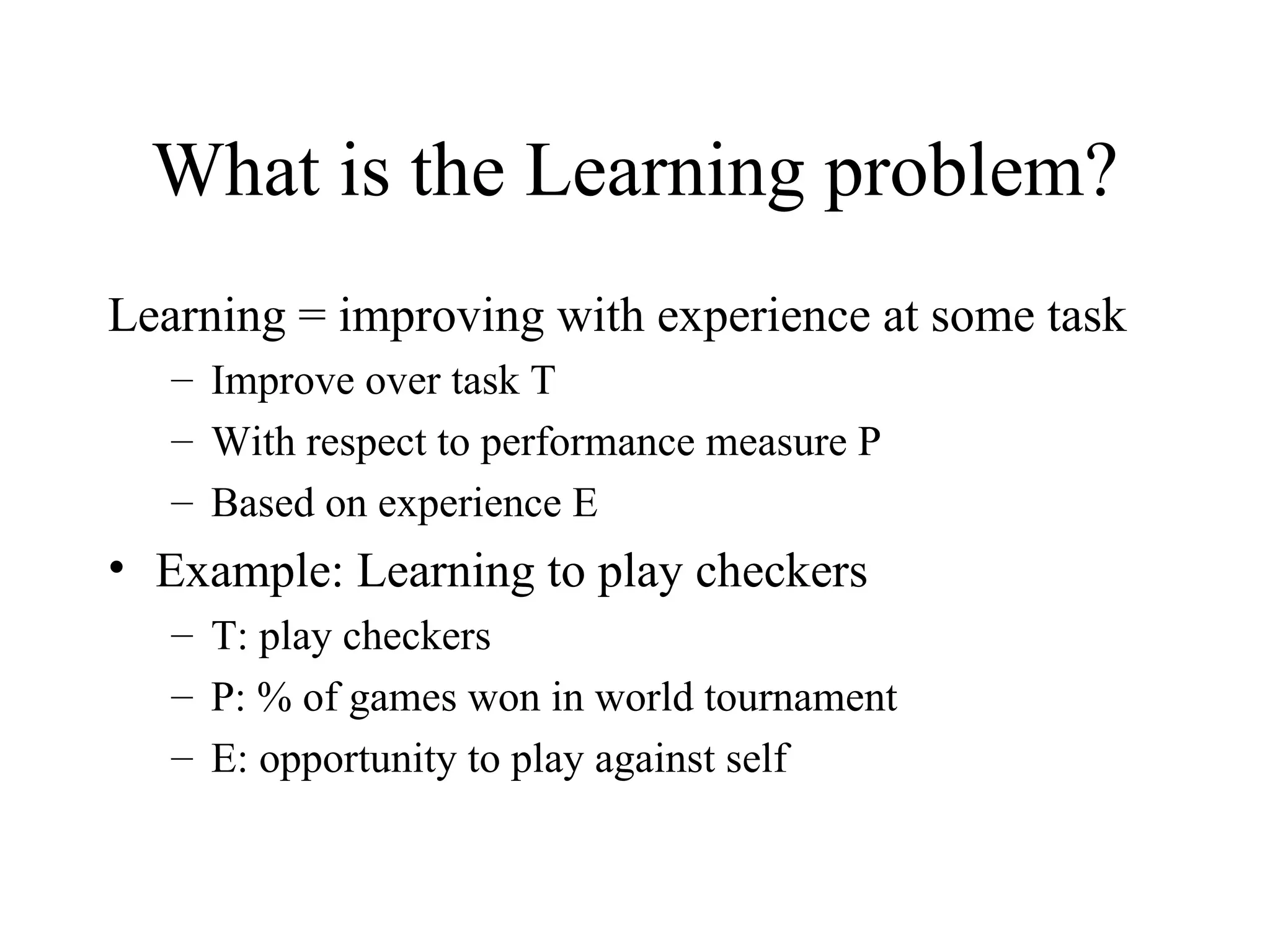
What is the Learning problem? Learning = improving with experience at some task Improve over task T With respect to performance measure P Based on experience E Example: Learning to play checkers T: play checkers P: % of games won in world tournament E: opportunity to play against self
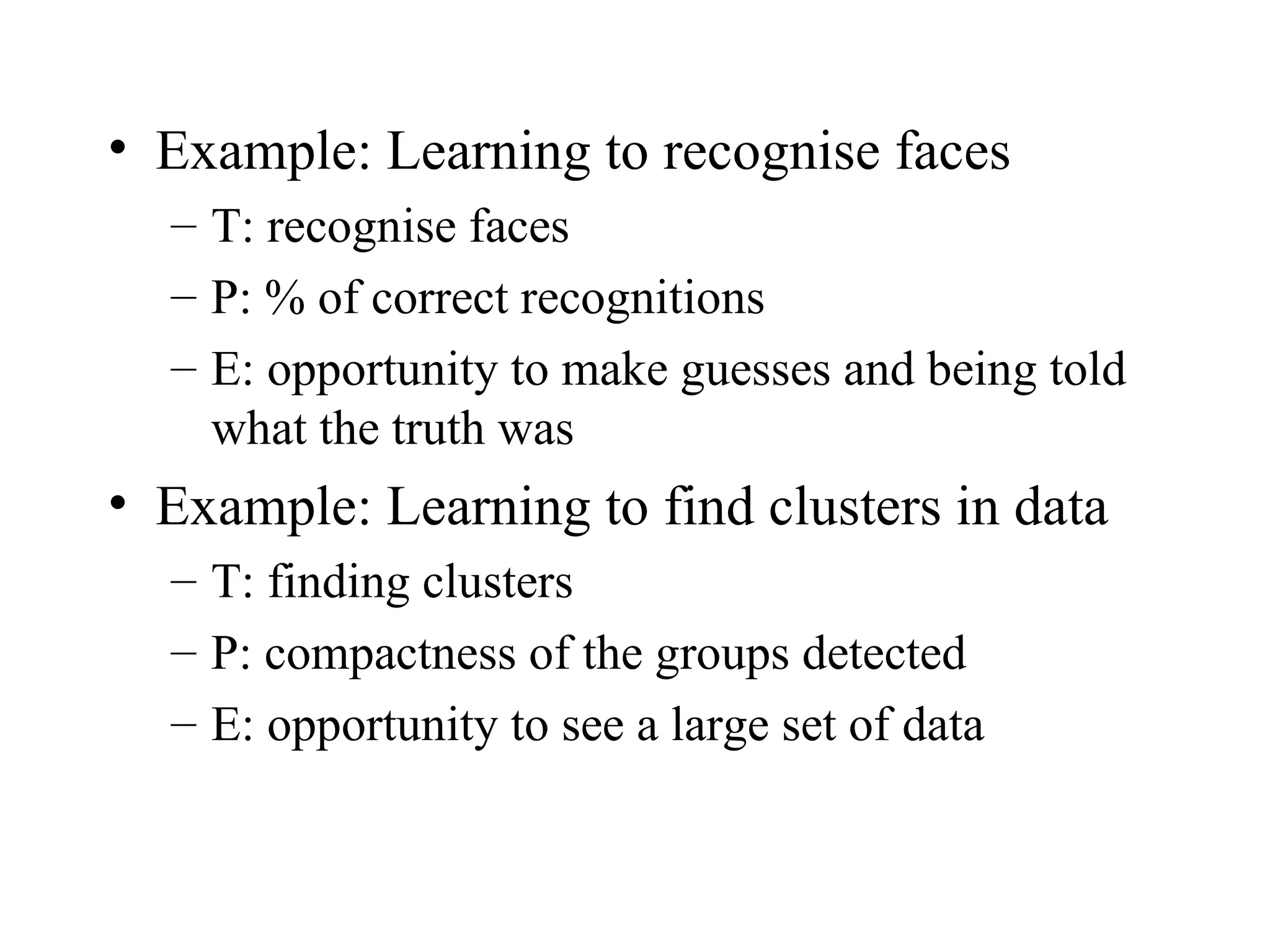
Example: Learning to recognise faces T: recognise faces P: % of correct recognitions E: opportunity to make guesses and being told what the truth was Example: Learning to find clusters in data T: finding clusters P: compactness of the groups detected E: opportunity to see a large set of data
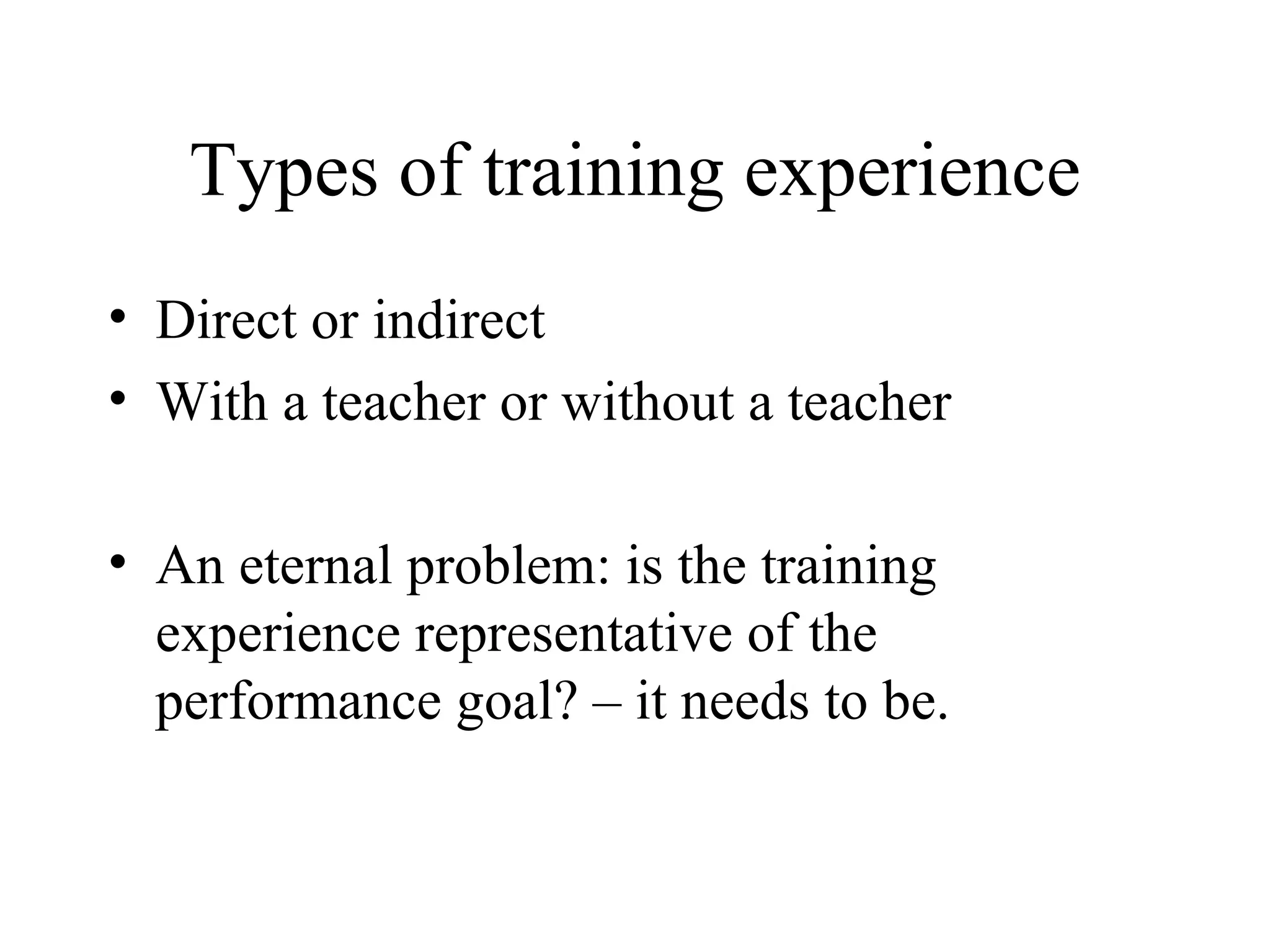
Types of training experience Direct or indirect With a teacher or without a teacher An eternal problem: is the training experience representative of the performance goal? – it needs to be.
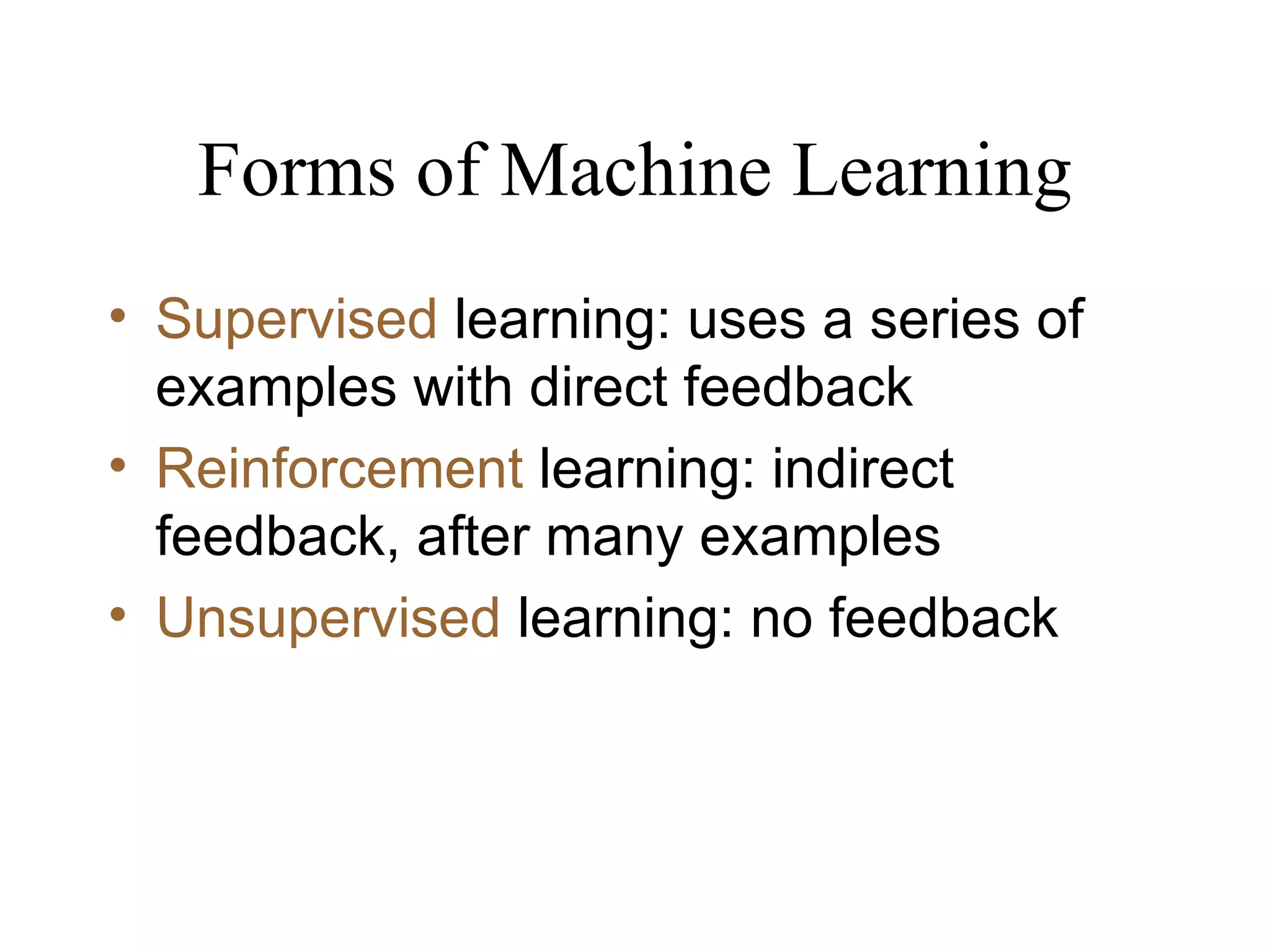
Forms of Machine Learning Supervised  learning: uses a series of examples with direct feedback Reinforcement  learning: indirect feedback, after many examples Unsupervised  learning: no feedback

Basic Notions of Learning, Introduction to Learning ...

  • 1.
    Machine Learning AtaKaban The University of Birmingham
  • 2.
    Machine Learning: TheModule What is Learning ? Decision trees Instance-based learning Kernel Machines Probabilistic Models Bayesian Learning Learning Theory Reinforcement Learning Genetic Algorithms
  • 3.
    Lectures & TutorialsLectures Tutorial immediately following lecture. Exercise sheets given out at lecture Solutions discussed during tutorials Handouts are on the module’s web page: http://www.cs.bham.ac.uk/~axk/ML_new.htm
  • 4.
    Continuous Assessment ML:20% of your final mark ML-EXTENDED: 40% of your final mark Two types of exercises Computer based practical work The exercises are posted on the module’s web page Deadline: end of term Paper-based exercises (worksheets) The exercises are on the module’s web page & are handed out in lectures Deadline: before the following weeks lecture Many options, but:
  • 5.
    Continuous Assessment (cont’d)Options and restrictions: You choose which pieces of your work you put forth for marking Best strategy to give a try to every Worksheet exercise, hand in your solution before we solve it in the class, then decide whether you leave your solution with me for marking or you take it back. You can only take it back before it gets marked I mark the first 5 (9 for EXT) pieces of work that you put forth and take the best 4 (8 for EXT) marks. Feedback: You get immediate feedback on Worksheet exercises as we solve them in the class. You will also get your marked work returned to you (in 2 weeks). You can approach me with questions in my office hours (as well as in tutorials, lectures, breaks).
  • 6.
    Office hours Thetime for my weekly office hours is communicated on my timetable (watch for possible changes): Location: UG32 What office hours are and aren’t for Yes: ask me concrete questions to clarify something that has not been clear to you from the lecture Yes: seek advice on your solutions to the given exercises Yes: seek advice on further readings on related material not covered in the lecture No: ask me to solve the exercises No: ask me to repeat a lecture http://www.cs.bham.ac.uk/~axk/timetable.html
  • 7.
    Literature Machine Learning(Mitchell) Reinforcement Learning … (Barto, Sutton) Modelling the Web (Baldi, Smyth) Support Vector Machines and Other Kernel-Based Learning Methods (Cristianini, Shawe-Taylor) Artificial Intelligence … (Russell, Norvig) Artificial Intelligence (Rich, Knight) Artificial Intelligence (Winston)
  • 8.
    Module Web Page~axk Syllabus Handouts Exercise sheets Computer-based practical exercises Links to ML resources on the web Literature
  • 9.
    What is Learning?How can Learning be measured? Any change in the knowledge of a system that allows it to perform better on subsequent tasks Knowledge. Hmmm. How should knowledge be represented. We do not know how it is represented in our own brains! Think for a moment about how knowledge might be represented in a computer. If I told you what subjects would come up in the exam, you might do very well. Would you do so well on randomly chosen subjects from the syllabus? This illustrates the notion called ‘overfitting’ - something one should guard against
  • 10.
    Ways humans learnthings … talking, walking, running… Learning by mimicking, reading or being told facts Tutoring Being informed when one is correct Experience Feedback from the environment Analogy Comparing certain features of existing knowledge to new problems Self-reflection Thinking things in ones own mind, deduction, discovery
  • 11.
    Machine Learning Interdisciplinaryfield Artificial intelligence Bayesian methods Computational complexity theory Control theory Information theory Philosophy Psychology and neurobiology Statistics …
  • 12.
    Achievements of MLComputer programs that can: Recognize spoken words Predict recovery rates of pneumonia patients Detect fraudulent use of credit cards Drive autonomous vehicles Play games like backgammon – approaching the human champion!
  • 13.
    What is theLearning problem? Learning = improving with experience at some task Improve over task T With respect to performance measure P Based on experience E Example: Learning to play checkers T: play checkers P: % of games won in world tournament E: opportunity to play against self
  • 14.
    Example: Learning torecognise faces T: recognise faces P: % of correct recognitions E: opportunity to make guesses and being told what the truth was Example: Learning to find clusters in data T: finding clusters P: compactness of the groups detected E: opportunity to see a large set of data
  • 15.
    Types of trainingexperience Direct or indirect With a teacher or without a teacher An eternal problem: is the training experience representative of the performance goal? – it needs to be.
  • 16.
    Forms of MachineLearning Supervised learning: uses a series of examples with direct feedback Reinforcement learning: indirect feedback, after many examples Unsupervised learning: no feedback