“Unlocking your Organization’s
Creative Potential”
through - Design Thinking
Sameer Chavan
Director - Experience Design
INTUIT
@sameerux
Design
What is Design?
What is Design ?
Many definitions!
Creation of plan or process to construct
object or system.
Detail drawing about form and function
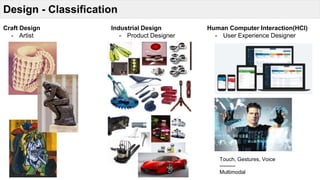
Design - Classification
Craft Design
- Artist
Industrial Design
- Product Designer
Human Computer Interaction(HCI)
- User Experience Designer
Touch, Gestures, Voice
---------
Multimodal
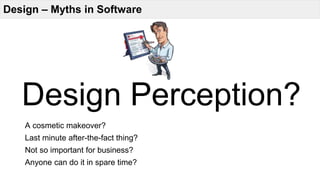
Design – Myths in Software
Design Perception?
A cosmetic makeover?
Last minute after-the-fact thing?
Not so important for business?
Anyone can do it in spare time?
Design - Facts
A cosmetic makeover?
Last minute after-the-fact thing?
Not so important for business?
Anyone can do it in spare time?
Is highly functional & user centric !
Involves in every stage of development !
Drives business. Can make or break !
Highly skilled, trained, design educated !
Design Perception?
Design - what is it ?
Is about improving human life
and influencing the future
Solve problems
Balancing of technical,
commercial, human and
aesthetic requirements.
So how it started at Intuit?
http://investors.intuit.com/press-releases/press-release-details/2015/Building-a-Design-Driven-Company/default.aspx
Design - Do you care ?
Design is what makes
you -
love or hate things!
Measuring Customer Experience
Intuit’s transformation arguably began in 2004, with its adoption of the
famous Net Promoter Score(NPS), developed by Fred Reichheld, of Bain &
Company.
NPS depends on one simple question for customers:
“How likely are you, on a scale of 0 (not at all likely) to 10 (extremely
likely), to recommend this product or service to a colleague or friend?”
• “Detractors” answer from 0 to 6,
• “passives” answer 7 or 8,
• “promoters” answer 9 or 10.
Trying hard to be design driven
For the first couple of years, Intuit saw its NPS rise
significantly.
But by 2007 NPS growth had stalled.
Everyone is a Designer!
2007 : Scott Cook wanted the company he had cofounded to
be like Apple—design driven, innovation intensive, wowing
consumers year in and year out with fantastic offerings
The Birth of the Idea
Cook, a member of Procter & Gamble’s board of directors,
approached Claudia Kotchka, then P&G’s vice president of
design innovation and strategy, for advice
Cook and Steve Bennett, then Intuit’s CEO, decided to focus
on the role of design in innovation at a two-day off-site for the
company’s top 300 managers
Cook created a one-day program on what he called
- Design for Delight (D4D)
From Idea to Initiative
Cook turned to a particularly talented young design director,
Kaaren Hanson, and asked her what she would do to promote
design at Intuit.
She persuaded Cook to let her create a team of design-
thinking coaches—“innovation catalysts”(IC)
FY 2009: The team worked through a design challenge,
creating prototypes, getting feedback, iterating, and refining.
From Idea to Initiative
From Presentations to Experiments
To begin building design thinking into the DNA of the company,
Cook and Hanson organized a series of Design for Delight
forums(D4D).
Employees have moved from satisfying customers to delighting
them.
• Focus on doing then talking
• Experimenting then debating
• Sketching, Rapid prototyping
• Testing with real users
• Iterating.
http://www.intuitlabs.com/resources/
Design in India
Do we have design
mark/standards for Indian product
like ISI ?
Design in India
www.indiadesignmark.in
History of Design - History
Early Design started in -
Typography - manuscripts
Architecture
Mechanical Design
Textile
Crafts
World War resulted in to lot of
inventions and their application/Design
User Research and Psychologist
involved in early fighter aircrafts
Prof M P Ranjan
History of Design - History
Bauhaus, was an art school in Germany that
combined crafts and the fine arts, and was
famous for the approach to design that it
publicised and taught. It operated from 1919 to
1933.
Design - Craft
Design as CRAFT ?
A craft is an activity such as weaving, carving, or pottery that involves making
things skilfully by hand, often in a traditional way.
● Craft artists create artwork and other
objects that are visually appealing
● Develop creative ideas or new methods for
making art
● Selects & process materials, often by
shaping, joining, or cutting
History of Design - Furniture
History of Design - Automobile
History of Design - Fashion
History of Design - Consumer Electronics
Iterations/Concepts
Detail Design/Function
Prototyping
Engineering
Research/Customer Insights Industrial Design (ID)
Industrial Design
Thinking process
● Analytical Thinking
● Creative Thinking
● Visual Thinking
● Design Thinking
Analytical Thinking
Breaks down raw information and undefined problems into specific, workable components that in-turn clearly identifies the issues at hand.
Makes logical conclusions, anticipates obstacles, and considers different approaches to the decision-making process.
Analytical Thinking
● Focusing on facts and evidence
● Analyzing data or information or systems
● Dissecting data/information and the analysis of complex things into
simpler constituents
● Reasoning – thinking that is coherent and logical
● Partitioning, breakdown – an analysis into mutually exclusive
categories
● Eliminating extraneous data or analysis of a problem into alternative
possibilities followed by the systematic rejection of unacceptable
alternatives
● Analyzing trends or the analysis of changes over time
Creative Thinking
A way of looking at problems or situations from a fresh perspective that suggests
unorthodox solutions (which may look unsettling at first).
http://blog.iqmatrix.com/better-creative-thinker
Creative Thinking
● Consider rejecting standardized
formats for problem solving.
● Have an interest in a wide range of
related and divergent fields.
● Take multiple perspectives on a
problem.
● Use trial-and-error methods in their
experimentation.
● Have a future orientation.
Analytical Thinking Creative Thinking
analytic generative
convergent divergent
vertical lateral
probability possibility
focused diffuse
objective subjective
left brain right brain
verbal visual
linear associative
reasoning richness, novelty
Visual Thinking (Rapid Prototyping) / Sketching UX
1973 - Robert McKim publishes Experiences in Visual Thinking, which includes
"Express, Test, Cycle" (ETC) as an iterative backbone for design processes.
● Thinking in mental images/pictures
● Converting every text, narration, words
into pictures and movies
● If your ideas can’t be drawn, they can’t
be done.
● It’s also about using tools — like pen
and paper, index cards and software
tools — to externalize your internal
thinking processes, making them more
clear, explicit and actionable.
● Rapid Prototyping ?
Visual Thinking (Rapid Prototyping)
Affinity Diagrams
Sketching ideas
Co-creations
Prototyping
Storytelling
Design Thinking
Design Thinking
“Everything that needs to be said
has already been said.
But, since no one was listening,
everything must be said again.”
André Paul Guillaume Gide was a
French author and winner of the Nobel
Prize in literature in 1947.
What is this sudden “Design Thinking”
There is nothing new about “Design Thinking”!
It’s about teaching non-designers
how designer thinks and solve
problem.
- Everyone is designer!
Designer has always been doing
Design Thinking anyway
What is this sudden “Design Thinking”
● Although Design is most often used to describe an object or end
result, Design in its most effective form is a process, an action, a
verb not a noun
● “Design Thinking” — a human-centered, prototype-driven process
for innovation that can be applied to product, service, and business
design.
● This human-centered methodology, coupled with a “fail fast” attitude,
allows us to quickly identify, build, and test our way to success.
● We spend less time planning, more time doing/sketching
Design Thinking is a MARKETING !
Today, design has gone far beyond its simple
origins as a craft to develop powerful new
ways for people to interact with the world,
emphasizing experience, not technology.
Moreover, it has evolved into a way of
thinking, of problem discovery, and of
enhancing the lives of individuals
Don Norman is well
known person in the field
of User Experience and
Usability. He has
education in Electrical
Engineering and
Psychology
“The phrase “Design Thinking” is controversial. Designers
have talked about design thinking for at least half a century.
It has recently been revived, in part as a marketing slogan
by the company IDEO” - Don Norman
Design Thinking?
The notion of design as a "way of thinking"
Problem-focused solvers vs Solution-focused solvers
First Divergent Thinking and then Convergent Thinking
Demystifying “Design Thinking”
● Design thinking, is more of a process to solve all kinds of problems
using existing design tools & methodologies.
● Design Thinking as a term was popularized to influence higher
management.
● It is about a mindset change in the entire organization.
● It’s about a changing paradigm in management theory, moving from the
traditional top‐down and quantitative approach to a more bottom‐up,
qualitative approach in innovation & transformation processes.
● It gives a seat for designers to be a part of top management.
● Spend less time planning, more time doing,
● Challenge ourselves to see the world through the eyes
of our customers every step of the way.
● It is applied where both the problem and the solution
are unknown at the outset of the problem-solving
process (as opposed to “tame” or “well-defined”
problems, where the problem is evident and the solution
is possible with some technical knowledge.)
● It has led to the creation of a new executive role of
“Chief Innovation Officer.”
Demystifying “Design Thinking”
Design Thinking - Is there anything new ?
Industrial Design
Design = Product (Problem Solving) Design Thinking = Process (Product + Business) = Strategic
User Centered Design
Business Centered Design
Design Thinking
Research Problem Statement Ideation Prototyping Testing Build
Research Concept Prototype Test Develop DeployRe-Design
UCD + Business Goals + Marketing
Emotional Design Participatory Design Contextual Design
Empathize Define Ideate Prototype Test
Design Thinking
Thanks
@SameerUX

Design Thinking - unlock your creative potential

  • 1.
    “Unlocking your Organization’s CreativePotential” through - Design Thinking Sameer Chavan Director - Experience Design INTUIT @sameerux
  • 2.
  • 3.
    What is Design? Many definitions! Creation of plan or process to construct object or system. Detail drawing about form and function
  • 4.
    Design - Classification CraftDesign - Artist Industrial Design - Product Designer Human Computer Interaction(HCI) - User Experience Designer Touch, Gestures, Voice --------- Multimodal
  • 5.
    Design – Mythsin Software Design Perception? A cosmetic makeover? Last minute after-the-fact thing? Not so important for business? Anyone can do it in spare time?
  • 6.
    Design - Facts Acosmetic makeover? Last minute after-the-fact thing? Not so important for business? Anyone can do it in spare time? Is highly functional & user centric ! Involves in every stage of development ! Drives business. Can make or break ! Highly skilled, trained, design educated ! Design Perception?
  • 7.
    Design - whatis it ? Is about improving human life and influencing the future Solve problems Balancing of technical, commercial, human and aesthetic requirements.
  • 8.
    So how itstarted at Intuit? http://investors.intuit.com/press-releases/press-release-details/2015/Building-a-Design-Driven-Company/default.aspx
  • 9.
    Design - Doyou care ? Design is what makes you - love or hate things!
  • 10.
    Measuring Customer Experience Intuit’stransformation arguably began in 2004, with its adoption of the famous Net Promoter Score(NPS), developed by Fred Reichheld, of Bain & Company. NPS depends on one simple question for customers: “How likely are you, on a scale of 0 (not at all likely) to 10 (extremely likely), to recommend this product or service to a colleague or friend?” • “Detractors” answer from 0 to 6, • “passives” answer 7 or 8, • “promoters” answer 9 or 10.
  • 11.
    Trying hard tobe design driven For the first couple of years, Intuit saw its NPS rise significantly. But by 2007 NPS growth had stalled.
  • 12.
    Everyone is aDesigner! 2007 : Scott Cook wanted the company he had cofounded to be like Apple—design driven, innovation intensive, wowing consumers year in and year out with fantastic offerings
  • 13.
    The Birth ofthe Idea Cook, a member of Procter & Gamble’s board of directors, approached Claudia Kotchka, then P&G’s vice president of design innovation and strategy, for advice Cook and Steve Bennett, then Intuit’s CEO, decided to focus on the role of design in innovation at a two-day off-site for the company’s top 300 managers Cook created a one-day program on what he called - Design for Delight (D4D)
  • 14.
    From Idea toInitiative Cook turned to a particularly talented young design director, Kaaren Hanson, and asked her what she would do to promote design at Intuit. She persuaded Cook to let her create a team of design- thinking coaches—“innovation catalysts”(IC) FY 2009: The team worked through a design challenge, creating prototypes, getting feedback, iterating, and refining.
  • 15.
    From Idea toInitiative
  • 16.
    From Presentations toExperiments To begin building design thinking into the DNA of the company, Cook and Hanson organized a series of Design for Delight forums(D4D). Employees have moved from satisfying customers to delighting them. • Focus on doing then talking • Experimenting then debating • Sketching, Rapid prototyping • Testing with real users • Iterating.
  • 17.
  • 18.
    Design in India Dowe have design mark/standards for Indian product like ISI ?
  • 19.
  • 20.
    History of Design- History Early Design started in - Typography - manuscripts Architecture Mechanical Design Textile Crafts World War resulted in to lot of inventions and their application/Design User Research and Psychologist involved in early fighter aircrafts Prof M P Ranjan
  • 21.
    History of Design- History Bauhaus, was an art school in Germany that combined crafts and the fine arts, and was famous for the approach to design that it publicised and taught. It operated from 1919 to 1933.
  • 22.
    Design - Craft Designas CRAFT ? A craft is an activity such as weaving, carving, or pottery that involves making things skilfully by hand, often in a traditional way. ● Craft artists create artwork and other objects that are visually appealing ● Develop creative ideas or new methods for making art ● Selects & process materials, often by shaping, joining, or cutting
  • 23.
    History of Design- Furniture
  • 24.
    History of Design- Automobile
  • 25.
  • 26.
    History of Design- Consumer Electronics
  • 27.
  • 28.
    Thinking process ● AnalyticalThinking ● Creative Thinking ● Visual Thinking ● Design Thinking
  • 29.
    Analytical Thinking Breaks downraw information and undefined problems into specific, workable components that in-turn clearly identifies the issues at hand. Makes logical conclusions, anticipates obstacles, and considers different approaches to the decision-making process.
  • 30.
    Analytical Thinking ● Focusingon facts and evidence ● Analyzing data or information or systems ● Dissecting data/information and the analysis of complex things into simpler constituents ● Reasoning – thinking that is coherent and logical ● Partitioning, breakdown – an analysis into mutually exclusive categories ● Eliminating extraneous data or analysis of a problem into alternative possibilities followed by the systematic rejection of unacceptable alternatives ● Analyzing trends or the analysis of changes over time
  • 31.
    Creative Thinking A wayof looking at problems or situations from a fresh perspective that suggests unorthodox solutions (which may look unsettling at first). http://blog.iqmatrix.com/better-creative-thinker
  • 32.
    Creative Thinking ● Considerrejecting standardized formats for problem solving. ● Have an interest in a wide range of related and divergent fields. ● Take multiple perspectives on a problem. ● Use trial-and-error methods in their experimentation. ● Have a future orientation. Analytical Thinking Creative Thinking analytic generative convergent divergent vertical lateral probability possibility focused diffuse objective subjective left brain right brain verbal visual linear associative reasoning richness, novelty
  • 33.
    Visual Thinking (RapidPrototyping) / Sketching UX 1973 - Robert McKim publishes Experiences in Visual Thinking, which includes "Express, Test, Cycle" (ETC) as an iterative backbone for design processes. ● Thinking in mental images/pictures ● Converting every text, narration, words into pictures and movies ● If your ideas can’t be drawn, they can’t be done. ● It’s also about using tools — like pen and paper, index cards and software tools — to externalize your internal thinking processes, making them more clear, explicit and actionable. ● Rapid Prototyping ?
  • 34.
    Visual Thinking (RapidPrototyping) Affinity Diagrams Sketching ideas Co-creations Prototyping Storytelling
  • 35.
  • 36.
    Design Thinking “Everything thatneeds to be said has already been said. But, since no one was listening, everything must be said again.” André Paul Guillaume Gide was a French author and winner of the Nobel Prize in literature in 1947.
  • 37.
    What is thissudden “Design Thinking” There is nothing new about “Design Thinking”! It’s about teaching non-designers how designer thinks and solve problem. - Everyone is designer! Designer has always been doing Design Thinking anyway
  • 38.
    What is thissudden “Design Thinking” ● Although Design is most often used to describe an object or end result, Design in its most effective form is a process, an action, a verb not a noun ● “Design Thinking” — a human-centered, prototype-driven process for innovation that can be applied to product, service, and business design. ● This human-centered methodology, coupled with a “fail fast” attitude, allows us to quickly identify, build, and test our way to success. ● We spend less time planning, more time doing/sketching
  • 39.
    Design Thinking isa MARKETING ! Today, design has gone far beyond its simple origins as a craft to develop powerful new ways for people to interact with the world, emphasizing experience, not technology. Moreover, it has evolved into a way of thinking, of problem discovery, and of enhancing the lives of individuals Don Norman is well known person in the field of User Experience and Usability. He has education in Electrical Engineering and Psychology “The phrase “Design Thinking” is controversial. Designers have talked about design thinking for at least half a century. It has recently been revived, in part as a marketing slogan by the company IDEO” - Don Norman
  • 40.
    Design Thinking? The notionof design as a "way of thinking" Problem-focused solvers vs Solution-focused solvers First Divergent Thinking and then Convergent Thinking
  • 41.
    Demystifying “Design Thinking” ●Design thinking, is more of a process to solve all kinds of problems using existing design tools & methodologies. ● Design Thinking as a term was popularized to influence higher management. ● It is about a mindset change in the entire organization. ● It’s about a changing paradigm in management theory, moving from the traditional top‐down and quantitative approach to a more bottom‐up, qualitative approach in innovation & transformation processes. ● It gives a seat for designers to be a part of top management.
  • 42.
    ● Spend lesstime planning, more time doing, ● Challenge ourselves to see the world through the eyes of our customers every step of the way. ● It is applied where both the problem and the solution are unknown at the outset of the problem-solving process (as opposed to “tame” or “well-defined” problems, where the problem is evident and the solution is possible with some technical knowledge.) ● It has led to the creation of a new executive role of “Chief Innovation Officer.” Demystifying “Design Thinking”
  • 43.
    Design Thinking -Is there anything new ? Industrial Design Design = Product (Problem Solving) Design Thinking = Process (Product + Business) = Strategic User Centered Design Business Centered Design Design Thinking Research Problem Statement Ideation Prototyping Testing Build Research Concept Prototype Test Develop DeployRe-Design UCD + Business Goals + Marketing Emotional Design Participatory Design Contextual Design Empathize Define Ideate Prototype Test
  • 44.
  • 45.

Editor's Notes

  • #3 What is Design? Design is the creation of a plan or convention for the construction of an object or a system (as in architectural blueprints,engineering drawings, business processes, circuit diagrams and sewing patterns).[1] Design has different connotations in different fields (see design disciplines below). In some cases the direct construction of an object (as in pottery, engineering, management,cowboy coding and graphic design) is also considered to be design. http://www.design.org.au/index.cfm?id=186
  • #5 The thinker : This famous sculpture was presumed by Auguste Robin based on the theme on the divine comedy of Dante. This sculpture appeared as nude with heroic figure in the tradition of Michelangelo and percept the wisdom of poetry. The thinker was literally destined to render Dante’s epic in front of the Gate of Hell. The final sculpture was a miniscule of the statue sits atop of gates with meditative of hellish fate. The Weeping Woman, is an oil on canvas painted by Pablo Picasso in France in 1937.
  • #6 We have technology - so bring someone to put graphic skin We are busy with coding. No time for design. Oh.. we build wrong function and interaction Our product idea is best. We will train users. Design is not selling point. Our program is. Oh we have a person in our team who does painting. He is our designer.
  • #23 http://designprogram.stanford.edu/history.php http://xplaner.com/visual-thinking-school/
  • #28 http://www.idsa.org/education/what-is-industrial-design#field--how-they-do-it-17
  • #30 http://designprogram.stanford.edu/history.php http://xplaner.com/visual-thinking-school/
  • #31 http://designprogram.stanford.edu/history.php http://xplaner.com/visual-thinking-school/
  • #32 Science has shown that we are all indeed born with the capacity to think creatively. However, over time this capacity seems to diminish and decline. When we reach high school we suddenly find our creative capacity squashed against a wall of criticism, judgment and punishment.
  • #33 http://www.virtualsalt.com/crebook1.htm
  • #34 http://designprogram.stanford.edu/history.php http://xplaner.com/visual-thinking-school/
  • #35 http://designprogram.stanford.edu/history.php http://xplaner.com/visual-thinking-school/
  • #36 http://designprogram.stanford.edu/history.php http://xplaner.com/visual-thinking-school/
  • #37 http://designprogram.stanford.edu/history.php http://xplaner.com/visual-thinking-school/
  • #38 https://ithinkidesign.wordpress.com/2012/06/08/a-brief-history-of-design-thinking-how-design-thinking-came-to-be/
  • #43 https://experience.sap.com/skillup/introduction-to-design-thinking/