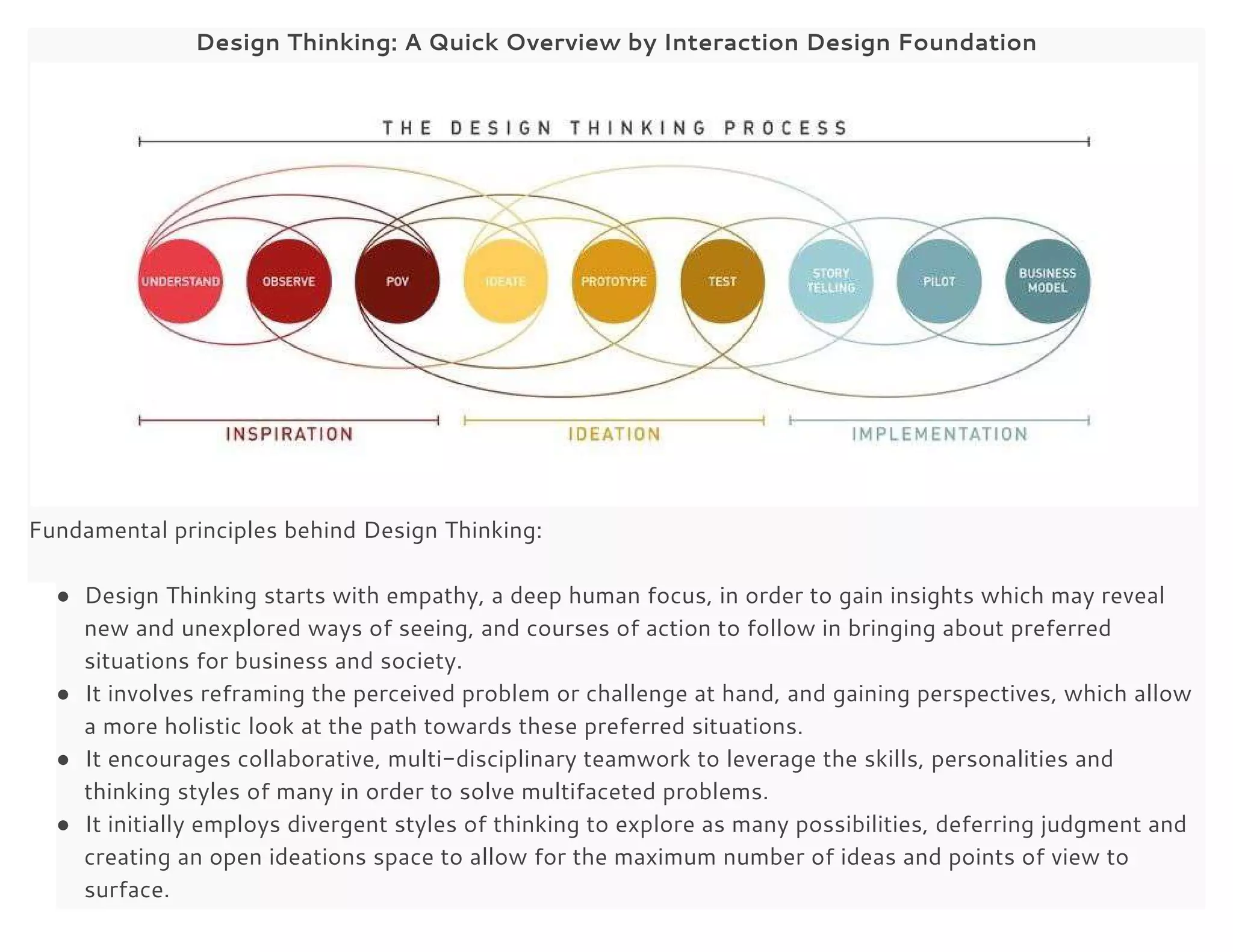
Design Thinking: A Quick Overview by Interaction Design Foundation
 
Fundamental principles behind Design Thinking: 
 
● Design Thinking starts with empathy, a deep human focus, in order to gain insights which may reveal 
new and unexplored ways of seeing, and courses of action to follow in bringing about preferred 
situations for business and society. 
● It involves reframing the perceived problem or challenge at hand, and gaining perspectives, which allow 
a more holistic look at the path towards these preferred situations. 
● It encourages collaborative, multi-disciplinary teamwork to leverage the skills, personalities and 
thinking styles of many in order to solve multifaceted problems. 
● It initially employs divergent styles of thinking to explore as many possibilities, deferring judgment and 
creating an open ideations space to allow for the maximum number of ideas and points of view to 
surface. 
● It later employs convergent styles of thinking to isolate potential solution streams, combining and 
refining insights and more mature ideas, which pave a path forward. 
● It engages in the early exploration of selected ideas, rapidly modeling potential solutions to encourage 
learning while doing, and allow for gaining additional insight into the ​viability​ of solutions before too 
much time or money has been spent 
● Tests the prototypes which survive the processes further to remove any potential issues. 
● Iterates through the various stages, revisiting empathetic frames of mind and then redefining the 
challenge as new knowledge and insight are gained along the way. 
● It starts off chaotic and cloudy steamrolling towards points of clarity until a desirable, feasible and 
viable solution emerges. 
 
As we have seen from the definitions and descriptions, Design Thinking means many things to many people, 
and this theme persists into the practical implementation as well. There are a wide variety of process 
breakdowns and visualizations ranging typically between 3 and 7 steps. Each process step or phase 
embodies one or more of the core ingredients of design thinking that being, reframing, ​empathy​, ​ideation​, 
prototyping and testing. These different implementation frameworks or models might have different names 
and number of stages, but they embody the same principles laid out in the bullet points above. 
 
Modeled on Early Traditional Design Processes 
 
The earliest process expressions of Design Thinking were almost exact replications of the traditional Design 
Process, with the later addition of deeper empathy and more specific forms of multidisciplinary collaboration. 
Taken from Herbert Simon's 1969 seminal work The Sciences of the Artificial, the design process: define, 
research, ideate, prototype, choose, implement, and learn has been the cornerstone of design process for 
decades. 
 
 
Popular Design Thinking Frameworks 
 
Heart, Head, and Hand 
 
The Design Thinking Process is a blend of Heart, Head, and Hand. This means the process is based on vision, 
need, ​emotion​ and feeling, to begin with, continuing on to the cognitive processing for ideation and 
evaluation and then diving into practical creation by hand. It's a holistic process and demands input from all 
of our faculties in order to be successful. 
 
Deep-Dive 
 
The Deep-Dive was IDEO'S first expression of this process, which they aired LIVE on ABC Nightline back in 
the late 90's. The Deep-Dive process comprises of the following steps: 
● Understand 
● Observe 
● Visualise 
● Evaluate 
● Implement 
Deloitte acquired the Deep-Dive process in 2006. 


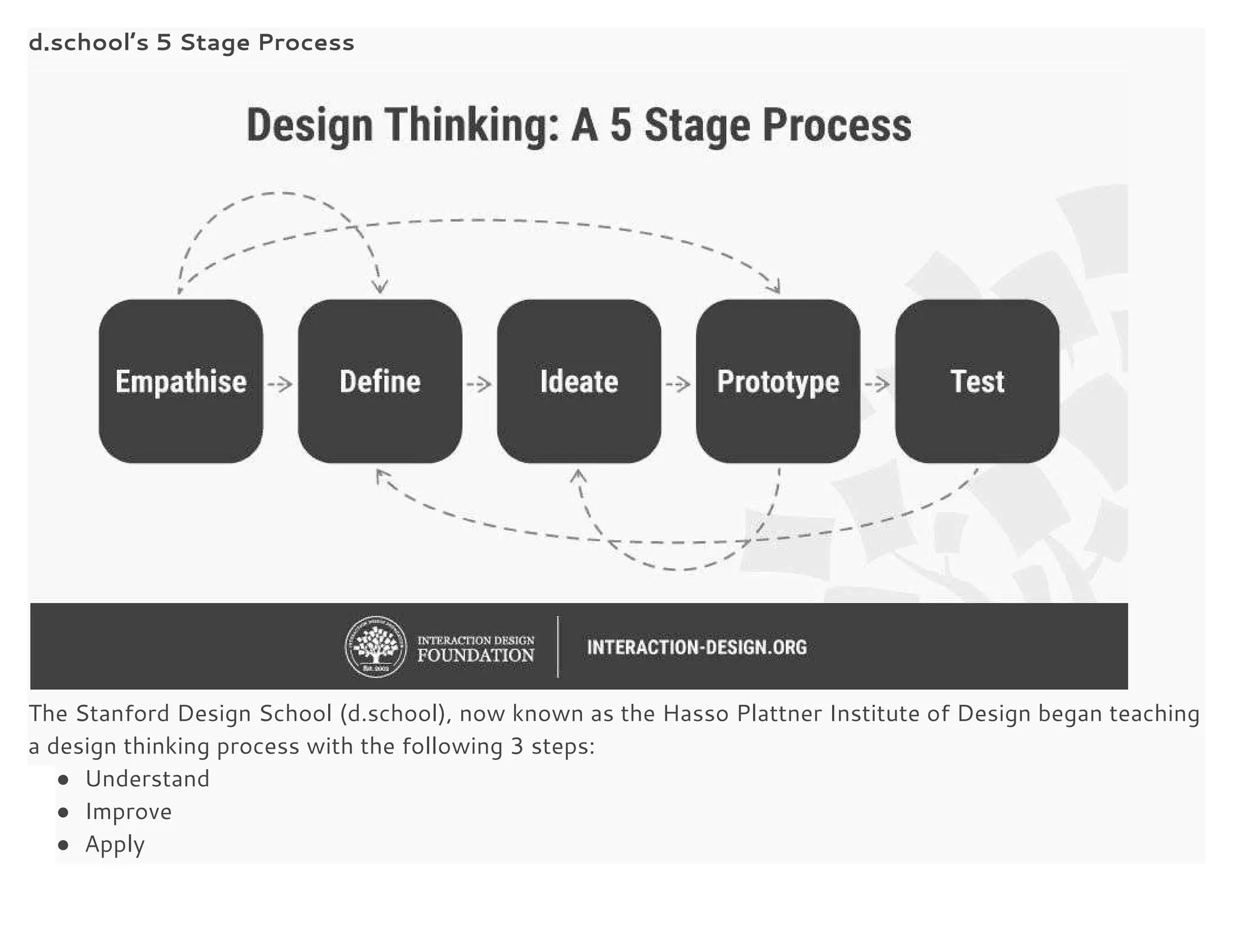
d.school’s 5 Stage Process 
 
The Stanford Design School (d.school), now known as the Hasso Plattner Institute of Design began teaching 
a design thinking process with the following 3 steps: 
● Understand 
● Improve 
● Apply 
They have since moved on to formulate and open-source their famous 5 stage process below which is widely 
used. This is the process we also recommend: 
1. Empathize 
2. Define 
3. Ideate 
4. Prototype 
5. Test 
The d.school represents the 5 stage process by their hexagonal Design Thinking Lenses. The lenses are 
purposely defined as such so they will be seen more as enablers or modes of thinking, rather than concrete 
linear steps. 
 
IDEO’s Design Thinking Process 
 
IDEO uses a different process, and while it has only three stages, it covers pretty much the same ground as 
the other processes covered here. The three stages are 
● Inspire: The problem or opportunity that motivates the search for a solution 
● Ideate: The process of generating ideas 
● Implement: The path that leads from the project room to the market 
IDEO has also released a deck of IDEO Method Cards covering the modes Learn, Look, Ask, Try each with 
their own collection of methods for an entire ​innovation​ cycle. 
 
HCD - Human Centred Design 
 
IDEO has also developed contextualized toolkits, which repackaged the Design Thinking processes. One 
such iteration focuses on the social innovation setting in developing countries. For this context, the 
terminology needed to be simplified, made memorable and restructured for the typical kinds of challenges 
faced. The HCD process (Human Centred Design) was re-interpreted as an acronym to mean Hear, Create, 
Deliver. 
 
H: Hear 
 
Similar to early phases in other Design Thinking processes, the Hear stage is about developing an empathic 
understanding of users, as well as ​defining the problem​ that the team is trying to solve. It serves the purpose 
of gaining a solid foundation in the context of the problem and sufficiently reframing it in order to progress. 
In this phase of the process, design thinkers need to 
● identify their challenge, 
● recognize existing knowledge in the challenge space, 
● identify people to engage with to understand the deeper human side of the challenge, 
● engage in a range of ​ethnographic research​ activities to uncover sufficient human insight, and 
● develop points of view or stories to guide the creation phase. 
 
C: Create 
 
Similar to the Ideate and Prototype phases in d.school’s 5-stage approach, the Create stage here is 
concerned with exploration, experimentation and learning through making. It involves pinpointing potential 
areas of exploration and then engaging those closest to the problem to co-create solutions. This allows 
design teams to maintain the highest levels of empathy during early design phases as well as weed out 
potential problematic ​assumptions​ made by designers who do not sufficiently understand the context. 
● Highlight Opportunities to explore from insights gained in the Hear Phase 
● Recruit participants for the co-design task from a diverse pool of those affected 
● Maintain awareness of sensitivities by avoiding judgments 
● Encouraging ​storytelling​ and expression 
● Facilitate action-orientated creation of tangible solution 
D: Deliver 
 
The Deliver phase of the HCD process is centered around logistical implementation and overcoming any 
obstacles which may exist when rolling out a solution within the required context. Though solutions arrived 
at may provide a functional patch to a problem, getting by in communities and bypassing any other 
roadblocks on the path of implementation is essential for the process to be completed successfully. 
 
Design Council of the UK: 4 D’s 
 
The Design Council of the UK has settled on 4 D's, Discover, Define, Develop, Deliver. They make use of a 
Double Diamond process diagram to indicate 2 cycles of divergent and ​convergent thinking​ and activities. 
 
Frog Design 
 
Frog Design's 3 D's Discover, Design Deliver has been replaced with Explore, Converge, Support, indicating a 
focus on more than just finite projects or products but an ongoing relationship with their clients well after 
the delivery date. 
 
What x 4 
 
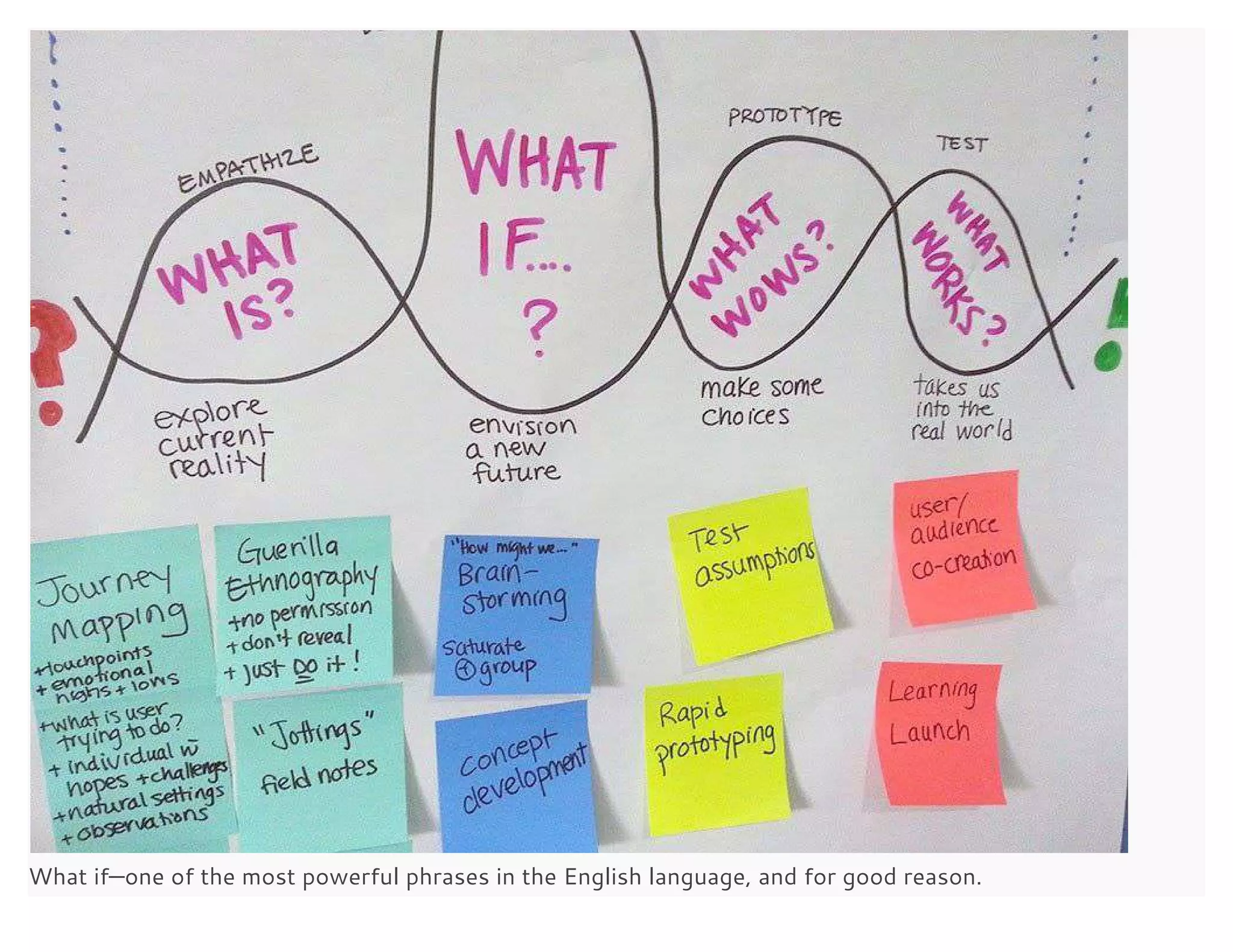
Jeanne Liedtka and Tim Ogilvie's book, Designing for Growth, puts forward a unique spin on the same 
journey, reframing the terminology into a more inquisitive and intuitive 4 W's. Jeanne Liedtka is a professor 
of business administration at the Darden School of the University of Virginia, while Tim Ogilvie is the 
founder of innovative consultancy firm Peer Insight, and both are experts in design thinking and strategic 
thinking. Their 4 W’s process involves asking: 
● What is? Exploring the current reality 
● What if? Envisioning Alternative Futures 
● What wows? Getting users to help us make some tough choices 
● What works? Making it work in-market, and as a business 
 
What if—one of the most powerful phrases in the English language, and for good reason. 
The LUMA System 
 
The LUMA Institute, a global firm that teaches innovation and human-centered design, has its own 
expression of Design ​Thinking modes​: Looking, Understanding and Making. This unfolds through a series of 
steps per mode completed with a proprietary user manual and method cards. The modes allow for remixing a 
wide range of processes through the 3 modes using methods specific to your needs. 
 
The Take-Away 
 
We could spend weeks exploring the Design Thinking Processes, their differences and similarities and the 
merits of variety or conformity. It is important for us to peel away the facade in order to understand the 
foundations. To the first-timer, at first sight, the Design Thinking process is mysterious, chaotic, and at 
many times complex. However, it's a discipline, which will grow on you with direct practice. You will learn 
things in a practical manner, which no theory can adequately cover growing in confidence with each new 
experience. You may even be tempted to develop your own expression of these steps, modes, and phases to 
suite a completely new context, and that's part of the beauty of Design Thinking. 
 

Design Thinking Overview (summary by Interaction Design Foundation)

  • 1.
    Design Thinking: AQuick Overview by Interaction Design Foundation   Fundamental principles behind Design Thinking:    ● Design Thinking starts with empathy, a deep human focus, in order to gain insights which may reveal  new and unexplored ways of seeing, and courses of action to follow in bringing about preferred  situations for business and society.  ● It involves reframing the perceived problem or challenge at hand, and gaining perspectives, which allow  a more holistic look at the path towards these preferred situations.  ● It encourages collaborative, multi-disciplinary teamwork to leverage the skills, personalities and  thinking styles of many in order to solve multifaceted problems.  ● It initially employs divergent styles of thinking to explore as many possibilities, deferring judgment and  creating an open ideations space to allow for the maximum number of ideas and points of view to  surface. 
  • 2.
    ● It lateremploys convergent styles of thinking to isolate potential solution streams, combining and  refining insights and more mature ideas, which pave a path forward.  ● It engages in the early exploration of selected ideas, rapidly modeling potential solutions to encourage  learning while doing, and allow for gaining additional insight into the ​viability​ of solutions before too  much time or money has been spent  ● Tests the prototypes which survive the processes further to remove any potential issues.  ● Iterates through the various stages, revisiting empathetic frames of mind and then redefining the  challenge as new knowledge and insight are gained along the way.  ● It starts off chaotic and cloudy steamrolling towards points of clarity until a desirable, feasible and  viable solution emerges.    As we have seen from the definitions and descriptions, Design Thinking means many things to many people,  and this theme persists into the practical implementation as well. There are a wide variety of process  breakdowns and visualizations ranging typically between 3 and 7 steps. Each process step or phase  embodies one or more of the core ingredients of design thinking that being, reframing, ​empathy​, ​ideation​,  prototyping and testing. These different implementation frameworks or models might have different names  and number of stages, but they embody the same principles laid out in the bullet points above.    Modeled on Early Traditional Design Processes    The earliest process expressions of Design Thinking were almost exact replications of the traditional Design  Process, with the later addition of deeper empathy and more specific forms of multidisciplinary collaboration.  Taken from Herbert Simon's 1969 seminal work The Sciences of the Artificial, the design process: define,  research, ideate, prototype, choose, implement, and learn has been the cornerstone of design process for  decades.     
  • 3.
    Popular Design ThinkingFrameworks    Heart, Head, and Hand    The Design Thinking Process is a blend of Heart, Head, and Hand. This means the process is based on vision,  need, ​emotion​ and feeling, to begin with, continuing on to the cognitive processing for ideation and  evaluation and then diving into practical creation by hand. It's a holistic process and demands input from all  of our faculties in order to be successful.    Deep-Dive    The Deep-Dive was IDEO'S first expression of this process, which they aired LIVE on ABC Nightline back in  the late 90's. The Deep-Dive process comprises of the following steps:  ● Understand  ● Observe  ● Visualise  ● Evaluate  ● Implement  Deloitte acquired the Deep-Dive process in 2006.                 
  • 4.
    d.school’s 5 StageProcess    The Stanford Design School (d.school), now known as the Hasso Plattner Institute of Design began teaching  a design thinking process with the following 3 steps:  ● Understand  ● Improve  ● Apply 
  • 5.
    They have sincemoved on to formulate and open-source their famous 5 stage process below which is widely  used. This is the process we also recommend:  1. Empathize  2. Define  3. Ideate  4. Prototype  5. Test  The d.school represents the 5 stage process by their hexagonal Design Thinking Lenses. The lenses are  purposely defined as such so they will be seen more as enablers or modes of thinking, rather than concrete  linear steps.    IDEO’s Design Thinking Process    IDEO uses a different process, and while it has only three stages, it covers pretty much the same ground as  the other processes covered here. The three stages are  ● Inspire: The problem or opportunity that motivates the search for a solution  ● Ideate: The process of generating ideas  ● Implement: The path that leads from the project room to the market  IDEO has also released a deck of IDEO Method Cards covering the modes Learn, Look, Ask, Try each with  their own collection of methods for an entire ​innovation​ cycle.    HCD - Human Centred Design    IDEO has also developed contextualized toolkits, which repackaged the Design Thinking processes. One  such iteration focuses on the social innovation setting in developing countries. For this context, the  terminology needed to be simplified, made memorable and restructured for the typical kinds of challenges 
  • 6.
    faced. The HCDprocess (Human Centred Design) was re-interpreted as an acronym to mean Hear, Create,  Deliver.    H: Hear    Similar to early phases in other Design Thinking processes, the Hear stage is about developing an empathic  understanding of users, as well as ​defining the problem​ that the team is trying to solve. It serves the purpose  of gaining a solid foundation in the context of the problem and sufficiently reframing it in order to progress.  In this phase of the process, design thinkers need to  ● identify their challenge,  ● recognize existing knowledge in the challenge space,  ● identify people to engage with to understand the deeper human side of the challenge,  ● engage in a range of ​ethnographic research​ activities to uncover sufficient human insight, and  ● develop points of view or stories to guide the creation phase.    C: Create    Similar to the Ideate and Prototype phases in d.school’s 5-stage approach, the Create stage here is  concerned with exploration, experimentation and learning through making. It involves pinpointing potential  areas of exploration and then engaging those closest to the problem to co-create solutions. This allows  design teams to maintain the highest levels of empathy during early design phases as well as weed out  potential problematic ​assumptions​ made by designers who do not sufficiently understand the context.  ● Highlight Opportunities to explore from insights gained in the Hear Phase  ● Recruit participants for the co-design task from a diverse pool of those affected  ● Maintain awareness of sensitivities by avoiding judgments  ● Encouraging ​storytelling​ and expression  ● Facilitate action-orientated creation of tangible solution 
  • 7.
    D: Deliver    The Deliverphase of the HCD process is centered around logistical implementation and overcoming any  obstacles which may exist when rolling out a solution within the required context. Though solutions arrived  at may provide a functional patch to a problem, getting by in communities and bypassing any other  roadblocks on the path of implementation is essential for the process to be completed successfully.    Design Council of the UK: 4 D’s    The Design Council of the UK has settled on 4 D's, Discover, Define, Develop, Deliver. They make use of a  Double Diamond process diagram to indicate 2 cycles of divergent and ​convergent thinking​ and activities.    Frog Design    Frog Design's 3 D's Discover, Design Deliver has been replaced with Explore, Converge, Support, indicating a  focus on more than just finite projects or products but an ongoing relationship with their clients well after  the delivery date.    What x 4    Jeanne Liedtka and Tim Ogilvie's book, Designing for Growth, puts forward a unique spin on the same  journey, reframing the terminology into a more inquisitive and intuitive 4 W's. Jeanne Liedtka is a professor  of business administration at the Darden School of the University of Virginia, while Tim Ogilvie is the  founder of innovative consultancy firm Peer Insight, and both are experts in design thinking and strategic  thinking. Their 4 W’s process involves asking:  ● What is? Exploring the current reality  ● What if? Envisioning Alternative Futures 
  • 8.
    ● What wows?Getting users to help us make some tough choices  ● What works? Making it work in-market, and as a business 
  • 9.
      What if—one ofthe most powerful phrases in the English language, and for good reason. 
  • 10.
    The LUMA System    TheLUMA Institute, a global firm that teaches innovation and human-centered design, has its own  expression of Design ​Thinking modes​: Looking, Understanding and Making. This unfolds through a series of  steps per mode completed with a proprietary user manual and method cards. The modes allow for remixing a  wide range of processes through the 3 modes using methods specific to your needs.    The Take-Away    We could spend weeks exploring the Design Thinking Processes, their differences and similarities and the  merits of variety or conformity. It is important for us to peel away the facade in order to understand the  foundations. To the first-timer, at first sight, the Design Thinking process is mysterious, chaotic, and at  many times complex. However, it's a discipline, which will grow on you with direct practice. You will learn  things in a practical manner, which no theory can adequately cover growing in confidence with each new  experience. You may even be tempted to develop your own expression of these steps, modes, and phases to  suite a completely new context, and that's part of the beauty of Design Thinking.