Strong Schools: An
Open Textbook
Online Class
Israt Jahan Oeeshi
Stefanie Panke
TCC 2023
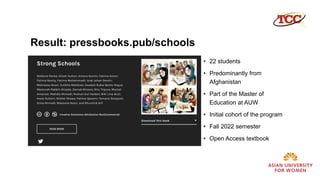
Result: pressbooks.pub/schools
• 22 students
• Predominantly from
Afghanistan
• Part of the Master of
Education at AUW
• Initial cohort of the program
• Fall 2022 semester
• Open Access textbook
Overview
• Context: Asian University for Women
• Background: Open Pedagogy & Open Textbooks
• Process: Timeline and Technologies
• Facilitation: Challenges & Opportunities
• Outcomes: Evaluation Results & Lessons Learned
About AUW Master of Arts in Education
• Inaugural Graduate Program: Crisis response to the Taliban invasion
• Hybrid Programme: Supported by Teaching Fellows in Digital Classroom setting
• Groundwork for AUW's Women Teaching Women, Women Learning from Women
(WTW-WLW) project
• Pioneering next-generation education leaders, entrepreneurs and policymakers
• To offer a full scholarship covering all expenses to students who demonstrate academic
achievement, a keen interest in research, and a willingness to strive for educational
equality but are in need of financial aid
• To assist students in cultivating their ambition to innovate and become socially
conscious educational entrepreneurs
Background: Why Open Pedagogy?
• Create opportunity for non-disposable assignments
• David Wiley on disposable assignments (2013):
“… assignments that add no value to the world – after a student spends three hours creating
it, a teacher spends 30 minutes grading it, and then the student throws it away.”
• Enhance diversity in OER/ open access textbook landscape
• Invite students to operate in technology-rich environment
• Learn about textbook genre elements, practice teacher thinking
• Create authentic writing, research and teamwork assessment
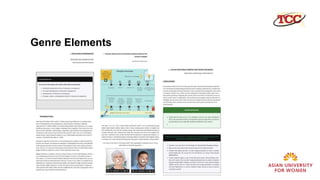
Genre Elements
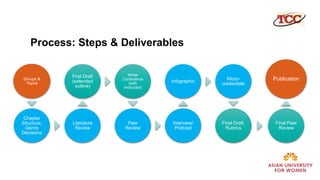
Process: Steps & Deliverables
Groups &
Topics
Chapter
Structure,
Genre
Decisions
Literature
Review
First Draft
(extended
outline)
Writer
Conference
(with
instructor)
Peer
Review
Interview/
Podcast
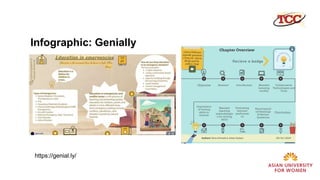
Infographic
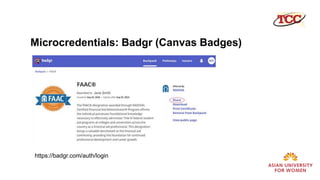
Micro-
credentials
Final Draft,
Rubrics
Final Peer
Review
Publication
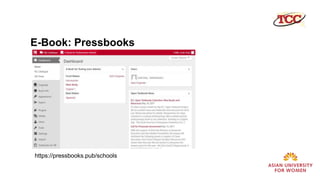
E-Book: Pressbooks
https://pressbooks.pub/schools
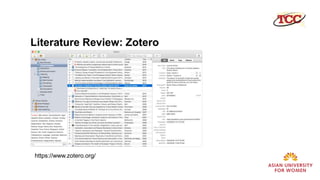
Literature Review: Zotero
https://www.zotero.org/
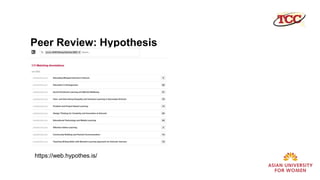
Peer Review: Hypothesis
https://web.hypothes.is/
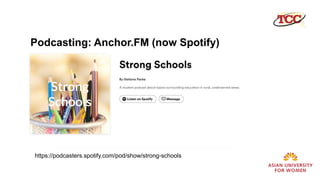
Podcasting: Anchor.FM (now Spotify)
https://podcasters.spotify.com/pod/show/strong-schools
Infographic: Genially
https://genial.ly/
Microcredentials: Badgr (Canvas Badges)
https://badgr.com/auth/login
Facilitation: Opportunities & Challenges
• Highly effective collaboration
• Exposure to Education Technologies and practical implementation
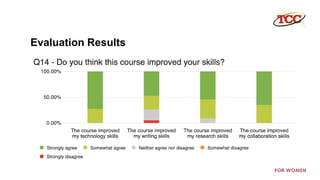
• Enhanced writing skills: how to write a book chapter and develop contents
• Improved research skills: Use of technology tools in research
• Challenges
– Distribution of works/responsibilities while collaboration
– Adapting to contemporary pedagogical techniques and technology tools
– Technical difficulties due to lack of resources (i.e., recording podcasts)
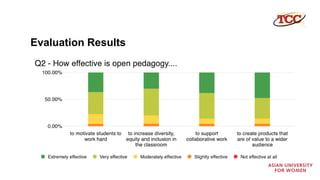
Evaluation Results
Evaluation Results
Interactive Part: Q&A with AUW Students
• Ritu Tripura (Bangladesh)
• Bibi Lina Azizi (Afghanistan)
• Sawdah Hoque (Bangladesh)
• Roshan Gul Haidari (Afghanistan)

StrongSchools: Presentation at TCC 2023

  • 1.
    Strong Schools: An OpenTextbook Online Class Israt Jahan Oeeshi Stefanie Panke TCC 2023
  • 2.
    Result: pressbooks.pub/schools • 22students • Predominantly from Afghanistan • Part of the Master of Education at AUW • Initial cohort of the program • Fall 2022 semester • Open Access textbook
  • 3.
    Overview • Context: AsianUniversity for Women • Background: Open Pedagogy & Open Textbooks • Process: Timeline and Technologies • Facilitation: Challenges & Opportunities • Outcomes: Evaluation Results & Lessons Learned
  • 4.
    About AUW Masterof Arts in Education • Inaugural Graduate Program: Crisis response to the Taliban invasion • Hybrid Programme: Supported by Teaching Fellows in Digital Classroom setting • Groundwork for AUW's Women Teaching Women, Women Learning from Women (WTW-WLW) project • Pioneering next-generation education leaders, entrepreneurs and policymakers • To offer a full scholarship covering all expenses to students who demonstrate academic achievement, a keen interest in research, and a willingness to strive for educational equality but are in need of financial aid • To assist students in cultivating their ambition to innovate and become socially conscious educational entrepreneurs
  • 5.
    Background: Why OpenPedagogy? • Create opportunity for non-disposable assignments • David Wiley on disposable assignments (2013): “… assignments that add no value to the world – after a student spends three hours creating it, a teacher spends 30 minutes grading it, and then the student throws it away.” • Enhance diversity in OER/ open access textbook landscape • Invite students to operate in technology-rich environment • Learn about textbook genre elements, practice teacher thinking • Create authentic writing, research and teamwork assessment
  • 6.
  • 7.
    Process: Steps &Deliverables Groups & Topics Chapter Structure, Genre Decisions Literature Review First Draft (extended outline) Writer Conference (with instructor) Peer Review Interview/ Podcast Infographic Micro- credentials Final Draft, Rubrics Final Peer Review Publication
  • 8.
  • 9.
  • 10.
  • 11.
    Podcasting: Anchor.FM (nowSpotify) https://podcasters.spotify.com/pod/show/strong-schools
  • 12.
  • 13.
    Microcredentials: Badgr (CanvasBadges) https://badgr.com/auth/login
  • 14.
    Facilitation: Opportunities &Challenges • Highly effective collaboration • Exposure to Education Technologies and practical implementation • Enhanced writing skills: how to write a book chapter and develop contents • Improved research skills: Use of technology tools in research • Challenges – Distribution of works/responsibilities while collaboration – Adapting to contemporary pedagogical techniques and technology tools – Technical difficulties due to lack of resources (i.e., recording podcasts)
  • 15.
  • 16.
  • 17.
    Interactive Part: Q&Awith AUW Students • Ritu Tripura (Bangladesh) • Bibi Lina Azizi (Afghanistan) • Sawdah Hoque (Bangladesh) • Roshan Gul Haidari (Afghanistan)