Design Thinking for Inclusive Community
Design: (How) Does it Work?
Dr. Stefanie Panke
Instructional Analyst
University of NorthCarolina at
ChapelHill, USA
Social Media Coordinator
Association for the Advancement
of Computing in Education(AACE)
aace.org/review
Prof. Dr. Thilo Harth
University of Applied Sciences
Münster, Germany
Institut für Berufliche
Lehrerbildung
Wandelwerk. Zentrumfür
Qualitätsentwicklung
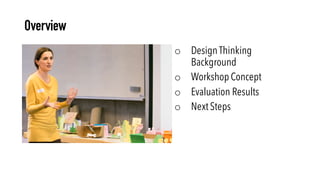
Overview
o Design Thinking
Background
o Workshop Concept
o Evaluation Results
o Next Steps
What’s	
  the	
  idea?	
  Design	
  Thinking
Design Thinking is problem solving method geared to overcome wicked
problems.
o Transcend the immediate boundaries of the problem to ensure that the right questions are
being addressed
o Analyze, synthesize, diverge, generate insights from different domains
o Drawing, prototypingand storytelling (Brown,2009)
o Constraints as inspiration (Brown,2009)
o Not directed towarda technological "quick fix” but towardnew integrations of signs, things,
actions, and environments (Buchanan, 1992)
o Fosters civic literacy, empathy, cultural awareness and risk taking (Sharples at al., 2016)
Design Thinking
Design Thinking and Cognitive Bias (Liedtka, 2015)
• Projection bias: People have a tendency to project their past experiences
and thus over-estimate the extentto which the futurewill resemblethe
present.
• Hot/cold gap: People’s emotional state, whether emotion-laden (hot) or
not (cold), unduly influences their assessmentof the potential value of an
idea.
• Egocentric empathy gap: People consistently overestimatethe similarity
between what they value and what others value.
• Focusing illusion: People tend to over-estimatethe effect of one factor at
the expenseof others,overreactingto specific stimuli,and ignoring others.
o February2018: Design thinking workshop at Muenster
University of Applied Sciences(Germany)
o Workshop theme:Inclusive community development -
designing neighborhoods for engagement,social cohesion
and inclusion
o Part of the researchcluster‘participation and well-being’
o Participants:Faculty from differentdisciplines,city planners,
architectsand students
Case Study
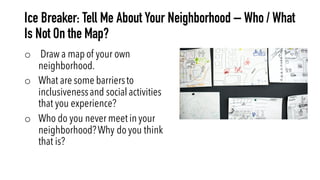
Ice Breaker: Tell Me About Your Neighborhood – Who / What
Is Not On the Map?
o Draw a map of your own
neighborhood.
o What are some barriersto
inclusivenessand social activities
that you experience?
o Who do you never meet in your
neighborhood?Why do you think
that is?
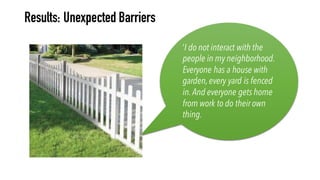
‘I do not interact with the
people in my neighborhood.
Everyone has a house with
garden,every yard is fenced
in.And everyone gets home
from work to do their own
thing.
Results: Unexpected Barriers
Audience:	
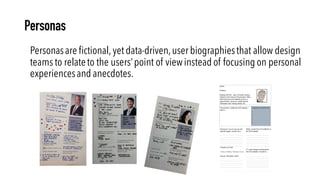
  Personas
Personasare fictional, yet data-driven,user biographiesthat allow design
teams to relateto the users’point of viewinstead of focusing on personal
experiencesand anecdotes.
Personas
Personas
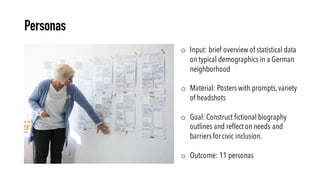
o Input: brief overview of statistical data
on typical demographics in a German
neighborhood
o Material: Posters with prompts,variety
of headshots
o Goal: Construct fictional biography
outlines and reflect on needs and
barriers forcivic inclusion.
o Outcome: 11 personas
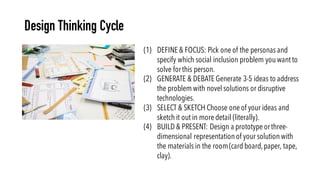
(1) DEFINE & FOCUS: Pick one of the personas and
specify which social inclusion problem you want to
solve forthis person.
(2) GENERATE & DEBATE Generate 3-5 ideas to address
the problem with novel solutions or disruptive
technologies.
(3) SELECT & SKETCH Choose one of your ideas and
sketch it out in more detail (literally).
(4) BUILD & PRESENT: Design a prototype orthree-
dimensional representation of your solution with
the materials in the room(card board,paper, tape,
clay).
Design Thinking Cycle
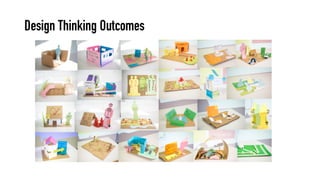
Design Thinking Outcomes
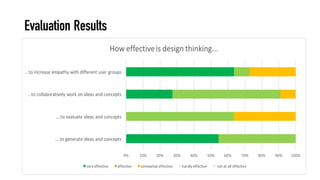
Evaluation Results
Evaluation Results – Positive Aspects
o To receiveimpulsesto think in other directions.
o Interdisciplinary approach
o The developmentof personas and the subsequent
prototyping
o The open approach and the integration of different
perspectives.
o Creativity, possibility to think through unconventional
ideas.
Evaluation Results – Negative Aspects
o It is unclear how to move from first ideasto further
development of innovative,marketableproducts / services.
o Unclearwhat is alreadyon the market.That would need to
be researched in a timely manner so that ideas do not fizzle
out.
o It lacks the opportunity to research whether the imagined
solution alreadyexists,and whether it makesany sense.
o Realistic assessments of models and ideas:all comments
and ideaswere treatedequal (both strength and weakness),
missing data (ideas arisefrom a ‘gut feeling’)
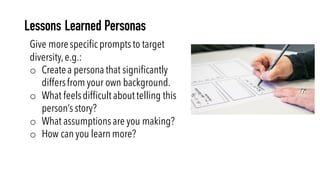
Give morespecific prompts to target
diversity,e.g.:
o Createa persona that significantly
differsfrom your own background.
o What feelsdifficult about telling this
person’s story?
o What assumptions are you making?
o How can you learn more?
Lessons Learned Personas
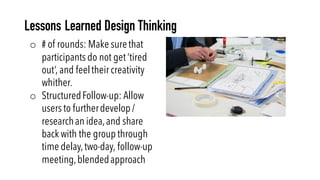
o # of rounds: Make surethat
participants do not get ‘tired
out’, and feeltheir creativity
whither.
o StructuredFollow-up: Allow
users to furtherdevelop /
researchan idea,and share
back with the group through
time delay,two-day, follow-up
meeting,blendedapproach
Lessons Learned Design Thinking
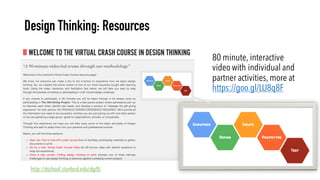
http://dschool.stanford.edu/dgift/
80 minute, interactive
video with individual and
partner activities,more at
https://goo.gl/LU8q8F
Design Thinking: Resources

Design Thinking

  • 1.
    Design Thinking forInclusive Community Design: (How) Does it Work? Dr. Stefanie Panke Instructional Analyst University of NorthCarolina at ChapelHill, USA Social Media Coordinator Association for the Advancement of Computing in Education(AACE) aace.org/review Prof. Dr. Thilo Harth University of Applied Sciences Münster, Germany Institut für Berufliche Lehrerbildung Wandelwerk. Zentrumfür Qualitätsentwicklung
  • 2.
    Overview o Design Thinking Background oWorkshop Concept o Evaluation Results o Next Steps
  • 3.
    What’s  the  idea?  Design  Thinking Design Thinking is problem solving method geared to overcome wicked problems. o Transcend the immediate boundaries of the problem to ensure that the right questions are being addressed o Analyze, synthesize, diverge, generate insights from different domains o Drawing, prototypingand storytelling (Brown,2009) o Constraints as inspiration (Brown,2009) o Not directed towarda technological "quick fix” but towardnew integrations of signs, things, actions, and environments (Buchanan, 1992) o Fosters civic literacy, empathy, cultural awareness and risk taking (Sharples at al., 2016) Design Thinking
  • 4.
    Design Thinking andCognitive Bias (Liedtka, 2015) • Projection bias: People have a tendency to project their past experiences and thus over-estimate the extentto which the futurewill resemblethe present. • Hot/cold gap: People’s emotional state, whether emotion-laden (hot) or not (cold), unduly influences their assessmentof the potential value of an idea. • Egocentric empathy gap: People consistently overestimatethe similarity between what they value and what others value. • Focusing illusion: People tend to over-estimatethe effect of one factor at the expenseof others,overreactingto specific stimuli,and ignoring others.
  • 5.
    o February2018: Designthinking workshop at Muenster University of Applied Sciences(Germany) o Workshop theme:Inclusive community development - designing neighborhoods for engagement,social cohesion and inclusion o Part of the researchcluster‘participation and well-being’ o Participants:Faculty from differentdisciplines,city planners, architectsand students Case Study
  • 6.
    Ice Breaker: TellMe About Your Neighborhood – Who / What Is Not On the Map? o Draw a map of your own neighborhood. o What are some barriersto inclusivenessand social activities that you experience? o Who do you never meet in your neighborhood?Why do you think that is?
  • 7.
    ‘I do notinteract with the people in my neighborhood. Everyone has a house with garden,every yard is fenced in.And everyone gets home from work to do their own thing. Results: Unexpected Barriers
  • 8.
    Audience:  Personas Personasare fictional,yet data-driven,user biographiesthat allow design teams to relateto the users’point of viewinstead of focusing on personal experiencesand anecdotes. Personas
  • 9.
    Personas o Input: briefoverview of statistical data on typical demographics in a German neighborhood o Material: Posters with prompts,variety of headshots o Goal: Construct fictional biography outlines and reflect on needs and barriers forcivic inclusion. o Outcome: 11 personas
  • 10.
    (1) DEFINE &FOCUS: Pick one of the personas and specify which social inclusion problem you want to solve forthis person. (2) GENERATE & DEBATE Generate 3-5 ideas to address the problem with novel solutions or disruptive technologies. (3) SELECT & SKETCH Choose one of your ideas and sketch it out in more detail (literally). (4) BUILD & PRESENT: Design a prototype orthree- dimensional representation of your solution with the materials in the room(card board,paper, tape, clay). Design Thinking Cycle
  • 11.
  • 12.
  • 13.
    Evaluation Results –Positive Aspects o To receiveimpulsesto think in other directions. o Interdisciplinary approach o The developmentof personas and the subsequent prototyping o The open approach and the integration of different perspectives. o Creativity, possibility to think through unconventional ideas.
  • 14.
    Evaluation Results –Negative Aspects o It is unclear how to move from first ideasto further development of innovative,marketableproducts / services. o Unclearwhat is alreadyon the market.That would need to be researched in a timely manner so that ideas do not fizzle out. o It lacks the opportunity to research whether the imagined solution alreadyexists,and whether it makesany sense. o Realistic assessments of models and ideas:all comments and ideaswere treatedequal (both strength and weakness), missing data (ideas arisefrom a ‘gut feeling’)
  • 15.
    Give morespecific promptsto target diversity,e.g.: o Createa persona that significantly differsfrom your own background. o What feelsdifficult about telling this person’s story? o What assumptions are you making? o How can you learn more? Lessons Learned Personas
  • 16.
    o # ofrounds: Make surethat participants do not get ‘tired out’, and feeltheir creativity whither. o StructuredFollow-up: Allow users to furtherdevelop / researchan idea,and share back with the group through time delay,two-day, follow-up meeting,blendedapproach Lessons Learned Design Thinking
  • 17.
    http://dschool.stanford.edu/dgift/ 80 minute, interactive videowith individual and partner activities,more at https://goo.gl/LU8q8F Design Thinking: Resources