DESIGN THINKING
Design in its most effective form is a process, an
action, a protocol for solving problems and
discovering new opportunities.
DESIGN
DESIGN THINKING
Design thinking is about believing we
can make a difference, come up with
solutions that bring about change and
value creation
WHAT IS DESIGN THINKING
●It is a mindset – Believing we can make a change, process
for transforming difficult challenges into opportunities for
design.
●It is human-centered – empathy and understanding the
needs and motivation for the people.
●It is collaborative – great minds together is always stronger
when a solving a challenge than just one mind.
●It is optimistic – We can all create a change no matter the
constraits that will be there.
●It is experimental – Failing and learning from the mistakes.
What is the design thinking process
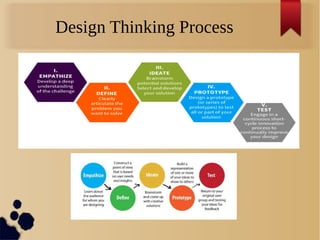
The Design Thinking process first defines the
problem and then implements the solutions.
This process focuses on needfinding,
understanding, creating, thinking, and doing.
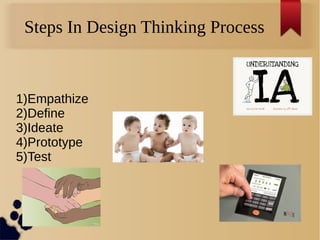
Steps In Design Thinking Process
1)Empathize
2)Define
3)Ideate
4)Prototype
5)Test
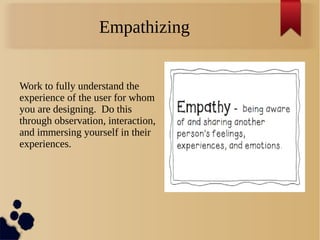
Empathizing
Work to fully understand the
experience of the user for whom
you are designing. Do this
through observation, interaction,
and immersing yourself in their
experiences.
Defining
● In this phase of design thinking, students
focus is on becoming aware of peoples’
needs and developing insights. The phrase
“How might we....” is often used to define a
point of view, which is a statement of the:
● user + need + insight
● This statement ends with a suggestion about
how to make changes that will have an
impact on peoples’ experiences.
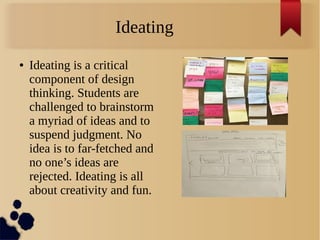
Ideating
● Ideating is a critical
component of design
thinking. Students are
challenged to brainstorm
a myriad of ideas and to
suspend judgment. No
idea is to far-fetched and
no one’s ideas are
rejected. Ideating is all
about creativity and fun.
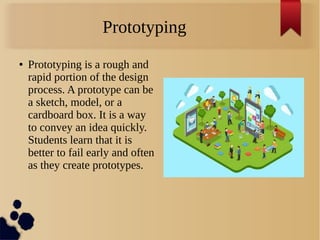
Prototyping
● Prototyping is a rough and
rapid portion of the design
process. A prototype can be
a sketch, model, or a
cardboard box. It is a way
to convey an idea quickly.
Students learn that it is
better to fail early and often
as they create prototypes.
DESIGN THINKING
DISCOVERY(Empathy)
I have a challenge.
How do I approach it?
●Understand the Challenge
●Prepare Research
●Gather Inspiration.
INTERPRATION (Defining)
I learned something.
How do I interpret it?
●Tell stories
●Search for meaning
●Frame opportunities
The Phases
IDEATION
I see an opportunity, What do I create
How do I evolve it
●Generate Ideas
●Refine Ideas
EXPERIMENTATION (Prototyping)
I have an idea
How do I build it
●Make Prototypes
●Get Feedback
EVOLUTION
I tried something new
How do I evolve it
●Track learning
●Move Forward
The Design Thinking process
oscillates between divergent and
convergent thinking modes. It can
be helpful to be aware of the mode
that corresponds to the design
phase you are working through.
Design Thinking Process

Design thinking

  • 1.
  • 2.
    Design in itsmost effective form is a process, an action, a protocol for solving problems and discovering new opportunities. DESIGN
  • 3.
    DESIGN THINKING Design thinkingis about believing we can make a difference, come up with solutions that bring about change and value creation
  • 4.
    WHAT IS DESIGNTHINKING ●It is a mindset – Believing we can make a change, process for transforming difficult challenges into opportunities for design. ●It is human-centered – empathy and understanding the needs and motivation for the people. ●It is collaborative – great minds together is always stronger when a solving a challenge than just one mind. ●It is optimistic – We can all create a change no matter the constraits that will be there. ●It is experimental – Failing and learning from the mistakes.
  • 5.
    What is thedesign thinking process The Design Thinking process first defines the problem and then implements the solutions. This process focuses on needfinding, understanding, creating, thinking, and doing.
  • 6.
    Steps In DesignThinking Process 1)Empathize 2)Define 3)Ideate 4)Prototype 5)Test
  • 7.
    Empathizing Work to fullyunderstand the experience of the user for whom you are designing. Do this through observation, interaction, and immersing yourself in their experiences.
  • 8.
    Defining ● In thisphase of design thinking, students focus is on becoming aware of peoples’ needs and developing insights. The phrase “How might we....” is often used to define a point of view, which is a statement of the: ● user + need + insight ● This statement ends with a suggestion about how to make changes that will have an impact on peoples’ experiences.
  • 9.
    Ideating ● Ideating isa critical component of design thinking. Students are challenged to brainstorm a myriad of ideas and to suspend judgment. No idea is to far-fetched and no one’s ideas are rejected. Ideating is all about creativity and fun.
  • 10.
    Prototyping ● Prototyping isa rough and rapid portion of the design process. A prototype can be a sketch, model, or a cardboard box. It is a way to convey an idea quickly. Students learn that it is better to fail early and often as they create prototypes.
  • 11.
    DESIGN THINKING DISCOVERY(Empathy) I havea challenge. How do I approach it? ●Understand the Challenge ●Prepare Research ●Gather Inspiration. INTERPRATION (Defining) I learned something. How do I interpret it? ●Tell stories ●Search for meaning ●Frame opportunities
  • 12.
    The Phases IDEATION I seean opportunity, What do I create How do I evolve it ●Generate Ideas ●Refine Ideas EXPERIMENTATION (Prototyping) I have an idea How do I build it ●Make Prototypes ●Get Feedback EVOLUTION I tried something new How do I evolve it ●Track learning ●Move Forward
  • 13.
    The Design Thinkingprocess oscillates between divergent and convergent thinking modes. It can be helpful to be aware of the mode that corresponds to the design phase you are working through.
  • 14.