

Introduksi Konsep
Data-Information-Knowledge-
Wisdom (DIKW)
Introduction to the Concept of Data-Information-Knowledge-Wisdom (DIKW)

Materi Kedua Matakuliah Pengantar Teknologi Informasi
Disampaikan oleh Coky Fauzi Alfi
Contents
▪ What is the Data?
▪ What is the Information?
▪ What is the Knowledge?
▪ What is the Wisdom?
▪ DIKW Hierarchy
All our knowledge brings us nearer to our ignorance,
All our ignorance brings us nearer to death,
But nearness to death no nearer to GOD.

Where is the Life we have lost in living?
Where is the wisdom we have lost in knowledge ?
Where is the   knowledge we have lost in information   ?


The cycles of Heaven in twenty centuries
Bring us farther from GOD and nearer to the Dust.

The Rock (T. S. Eliot)
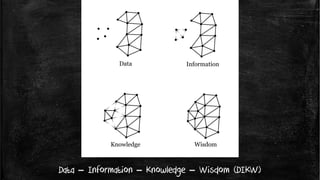
Data – Information – Knowledge – Wisdom (DIKW)
What is the Data ?
What is the Data?
▪ Kamus Besar Bahasa Indonesia, Data adalah:
  1. kenyataan yang ada yang berfungsi sebagai bahan
     sumber untuk menyusun suatu pendapat;
  2. keterangan yang benar;
  3. keterangan atau bahan yang dipakai untuk penalaran
     atau penyelidikan.
▪ Tesaurus Bahasa Indonesia, Data sama dengan:
                                                            ??
  – bahan, bukti, evidensi, fakta, informasi, keterangan,
     masukan, petunjuk, statistik
What is the Data?
▪ Data is raw.
▪ It simply exists and has no significance
  beyond its existence (in and of itself).
▪ It can exist in any form, usable or not.
▪ It does not have meaning of itself
(Russell Ackoff)
What is the Data?
▪ Data by itself has no meaning → "of no use until...in
  a usable form“ → "know-nothing“ (Milan Zeleny)
▪ Data are values of qualitative or quantitative
  variables. Data are typically the results of
  measurements and can be visualized using graphs
  or images.
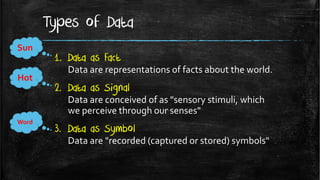
Types of Data
Sun
        1. Data as Fact
           Data are representations of facts about the world.
Hot
        2. Data as Signal
           Data are conceived of as "sensory stimuli, which
           we perceive through our senses"
Word
        3. Data as Symbol
           Data are "recorded (captured or stored) symbols"
What is the Information ?
▪ Kamus Besar Bahasa Indonesia, Informasi adalah:
  1. penerangan;
  2. pemberitahuan
▪ Tesaurus Bahasa Indonesia, Informasi adalah:
  1. penerangan, penjelasan;
  2. bahan, berita, data, embaran, fakta, kabar,
     keterangan, laporan, liputan, warta
What is the Information ?
Information is data that has been given
meaning by way of relational connection. This
"meaning" can be useful, but does not have to
be.
(Russell Ackoff)
What is the Information ?
Information is inferred from data in the process
of answering interrogative questions (e.g.,
"who", "what", "where", "how many", "when"),
thereby making the data useful for decisions
and/or action.
What is the Knowledge ?

Knowledge transforms "information   into
instructions.“
(Russel Ackoff)
What is the Knowledge ?
 Knowledge is the combination of data and
information, to which is added expert opinion, skills
and experience, to result in a valuable asset which
can be used to aid decision making.
(The European Committee for Standardization's
"Guide to Good Practice in Knowledge Management“)
Theories of Knowledge
1. Communicating Knowledge
2. Situated knowledge
3. Partial knowledge
4. Scientific knowledge
Communicating Knowledge

Knowledge can be transferred.
Writing is the most available and most universal of all
forms of recording and transmitting knowledge.
Situated Knowledge

Situated knowledge is knowledge specific to a
particular situation, generated by trial and error
or learning from experience.
Partial Knowledge

In real life situations, our knowledge is always
incomplete or partial. We often have a limited
amount of information and make decisions
accordingly.
Scientific Knowledge
Scientific knowledge is generated by scientific
method.
The scientific method consists of the collection of
data through observation and experimentation, and
the formulation and testing of hypotheses.
Types of Knowledge
1. Tacit Knowledge
  Kind of knowledge that is hard to encode and
  communicate
2. Explicit Knowledge
  Kind of knowledge that can be encoded and is
  transmittable in language
What is the Wisdom ?
Wisdom is the ability to increase effectiveness.
Wisdom adds value, which requires the mental
function that we call judgment. The ethical and
aesthetic values that this implies are inherent to the
actor and are unique and personal.
(Jennifer Rowley)
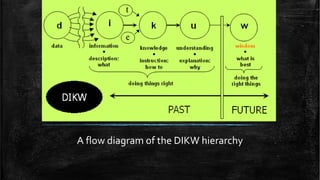
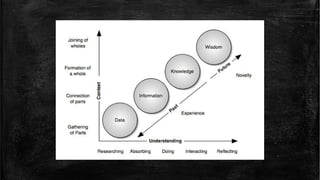
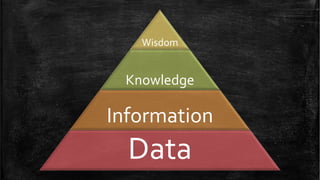
DIKW Hierarchy
A flow diagram of the DIKW hierarchy
Wisdom


 Knowledge

Information
  Data
Thanks


          © 2012
cokyfauzialfi.wordpress.com

M03 introduksi dikw

  • 1.
    Introduksi Konsep Data-Information-Knowledge- Data-Information-Knowledge- Wisdom (DIKW) Introductionto the Concept of Data-Information-Knowledge-Wisdom (DIKW) Materi Kedua Matakuliah Pengantar Teknologi Informasi Disampaikan oleh Coky Fauzi Alfi
  • 2.
    Contents ▪ What isthe Data? ▪ What is the Information? ▪ What is the Knowledge? ▪ What is the Wisdom? ▪ DIKW Hierarchy
  • 3.
    All our knowledgebrings us nearer to our ignorance, All our ignorance brings us nearer to death, But nearness to death no nearer to GOD. Where is the Life we have lost in living? Where is the wisdom we have lost in knowledge ? Where is the knowledge we have lost in information ? The cycles of Heaven in twenty centuries Bring us farther from GOD and nearer to the Dust. The Rock (T. S. Eliot)
  • 4.
    Data – Information– Knowledge – Wisdom (DIKW)
  • 5.
  • 6.
    What is theData? ▪ Kamus Besar Bahasa Indonesia, Data adalah: 1. kenyataan yang ada yang berfungsi sebagai bahan sumber untuk menyusun suatu pendapat; 2. keterangan yang benar; 3. keterangan atau bahan yang dipakai untuk penalaran atau penyelidikan. ▪ Tesaurus Bahasa Indonesia, Data sama dengan: ?? – bahan, bukti, evidensi, fakta, informasi, keterangan, masukan, petunjuk, statistik
  • 7.
    What is theData? ▪ Data is raw. ▪ It simply exists and has no significance beyond its existence (in and of itself). ▪ It can exist in any form, usable or not. ▪ It does not have meaning of itself (Russell Ackoff)
  • 8.
    What is theData? ▪ Data by itself has no meaning → "of no use until...in a usable form“ → "know-nothing“ (Milan Zeleny) ▪ Data are values of qualitative or quantitative variables. Data are typically the results of measurements and can be visualized using graphs or images.
  • 9.
    Types of Data Sun 1. Data as Fact Data are representations of facts about the world. Hot 2. Data as Signal Data are conceived of as "sensory stimuli, which we perceive through our senses" Word 3. Data as Symbol Data are "recorded (captured or stored) symbols"
  • 10.
    What is theInformation ?
  • 11.
    What is theInformation ? ▪ Kamus Besar Bahasa Indonesia, Informasi adalah: 1. penerangan; 2. pemberitahuan ▪ Tesaurus Bahasa Indonesia, Informasi adalah: 1. penerangan, penjelasan; 2. bahan, berita, data, embaran, fakta, kabar, keterangan, laporan, liputan, warta
  • 12.
    What is theInformation ? Information is data that has been given meaning by way of relational connection. This "meaning" can be useful, but does not have to be. (Russell Ackoff)
  • 13.
    What is theInformation ? Information is inferred from data in the process of answering interrogative questions (e.g., "who", "what", "where", "how many", "when"), thereby making the data useful for decisions and/or action.
  • 14.
    What is theKnowledge ?
  • 15.
    What is theKnowledge ? Knowledge transforms "information into instructions.“ (Russel Ackoff)
  • 16.
    What is theKnowledge ? Knowledge is the combination of data and information, to which is added expert opinion, skills and experience, to result in a valuable asset which can be used to aid decision making. (The European Committee for Standardization's "Guide to Good Practice in Knowledge Management“)
  • 17.
    Theories of Knowledge 1.Communicating Knowledge 2. Situated knowledge 3. Partial knowledge 4. Scientific knowledge
  • 18.
    Communicating Knowledge Knowledge canbe transferred. Writing is the most available and most universal of all forms of recording and transmitting knowledge.
  • 19.
    Situated Knowledge Situated knowledgeis knowledge specific to a particular situation, generated by trial and error or learning from experience.
  • 20.
    Partial Knowledge In reallife situations, our knowledge is always incomplete or partial. We often have a limited amount of information and make decisions accordingly.
  • 21.
    Scientific Knowledge Scientific knowledgeis generated by scientific method. The scientific method consists of the collection of data through observation and experimentation, and the formulation and testing of hypotheses.
  • 22.
    Types of Knowledge 1.Tacit Knowledge Kind of knowledge that is hard to encode and communicate 2. Explicit Knowledge Kind of knowledge that can be encoded and is transmittable in language
  • 23.
    What is theWisdom ?
  • 24.
    What is theWisdom ? Wisdom is the ability to increase effectiveness. Wisdom adds value, which requires the mental function that we call judgment. The ethical and aesthetic values that this implies are inherent to the actor and are unique and personal. (Jennifer Rowley)
  • 25.
  • 26.
    A flow diagramof the DIKW hierarchy
  • 28.
  • 29.
    Thanks © 2012 cokyfauzialfi.wordpress.com