UNIT 1: Design of Simple Machine Elements
 Machine Design, Design considerations - Strength, Rigidity,
Manufacture, Assembly and Cost, Standards and codes, Use of
preferred series, Factor of safety, Service factor. Design of Cotter
joint, Knuckle joint, Levers - hand / foot lever, lever for safety
valve, bell crank lever, and components subjected to eccentric
loading.
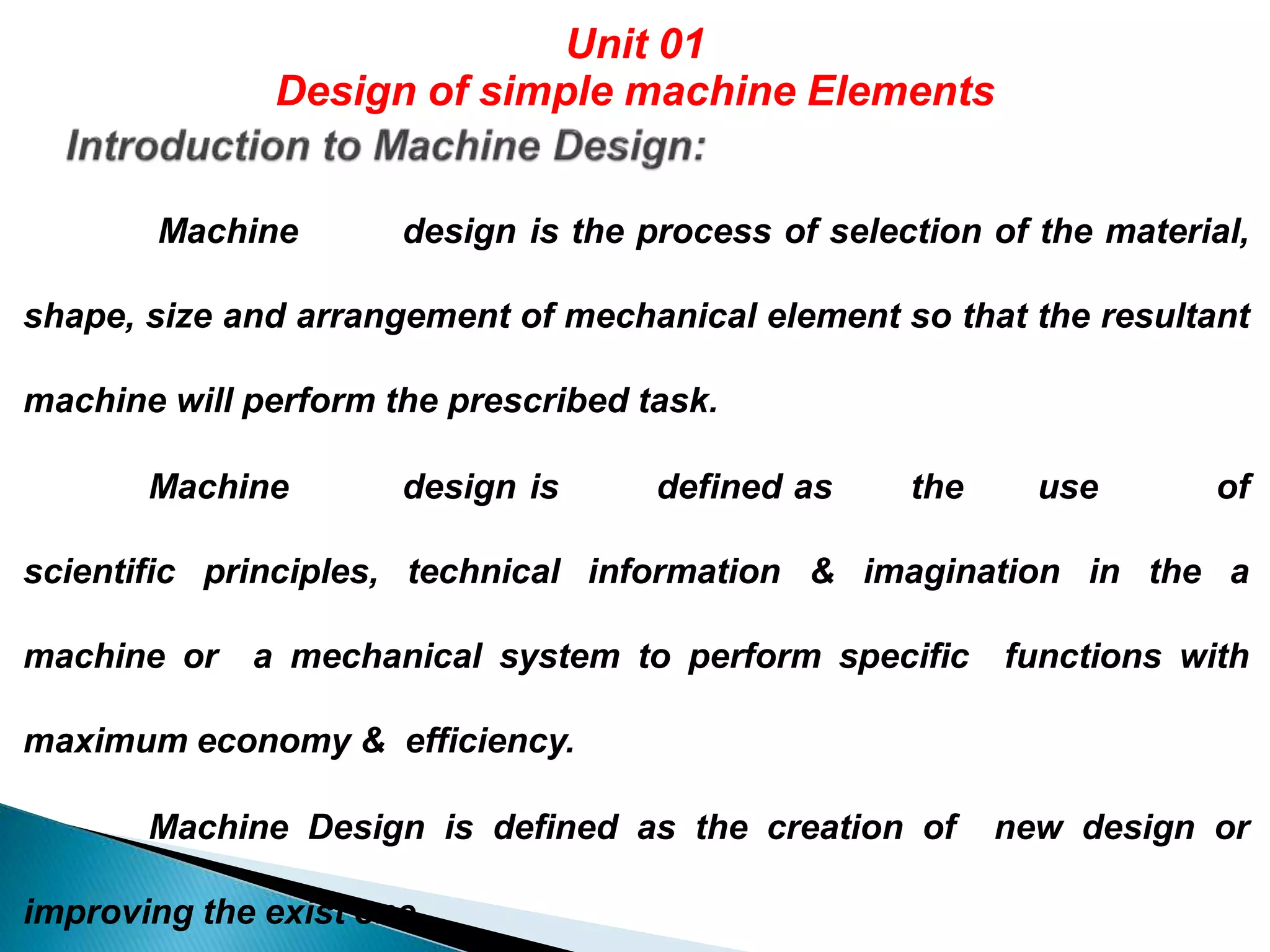
Machine design is the process of selection of the material,
shape, size and arrangement of mechanical element so that the resultant
machine will perform the prescribed task.
Machine design is defined as the use of
scientific principles, technical information & imagination in the a
machine or a mechanical system to perform specific functions with
maximum economy & efficiency.
Machine Design is defined as the creation of new design or
improving the exist one.
Unit 01
Design of simple machine Elements
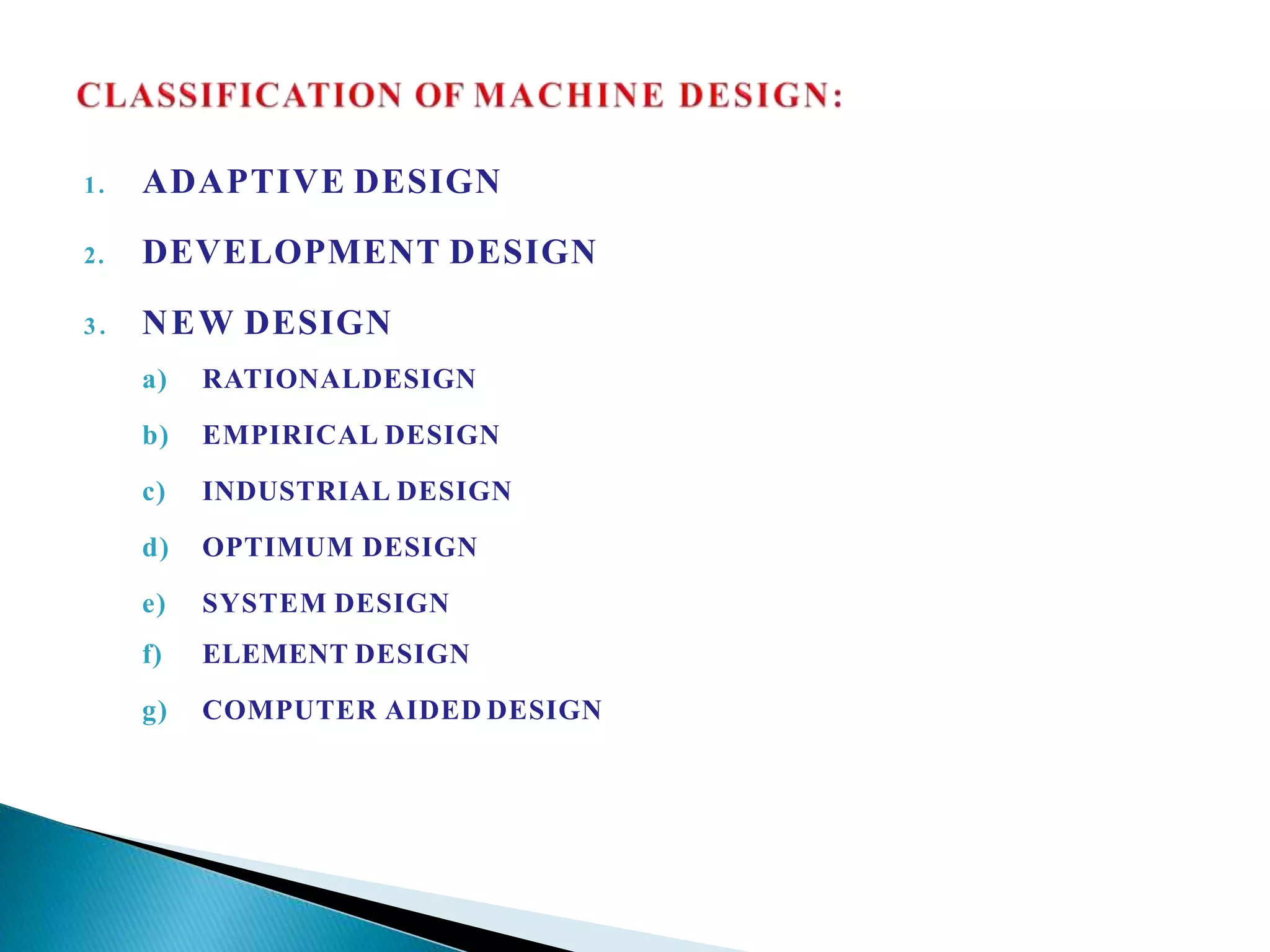
1. ADAPTIVE DESIGN
2. DEVELOPMENT DESIGN
3 . NEW DESIGN
a) RATIONALDESIGN
b) EMPIRICAL DESIGN
c) INDUSTRIAL DESIGN
d) OPTIMUM DESIGN
e) SYSTEM DESIGN
f) ELEMENT DESIGN
g) COMPUTER AIDED DESIGN
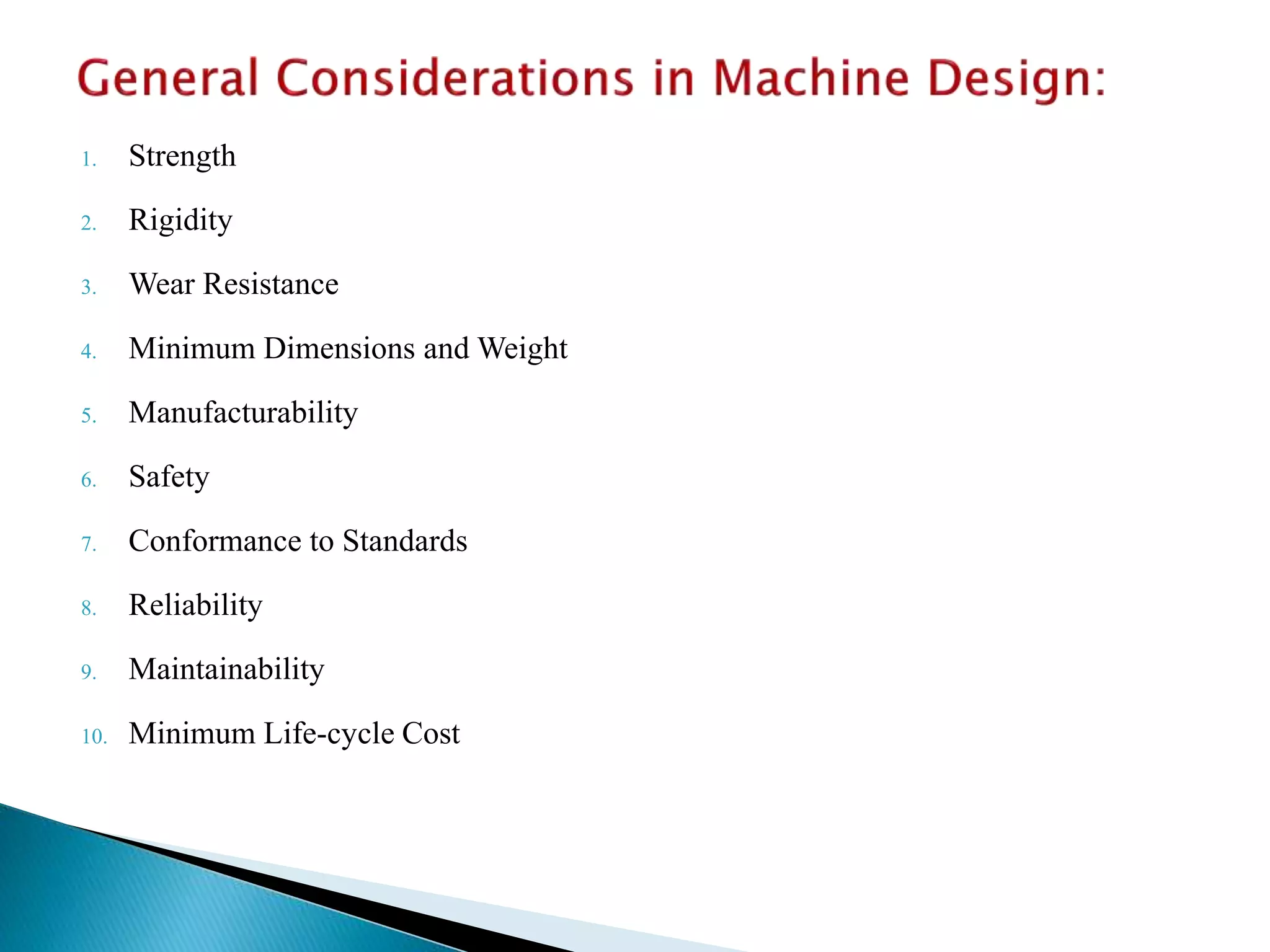
1. Strength
2. Rigidity
3. Wear Resistance
4. Minimum Dimensions and Weight
5. Manufacturability
6. Safety
7. Conformance to Standards
8. Reliability
9. Maintainability
10. Minimum Life-cycle Cost
Standards:
Standard can define as a set of technical definitions and guidelines – or simply a “how
to” instructions for designers and manufacturers. It gives all the necessary requirements
for the product, service, and operation.
Standardization is defined as the process of establishing standards so as to minimize the
varieties in the characteristics.
 Standards used in design are:
1. Standards for material, their mechanical properties and chemical composition.
2. Standards for dimensions of commonly used machine elements.
3. Standards for fits, tolerances and surface finish of machine elements.
4. Standards for engineering drawing of components.
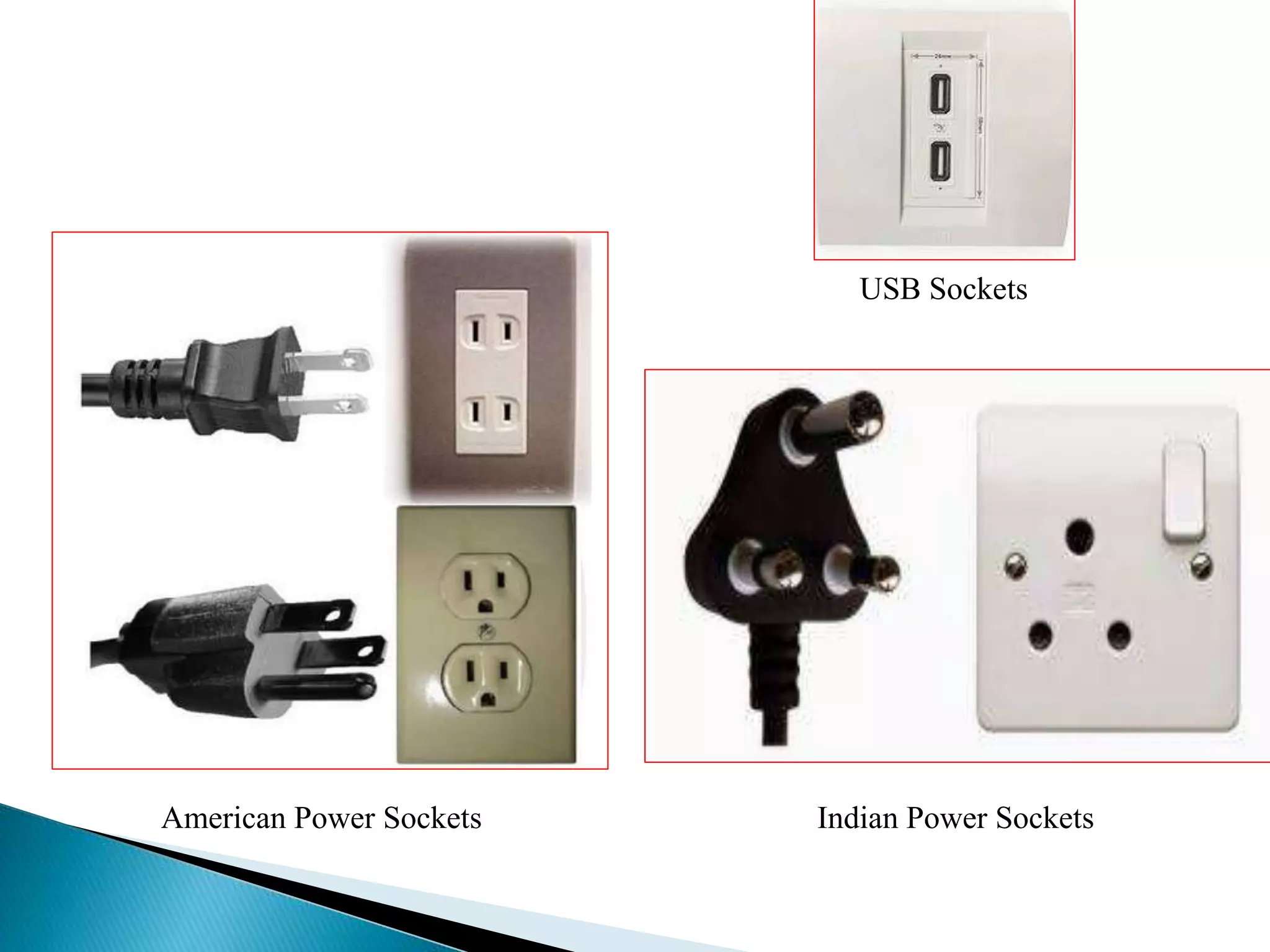
American Power Sockets Indian Power Sockets
USB Sockets
1) Company Standards
2) National Standards
3) International Standards
 Benefits of Standardization:
1. It helps in manufacturing the components quickly and economically.
2. It saves effort of design engineer to design and manufacture new machines, as
standard components are readily designed by experts.
3. It helps in manufacturing the components on mass production.
4. Interchange ability of components is possible.
5. It ensures certain minimum specified quality.
6. Effective utilization of resources.
7. Easy and quick replacement of the components is possible.
8. It also contributes to ensure the safety.
 When governmental bodies adopt the standard and become legally
enforceable, or when it has been incorporated into a business contract, the
standard will become a code.
 ASME Codes are legally enforceable in many US state. Whereas, in the
other part of the world they are not legally enforceable but such countries
have their own similar codes.
 Requirement of Code:
 Code provides a set of rules that specify the minimum acceptable level of
safety & Quality for manufactured, fabricated or constructed goods.
 Codes also refer out to standards or specifications for the specific details on
additional requirements that are not specified in the Code
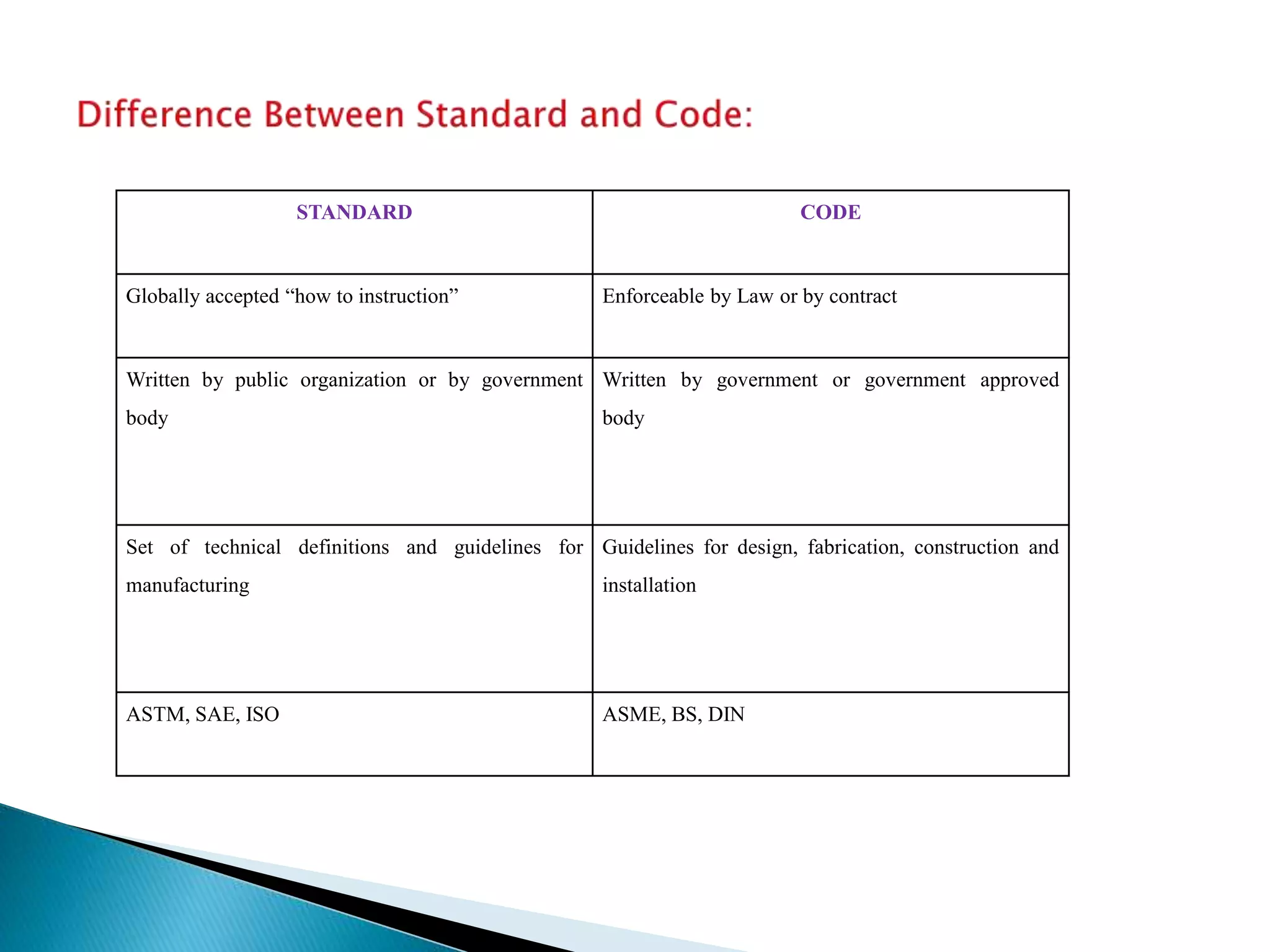
STANDARD CODE
Globally accepted “how to instruction” Enforceable by Law or by contract
Written by public organization or by government
body
Written by government or government approved
body
Set of technical definitions and guidelines for
manufacturing
Guidelines for design, fabrication, construction and
installation
ASTM, SAE, ISO ASME, BS, DIN
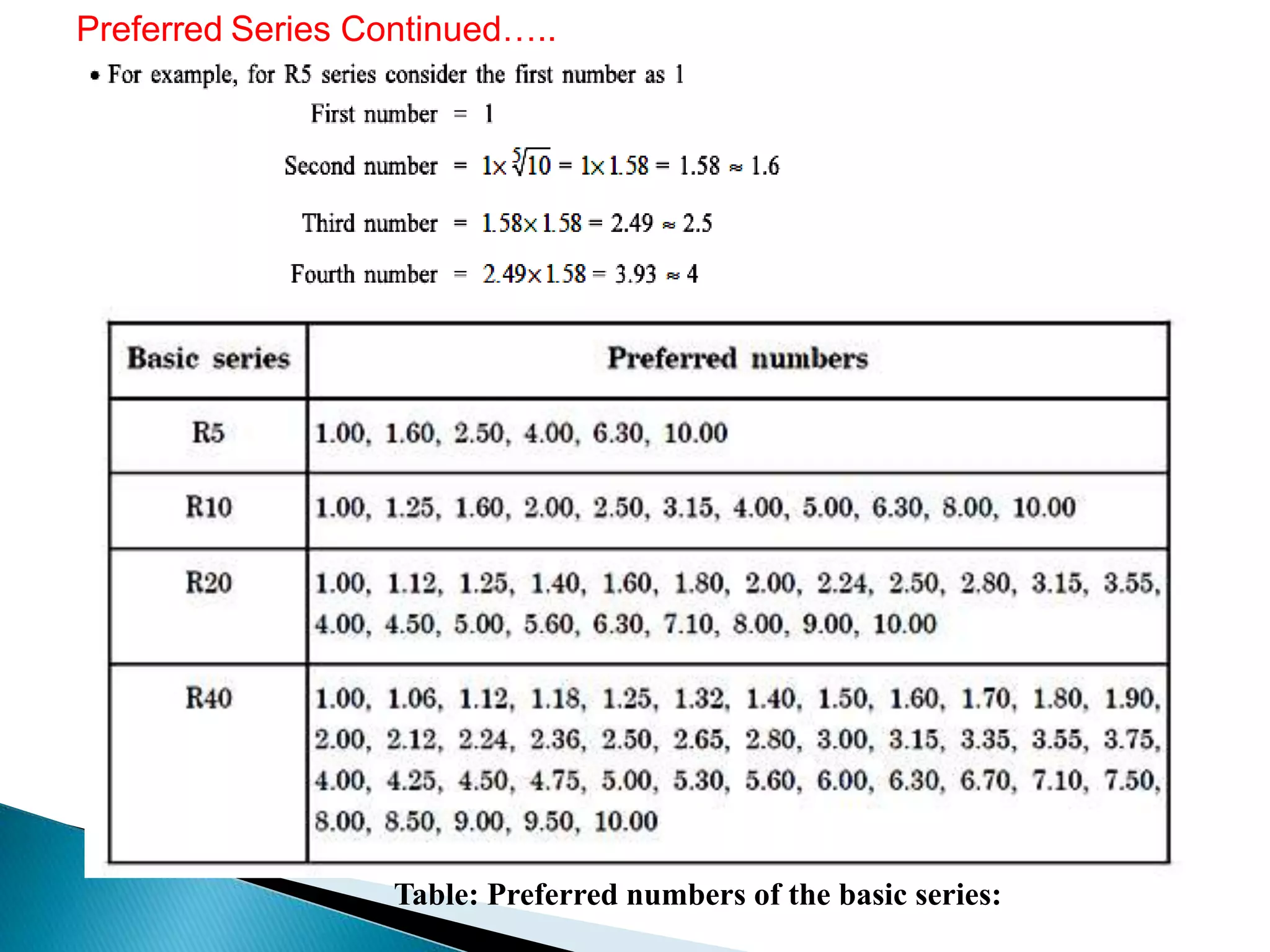
Preferred Series Continued…..
Table: Preferred numbers of the basic series:
Preferred Series Continued…..
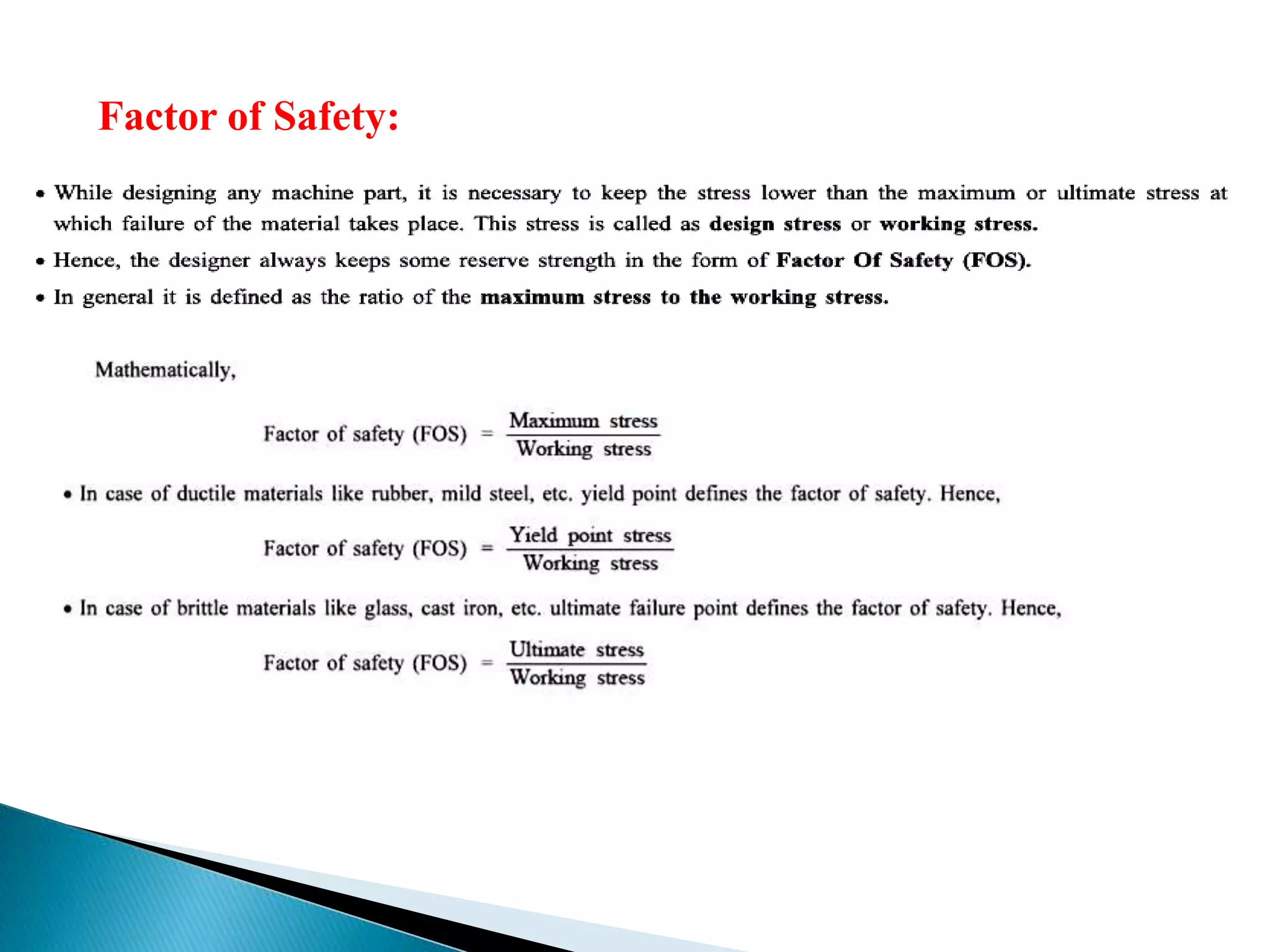
Factor of Safety:
The reliability of the properties of the material and change of these
properties during service;
The reliability of test results and accuracy of application of these
results to actual machine parts;
The reliabilityof applied load;
The certaintyas to exactmode of failure;
The extent of simplifying assumptions;
The extent of localised stresses;
The extent of initialstresses set up during manufacture;
The extent of loss of life if failure occurs ;and
The extent of loss of property if failure occurs.
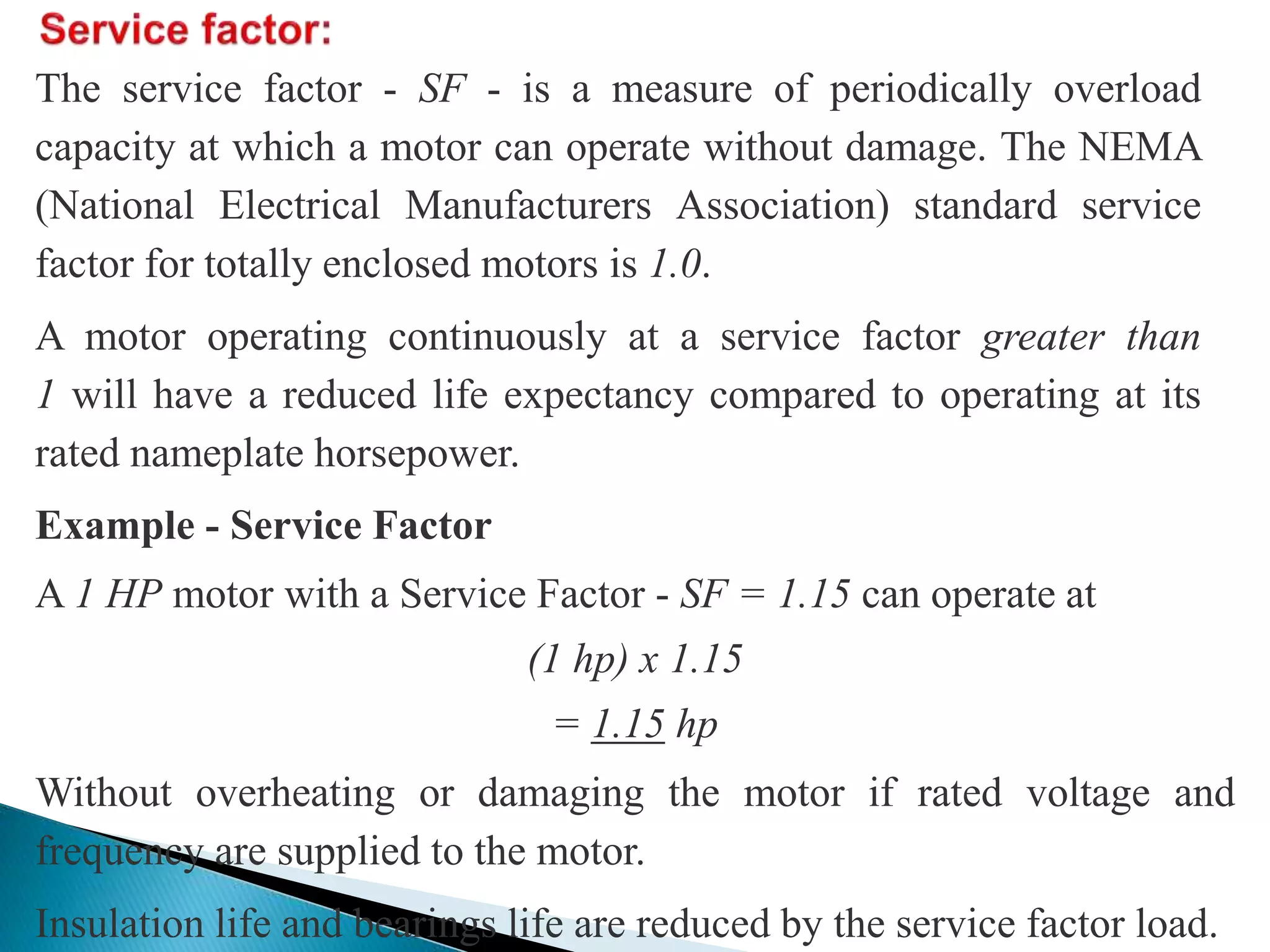
The service factor - SF - is a measure of periodically overload
capacity at which a motor can operate without damage. The NEMA
(National Electrical Manufacturers Association) standard service
factor for totally enclosed motors is 1.0.
A motor operating continuously at a service factor greater than
1 will have a reduced life expectancy compared to operating at its
rated nameplate horsepower.
Example - Service Factor
A 1 HP motor with a Service Factor - SF = 1.15 can operate at
(1 hp) x 1.15
= 1.15 hp
Without overheating or damaging the motor if rated voltage and
frequency are supplied to the motor.
Insulation life and bearings life are reduced by the service factor load.
 The service factor (KS ) is the product of various factors, such as load factor
(K1), lubrication factor (K2) and rating factor (K3).
 The values of these factors are taken as follows:

Design of simple machine Elements.pptx

  • 1.
    UNIT 1: Designof Simple Machine Elements  Machine Design, Design considerations - Strength, Rigidity, Manufacture, Assembly and Cost, Standards and codes, Use of preferred series, Factor of safety, Service factor. Design of Cotter joint, Knuckle joint, Levers - hand / foot lever, lever for safety valve, bell crank lever, and components subjected to eccentric loading.
  • 2.
    Machine design isthe process of selection of the material, shape, size and arrangement of mechanical element so that the resultant machine will perform the prescribed task. Machine design is defined as the use of scientific principles, technical information & imagination in the a machine or a mechanical system to perform specific functions with maximum economy & efficiency. Machine Design is defined as the creation of new design or improving the exist one. Unit 01 Design of simple machine Elements
  • 3.
    1. ADAPTIVE DESIGN 2.DEVELOPMENT DESIGN 3 . NEW DESIGN a) RATIONALDESIGN b) EMPIRICAL DESIGN c) INDUSTRIAL DESIGN d) OPTIMUM DESIGN e) SYSTEM DESIGN f) ELEMENT DESIGN g) COMPUTER AIDED DESIGN
  • 5.
    1. Strength 2. Rigidity 3.Wear Resistance 4. Minimum Dimensions and Weight 5. Manufacturability 6. Safety 7. Conformance to Standards 8. Reliability 9. Maintainability 10. Minimum Life-cycle Cost
  • 6.
    Standards: Standard can defineas a set of technical definitions and guidelines – or simply a “how to” instructions for designers and manufacturers. It gives all the necessary requirements for the product, service, and operation. Standardization is defined as the process of establishing standards so as to minimize the varieties in the characteristics.  Standards used in design are: 1. Standards for material, their mechanical properties and chemical composition. 2. Standards for dimensions of commonly used machine elements. 3. Standards for fits, tolerances and surface finish of machine elements. 4. Standards for engineering drawing of components.
  • 7.
    American Power SocketsIndian Power Sockets USB Sockets
  • 8.
    1) Company Standards 2)National Standards 3) International Standards  Benefits of Standardization: 1. It helps in manufacturing the components quickly and economically. 2. It saves effort of design engineer to design and manufacture new machines, as standard components are readily designed by experts. 3. It helps in manufacturing the components on mass production. 4. Interchange ability of components is possible. 5. It ensures certain minimum specified quality. 6. Effective utilization of resources. 7. Easy and quick replacement of the components is possible. 8. It also contributes to ensure the safety.
  • 9.
     When governmentalbodies adopt the standard and become legally enforceable, or when it has been incorporated into a business contract, the standard will become a code.  ASME Codes are legally enforceable in many US state. Whereas, in the other part of the world they are not legally enforceable but such countries have their own similar codes.  Requirement of Code:  Code provides a set of rules that specify the minimum acceptable level of safety & Quality for manufactured, fabricated or constructed goods.  Codes also refer out to standards or specifications for the specific details on additional requirements that are not specified in the Code
  • 10.
    STANDARD CODE Globally accepted“how to instruction” Enforceable by Law or by contract Written by public organization or by government body Written by government or government approved body Set of technical definitions and guidelines for manufacturing Guidelines for design, fabrication, construction and installation ASTM, SAE, ISO ASME, BS, DIN
  • 12.
    Preferred Series Continued….. Table:Preferred numbers of the basic series:
  • 13.
  • 14.
  • 15.
    The reliability ofthe properties of the material and change of these properties during service; The reliability of test results and accuracy of application of these results to actual machine parts; The reliabilityof applied load; The certaintyas to exactmode of failure; The extent of simplifying assumptions; The extent of localised stresses; The extent of initialstresses set up during manufacture; The extent of loss of life if failure occurs ;and The extent of loss of property if failure occurs.
  • 16.
    The service factor- SF - is a measure of periodically overload capacity at which a motor can operate without damage. The NEMA (National Electrical Manufacturers Association) standard service factor for totally enclosed motors is 1.0. A motor operating continuously at a service factor greater than 1 will have a reduced life expectancy compared to operating at its rated nameplate horsepower. Example - Service Factor A 1 HP motor with a Service Factor - SF = 1.15 can operate at (1 hp) x 1.15 = 1.15 hp Without overheating or damaging the motor if rated voltage and frequency are supplied to the motor. Insulation life and bearings life are reduced by the service factor load.
  • 17.
     The servicefactor (KS ) is the product of various factors, such as load factor (K1), lubrication factor (K2) and rating factor (K3).  The values of these factors are taken as follows: