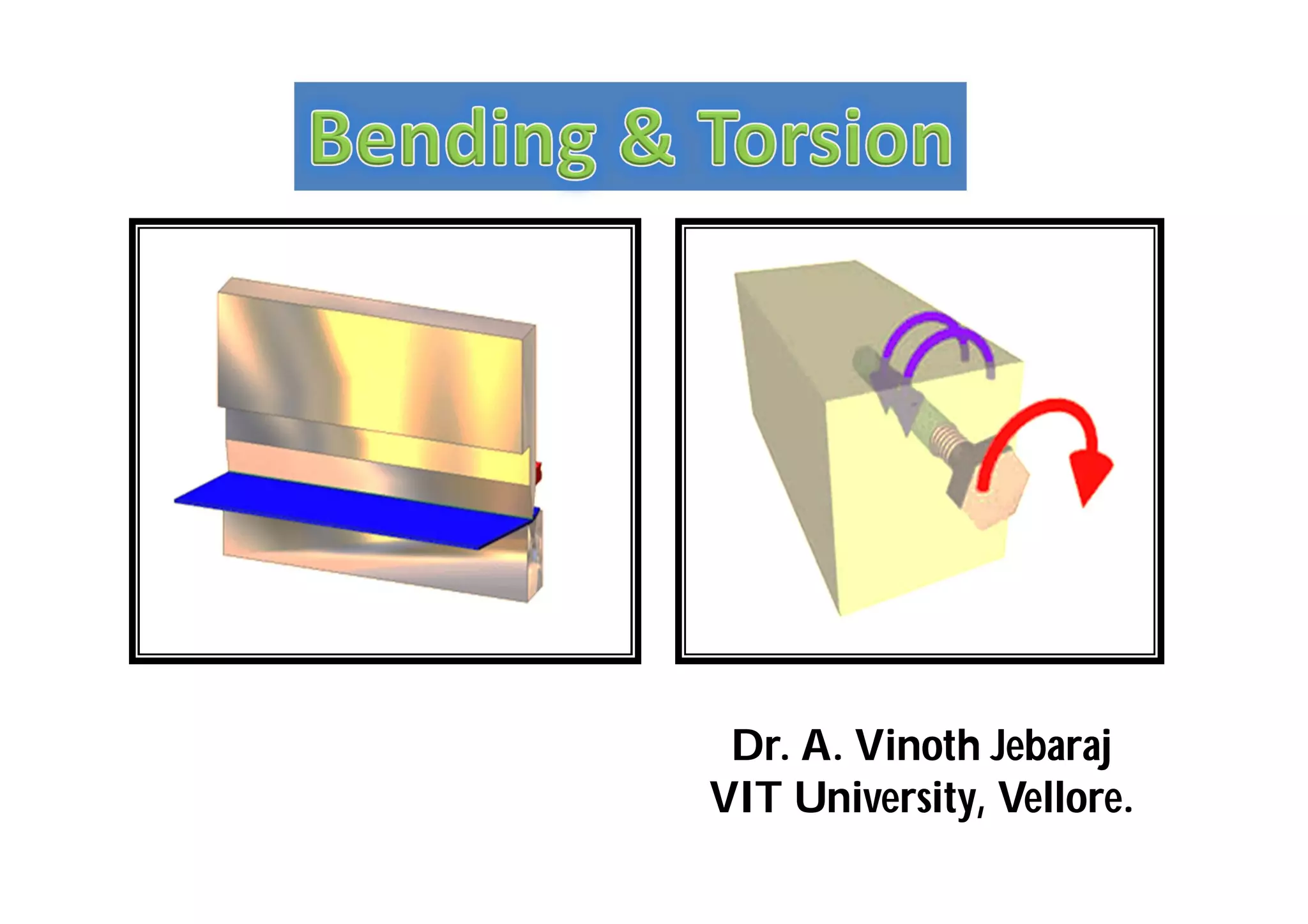
Dr. A. Vinoth Jebaraj
VIT University, Vellore.
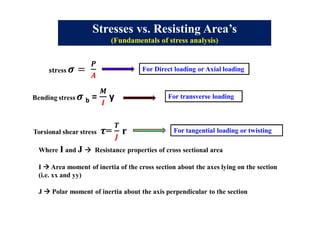
Stresses vs. Resisting Area’s
(Fundamentals of stress analysis)
For Direct loading or Axial loading
For transverse loading
For tangential loading or twisting
Where I and J  Resistance properties of cross sectional area
I  Area moment of inertia of the cross section about the axes lying on the section
(i.e. xx and yy)
J  Polar moment of inertia about the axis perpendicular to the section
Varying cross section Constant cross section vertical position
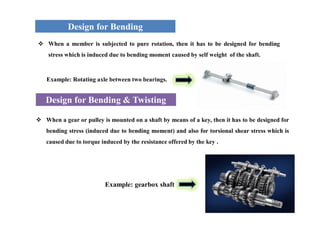
Design for Bending
Design for Bending & Twisting
 When a member is subjected to pure rotation, then it has to be designed for bending
stress which is induced due to bending moment caused by self weight of the shaft.
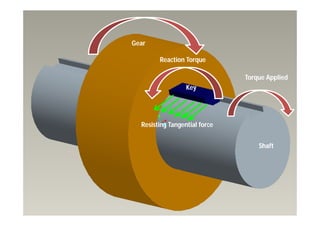
 When a gear or pulley is mounted on a shaft by means of a key, then it has to be designed for
bending stress (induced due to bending moment) and also for torsional shear stress which is
caused due to torque induced by the resistance offered by the key .
Example: Rotating axle between two bearings.
Example: gearbox shaft
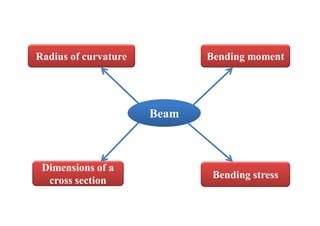
Beam
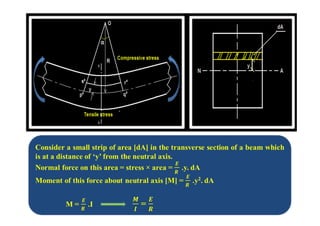
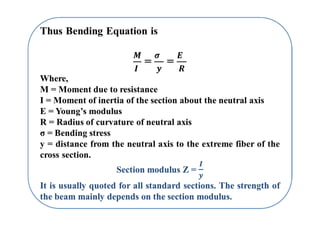
Radius of curvature Bending moment
Dimensions of a
cross section
Bending stress
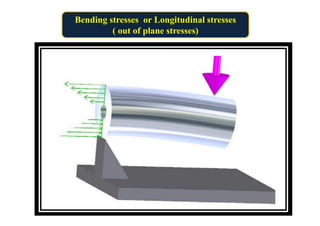
Bending stresses or Longitudinal stresses
( out of plane stresses)
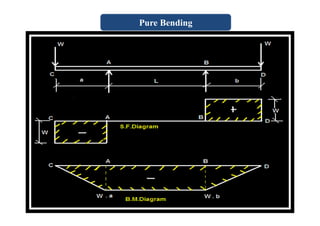
Pure Bending
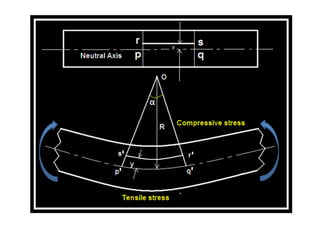
 If the length of a beam is subjected to a constant bending
moment and no shear force ( zero shear force) then the
stresses will be set up in that length of the beam due to
bending moment only then it is said to be in pure bending.
 Under bending, top fibers subjected to compressive
stresses and bottom fiber subjected to tensile stresses and
vice versa.
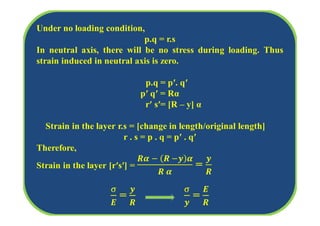
 In the middle layer (neutral axis), there is no stress due to
external load.
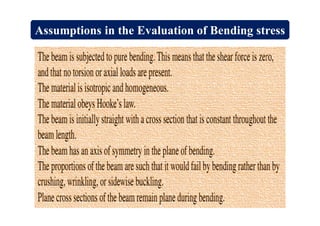
Assumptions in the Evaluation of Bending stress
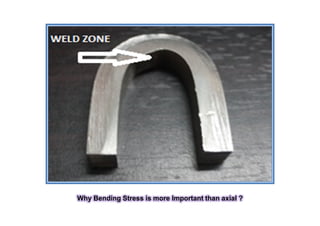
Why Bending Stress is more Important than axial ?
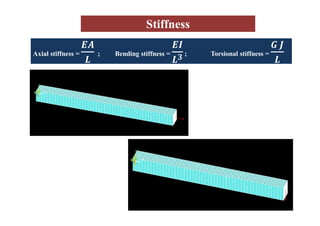
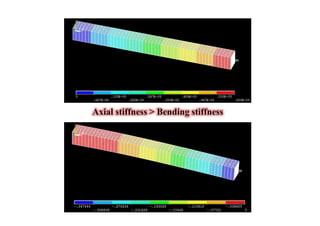
Stiffness
Axial stiffness = ; Bending stiffness = ; Torsional stiffness =
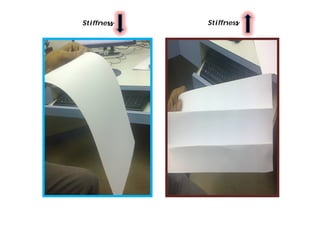
Stiffness Stiffness
= y
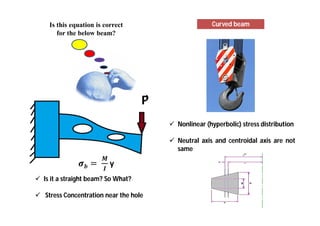
Is this equation is correct
for the below beam?
P
 Is it a straight beam? So What?
 Stress Concentration near the hole
Curved beam
 Nonlinear (hyperbolic) stress distribution
 Neutral axis and centroidal axis are not
same
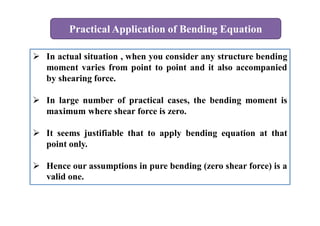
Practical Application of Bending Equation
 In actual situation , when you consider any structure bending
moment varies from point to point and it also accompanied
by shearing force.
 In large number of practical cases, the bending moment is
maximum where shear force is zero.
 It seems justifiable that to apply bending equation at that
point only.
 Hence our assumptions in pure bending (zero shear force) is a
valid one.
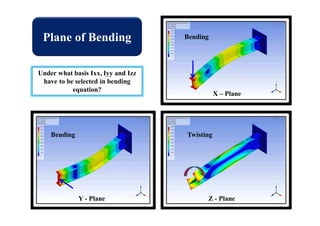
Plane of Bending
X – Plane
Y - Plane Z - Plane
Under what basis Ixx, Iyy and Izz
have to be selected in bending
equation?
Bending
Bending Twisting
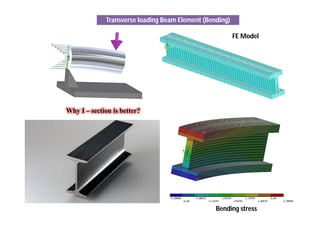
Transverse loading Beam Element (Bending)
Bending stress
FE Model
Why I – section is better?
Torque Applied
Reaction Torque
Shaft
Gear
Key
Resisting Tangential force
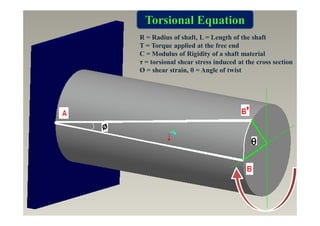
R = Radius of shaft, L = Length of the shaft
T = Torque applied at the free end
C = Modulus of Rigidity of a shaft material
τ = torsional shear stress induced at the cross section
Ø = shear strain, θ = Angle of twist
Torsional Equation
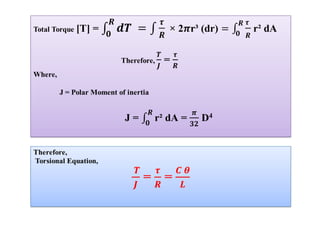
Polar moment of inertia [J]
[Area moment of inertia about the axis perpendicular to the section of the shaft]
Shaft circular cross
section
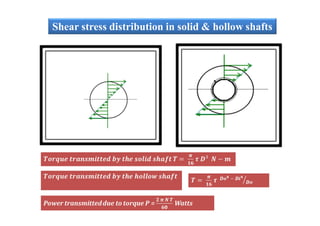
Shear stress distribution in solid & hollow shafts
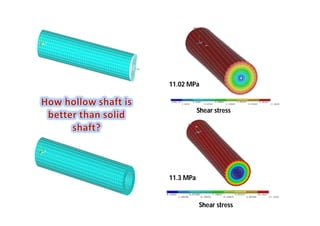
Shear stress
Shear stress
11.02 MPa
11.3 MPa
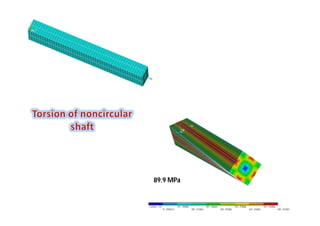
89.9 MPa

Bending and Torsion A.Vinoth Jebaraj

  • 1.
    Dr. A. VinothJebaraj VIT University, Vellore.
  • 2.
    Stresses vs. ResistingArea’s (Fundamentals of stress analysis) For Direct loading or Axial loading For transverse loading For tangential loading or twisting Where I and J  Resistance properties of cross sectional area I  Area moment of inertia of the cross section about the axes lying on the section (i.e. xx and yy) J  Polar moment of inertia about the axis perpendicular to the section
  • 3.
    Varying cross sectionConstant cross section vertical position
  • 4.
    Design for Bending Designfor Bending & Twisting  When a member is subjected to pure rotation, then it has to be designed for bending stress which is induced due to bending moment caused by self weight of the shaft.  When a gear or pulley is mounted on a shaft by means of a key, then it has to be designed for bending stress (induced due to bending moment) and also for torsional shear stress which is caused due to torque induced by the resistance offered by the key . Example: Rotating axle between two bearings. Example: gearbox shaft
  • 5.
    Beam Radius of curvatureBending moment Dimensions of a cross section Bending stress
  • 6.
    Bending stresses orLongitudinal stresses ( out of plane stresses)
  • 7.
  • 8.
     If thelength of a beam is subjected to a constant bending moment and no shear force ( zero shear force) then the stresses will be set up in that length of the beam due to bending moment only then it is said to be in pure bending.  Under bending, top fibers subjected to compressive stresses and bottom fiber subjected to tensile stresses and vice versa.  In the middle layer (neutral axis), there is no stress due to external load.
  • 9.
    Assumptions in theEvaluation of Bending stress
  • 10.
    Why Bending Stressis more Important than axial ?
  • 11.
    Stiffness Axial stiffness =; Bending stiffness = ; Torsional stiffness =
  • 13.
  • 18.
    = y Is thisequation is correct for the below beam? P  Is it a straight beam? So What?  Stress Concentration near the hole Curved beam  Nonlinear (hyperbolic) stress distribution  Neutral axis and centroidal axis are not same
  • 19.
    Practical Application ofBending Equation  In actual situation , when you consider any structure bending moment varies from point to point and it also accompanied by shearing force.  In large number of practical cases, the bending moment is maximum where shear force is zero.  It seems justifiable that to apply bending equation at that point only.  Hence our assumptions in pure bending (zero shear force) is a valid one.
  • 20.
    Plane of Bending X– Plane Y - Plane Z - Plane Under what basis Ixx, Iyy and Izz have to be selected in bending equation? Bending Bending Twisting
  • 21.
    Transverse loading BeamElement (Bending) Bending stress FE Model Why I – section is better?
  • 22.
  • 23.
    R = Radiusof shaft, L = Length of the shaft T = Torque applied at the free end C = Modulus of Rigidity of a shaft material τ = torsional shear stress induced at the cross section Ø = shear strain, θ = Angle of twist Torsional Equation
  • 25.
    Polar moment ofinertia [J] [Area moment of inertia about the axis perpendicular to the section of the shaft] Shaft circular cross section
  • 27.
    Shear stress distributionin solid & hollow shafts
  • 28.
  • 29.