http://www.iaeme.com/IJCIET/index.asp 409 editor@iaeme.com
International Journal of Civil Engineering and Technology (IJCIET)
Volume 8, Issue 1, January 2017, pp. 409–417, Article ID: IJCIET_08_01_046
Available online at http://www.iaeme.com/IJCIET/issues.asp?JType=IJCIET&VType=8&IType=1
ISSN Print: 0976-6308 and ISSN Online: 0976-6316
© IAEME Publication
DESIGN OF RIGID PAVEMENT AND ITS COST-
BENEFIT ANALYSIS BY USAGE OF VITRIFIED
POLISH WASTE AND RECRON POLYESTER FIBRE
M. T. S. Lakshmayya
Civil Engineering Department, G.M. R. Institute of Technology,
Rajam, Andhra Pradesh, India
G. Aditya
Civil Engineering Department, G. M. R. Institute of Technology,
Rajam, Andhra Pradesh, India
ABSTRACT
A country can achieve sustainable and rapid growth in all fields by improving its connectivity
and transit systems. Connectivity of people to resources by improved transit mechanism results in
improved living standards. Apart from other means, the major part of connectivity of any country is
through road systems. Well designed and maintained pavements provide better and long lasting
service. In India, all the major road systems are designed as flexible pavements only, because of
their ease of construction and less time it takes to be opened to traffic operations. The major
problem with flexible pavements is their design life and high maintenance costs. Also, globally
reducing petrol reserves, which are used for bitumen and asphalt production are also increasing
the need for alternatives. To tackle these problems, rigid pavements can be constructed. Although
the cost of construction of rigid pavements is high, its long life, high load carrying capabilities and
low maintenance cost will balance the initial cost aspect. Recently, many studies are being
conducted on different pozzolanic admixtures which can be used as partial replacement of cement
in rigid pavements, thereby reducing its cost and enhancing properties of the mix. Here, an attempt
is made to reduce the construction cost of rigid pavements by incorporating Vitrified Polish Waste
(VPW) as partial cement replacement in proportions of 5% for M40 grade concrete. Further, to
enhance flexural properties of pavement, Recron fibre is added to optimum VPW in increments of
0.1%, then after C.C pavement is designed for two lane two way national highway and cost benefit
analysis is performed.
Key words: Vitrified Polish Waste (VPW),Recron, Rigid Pavement Design, Cost-Benefit Analysis
Cite this Article: M. T. S. Lakshmayya and G. Aditya, Design of Rigid Pavement and its Cost-
Benefit Analysis By Usage of Vitrified Polish Waste and Recron Polyester Fibre. International
Journal of Civil Engineering and Technology, 8(1), 2017, pp. 409–417.
http://www.iaeme.com/IJCIET/issues.asp?JType=IJCIET&VType=8&IType=1
M. T. S. Lakshmayya and G. Aditya
http://www.iaeme.com/IJCIET/index.asp 410 editor@iaeme.com
1. INTRODUCTION
After understanding the importance and necessity of rigid pavement construction many researches and
studies are conducted in this aspect. The studies mainly focused on improvement of mechanical and
durability properties of concrete by usage of various additives, admixtures and fibres to concrete mix.
These admixtures are used as partial or full replacement of cement along or without fibres. The fibres used
are also available in different types like steel, glass etc. Studies are also conducted on them individually as
well as compositely.Luiz Renato, Steiner Adriano et.al [2001] studied, the properties of sludge obtained
from polishing of ceramic tiles. X-ray diffraction, X-ray fluorescence, laser diffraction and several other
tests were conducted to study physical and chemical properties of this sludge. Also, recommended its
usage as Supplementary Cementious Material (SCM) in various engineering constructions. Jay Patel, B.K.
Shahet.al [2014] in his literature analysis about ceramic waste inclusion in concrete making concluded that,
ceramic products have good pozzolanic activity because of their manufacturing temperature and its usage
is good for economy and environment. He also concluded that, cost of construction can be reduced by 20-
30% for higher grades of concrete by its usage.
Electricwala Fatima, Ankit Jhamb, Rakesh Kumar et al [2013] have investigated on M35 grade of
concrete by replacing up to 30% of cement with ceramic dust and observed an increment in compressive
strength, flexural strength. The results showed an increase in compressive strength by 3.9% to 5.6% by
replacing 20% cement content with ceramic dust. Ponnapati Manogna, M. Sri Lakshmi [2015]
investigated on partial replacement of cement by tile waste in M30 grade of concrete in increments of 10%
up to 50%.Compressive, tensile and flexural strength tests were conducted for 7, 28 and 56 days
respectively and suggested that a replacement up to 30% can be made without compromising on design
strength. However, optimum results for compression,tension and flexure strength were attained at 10%
replacement. Abhinav. S. Pawar, K.R. Dhabekar [2014] investigated on addition of waste material (GGBS)
and steel fibresin M40 grade concrete for rigid pavement and compared with normal concrete of M40
grade.After testing it was found that, 30% GGBS is the optimum replacement for M40 grade of concrete
but, flexural strength decreased by increasing percentage of GGBS, so as to increase flexural strength, steel
fibres of two different aspect ratios (7560 & 7530) were used. Steel fibres were added in concrete by 1% of
total weight of concrete with different proportions.
Nandish S.C, Ajith B.T et.al [2015] studied about strength enhancement of conventional concrete with
addition of Coconut fibres and polypropylene fibres. The coconut fibres of various proportions like 1%,
1.5%, 2%, 2.5% and polypropylene fibres of proportions of 0.4% by volume of concrete were used in the
M40 grade concrete mix tests to determine the mechanical properties of concrete up to 7, 28, 56 and 90
days. Use of fibres tends to enhance the flexural strength of the mix. Fibre mixed concrete has higher value
than that of the control mix. For 2.0%CF and 0.4%PF of fiber, flexural strength found to be 14% higher
than that of control mix concrete. Mehul. J. Patel, S. M. Kulkarni [2013] studied effects of poly propylene
fibres on M40 grade of concrete by adding in proportions of 0.5%, 1%, and 1.5% and investigated for
compressive, flexural and split tensile strengths and reported an increase in above parameters when
compared to conventional concrete.
Vipul. D. Prajapathi, Nilay Joshi et.al [2013] experimented on usage of fine aggregate replaced by used
foundry sand in proportions of 0%, 10%, 30% and 50% for M20 grade of concrete and studied their
mechanical properties. He concluded that, maximum compressive and flexural strengths are achieved at
50% replacement of natural fine aggregate with used foundry sand and designed a pavement for
3000CVPD flow. As a part of such studies, usage of Vitrified Polish Waste (VPW) along with recron
polyester fibre is studied in this experimental investigation. Ceramic industry is extensively growing with
the infrastructural needs of the present world and waste generated is also increasing rapidly there by
incorporating these wastes in pavement construction will also help environmentally. A good study on
Indian standard codes for laboratory sampling, and testing of concrete and materials used is also done
before proceeding into testing phase, which includes the following codes (IS: 10262-2009 , IS: 456-2000 ,
Design of Rigid Pavement and its Cost-Benefit Analysis By Usage of Vitrified Polish Waste and Recron
Polyester Fibre
http://www.iaeme.com/IJCIET/index.asp 411 editor@iaeme.com
IS: 2386-1963, IS: 4031-1988, IRC: 44-2008, IS: 516-1959 ), the design of rigid pavement is performed
according to standards specified by IRC: 58-2002.
1.1. Objectives of the Study
The major objectives of study are
• To enhance the mechanical properties of rigid pavements effectively by inclusion of industrial waste
admixture (VPW) as a partial cement replacement.
• Designing a rigid pavement based on VPW and Recron fibre admixed concrete mixes.
• Performing cost-benefit analysis and evaluating the reduction in cost of construction.
2. MATERIALSUSED IN INVESTIGATION
The materials like fine aggregate, coarse aggregate and cement used in this investigation are bought from
locally available sources; VPW is procured from RAK Ceramics, Samalkot, Andhra Pradesh and Recron-
3S fibres from Reliance Industries. The cement used is of OPC 43 grade and having specific gravity of
3.12 and is strictly confirming to IS: 8112-2013. The fine aggregate used is of Zone-III confining to IS:
383-1987 standards and having a specific gravity of 2.67. Two sizes of coarse aggregate confining to IS:
383-1987 standards and having sizes 20mm and 10mm is attained from local crusher units and their
flakiness and elongation index is <15% with a specific gravity of 2.69 for both sizes used. The VPW
procured is having a fineness of 98% and specific gravity of 2.46, 12mm Recron fibre is used in the study.
A chloride free plasticizer Master Rehobuild 823 PQ manufactured by B.A.S.F industries confining to IS:
9103-1999 is used to enhance workability. Mixing water confining to IS: 456-2000 is used in the
experimental investigation.
3. METHODOLOGY AND MIX DESIGN
The experimental investigation is started by conducting necessary preliminary testing and determining
required properties of materials to perform mix design. Design mix samples are casted and checked for
attaining target strength. For this design mix, cement is partially replaced by VPW in incremental
proportions of 5% and samples are casted and tested for slump, compression, flexure, split tensile and
water absorption for 7 and 28 days respectively. From the results obtained, optimum replacement of
cement by VPW is found out. To this optimum VPW replacement, Recron fibres are added in proportions
of 0.1% increments and samples are tested in the above similar manner to know the optimum fibre dosage
with optimum VPW replacement. The mix design is made for M40 grade of concrete, following
specifications of IRC: 44-2002 in accordance with IS: 10262-2008.The trail mixes casted with varying w/c
ratios to attain slump range of 50±5 mm gave a final w/c ratio of 0.38% and obtained mix proportion is
(1:1.529:2.987) i.e. 418.42Kgs cement, 640.14Kgs of fine aggregate and 1250.00Kgs of coarse aggregate
are usedcu.m of concrete along with 1.59liters of water and 2.94liters plasticizer. Aggregates of size 20mm
and 10mm are used in proportions of 60% and 40% respectively in the mix.
4. EXPEIMENTAL PROCEDURE
The experimental investigation on fresh and hardened concrete for checking its durability and engineering
properties is done strictly confining to IS: 516-1959. Compressive Strength test (C.S) is performed on
cubes of (150x150x150mm) in a compressive testing machine having capacity of 2000kN @ 5.25kN/s
loading. Flexural Strength (F.S) testing is performed on prisms of (500x100x100mm) in universal testing
machine having capacity of 2000kN @1.8kN/min. Similarly, Split Tensile Strength (S.T.S) is also
performed on cylinders of 150mm diameter and 300mm height in a compression testing machine having
capacity 2000kN @ 1.2 to 2.4N/(mm2
/min) following IS: 5186-1999. The compressive flexural and split
tensile strength tests are carried on samples for 7 and 28 days and results are calculated following above
M. T. S. Lakshmayya and G. Aditya
http://www.iaeme.com/IJCIET/index.asp 412 editor@iaeme.com
mentioned codes. Durability tests on concrete were also conducted such as water absorption test and acid
resistance test by soaking in 5% HCl solution for 30days after initial curing of 28days.Later compressive
test is conducted on samples and results are compared with conventional concrete. The results are shown
and discussed below.
5. RESULTS AND DISCUSSION
The slump values showed a decreasing pattern with addition of VPW and further decreased more with
addition of fibres as shown in Table.1. The optimum dosage of VPW for the design mix is attained at 15%
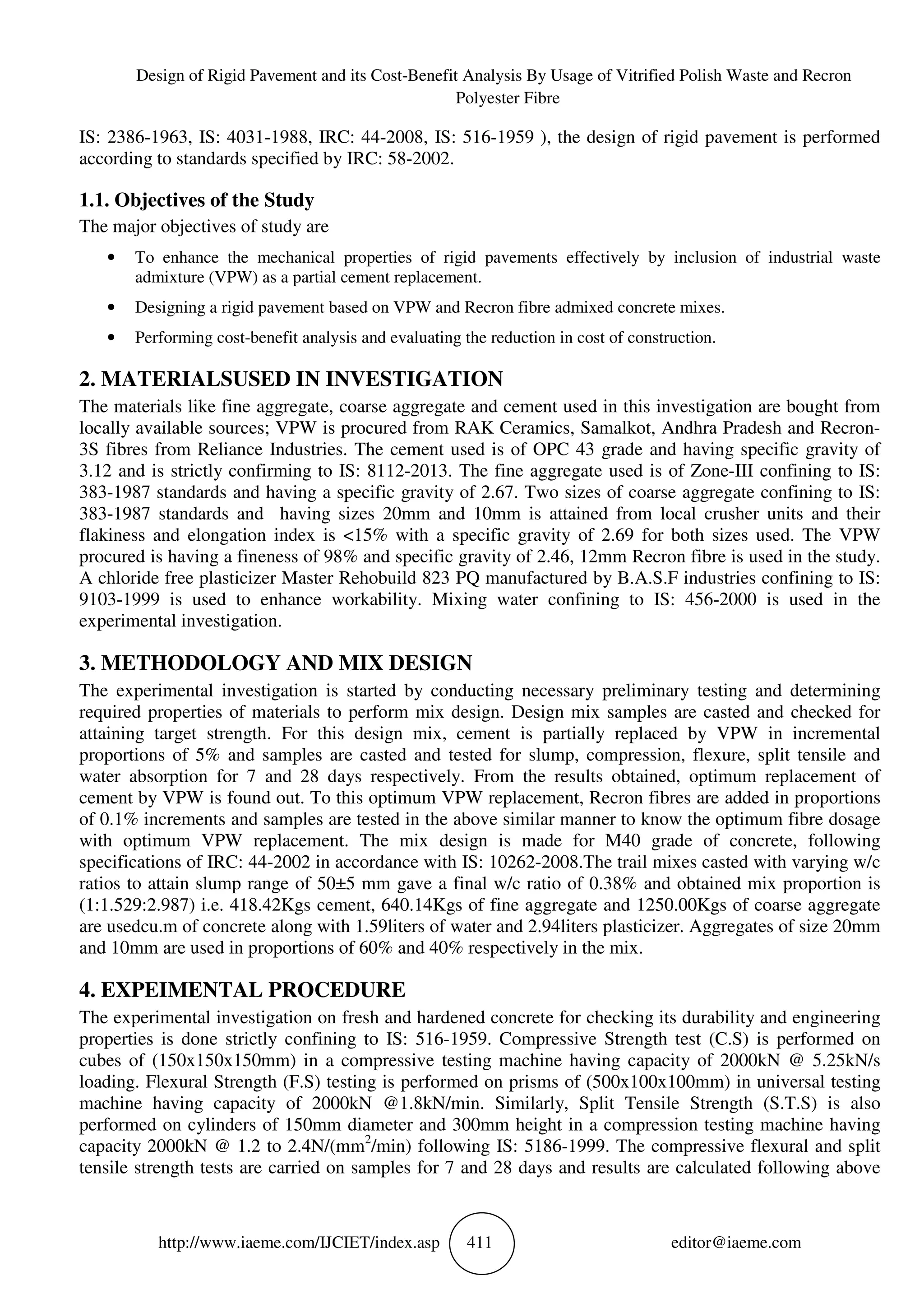
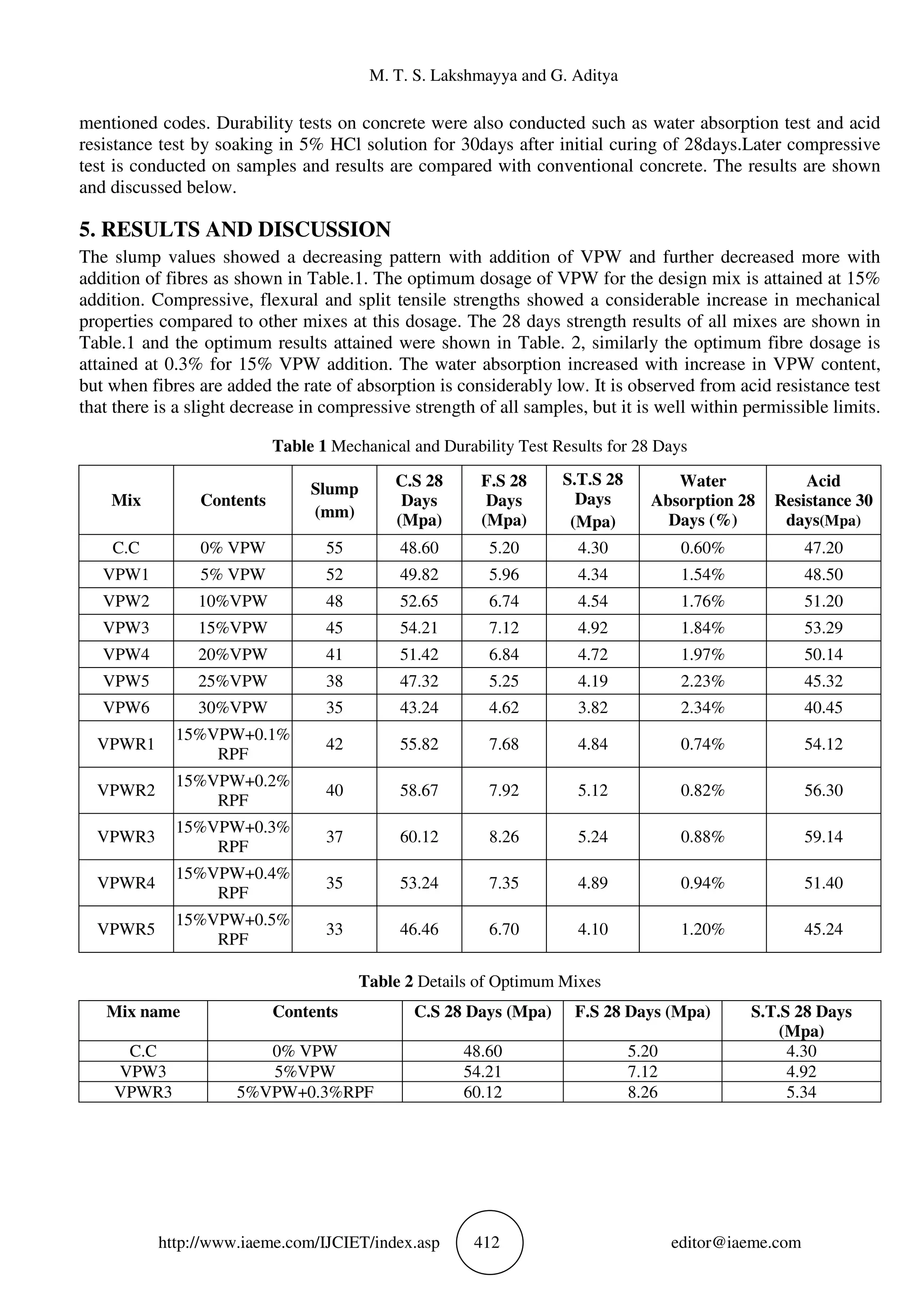
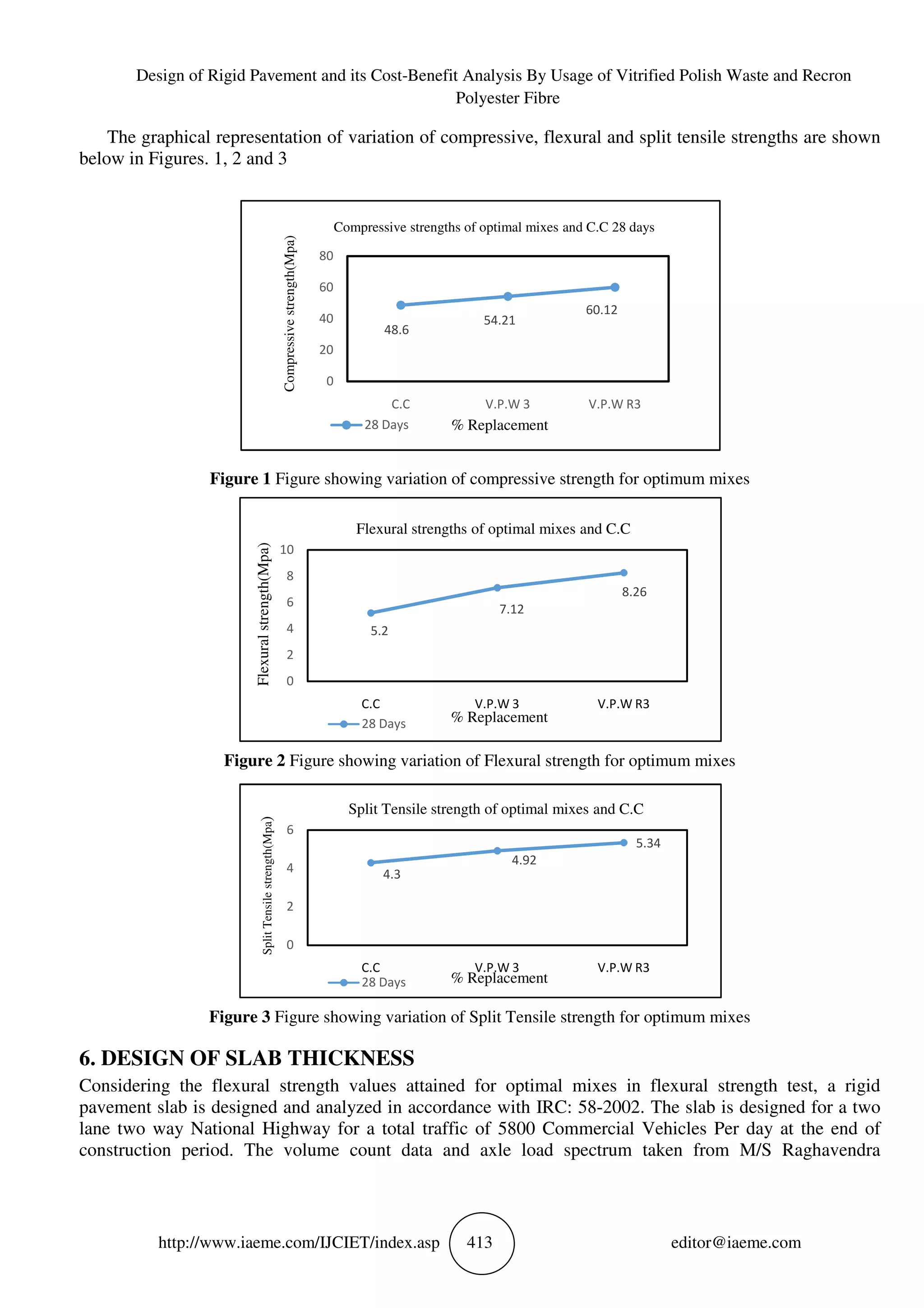
addition. Compressive, flexural and split tensile strengths showed a considerable increase in mechanical
properties compared to other mixes at this dosage. The 28 days strength results of all mixes are shown in
Table.1 and the optimum results attained were shown in Table. 2, similarly the optimum fibre dosage is
attained at 0.3% for 15% VPW addition. The water absorption increased with increase in VPW content,
but when fibres are added the rate of absorption is considerably low. It is observed from acid resistance test
that there is a slight decrease in compressive strength of all samples, but it is well within permissible limits.
Table 1 Mechanical and Durability Test Results for 28 Days
Mix Contents
Slump
(mm)
C.S 28
Days
(Mpa)
F.S 28
Days
(Mpa)
S.T.S 28
Days
(Mpa)
Water
Absorption 28
Days (%)
Acid
Resistance 30
days(Mpa)
C.C 0% VPW 55 48.60 5.20 4.30 0.60% 47.20
VPW1 5% VPW 52 49.82 5.96 4.34 1.54% 48.50
VPW2 10%VPW 48 52.65 6.74 4.54 1.76% 51.20
VPW3 15%VPW 45 54.21 7.12 4.92 1.84% 53.29
VPW4 20%VPW 41 51.42 6.84 4.72 1.97% 50.14
VPW5 25%VPW 38 47.32 5.25 4.19 2.23% 45.32
VPW6 30%VPW 35 43.24 4.62 3.82 2.34% 40.45
VPWR1
15%VPW+0.1%
RPF
42 55.82 7.68 4.84 0.74% 54.12
VPWR2
15%VPW+0.2%
RPF
40 58.67 7.92 5.12 0.82% 56.30
VPWR3
15%VPW+0.3%
RPF
37 60.12 8.26 5.24 0.88% 59.14
VPWR4
15%VPW+0.4%
RPF
35 53.24 7.35 4.89 0.94% 51.40
VPWR5
15%VPW+0.5%
RPF
33 46.46 6.70 4.10 1.20% 45.24
Table 2 Details of Optimum Mixes
Mix name Contents C.S 28 Days (Mpa) F.S 28 Days (Mpa) S.T.S 28 Days
(Mpa)
C.C 0% VPW 48.60 5.20 4.30
VPW3 5%VPW 54.21 7.12 4.92
VPWR3 5%VPW+0.3%RPF 60.12 8.26 5.34
Design of Rigid Pavement and its Cost-Benefit Analysis By Usage of Vitrified Polish Waste and Recron
Polyester Fibre
http://www.iaeme.com/IJCIET/index.asp 413 editor@iaeme.com
The graphical representation of variation of compressive, flexural and split tensile strengths are shown
below in Figures. 1, 2 and 3
Figure 1 Figure showing variation of compressive strength for optimum mixes
Figure 2 Figure showing variation of Flexural strength for optimum mixes
Figure 3 Figure showing variation of Split Tensile strength for optimum mixes
6. DESIGN OF SLAB THICKNESS
Considering the flexural strength values attained for optimal mixes in flexural strength test, a rigid
pavement slab is designed and analyzed in accordance with IRC: 58-2002. The slab is designed for a two
lane two way National Highway for a total traffic of 5800 Commercial Vehicles Per day at the end of
construction period. The volume count data and axle load spectrum taken from M/S Raghavendra
48.6
54.21
60.12
0
20
40
60
80
C.C V.P.W 3 V.P.W R3
Compressivestrength(Mpa)
% Replacement
Compressive strengths of optimal mixes and C.C 28 days
28 Days
5.2
7.12
8.26
0
2
4
6
8
10
C.C V.P.W 3 V.P.W R3
Flexuralstrength(Mpa)
% Replacement
Flexural strengths of optimal mixes and C.C
28 Days
4.3
4.92
5.34
0
2
4
6
C.C V.P.W 3 V.P.W R3
SplitTensilestrength(Mpa)
% Replacement
Split Tensile strength of optimal mixes and C.C
28 Days
M. T. S. Lakshmayya and G. Aditya
http://www.iaeme.com/IJCIET/index.asp 414 editor@iaeme.com
Constructions, Chilakaluripeta. The design parameters and design for C.C and optimum mixes VPW3 and
VPWR3 are detailed below
6.1. Design Data
Effective modulus of subgrade reaction of = 8 kg/cm3
the DLC sub-base
Elastic modulus of concrete = 3×10⁵
kg/ cm2
Poisson’s ratio = 0.15
Coefficient of thermal expansion of concrete = 10×10-6
/0
C
Tyre pressure = 8 kg/cm2
Rate of traffic increase = 0.075
Spacing of contrction joints = 4.5 m
Width of slab = 3.5 m
Design life = 30 years
Present traffic = 5800 cvpd
Wheel load (P) = 10200 kg
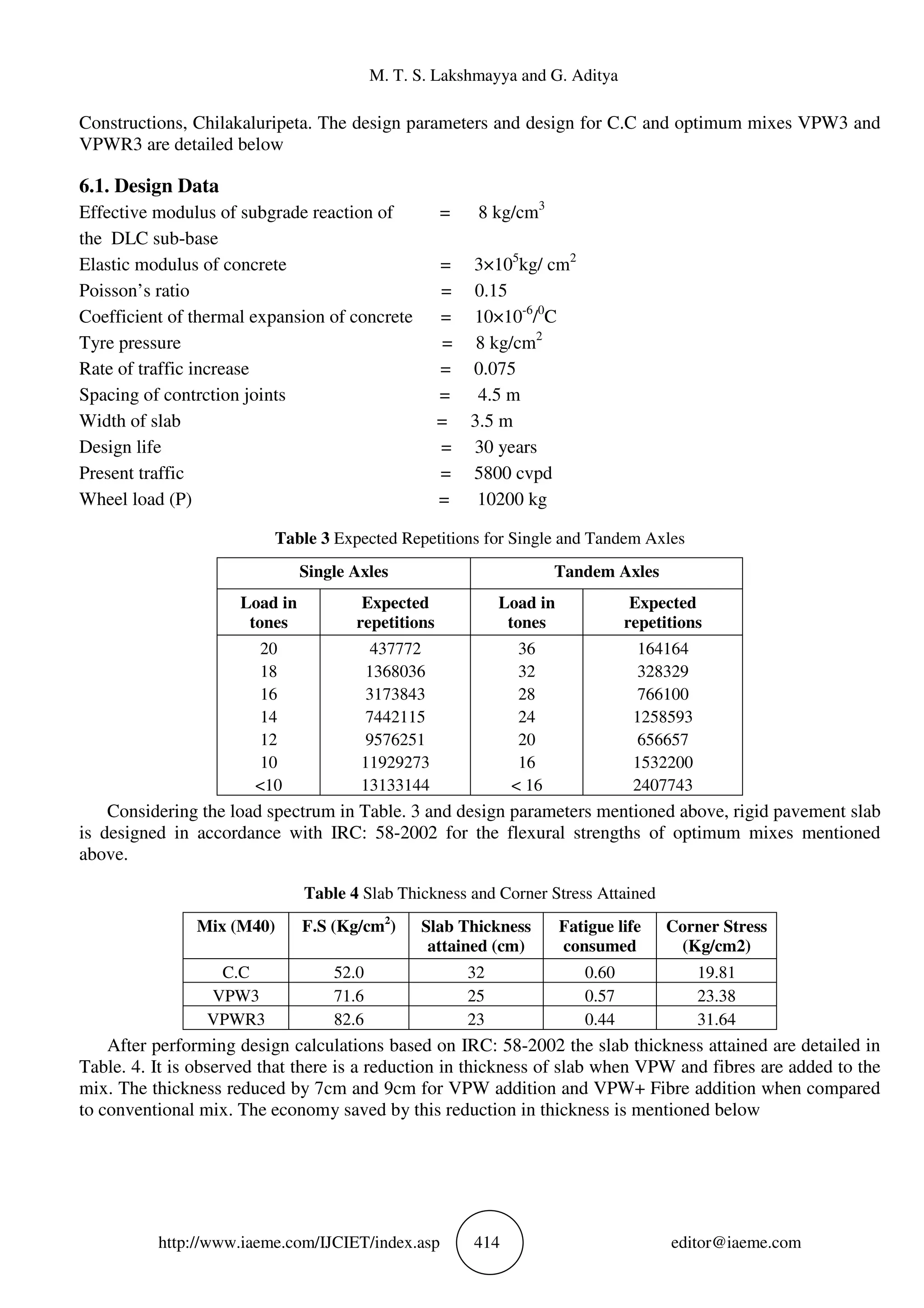
Table 3 Expected Repetitions for Single and Tandem Axles
Single Axles Tandem Axles
Load in
tones
Expected
repetitions
Load in
tones
Expected
repetitions
20
18
16
14
12
10
<10
437772
1368036
3173843
7442115
9576251
11929273
13133144
36
32
28
24
20
16
< 16
164164
328329
766100
1258593
656657
1532200
2407743
Considering the load spectrum in Table. 3 and design parameters mentioned above, rigid pavement slab
is designed in accordance with IRC: 58-2002 for the flexural strengths of optimum mixes mentioned
above.
Table 4 Slab Thickness and Corner Stress Attained
Mix (M40) F.S (Kg/cm2
) Slab Thickness
attained (cm)
Fatigue life
consumed
Corner Stress
(Kg/cm2)
C.C 52.0 32 0.60 19.81
VPW3 71.6 25 0.57 23.38
VPWR3 82.6 23 0.44 31.64
After performing design calculations based on IRC: 58-2002 the slab thickness attained are detailed in
Table. 4. It is observed that there is a reduction in thickness of slab when VPW and fibres are added to the
mix. The thickness reduced by 7cm and 9cm for VPW addition and VPW+ Fibre addition when compared
to conventional mix. The economy saved by this reduction in thickness is mentioned below
Design of Rigid Pavement and its Cost-Benefit Analysis By Usage of Vitrified Polish Waste and Recron
Polyester Fibre
http://www.iaeme.com/IJCIET/index.asp 415 editor@iaeme.com
7. COST-BENIFIT ANALYSIS
Construction costs are estimated in terms of cu.m and comparative statements of costs and materials are
prepared for conventional concrete, VPW3 and VPWR3 mixes.
These rates are taken in to account on the basis of present construction rates in Visakhapatnam and rates
are collected by conducting a survey to the construction sites, builders and material suppliers.
Table 5 Item rates
S.no. Material Cost in INR/Kg
1 Cement 5.80
2 V.P.W 0.12
3 C.A (20mm) 0.87
4 C.A (10mm) 0.65
5 Fine aggregate 0.45
6 Fiber 130
7 Super plasticizer 60
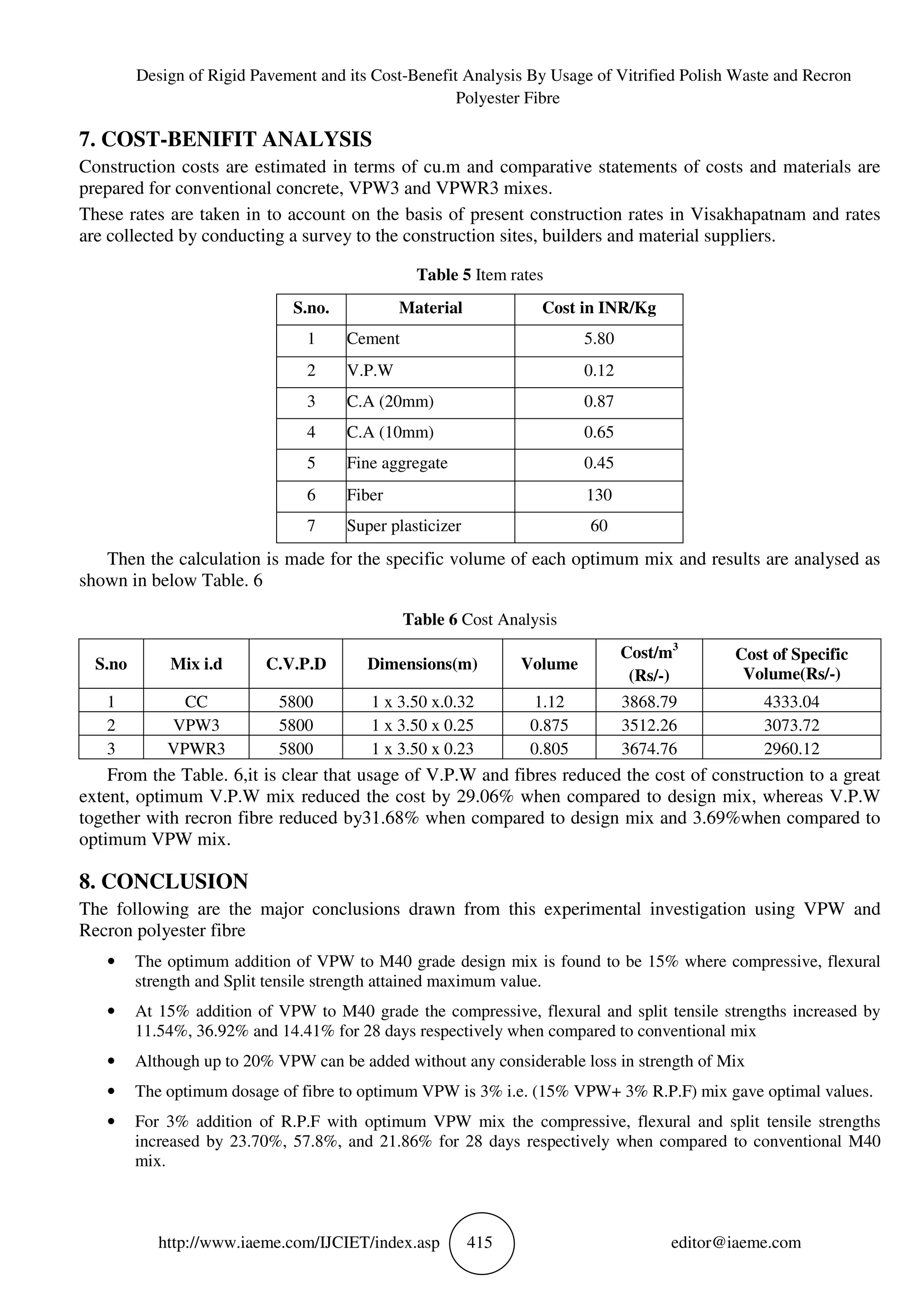
Then the calculation is made for the specific volume of each optimum mix and results are analysed as
shown in below Table. 6
Table 6 Cost Analysis
S.no Mix i.d C.V.P.D Dimensions(m) Volume
Cost/m3
(Rs/-)
Cost of Specific
Volume(Rs/-)
1 CC 5800 1 x 3.50 x.0.32 1.12 3868.79 4333.04
2 VPW3 5800 1 x 3.50 x 0.25 0.875 3512.26 3073.72
3 VPWR3 5800 1 x 3.50 x 0.23 0.805 3674.76 2960.12
From the Table. 6,it is clear that usage of V.P.W and fibres reduced the cost of construction to a great
extent, optimum V.P.W mix reduced the cost by 29.06% when compared to design mix, whereas V.P.W
together with recron fibre reduced by31.68% when compared to design mix and 3.69%when compared to
optimum VPW mix.
8. CONCLUSION
The following are the major conclusions drawn from this experimental investigation using VPW and
Recron polyester fibre
• The optimum addition of VPW to M40 grade design mix is found to be 15% where compressive, flexural
strength and Split tensile strength attained maximum value.
• At 15% addition of VPW to M40 grade the compressive, flexural and split tensile strengths increased by
11.54%, 36.92% and 14.41% for 28 days respectively when compared to conventional mix
• Although up to 20% VPW can be added without any considerable loss in strength of Mix
• The optimum dosage of fibre to optimum VPW is 3% i.e. (15% VPW+ 3% R.P.F) mix gave optimal values.
• For 3% addition of R.P.F with optimum VPW mix the compressive, flexural and split tensile strengths
increased by 23.70%, 57.8%, and 21.86% for 28 days respectively when compared to conventional M40
mix.
M. T. S. Lakshmayya and G. Aditya
http://www.iaeme.com/IJCIET/index.asp 416 editor@iaeme.com
• The compressive and flexural strengths of optimum VPW mix with 3% R.P.F increased by 10.9% and 16%
for 28 days when compared to VPW optimum mix without fibres.
• The workability of the mix decreased gradually because of VPW addition and when further fibre is added to
mix, workability decreased even more
• There is a nominal reduction in compressive strength in HCl resistance test which is in permissible limits
• The water absorption increased considerably with increase in VPW addition, when fibres are added to
optimum VPW this increased further.
• The thickness of pavement attained for mixes CC, VPW3, VPWR3 are 32, 25 and 23 cm respectively
• Cost of construction decreased when compared to design mix for VPW3 and VPWR3
• The environmental disposal problem of industrial wastes can be tackled. There by leading to sustainable and
eco- friendly pavement construction.
9. ACKNOWLEDGEMENTS
I humbly express my profound gratitude to my guide M.T.S. Lakshmayya for his guidance and my parents
for their support during the course of study. I would also like to thank the H.O.D, faculty members and lab
technicians, department of civil engineering, GMRIT for their cooperation
REFERENCES
[1] Luiz Renato, Steiner Adriano et.al,”Effectiveness of ceramic tile polishing residues as supplementary
cementitious materials for cement mortars", The Journal Of Sustainable Materials And
Technologies,vol.4,pp-30-35,April 2014.
[2] Jay Patel, B.K. Shah, P.J. Patel, “Ceramic Powder in Concrete by Partial Replacement of Cement- A
Literature Analysis”, Journal of International Academic Research for Multi-Disciplinary, Vol-2, Isuue-3,
April- 2014, ISSN-2320-5083
[3] Fatima, Electricwala, Ankit Jhamb, and Rakesh Kumar. "Ceramic Dust as Construction Material in
Rigid Pavement." American Journal of Civil Engineering and Architecture 1.5 (2013): 112-116.
[4] Ponnapati Manogna, M. Sri Lakshmi, “Tile Powder as Partial Replacement of Cement in Concrete”,
International Research Journal of Engineering and Technology, Vol-2, Issue-4, July-2015, e- ISSN-
2395-0056.
[5] Abhinav.S.Pawar,K.R.Dabhekar,”Study of Concrete based Pavement by using Fibres and Cementing
Waste Materials” International Journal of Research in Engineering and Technology,Vol-3,issue-5,May-
2014.
[6] Nandish S.C,Ajith B.T et.al,”Impact of Coconut Fibre and Polypropylene Fibre (Recron 3s) on
Concrete Mix Including Admixture” International Journal Of Engineering Research And Technology,
ISSN: 2278-018,vol.4,issue 6,June 2015
[7] Mehul. J. Patel, S. M. Kulkarni, “Effect of Polypropylene Fibre on High Strength Concrete”, Journal of
Information, Knowledge and Research in Civil Engineering”, Vol-2, Issue -2, October- 2013, ISSN-
0975-6744.
[8] Vipul. D. Prajapathi, Nilay Joshi, Jayesh Kumar Pitroda, “Techno- Economical Study of Rigid
Pavements by Usage of Used Foundry Sand”, International Journal of Engineering Trends and
Technology, Vol-4, Issue-5, May-2013, ISSN-2321-5381
[9] VenkataSairam Kumar, Dr.B.Panduranga Rao, Krishna Sai M.L.N,” Experimental study on partial
replacement of cement with quarry dust, International Journal of Advanced Engineering Research and
Studies E-ISSN: 2249–8974. IS: 2720 (Part - 16)-1979, "Laboratory determination of CBR". June 2013.
[10] R. Srinivasan, K. Sathiya, “Experimental Study of Bagasse ash in Concrete”, international Journal for
Service Learning in Engineering, Vol. 5, No. 2, pp. 60-66, Fall 2010, ISSN 1555-9033.
Design of Rigid Pavement and its Cost-Benefit Analysis By Usage of Vitrified Polish Waste and Recron
Polyester Fibre
http://www.iaeme.com/IJCIET/index.asp 417 editor@iaeme.com
[11] Dhillon. Ramandeep, Sharma. Shruti et.al, “Effect steel and polypropylene fibres on fly ash concrete”,
International Journal of Research in Advent Technology, Vol. 2, No. 3, March 2014, E-ISSN: 2321-
9637
[12] Bibha Kumari and Vikas Srivastava, Effect of Waste Plastic and Fly Ash on Mechanical Properties of
Rigid Pavement. International Journal of Civil Engineering and Technology (IJCIET), 7(5), 2016,
pp.247–256.
[13] Shaik. Allimran Tippu, Vr. Prasanth Kumar, “A study on effect of silica fume on mechanical properties
of light weight coconut shell concrete”, International Journal of Research in Engineering and
Technology, Vol-4, Issue-4, April 2015, E-ISSN: 2319-1163
[14] IS: 10262-2009, “Recommended guidelines for concrete mix design, Bureau of Indian standards”, New
Delhi, India.
[15] IS 456 -2000, “Code of Practice for Plain and Reinforced Concrete”, Bureau of Indian Standards, New
Delhi.
[16] IS: 2386-1963, “Methods of testing aggregate for concrete”.
[17] IS: 4031-1988, “Code for physical tests on O.P.C”.
[18] IRC: 44-2008, “Recommended guidelines for mix design of Cement Concrete Pavements”
[19] IS: 516-1959, “Indian standard methods of tests for strength of concrete, Bureau of Indian Standards”,
New Delhi, India
[20] IRC: 58-2002, “Guide lines for the design of plain jointed Rigid Pavements for the Highways”.
[21] IS: 8112-2013, “Indian standard specifications for OPC 43 grade cement”.
[22] IS: 383-1987, “Indian standard specifications for coarse and fine aggregate from natural sources for
concrete”.
[23] IS: 9103-1999, “ Indian standard specifications for concrete admixtures”
[24] Messi Alfred François, Mamba Mpele, Tchoumi Dany Franky, Koumbe Mbock and Okpwe Mbarga
Richard, Multiple Correlations between Physical Properties of Lateric Soils for Pavement Design.
International Journal of Civil Engineering and Technology (IJCIET), 7(5), 2016, pp.485 – 499

DESIGN OF RIGID PAVEMENT AND ITS COST-BENEFIT ANALYSIS BY USAGE OF VITRIFIED POLISH WASTE AND RECRON POLYESTER FIBRE

  • 1.
    http://www.iaeme.com/IJCIET/index.asp 409 editor@iaeme.com InternationalJournal of Civil Engineering and Technology (IJCIET) Volume 8, Issue 1, January 2017, pp. 409–417, Article ID: IJCIET_08_01_046 Available online at http://www.iaeme.com/IJCIET/issues.asp?JType=IJCIET&VType=8&IType=1 ISSN Print: 0976-6308 and ISSN Online: 0976-6316 © IAEME Publication DESIGN OF RIGID PAVEMENT AND ITS COST- BENEFIT ANALYSIS BY USAGE OF VITRIFIED POLISH WASTE AND RECRON POLYESTER FIBRE M. T. S. Lakshmayya Civil Engineering Department, G.M. R. Institute of Technology, Rajam, Andhra Pradesh, India G. Aditya Civil Engineering Department, G. M. R. Institute of Technology, Rajam, Andhra Pradesh, India ABSTRACT A country can achieve sustainable and rapid growth in all fields by improving its connectivity and transit systems. Connectivity of people to resources by improved transit mechanism results in improved living standards. Apart from other means, the major part of connectivity of any country is through road systems. Well designed and maintained pavements provide better and long lasting service. In India, all the major road systems are designed as flexible pavements only, because of their ease of construction and less time it takes to be opened to traffic operations. The major problem with flexible pavements is their design life and high maintenance costs. Also, globally reducing petrol reserves, which are used for bitumen and asphalt production are also increasing the need for alternatives. To tackle these problems, rigid pavements can be constructed. Although the cost of construction of rigid pavements is high, its long life, high load carrying capabilities and low maintenance cost will balance the initial cost aspect. Recently, many studies are being conducted on different pozzolanic admixtures which can be used as partial replacement of cement in rigid pavements, thereby reducing its cost and enhancing properties of the mix. Here, an attempt is made to reduce the construction cost of rigid pavements by incorporating Vitrified Polish Waste (VPW) as partial cement replacement in proportions of 5% for M40 grade concrete. Further, to enhance flexural properties of pavement, Recron fibre is added to optimum VPW in increments of 0.1%, then after C.C pavement is designed for two lane two way national highway and cost benefit analysis is performed. Key words: Vitrified Polish Waste (VPW),Recron, Rigid Pavement Design, Cost-Benefit Analysis Cite this Article: M. T. S. Lakshmayya and G. Aditya, Design of Rigid Pavement and its Cost- Benefit Analysis By Usage of Vitrified Polish Waste and Recron Polyester Fibre. International Journal of Civil Engineering and Technology, 8(1), 2017, pp. 409–417. http://www.iaeme.com/IJCIET/issues.asp?JType=IJCIET&VType=8&IType=1
  • 2.
    M. T. S.Lakshmayya and G. Aditya http://www.iaeme.com/IJCIET/index.asp 410 editor@iaeme.com 1. INTRODUCTION After understanding the importance and necessity of rigid pavement construction many researches and studies are conducted in this aspect. The studies mainly focused on improvement of mechanical and durability properties of concrete by usage of various additives, admixtures and fibres to concrete mix. These admixtures are used as partial or full replacement of cement along or without fibres. The fibres used are also available in different types like steel, glass etc. Studies are also conducted on them individually as well as compositely.Luiz Renato, Steiner Adriano et.al [2001] studied, the properties of sludge obtained from polishing of ceramic tiles. X-ray diffraction, X-ray fluorescence, laser diffraction and several other tests were conducted to study physical and chemical properties of this sludge. Also, recommended its usage as Supplementary Cementious Material (SCM) in various engineering constructions. Jay Patel, B.K. Shahet.al [2014] in his literature analysis about ceramic waste inclusion in concrete making concluded that, ceramic products have good pozzolanic activity because of their manufacturing temperature and its usage is good for economy and environment. He also concluded that, cost of construction can be reduced by 20- 30% for higher grades of concrete by its usage. Electricwala Fatima, Ankit Jhamb, Rakesh Kumar et al [2013] have investigated on M35 grade of concrete by replacing up to 30% of cement with ceramic dust and observed an increment in compressive strength, flexural strength. The results showed an increase in compressive strength by 3.9% to 5.6% by replacing 20% cement content with ceramic dust. Ponnapati Manogna, M. Sri Lakshmi [2015] investigated on partial replacement of cement by tile waste in M30 grade of concrete in increments of 10% up to 50%.Compressive, tensile and flexural strength tests were conducted for 7, 28 and 56 days respectively and suggested that a replacement up to 30% can be made without compromising on design strength. However, optimum results for compression,tension and flexure strength were attained at 10% replacement. Abhinav. S. Pawar, K.R. Dhabekar [2014] investigated on addition of waste material (GGBS) and steel fibresin M40 grade concrete for rigid pavement and compared with normal concrete of M40 grade.After testing it was found that, 30% GGBS is the optimum replacement for M40 grade of concrete but, flexural strength decreased by increasing percentage of GGBS, so as to increase flexural strength, steel fibres of two different aspect ratios (7560 & 7530) were used. Steel fibres were added in concrete by 1% of total weight of concrete with different proportions. Nandish S.C, Ajith B.T et.al [2015] studied about strength enhancement of conventional concrete with addition of Coconut fibres and polypropylene fibres. The coconut fibres of various proportions like 1%, 1.5%, 2%, 2.5% and polypropylene fibres of proportions of 0.4% by volume of concrete were used in the M40 grade concrete mix tests to determine the mechanical properties of concrete up to 7, 28, 56 and 90 days. Use of fibres tends to enhance the flexural strength of the mix. Fibre mixed concrete has higher value than that of the control mix. For 2.0%CF and 0.4%PF of fiber, flexural strength found to be 14% higher than that of control mix concrete. Mehul. J. Patel, S. M. Kulkarni [2013] studied effects of poly propylene fibres on M40 grade of concrete by adding in proportions of 0.5%, 1%, and 1.5% and investigated for compressive, flexural and split tensile strengths and reported an increase in above parameters when compared to conventional concrete. Vipul. D. Prajapathi, Nilay Joshi et.al [2013] experimented on usage of fine aggregate replaced by used foundry sand in proportions of 0%, 10%, 30% and 50% for M20 grade of concrete and studied their mechanical properties. He concluded that, maximum compressive and flexural strengths are achieved at 50% replacement of natural fine aggregate with used foundry sand and designed a pavement for 3000CVPD flow. As a part of such studies, usage of Vitrified Polish Waste (VPW) along with recron polyester fibre is studied in this experimental investigation. Ceramic industry is extensively growing with the infrastructural needs of the present world and waste generated is also increasing rapidly there by incorporating these wastes in pavement construction will also help environmentally. A good study on Indian standard codes for laboratory sampling, and testing of concrete and materials used is also done before proceeding into testing phase, which includes the following codes (IS: 10262-2009 , IS: 456-2000 ,
  • 3.
    Design of RigidPavement and its Cost-Benefit Analysis By Usage of Vitrified Polish Waste and Recron Polyester Fibre http://www.iaeme.com/IJCIET/index.asp 411 editor@iaeme.com IS: 2386-1963, IS: 4031-1988, IRC: 44-2008, IS: 516-1959 ), the design of rigid pavement is performed according to standards specified by IRC: 58-2002. 1.1. Objectives of the Study The major objectives of study are • To enhance the mechanical properties of rigid pavements effectively by inclusion of industrial waste admixture (VPW) as a partial cement replacement. • Designing a rigid pavement based on VPW and Recron fibre admixed concrete mixes. • Performing cost-benefit analysis and evaluating the reduction in cost of construction. 2. MATERIALSUSED IN INVESTIGATION The materials like fine aggregate, coarse aggregate and cement used in this investigation are bought from locally available sources; VPW is procured from RAK Ceramics, Samalkot, Andhra Pradesh and Recron- 3S fibres from Reliance Industries. The cement used is of OPC 43 grade and having specific gravity of 3.12 and is strictly confirming to IS: 8112-2013. The fine aggregate used is of Zone-III confining to IS: 383-1987 standards and having a specific gravity of 2.67. Two sizes of coarse aggregate confining to IS: 383-1987 standards and having sizes 20mm and 10mm is attained from local crusher units and their flakiness and elongation index is <15% with a specific gravity of 2.69 for both sizes used. The VPW procured is having a fineness of 98% and specific gravity of 2.46, 12mm Recron fibre is used in the study. A chloride free plasticizer Master Rehobuild 823 PQ manufactured by B.A.S.F industries confining to IS: 9103-1999 is used to enhance workability. Mixing water confining to IS: 456-2000 is used in the experimental investigation. 3. METHODOLOGY AND MIX DESIGN The experimental investigation is started by conducting necessary preliminary testing and determining required properties of materials to perform mix design. Design mix samples are casted and checked for attaining target strength. For this design mix, cement is partially replaced by VPW in incremental proportions of 5% and samples are casted and tested for slump, compression, flexure, split tensile and water absorption for 7 and 28 days respectively. From the results obtained, optimum replacement of cement by VPW is found out. To this optimum VPW replacement, Recron fibres are added in proportions of 0.1% increments and samples are tested in the above similar manner to know the optimum fibre dosage with optimum VPW replacement. The mix design is made for M40 grade of concrete, following specifications of IRC: 44-2002 in accordance with IS: 10262-2008.The trail mixes casted with varying w/c ratios to attain slump range of 50±5 mm gave a final w/c ratio of 0.38% and obtained mix proportion is (1:1.529:2.987) i.e. 418.42Kgs cement, 640.14Kgs of fine aggregate and 1250.00Kgs of coarse aggregate are usedcu.m of concrete along with 1.59liters of water and 2.94liters plasticizer. Aggregates of size 20mm and 10mm are used in proportions of 60% and 40% respectively in the mix. 4. EXPEIMENTAL PROCEDURE The experimental investigation on fresh and hardened concrete for checking its durability and engineering properties is done strictly confining to IS: 516-1959. Compressive Strength test (C.S) is performed on cubes of (150x150x150mm) in a compressive testing machine having capacity of 2000kN @ 5.25kN/s loading. Flexural Strength (F.S) testing is performed on prisms of (500x100x100mm) in universal testing machine having capacity of 2000kN @1.8kN/min. Similarly, Split Tensile Strength (S.T.S) is also performed on cylinders of 150mm diameter and 300mm height in a compression testing machine having capacity 2000kN @ 1.2 to 2.4N/(mm2 /min) following IS: 5186-1999. The compressive flexural and split tensile strength tests are carried on samples for 7 and 28 days and results are calculated following above
  • 4.
    M. T. S.Lakshmayya and G. Aditya http://www.iaeme.com/IJCIET/index.asp 412 editor@iaeme.com mentioned codes. Durability tests on concrete were also conducted such as water absorption test and acid resistance test by soaking in 5% HCl solution for 30days after initial curing of 28days.Later compressive test is conducted on samples and results are compared with conventional concrete. The results are shown and discussed below. 5. RESULTS AND DISCUSSION The slump values showed a decreasing pattern with addition of VPW and further decreased more with addition of fibres as shown in Table.1. The optimum dosage of VPW for the design mix is attained at 15% addition. Compressive, flexural and split tensile strengths showed a considerable increase in mechanical properties compared to other mixes at this dosage. The 28 days strength results of all mixes are shown in Table.1 and the optimum results attained were shown in Table. 2, similarly the optimum fibre dosage is attained at 0.3% for 15% VPW addition. The water absorption increased with increase in VPW content, but when fibres are added the rate of absorption is considerably low. It is observed from acid resistance test that there is a slight decrease in compressive strength of all samples, but it is well within permissible limits. Table 1 Mechanical and Durability Test Results for 28 Days Mix Contents Slump (mm) C.S 28 Days (Mpa) F.S 28 Days (Mpa) S.T.S 28 Days (Mpa) Water Absorption 28 Days (%) Acid Resistance 30 days(Mpa) C.C 0% VPW 55 48.60 5.20 4.30 0.60% 47.20 VPW1 5% VPW 52 49.82 5.96 4.34 1.54% 48.50 VPW2 10%VPW 48 52.65 6.74 4.54 1.76% 51.20 VPW3 15%VPW 45 54.21 7.12 4.92 1.84% 53.29 VPW4 20%VPW 41 51.42 6.84 4.72 1.97% 50.14 VPW5 25%VPW 38 47.32 5.25 4.19 2.23% 45.32 VPW6 30%VPW 35 43.24 4.62 3.82 2.34% 40.45 VPWR1 15%VPW+0.1% RPF 42 55.82 7.68 4.84 0.74% 54.12 VPWR2 15%VPW+0.2% RPF 40 58.67 7.92 5.12 0.82% 56.30 VPWR3 15%VPW+0.3% RPF 37 60.12 8.26 5.24 0.88% 59.14 VPWR4 15%VPW+0.4% RPF 35 53.24 7.35 4.89 0.94% 51.40 VPWR5 15%VPW+0.5% RPF 33 46.46 6.70 4.10 1.20% 45.24 Table 2 Details of Optimum Mixes Mix name Contents C.S 28 Days (Mpa) F.S 28 Days (Mpa) S.T.S 28 Days (Mpa) C.C 0% VPW 48.60 5.20 4.30 VPW3 5%VPW 54.21 7.12 4.92 VPWR3 5%VPW+0.3%RPF 60.12 8.26 5.34
  • 5.
    Design of RigidPavement and its Cost-Benefit Analysis By Usage of Vitrified Polish Waste and Recron Polyester Fibre http://www.iaeme.com/IJCIET/index.asp 413 editor@iaeme.com The graphical representation of variation of compressive, flexural and split tensile strengths are shown below in Figures. 1, 2 and 3 Figure 1 Figure showing variation of compressive strength for optimum mixes Figure 2 Figure showing variation of Flexural strength for optimum mixes Figure 3 Figure showing variation of Split Tensile strength for optimum mixes 6. DESIGN OF SLAB THICKNESS Considering the flexural strength values attained for optimal mixes in flexural strength test, a rigid pavement slab is designed and analyzed in accordance with IRC: 58-2002. The slab is designed for a two lane two way National Highway for a total traffic of 5800 Commercial Vehicles Per day at the end of construction period. The volume count data and axle load spectrum taken from M/S Raghavendra 48.6 54.21 60.12 0 20 40 60 80 C.C V.P.W 3 V.P.W R3 Compressivestrength(Mpa) % Replacement Compressive strengths of optimal mixes and C.C 28 days 28 Days 5.2 7.12 8.26 0 2 4 6 8 10 C.C V.P.W 3 V.P.W R3 Flexuralstrength(Mpa) % Replacement Flexural strengths of optimal mixes and C.C 28 Days 4.3 4.92 5.34 0 2 4 6 C.C V.P.W 3 V.P.W R3 SplitTensilestrength(Mpa) % Replacement Split Tensile strength of optimal mixes and C.C 28 Days
  • 6.
    M. T. S.Lakshmayya and G. Aditya http://www.iaeme.com/IJCIET/index.asp 414 editor@iaeme.com Constructions, Chilakaluripeta. The design parameters and design for C.C and optimum mixes VPW3 and VPWR3 are detailed below 6.1. Design Data Effective modulus of subgrade reaction of = 8 kg/cm3 the DLC sub-base Elastic modulus of concrete = 3×10⁵ kg/ cm2 Poisson’s ratio = 0.15 Coefficient of thermal expansion of concrete = 10×10-6 /0 C Tyre pressure = 8 kg/cm2 Rate of traffic increase = 0.075 Spacing of contrction joints = 4.5 m Width of slab = 3.5 m Design life = 30 years Present traffic = 5800 cvpd Wheel load (P) = 10200 kg Table 3 Expected Repetitions for Single and Tandem Axles Single Axles Tandem Axles Load in tones Expected repetitions Load in tones Expected repetitions 20 18 16 14 12 10 <10 437772 1368036 3173843 7442115 9576251 11929273 13133144 36 32 28 24 20 16 < 16 164164 328329 766100 1258593 656657 1532200 2407743 Considering the load spectrum in Table. 3 and design parameters mentioned above, rigid pavement slab is designed in accordance with IRC: 58-2002 for the flexural strengths of optimum mixes mentioned above. Table 4 Slab Thickness and Corner Stress Attained Mix (M40) F.S (Kg/cm2 ) Slab Thickness attained (cm) Fatigue life consumed Corner Stress (Kg/cm2) C.C 52.0 32 0.60 19.81 VPW3 71.6 25 0.57 23.38 VPWR3 82.6 23 0.44 31.64 After performing design calculations based on IRC: 58-2002 the slab thickness attained are detailed in Table. 4. It is observed that there is a reduction in thickness of slab when VPW and fibres are added to the mix. The thickness reduced by 7cm and 9cm for VPW addition and VPW+ Fibre addition when compared to conventional mix. The economy saved by this reduction in thickness is mentioned below
  • 7.
    Design of RigidPavement and its Cost-Benefit Analysis By Usage of Vitrified Polish Waste and Recron Polyester Fibre http://www.iaeme.com/IJCIET/index.asp 415 editor@iaeme.com 7. COST-BENIFIT ANALYSIS Construction costs are estimated in terms of cu.m and comparative statements of costs and materials are prepared for conventional concrete, VPW3 and VPWR3 mixes. These rates are taken in to account on the basis of present construction rates in Visakhapatnam and rates are collected by conducting a survey to the construction sites, builders and material suppliers. Table 5 Item rates S.no. Material Cost in INR/Kg 1 Cement 5.80 2 V.P.W 0.12 3 C.A (20mm) 0.87 4 C.A (10mm) 0.65 5 Fine aggregate 0.45 6 Fiber 130 7 Super plasticizer 60 Then the calculation is made for the specific volume of each optimum mix and results are analysed as shown in below Table. 6 Table 6 Cost Analysis S.no Mix i.d C.V.P.D Dimensions(m) Volume Cost/m3 (Rs/-) Cost of Specific Volume(Rs/-) 1 CC 5800 1 x 3.50 x.0.32 1.12 3868.79 4333.04 2 VPW3 5800 1 x 3.50 x 0.25 0.875 3512.26 3073.72 3 VPWR3 5800 1 x 3.50 x 0.23 0.805 3674.76 2960.12 From the Table. 6,it is clear that usage of V.P.W and fibres reduced the cost of construction to a great extent, optimum V.P.W mix reduced the cost by 29.06% when compared to design mix, whereas V.P.W together with recron fibre reduced by31.68% when compared to design mix and 3.69%when compared to optimum VPW mix. 8. CONCLUSION The following are the major conclusions drawn from this experimental investigation using VPW and Recron polyester fibre • The optimum addition of VPW to M40 grade design mix is found to be 15% where compressive, flexural strength and Split tensile strength attained maximum value. • At 15% addition of VPW to M40 grade the compressive, flexural and split tensile strengths increased by 11.54%, 36.92% and 14.41% for 28 days respectively when compared to conventional mix • Although up to 20% VPW can be added without any considerable loss in strength of Mix • The optimum dosage of fibre to optimum VPW is 3% i.e. (15% VPW+ 3% R.P.F) mix gave optimal values. • For 3% addition of R.P.F with optimum VPW mix the compressive, flexural and split tensile strengths increased by 23.70%, 57.8%, and 21.86% for 28 days respectively when compared to conventional M40 mix.
  • 8.
    M. T. S.Lakshmayya and G. Aditya http://www.iaeme.com/IJCIET/index.asp 416 editor@iaeme.com • The compressive and flexural strengths of optimum VPW mix with 3% R.P.F increased by 10.9% and 16% for 28 days when compared to VPW optimum mix without fibres. • The workability of the mix decreased gradually because of VPW addition and when further fibre is added to mix, workability decreased even more • There is a nominal reduction in compressive strength in HCl resistance test which is in permissible limits • The water absorption increased considerably with increase in VPW addition, when fibres are added to optimum VPW this increased further. • The thickness of pavement attained for mixes CC, VPW3, VPWR3 are 32, 25 and 23 cm respectively • Cost of construction decreased when compared to design mix for VPW3 and VPWR3 • The environmental disposal problem of industrial wastes can be tackled. There by leading to sustainable and eco- friendly pavement construction. 9. ACKNOWLEDGEMENTS I humbly express my profound gratitude to my guide M.T.S. Lakshmayya for his guidance and my parents for their support during the course of study. I would also like to thank the H.O.D, faculty members and lab technicians, department of civil engineering, GMRIT for their cooperation REFERENCES [1] Luiz Renato, Steiner Adriano et.al,”Effectiveness of ceramic tile polishing residues as supplementary cementitious materials for cement mortars", The Journal Of Sustainable Materials And Technologies,vol.4,pp-30-35,April 2014. [2] Jay Patel, B.K. Shah, P.J. Patel, “Ceramic Powder in Concrete by Partial Replacement of Cement- A Literature Analysis”, Journal of International Academic Research for Multi-Disciplinary, Vol-2, Isuue-3, April- 2014, ISSN-2320-5083 [3] Fatima, Electricwala, Ankit Jhamb, and Rakesh Kumar. "Ceramic Dust as Construction Material in Rigid Pavement." American Journal of Civil Engineering and Architecture 1.5 (2013): 112-116. [4] Ponnapati Manogna, M. Sri Lakshmi, “Tile Powder as Partial Replacement of Cement in Concrete”, International Research Journal of Engineering and Technology, Vol-2, Issue-4, July-2015, e- ISSN- 2395-0056. [5] Abhinav.S.Pawar,K.R.Dabhekar,”Study of Concrete based Pavement by using Fibres and Cementing Waste Materials” International Journal of Research in Engineering and Technology,Vol-3,issue-5,May- 2014. [6] Nandish S.C,Ajith B.T et.al,”Impact of Coconut Fibre and Polypropylene Fibre (Recron 3s) on Concrete Mix Including Admixture” International Journal Of Engineering Research And Technology, ISSN: 2278-018,vol.4,issue 6,June 2015 [7] Mehul. J. Patel, S. M. Kulkarni, “Effect of Polypropylene Fibre on High Strength Concrete”, Journal of Information, Knowledge and Research in Civil Engineering”, Vol-2, Issue -2, October- 2013, ISSN- 0975-6744. [8] Vipul. D. Prajapathi, Nilay Joshi, Jayesh Kumar Pitroda, “Techno- Economical Study of Rigid Pavements by Usage of Used Foundry Sand”, International Journal of Engineering Trends and Technology, Vol-4, Issue-5, May-2013, ISSN-2321-5381 [9] VenkataSairam Kumar, Dr.B.Panduranga Rao, Krishna Sai M.L.N,” Experimental study on partial replacement of cement with quarry dust, International Journal of Advanced Engineering Research and Studies E-ISSN: 2249–8974. IS: 2720 (Part - 16)-1979, "Laboratory determination of CBR". June 2013. [10] R. Srinivasan, K. Sathiya, “Experimental Study of Bagasse ash in Concrete”, international Journal for Service Learning in Engineering, Vol. 5, No. 2, pp. 60-66, Fall 2010, ISSN 1555-9033.
  • 9.
    Design of RigidPavement and its Cost-Benefit Analysis By Usage of Vitrified Polish Waste and Recron Polyester Fibre http://www.iaeme.com/IJCIET/index.asp 417 editor@iaeme.com [11] Dhillon. Ramandeep, Sharma. Shruti et.al, “Effect steel and polypropylene fibres on fly ash concrete”, International Journal of Research in Advent Technology, Vol. 2, No. 3, March 2014, E-ISSN: 2321- 9637 [12] Bibha Kumari and Vikas Srivastava, Effect of Waste Plastic and Fly Ash on Mechanical Properties of Rigid Pavement. International Journal of Civil Engineering and Technology (IJCIET), 7(5), 2016, pp.247–256. [13] Shaik. Allimran Tippu, Vr. Prasanth Kumar, “A study on effect of silica fume on mechanical properties of light weight coconut shell concrete”, International Journal of Research in Engineering and Technology, Vol-4, Issue-4, April 2015, E-ISSN: 2319-1163 [14] IS: 10262-2009, “Recommended guidelines for concrete mix design, Bureau of Indian standards”, New Delhi, India. [15] IS 456 -2000, “Code of Practice for Plain and Reinforced Concrete”, Bureau of Indian Standards, New Delhi. [16] IS: 2386-1963, “Methods of testing aggregate for concrete”. [17] IS: 4031-1988, “Code for physical tests on O.P.C”. [18] IRC: 44-2008, “Recommended guidelines for mix design of Cement Concrete Pavements” [19] IS: 516-1959, “Indian standard methods of tests for strength of concrete, Bureau of Indian Standards”, New Delhi, India [20] IRC: 58-2002, “Guide lines for the design of plain jointed Rigid Pavements for the Highways”. [21] IS: 8112-2013, “Indian standard specifications for OPC 43 grade cement”. [22] IS: 383-1987, “Indian standard specifications for coarse and fine aggregate from natural sources for concrete”. [23] IS: 9103-1999, “ Indian standard specifications for concrete admixtures” [24] Messi Alfred François, Mamba Mpele, Tchoumi Dany Franky, Koumbe Mbock and Okpwe Mbarga Richard, Multiple Correlations between Physical Properties of Lateric Soils for Pavement Design. International Journal of Civil Engineering and Technology (IJCIET), 7(5), 2016, pp.485 – 499