Y.Yaswanth Kumar et al. Int. Journal of Engineering Research and Applications www.ijera.com
ISSN : 2248-9622, Vol. 5, Issue 4, ( Part -6) April 2015, pp.25-31
www.ijera.com 25 | P a g e
Use of Granite Waste as Partial Substitute to Cement in Concrete
Y.Yaswanth Kumar1*
, C.M. Vivek Vardhan1
, A.Anitha1
1
Assistant professor, Annamacharya Institute of Technology and Sciences, Tirupati, Andhra Pradesh
ABSTRACT
With the ever increasing cost of construction materials there is a need to curtail the same by using cheaper
substitutes. In this investigation Granite Slurry (GS) was used as partial substitute in proportions varying from
5% to 20% by weight to cement in concrete and tested for compressive strength, tensile strength and flexure
strength. It was observed that substitution of 10% of cement by weight with GS in concrete resulted in an
increase in compressive strength to 48 N/mm2
compared to 35 N/mm2
of conventional concrete. Tensile strength
too followed a similar pattern with a 10% substitution with GS increasing the tensile strength to 3.6N/mm2
compared with a 2.4 N/mm2
of conventional concrete. However flexure strength of 10% GS replacement
exhibited a good improvement of flexural strength to 4.6 N/mm2
compared to a 3.2 N/mm2
of conventional
concrete. Further investigations revealed that to attain the same strength of conventional concrete a 20%
substitution with GS is effective. So it can be concluded that when locally available GS is a good partial
substitute to concrete and improves compressive, tensile and flexure characteristics of concrete, while
simultaneously offsetting the overall cost of concrete substantially.
I. INTRODUCTION
Concrete has been a leading construction
material for over a century. Its annual global
production is about 3.8 billion m3
- roughly 1.5
tonnes per capita according to data obtained from
Portland Cement Association (http://www.cement.
org/). In the past few years, great emphasis was given
on green concrete as it results in sustainable
development. Green concrete is implies by
application of industrial wastes to reduce
consumption of natural resources, save energy and
minimize pollution of the environment. Among the
various varieties of solid industrial wastes generated
the marble and granite wastes, have potentiality for
utilisation in concrete. These wastes can be used as a
filler (substituting sand) to reduce the total voids
content in concrete and/or pozzolanic material
(substituting cement) in the concrete mix while
maintaining its physical and mechanical properties.
Granite waste is an industrial waste which is
obtained from the granite polishing industry in a
powder form.
The waste is produced at Dhone and surrounding
areas of Kurnool. Total waste produced by all
industries in this region may be approximately 2000
tonnes per week. This waste is easily carried away by
the air and hence causes problems to human health
and environment.
With the enormous increase in the quantity of
waste needing disposal, coupled with acute shortage
of dumping sites, and sharp increase in the
transportation and dumping costs the quality of
environment, has got seriously deteriorated
preventing sustainable development. As granite
powder waste (GPW) is a fine material, it will be
easily carried away by the air and will cause nuisance
causing health problems and environmental pollution.
Granite powder waste (GPW) is a fine material; it
gets easily carried away by air and causes nuisance
and health problems as well as environmental
pollution. The major effects of air pollution are lung
diseases and inhaling problems with the majority of
people living in and around being affected the worst.
In this present work, GPW to cement. To find in this
investigation have used granite waste as partial
replacement to different percentage the compressive
strength, split tensile strength and flexural strengths
of concrete have been determined. By doing so, the
objective of reduction of cost construction can be met
and it will help to overcome the environmental
problem associated with its disposal including the
environmental problems of the region.
1.1 REVIEW OF LITERATURE
Several industrial wastes, such as flyash , quarry
dust waste, recycled aggregate, used soft drink bottle
caps as fibre reinforced concrete have been tried by
various researches. The results have been
encouragingly increased in terms of improvement in
strength parameters like compressive strength, split
tensile strength and flexural strength.
B.Vidivelli et.al., [2] had studied on flyash
concrete using SEM analysis as partial replacement
to cement and had reported a significant increase of
20% compressive strength respectively.
Lalit Gamashta et.al., [3] developed the concrete
strength by using masonry waste material in concrete
mix in construction to minimize the environmental
damages due to quarrying. It is highly desirable that
the waste materials of concrete and bricks are further
RESEARCH ARTICLE OPEN ACCESS
Y.Yaswanth Kumar et al. Int. Journal of Engineering Research and Applications www.ijera.com
ISSN : 2248-9622, Vol. 5, Issue 4, ( Part -6) April 2015, pp.25-31
www.ijera.com 26 | P a g e
reutilized after the demolition of old structures in an
effective manner especially realizing that it will help
in reducing the environmental damages caused by
excessive reckless quarrying for earth materials and
stones. Secondly, this will reduce pressure on finding
new dumping ground for these wastes, thus further
saving the natural environment and eco-systems.
Durability, reliability and adequate in service
performance of these reused waste materials over the
stipulated design life of designed structures are of
paramount importance to Structural Designers. This
paper critically examines such properties in reused
concrete and brick masonry waste materials and
suggests suitable recommendations for further
enhancing life of such structures, thereby resulting in
sufficient economy to the cost of buildings.
M.L.V. Prasad et.al., [4] had studied mechanical
properties of fiber reinforced concretes produced
from building demolished waste and observed that
target mean strength had been achieved in 100%
recycled concrete aggregate replacement.
M. Mageswari et.al., [5] using the combination
of waste Sheet Glass Powder (SGP) as fine
aggregate and Portland cement with 20% optimum
replacement of fly ash as cementations binder offers
an economically viable technology for high value
utilization of industrial waste. Using of SGP in
concrete is an interesting possibility for economy on
waste disposal sites and conservation of natural
resources. Natural sand was partially replaced (10%,
20%, 30%, 40% and 50%) with SGP and 20%
optimum replacement of fly ash in Portland cement.
Compressive strength, Tensile strength (cubes and
cylinders) and Flexural strength up to 180 days of age
were compared with those of concrete made with
natural fine aggregates. Fineness modulus, Specific
gravity, Moisture content, Water absorption, Bulk
density, Percentage of voids, Percentage of porosity
(loose and compact) state for sand and SGP were also
studied. The test results indicate that it is possible to
manufacture low cost concrete containing SGP with
characteristics similar to those of natural sand
aggregate concrete provided that the percentage of
SGP as fine aggregate up to 30% along with fly ash
20% optimum in cement replacement can be used
respectively.
Ustev.J et.al., [6] determined the performance of
concrete made with coconut shell as a replacement of
cement. Cement was replaced with coconut shell in
steps of 0%, 10%, 15%, 20%, 25% and 30%. The
results obtained for compressive strength was
increased from 12.45 N/mm2
at 7days to31.28 N/mm2
at 28 days curing and it met the requirement for use
in both heavy weight and light weight concreting.
Amitkumar D. Raval et.al., [7] explained the
compressive strength by replacing cement with
ceramic waste and utilizing the same in construction
industry.
Dr. G.Vijayakumar et.al., [8] had found that use
of glass powder as partial replacement to cement was
effective.
Ankit Nileshchandra Patel et.al., [9] examined
the possibility of using stone waste as replacement of
Pozzolana Portland Cement in the range of 5%, 10%,
30%, 40% and 50% by weight of M 25 grade
concrete. They reported that stone waste of marginal
quantity as partial replacement to the cement had
beneficial effect on the mechanical properties such as
compressive strength values for 7, 14, 28 days were
less than the ppc cement.
Venkata Sairam Kumar et.al., [10] investigated
the effect of using quarry dust as a possible substitute
for cement in concrete. Partial replacement of cement
with varying percentage of quarry dust (0%, 10%,
15%, 20%, 25%, 30%, 35%, 40%) by weight of M
20, M 30 and M 40 grade of concrete cubes were
made for conducting compressive strength. From the
experimental studies 25% partial replacement of
cement with quarry dust showed improvement in
hardened of concrete.
Jayesh kumar et.al., [11] studied the performance
of fly ash as partial replacement of cement. The
values of compressive strength and split tensile
strength are found by partial replacement of cement
with varying percentage of 0%, 10%, 20%, 30% and
40% by weight of cement of M 25 and M 40 mix.
The compressive strength of the samples was
recorded at the curing age of 7, 14, 28 days and for
split tensile strength of the sample were conducted
test on age of 56 days. It was observed that the
compressive strength was better on age of 14 days
than the other proportions of cement.
Debarata Pradhan et.al., [12] determined the
compressive strength of concrete in which cement
was partially replaced with silica fume (0%, 5%,
10%, 15%, and 20%). The compressive strength test
was conducted on age of 24 hours, 7 days and 28
days for 100 mm and 150 mm cubes. The results
indicated that the compressive strength of concrete
increased with additional of silica fume up to 20%
replaced by weight of cement further addition of
silica fume was found that the compressive strength
may increase or decrease.
Amudhavalli et.al., [13] examined the
performance of concrete made with silica fume as the
partial replacement of cement. Cement was replaced
with silica fume in steps of 0%, 5%, 10%, 15% and
20% by weight by M 35 mix. The reported from this
percentage mixes in compressive strength, split
tensile strength and flexural strength at age of 7 days
and 28 days. The results indicated that use of silica
fume in concrete has improved the performance of
concrete in strength and durability aspects.
Md Moinul Islam et.al., [14] investigated the
usage of fly ash as substitutes for the cement was
replaced with fly ash in steps of 10%, 20%, 30%,
Y.Yaswanth Kumar et al. Int. Journal of Engineering Research and Applications www.ijera.com
ISSN : 2248-9622, Vol. 5, Issue 4, ( Part -6) April 2015, pp.25-31
www.ijera.com 27 | P a g e
40%, 50% and 60%. Compressive strength and
tensile strength were determined at 3, 7, 14, 28, 60
and 90 days. The reported from this paper sows the
results that strength increased with increased of fly
ash up to an optimum value, beyond which the
strength value starts decrease from with further
addition of fly ash. The six fly ash motors, the
amount of optimum amount of cement replacement in
motors is about 40% higher compressive strength and
8% higher tensile strength as compared to Ordinary
Portland Cement mortar.
D.Gowsika et.al., [15] investigated the usage of
eggshell powder from egg production industry as
partial replacement for Ordinary Portland Cement in
cement mortar of mix proportions 1:3 in which
cement is partially replaced with egg shell powder as
5%, 10%, 15%, 20%, 25% and 30% by weight of
cement. The compressive strength was determined at
curing ages 28 days. There was a sharp decrease in
compressive strength beyond 5% egg shell powder
substitution. The admixtures used are Saw Dust ash,
Fly Ash and Micro silica to enhance the strength of
the concrete mix with 5% egg shell powder as partial
replacement for cement. In this direction, an
experimental investigation of compressive strength,
split tensile strength, and Flexural strength was
undertaken to use egg shell powder and admixtures
as partial replacement for cement in concrete.
Ghassan K. Al-Chaar et.al., [16] determined the
use of natural pozzolanic cement substitute in
concrete materials. By means of a test series, four
mixes using three types of natural pozzolanic, as well
as a Class F fly ash, are evaluated. The effectiveness
of each pozzolanic in controlling alkali-silica
reactions has been studied. Correlations have been
revealed between the mechanical properties of the
proposed mixes and a Portland cement control mix.
The results are also compared with industry standards
for mortars made with fly ash and silica fume. It is
findings to indicate that one type of pozzolanic may
be used as a substitute for fly ash, but not for silica
fume.
Biruk Hailu et.al., [17] investigated the usage of
sugar bagasse ash is as by-product of sugar factories
as a possibilities for the cement was replaced with
sugar bagasse in steps of 0%, 5%, 15% and 25% of
the Ordinary Portland Cement were prepared with
water to cement ratio of 0.55 and cement content 350
kg/m3
for the control mix. The test results indicated
that up to 10% replacement of cement by bagasse ash
results in better or similar concrete properties and
further environmental and economical advantages
can also be exploited by using bagasse ash as a
partial cement replacement material.
Seyyedeh Fatemeh Seyyedalipour et.al., [18]
investigated the usage of paper waste as a partial
replacement of cement to controlling environmental
aspects has become a major priority. The concrete
mixes prepared with adequate amount of these
wastes, cement, aggregate and water compared in
terms of some tests especially strength with the
conventional concrete. At the end, the advantages and
disadvantages of the use of pulp and paper industry
wastes in concrete formulations as an alternative to
landfill disposal were discussed. The research on use
of pulp and paper industry wastes can be further
carried out in concrete manufacturing as a new
recycled material.
Faseyemi Victor Ajileye et.al., [19] examined the
usage of microsillica as a partial replacement of
cement in concrete. Cement was replaced with
coconut shell in steps of 0%, 5%, 10%, 15%, 20%,
and 25%. The compressive strength and of the
samples was recorded at the curing age of 3, 7, 14, 28
days. The results indicated that the compressive
strength of concrete increased with additional of
silica fume up to10% replaced by weight of cement
further addition of microsillica was found that the
compressive strength will be decreasing from 10%
replacement of cement.
Prof. Vishal S. Ghutke1 et.al., [20] examined the
usage of silica fume as a partial replacement of
cement in concrete. It is suitable for concrete mix and
improves the properties of concrete i.e., compressive
strength etc. The objectives of various properties of
concrete using silica fume have been evaluated.
Further to determine the optimum replacement
percentage comparison between the regular concrete
and concrete containing silica fume is done .It has
been seen that when cement is replaced by silica
fume compressive strength increases up to certain
percentage (10% replacement of cement by silica
fume). But higher replacement of cement by silica
fume gives lower strength. The effect of Silica fume
on various other properties of Concrete has also been
evaluated.
Dilip Kumar Singha Roy et.al., [21] investigate
the strength parameters of concrete made with partial
replacement of cement by Silica Fume. Very little or
no work has been carried out using silica fume as a
replacement of cement. Moreover, no such attempt
has been made in substituting silica fume with
cement for low/medium grade concretes (viz. M 20,
M 25). Properties of hardened concrete viz Ultimate
Compressive strength, Flexural strength, Splitting
Tensile strength has been determined for different
mix combinations of materials and these values are
compared with the corresponding values of
conventional concrete.
It has been found that utilization of recycled
waste water in concrete construction have lately
gained worldwide consideration and attention,
Mohamed Elchalakani et.al., [22] explained about
sustainable concrete by using recycled waste water
from construction and demolition waste.
Y.Yaswanth Kumar et al. Int. Journal of Engineering Research and Applications www.ijera.com
ISSN : 2248-9622, Vol. 5, Issue 4, ( Part -6) April 2015, pp.25-31
www.ijera.com 28 | P a g e
Marcia Silva et.al., [23] examined to add the
recycling of sewage treatment water in concrete mix
to determine the concrete strength. Concrete is the
most widely used construction material in the world.
Production of Portland cement used in concrete
produces over 2.5 billion tons of carbon dioxide and
other green-house gases worldwide. In addition,
concrete is one of the largest water consuming
industries. Approximately 150 liters of water is
required per cubic meter. of concrete mixture,
without considering other applications of water at the
concrete industry. A detailed research agenda has
also been developed for additional knowledge on this
topic in order to understand and to reduce the
environmental impacts of the concrete industry.
G.Murali, C.M. Vivek Vardhan et.al. [24]
studied the influence of various effluents on concrete
structures. Laboratory scale concrete blocks of M 25
grade were moulded and used for strength analysis.
Effluents from automobile industry (E1), powder
coating industry (E2) and chocolate factory (E3) were
used for curing concrete and its strength parameters
like compression, tension and flexure were tested
after 28 days. It was observed that E3 enhanced the
compressive strength of concrete by 3.84%, tensile
strength by 2.46% and flexural strength by 1.96%
compared to conventional water curing, indicating its
direct applicability in concrete curing sector.
II. EXPERIMENTAL INVESTIGATION
2.1 CEMENT
Ordinary Portland cement 53 grade Dalmia
Brand confirming to B.I.S standards is used in the
present investigations. Fineness test was conducted
for cement and it was found to be 2.8% which
conforms to IS 8122-1989.
2.2 GRANITE WASTE
Granite waste was obtained from granite
polishing industries at Dhone of Kurnool district in
Andhra Pradesh, India. The specific gravity of granite
waste was 2.53 respectively and its size was less than
90 microns. The fineness modulus of granite waste
was 2.43 respectively.
2.3 FINE AGGREGATE
Hundri River near Kurnool was used as fine
aggregate in this project investigation. The sand was
free from clayey matter, silt and organic impurities
etc. The sand was tested for specific gravity, in
accordance with IS 2386-1963 and it is 2.65, where
as its fineness modulus was 2.31. The sand confirms
to zone-III.
2.4 COARSE AGGREGATE
Machine crushed angular Basalt metal obtained
from Tammaraju near Panyam was used as coarse
aggregate. The coarse aggregate was free from clayey
matter, silt and organic impurities. The coarse
aggregate was also tested for specific gravity and it
was 2.72. Fineness modulus was 4.20. Aggregate
passing through 12.5mm and retained from 4.75mm
was used in the experimental work, which is
acceptable according to IS 383-1970.
2.5 WATER
This locally available potable water, which was
free from concentrated of acid and organic
substances, was used for mixing the concrete
2.6 PLASTICIZER
2.6.1 PURPOSE OF PLASTICIZER:-
The action of plasticizers is to fluidify the mix
and improve the workability of concrete, mortar or
grout. Flowing concrete is also referred as self
compacting concrete,. This concrete has a slump
value equal to 200mm or more, a compaction factor
of 0.98. Plasticizing admixtures are added to a
concrete mixture to make plastic concrete extremely
workable without additional water and corresponding
loss of strength which makes it ideal for use in ready
mixed concrete where workability is an important
factor especially in places of congested reinforcement
like beam column junction, heavy rafts and machine
foundation, foundation of heavy structures.
The use of plasticizers in ready mixed concretes and
construction industry reduces the possibility of
detoriation of concrete in terms of its appearance,
density and strength. On the other hand, it makes the
placing of concrete more economical by increasing
productivity and reducing cost of labour during
handling and moving operations at the construction
site.
Plasticizer used in the present project is conplast
sd110
2.7 PREPARATION OF TEST SPECIMENS
The granite powder collected from polishing
units was dried. As per the mix proportions, given in
table-1 the quantities of various ingredients were
weighed. Initially cement and granite powder were
mixed thoroughly. Further sand and coarse aggregate
were added to the mix. Once all the materials were
mixed well, 0.5% of super plasticiser was added to
water and water containing super plasticiser was
added to the dry mix to form concrete. Cubes of
size150mmX150mmX150mm and cylinder were
cast. The specimens were cured in curing tank for a
period of 28days.
III. TEST RESULTS
3.1 COMPRESSIVE STRENGTH
In the present investigation granite waste has
been used as replacement of cement up to a
maximum of 20%. The compressive strength for
different percentage of silica fume and percentage
Y.Yaswanth Kumar et al. Int. Journal of Engineering Research and Applications www.ijera.com
ISSN : 2248-9622, Vol. 5, Issue 4, ( Part -6) April 2015, pp.25-31
www.ijera.com 29 | P a g e
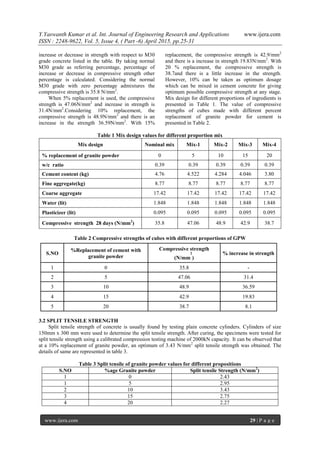
increase or decrease in strength with respect to M30
grade concrete listed in the table. By taking normal
M30 grade as referring percentage, percentage of
increase or decrease in compressive strength other
percentage is calculated. Considering the normal
M30 grade with zero percentage admixtures the
compressive strength is 35.8 N/mm2
.
When 5% replacement is used, the compressive
strength is 47.06N/mm2
and increase in strength is
31.4N/mm2
.Considering 10% replacement, the
compressive strength is 48.9N/mm2
and there is an
increase in the strength 36.59N/mm2
. With 15%
replacement, the compressive strength is 42.9/mm2
and there is a increase in strength 19.83N/mm2
. With
20 % replacement, the compressive strength is
38.7and there is a little increase in the strength.
However, 10% can be taken as optimum dosage
which can be mixed in cement concrete for giving
optimum possible compressive strength at any stage.
Mix design for different proportions of ingredients is
presented in Table 1. The value of compressive
strengths of cubes made with different percent
replacement of granite powder for cement is
presented in Table 2.
Table 1 Mix design values for different proportion mix
Mix design Nominal mix Mix-1 Mix-2 Mix-3 Mix-4
% replacement of granite powder 0 5 10 15 20
w/c ratio 0.39 0.39 0.39 0.39 0.39
Cement content (kg) 4.76 4.522 4.284 4.046 3.80
Fine aggregate(kg) 8.77 8.77 8.77 8.77 8.77
Coarse aggregate 17.42 17.42 17.42 17.42 17.42
Water (lit) 1.848 1.848 1.848 1.848 1.848
Plasticizer (lit) 0.095 0.095 0.095 0.095 0.095
Compressive strength 28 days (N/mm2
) 35.8 47.06 48.9 42.9 38.7
Table 2 Compressive strengths of cubes with different proportions of GPW
3.2 SPLIT TENSILE STRENGTH
Split tensile strength of concrete is usually found by testing plain concrete cylinders. Cylinders of size
150mm x 300 mm were used to determine the split tensile strength. After curing, the specimens were tested for
split tensile strength using a calibrated compression testing machine of 2000kN capacity. It can be observed that
at a 10% replacement of granite powder, an optimum of 3.43 N/mm2
split tensile strength was obtained. The
details of same are represented in table 3.
Table 3 Split tensile of granite powder values for different propositions
S.NO %age Granite powder Split tensile Strength (N/mm2
)
1 0 2.43
1 5 2.95
2 10 3.43
3 15 2.75
4 20 2.27
S.NO
%Replacement of cement with
granite powder
Compressive strength
(N/mm
2
)
% increase in strength
1 0 35.8 -
2 5 47.06 31.4
3 10 48.9 36.59
4 15 42.9 19.83
5 20 38.7 8.1
Y.Yaswanth Kumar et al. Int. Journal of Engineering Research and Applications www.ijera.com
ISSN : 2248-9622, Vol. 5, Issue 4, ( Part -6) April 2015, pp.25-31
www.ijera.com 30 | P a g e
3.3 FLEXURAL STRENGTH OF CONCRETE
The determination of flexural strength is essential to estimate the load at which the concrete members may
crack. The flexural strength at failure is the modulus of rupture.
The modulus of rupture is determined by testing standard test specimens of size 100 X 100 X 500 mm over
a span of 400 mm under two point loading.
Bending Tensile Stress or Flexural Strength (σbt )=
Where P is load,l length, b breadth and d is depth of concrete block tested.
The results of flexural strength obtained on different percentage substitutions of granite powder with
cement are presented in Table 4. On mediation of the results, it can be observed that at 10% partial substitution,
a maximum of 4.62 N/mm2
flexural strength was obtained.
Table 4 Flexural strength of granite powder values for different propositions
S.NO %age granite powder Flexural Strength (N/mm2
)
1 0 3.23
2 5 3.61
3 10 4.62
4 15 3.49
5 20 3.24
IV. CONCLUSIONS
Based on the experimental investigation
concerning the compressive strength, split tensile
strength and flexural strength of the concrete, the
following observation were made regarding the
resistance of partially replaced with granite powder.
1. Compressive strength increases with replacement
of granite wastes, at 10% and is comparable to
normal concrete (47.06 N/mm2
).
2. Split tensile strength and flexural strength also
got increased at 10% of replacement of cement
and gave values of 3.43 N/mm2
and 4.62 N/mm2
respectively.
3. Thus Waste was utilized and makes more
environmental friendly.
Thus granite powder aggregate is the best choice
where there are available.
REFERENCES
[1]. http://www.cement.org/
[2] B.Vidivelli and M. Mageswari, Study on
flyash concrete using SEM analysis, J. of
Environ. Res. Develop., 5(1), 46-52, (2010).
[3] Lalit Gamashta and Swarna Gumashta,
Reuse of concrete and masonry waste
materials in construction to minimize
environmental damages due to quarrying, J.
of Environ. Res. Develop. 1(1), 65-67,
(2006).
[4] M.L.V. Prasad and P. Rathish Kumar,
Mechanical properties of fiber reinforced
concretes produced from building
demolished waste, J. of Environ. Res.
Develop. 2(2), 180-187, (2007).
[5] M. Mageswari* and B. Vidivelli, Innovative
concrete using flyash and waste sheet glass,
J. of Environ. Res. Develop. 4(2), 476-483,
(2009).
[6] Utsev, J. T., Taku, J. K., Coconut Shell Ash
As Partial Replacement of Ordinary
Portland Cement In Concrete Production,
Inter.l J. Scientific & Tech. Res., 1(8), 86-
89, (2012).
[7] Amitkumar D. Raval, Dr.Indrajit N. Patel,
Prof. Jayeshkumar Pitroda, Ceramic Waste:
Effective Replacement Of Cement For
Establishing Sustainable Concrete, Inter. J.
Engineering Trends and Tech. (IJETT), 4(6),
2324-2329, (2013).
[8] Dr. G.Vijayakumar, Ms H. Vishaliny, Dr. D.
Govindarajulu, Studies on Glass Powder as
Partial Replacement of Cement in Concrete
Production, Inter. J. of Emerging Tech. and
Advan. Engineering, 3(2), 153-157, (2013).
[9] Ankit Nileshchandra Patel, Jayeshkumar
Pitroda, Stone Waste: Effective
Replacement Of Cement For Establishing
Green Concrete, Inter. J. Innovative Tech.
and Exploring Engineering, 2(5), 24-27,
(2013).
[10] Venkata Sairam Kumar N., Dr. B.
Panduranga Rao, Krishna Sai M.L.N.,
Experimental study on partial replacement
of Cement with quarry dust, Inter. J.
Y.Yaswanth Kumar et al. Int. Journal of Engineering Research and Applications www.ijera.com
ISSN : 2248-9622, Vol. 5, Issue 4, ( Part -6) April 2015, pp.25-31
www.ijera.com 31 | P a g e
Advanced Engineering Res. and Studies,
2(3), 136-137, (2013).
[11] Prof. Jayeshkumar Pitroda, Dr. L.B.Zala,
Dr.F.S.Umrigar, Experimental investigations
on partial replacement of cement with fly
ash in design mix concrete, Inter. J. of
Advanced Engineering Tech., 3(4), 126-129,
(2012).
[12] Debabrata Pradhan, D. Dutta, Influence of
Silica Fume on Normal Concrete, Int. J. of
Engineering Res. and Application, 3(5), 79-
82, (2013).
[13] N. K. Amudhavalli, Jeena Mathew, Effect of
silica fume on strength and durability
parameters of concrete, Inter. J.
Engineering Sciences & Emerging Tech.,
3(1), 28-35, (2012).
[14] Md. Moinul Islam and Md. Saiful Islam,
Strength Behaviour of Mortar Using Fly Ash
as Partial Replacement of Cement, Concrete
Research Letters, 1(3), 98-106, (2010).
[15] D.Gowsika, S.Sarankokila, K.Sargunan,
Experimental Investigation of Egg Shell
Powder as Partial Replacement with Cement
in Concrete, Inter. J. Engineering Trends
and Tech., 14(2), 65-68, (2014).
[16] Ghassan K. Al-Chaar, Mouin Alkadi and
Panagiotis G. Asteris, Natural Pozzolan as a
Partial Substitute for Cement in Concrete,
The Open Construction and Building Tech.
J., 7, 33-42, (2013).
[17] Biruk Hailu, Abebe Dinku, Application of
sugarcane bagasse ash as a partial cement
replacement material, J. EEA, 29, 1-12,
(2012).
[18] Seyyedeh Fatemeh Seyyedalipour, Daryosh
Yousefi Kebria, Nima Ranjbar Malidarreh,
Ghasem Norouznejad, Study of Utilization
of Pulp and Paper Industry Wastes in
Production of Concrete, Int. J. Engineering
Res. and Applications,4(1), 115-122, (2014).
[19] Faseyemi Victor Ajileye, Investigations on
Microsilica (Silica Fume) As Partial Cement
Replacement in Concrete, Global J. res. in
engineering Civil And Structural
engineering, 12(1), 17-23, (2012)
[20] Prof. Vishal S. Ghutke, Prof. Pranita
S.Bhandari, Influence of silica fume on
concrete, IOSR J. Mech. and Civil
Engineering, 44-47, (2014).
[21] Dilip Kumar Singha Roy1, Amitava Sil,
Effect of Partial Replacement of Cement by
Silica Fume on Hardened Concrete, Inter. J.
Emerging Tech. and Advanced
Engineering, 2(8), 472-475, (2012).
[22] Mohamed Elchalakani, Elgaali Elgaali,
Sustainable concrete made of construction
and demolition wastes using recycled waste
water in the UAE, J. Advanced Concrete
Tech., 10, 110-125, (2012).
[23] Marcia Silva and Tarun R. Naik, Sustainable
Use of Resources – Recycling of Sewage
Treatment Plant Water in Concrete,
Coventry University and The University of
Wisconsin Milwaukee Centre for By-
products Utilization, Second International
Conference on Sustainable Construction
Materials and Technologies, (2010).
[24] G.Murali, C.M. Vivek Vardhan, Siji Raju,
C.Mahalakshmi , G.Srinidhi and Deepthi
Susan Zachariah, Influence of various
industrial effluents on concrete structures,
Intern. J. Engineering Res. and
Applications, 2(2), 704-709, (2012).

Use of Granite Waste as Partial Substitute to Cement in Concrete

  • 1.
    Y.Yaswanth Kumar etal. Int. Journal of Engineering Research and Applications www.ijera.com ISSN : 2248-9622, Vol. 5, Issue 4, ( Part -6) April 2015, pp.25-31 www.ijera.com 25 | P a g e Use of Granite Waste as Partial Substitute to Cement in Concrete Y.Yaswanth Kumar1* , C.M. Vivek Vardhan1 , A.Anitha1 1 Assistant professor, Annamacharya Institute of Technology and Sciences, Tirupati, Andhra Pradesh ABSTRACT With the ever increasing cost of construction materials there is a need to curtail the same by using cheaper substitutes. In this investigation Granite Slurry (GS) was used as partial substitute in proportions varying from 5% to 20% by weight to cement in concrete and tested for compressive strength, tensile strength and flexure strength. It was observed that substitution of 10% of cement by weight with GS in concrete resulted in an increase in compressive strength to 48 N/mm2 compared to 35 N/mm2 of conventional concrete. Tensile strength too followed a similar pattern with a 10% substitution with GS increasing the tensile strength to 3.6N/mm2 compared with a 2.4 N/mm2 of conventional concrete. However flexure strength of 10% GS replacement exhibited a good improvement of flexural strength to 4.6 N/mm2 compared to a 3.2 N/mm2 of conventional concrete. Further investigations revealed that to attain the same strength of conventional concrete a 20% substitution with GS is effective. So it can be concluded that when locally available GS is a good partial substitute to concrete and improves compressive, tensile and flexure characteristics of concrete, while simultaneously offsetting the overall cost of concrete substantially. I. INTRODUCTION Concrete has been a leading construction material for over a century. Its annual global production is about 3.8 billion m3 - roughly 1.5 tonnes per capita according to data obtained from Portland Cement Association (http://www.cement. org/). In the past few years, great emphasis was given on green concrete as it results in sustainable development. Green concrete is implies by application of industrial wastes to reduce consumption of natural resources, save energy and minimize pollution of the environment. Among the various varieties of solid industrial wastes generated the marble and granite wastes, have potentiality for utilisation in concrete. These wastes can be used as a filler (substituting sand) to reduce the total voids content in concrete and/or pozzolanic material (substituting cement) in the concrete mix while maintaining its physical and mechanical properties. Granite waste is an industrial waste which is obtained from the granite polishing industry in a powder form. The waste is produced at Dhone and surrounding areas of Kurnool. Total waste produced by all industries in this region may be approximately 2000 tonnes per week. This waste is easily carried away by the air and hence causes problems to human health and environment. With the enormous increase in the quantity of waste needing disposal, coupled with acute shortage of dumping sites, and sharp increase in the transportation and dumping costs the quality of environment, has got seriously deteriorated preventing sustainable development. As granite powder waste (GPW) is a fine material, it will be easily carried away by the air and will cause nuisance causing health problems and environmental pollution. Granite powder waste (GPW) is a fine material; it gets easily carried away by air and causes nuisance and health problems as well as environmental pollution. The major effects of air pollution are lung diseases and inhaling problems with the majority of people living in and around being affected the worst. In this present work, GPW to cement. To find in this investigation have used granite waste as partial replacement to different percentage the compressive strength, split tensile strength and flexural strengths of concrete have been determined. By doing so, the objective of reduction of cost construction can be met and it will help to overcome the environmental problem associated with its disposal including the environmental problems of the region. 1.1 REVIEW OF LITERATURE Several industrial wastes, such as flyash , quarry dust waste, recycled aggregate, used soft drink bottle caps as fibre reinforced concrete have been tried by various researches. The results have been encouragingly increased in terms of improvement in strength parameters like compressive strength, split tensile strength and flexural strength. B.Vidivelli et.al., [2] had studied on flyash concrete using SEM analysis as partial replacement to cement and had reported a significant increase of 20% compressive strength respectively. Lalit Gamashta et.al., [3] developed the concrete strength by using masonry waste material in concrete mix in construction to minimize the environmental damages due to quarrying. It is highly desirable that the waste materials of concrete and bricks are further RESEARCH ARTICLE OPEN ACCESS
  • 2.
    Y.Yaswanth Kumar etal. Int. Journal of Engineering Research and Applications www.ijera.com ISSN : 2248-9622, Vol. 5, Issue 4, ( Part -6) April 2015, pp.25-31 www.ijera.com 26 | P a g e reutilized after the demolition of old structures in an effective manner especially realizing that it will help in reducing the environmental damages caused by excessive reckless quarrying for earth materials and stones. Secondly, this will reduce pressure on finding new dumping ground for these wastes, thus further saving the natural environment and eco-systems. Durability, reliability and adequate in service performance of these reused waste materials over the stipulated design life of designed structures are of paramount importance to Structural Designers. This paper critically examines such properties in reused concrete and brick masonry waste materials and suggests suitable recommendations for further enhancing life of such structures, thereby resulting in sufficient economy to the cost of buildings. M.L.V. Prasad et.al., [4] had studied mechanical properties of fiber reinforced concretes produced from building demolished waste and observed that target mean strength had been achieved in 100% recycled concrete aggregate replacement. M. Mageswari et.al., [5] using the combination of waste Sheet Glass Powder (SGP) as fine aggregate and Portland cement with 20% optimum replacement of fly ash as cementations binder offers an economically viable technology for high value utilization of industrial waste. Using of SGP in concrete is an interesting possibility for economy on waste disposal sites and conservation of natural resources. Natural sand was partially replaced (10%, 20%, 30%, 40% and 50%) with SGP and 20% optimum replacement of fly ash in Portland cement. Compressive strength, Tensile strength (cubes and cylinders) and Flexural strength up to 180 days of age were compared with those of concrete made with natural fine aggregates. Fineness modulus, Specific gravity, Moisture content, Water absorption, Bulk density, Percentage of voids, Percentage of porosity (loose and compact) state for sand and SGP were also studied. The test results indicate that it is possible to manufacture low cost concrete containing SGP with characteristics similar to those of natural sand aggregate concrete provided that the percentage of SGP as fine aggregate up to 30% along with fly ash 20% optimum in cement replacement can be used respectively. Ustev.J et.al., [6] determined the performance of concrete made with coconut shell as a replacement of cement. Cement was replaced with coconut shell in steps of 0%, 10%, 15%, 20%, 25% and 30%. The results obtained for compressive strength was increased from 12.45 N/mm2 at 7days to31.28 N/mm2 at 28 days curing and it met the requirement for use in both heavy weight and light weight concreting. Amitkumar D. Raval et.al., [7] explained the compressive strength by replacing cement with ceramic waste and utilizing the same in construction industry. Dr. G.Vijayakumar et.al., [8] had found that use of glass powder as partial replacement to cement was effective. Ankit Nileshchandra Patel et.al., [9] examined the possibility of using stone waste as replacement of Pozzolana Portland Cement in the range of 5%, 10%, 30%, 40% and 50% by weight of M 25 grade concrete. They reported that stone waste of marginal quantity as partial replacement to the cement had beneficial effect on the mechanical properties such as compressive strength values for 7, 14, 28 days were less than the ppc cement. Venkata Sairam Kumar et.al., [10] investigated the effect of using quarry dust as a possible substitute for cement in concrete. Partial replacement of cement with varying percentage of quarry dust (0%, 10%, 15%, 20%, 25%, 30%, 35%, 40%) by weight of M 20, M 30 and M 40 grade of concrete cubes were made for conducting compressive strength. From the experimental studies 25% partial replacement of cement with quarry dust showed improvement in hardened of concrete. Jayesh kumar et.al., [11] studied the performance of fly ash as partial replacement of cement. The values of compressive strength and split tensile strength are found by partial replacement of cement with varying percentage of 0%, 10%, 20%, 30% and 40% by weight of cement of M 25 and M 40 mix. The compressive strength of the samples was recorded at the curing age of 7, 14, 28 days and for split tensile strength of the sample were conducted test on age of 56 days. It was observed that the compressive strength was better on age of 14 days than the other proportions of cement. Debarata Pradhan et.al., [12] determined the compressive strength of concrete in which cement was partially replaced with silica fume (0%, 5%, 10%, 15%, and 20%). The compressive strength test was conducted on age of 24 hours, 7 days and 28 days for 100 mm and 150 mm cubes. The results indicated that the compressive strength of concrete increased with additional of silica fume up to 20% replaced by weight of cement further addition of silica fume was found that the compressive strength may increase or decrease. Amudhavalli et.al., [13] examined the performance of concrete made with silica fume as the partial replacement of cement. Cement was replaced with silica fume in steps of 0%, 5%, 10%, 15% and 20% by weight by M 35 mix. The reported from this percentage mixes in compressive strength, split tensile strength and flexural strength at age of 7 days and 28 days. The results indicated that use of silica fume in concrete has improved the performance of concrete in strength and durability aspects. Md Moinul Islam et.al., [14] investigated the usage of fly ash as substitutes for the cement was replaced with fly ash in steps of 10%, 20%, 30%,
  • 3.
    Y.Yaswanth Kumar etal. Int. Journal of Engineering Research and Applications www.ijera.com ISSN : 2248-9622, Vol. 5, Issue 4, ( Part -6) April 2015, pp.25-31 www.ijera.com 27 | P a g e 40%, 50% and 60%. Compressive strength and tensile strength were determined at 3, 7, 14, 28, 60 and 90 days. The reported from this paper sows the results that strength increased with increased of fly ash up to an optimum value, beyond which the strength value starts decrease from with further addition of fly ash. The six fly ash motors, the amount of optimum amount of cement replacement in motors is about 40% higher compressive strength and 8% higher tensile strength as compared to Ordinary Portland Cement mortar. D.Gowsika et.al., [15] investigated the usage of eggshell powder from egg production industry as partial replacement for Ordinary Portland Cement in cement mortar of mix proportions 1:3 in which cement is partially replaced with egg shell powder as 5%, 10%, 15%, 20%, 25% and 30% by weight of cement. The compressive strength was determined at curing ages 28 days. There was a sharp decrease in compressive strength beyond 5% egg shell powder substitution. The admixtures used are Saw Dust ash, Fly Ash and Micro silica to enhance the strength of the concrete mix with 5% egg shell powder as partial replacement for cement. In this direction, an experimental investigation of compressive strength, split tensile strength, and Flexural strength was undertaken to use egg shell powder and admixtures as partial replacement for cement in concrete. Ghassan K. Al-Chaar et.al., [16] determined the use of natural pozzolanic cement substitute in concrete materials. By means of a test series, four mixes using three types of natural pozzolanic, as well as a Class F fly ash, are evaluated. The effectiveness of each pozzolanic in controlling alkali-silica reactions has been studied. Correlations have been revealed between the mechanical properties of the proposed mixes and a Portland cement control mix. The results are also compared with industry standards for mortars made with fly ash and silica fume. It is findings to indicate that one type of pozzolanic may be used as a substitute for fly ash, but not for silica fume. Biruk Hailu et.al., [17] investigated the usage of sugar bagasse ash is as by-product of sugar factories as a possibilities for the cement was replaced with sugar bagasse in steps of 0%, 5%, 15% and 25% of the Ordinary Portland Cement were prepared with water to cement ratio of 0.55 and cement content 350 kg/m3 for the control mix. The test results indicated that up to 10% replacement of cement by bagasse ash results in better or similar concrete properties and further environmental and economical advantages can also be exploited by using bagasse ash as a partial cement replacement material. Seyyedeh Fatemeh Seyyedalipour et.al., [18] investigated the usage of paper waste as a partial replacement of cement to controlling environmental aspects has become a major priority. The concrete mixes prepared with adequate amount of these wastes, cement, aggregate and water compared in terms of some tests especially strength with the conventional concrete. At the end, the advantages and disadvantages of the use of pulp and paper industry wastes in concrete formulations as an alternative to landfill disposal were discussed. The research on use of pulp and paper industry wastes can be further carried out in concrete manufacturing as a new recycled material. Faseyemi Victor Ajileye et.al., [19] examined the usage of microsillica as a partial replacement of cement in concrete. Cement was replaced with coconut shell in steps of 0%, 5%, 10%, 15%, 20%, and 25%. The compressive strength and of the samples was recorded at the curing age of 3, 7, 14, 28 days. The results indicated that the compressive strength of concrete increased with additional of silica fume up to10% replaced by weight of cement further addition of microsillica was found that the compressive strength will be decreasing from 10% replacement of cement. Prof. Vishal S. Ghutke1 et.al., [20] examined the usage of silica fume as a partial replacement of cement in concrete. It is suitable for concrete mix and improves the properties of concrete i.e., compressive strength etc. The objectives of various properties of concrete using silica fume have been evaluated. Further to determine the optimum replacement percentage comparison between the regular concrete and concrete containing silica fume is done .It has been seen that when cement is replaced by silica fume compressive strength increases up to certain percentage (10% replacement of cement by silica fume). But higher replacement of cement by silica fume gives lower strength. The effect of Silica fume on various other properties of Concrete has also been evaluated. Dilip Kumar Singha Roy et.al., [21] investigate the strength parameters of concrete made with partial replacement of cement by Silica Fume. Very little or no work has been carried out using silica fume as a replacement of cement. Moreover, no such attempt has been made in substituting silica fume with cement for low/medium grade concretes (viz. M 20, M 25). Properties of hardened concrete viz Ultimate Compressive strength, Flexural strength, Splitting Tensile strength has been determined for different mix combinations of materials and these values are compared with the corresponding values of conventional concrete. It has been found that utilization of recycled waste water in concrete construction have lately gained worldwide consideration and attention, Mohamed Elchalakani et.al., [22] explained about sustainable concrete by using recycled waste water from construction and demolition waste.
  • 4.
    Y.Yaswanth Kumar etal. Int. Journal of Engineering Research and Applications www.ijera.com ISSN : 2248-9622, Vol. 5, Issue 4, ( Part -6) April 2015, pp.25-31 www.ijera.com 28 | P a g e Marcia Silva et.al., [23] examined to add the recycling of sewage treatment water in concrete mix to determine the concrete strength. Concrete is the most widely used construction material in the world. Production of Portland cement used in concrete produces over 2.5 billion tons of carbon dioxide and other green-house gases worldwide. In addition, concrete is one of the largest water consuming industries. Approximately 150 liters of water is required per cubic meter. of concrete mixture, without considering other applications of water at the concrete industry. A detailed research agenda has also been developed for additional knowledge on this topic in order to understand and to reduce the environmental impacts of the concrete industry. G.Murali, C.M. Vivek Vardhan et.al. [24] studied the influence of various effluents on concrete structures. Laboratory scale concrete blocks of M 25 grade were moulded and used for strength analysis. Effluents from automobile industry (E1), powder coating industry (E2) and chocolate factory (E3) were used for curing concrete and its strength parameters like compression, tension and flexure were tested after 28 days. It was observed that E3 enhanced the compressive strength of concrete by 3.84%, tensile strength by 2.46% and flexural strength by 1.96% compared to conventional water curing, indicating its direct applicability in concrete curing sector. II. EXPERIMENTAL INVESTIGATION 2.1 CEMENT Ordinary Portland cement 53 grade Dalmia Brand confirming to B.I.S standards is used in the present investigations. Fineness test was conducted for cement and it was found to be 2.8% which conforms to IS 8122-1989. 2.2 GRANITE WASTE Granite waste was obtained from granite polishing industries at Dhone of Kurnool district in Andhra Pradesh, India. The specific gravity of granite waste was 2.53 respectively and its size was less than 90 microns. The fineness modulus of granite waste was 2.43 respectively. 2.3 FINE AGGREGATE Hundri River near Kurnool was used as fine aggregate in this project investigation. The sand was free from clayey matter, silt and organic impurities etc. The sand was tested for specific gravity, in accordance with IS 2386-1963 and it is 2.65, where as its fineness modulus was 2.31. The sand confirms to zone-III. 2.4 COARSE AGGREGATE Machine crushed angular Basalt metal obtained from Tammaraju near Panyam was used as coarse aggregate. The coarse aggregate was free from clayey matter, silt and organic impurities. The coarse aggregate was also tested for specific gravity and it was 2.72. Fineness modulus was 4.20. Aggregate passing through 12.5mm and retained from 4.75mm was used in the experimental work, which is acceptable according to IS 383-1970. 2.5 WATER This locally available potable water, which was free from concentrated of acid and organic substances, was used for mixing the concrete 2.6 PLASTICIZER 2.6.1 PURPOSE OF PLASTICIZER:- The action of plasticizers is to fluidify the mix and improve the workability of concrete, mortar or grout. Flowing concrete is also referred as self compacting concrete,. This concrete has a slump value equal to 200mm or more, a compaction factor of 0.98. Plasticizing admixtures are added to a concrete mixture to make plastic concrete extremely workable without additional water and corresponding loss of strength which makes it ideal for use in ready mixed concrete where workability is an important factor especially in places of congested reinforcement like beam column junction, heavy rafts and machine foundation, foundation of heavy structures. The use of plasticizers in ready mixed concretes and construction industry reduces the possibility of detoriation of concrete in terms of its appearance, density and strength. On the other hand, it makes the placing of concrete more economical by increasing productivity and reducing cost of labour during handling and moving operations at the construction site. Plasticizer used in the present project is conplast sd110 2.7 PREPARATION OF TEST SPECIMENS The granite powder collected from polishing units was dried. As per the mix proportions, given in table-1 the quantities of various ingredients were weighed. Initially cement and granite powder were mixed thoroughly. Further sand and coarse aggregate were added to the mix. Once all the materials were mixed well, 0.5% of super plasticiser was added to water and water containing super plasticiser was added to the dry mix to form concrete. Cubes of size150mmX150mmX150mm and cylinder were cast. The specimens were cured in curing tank for a period of 28days. III. TEST RESULTS 3.1 COMPRESSIVE STRENGTH In the present investigation granite waste has been used as replacement of cement up to a maximum of 20%. The compressive strength for different percentage of silica fume and percentage
  • 5.
    Y.Yaswanth Kumar etal. Int. Journal of Engineering Research and Applications www.ijera.com ISSN : 2248-9622, Vol. 5, Issue 4, ( Part -6) April 2015, pp.25-31 www.ijera.com 29 | P a g e increase or decrease in strength with respect to M30 grade concrete listed in the table. By taking normal M30 grade as referring percentage, percentage of increase or decrease in compressive strength other percentage is calculated. Considering the normal M30 grade with zero percentage admixtures the compressive strength is 35.8 N/mm2 . When 5% replacement is used, the compressive strength is 47.06N/mm2 and increase in strength is 31.4N/mm2 .Considering 10% replacement, the compressive strength is 48.9N/mm2 and there is an increase in the strength 36.59N/mm2 . With 15% replacement, the compressive strength is 42.9/mm2 and there is a increase in strength 19.83N/mm2 . With 20 % replacement, the compressive strength is 38.7and there is a little increase in the strength. However, 10% can be taken as optimum dosage which can be mixed in cement concrete for giving optimum possible compressive strength at any stage. Mix design for different proportions of ingredients is presented in Table 1. The value of compressive strengths of cubes made with different percent replacement of granite powder for cement is presented in Table 2. Table 1 Mix design values for different proportion mix Mix design Nominal mix Mix-1 Mix-2 Mix-3 Mix-4 % replacement of granite powder 0 5 10 15 20 w/c ratio 0.39 0.39 0.39 0.39 0.39 Cement content (kg) 4.76 4.522 4.284 4.046 3.80 Fine aggregate(kg) 8.77 8.77 8.77 8.77 8.77 Coarse aggregate 17.42 17.42 17.42 17.42 17.42 Water (lit) 1.848 1.848 1.848 1.848 1.848 Plasticizer (lit) 0.095 0.095 0.095 0.095 0.095 Compressive strength 28 days (N/mm2 ) 35.8 47.06 48.9 42.9 38.7 Table 2 Compressive strengths of cubes with different proportions of GPW 3.2 SPLIT TENSILE STRENGTH Split tensile strength of concrete is usually found by testing plain concrete cylinders. Cylinders of size 150mm x 300 mm were used to determine the split tensile strength. After curing, the specimens were tested for split tensile strength using a calibrated compression testing machine of 2000kN capacity. It can be observed that at a 10% replacement of granite powder, an optimum of 3.43 N/mm2 split tensile strength was obtained. The details of same are represented in table 3. Table 3 Split tensile of granite powder values for different propositions S.NO %age Granite powder Split tensile Strength (N/mm2 ) 1 0 2.43 1 5 2.95 2 10 3.43 3 15 2.75 4 20 2.27 S.NO %Replacement of cement with granite powder Compressive strength (N/mm 2 ) % increase in strength 1 0 35.8 - 2 5 47.06 31.4 3 10 48.9 36.59 4 15 42.9 19.83 5 20 38.7 8.1
  • 6.
    Y.Yaswanth Kumar etal. Int. Journal of Engineering Research and Applications www.ijera.com ISSN : 2248-9622, Vol. 5, Issue 4, ( Part -6) April 2015, pp.25-31 www.ijera.com 30 | P a g e 3.3 FLEXURAL STRENGTH OF CONCRETE The determination of flexural strength is essential to estimate the load at which the concrete members may crack. The flexural strength at failure is the modulus of rupture. The modulus of rupture is determined by testing standard test specimens of size 100 X 100 X 500 mm over a span of 400 mm under two point loading. Bending Tensile Stress or Flexural Strength (σbt )= Where P is load,l length, b breadth and d is depth of concrete block tested. The results of flexural strength obtained on different percentage substitutions of granite powder with cement are presented in Table 4. On mediation of the results, it can be observed that at 10% partial substitution, a maximum of 4.62 N/mm2 flexural strength was obtained. Table 4 Flexural strength of granite powder values for different propositions S.NO %age granite powder Flexural Strength (N/mm2 ) 1 0 3.23 2 5 3.61 3 10 4.62 4 15 3.49 5 20 3.24 IV. CONCLUSIONS Based on the experimental investigation concerning the compressive strength, split tensile strength and flexural strength of the concrete, the following observation were made regarding the resistance of partially replaced with granite powder. 1. Compressive strength increases with replacement of granite wastes, at 10% and is comparable to normal concrete (47.06 N/mm2 ). 2. Split tensile strength and flexural strength also got increased at 10% of replacement of cement and gave values of 3.43 N/mm2 and 4.62 N/mm2 respectively. 3. Thus Waste was utilized and makes more environmental friendly. Thus granite powder aggregate is the best choice where there are available. REFERENCES [1]. http://www.cement.org/ [2] B.Vidivelli and M. Mageswari, Study on flyash concrete using SEM analysis, J. of Environ. Res. Develop., 5(1), 46-52, (2010). [3] Lalit Gamashta and Swarna Gumashta, Reuse of concrete and masonry waste materials in construction to minimize environmental damages due to quarrying, J. of Environ. Res. Develop. 1(1), 65-67, (2006). [4] M.L.V. Prasad and P. Rathish Kumar, Mechanical properties of fiber reinforced concretes produced from building demolished waste, J. of Environ. Res. Develop. 2(2), 180-187, (2007). [5] M. Mageswari* and B. Vidivelli, Innovative concrete using flyash and waste sheet glass, J. of Environ. Res. Develop. 4(2), 476-483, (2009). [6] Utsev, J. T., Taku, J. K., Coconut Shell Ash As Partial Replacement of Ordinary Portland Cement In Concrete Production, Inter.l J. Scientific & Tech. Res., 1(8), 86- 89, (2012). [7] Amitkumar D. Raval, Dr.Indrajit N. Patel, Prof. Jayeshkumar Pitroda, Ceramic Waste: Effective Replacement Of Cement For Establishing Sustainable Concrete, Inter. J. Engineering Trends and Tech. (IJETT), 4(6), 2324-2329, (2013). [8] Dr. G.Vijayakumar, Ms H. Vishaliny, Dr. D. Govindarajulu, Studies on Glass Powder as Partial Replacement of Cement in Concrete Production, Inter. J. of Emerging Tech. and Advan. Engineering, 3(2), 153-157, (2013). [9] Ankit Nileshchandra Patel, Jayeshkumar Pitroda, Stone Waste: Effective Replacement Of Cement For Establishing Green Concrete, Inter. J. Innovative Tech. and Exploring Engineering, 2(5), 24-27, (2013). [10] Venkata Sairam Kumar N., Dr. B. Panduranga Rao, Krishna Sai M.L.N., Experimental study on partial replacement of Cement with quarry dust, Inter. J.
  • 7.
    Y.Yaswanth Kumar etal. Int. Journal of Engineering Research and Applications www.ijera.com ISSN : 2248-9622, Vol. 5, Issue 4, ( Part -6) April 2015, pp.25-31 www.ijera.com 31 | P a g e Advanced Engineering Res. and Studies, 2(3), 136-137, (2013). [11] Prof. Jayeshkumar Pitroda, Dr. L.B.Zala, Dr.F.S.Umrigar, Experimental investigations on partial replacement of cement with fly ash in design mix concrete, Inter. J. of Advanced Engineering Tech., 3(4), 126-129, (2012). [12] Debabrata Pradhan, D. Dutta, Influence of Silica Fume on Normal Concrete, Int. J. of Engineering Res. and Application, 3(5), 79- 82, (2013). [13] N. K. Amudhavalli, Jeena Mathew, Effect of silica fume on strength and durability parameters of concrete, Inter. J. Engineering Sciences & Emerging Tech., 3(1), 28-35, (2012). [14] Md. Moinul Islam and Md. Saiful Islam, Strength Behaviour of Mortar Using Fly Ash as Partial Replacement of Cement, Concrete Research Letters, 1(3), 98-106, (2010). [15] D.Gowsika, S.Sarankokila, K.Sargunan, Experimental Investigation of Egg Shell Powder as Partial Replacement with Cement in Concrete, Inter. J. Engineering Trends and Tech., 14(2), 65-68, (2014). [16] Ghassan K. Al-Chaar, Mouin Alkadi and Panagiotis G. Asteris, Natural Pozzolan as a Partial Substitute for Cement in Concrete, The Open Construction and Building Tech. J., 7, 33-42, (2013). [17] Biruk Hailu, Abebe Dinku, Application of sugarcane bagasse ash as a partial cement replacement material, J. EEA, 29, 1-12, (2012). [18] Seyyedeh Fatemeh Seyyedalipour, Daryosh Yousefi Kebria, Nima Ranjbar Malidarreh, Ghasem Norouznejad, Study of Utilization of Pulp and Paper Industry Wastes in Production of Concrete, Int. J. Engineering Res. and Applications,4(1), 115-122, (2014). [19] Faseyemi Victor Ajileye, Investigations on Microsilica (Silica Fume) As Partial Cement Replacement in Concrete, Global J. res. in engineering Civil And Structural engineering, 12(1), 17-23, (2012) [20] Prof. Vishal S. Ghutke, Prof. Pranita S.Bhandari, Influence of silica fume on concrete, IOSR J. Mech. and Civil Engineering, 44-47, (2014). [21] Dilip Kumar Singha Roy1, Amitava Sil, Effect of Partial Replacement of Cement by Silica Fume on Hardened Concrete, Inter. J. Emerging Tech. and Advanced Engineering, 2(8), 472-475, (2012). [22] Mohamed Elchalakani, Elgaali Elgaali, Sustainable concrete made of construction and demolition wastes using recycled waste water in the UAE, J. Advanced Concrete Tech., 10, 110-125, (2012). [23] Marcia Silva and Tarun R. Naik, Sustainable Use of Resources – Recycling of Sewage Treatment Plant Water in Concrete, Coventry University and The University of Wisconsin Milwaukee Centre for By- products Utilization, Second International Conference on Sustainable Construction Materials and Technologies, (2010). [24] G.Murali, C.M. Vivek Vardhan, Siji Raju, C.Mahalakshmi , G.Srinidhi and Deepthi Susan Zachariah, Influence of various industrial effluents on concrete structures, Intern. J. Engineering Res. and Applications, 2(2), 704-709, (2012).